Region:Global
Author(s):Rebecca
Product Code:KRAD0279
Pages:83
Published On:August 2025
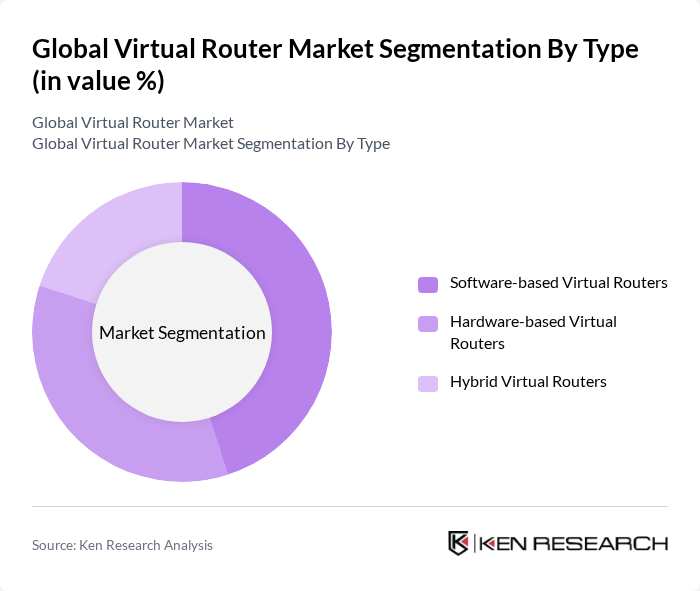
By Type:The market is segmented into Software-based Virtual Routers, Hardware-based Virtual Routers, and Hybrid Virtual Routers. Software-based Virtual Routers are gaining traction due to their flexibility, scalability, and cost-effectiveness, especially as organizations shift toward cloud and multi-cloud environments. Hardware-based Virtual Routers are preferred for their reliability and performance in high-demand and mission-critical environments. Hybrid Virtual Routers combine the benefits of both, providing tailored solutions for complex enterprise networking needs.
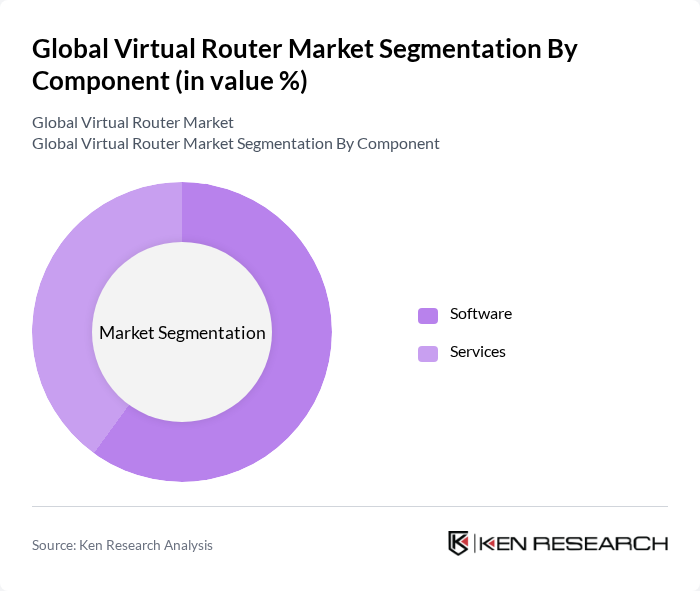
By Component:The market is divided into Software and Services. Software solutions are increasingly favored for their scalability, ease of integration, and ability to support cloud-native architectures. Services, including support, consulting, and maintenance, are essential for ensuring optimal performance, security, and continuous network availability. The growing complexity of network environments and the adoption of SDN (Software Defined Networking) and NFV (Network Function Virtualization) drive demand for comprehensive service offerings.
The Global Virtual Router Market is characterized by a dynamic mix of regional and international players. Leading participants such as Cisco Systems, Inc., Juniper Networks, Inc., Arista Networks, Inc., VMware, Inc., Hewlett Packard Enterprise Company (HPE), Nokia Corporation, Huawei Technologies Co., Ltd., Extreme Networks, Inc., 6WIND S.A., Cumulus Networks, Inc., Netgear, Inc., TP-Link Technologies Co., Ltd., Fortinet, Inc., ZTE Corporation, Check Point Software Technologies Ltd., Palo Alto Networks, Inc., Allied Telesis, Inc., International Business Machines Corporation (IBM), Mellanox Technologies, Ltd. contribute to innovation, geographic expansion, and service delivery in this space.
The future of the virtual router market appears promising, driven by technological advancements and increasing digital transformation across industries. The adoption of 5G technology is expected to enhance network capabilities, facilitating faster data transmission and improved connectivity. Additionally, the rise of edge computing will create new opportunities for virtual routers, enabling real-time data processing closer to the source. As organizations continue to embrace these trends, the demand for innovative virtual routing solutions will likely accelerate, shaping the market landscape.
| Segment | Sub-Segments |
|---|---|
| By Type | Software-based Virtual Routers Hardware-based Virtual Routers Hybrid Virtual Routers |
| By Component | Software Services |
| By End-User | Service Providers Enterprises Data Centers |
| By Application | Data Center Networking WAN Optimization Network Security Cloud Networking |
| By Deployment Model | On-Premises Cloud-Based |
| By Region | North America Europe Asia-Pacific Latin America Middle East & Africa |
| By Pricing Model | Subscription-Based Pay-As-You-Go |
| By Others | Custom Solutions Managed Services |
| Scope Item/Segment | Sample Size | Target Respondent Profiles |
|---|---|---|
| Enterprise Virtual Router Adoption | 100 | IT Directors, Network Engineers |
| Telecom Service Provider Insights | 80 | Product Managers, Network Operations Managers |
| SME Virtual Networking Solutions | 60 | Small Business Owners, IT Consultants |
| Cloud Service Provider Feedback | 50 | Cloud Architects, Service Delivery Managers |
| Industry Trends and Challenges | 40 | Industry Analysts, Technology Strategists |
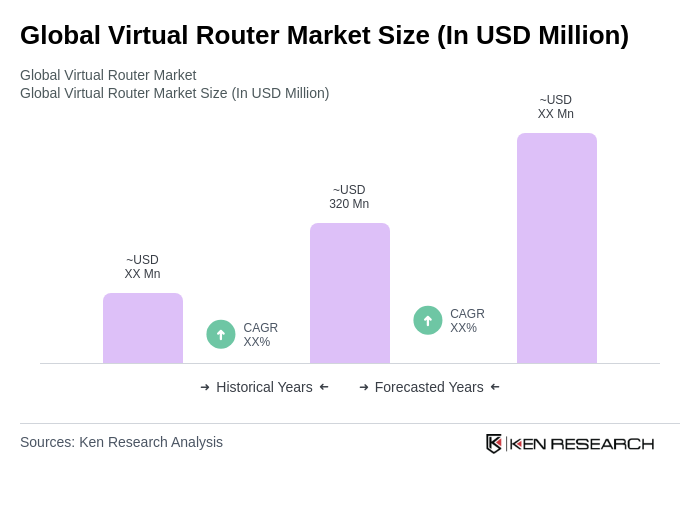
The Global Virtual Router Market is valued at approximately USD 320 million, reflecting significant growth driven by the demand for efficient network management solutions, cloud computing, and enhanced security measures in data transmission.

What makes us stand out is that our consultants follow Robust, Refine and Result (RRR) methodology. Robust for clear definitions, approaches and sanity checking, Refine for differentiating respondents' facts and opinions, and Result for presenting data with story.

We have set a benchmark in the industry by offering our clients with syndicated and customized market research reports featuring coverage of entire market as well as meticulous research and analyst insights.

While we don't replace traditional research, we flip the method upside down. Our dual approach of Top Bottom & Bottom Top ensures quality deliverable by not just verifying company fundamentals but also looking at the sector and macroeconomic factors.

With one step in the future, our research team constantly tries to show you the bigger picture. We help with some of the tough questions you may encounter along the way: How is the industry positioned? Best marketing channel? KPI's of competitors? By aligning every element, we help maximize success.

Our report gives you instant access to the answers and sources that other companies might choose to hide. We elaborate each steps of research methodology we have used and showcase you the sample size to earn your trust.

If you need any support, we are here! We pride ourselves on universe strength, data quality, and quick, friendly, and professional service.













