About the Report
Base Year 2024Global Visible Light Communication Market Overview
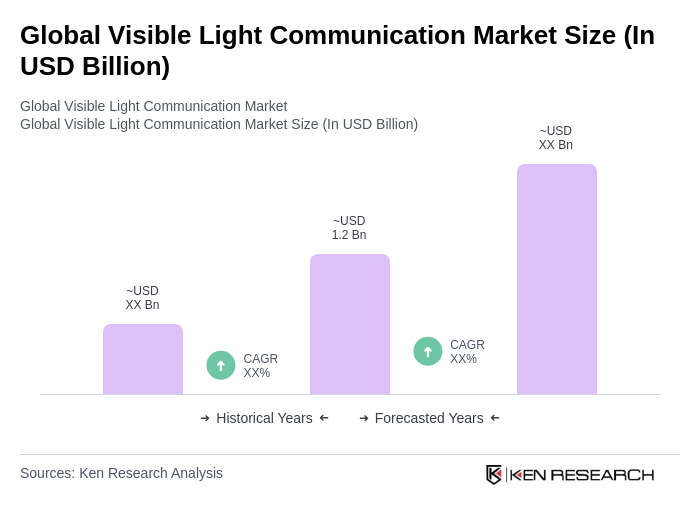
- The Global Visible Light Communication Market is valued at USD 1.2 billion, based on a five-year historical analysis. This growth is supported by rising demand for high-speed data transmission, proliferation of smart LED lighting, and use cases in RF-restricted environments such as hospitals, aircraft cabins, and industrial sites.
- Key leading ecosystems are anchored by the United States, Germany, and Japan, driven by strong R&D bases, electronics/semiconductor supply chains, and early pilots in Li-Fi for enterprise, defense, and transportation, alongside active standards and public research programs in these regions.
- There is no EU-wide regulation mandating visible light communication deployment in public infrastructure during the stated period; however, VLC/Li-Fi pilots and initiatives have been pursued in Europe via industry and research programs, with ongoing interest for EMI-sensitive settings.
Global Visible Light Communication Market Segmentation
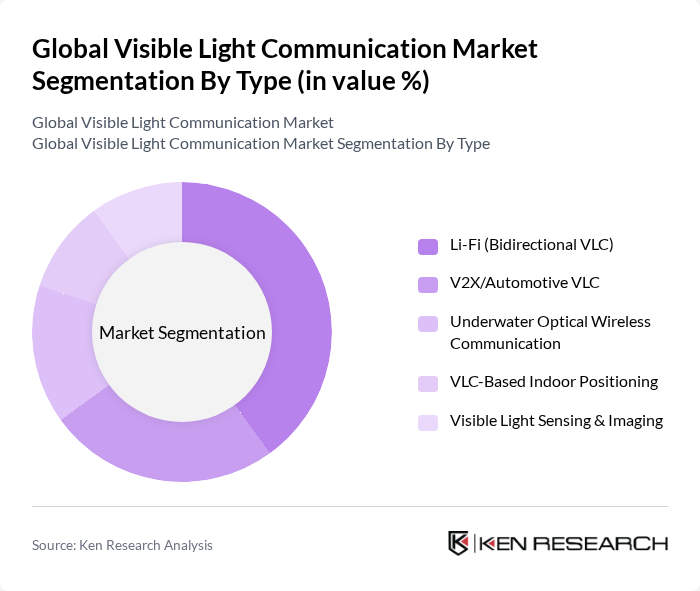
By Type:The types of visible light communication include various technologies that cater to different applications and user needs. The subsegments are Li-Fi (Bidirectional VLC), V2X/Automotive VLC, Underwater Optical Wireless Communication, VLC-Based Indoor Positioning, and Visible Light Sensing & Imaging. Among these, Li-Fi is gaining traction due to its ability to provide high-speed, secure connectivity using LEDs where RF is constrained, and to leverage existing lighting for dual-use communications.
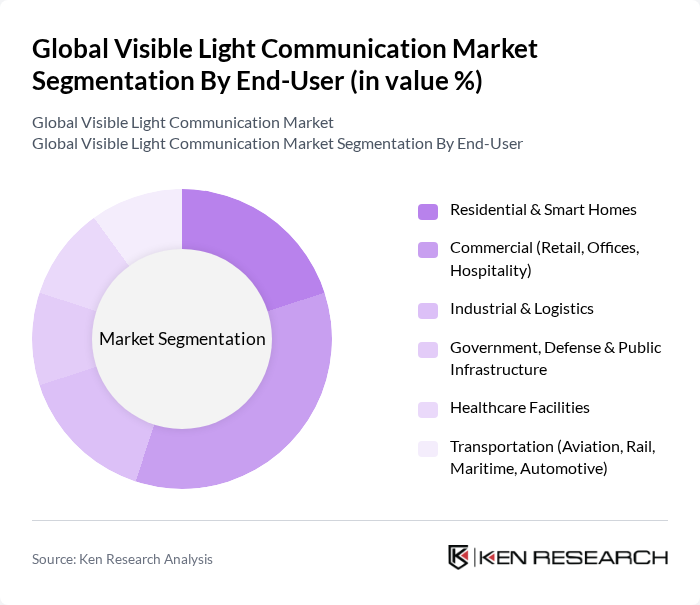
By End-User:The end-users of visible light communication span various sectors, including Residential & Smart Homes, Commercial (Retail, Offices, Hospitality), Industrial & Logistics, Government, Defense & Public Infrastructure, Healthcare Facilities, and Transportation (Aviation, Rail, Maritime, Automotive). The commercial sector is significant due to demand for secure, high-throughput connectivity, indoor positioning in retail/venues, and integration with smart lighting for efficiency.
Global Visible Light Communication Market Competitive Landscape
The Global Visible Light Communication Market is characterized by a dynamic mix of regional and international players. Leading participants such as Signify N.V. (formerly Philips Lighting), pureLiFi Ltd., Oledcomm S.A.S., LightBee S.L., LVX System, Qualcomm Technologies, Inc., Panasonic Holdings Corporation, Samsung Electronics Co., Ltd., Cisco Systems, Inc., Broadcom Inc., Infineon Technologies AG, NEC Corporation, fSONA Networks Corporation, Acuity Brands, Inc., Nav Wireless Technologies Pvt. Ltd. contribute to innovation, geographic expansion, and service delivery in this space.
Global Visible Light Communication Market Industry Analysis
Growth Drivers
- Increasing Demand for High-Speed Data Transmission:The global demand for high-speed data transmission is projected to reach 175 zettabytes in the future, driven by the exponential growth of data traffic. Visible Light Communication (VLC) technology, which can achieve speeds up to 10 Gbps, is becoming increasingly attractive for applications requiring rapid data transfer. This demand is further fueled by the rise of cloud computing and streaming services, which necessitate faster and more reliable communication methods to handle large volumes of data efficiently.
- Rising Adoption of Smart Lighting Solutions:The smart lighting market is expected to grow to $100 billion in the future, with VLC playing a crucial role in this transformation. As cities and businesses adopt smart lighting systems, the integration of VLC technology allows for dual functionality—providing illumination while enabling high-speed data transmission. This trend is supported by the increasing focus on energy efficiency and sustainability, as smart lighting solutions can reduce energy consumption by up to 60%, making them an attractive option for urban development.
- Growing Need for Enhanced Security in Communication:With cyber threats on the rise, the need for secure communication methods is paramount. VLC offers a significant advantage as it operates in the visible light spectrum, which is confined to line-of-sight communication, reducing the risk of interception. The global cybersecurity market is projected to reach $345 billion in the future, highlighting the increasing investment in secure communication technologies. This trend is driving interest in VLC as a secure alternative to traditional wireless communication methods.
Market Challenges
- Limited Range of Visible Light Communication:One of the primary challenges facing VLC technology is its limited operational range, typically confined to a few meters. This limitation restricts its application in larger spaces, such as warehouses or outdoor environments. As a result, industries requiring extensive coverage may find VLC less viable compared to traditional wireless technologies, which can cover larger areas without the need for direct line-of-sight, thus hindering widespread adoption.
- High Initial Setup Costs:The initial investment required for implementing VLC systems can be substantial, often exceeding $50,000 for comprehensive installations in commercial settings. This high cost can deter potential adopters, especially small to medium-sized enterprises. Additionally, the need for specialized equipment and infrastructure to support VLC technology further compounds these costs, making it less attractive compared to established wireless solutions that may offer lower entry barriers.
Global Visible Light Communication Market Future Outlook
The future of the visible light communication market appears promising, driven by technological advancements and increasing integration with existing infrastructures. As industries continue to prioritize energy efficiency and security, VLC is likely to gain traction in various sectors, including healthcare and smart cities. The ongoing development of innovative applications and the potential for collaboration with 5G networks will further enhance the market's growth trajectory, positioning VLC as a key player in the future of wireless communication technologies.
Market Opportunities
- Integration with 5G Networks:The convergence of VLC with 5G technology presents a significant opportunity for enhanced data transmission capabilities. By leveraging the high-speed and low-latency features of 5G, VLC can provide seamless connectivity in urban environments, potentially increasing the efficiency of smart city applications and IoT devices, which are projected to reach 75 billion in the future.
- Development of New Applications in Healthcare:The healthcare sector is increasingly exploring VLC for applications such as patient monitoring and data transfer in hospitals. With the global telemedicine market expected to reach $459 billion in the future, VLC can offer secure and efficient communication solutions, particularly in environments where radio frequency interference is a concern, thus enhancing patient care and operational efficiency.
Scope of the Report
| Segment | Sub-Segments |
|---|---|
| By Type | Li?Fi (Bidirectional VLC) V2X/Automotive VLC Underwater Optical Wireless Communication VLC-Based Indoor Positioning Visible Light Sensing & Imaging |
| By End-User | Residential & Smart Homes Commercial (Retail, Offices, Hospitality) Industrial & Logistics Government, Defense & Public Infrastructure Healthcare Facilities Transportation (Aviation, Rail, Maritime, Automotive) |
| By Application | High?Speed Data Communication/Internet Access Indoor Positioning & Location?Based Services Smart Lighting & Building Automation Vehicle?to?Vehicle/Infrastructure Communication Secure Communications in EMI?Sensitive Environments Underwater Communications & Sensing |
| By Component | LED Transmitters/Lighting Fixtures Photodiodes/Photodetectors Modems, Controllers & Drivers Optical Receivers, Lenses & Filters Software/Algorithms (MAC, Modulation, Positioning) |
| By Transmission Mode | Unidirectional Bidirectional Multiuser/Networked Cells |
| By Deployment Environment | Indoor Outdoor/Urban Harsh & EMI?Sensitive (Hospitals, Aircraft, Petrochemical) |
| By Sales Channel | Direct (Projects, System Integration) Indirect (Distributors, OEM Partnerships) |
Key Target Audience
Investors and Venture Capitalist Firms
Government and Regulatory Bodies (e.g., Federal Communications Commission, National Institute of Standards and Technology)
Manufacturers and Producers of VLC Technology
Telecommunications Service Providers
Smart Lighting Solution Providers
Automotive Industry Stakeholders
Healthcare Technology Providers
Logistics and Supply Chain Companies
Players Mentioned in the Report:
Signify N.V. (formerly Philips Lighting)
pureLiFi Ltd.
Oledcomm S.A.S.
LightBee S.L.
LVX System
Qualcomm Technologies, Inc.
Panasonic Holdings Corporation
Samsung Electronics Co., Ltd.
Cisco Systems, Inc.
Broadcom Inc.
Infineon Technologies AG
NEC Corporation
fSONA Networks Corporation
Acuity Brands, Inc.
Nav Wireless Technologies Pvt. Ltd.
Table of Contents
Market Assessment Phase
1. Executive Summary and Approach
2. Global Visible Light Communication Market Overview
2.1 Key Insights and Strategic Recommendations
2.2 Global Visible Light Communication Market Overview
2.3 Definition and Scope
2.4 Evolution of Market Ecosystem
2.5 Timeline of Key Regulatory Milestones
2.6 Value Chain & Stakeholder Mapping
2.7 Business Cycle Analysis
2.8 Policy & Incentive Landscape
3. Global Visible Light Communication Market Analysis
3.1 Growth Drivers
3.1.1 Increasing Demand for High-Speed Data Transmission
3.1.2 Rising Adoption of Smart Lighting Solutions
3.1.3 Growing Need for Enhanced Security in Communication
3.1.4 Expansion of IoT Applications
3.2 Market Challenges
3.2.1 Limited Range of Visible Light Communication
3.2.2 High Initial Setup Costs
3.2.3 Lack of Standardization
3.2.4 Competition from Established Wireless Technologies
3.3 Market Opportunities
3.3.1 Integration with 5G Networks
3.3.2 Development of New Applications in Healthcare
3.3.3 Expansion in Emerging Markets
3.3.4 Innovations in LED Technology
3.4 Market Trends
3.4.1 Increasing Use of Li-Fi Technology
3.4.2 Growing Focus on Energy Efficiency
3.4.3 Advancements in Optical Wireless Communication
3.4.4 Rising Interest in Smart Cities
3.5 Government Regulation
3.5.1 Regulations on Energy Efficiency Standards
3.5.2 Policies Supporting Smart Infrastructure Development
3.5.3 Guidelines for Wireless Communication Technologies
3.5.4 Incentives for Research and Development in Optical Technologies
4. SWOT Analysis
5. Stakeholder Analysis
6. Porter's Five Forces Analysis
7. Global Visible Light Communication Market Market Size, 2019-2024
7.1 By Value
7.2 By Volume
7.3 By Average Selling Price
8. Global Visible Light Communication Market Segmentation
8.1 By Type
8.1.1 Li?Fi (Bidirectional VLC)
8.1.2 V2X/Automotive VLC
8.1.3 Underwater Optical Wireless Communication
8.1.4 VLC-Based Indoor Positioning
8.1.5 Visible Light Sensing & Imaging
8.2 By End-User
8.2.1 Residential & Smart Homes
8.2.2 Commercial (Retail, Offices, Hospitality)
8.2.3 Industrial & Logistics
8.2.4 Government, Defense & Public Infrastructure
8.2.5 Healthcare Facilities
8.2.6 Transportation (Aviation, Rail, Maritime, Automotive)
8.3 By Application
8.3.1 High?Speed Data Communication/Internet Access
8.3.2 Indoor Positioning & Location?Based Services
8.3.3 Smart Lighting & Building Automation
8.3.4 Vehicle?to?Vehicle/Infrastructure Communication
8.3.5 Secure Communications in EMI?Sensitive Environments
8.3.6 Underwater Communications & Sensing
8.4 By Component
8.4.1 LED Transmitters/Lighting Fixtures
8.4.2 Photodiodes/Photodetectors
8.4.3 Modems, Controllers & Drivers
8.4.4 Optical Receivers, Lenses & Filters
8.4.5 Software/Algorithms (MAC, Modulation, Positioning)
8.5 By Transmission Mode
8.5.1 Unidirectional
8.5.2 Bidirectional
8.5.3 Multiuser/Networked Cells
8.6 By Deployment Environment
8.6.1 Indoor
8.6.2 Outdoor/Urban
8.6.3 Harsh & EMI?Sensitive (Hospitals, Aircraft, Petrochemical)
8.7 By Sales Channel
8.7.1 Direct (Projects, System Integration)
8.7.2 Indirect (Distributors, OEM Partnerships)
9. Global Visible Light Communication Market Competitive Analysis
9.1 Market Share of Key Players
9.2 Cross Comparison of Key Players
9.2.1 Company Name
9.2.2 Company Type (Component, System, or Integrated Solution Provider)
9.2.3 VLC/Li?Fi Revenue (latest FY, USD)
9.2.4 YoY Revenue Growth in VLC/Li?Fi (%)
9.2.5 Active Deployments/Projects (count, latest 3 years)
9.2.6 Geographic Footprint (No. of countries with deployments)
9.2.7 Patent Portfolio Strength (granted/pending, VLC-related)
9.2.8 Peak Data Rate Supported (Gbps)
9.2.9 Latency Performance (ms)
9.2.10 Energy Efficiency (Gbps per Watt or lumen/W KPI)
9.2.11 Compliance/Certification (e.g., ITU?T G.vlc, IEEE 802.11bb, aviation/healthcare)
9.2.12 Partnership Ecosystem (No. of OEM/SI/Carrier partners)
9.2.13 Conversion Cost per Connected Point (USD)
9.2.14 Customer Retention/Repeat Contract Rate (%)
9.2.15 R&D Intensity (% of revenue in VLC/Li?Fi)
9.3 SWOT Analysis of Top Players
9.4 Pricing Analysis
9.5 Detailed Profile of Major Companies
9.5.1 Signify N.V. (formerly Philips Lighting)
9.5.2 pureLiFi Ltd.
9.5.3 Oledcomm S.A.S.
9.5.4 LightBee S.L.
9.5.5 LVX System
9.5.6 Qualcomm Technologies, Inc.
9.5.7 Panasonic Holdings Corporation
9.5.8 Samsung Electronics Co., Ltd.
9.5.9 Cisco Systems, Inc.
9.5.10 Broadcom Inc.
9.5.11 Infineon Technologies AG
9.5.12 NEC Corporation
9.5.13 fSONA Networks Corporation
9.5.14 Acuity Brands, Inc.
9.5.15 Nav Wireless Technologies Pvt. Ltd.
10. Global Visible Light Communication Market End-User Analysis
10.1 Procurement Behavior of Key Ministries
10.1.1 Government Procurement Policies
10.1.2 Budget Allocations for Technology
10.1.3 Decision-Making Processes
10.2 Corporate Spend on Infrastructure & Energy
10.2.1 Investment Trends in Smart Technologies
10.2.2 Budgeting for Energy Efficiency
10.2.3 Corporate Sustainability Initiatives
10.3 Pain Point Analysis by End-User Category
10.3.1 Challenges in Implementation
10.3.2 Cost-Related Concerns
10.3.3 Technical Support Needs
10.4 User Readiness for Adoption
10.4.1 Awareness Levels
10.4.2 Training and Support Requirements
10.4.3 Infrastructure Readiness
10.5 Post-Deployment ROI and Use Case Expansion
10.5.1 Measurement of ROI
10.5.2 Expansion into New Use Cases
10.5.3 Long-Term Benefits Analysis
11. Global Visible Light Communication Market Future Size, 2025-2030
11.1 By Value
11.2 By Volume
11.3 By Average Selling Price
Go-To-Market Strategy Phase
1. Whitespace Analysis + Business Model Canvas
1.1 Market Gaps Identification
1.2 Business Model Development
2. Marketing and Positioning Recommendations
2.1 Branding Strategies
2.2 Product USPs
3. Distribution Plan
3.1 Urban Retail Strategies
3.2 Rural NGO Tie-Ups
4. Channel & Pricing Gaps
4.1 Underserved Routes
4.2 Pricing Bands Analysis
5. Unmet Demand & Latent Needs
5.1 Category Gaps
5.2 Consumer Segments
6. Customer Relationship
6.1 Loyalty Programs
6.2 After-Sales Service
7. Value Proposition
7.1 Sustainability Initiatives
7.2 Integrated Supply Chains
8. Key Activities
8.1 Regulatory Compliance
8.2 Branding Efforts
8.3 Distribution Setup
9. Entry Strategy Evaluation
9.1 Domestic Market Entry Strategy
9.1.1 Product Mix Considerations
9.1.2 Pricing Band Strategy
9.1.3 Packaging Approaches
9.2 Export Entry Strategy
9.2.1 Target Countries
9.2.2 Compliance Roadmap
10. Entry Mode Assessment
10.1 Joint Ventures
10.2 Greenfield Investments
10.3 Mergers & Acquisitions
10.4 Distributor Model
11. Capital and Timeline Estimation
11.1 Capital Requirements
11.2 Timelines for Implementation
12. Control vs Risk Trade-Off
12.1 Ownership Considerations
12.2 Partnerships Evaluation
13. Profitability Outlook
13.1 Breakeven Analysis
13.2 Long-Term Sustainability
14. Potential Partner List
14.1 Distributors
14.2 Joint Ventures
14.3 Acquisition Targets
15. Execution Roadmap
15.1 Phased Plan for Market Entry
15.1.1 Market Setup
15.1.2 Market Entry
15.1.3 Growth Acceleration
15.1.4 Scale & Stabilize
15.2 Key Activities and Milestones
15.2.1 Milestone Planning
15.2.2 Activity Tracking
Research Methodology
Phase 1: Approach1
Desk Research
- Industry reports from organizations such as the IEEE and relevant trade associations
- Market analysis publications focusing on the visible light communication technology landscape
- Academic journals and white papers detailing advancements in VLC technology and applications
Primary Research
- Interviews with technology developers and researchers in the VLC field
- Surveys targeting end-users in sectors such as retail, healthcare, and automotive
- Field interviews with installation and maintenance professionals in VLC systems
Validation & Triangulation
- Cross-validation of findings through multiple industry expert interviews
- Triangulation of data from market reports, academic research, and primary interviews
- Sanity checks through feedback from a panel of VLC technology experts
Phase 2: Market Size Estimation1
Top-down Assessment
- Analysis of global telecommunications spending and its correlation with VLC adoption
- Segmentation of the market by application areas such as indoor positioning and data transmission
- Incorporation of government initiatives promoting smart city technologies
Bottom-up Modeling
- Volume estimates based on the number of VLC-enabled devices deployed across sectors
- Cost analysis derived from pricing models of VLC technology providers
- Revenue projections based on estimated usage rates and service contracts
Forecasting & Scenario Analysis
- Multi-factor regression analysis incorporating factors like IoT growth and urbanization trends
- Scenario modeling based on varying levels of regulatory support and technological advancements
- Baseline, optimistic, and pessimistic forecasts through 2030
Phase 3: CATI Sample Composition1
| Scope Item/Segment | Sample Size | Target Respondent Profiles |
|---|---|---|
| Retail Sector VLC Applications | 100 | IT Managers, Retail Operations Directors |
| Healthcare VLC Implementations | 80 | Healthcare IT Specialists, Facility Managers |
| Smart City VLC Projects | 70 | Urban Planners, City Infrastructure Managers |
| Automotive VLC Integration | 60 | Automotive Engineers, R&D Managers |
| Education Sector VLC Usage | 90 | IT Administrators, Educational Technology Coordinators |
Frequently Asked Questions
What is the current value of the Global Visible Light Communication Market?
The Global Visible Light Communication Market is valued at approximately USD 1.2 billion, reflecting a significant growth trend driven by the increasing demand for high-speed data transmission and the proliferation of smart LED lighting technologies.
What are the main drivers of growth in the Visible Light Communication Market?
Which regions are leading in the Visible Light Communication Market?
What are the main applications of Visible Light Communication technology?
Other Regional/Country Reports
Indonesia Visible Light Communication Market
Malaysia Visible Light Communication Market
APAC Visible Light Communication Market
SEA Visible Light Communication Market
Why Buy From Us?

What makes us stand out is that our consultants follow Robust, Refine and Result (RRR) methodology. Robust for clear definitions, approaches and sanity checking, Refine for differentiating respondents' facts and opinions, and Result for presenting data with story.

We have set a benchmark in the industry by offering our clients with syndicated and customized market research reports featuring coverage of entire market as well as meticulous research and analyst insights.

While we don't replace traditional research, we flip the method upside down. Our dual approach of Top Bottom & Bottom Top ensures quality deliverable by not just verifying company fundamentals but also looking at the sector and macroeconomic factors.

With one step in the future, our research team constantly tries to show you the bigger picture. We help with some of the tough questions you may encounter along the way: How is the industry positioned? Best marketing channel? KPI's of competitors? By aligning every element, we help maximize success.

Our report gives you instant access to the answers and sources that other companies might choose to hide. We elaborate each steps of research methodology we have used and showcase you the sample size to earn your trust.

If you need any support, we are here! We pride ourselves on universe strength, data quality, and quick, friendly, and professional service.