Region:Global
Author(s):Dev
Product Code:KRAB0634
Pages:92
Published On:August 2025
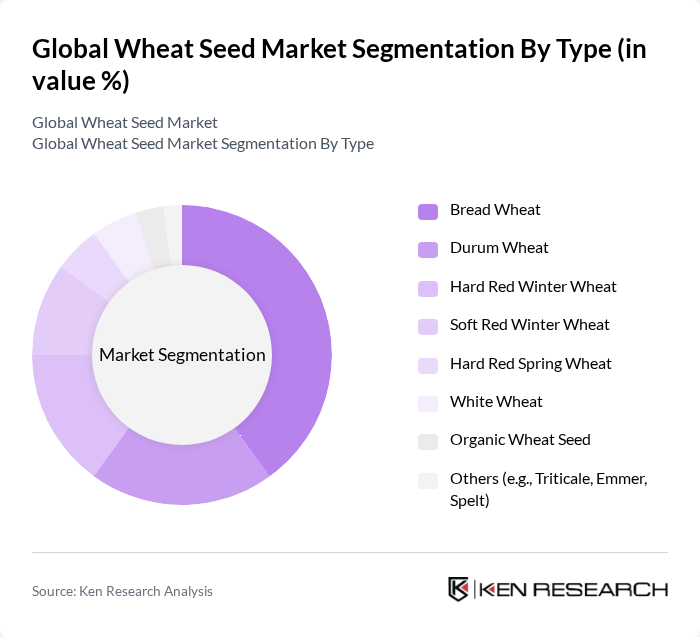
By Type:The wheat seed market can be segmented into various types, including Bread Wheat, Durum Wheat, Hard Red Winter Wheat, Soft Red Winter Wheat, Hard Red Spring Wheat, White Wheat, Organic Wheat Seed, and Others (e.g., Triticale, Emmer, Spelt). Among these, Bread Wheat is the most dominant segment due to its widespread use in food products such as bread, pasta, and other baked goods. The increasing consumer preference for high-quality bread products and the growing demand for processed foods contribute to the strong market position of Bread Wheat. This dominance is reinforced by the global dietary reliance on bread and related products .
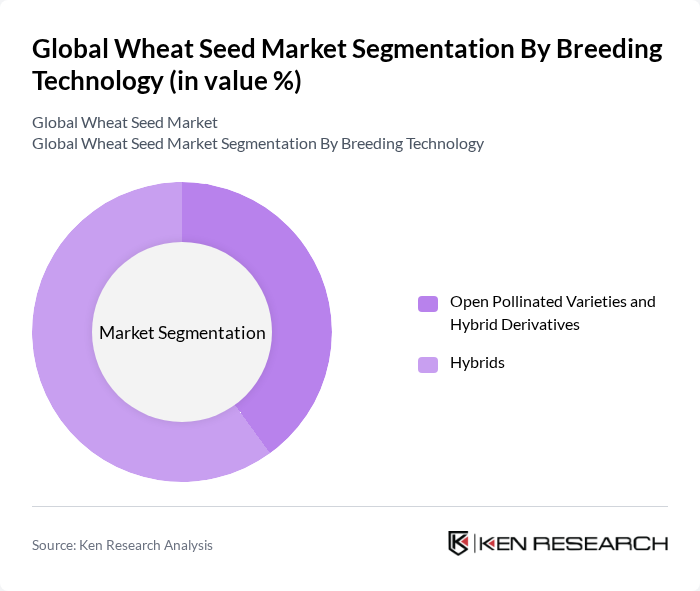
By Breeding Technology:The market can also be segmented based on breeding technology into Open Pollinated Varieties and Hybrid Derivatives, and Hybrids. The Hybrids segment is currently leading the market due to the increasing adoption of hybrid seeds that offer higher yields, improved disease resistance, and better adaptability to climate variability. Farmers are increasingly opting for hybrid varieties to maximize productivity and profitability, supported by ongoing R&D in hybrid seed development and government incentives for modern agricultural practices .
The Global Wheat Seed Market is characterized by a dynamic mix of regional and international players. Leading participants such as Bayer Crop Science, Corteva Agriscience, Syngenta AG, Limagrain (Vilmorin & Cie SA), KWS SAAT SE & Co. KGaA, RAGT Semences, DLF Seeds A/S, Takii & Co., Ltd., Seed Co Limited, Advanta Seeds (UPL Limited), Mahyco (Maharashtra Hybrid Seeds Company Ltd.), Jiangsu Dahua Seed Co., Ltd., Anhui Wanken Seed Co., Ltd., East-West Seed, Sakata Seed Corporation contribute to innovation, geographic expansion, and service delivery in this space.
The future of the wheat seed market is poised for transformation, driven by technological advancements and changing agricultural practices. As farmers increasingly adopt sustainable farming methods, the demand for high-quality, certified seeds will rise. Additionally, the integration of precision agriculture technologies will enhance crop management, optimizing yields. The focus on developing drought-resistant varieties will also gain momentum, addressing climate challenges while ensuring food security. Overall, the market is expected to evolve significantly, adapting to both consumer preferences and environmental demands.
| Segment | Sub-Segments |
|---|---|
| By Type | Bread Wheat Durum Wheat Hard Red Winter Wheat Soft Red Winter Wheat Hard Red Spring Wheat White Wheat Organic Wheat Seed Others (e.g., Triticale, Emmer, Spelt) |
| By Breeding Technology | Open Pollinated Varieties and Hybrid Derivatives Hybrids |
| By Application | Food Production Animal Feed Biofuel Production Industrial Uses Farm Planting Personal Planting |
| By End-User | Farmers Agricultural Cooperatives Seed Distributors Research Institutions |
| By Distribution Channel | Direct Sales Retail Outlets Online Sales Agricultural Shows and Expos |
| By Region | North America (U.S., Canada) Europe (Germany, France, U.K., Italy, Spain, Russia, Others) Asia-Pacific (China, India, Japan, Australia, Others) Latin America (Brazil, Mexico, Others) Middle East & Africa |
| By Seed Treatment | Chemical Treatment Biological Treatment Physical Treatment |
| By Price Range | Low Price Mid Price High Price Premium Price |
| Scope Item/Segment | Sample Size | Target Respondent Profiles |
|---|---|---|
| Seed Producers | 100 | Production Managers, R&D Directors |
| Agricultural Distributors | 60 | Sales Managers, Supply Chain Coordinators |
| Farmers (Commercial) | 120 | Crop Farmers, Farm Managers |
| Research Institutions | 40 | Agricultural Researchers, Policy Analysts |
| Government Agricultural Departments | 40 | Policy Makers, Agricultural Extension Officers |
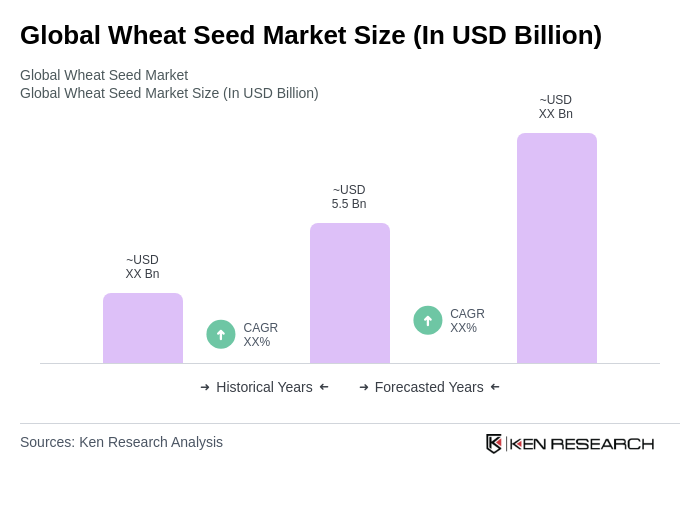
The Global Wheat Seed Market is valued at approximately USD 5.5 billion, driven by increasing demand for wheat as a staple food, advancements in seed technology, and the need for food security due to population growth.

What makes us stand out is that our consultants follow Robust, Refine and Result (RRR) methodology. Robust for clear definitions, approaches and sanity checking, Refine for differentiating respondents' facts and opinions, and Result for presenting data with story.

We have set a benchmark in the industry by offering our clients with syndicated and customized market research reports featuring coverage of entire market as well as meticulous research and analyst insights.

While we don't replace traditional research, we flip the method upside down. Our dual approach of Top Bottom & Bottom Top ensures quality deliverable by not just verifying company fundamentals but also looking at the sector and macroeconomic factors.

With one step in the future, our research team constantly tries to show you the bigger picture. We help with some of the tough questions you may encounter along the way: How is the industry positioned? Best marketing channel? KPI's of competitors? By aligning every element, we help maximize success.

Our report gives you instant access to the answers and sources that other companies might choose to hide. We elaborate each steps of research methodology we have used and showcase you the sample size to earn your trust.

If you need any support, we are here! We pride ourselves on universe strength, data quality, and quick, friendly, and professional service.













