About the Report
Base Year 2024Global Whisky Market Overview
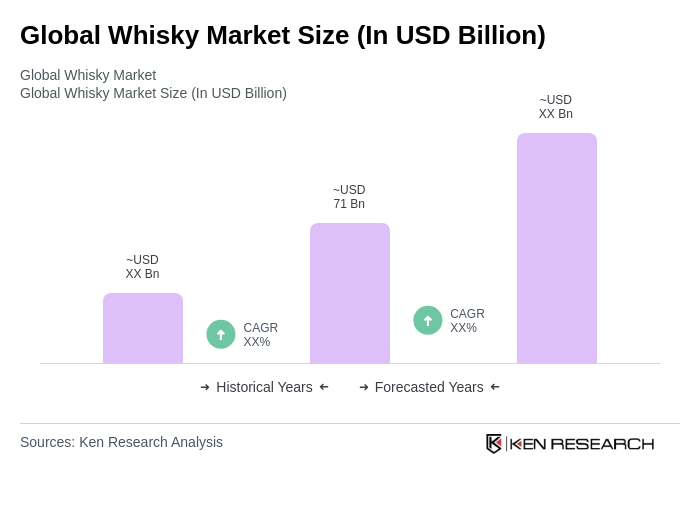
- The Global Whisky Market is valued at USD 71 billion, based on a five-year historical analysis. This growth is primarily driven by increasing consumer interest in premium and craft spirits, along with a rising trend of whisky tourism. The market has seen a surge in demand for aged and specialty whiskies, reflecting a shift in consumer preferences towards quality over quantity .
- Key players in this market include Scotland, the United States, and Japan, which dominate due to their rich heritage and established distillation practices. Scotland is renowned for its Scotch whisky, the U.S. is famous for Bourbon and Tennessee whiskey, and Japan has gained international acclaim for its distinct styles, contributing to global prestige and demand .
- In 2023, the European Union implemented regulations requiring all whisky producers to adhere to strict labeling standards, ensuring transparency regarding ingredients and production methods. This builds on long-standing spirit definitions under EU Regulation 2019/787 and subsequent spirit drink labelling rules aimed at consumer protection and fair competition .
Global Whisky Market Segmentation
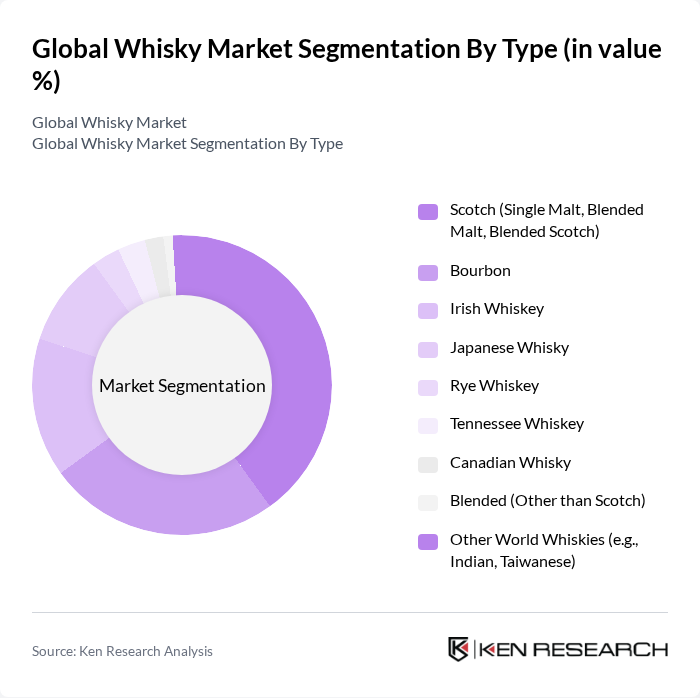
By Type:The whisky market is segmented into various types, including Scotch, Bourbon, Irish Whiskey, Japanese Whisky, Rye Whiskey, Tennessee Whiskey, Canadian Whisky, Blended (Other than Scotch), and Other World Whiskies. Among these, Scotch whisky, particularly Single Malt and Blended Scotch, maintains leading share globally due to its recognition, protected geographical indication, and strong premium positioning. Growing whisky appreciation, collectibles, and cask-finish experimentation are further supporting Scotch demand across both on-trade and off-trade channels .
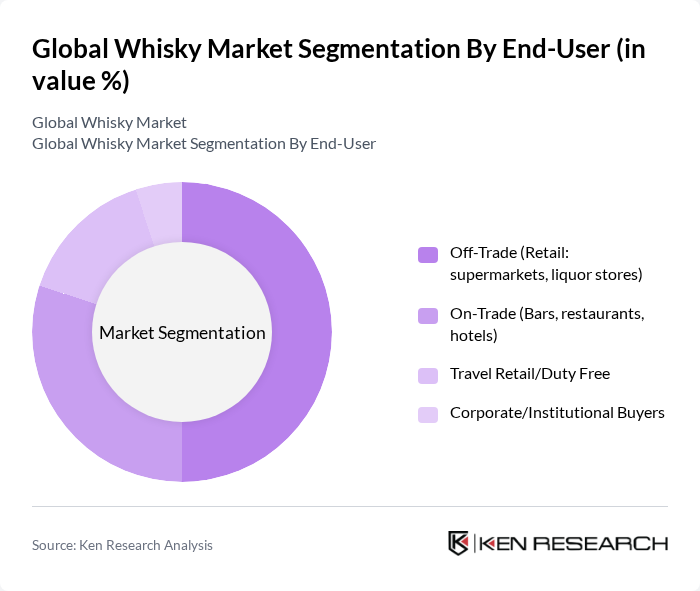
By End-User:The whisky market is further segmented by end-user categories, including Off-Trade (Retail: supermarkets, liquor stores), On-Trade (Bars, restaurants, hotels), Travel Retail/Duty Free, and Corporate/Institutional Buyers. The Off-Trade segment is currently leading the market, supported by home consumption habits, broad retail assortment, and growing e-commerce availability and direct-to-consumer channels for spirits in many markets .
Global Whisky Market Competitive Landscape
The Global Whisky Market is characterized by a dynamic mix of regional and international players. Leading participants such as Diageo plc, Pernod Ricard S.A., Brown?Forman Corporation, William Grant & Sons Ltd., Beam Suntory, Inc., Bacardi Limited, The Edrington Group Limited, Davide Campari?Milano N.V. (Campari Group), Sazerac Company, Inc., Constellation Brands, Inc., Moët Hennessy (LVMH), Rémy Cointreau S.A., Chivas Brothers Ltd. (Pernod Ricard), Whyte & Mackay Ltd., La Martiniquaise-Bardinet, The Loch Lomond Group, Inver House Distillers (International Beverage), Nikka Whisky Distilling Co., Ltd. (Asahi), Suntory Spirits Ltd. (Japan), John Distilleries Pvt. Ltd. contribute to innovation, geographic expansion, and service delivery in this space.
Global Whisky Market Industry Analysis
Growth Drivers
- Increasing Consumer Interest in Premium and Craft Whiskies:The global demand for premium and craft whiskies has surged, with sales of high-end whiskies increasing by 15 million liters in the future. This trend is driven by consumers seeking unique flavors and artisanal production methods. The premium segment now accounts for approximately 30% of total whisky sales, reflecting a shift towards quality over quantity. This growing interest is supported by a rise in whisky festivals and tasting events, enhancing consumer engagement and education.
- Rising Disposable Incomes in Emerging Markets:Emerging markets, particularly in Asia and Latin America, are witnessing a significant rise in disposable incomes, projected to reach ten trillion dollars in the future. This economic growth is enabling consumers to spend more on luxury goods, including premium whiskies. Countries like India and China are experiencing a 20% annual increase in whisky consumption, driven by a burgeoning middle class eager to explore premium alcoholic beverages, thus expanding the market base for whisky brands.
- Expansion of E-commerce Platforms for Alcohol Sales:The rise of e-commerce has transformed the whisky purchasing landscape, with online sales of alcoholic beverages expected to exceed fifty billion dollars globally in the future. This shift allows consumers to access a wider variety of whiskies, including rare and limited editions, from the comfort of their homes. E-commerce platforms are also enhancing customer experience through personalized recommendations and subscription services, further driving whisky sales and brand loyalty in the digital age.
Market Challenges
- Stringent Regulations on Alcohol Sales:The whisky industry faces significant challenges due to stringent regulations governing alcohol sales, which vary widely across regions. For instance, in the European Union, compliance with over 200 regulations can complicate market entry for new brands. Additionally, the enforcement of age restrictions and advertising limitations can hinder marketing efforts, impacting brand visibility and sales growth. These regulatory hurdles can deter investment and innovation within the sector.
- Increasing Competition from Other Spirits:The whisky market is experiencing heightened competition from other spirits, particularly vodka and rum, which have seen a combined sales increase of 12 million liters in the future. This competition is intensified by the growing popularity of cocktails and mixed drinks, which often feature these alternative spirits. As consumer preferences shift towards diverse drinking experiences, whisky brands must innovate and differentiate themselves to maintain market share and attract new consumers.
Global Whisky Market Future Outlook
The future of the whisky market appears promising, driven by evolving consumer preferences and innovative marketing strategies. As the trend towards premiumization continues, brands are likely to invest in unique flavor profiles and sustainable production methods. Additionally, the rise of whisky tourism and experiential marketing will enhance brand engagement. Companies that adapt to these trends and leverage digital platforms for outreach will likely capture a larger share of the market, ensuring sustained growth in the future.
Market Opportunities
- Growth in Demand for Organic and Sustainable Products:The increasing consumer preference for organic and sustainably produced goods presents a significant opportunity for whisky brands. With the organic food and beverage market projected to reach three hundred billion dollars in the future, whisky producers can capitalize on this trend by offering organic options, appealing to environmentally conscious consumers and enhancing brand loyalty.
- Expansion into Untapped Markets:Untapped markets in regions such as Africa and Southeast Asia present substantial growth opportunities for whisky brands. With a combined population of over 1.5 billion and a growing middle class, these regions are poised for increased whisky consumption. Strategic market entry and localized marketing efforts can help brands establish a foothold and drive sales in these emerging markets.
Scope of the Report
| Segment | Sub-Segments |
|---|---|
| By Type | Scotch (Single Malt, Blended Malt, Blended Scotch) Bourbon Irish Whiskey Japanese Whisky Rye Whiskey Tennessee Whiskey Canadian Whisky Blended (Other than Scotch) Other World Whiskies (e.g., Indian, Taiwanese) |
| By End-User | Off-Trade (Retail: supermarkets, liquor stores) On-Trade (Bars, restaurants, hotels) Travel Retail/Duty Free Corporate/Institutional Buyers |
| By Price Range | Economy/Standard Premium Super-Premium & Ultra-Premium |
| By Packaging Type | Glass Bottles Cans (RTD whisky-based beverages) Tetra Packs (selected markets) Miniatures and Gift Packs |
| By Distribution Channel | Supermarkets/Hypermarkets Specialty & Liquor Stores Online/E-commerce HoReCa/On-Premise Distributors Travel Retail |
| By Occasion | Celebrations & Social Events Gifting & Collectibles Casual/Home Consumption Mixology/Cocktail Use |
| By Region | North America Europe Asia-Pacific Latin America Middle East & Africa Others (including Travel Retail) |
Key Target Audience
Investors and Venture Capitalist Firms
Government and Regulatory Bodies (e.g., Alcohol and Gaming Commission, Food and Drug Administration)
Manufacturers and Producers
Distributors and Retailers
Importers and Exporters
Brand Owners and Marketers
Industry Associations (e.g., Scotch Whisky Association, American Distilling Institute)
Financial Institutions
Players Mentioned in the Report:
Diageo plc
Pernod Ricard S.A.
BrownForman Corporation
William Grant & Sons Ltd.
Beam Suntory, Inc.
Bacardi Limited
The Edrington Group Limited
Davide CampariMilano N.V. (Campari Group)
Sazerac Company, Inc.
Constellation Brands, Inc.
Moet Hennessy (LVMH)
Remy Cointreau S.A.
Chivas Brothers Ltd. (Pernod Ricard)
Whyte & Mackay Ltd.
La Martiniquaise-Bardinet
The Loch Lomond Group
Inver House Distillers (International Beverage)
Nikka Whisky Distilling Co., Ltd. (Asahi)
Suntory Spirits Ltd. (Japan)
John Distilleries Pvt. Ltd.
Table of Contents
Market Assessment Phase
1. Executive Summary and Approach
2. Global Whisky Market Overview
2.1 Key Insights and Strategic Recommendations
2.2 Global Whisky Market Overview
2.3 Definition and Scope
2.4 Evolution of Market Ecosystem
2.5 Timeline of Key Regulatory Milestones
2.6 Value Chain & Stakeholder Mapping
2.7 Business Cycle Analysis
2.8 Policy & Incentive Landscape
3. Global Whisky Market Analysis
3.1 Growth Drivers
3.1.1 Increasing consumer interest in premium and craft whiskies
3.1.2 Rising disposable incomes in emerging markets
3.1.3 Growth of the global tourism industry
3.1.4 Expansion of e-commerce platforms for alcohol sales
3.2 Market Challenges
3.2.1 Stringent regulations on alcohol sales
3.2.2 Increasing competition from other spirits
3.2.3 Fluctuating raw material prices
3.2.4 Changing consumer preferences towards healthier options
3.3 Market Opportunities
3.3.1 Growth in the demand for organic and sustainable products
3.3.2 Expansion into untapped markets
3.3.3 Innovations in flavor profiles and product offerings
3.3.4 Collaborations with food and beverage sectors
3.4 Market Trends
3.4.1 Increasing popularity of whisky cocktails
3.4.2 Rise of whisky tourism experiences
3.4.3 Growth of whisky subscription services
3.4.4 Emphasis on brand storytelling and heritage
3.5 Government Regulation
3.5.1 Minimum legal drinking age laws
3.5.2 Labeling and advertising restrictions
3.5.3 Taxation policies on alcoholic beverages
3.5.4 Import/export regulations for spirits
4. SWOT Analysis
5. Stakeholder Analysis
6. Porter's Five Forces Analysis
7. Global Whisky Market Market Size, 2019-2024
7.1 By Value
7.2 By Volume
7.3 By Average Selling Price
8. Global Whisky Market Segmentation
8.1 By Type
8.1.1 Scotch (Single Malt, Blended Malt, Blended Scotch)
8.1.2 Bourbon
8.1.3 Irish Whiskey
8.1.4 Japanese Whisky
8.1.5 Rye Whiskey
8.1.6 Tennessee Whiskey
8.1.7 Canadian Whisky
8.1.8 Blended (Other than Scotch)
8.1.9 Other World Whiskies (e.g., Indian, Taiwanese)
8.2 By End-User
8.2.1 Off-Trade (Retail: supermarkets, liquor stores)
8.2.2 On-Trade (Bars, restaurants, hotels)
8.2.3 Travel Retail/Duty Free
8.2.4 Corporate/Institutional Buyers
8.3 By Price Range
8.3.1 Economy/Standard
8.3.2 Premium
8.3.3 Super-Premium & Ultra-Premium
8.4 By Packaging Type
8.4.1 Glass Bottles
8.4.2 Cans (RTD whisky-based beverages)
8.4.3 Tetra Packs (selected markets)
8.4.4 Miniatures and Gift Packs
8.5 By Distribution Channel
8.5.1 Supermarkets/Hypermarkets
8.5.2 Specialty & Liquor Stores
8.5.3 Online/E-commerce
8.5.4 HoReCa/On-Premise Distributors
8.5.5 Travel Retail
8.6 By Occasion
8.6.1 Celebrations & Social Events
8.6.2 Gifting & Collectibles
8.6.3 Casual/Home Consumption
8.6.4 Mixology/Cocktail Use
8.7 By Region
8.7.1 North America
8.7.2 Europe
8.7.3 Asia-Pacific
8.7.4 Latin America
8.7.5 Middle East & Africa
8.7.6 Others (including Travel Retail)
9. Global Whisky Market Competitive Analysis
9.1 Market Share of Key Players
9.2 Cross Comparison of Key Players
9.2.1 Company Name
9.2.2 Group Size (Global, Multinational, or Regional)
9.2.3 Whisky Net Sales/Revenue (latest FY)
9.2.4 Volume Sold (9L cases)
9.2.5 Geographic Footprint (countries/regions served)
9.2.6 Portfolio Mix (Scotch/Bourbon/Irish/Japanese/Other)
9.2.7 Premiumization Share (premium & above as % of sales)
9.2.8 Travel Retail Contribution (% of sales)
9.2.9 Organic vs. Acquisition-led Growth (last 3 years)
9.2.10 Innovation Rate (new SKUs/line extensions per year)
9.2.11 Average Realized Price per 9L Case
9.2.12 Brand Power Indicators (top brands/rankings/awards)
9.2.13 Route-to-Market Strength (own distribution vs. partners)
9.2.14 Sustainability KPIs (renewable energy, packaging, water use)
9.2.15 Marketing Intensity (A&P spend as % of sales)
9.3 SWOT Analysis of Top Players
9.4 Pricing Analysis
9.5 Detailed Profile of Major Companies
9.5.1 Diageo plc
9.5.2 Pernod Ricard S.A.
9.5.3 Brown?Forman Corporation
9.5.4 William Grant & Sons Ltd.
9.5.5 Beam Suntory, Inc.
9.5.6 Bacardi Limited
9.5.7 The Edrington Group Limited
9.5.8 Davide Campari?Milano N.V. (Campari Group)
9.5.9 Sazerac Company, Inc.
9.5.10 Constellation Brands, Inc.
9.5.11 Moët Hennessy (LVMH)
9.5.12 Rémy Cointreau S.A.
9.5.13 Chivas Brothers Ltd. (Pernod Ricard)
9.5.14 Whyte & Mackay Ltd.
9.5.15 La Martiniquaise-Bardinet
9.5.16 The Loch Lomond Group
9.5.17 Inver House Distillers (International Beverage)
9.5.18 Nikka Whisky Distilling Co., Ltd. (Asahi)
9.5.19 Suntory Spirits Ltd. (Japan)
9.5.20 John Distilleries Pvt. Ltd.
10. Global Whisky Market End-User Analysis
10.1 Procurement Behavior of Key Ministries
10.1.1 Government procurement policies
10.1.2 Budget allocation for alcohol purchases
10.1.3 Compliance with local regulations
10.2 Corporate Spend on Infrastructure & Energy
10.2.1 Investment in distillery infrastructure
10.2.2 Energy consumption patterns
10.2.3 Sustainability initiatives
10.3 Pain Point Analysis by End-User Category
10.3.1 Supply chain disruptions
10.3.2 Quality control issues
10.3.3 Regulatory compliance challenges
10.4 User Readiness for Adoption
10.4.1 Awareness of whisky varieties
10.4.2 Willingness to experiment with new brands
10.4.3 Accessibility of products
10.5 Post-Deployment ROI and Use Case Expansion
10.5.1 Measurement of sales growth
10.5.2 Customer feedback and satisfaction
10.5.3 Market share analysis
11. Global Whisky Market Future Size, 2025-2030
11.1 By Value
11.2 By Volume
11.3 By Average Selling Price
Go-To-Market Strategy Phase
1. Whitespace Analysis + Business Model Canvas
1.1 Market gaps identification
1.2 Value proposition development
1.3 Revenue model exploration
1.4 Key partnerships and resources
1.5 Customer segments analysis
1.6 Cost structure evaluation
1.7 Channels for delivery
2. Marketing and Positioning Recommendations
2.1 Branding strategies
2.2 Product USPs
2.3 Target audience identification
2.4 Communication strategies
2.5 Digital marketing initiatives
3. Distribution Plan
3.1 Urban retail strategies
3.2 Rural NGO tie-ups
3.3 Online distribution channels
3.4 Partnerships with local distributors
4. Channel & Pricing Gaps
4.1 Underserved routes
4.2 Pricing bands analysis
4.3 Competitor pricing strategies
4.4 Consumer price sensitivity
5. Unmet Demand & Latent Needs
5.1 Category gaps identification
5.2 Consumer segments analysis
5.3 Product development opportunities
5.4 Market entry strategies
6. Customer Relationship
6.1 Loyalty programs
6.2 After-sales service
6.3 Customer engagement strategies
6.4 Feedback mechanisms
7. Value Proposition
7.1 Sustainability initiatives
7.2 Integrated supply chains
7.3 Unique selling propositions
7.4 Customer-centric approaches
8. Key Activities
8.1 Regulatory compliance
8.2 Branding efforts
8.3 Distribution setup
8.4 Marketing campaigns
9. Entry Strategy Evaluation
9.1 Domestic Market Entry Strategy
9.1.1 Product mix considerations
9.1.2 Pricing band strategies
9.1.3 Packaging innovations
9.2 Export Entry Strategy
9.2.1 Target countries analysis
9.2.2 Compliance roadmap development
10. Entry Mode Assessment
10.1 Joint Ventures
10.2 Greenfield investments
10.3 Mergers & Acquisitions
10.4 Distributor Model
11. Capital and Timeline Estimation
11.1 Capital requirements
11.2 Timelines for market entry
12. Control vs Risk Trade-Off
12.1 Ownership considerations
12.2 Partnerships evaluation
13. Profitability Outlook
13.1 Breakeven analysis
13.2 Long-term sustainability strategies
14. Potential Partner List
14.1 Distributors
14.2 Joint Ventures
14.3 Acquisition targets
15. Execution Roadmap
15.1 Phased Plan for Market Entry
15.1.1 Market Setup
15.1.2 Market Entry
15.1.3 Growth Acceleration
15.1.4 Scale & Stabilize
15.2 Key Activities and Milestones
15.2.1 Activity timelines
15.2.2 Milestone tracking
Research Methodology
Phase 1: Approach1
Desk Research
- Analysis of global whisky market reports from industry associations and trade publications
- Review of historical sales data and market trends from government databases and market research firms
- Examination of consumer behavior studies and demographic reports related to whisky consumption
Primary Research
- Interviews with distillery owners and master blenders to gain insights on production trends
- Surveys with whisky distributors and retailers to understand market dynamics and pricing strategies
- Focus groups with whisky enthusiasts to explore consumer preferences and emerging trends
Validation & Triangulation
- Cross-validation of findings through multiple data sources, including trade publications and expert opinions
- Triangulation of market size estimates using sales data, production statistics, and consumer surveys
- Sanity checks conducted through expert panel reviews and feedback from industry stakeholders
Phase 2: Market Size Estimation1
Top-down Assessment
- Estimation of total market size based on global alcohol consumption statistics and whisky's market share
- Segmentation of the market by region, type (e.g., Scotch, Bourbon, Irish), and distribution channel
- Incorporation of macroeconomic factors such as GDP growth and disposable income trends affecting whisky sales
Bottom-up Modeling
- Collection of sales volume data from leading whisky brands and distilleries
- Estimation of average selling prices across different whisky categories and regions
- Calculation of market size based on production volumes and retail sales data
Forecasting & Scenario Analysis
- Multi-factor regression analysis incorporating variables such as consumer trends, economic indicators, and regulatory changes
- Scenario planning based on potential shifts in consumer preferences and market disruptions
- Development of baseline, optimistic, and pessimistic forecasts through 2030
Phase 3: CATI Sample Composition1
| Scope Item/Segment | Sample Size | Target Respondent Profiles |
|---|---|---|
| Whisky Retailers | 140 | Store Managers, Purchasing Agents |
| Whisky Distributors | 110 | Sales Directors, Distribution Managers |
| Distillery Operations | 90 | Master Distillers, Production Managers |
| Whisky Enthusiasts | 120 | Brand Ambassadors, Whisky Club Members |
| Market Analysts | 60 | Industry Analysts, Market Researchers |
Frequently Asked Questions
What is the current value of the Global Whisky Market?
The Global Whisky Market is valued at approximately USD 71 billion, reflecting a significant growth trend driven by consumer interest in premium and craft spirits, as well as whisky tourism.
Which countries are the leading producers of whisky?
What are the recent regulatory changes affecting the whisky market?
What types of whisky are most popular globally?
Other Regional/Country Reports
Indonesia Whisky Market
Malaysia Whisky Market
APAC Whisky Market
SEA Whisky Market
Why Buy From Us?

What makes us stand out is that our consultants follow Robust, Refine and Result (RRR) methodology. Robust for clear definitions, approaches and sanity checking, Refine for differentiating respondents' facts and opinions, and Result for presenting data with story.

We have set a benchmark in the industry by offering our clients with syndicated and customized market research reports featuring coverage of entire market as well as meticulous research and analyst insights.

While we don't replace traditional research, we flip the method upside down. Our dual approach of Top Bottom & Bottom Top ensures quality deliverable by not just verifying company fundamentals but also looking at the sector and macroeconomic factors.

With one step in the future, our research team constantly tries to show you the bigger picture. We help with some of the tough questions you may encounter along the way: How is the industry positioned? Best marketing channel? KPI's of competitors? By aligning every element, we help maximize success.

Our report gives you instant access to the answers and sources that other companies might choose to hide. We elaborate each steps of research methodology we have used and showcase you the sample size to earn your trust.

If you need any support, we are here! We pride ourselves on universe strength, data quality, and quick, friendly, and professional service.