Global Wi Fi Market

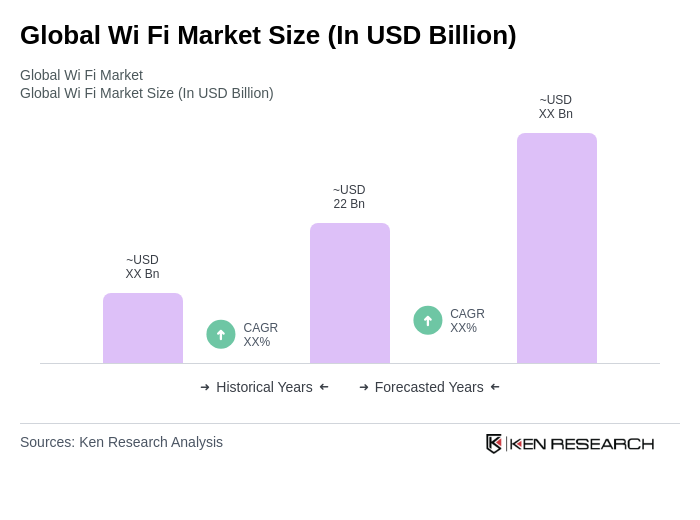
Global Wi-Fi market, valued at USD 22 Bn, is set to double by 2029, fueled by smart devices, IoT applications, and Wi-Fi technology advancements like 6E/7.

Region:Global

Author(s):Shubham

Product Code:KRAD0718

Pages:97

Published On:August 2025
About the Report

Base Year 2024

Global Wi Fi Market Overview

  • The Global Wi Fi Market is valued at USD 22 billion, based on a five-year historical analysis. This level aligns with recent industry trackers that place the market in the low?twenties in USD billions for the latest reported period, with momentum supported by Wi?Fi 6/6E upgrades and initial Wi?Fi 7 rollouts in both consumer and enterprise segments . The growth is primarily driven by increasing demand for high?speed internet connectivity, proliferation of smart devices, and expansion of IoT applications, alongside stronger refresh cycles for Wi?Fi 6/6E/7 equipment and growing managed Wi?Fi services adoption .
  • Key players in this market include the United States, China, and Germany, underpinned by advanced network infrastructure, high internet penetration, and strong R&D and manufacturing ecosystems; the rapid uptake of Wi?Fi 6/6E/7 equipment by enterprises in the Americas and Asia?Pacific further reinforces leadership in these regions . The presence of major semiconductor and networking vendors accelerating Wi?Fi 7 chipsets and products also supports these countries’ positions .
  • In 2023, the U.S. government did not enact a single nation?wide mandate requiring all public Wi?Fi providers to implement specific security protocols; U.S. Wi?Fi security guidance is largely driven by standards bodies and agency recommendations, while enterprise WLAN security advancements are being propelled by vendor adoption of Wi?Fi 6E/7 and evolving best practices rather than a uniform federal regulation .
Global Wi Fi Market Size

Global Wi Fi Market Segmentation

By Type:The market is segmented into various types, including Wi?Fi Access Points (Indoor, Outdoor), Wi?Fi Routers & Gateways, Wi?Fi Mesh Systems, Wi?Fi Range Extenders/Repeaters, Wi?Fi Controllers & Cloud?Managed Platforms, CPE and Customer Premises Equipment, Chipsets & Modules (Wi?Fi 5/6/6E/7), and Services (Planning, Installation, Managed Wi?Fi, Wi?Fi as a Service). Among these, Wi?Fi Routers & Gateways are leading high?volume consumer shipments, while enterprise spending is concentrated in access points and cloud?managed platforms as organizations transition to Wi?Fi 6E/7 and expand dependent AP deployments . The increasing demand for high?speed internet and the rise of smart home devices have further propelled routers, mesh systems, and upgraded CPE at the household level .
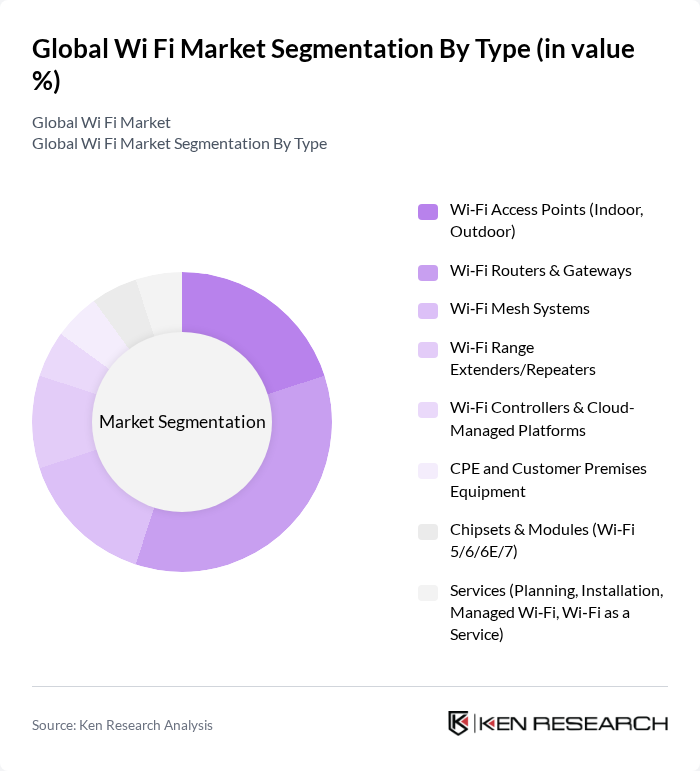
Global Wi Fi Market segmentation by Type.

By End-User:The end-user segmentation includes Residential, Small & Medium Enterprises (SMEs), Large Enterprises, Education (K?12, Higher Education, Campuses), Hospitality & Retail, Healthcare, Industrial & Manufacturing, and Government, Public Sector & Utilities. The Residential segment is currently the dominant end?user category in unit volumes because of the increasing number of smart devices and the need for reliable home connectivity, while enterprise WLAN spending shows robust growth as organizations modernize to Wi?Fi 6E/7 and expand dependent AP deployments . Broader applications in smart cities, Industry 4.0, and smart healthcare are also supporting adoption across non?residential segments .
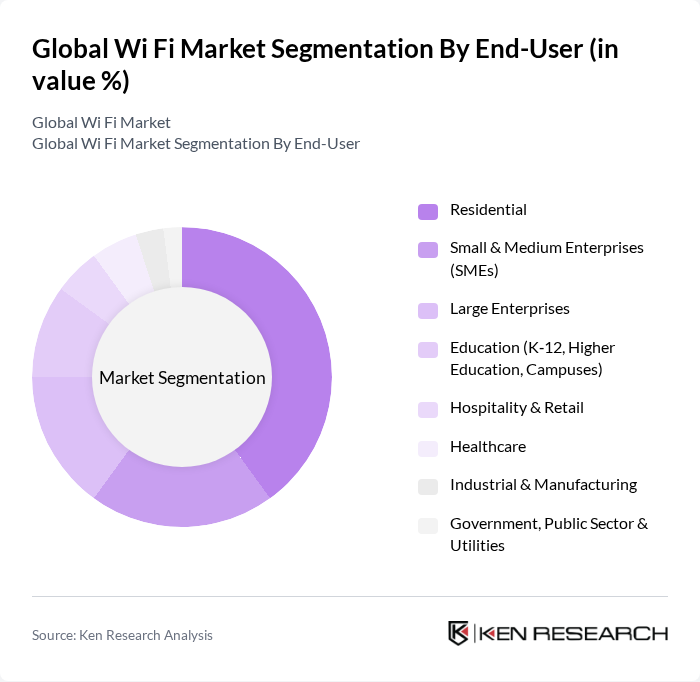
Global Wi Fi Market segmentation by End-User.

Global Wi Fi Market Competitive Landscape

The Global Wi Fi Market is characterized by a dynamic mix of regional and international players. Leading participants such as Cisco Systems, Inc., HPE Aruba Networking (Hewlett Packard Enterprise), Ruckus Networks (a CommScope company), NETGEAR, Inc., TP?Link Technologies Co., Ltd., D?Link Corporation, Ubiquiti Inc., Extreme Networks, Inc., Huawei Technologies Co., Ltd., ZTE Corporation, Linksys (a division of Belkin International, Inc.), MikroTik SIA, Juniper Networks, Inc. (Mist Systems), Fortinet, Inc. (FortiAP/FortiWLC), Cambium Networks, Ltd. contribute to innovation, geographic expansion, and service delivery in this space .

Cisco Systems, Inc.

1984

San Jose, California, USA

HPE Aruba Networking

2002

Santa Clara, California, USA

Ruckus Networks

2004

Sunnyvale, California, USA

NETGEAR, Inc.

1996

San Jose, California, USA

TP-Link Technologies Co., Ltd.

1996

Shenzhen, China

Company

Establishment Year

Headquarters

Product Portfolio Breadth (APs, Controllers, Mesh, CPE, Cloud)

Enterprise WLAN Revenue (latest FY)

YoY Growth in WLAN Segment

Share of Wi?Fi 6/6E/7 in Shipments/Revenue

Average Selling Price (ASP) of APs/Routers

Installed Base/Deployed Access Points

Global Wi Fi Market Industry Analysis

Growth Drivers

  • Increasing Demand for High-Speed Internet:The global demand for high-speed internet is projected to reach 1.5 billion broadband subscriptions in future, driven by a surge in remote work and online education. According to the International Telecommunication Union, the number of internet users is expected to exceed 5 billion, highlighting the necessity for robust Wi-Fi infrastructure. This demand is further supported by the World Bank's report indicating that countries with higher internet penetration experience GDP growth rates of up to 1.38% annually.
  • Proliferation of Smart Devices:The number of connected devices is anticipated to surpass 30 billion in future, as reported by Statista. This proliferation includes smartphones, tablets, and smart home devices, all requiring reliable Wi-Fi connectivity. The increasing consumer preference for smart technology is evident, with a 2023 survey indicating that 70% of households own at least one smart device. This trend necessitates enhanced Wi-Fi solutions to accommodate the growing data traffic and connectivity demands.
  • Expansion of IoT Applications:The Internet of Things (IoT) market is projected to grow to $1.1 trillion in future, according to Fortune Business Insights. This expansion is driven by applications in smart cities, healthcare, and industrial automation, all relying on seamless Wi-Fi connectivity. The World Economic Forum estimates that IoT devices will generate over 79.4 zettabytes of data in future, emphasizing the need for advanced Wi-Fi technologies to manage this data effectively and efficiently.

Market Challenges

  • Network Security Concerns:As the number of connected devices increases, so do the vulnerabilities associated with network security. Cybersecurity Ventures predicts that cybercrime will cost the world $10.5 trillion annually in future. This alarming statistic underscores the urgent need for robust security measures in Wi-Fi networks, as breaches can lead to significant financial losses and damage to consumer trust, hindering market growth.
  • High Installation Costs:The initial costs associated with deploying advanced Wi-Fi infrastructure can be prohibitive. For instance, the average cost of installing a commercial-grade Wi-Fi network can range from $10,000 to $100,000, depending on the scale and complexity. This financial barrier can deter small businesses and rural areas from upgrading their systems, limiting overall market expansion and accessibility to high-speed internet services.

Global Wi Fi Market Future Outlook

The future of the Wi-Fi market appears promising, driven by technological advancements and increasing connectivity needs. The shift towards Wi-Fi 6 technology is expected to enhance network efficiency and speed, accommodating the growing number of devices. Additionally, the integration of artificial intelligence in network management will streamline operations and improve security. As urbanization continues, investments in smart city infrastructure will further propel the demand for reliable Wi-Fi solutions, ensuring seamless connectivity for residents and businesses alike.

Market Opportunities

  • Growth in Public Wi-Fi Hotspots:The number of public Wi-Fi hotspots is projected to reach 1.5 billion in future, according to Wireless Broadband Alliance. This growth presents significant opportunities for service providers to expand their offerings and enhance user experiences in urban areas, public transport, and commercial spaces, driving revenue and customer engagement.
  • Development of 5G Technology:The rollout of 5G technology is expected to create synergies with Wi-Fi networks, enhancing overall connectivity. In future, 5G subscriptions are projected to reach 1.5 billion globally, as per GSMA. This convergence will enable faster data transfer rates and lower latency, providing a robust platform for innovative applications and services, thus expanding market potential.

Scope of the Report

SegmentSub-Segments
By Type

Wi?Fi Access Points (Indoor, Outdoor)

Wi?Fi Routers & Gateways

Wi?Fi Mesh Systems

Wi?Fi Range Extenders/Repeaters

Wi?Fi Controllers & Cloud-Managed Platforms

CPE and Customer Premises Equipment

Chipsets & Modules (Wi?Fi 5/6/6E/7)

Services (Planning, Installation, Managed Wi?Fi, Wi?Fi as a Service)

By End-User

Residential

Small & Medium Enterprises (SMEs)

Large Enterprises

Education (K?12, Higher Education, Campuses)

Hospitality & Retail

Healthcare

Industrial & Manufacturing

Government, Public Sector & Utilities

By Application

Enterprise WLAN

Public Wi?Fi Hotspots & Smart City Connectivity

Home Networking & Smart Home

Carrier Wi?Fi & Offload

Location Analytics & Indoor Positioning

IoT Connectivity (Industrial IoT, Healthcare IoT, Retail IoT)

By Distribution Channel

Online Retail & Marketplaces

Value-Added Resellers (VARs) & System Integrators

Direct Enterprise Sales

Telco/ISP Channels

By Component

Hardware (APs, Routers, Gateways, Controllers, CPE)

Software (Controller OS, Cloud Management, Security, Analytics)

Services (Professional, Managed, Support & Maintenance)

By Pricing Model

Subscription & Recurring (Cloud Management, WaaS)

Perpetual/One?Time License

Hardware + SaaS Bundles

Usage?Based/Bandwidth?Based

By Technology Standard/Band

Wi?Fi 5 (802.11ac)

Wi?Fi 6/6E (802.11ax, incl. 6 GHz)

Wi?Fi 7 (802.11be)

Frequency Bands (2.4 GHz, 5 GHz, 6 GHz, 60 GHz WiGig)

Key Target Audience

Investors and Venture Capitalist Firms

Government and Regulatory Bodies (e.g., Federal Communications Commission, International Telecommunication Union)

Manufacturers and Producers

Telecommunications Service Providers

Network Equipment Suppliers

Industry Associations (e.g., Wi-Fi Alliance)

Financial Institutions

Real Estate Developers and Property Management Firms

Players Mentioned in the Report:

Cisco Systems, Inc.

HPE Aruba Networking (Hewlett Packard Enterprise)

Ruckus Networks (a CommScope company)

NETGEAR, Inc.

TP-Link Technologies Co., Ltd.

D-Link Corporation

Ubiquiti Inc.

Extreme Networks, Inc.

Huawei Technologies Co., Ltd.

ZTE Corporation

Linksys (a division of Belkin International, Inc.)

MikroTik SIA

Juniper Networks, Inc. (Mist Systems)

Fortinet, Inc. (FortiAP/FortiWLC)

Cambium Networks, Ltd.

Table of Contents

Market Assessment Phase

1. Executive Summary and Approach


2. Global Wi Fi Market Overview

2.1 Key Insights and Strategic Recommendations

2.2 Global Wi Fi Market Overview

2.3 Definition and Scope

2.4 Evolution of Market Ecosystem

2.5 Timeline of Key Regulatory Milestones

2.6 Value Chain & Stakeholder Mapping

2.7 Business Cycle Analysis

2.8 Policy & Incentive Landscape


3. Global Wi Fi Market Analysis

3.1 Growth Drivers

3.1.1 Increasing demand for high-speed internet
3.1.2 Proliferation of smart devices
3.1.3 Expansion of IoT applications
3.1.4 Rising adoption of cloud services

3.2 Market Challenges

3.2.1 Network security concerns
3.2.2 High installation costs
3.2.3 Regulatory compliance issues
3.2.4 Limited coverage in rural areas

3.3 Market Opportunities

3.3.1 Growth in public Wi Fi hotspots
3.3.2 Development of 5G technology
3.3.3 Increased investment in smart cities
3.3.4 Expansion of e-commerce platforms

3.4 Market Trends

3.4.1 Shift towards Wi Fi 6 technology
3.4.2 Integration of AI in network management
3.4.3 Rise of mesh networking solutions
3.4.4 Growing focus on energy-efficient devices

3.5 Government Regulation

3.5.1 Data privacy regulations
3.5.2 Spectrum allocation policies
3.5.3 Cybersecurity mandates
3.5.4 Infrastructure funding initiatives

4. SWOT Analysis


5. Stakeholder Analysis


6. Porter's Five Forces Analysis


7. Global Wi Fi Market Market Size, 2019-2024

7.1 By Value

7.2 By Volume

7.3 By Average Selling Price


8. Global Wi Fi Market Segmentation

8.1 By Type

8.1.1 Wi?Fi Access Points (Indoor, Outdoor)
8.1.2 Wi?Fi Routers & Gateways
8.1.3 Wi?Fi Mesh Systems
8.1.4 Wi?Fi Range Extenders/Repeaters
8.1.5 Wi?Fi Controllers & Cloud-Managed Platforms
8.1.6 CPE and Customer Premises Equipment
8.1.7 Chipsets & Modules (Wi?Fi 5/6/6E/7)
8.1.8 Services (Planning, Installation, Managed Wi?Fi, Wi?Fi as a Service)

8.2 By End-User

8.2.1 Residential
8.2.2 Small & Medium Enterprises (SMEs)
8.2.3 Large Enterprises
8.2.4 Education (K?12, Higher Education, Campuses)
8.2.5 Hospitality & Retail
8.2.6 Healthcare
8.2.7 Industrial & Manufacturing
8.2.8 Government, Public Sector & Utilities

8.3 By Application

8.3.1 Enterprise WLAN
8.3.2 Public Wi?Fi Hotspots & Smart City Connectivity
8.3.3 Home Networking & Smart Home
8.3.4 Carrier Wi?Fi & Offload
8.3.5 Location Analytics & Indoor Positioning
8.3.6 IoT Connectivity (Industrial IoT, Healthcare IoT, Retail IoT)

8.4 By Distribution Channel

8.4.1 Online Retail & Marketplaces
8.4.2 Value-Added Resellers (VARs) & System Integrators
8.4.3 Direct Enterprise Sales
8.4.4 Telco/ISP Channels

8.5 By Component

8.5.1 Hardware (APs, Routers, Gateways, Controllers, CPE)
8.5.2 Software (Controller OS, Cloud Management, Security, Analytics)
8.5.3 Services (Professional, Managed, Support & Maintenance)

8.6 By Pricing Model

8.6.1 Subscription & Recurring (Cloud Management, WaaS)
8.6.2 Perpetual/One?Time License
8.6.3 Hardware + SaaS Bundles
8.6.4 Usage?Based/Bandwidth?Based

8.7 By Technology Standard/Band

8.7.1 Wi?Fi 5 (802.11ac)
8.7.2 Wi?Fi 6/6E (802.11ax, incl. 6 GHz)
8.7.3 Wi?Fi 7 (802.11be)
8.7.4 Frequency Bands (2.4 GHz, 5 GHz, 6 GHz, 60 GHz WiGig)

9. Global Wi Fi Market Competitive Analysis

9.1 Market Share of Key Players

9.2 Cross Comparison of Key Players

9.2.1 Company Name
9.2.2 Product Portfolio Breadth (APs, Controllers, Mesh, CPE, Cloud)
9.2.3 Enterprise WLAN Revenue (latest FY)
9.2.4 YoY Growth in WLAN Segment
9.2.5 Share of Wi?Fi 6/6E/7 in Shipments/Revenue
9.2.6 Average Selling Price (ASP) of APs/Routers
9.2.7 Installed Base/Deployed Access Points
9.2.8 Geography Mix (Americas/EMEA/APAC %)
9.2.9 Channel Mix (Direct, VAR/SI, Telco/ISP, Online)
9.2.10 R&D Intensity (% of revenue)
9.2.11 Feature Leadership (AI ops, security, MLO, 6 GHz support)
9.2.12 Customer Retention/Net Revenue Retention (Cloud Mgmt)
9.2.13 SLA/Support Metrics (MTTR, uptime)
9.2.14 Notable Certifications & Compliance (WFA, WPA3, CSA)
9.2.15 Strategic Partnerships (chipsets, ISPs, cloud)

9.3 SWOT Analysis of Top Players

9.4 Pricing Analysis

9.5 Detailed Profile of Major Companies

9.5.1 Cisco Systems, Inc.
9.5.2 HPE Aruba Networking (Hewlett Packard Enterprise)
9.5.3 Ruckus Networks (a CommScope company)
9.5.4 NETGEAR, Inc.
9.5.5 TP-Link Technologies Co., Ltd.
9.5.6 D-Link Corporation
9.5.7 Ubiquiti Inc.
9.5.8 Extreme Networks, Inc.
9.5.9 Huawei Technologies Co., Ltd.
9.5.10 ZTE Corporation
9.5.11 Linksys (a division of Belkin International, Inc.)
9.5.12 MikroTik SIA
9.5.13 Juniper Networks, Inc. (Mist Systems)
9.5.14 Fortinet, Inc. (FortiAP/FortiWLC)
9.5.15 Cambium Networks, Ltd.

10. Global Wi Fi Market End-User Analysis

10.1 Procurement Behavior of Key Ministries

10.1.1 Budget Allocation Trends
10.1.2 Procurement Processes
10.1.3 Preferred Vendors

10.2 Corporate Spend on Infrastructure & Energy

10.2.1 Investment Priorities
10.2.2 Spending Patterns
10.2.3 Infrastructure Upgrades

10.3 Pain Point Analysis by End-User Category

10.3.1 Connectivity Issues
10.3.2 Cost Constraints
10.3.3 Security Concerns

10.4 User Readiness for Adoption

10.4.1 Awareness Levels
10.4.2 Training Needs
10.4.3 Technology Acceptance

10.5 Post-Deployment ROI and Use Case Expansion

10.5.1 Performance Metrics
10.5.2 User Feedback
10.5.3 Future Expansion Plans

11. Global Wi Fi Market Future Size, 2025-2030

11.1 By Value

11.2 By Volume

11.3 By Average Selling Price


Go-To-Market Strategy Phase

1. Whitespace Analysis + Business Model Canvas

1.1 Market Gaps Identification

1.2 Value Proposition Development

1.3 Revenue Streams Analysis

1.4 Cost Structure Evaluation

1.5 Key Partnerships Exploration

1.6 Customer Segmentation

1.7 Channels Strategy


2. Marketing and Positioning Recommendations

2.1 Branding Strategies

2.2 Product USPs

2.3 Target Audience Identification

2.4 Communication Strategy

2.5 Digital Marketing Tactics


3. Distribution Plan

3.1 Urban Retail Strategies

3.2 Rural NGO Tie-Ups

3.3 E-commerce Integration

3.4 Direct Sales Approaches


4. Channel & Pricing Gaps

4.1 Underserved Routes

4.2 Pricing Bands Analysis

4.3 Competitor Pricing Comparison


5. Unmet Demand & Latent Needs

5.1 Category Gaps

5.2 Consumer Segments

5.3 Emerging Trends


6. Customer Relationship

6.1 Loyalty Programs

6.2 After-sales Service

6.3 Customer Engagement Strategies


7. Value Proposition

7.1 Sustainability Initiatives

7.2 Integrated Supply Chains

7.3 Unique Selling Points


8. Key Activities

8.1 Regulatory Compliance

8.2 Branding Efforts

8.3 Distribution Setup


9. Entry Strategy Evaluation

9.1 Domestic Market Entry Strategy

9.1.1 Product Mix
9.1.2 Pricing Band
9.1.3 Packaging

9.2 Export Entry Strategy

9.2.1 Target Countries
9.2.2 Compliance Roadmap

10. Entry Mode Assessment

10.1 Joint Ventures

10.2 Greenfield Investments

10.3 Mergers & Acquisitions

10.4 Distributor Model


11. Capital and Timeline Estimation

11.1 Capital Requirements

11.2 Timelines


12. Control vs Risk Trade-Off

12.1 Ownership vs Partnerships


13. Profitability Outlook

13.1 Breakeven Analysis

13.2 Long-term Sustainability


14. Potential Partner List

14.1 Distributors

14.2 Joint Ventures

14.3 Acquisition Targets


15. Execution Roadmap

15.1 Phased Plan for Market Entry

15.1.1 Market Setup
15.1.2 Market Entry
15.1.3 Growth Acceleration
15.1.4 Scale & Stabilize

15.2 Key Activities and Milestones

15.2.1 Activity Planning
15.2.2 Milestone Tracking

Research Methodology

ApproachModellingSample

Phase 1: Approach1

Desk Research

  • Analysis of industry reports from global telecommunications organizations
  • Review of market trends and forecasts from Wi-Fi technology publications
  • Examination of regulatory frameworks and compliance documents from telecommunications authorities

Primary Research

  • Interviews with network infrastructure providers and Wi-Fi equipment manufacturers
  • Surveys with IT managers and decision-makers in various sectors
  • Field interviews with end-users to understand Wi-Fi usage patterns and preferences

Validation & Triangulation

  • Cross-validation of data through multiple industry sources and reports
  • Triangulation of findings from primary interviews and secondary data sources
  • Sanity checks conducted through expert panel discussions and feedback

Phase 2: Market Size Estimation1

Top-down Assessment

  • Estimation of market size based on global internet penetration rates and Wi-Fi adoption
  • Segmentation by geographical regions and industry verticals
  • Incorporation of growth rates from emerging markets and urbanization trends

Bottom-up Modeling

  • Data collection from leading Wi-Fi service providers on subscriber numbers and revenue
  • Estimation of average revenue per user (ARPU) across different service tiers
  • Volume analysis based on the number of Wi-Fi hotspots and access points deployed

Forecasting & Scenario Analysis

  • Multi-variable regression analysis incorporating technological advancements and consumer behavior
  • Scenario modeling based on potential regulatory changes and market disruptions
  • Development of baseline, optimistic, and pessimistic forecasts through 2030

Phase 3: CATI Sample Composition1

Scope Item/SegmentSample SizeTarget Respondent Profiles
Enterprise Wi-Fi Solutions120IT Managers, Network Administrators
Public Wi-Fi Access Points90City Planners, Municipal IT Directors
Residential Wi-Fi Services100Homeowners, Internet Service Subscribers
Wi-Fi in Educational Institutions70School Administrators, IT Coordinators
Wi-Fi for Hospitality Industry80Hotel Managers, Guest Experience Directors

Frequently Asked Questions

What is the current value of the Global Wi-Fi Market?

The Global Wi-Fi Market is valued at approximately USD 22 billion, reflecting a robust growth trajectory driven by advancements in Wi-Fi technology, particularly Wi-Fi 6/6E upgrades and the initial rollouts of Wi-Fi 7 across consumer and enterprise segments.

What factors are driving the growth of the Global Wi-Fi Market?

Which regions are leading in the Global Wi-Fi Market?

What are the main types of Wi-Fi products in the market?

Other Regional/Country Reports

UAE Wi Fi MarketKSA Wi Fi Market

Indonesia Wi Fi Market

Malaysia Wi Fi Market

APAC Wi Fi Market

SEA Wi Fi Market

Why Buy From Us?

Refine Robust Result (RRR) Framework

What makes us stand out is that our consultants follow Robust, Refine and Result (RRR) methodology. Robust for clear definitions, approaches and sanity checking, Refine for differentiating respondents' facts and opinions, and Result for presenting data with story.

Our Reach Is Unmatched

We have set a benchmark in the industry by offering our clients with syndicated and customized market research reports featuring coverage of entire market as well as meticulous research and analyst insights.

Shifting the Research Paradigm

While we don't replace traditional research, we flip the method upside down. Our dual approach of Top Bottom & Bottom Top ensures quality deliverable by not just verifying company fundamentals but also looking at the sector and macroeconomic factors.

More Insights-Better Decisions

With one step in the future, our research team constantly tries to show you the bigger picture. We help with some of the tough questions you may encounter along the way: How is the industry positioned? Best marketing channel? KPI's of competitors? By aligning every element, we help maximize success.

Transparency and Trust

Our report gives you instant access to the answers and sources that other companies might choose to hide. We elaborate each steps of research methodology we have used and showcase you the sample size to earn your trust.

Round the Clock Support

If you need any support, we are here! We pride ourselves on universe strength, data quality, and quick, friendly, and professional service.

Why Clients Choose Us?

400000+
Reports in repository
150+
Consulting projects a year
100+
Analysts
8000+
Client Queries in 2022








