About the Report
Base Year 2024Global Wireless Audio Device Market Overview
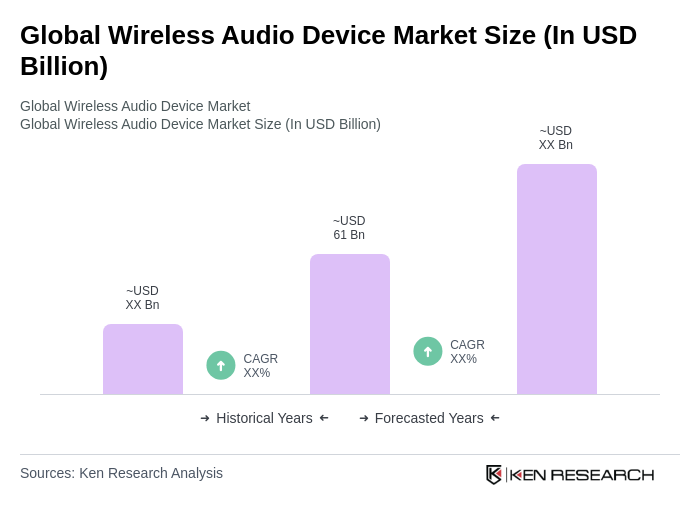
- The Global Wireless Audio Device Market is valued at USD 61 billion, based on a five-year historical analysis. This growth is primarily driven by the increasing adoption of wireless technology, the rise in demand for portable audio solutions, the integration of voice assistants, and the growing trend of smart home devices. The market has seen a significant shift towards wireless audio solutions, with consumers favoring convenience, mobility, and seamless connectivity in their audio experiences .
- Key players in this market include the United States, China, and Germany. The United States leads due to its advanced technological infrastructure, high consumer spending on electronics, and strong presence of leading brands. China benefits from its vast manufacturing capabilities and a large consumer base, while Germany is known for its strong engineering and innovation in audio technology, making these countries dominant in the wireless audio device market .
- In 2023, the European Union implemented regulations aimed at enhancing the energy efficiency of electronic devices, including wireless audio products. This regulation mandates that all wireless audio devices must meet specific energy consumption standards, promoting sustainability and reducing environmental impact. Manufacturers are required to comply with these standards to ensure their products are marketable within the EU .
Global Wireless Audio Device Market Segmentation
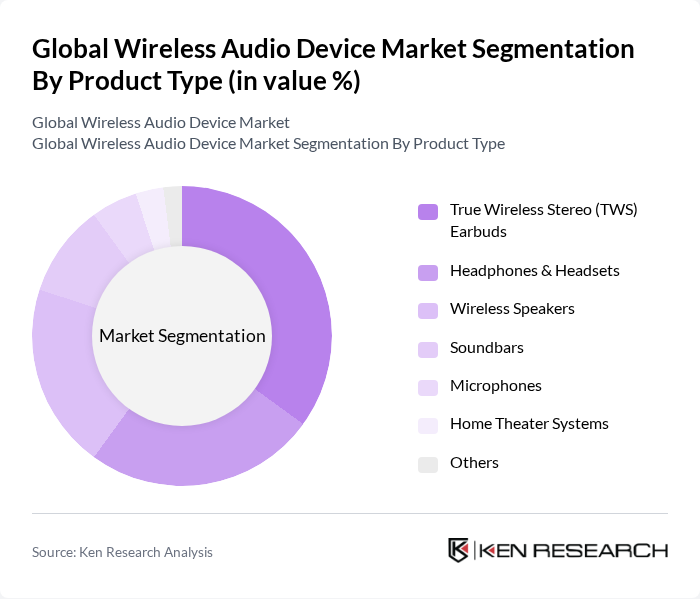
By Product Type:The product type segmentation includes various categories such as True Wireless Stereo (TWS) Earbuds, Headphones & Headsets, Wireless Speakers, Soundbars, Microphones, Home Theater Systems, and Others. Among these, True Wireless Stereo (TWS) Earbuds have gained significant popularity due to their compact design, convenience, and integration with smart assistants, appealing to consumers seeking mobility and ease of use. The demand for wireless speakers is also on the rise, driven by the increasing trend of home entertainment systems and the popularity of multi-room audio solutions .
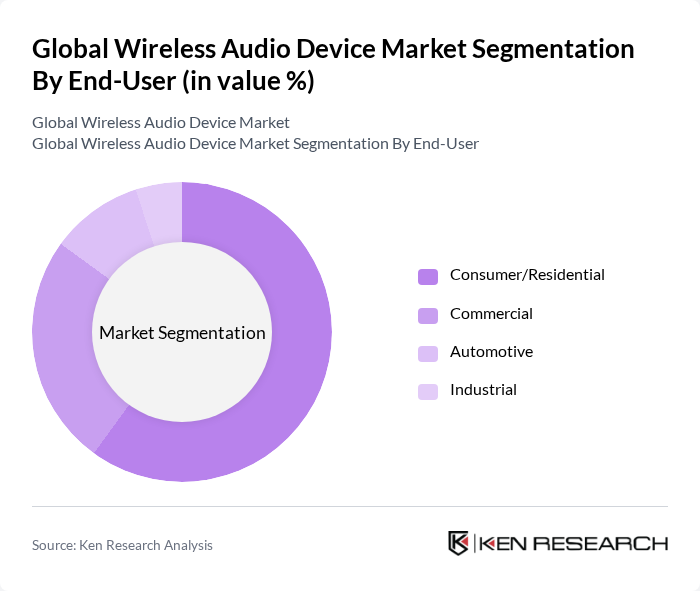
By End-User:The end-user segmentation encompasses Consumer/Residential, Commercial, Automotive, and Industrial categories. The Consumer/Residential segment dominates the market, driven by the increasing demand for personal audio devices, smart home integration, and streaming services among consumers. The rise in remote work and home entertainment has further fueled this demand, as individuals seek high-quality audio solutions for leisure and professional use. The Commercial segment is also growing, particularly in sectors like hospitality, retail, and education, where audio solutions enhance customer and user experience .
Global Wireless Audio Device Market Competitive Landscape
The Global Wireless Audio Device Market is characterized by a dynamic mix of regional and international players. Leading participants such as Apple Inc., Sony Corporation, Bose Corporation, Samsung Electronics Co., Ltd., Sennheiser electronic GmbH & Co. KG, JBL (HARMAN International Industries, Incorporated), Bang & Olufsen A/S, Anker Innovations Limited, Amazon.com, Inc., Google LLC, Microsoft Corporation, Audio-Technica Corporation, Plantronics, Inc. (Poly, now part of HP Inc.), Ultimate Ears (Logitech International S.A.), Skullcandy, Inc., GN Store Nord A/S (Jabra), Sonos, Inc., Xiaomi Corporation, Shure Incorporated, Imagine Marketing Limited (boAt), Panasonic Corporation contribute to innovation, geographic expansion, and service delivery in this space.
Global Wireless Audio Device Market Industry Analysis
Growth Drivers
- Increasing Consumer Demand for Portable Audio Solutions:The global demand for portable audio devices is projected to reach 1.5 billion units in future, driven by a growing preference for on-the-go entertainment. The rise in mobile device usage, with over 6.8 billion smartphone subscriptions globally, has significantly contributed to this trend. Additionally, the convenience of wireless audio solutions aligns with the fast-paced lifestyle of consumers, further propelling market growth in the None region.
- Advancements in Wireless Technology:The wireless audio device market is benefiting from rapid advancements in Bluetooth technology, with Bluetooth 5.0 expected to enhance connectivity range to 240 meters and improve data transfer speeds. This technological evolution is crucial as it addresses consumer concerns regarding audio quality and latency. Furthermore, the integration of low-energy protocols is projected to increase battery life, making devices more appealing to tech-savvy consumers in None.
- Growth in Streaming Services and Digital Content Consumption:The global streaming market is anticipated to reach $124 billion in future, with a significant increase in subscribers across platforms like Spotify and Apple Music. This surge in digital content consumption is driving demand for high-quality audio devices that enhance user experience. In None, the increase in internet penetration, projected to reach 75% in future, further supports the growth of wireless audio devices as consumers seek superior audio solutions for streaming.
Market Challenges
- High Competition and Market Saturation:The wireless audio device market is characterized by intense competition, with over 200 brands vying for market share. This saturation leads to price wars, which can erode profit margins. In None, the presence of established players like Sony and Bose, alongside emerging brands, complicates market entry for new companies. As a result, differentiation through innovation and branding becomes essential for survival in this crowded landscape.
- Concerns Over Audio Quality and Latency:Despite advancements in technology, many consumers remain skeptical about the audio quality of wireless devices. Reports indicate that 40% of users experience latency issues, particularly in gaming and video applications. This concern is critical in None, where high-quality audio is a significant purchasing factor. Manufacturers must address these issues through rigorous testing and quality assurance to maintain consumer trust and satisfaction.
Global Wireless Audio Device Market Future Outlook
The future of the wireless audio device market appears promising, driven by continuous technological innovations and evolving consumer preferences. As the demand for seamless connectivity and high-quality audio experiences grows, manufacturers are likely to invest in research and development. Additionally, the integration of artificial intelligence and machine learning in audio devices is expected to enhance personalization, making products more appealing to consumers. This trend will likely shape the market landscape in None, fostering a competitive environment focused on innovation.
Market Opportunities
- Expansion into Emerging Markets:Emerging markets in Asia and Africa present significant growth opportunities, with a projected increase in smartphone penetration to 80% in future. This demographic shift is expected to drive demand for affordable wireless audio solutions, allowing companies to tap into new customer bases and increase sales volumes in None.
- Development of Innovative Audio Solutions:The rise of personalized audio experiences is creating opportunities for companies to develop innovative products, such as adaptive sound technology and customizable audio profiles. With 60% of consumers expressing interest in personalized audio features, companies in None can leverage this trend to differentiate their offerings and enhance customer loyalty.
Scope of the Report
| Segment | Sub-Segments |
|---|---|
| By Product Type | True Wireless Stereo (TWS) Earbuds Headphones & Headsets Wireless Speakers Soundbars Microphones Home Theater Systems Others |
| By End-User | Consumer/Residential Commercial Automotive Industrial |
| By Distribution Channel | Online Retail Offline Retail Direct Sales Distributors |
| By Price Range | Budget Mid-Range Premium |
| By Application | Personal Use Professional/Studio Use Events and Entertainment Automotive Audio |
| By Connectivity Technology | Bluetooth Wi-Fi AirPlay NFC Others |
| By Region | North America Europe Asia Pacific Latin America Middle East & Africa |
Key Target Audience
Investors and Venture Capitalist Firms
Government and Regulatory Bodies (e.g., Federal Communications Commission, European Telecommunications Standards Institute)
Manufacturers and Producers
Distributors and Retailers
Telecommunications Companies
Audio Technology Developers
Consumer Electronics Retail Chains
Market Analysts and Industry Experts
Players Mentioned in the Report:
Apple Inc.
Sony Corporation
Bose Corporation
Samsung Electronics Co., Ltd.
Sennheiser electronic GmbH & Co. KG
JBL (HARMAN International Industries, Incorporated)
Bang & Olufsen A/S
Anker Innovations Limited
Amazon.com, Inc.
Google LLC
Microsoft Corporation
Audio-Technica Corporation
Plantronics, Inc. (Poly, now part of HP Inc.)
Ultimate Ears (Logitech International S.A.)
Skullcandy, Inc.
GN Store Nord A/S (Jabra)
Sonos, Inc.
Xiaomi Corporation
Shure Incorporated
Imagine Marketing Limited (boAt)
Panasonic Corporation
Table of Contents
Market Assessment Phase
1. Executive Summary and Approach
2. Global Wireless Audio Device Market Overview
2.1 Key Insights and Strategic Recommendations
2.2 Global Wireless Audio Device Market Overview
2.3 Definition and Scope
2.4 Evolution of Market Ecosystem
2.5 Timeline of Key Regulatory Milestones
2.6 Value Chain & Stakeholder Mapping
2.7 Business Cycle Analysis
2.8 Policy & Incentive Landscape
3. Global Wireless Audio Device Market Analysis
3.1 Growth Drivers
3.1.1 Increasing consumer demand for portable audio solutions
3.1.2 Advancements in wireless technology
3.1.3 Rising popularity of smart home devices
3.1.4 Growth in streaming services and digital content consumption
3.2 Market Challenges
3.2.1 High competition and market saturation
3.2.2 Concerns over audio quality and latency
3.2.3 Regulatory compliance and standards
3.2.4 Rapid technological changes
3.3 Market Opportunities
3.3.1 Expansion into emerging markets
3.3.2 Development of innovative audio solutions
3.3.3 Collaborations with content providers
3.3.4 Increasing demand for personalized audio experiences
3.4 Market Trends
3.4.1 Growth of true wireless stereo (TWS) devices
3.4.2 Integration of voice assistants in audio devices
3.4.3 Shift towards sustainable and eco-friendly products
3.4.4 Rise of multi-room audio systems
3.5 Government Regulation
3.5.1 Compliance with wireless communication standards
3.5.2 Environmental regulations on electronic waste
3.5.3 Consumer protection laws regarding product safety
3.5.4 Regulations on data privacy and security
4. SWOT Analysis
5. Stakeholder Analysis
6. Porter's Five Forces Analysis
7. Global Wireless Audio Device Market Market Size, 2019-2024
7.1 By Value
7.2 By Volume
7.3 By Average Selling Price
8. Global Wireless Audio Device Market Segmentation
8.1 By Product Type
8.1.1 True Wireless Stereo (TWS) Earbuds
8.1.2 Headphones & Headsets
8.1.3 Wireless Speakers
8.1.4 Soundbars
8.1.5 Microphones
8.1.6 Home Theater Systems
8.1.7 Others
8.2 By End-User
8.2.1 Consumer/Residential
8.2.2 Commercial
8.2.3 Automotive
8.2.4 Industrial
8.3 By Distribution Channel
8.3.1 Online Retail
8.3.2 Offline Retail
8.3.3 Direct Sales
8.3.4 Distributors
8.4 By Price Range
8.4.1 Budget
8.4.2 Mid-Range
8.4.3 Premium
8.5 By Application
8.5.1 Personal Use
8.5.2 Professional/Studio Use
8.5.3 Events and Entertainment
8.5.4 Automotive Audio
8.6 By Connectivity Technology
8.6.1 Bluetooth
8.6.2 Wi-Fi
8.6.3 AirPlay
8.6.4 NFC
8.6.5 Others
8.7 By Region
8.7.1 North America
8.7.2 Europe
8.7.3 Asia Pacific
8.7.4 Latin America
8.7.5 Middle East & Africa
9. Global Wireless Audio Device Market Competitive Analysis
9.1 Market Share of Key Players
9.2 KPIs for Cross Comparison of Key Players
9.2.1 Revenue (USD Million)
9.2.2 Market Share (%)
9.2.3 Revenue Growth Rate (%)
9.2.4 Geographic Presence (Number of Countries/Regions)
9.2.5 R&D Expenditure (% of Revenue)
9.2.6 Number of Patents/Intellectual Property Assets
9.2.7 Product Portfolio Breadth (Number of SKUs/Models)
9.2.8 Product Innovation Rate (New Launches per Year)
9.2.9 Distribution Channel Diversity (Online/Offline/Direct)
9.2.10 Customer Satisfaction Index (NPS or Equivalent)
9.2.11 Brand Recognition Score (Survey-Based)
9.2.12 Sustainability/ESG Initiatives (Qualitative/Quantitative)
9.3 SWOT Analysis of Top Players
9.4 Pricing Analysis
9.5 Detailed Profile of Major Companies
9.5.1 Apple Inc.
9.5.2 Sony Corporation
9.5.3 Bose Corporation
9.5.4 Samsung Electronics Co., Ltd.
9.5.5 Sennheiser electronic GmbH & Co. KG
9.5.6 JBL (HARMAN International Industries, Incorporated)
9.5.7 Bang & Olufsen A/S
9.5.8 Anker Innovations Limited
9.5.9 Amazon.com, Inc.
9.5.10 Google LLC
9.5.11 Microsoft Corporation
9.5.12 Audio-Technica Corporation
9.5.13 Plantronics, Inc. (Poly, now part of HP Inc.)
9.5.14 Ultimate Ears (Logitech International S.A.)
9.5.15 Skullcandy, Inc.
9.5.16 GN Store Nord A/S (Jabra)
9.5.17 Sonos, Inc.
9.5.18 Xiaomi Corporation
9.5.19 Shure Incorporated
9.5.20 Imagine Marketing Limited (boAt)
9.5.21 Panasonic Corporation
10. Global Wireless Audio Device Market End-User Analysis
10.1 Procurement Behavior of Key Ministries
10.1.1 Government procurement policies
10.1.2 Budget allocation for audio devices
10.1.3 Evaluation criteria for suppliers
10.2 Corporate Spend on Infrastructure & Energy
10.2.1 Investment in audio technology
10.2.2 Budget trends in corporate audio solutions
10.2.3 Impact of audio devices on productivity
10.3 Pain Point Analysis by End-User Category
10.3.1 Audio quality concerns
10.3.2 Integration with existing systems
10.3.3 Cost vs. performance trade-offs
10.4 User Readiness for Adoption
10.4.1 Awareness of wireless audio technology
10.4.2 Training and support needs
10.4.3 Adoption barriers
10.5 Post-Deployment ROI and Use Case Expansion
10.5.1 Measurement of audio device effectiveness
10.5.2 Expansion into new use cases
10.5.3 Long-term benefits of wireless audio solutions
11. Global Wireless Audio Device Market Future Size, 2025-2030
11.1 By Value
11.2 By Volume
11.3 By Average Selling Price
Go-To-Market Strategy Phase
1. Whitespace Analysis + Business Model Canvas
1.1 Market gaps and opportunities
1.2 Business model options
2. Marketing and Positioning Recommendations
2.1 Branding strategies
2.2 Product USPs
3. Distribution Plan
3.1 Urban retail vs rural NGO tie-ups
4. Channel & Pricing Gaps
4.1 Underserved routes
4.2 Pricing bands
5. Unmet Demand & Latent Needs
5.1 Category gaps
5.2 Consumer segments
6. Customer Relationship
6.1 Loyalty programs
6.2 After-sales service
7. Value Proposition
7.1 Sustainability
7.2 Integrated supply chains
8. Key Activities
8.1 Regulatory compliance
8.2 Branding
8.3 Distribution setup
9. Entry Strategy Evaluation
9.1 Domestic Market Entry Strategy
9.1.1 Product mix
9.1.2 Pricing band
9.1.3 Packaging
9.2 Export Entry Strategy
9.2.1 Target countries
9.2.2 Compliance roadmap
10. Entry Mode Assessment
10.1 JV
10.2 Greenfield
10.3 M&A
10.4 Distributor Model
11. Capital and Timeline Estimation
11.1 Capital requirements
11.2 Timelines
12. Control vs Risk Trade-Off
12.1 Ownership vs Partnerships
13. Profitability Outlook
13.1 Breakeven analysis
13.2 Long-term sustainability
14. Potential Partner List
14.1 Distributors
14.2 JVs
14.3 Acquisition targets
15. Execution Roadmap
15.1 Phased Plan for Market Entry
15.1.1 Market Setup
15.1.2 Market Entry
15.1.3 Growth Acceleration
15.1.4 Scale & Stabilize
15.2 Key Activities and Milestones
15.2.1 Milestone tracking
15.2.2 Activity scheduling
Research Methodology
Phase 1: Approach1
Desk Research
- Market reports from industry associations such as the Consumer Technology Association
- Analysis of sales data from leading wireless audio device manufacturers
- Review of consumer behavior studies published in technology journals
Primary Research
- Interviews with product managers at major audio device companies
- Surveys targeting end-users to understand preferences and usage patterns
- Focus groups with audiophiles and casual listeners to gather qualitative insights
Validation & Triangulation
- Cross-validation of findings with sales data from retail partners
- Triangulation of consumer insights with industry expert opinions
- Sanity checks through feedback from a panel of audio technology experts
Phase 2: Market Size Estimation1
Top-down Assessment
- Estimation of market size based on global consumer electronics sales data
- Segmentation by product type, including headphones, speakers, and soundbars
- Incorporation of growth trends in wireless technology adoption
Bottom-up Modeling
- Volume estimates derived from unit sales data of leading brands
- Pricing analysis based on retail and wholesale price points
- Calculation of market size using volume x average selling price
Forecasting & Scenario Analysis
- Multi-variable forecasting using trends in consumer electronics and audio quality
- Scenario analysis based on potential shifts in consumer preferences and technology
- Baseline, optimistic, and pessimistic forecasts through 2030
Phase 3: CATI Sample Composition1
| Scope Item/Segment | Sample Size | Target Respondent Profiles |
|---|---|---|
| Wireless Headphones Market | 100 | Audio Product Managers, Retail Buyers |
| Bluetooth Speakers Segment | 90 | Consumer Electronics Retailers, Marketing Executives |
| Smart Soundbars Analysis | 60 | Home Theater Specialists, Product Developers |
| Market for Audiophile Equipment | 50 | High-End Audio Retailers, Sound Engineers |
| Trends in Wireless Audio Accessories | 40 | Accessory Manufacturers, Consumer Insights Analysts |
Frequently Asked Questions
What is the current value of the Global Wireless Audio Device Market?
The Global Wireless Audio Device Market is valued at approximately USD 61 billion, reflecting significant growth driven by the increasing adoption of wireless technology and demand for portable audio solutions.
What factors are driving the growth of the wireless audio device market?
Which countries are leading in the wireless audio device market?
What are the main product types in the wireless audio device market?
Other Regional/Country Reports
Indonesia Wireless Audio Device Market
Malaysia Wireless Audio Device Market
APAC Wireless Audio Device Market
Why Buy From Us?

What makes us stand out is that our consultants follow Robust, Refine and Result (RRR) methodology. Robust for clear definitions, approaches and sanity checking, Refine for differentiating respondents' facts and opinions, and Result for presenting data with story.

We have set a benchmark in the industry by offering our clients with syndicated and customized market research reports featuring coverage of entire market as well as meticulous research and analyst insights.

While we don't replace traditional research, we flip the method upside down. Our dual approach of Top Bottom & Bottom Top ensures quality deliverable by not just verifying company fundamentals but also looking at the sector and macroeconomic factors.

With one step in the future, our research team constantly tries to show you the bigger picture. We help with some of the tough questions you may encounter along the way: How is the industry positioned? Best marketing channel? KPI's of competitors? By aligning every element, we help maximize success.

Our report gives you instant access to the answers and sources that other companies might choose to hide. We elaborate each steps of research methodology we have used and showcase you the sample size to earn your trust.

If you need any support, we are here! We pride ourselves on universe strength, data quality, and quick, friendly, and professional service.