About the Report
Base Year 2024India Aviation Industry Market Overview
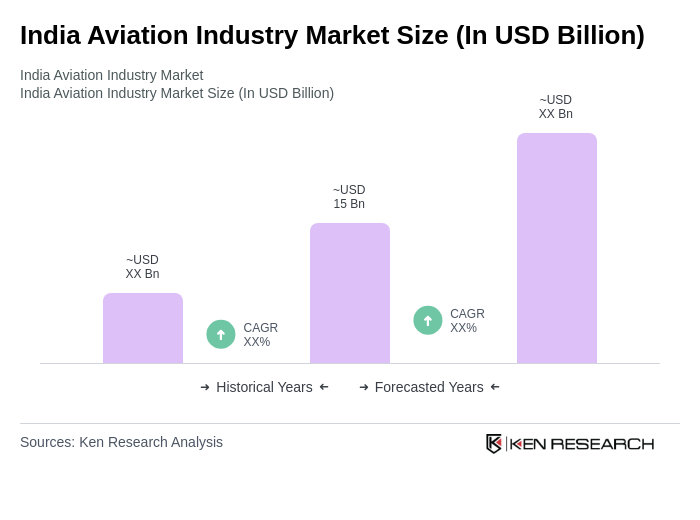
- The India Aviation Industry Market is valued at USD 15 billion, based on a five-year historical analysis. This growth is primarily driven by increasing passenger traffic, rising disposable incomes, and the expansion of low-cost carriers. The market has witnessed a significant recovery post-pandemic, with a surge in both domestic and international travel, supported by government initiatives to enhance airport infrastructure and connectivity.
- Key players in this market include major cities such as Delhi, Mumbai, and Bengaluru, which serve as primary hubs for both domestic and international flights. The dominance of these cities is attributed to their economic significance, population density, and the presence of major airlines and cargo operators, making them critical nodes in the aviation network.
- The National Civil Aviation Policy framework has driven regional connectivity and smaller airport development through UDAN/RCS, providing incentives for underserved routes and airports; ongoing policy execution continues to expand tier-2/3 connectivity and infrastructure upgrades.
India Aviation Industry Market Segmentation
By Type:The aviation market can be segmented into various types, including Commercial Passenger Aviation (Scheduled), Domestic Air Cargo & Express, International Air Cargo, Business & General Aviation (Non-scheduled), and Helicopter Services (Offshore, EMS, Heli-tourism). Each of these segments plays a crucial role in catering to different consumer needs and operational requirements.
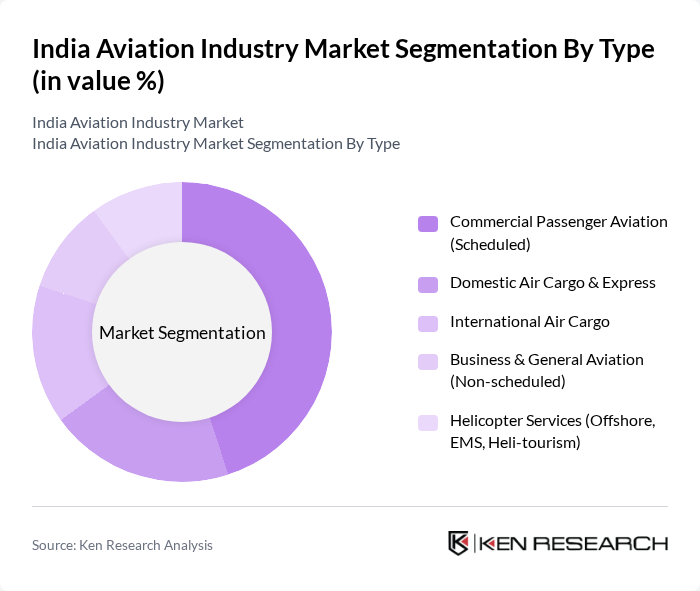
The Commercial Passenger Aviation (Scheduled) segment dominates the market, driven by the increasing demand for air travel among both leisure and business travelers. The rise of low-cost carriers has made air travel more accessible, leading to a significant increase in passenger numbers. Additionally, the expansion of airport infrastructure and improved connectivity have further fueled growth in this segment, making it the backbone of the aviation industry.
By End-User:The aviation market can also be segmented by end-user categories, including Leisure & VFR Passengers, Corporate & SME Travelers, Government & Public Sector (including PSUs), Freight Forwarders & Integrators, and E-commerce & 3PLs. Each of these categories reflects different consumer behaviors and operational needs within the aviation sector.
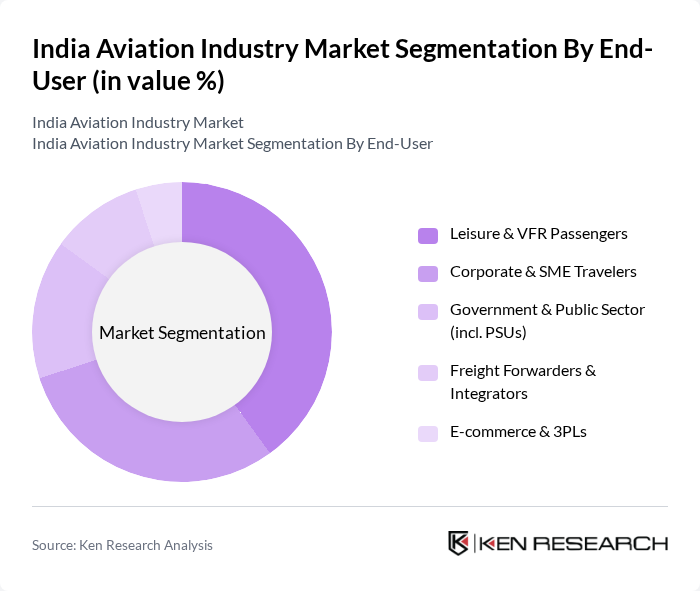
The Leisure & VFR Passengers segment is the largest, driven by the growing trend of domestic tourism and increased disposable incomes. The rise in travel for leisure purposes, coupled with the popularity of visiting friends and relatives (VFR), has significantly boosted demand in this segment. Additionally, the expansion of low-cost airlines has made air travel more affordable, further contributing to its dominance.
India Aviation Industry Market Competitive Landscape
The India Aviation Industry Market is characterized by a dynamic mix of regional and international players. Leading participants such as IndiGo (InterGlobe Aviation Ltd.), Air India (Tata Group), Air India Express, Vistara (Tata SIA Airlines Ltd.), Akasa Air (SNV Aviation), SpiceJet, Alliance Air, Blue Dart Aviation, Quikjet Airlines, Star Air (Ghodawat Enterprises), Fly91 (Just Udo Aviation Pvt. Ltd.), IndiaOne Air, Pawan Hans, TAAL SASE (Taneja Aerospace & Aviation Ltd. – charter/MRO), Zoom Air (Zexus Air Services) – currently non-operational contribute to innovation, geographic expansion, and service delivery in this space.
Sources: - - -
India Aviation Industry Market Industry Analysis
Growth Drivers
- Increasing Air Travel Demand:The Indian aviation sector is witnessing a surge in air travel demand, with passenger traffic expected to reach 376 million in the future, up from 341 million in 2020. This growth is driven by factors such as urbanization, increased disposable income, and a growing preference for air travel over other modes. The International Air Transport Association (IATA) projects that India will become the third-largest aviation market globally in the future, further emphasizing the robust demand for air travel.
- Government Initiatives for Infrastructure Development:The Indian government has allocated approximately $1.83 billion for airport infrastructure development in the future, aiming to enhance capacity and efficiency. Initiatives like the UDAN scheme are designed to improve regional connectivity, with over 400 routes operational in the future. This investment in infrastructure is crucial for accommodating the increasing passenger traffic and ensuring the long-term sustainability of the aviation sector in India.
- Expansion of Low-Cost Carriers:The rise of low-cost carriers (LCCs) has significantly transformed the Indian aviation landscape, with LCCs accounting for over 70% of domestic market share in the future. Airlines like IndiGo and SpiceJet have expanded their fleets, contributing to competitive pricing and increased accessibility for travelers. This trend is expected to continue, as LCCs focus on expanding routes and enhancing service offerings, further driving air travel demand across the country.
Market Challenges
- High Operational Costs:The Indian aviation industry faces significant operational costs, with fuel prices constituting about 30% of total operating expenses. In the future, jet fuel prices are projected to remain high, impacting profitability. Additionally, maintenance, airport fees, and labor costs contribute to the financial strain on airlines, making it challenging for carriers to maintain competitive pricing while ensuring service quality and safety standards.
- Infrastructure Limitations:Despite government efforts, India's aviation infrastructure is struggling to keep pace with the rapid growth in air travel. Major airports are operating at over 90% capacity, leading to congestion and delays. In the future, the lack of adequate facilities at regional airports remains a critical challenge, hindering the expansion of air travel options and affecting overall passenger experience in the aviation sector.
India Aviation Industry Market Future Outlook
The future of the Indian aviation industry appears promising, driven by increasing air travel demand and government support for infrastructure development. As the sector adapts to challenges such as high operational costs and infrastructure limitations, innovations in technology and customer service will play a crucial role. The focus on sustainability and regional connectivity will likely shape the industry's trajectory, ensuring that it remains resilient and competitive in the global aviation landscape.
Market Opportunities
- Growth in Cargo Transportation:The cargo segment is projected to grow significantly, with air cargo volumes expected to reach 3 million metric tons in the future. This growth is driven by the rise of e-commerce and the need for faster delivery solutions. Airlines are increasingly investing in dedicated cargo fleets, enhancing their capacity to meet this demand and capitalize on the lucrative logistics market.
- Investment in Sustainable Aviation:With a growing emphasis on environmental sustainability, investments in sustainable aviation technologies are on the rise. The Indian government aims to reduce carbon emissions by 30% in the future, prompting airlines to explore alternative fuels and energy-efficient aircraft. This shift presents opportunities for innovation and partnerships in developing eco-friendly aviation solutions, aligning with global sustainability goals.
Scope of the Report
| Segment | Sub-Segments |
|---|---|
| By Type | Commercial Passenger Aviation (Scheduled) Domestic Air Cargo & Express International Air Cargo Business & General Aviation (Non-scheduled) Helicopter Services (Offshore, EMS, Heli-tourism) |
| By End-User | Leisure & VFR Passengers Corporate & SME Travelers Government & Public Sector (incl. PSUs) Freight Forwarders & Integrators E-commerce & 3PLs |
| By Region | North India South India East & Northeast India West India Central India |
| By Aircraft Category | Narrow-Body Jets Wide-Body Jets Regional Jets & Turboprops Freighters (Dedicated Cargo Aircraft) |
| By Service Type | Scheduled Services Non-Scheduled/Charter Services Regional Connectivity (UDAN/RCS) |
| By Distribution Channel | Direct (Airline Websites/Apps) Travel Agencies & OTAs GDS/Corporate Travel Management |
| By Pricing Model | Dynamic/Yield-Based Pricing Ancillary Revenue Bundles (Seats, Bags, Meals) Subscription & Corporate Contracts |
Key Target Audience
Investors and Venture Capitalist Firms
Government and Regulatory Bodies (e.g., Ministry of Civil Aviation, Directorate General of Civil Aviation)
Airline Operators
Aerospace Manufacturers
Airport Authorities
Ground Handling Service Providers
Maintenance, Repair, and Overhaul (MRO) Service Providers
Fuel Suppliers and Logistics Companies
Players Mentioned in the Report:
IndiGo (InterGlobe Aviation Ltd.)
Air India (Tata Group)
Air India Express
Vistara (Tata SIA Airlines Ltd.)
Akasa Air (SNV Aviation)
SpiceJet
Alliance Air
Blue Dart Aviation
Quikjet Airlines
Star Air (Ghodawat Enterprises)
Fly91 (Just Udo Aviation Pvt. Ltd.)
IndiaOne Air
Pawan Hans
TAAL SASE (Taneja Aerospace & Aviation Ltd. charter/MRO)
Zoom Air (Zexus Air Services) currently non-operational
Table of Contents
Market Assessment Phase
1. Executive Summary and Approach
2. India Aviation Industry Market Overview
2.1 Key Insights and Strategic Recommendations
2.2 India Aviation Industry Market Overview
2.3 Definition and Scope
2.4 Evolution of Market Ecosystem
2.5 Timeline of Key Regulatory Milestones
2.6 Value Chain & Stakeholder Mapping
2.7 Business Cycle Analysis
2.8 Policy & Incentive Landscape
3. India Aviation Industry Market Analysis
3.1 Growth Drivers
3.1.1 Increasing Air Travel Demand
3.1.2 Government Initiatives for Infrastructure Development
3.1.3 Rise in Middle-Class Income
3.1.4 Expansion of Low-Cost Carriers
3.2 Market Challenges
3.2.1 High Operational Costs
3.2.2 Regulatory Compliance Issues
3.2.3 Infrastructure Limitations
3.2.4 Environmental Concerns
3.3 Market Opportunities
3.3.1 Growth in Cargo Transportation
3.3.2 Technological Advancements in Aviation
3.3.3 Expansion of Regional Connectivity
3.3.4 Investment in Sustainable Aviation
3.4 Market Trends
3.4.1 Digital Transformation in Operations
3.4.2 Increased Focus on Customer Experience
3.4.3 Adoption of Green Technologies
3.4.4 Mergers and Acquisitions Activity
3.5 Government Regulation
3.5.1 Air Traffic Management Reforms
3.5.2 Safety and Security Regulations
3.5.3 Environmental Regulations
3.5.4 Foreign Direct Investment Policies
4. SWOT Analysis
5. Stakeholder Analysis
6. Porter's Five Forces Analysis
7. India Aviation Industry Market Market Size, 2019-2024
7.1 By Value
7.2 By Volume
7.3 By Average Selling Price
8. India Aviation Industry Market Segmentation
8.1 By Type
8.1.1 Commercial Passenger Aviation (Scheduled)
8.1.2 Domestic Air Cargo & Express
8.1.3 International Air Cargo
8.1.4 Business & General Aviation (Non-scheduled)
8.1.5 Helicopter Services (Offshore, EMS, Heli-tourism)
8.2 By End-User
8.2.1 Leisure & VFR Passengers
8.2.2 Corporate & SME Travelers
8.2.3 Government & Public Sector (incl. PSUs)
8.2.4 Freight Forwarders & Integrators
8.2.5 E-commerce & 3PLs
8.3 By Region
8.3.1 North India
8.3.2 South India
8.3.3 East & Northeast India
8.3.4 West India
8.3.5 Central India
8.4 By Aircraft Category
8.4.1 Narrow-Body Jets
8.4.2 Wide-Body Jets
8.4.3 Regional Jets & Turboprops
8.4.4 Freighters (Dedicated Cargo Aircraft)
8.5 By Service Type
8.5.1 Scheduled Services
8.5.2 Non-Scheduled/Charter Services
8.5.3 Regional Connectivity (UDAN/RCS)
8.6 By Distribution Channel
8.6.1 Direct (Airline Websites/Apps)
8.6.2 Travel Agencies & OTAs
8.6.3 GDS/Corporate Travel Management
8.7 By Pricing Model
8.7.1 Dynamic/Yield-Based Pricing
8.7.2 Ancillary Revenue Bundles (Seats, Bags, Meals)
8.7.3 Subscription & Corporate Contracts
9. India Aviation Industry Market Competitive Analysis
9.1 Market Share of Key Players
9.2 Cross Comparison of Key Players
9.2.1 Company Name
9.2.2 Business Model (LCC, FSC, Regional, Cargo)
9.2.3 Available Seat Kilometers (ASK) Growth
9.2.4 Revenue Passenger Kilometers (RPK) Growth
9.2.5 Yield (INR per RPK) and Ancillary Revenue per Pax
9.2.6 Cost Metrics: CASK and CASK-ex Fuel
9.2.7 Load Factor (%)
9.2.8 On-Time Performance (DGCA OTP %)
9.2.9 Fleet Size and Order Book
9.2.10 Network Breadth (Cities/Routes; Intl share %)
9.2.11 Unit Revenue: RASK/PRASM
9.2.12 Cargo Tonnage and CTK (for cargo operators)
9.2.13 Balance Sheet Health (Debt/EBITDAR; Liquidity months)
9.2.14 Customer NPS/Loyalty Program Strength
9.3 SWOT Analysis of Top Players
9.4 Pricing Analysis
9.5 Detailed Profile of Major Companies
9.5.1 IndiGo (InterGlobe Aviation Ltd.)
9.5.2 Air India (Tata Group)
9.5.3 Air India Express
9.5.4 Vistara (Tata SIA Airlines Ltd.)
9.5.5 Akasa Air (SNV Aviation)
9.5.6 SpiceJet
9.5.7 Alliance Air
9.5.8 Blue Dart Aviation
9.5.9 Quikjet Airlines
9.5.10 Star Air (Ghodawat Enterprises)
9.5.11 Fly91 (Just Udo Aviation Pvt. Ltd.)
9.5.12 IndiaOne Air
9.5.13 Pawan Hans
9.5.14 TAAL SASE (Taneja Aerospace & Aviation Ltd. – charter/MRO)
9.5.15 Zoom Air (Zexus Air Services) – currently non-operational
10. India Aviation Industry Market End-User Analysis
10.1 Procurement Behavior of Key Ministries
10.1.1 Ministry of Civil Aviation
10.1.2 Ministry of Defence
10.1.3 Ministry of Tourism
10.1.4 Ministry of Commerce
10.2 Corporate Spend on Infrastructure & Energy
10.2.1 Investment in Airport Infrastructure
10.2.2 Spending on Ground Handling Services
10.2.3 Expenditure on Safety and Security
10.3 Pain Point Analysis by End-User Category
10.3.1 Delays and Cancellations
10.3.2 High Ticket Prices
10.3.3 Limited Connectivity
10.4 User Readiness for Adoption
10.4.1 Awareness of New Technologies
10.4.2 Acceptance of Digital Solutions
10.5 Post-Deployment ROI and Use Case Expansion
10.5.1 Evaluation of Cost Savings
10.5.2 Expansion of Service Offerings
11. India Aviation Industry Market Future Size, 2025-2030
11.1 By Value
11.2 By Volume
11.3 By Average Selling Price
Go-To-Market Strategy Phase
1. Whitespace Analysis + Business Model Canvas
1.1 Market Gaps Identification
1.2 Business Model Framework
2. Marketing and Positioning Recommendations
2.1 Branding Strategies
2.2 Product USPs
3. Distribution Plan
3.1 Urban Retail vs Rural NGO Tie-ups
4. Channel & Pricing Gaps
4.1 Underserved Routes
4.2 Pricing Bands
5. Unmet Demand & Latent Needs
5.1 Category Gaps
5.2 Consumer Segments
6. Customer Relationship
6.1 Loyalty Programs
6.2 After-sales Service
7. Value Proposition
7.1 Sustainability
7.2 Integrated Supply Chains
8. Key Activities
8.1 Regulatory Compliance
8.2 Branding
8.3 Distribution Setup
9. Entry Strategy Evaluation
9.1 Domestic Market Entry Strategy
9.1.1 Product Mix
9.1.2 Pricing Band
9.1.3 Packaging
9.2 Export Entry Strategy
9.2.1 Target Countries
9.2.2 Compliance Roadmap
10. Entry Mode Assessment
10.1 JV
10.2 Greenfield
10.3 M&A
10.4 Distributor Model
11. Capital and Timeline Estimation
11.1 Capital Requirements
11.2 Timelines
12. Control vs Risk Trade-Off
12.1 Ownership vs Partnerships
13. Profitability Outlook
13.1 Breakeven Analysis
13.2 Long-term Sustainability
14. Potential Partner List
14.1 Distributors
14.2 JVs
14.3 Acquisition Targets
15. Execution Roadmap
15.1 Phased Plan for Market Entry
15.1.1 Market Setup
15.1.2 Market Entry
15.1.3 Growth Acceleration
15.1.4 Scale & Stabilize
15.2 Key Activities and Milestones
15.2.1 Activity Timeline
15.2.2 Milestone Tracking
Research Methodology
Phase 1: Approach1
Desk Research
- Analysis of aviation traffic data from the Airports Authority of India (AAI)
- Review of industry reports from the Ministry of Civil Aviation and IATA
- Examination of market trends and forecasts from aviation consultancy firms
Primary Research
- Interviews with airline executives and operational managers
- Surveys with airport authorities and ground handling service providers
- Focus groups with aviation industry analysts and economists
Validation & Triangulation
- Cross-validation of data from multiple industry reports and government publications
- Triangulation of insights from primary interviews with secondary data findings
- Sanity checks through expert panel discussions and feedback sessions
Phase 2: Market Size Estimation1
Top-down Assessment
- Estimation of total passenger traffic growth based on historical data
- Analysis of revenue generation from ticket sales, cargo, and ancillary services
- Incorporation of government initiatives to boost regional connectivity
Bottom-up Modeling
- Volume estimates based on individual airline performance metrics
- Cost analysis of operational expenditures across different airline segments
- Revenue projections based on fare structures and load factors
Forecasting & Scenario Analysis
- Multi-variable regression analysis incorporating GDP growth and tourism trends
- Scenario modeling based on potential regulatory changes and market disruptions
- Development of baseline, optimistic, and pessimistic forecasts through 2030
Phase 3: CATI Sample Composition1
| Scope Item/Segment | Sample Size | Target Respondent Profiles |
|---|---|---|
| Commercial Airlines Operations | 150 | Airline Executives, Operations Managers |
| Airport Management and Operations | 100 | Airport Authorities, Facility Managers |
| Cargo and Freight Services | 80 | Cargo Managers, Logistics Coordinators |
| Aviation Regulatory Bodies | 60 | Regulatory Officials, Policymakers |
| Aviation Support Services | 70 | Ground Handling Managers, Maintenance Supervisors |
Frequently Asked Questions
What is the current value of the India Aviation Industry Market?
The India Aviation Industry Market is valued at approximately USD 15 billion, reflecting significant growth driven by increasing passenger traffic, rising disposable incomes, and the expansion of low-cost carriers, particularly following the recovery from the pandemic.
What are the key growth drivers of the India Aviation Industry?
Which cities are the primary hubs in the India Aviation Industry?
What is the impact of government initiatives on the aviation sector?
Other Regional/Country Reports
Indonesia Aviation Industry Market
Malaysia Aviation Industry Market
KSA Aviation Industry Market
APAC Aviation Industry Market
SEA Aviation Industry Market
Vietnam Aviation Industry Market
Why Buy From Us?

What makes us stand out is that our consultants follow Robust, Refine and Result (RRR) methodology. Robust for clear definitions, approaches and sanity checking, Refine for differentiating respondents' facts and opinions, and Result for presenting data with story.

We have set a benchmark in the industry by offering our clients with syndicated and customized market research reports featuring coverage of entire market as well as meticulous research and analyst insights.

While we don't replace traditional research, we flip the method upside down. Our dual approach of Top Bottom & Bottom Top ensures quality deliverable by not just verifying company fundamentals but also looking at the sector and macroeconomic factors.

With one step in the future, our research team constantly tries to show you the bigger picture. We help with some of the tough questions you may encounter along the way: How is the industry positioned? Best marketing channel? KPI's of competitors? By aligning every element, we help maximize success.

Our report gives you instant access to the answers and sources that other companies might choose to hide. We elaborate each steps of research methodology we have used and showcase you the sample size to earn your trust.

If you need any support, we are here! We pride ourselves on universe strength, data quality, and quick, friendly, and professional service.