About the Report
Base Year 2024India Desalination Systems Market Overview
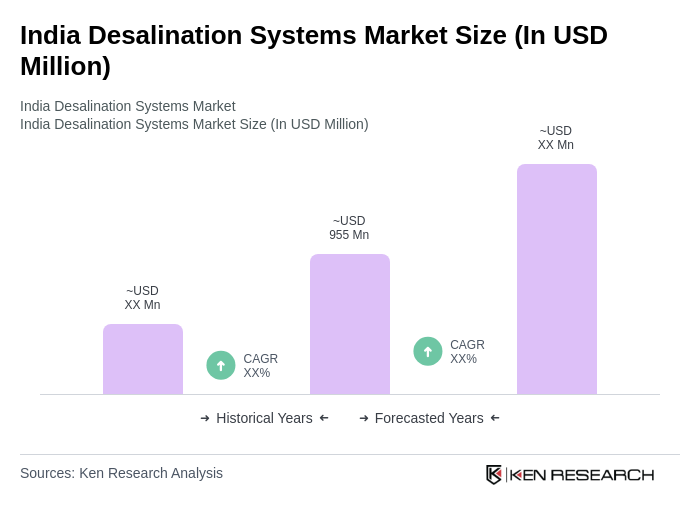
- The India Desalination Systems Market is valued at USD 955 million, based on a five-year historical analysis. This growth is primarily driven by increasing water scarcity, rapid urbanization, and the urgent need for sustainable water management solutions. The demand for desalination technologies has surged as cities and industries seek reliable sources of potable water, particularly in coastal regions where freshwater resources are limited. Large-scale investments in desalination infrastructure are being made to address water shortages in urban and industrial corridors, especially in coastal states .
- Key players in this market includeGujarat, Maharashtra, and Tamil Nadu, which dominate due to their extensive coastlines and high population densities. These regions face significant water stress, prompting investments in desalination infrastructure to meet the growing demand for clean water. The presence of industrial hubs and tourism in these states further accelerates the adoption of desalination technologies. Major urban centers such as Chennai and Mumbai are leading in the commissioning of large municipal desalination plants .
- The Indian government has strengthened its policy focus on desalination through initiatives under the National Water Policy, which emphasizes the importance of desalination as a viable solution to address water scarcity. This policy encourages investments in desalination projects and promotes the use of innovative technologies to enhance water supply, supporting the growth of the desalination systems market. Additionally, public-private partnerships and integration of renewable energy with desalination operations are emerging as key trends .
India Desalination Systems Market Segmentation
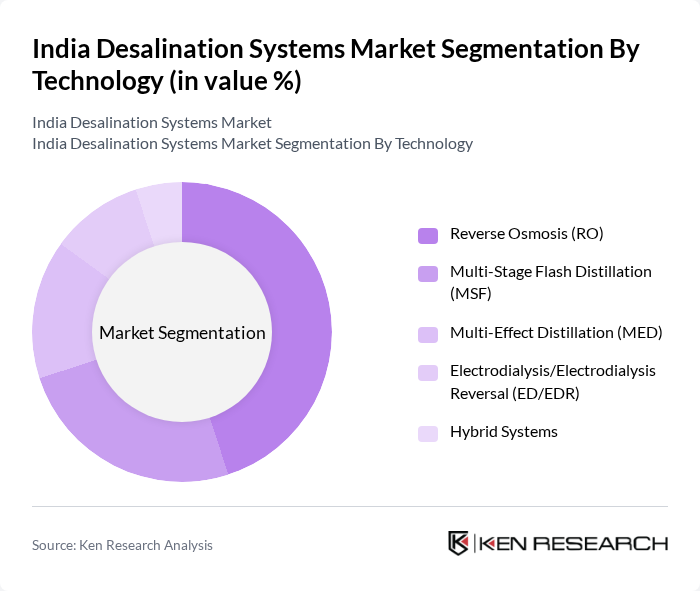
By Technology:The technology segment of the desalination systems market includes various methods such asReverse Osmosis (RO), Multi-Stage Flash Distillation (MSF), Multi-Effect Distillation (MED), Electrodialysis/Electrodialysis Reversal (ED/EDR), and Hybrid Systems. Among these,Reverse Osmosis (RO)is the most widely adopted technology due to its high energy efficiency, lower operational cost, and scalability. The increasing demand for freshwater in urban areas and industries has led to a significant rise in the installation of RO systems, making it the dominant technology in the market. Recent trends also highlight the growing adoption of hybrid and renewable energy-powered desalination systems to improve sustainability .
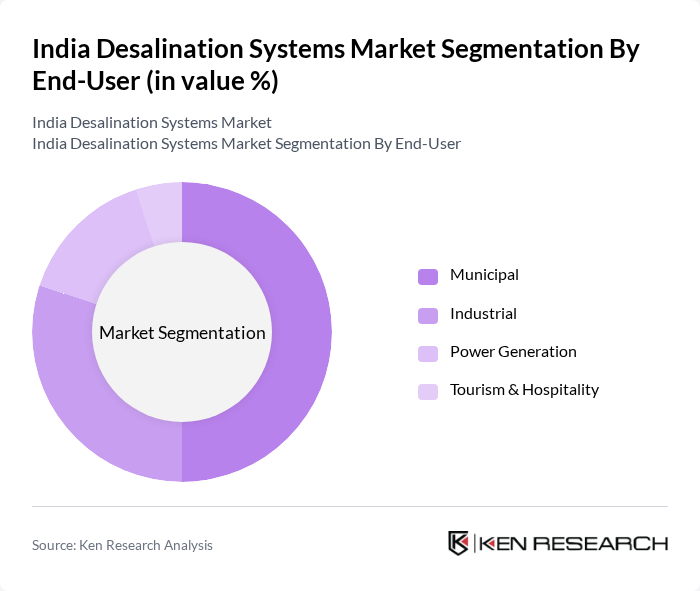
By End-User:The end-user segment encompassesMunicipal, Industrial, Power Generation, and Tourism & Hospitalitysectors. TheMunicipalsegment is the largest consumer of desalination systems, driven by the urgent need for potable water in urban areas. As cities expand and face water shortages, municipal authorities are increasingly investing in desalination plants to ensure a sustainable water supply for their populations. The industrial segment is also witnessing robust growth, particularly in coastal industrial corridors where process water demand is high. The adoption of desalination in power generation and tourism is rising, but these remain smaller segments compared to municipal and industrial users .
India Desalination Systems Market Competitive Landscape
The India Desalination Systems Market is characterized by a dynamic mix of regional and international players. Leading participants such as VA Tech Wabag Limited, Tata Projects Limited, L&T Construction (Larsen & Toubro), SUEZ Water Technologies & Solutions, IDE Technologies, Aquatech International LLC, Ion Exchange (India) Ltd., Thermax Limited, Veolia Water Technologies, Xylem Inc., Acciona Agua, Pentair plc, Aqualia, GE Water & Process Technologies (now SUEZ WTS), and Doosan Heavy Industries & Construction contribute to innovation, geographic expansion, and service delivery in this space. These companies are actively involved in large-scale municipal and industrial desalination projects, leveraging advanced technologies and public-private partnerships to expand their footprint in India .
India Desalination Systems Market Industry Analysis
Growth Drivers
- Increasing Water Scarcity:India faces severe water scarcity, with over 600 million people experiencing high to extreme water stress, according to the NITI Aayog. The demand for fresh water is projected to reach 1,500 billion cubic meters in future, while supply is only expected to be around 1,000 billion cubic meters. This gap drives the need for desalination systems, particularly in coastal regions where seawater is abundant, making desalination a viable solution to address the growing crisis.
- Government Initiatives and Funding:The Indian government has allocated approximately ?1,000 crore (around $120 million) for desalination projects under the National Water Mission. Initiatives like the Atal Mission for Rejuvenation and Urban Transformation (AMRUT) aim to enhance water supply infrastructure, including desalination plants. These efforts are crucial in promoting sustainable water management practices, thereby encouraging investments in desalination technologies across various states, particularly in water-scarce regions.
- Technological Advancements:The desalination industry in India is witnessing rapid technological advancements, with innovations such as reverse osmosis (RO) and solar desalination gaining traction. The cost of RO technology has decreased by approximately 30% in recent years, making it more accessible. Furthermore, the integration of energy-efficient systems is expected to reduce operational costs significantly, enhancing the feasibility of desalination projects and attracting more investments in the sector.
Market Challenges
- High Capital Investment:The initial capital investment for desalination plants is substantial, often exceeding ?500 crore (around $60 million) for medium-sized facilities. This high upfront cost poses a significant barrier to entry for many potential investors and operators. Additionally, securing financing can be challenging, particularly in a market where alternative water sources are often prioritized, limiting the growth of desalination projects despite their necessity.
- Environmental Concerns:Desalination processes can have adverse environmental impacts, including the discharge of brine, which can harm marine ecosystems. The Environmental Protection Act mandates strict compliance with environmental standards, which can complicate project approvals. In future, the Ministry of Environment, Forest and Climate Change reported that 40% of proposed desalination projects faced delays due to environmental assessments, highlighting the need for sustainable practices in the industry.
India Desalination Systems Market Future Outlook
The future of the India desalination systems market appears promising, driven by increasing water scarcity and supportive government policies. As urbanization accelerates, the demand for reliable water sources will intensify, prompting further investments in desalination technologies. Additionally, the integration of renewable energy sources and smart water management systems will enhance operational efficiency. The focus on sustainability will likely lead to innovative solutions that address environmental concerns while meeting the growing water needs of the population and industries.
Market Opportunities
- Expansion in Coastal Areas:Coastal regions in India, such as Gujarat and Tamil Nadu, present significant opportunities for desalination projects. With over 7,500 kilometers of coastline, these areas can leverage seawater for freshwater production. The government’s focus on developing coastal infrastructure further supports this expansion, potentially increasing the number of operational desalination plants by 20% in future.
- Partnerships with Private Sector:Collaborations between public and private sectors can enhance the development of desalination projects. The government is encouraging private investments through Public-Private Partnerships (PPP), which can reduce financial burdens and expedite project implementation. In future, the government announced plans to invite private players to invest in at least five new desalination plants, aiming to boost capacity and efficiency in water supply.
Scope of the Report
| Segment | Sub-Segments |
|---|---|
| By Technology | Reverse Osmosis (RO) Multi-Stage Flash Distillation (MSF) Multi-Effect Distillation (MED) Electrodialysis/Electrodialysis Reversal (ED/EDR) Hybrid Systems |
| By End-User | Municipal Industrial Power Generation Tourism & Hospitality |
| By Region | Gujarat Maharashtra Tamil Nadu Andhra Pradesh Other States |
| By Capacity | Small-scale Plants (<10 MLD) Medium-scale Plants (10–50 MLD) Large-scale Plants (>50 MLD) |
| By Application | Drinking Water Supply Industrial Processes Agricultural Irrigation Desalination for Power Generation |
| By Investment Source | Domestic Foreign Direct Investment (FDI) Public-Private Partnership (PPP) Government Schemes |
| By Energy Source | Conventional (Grid/Electricity) Solar-Powered Desalination Wind-Powered Desalination Hybrid Energy Systems |
Key Target Audience
Investors and Venture Capitalist Firms
Government and Regulatory Bodies (e.g., Ministry of Water Resources, Central Water Commission)
Manufacturers and Producers of Desalination Equipment
Water Utility Companies
Infrastructure Development Agencies
Environmental NGOs and Advocacy Groups
Industry Associations (e.g., Indian Desalination Association)
Financial Institutions and Banks
Players Mentioned in the Report:
VA Tech Wabag Limited
Tata Projects Limited
L&T Construction (Larsen & Toubro)
SUEZ Water Technologies & Solutions
IDE Technologies
Aquatech International LLC
Ion Exchange (India) Ltd.
Thermax Limited
Veolia Water Technologies
Xylem Inc.
Acciona Agua
Pentair plc
Aqualia
GE Water & Process Technologies (now SUEZ WTS)
Doosan Heavy Industries & Construction
Table of Contents
Market Assessment Phase
1. Executive Summary and Approach
2. India Desalination Systems Market Overview
2.1 Key Insights and Strategic Recommendations
2.2 India Desalination Systems Market Overview
2.3 Definition and Scope
2.4 Evolution of Market Ecosystem
2.5 Timeline of Key Regulatory Milestones
2.6 Value Chain & Stakeholder Mapping
2.7 Business Cycle Analysis
2.8 Policy & Incentive Landscape
3. India Desalination Systems Market Analysis
3.1 Growth Drivers
3.1.1 Increasing Water Scarcity
3.1.2 Government Initiatives and Funding
3.1.3 Technological Advancements
3.1.4 Rising Demand from Industrial Sector
3.2 Market Challenges
3.2.1 High Capital Investment
3.2.2 Environmental Concerns
3.2.3 Operational Costs
3.2.4 Regulatory Hurdles
3.3 Market Opportunities
3.3.1 Expansion in Coastal Areas
3.3.2 Partnerships with Private Sector
3.3.3 Innovations in Energy Efficiency
3.3.4 Export Potential
3.4 Market Trends
3.4.1 Adoption of Renewable Energy Sources
3.4.2 Smart Water Management Systems
3.4.3 Increased Focus on Sustainability
3.4.4 Integration of IoT in Desalination
3.5 Government Regulation
3.5.1 National Water Policy
3.5.2 Environmental Protection Act
3.5.3 Coastal Regulation Zone Notification
3.5.4 Desalination Plant Guidelines
4. SWOT Analysis
5. Stakeholder Analysis
6. Porter's Five Forces Analysis
7. India Desalination Systems Market Market Size, 2019-2024
7.1 By Value
7.2 By Volume
7.3 By Average Selling Price
8. India Desalination Systems Market Segmentation
8.1 By Technology
8.1.1 Reverse Osmosis (RO)
8.1.2 Multi-Stage Flash Distillation (MSF)
8.1.3 Multi-Effect Distillation (MED)
8.1.4 Electrodialysis/Electrodialysis Reversal (ED/EDR)
8.1.5 Hybrid Systems
8.2 By End-User
8.2.1 Municipal
8.2.2 Industrial
8.2.3 Power Generation
8.2.4 Tourism & Hospitality
8.3 By Region
8.3.1 Gujarat
8.3.2 Maharashtra
8.3.3 Tamil Nadu
8.3.4 Andhra Pradesh
8.3.5 Other States
8.4 By Capacity
8.4.1 Small-scale Plants (<10 MLD)
8.4.2 Medium-scale Plants (10–50 MLD)
8.4.3 Large-scale Plants (>50 MLD)
8.5 By Application
8.5.1 Drinking Water Supply
8.5.2 Industrial Processes
8.5.3 Agricultural Irrigation
8.5.4 Desalination for Power Generation
8.6 By Investment Source
8.6.1 Domestic
8.6.2 Foreign Direct Investment (FDI)
8.6.3 Public-Private Partnership (PPP)
8.6.4 Government Schemes
8.7 By Energy Source
8.7.1 Conventional (Grid/Electricity)
8.7.2 Solar-Powered Desalination
8.7.3 Wind-Powered Desalination
8.7.4 Hybrid Energy Systems
9. India Desalination Systems Market Competitive Analysis
9.1 Market Share of Key Players
9.2 KPIs for Cross Comparison of Key Players
9.2.1 Total Installed Desalination Capacity (MLD)
9.2.2 Number of Operational Plants in India
9.2.3 Revenue from Desalination Projects (INR Crore/USD Million)
9.2.4 Market Share (%)
9.2.5 Average Plant Efficiency (kWh/m³)
9.2.6 Project Delivery Timelines (Months)
9.2.7 Technology Portfolio Breadth
9.2.8 R&D/Innovation Investment (% of Revenue)
9.2.9 Major Public-Private Partnerships/Contracts Secured
9.2.10 Customer Base Diversification (Municipal/Industrial/Other)
9.3 SWOT Analysis of Top Players
9.4 Pricing Analysis
9.5 List of Major Companies
9.5.1 VA Tech Wabag Limited
9.5.2 Tata Projects Limited
9.5.3 L&T Construction (Larsen & Toubro)
9.5.4 SUEZ Water Technologies & Solutions
9.5.5 IDE Technologies
9.5.6 Aquatech International LLC
9.5.7 Ion Exchange (India) Ltd.
9.5.8 Thermax Limited
9.5.9 Veolia Water Technologies
9.5.10 Xylem Inc.
9.5.11 Acciona Agua
9.5.12 Pentair plc
9.5.13 Aqualia
9.5.14 GE Water & Process Technologies (now SUEZ WTS)
9.5.15 Doosan Heavy Industries & Construction
10. India Desalination Systems Market End-User Analysis
10.1 Procurement Behavior of Key Ministries
10.1.1 Ministry of Water Resources
10.1.2 Ministry of Environment, Forest and Climate Change
10.1.3 Ministry of Urban Development
10.2 Corporate Spend on Infrastructure & Energy
10.2.1 Investment Trends in Desalination
10.2.2 Budget Allocations for Water Projects
10.2.3 Corporate Social Responsibility Initiatives
10.3 Pain Point Analysis by End-User Category
10.3.1 Water Quality Issues
10.3.2 Supply Chain Disruptions
10.3.3 Cost Management Challenges
10.4 User Readiness for Adoption
10.4.1 Awareness of Desalination Benefits
10.4.2 Financial Readiness
10.4.3 Technical Capability
10.5 Post-Deployment ROI and Use Case Expansion
10.5.1 Performance Metrics
10.5.2 Case Studies of Successful Implementations
10.5.3 Future Expansion Plans
11. India Desalination Systems Market Future Size, 2025-2030
11.1 By Value
11.2 By Volume
11.3 By Average Selling Price
Go-To-Market Strategy Phase
1. Whitespace Analysis + Business Model Canvas
1.1 Market Gaps Identification
1.2 Business Model Framework
2. Marketing and Positioning Recommendations
2.1 Branding Strategies
2.2 Product USPs
3. Distribution Plan
3.1 Urban Retail vs Rural NGO Tie-ups
4. Channel & Pricing Gaps
4.1 Underserved Routes
4.2 Pricing Bands
5. Unmet Demand & Latent Needs
5.1 Category Gaps
5.2 Consumer Segments
6. Customer Relationship
6.1 Loyalty Programs
6.2 After-sales Service
7. Value Proposition
7.1 Sustainability
7.2 Integrated Supply Chains
8. Key Activities
8.1 Regulatory Compliance
8.2 Branding
8.3 Distribution Setup
9. Entry Strategy Evaluation
9.1 Domestic Market Entry Strategy
9.1.1 Product Mix
9.1.2 Pricing Band
9.1.3 Packaging
9.2 Export Entry Strategy
9.2.1 Target Countries
9.2.2 Compliance Roadmap
10. Entry Mode Assessment
10.1 JV, Greenfield, M&A, Distributor Model
11. Capital and Timeline Estimation
11.1 Capital Requirements
11.2 Timelines
12. Control vs Risk Trade-Off
12.1 Ownership vs Partnerships
13. Profitability Outlook
13.1 Breakeven Analysis
13.2 Long-term Sustainability
14. Potential Partner List
14.1 Distributors
14.2 JVs
14.3 Acquisition Targets
15. Execution Roadmap
15.1 Phased Plan for Market Entry
15.1.1 Market Setup
15.1.2 Market Entry
15.1.3 Growth Acceleration
15.1.4 Scale & Stabilize
15.2 Key Activities and Milestones
15.2.1 Milestone Planning
15.2.2 Activity Tracking
Research Methodology
Phase 1: Approach1
Desk Research
- Analysis of government reports on water scarcity and desalination initiatives in India
- Review of industry publications and market reports from relevant trade associations
- Examination of academic journals focusing on desalination technologies and their applications
Primary Research
- Interviews with key stakeholders in the desalination industry, including technology providers and project developers
- Surveys conducted with municipal water authorities and private sector water management firms
- Field visits to operational desalination plants to gather firsthand insights on technology and processes
Validation & Triangulation
- Cross-validation of data from multiple sources, including government statistics and industry reports
- Triangulation of findings from primary interviews with secondary data to ensure consistency
- Sanity checks through expert panel discussions with industry veterans and academic researchers
Phase 2: Market Size Estimation1
Top-down Assessment
- Estimation of total addressable market based on national water demand and supply gaps
- Segmentation of market size by technology type (reverse osmosis, multi-effect distillation, etc.)
- Incorporation of government policies and funding initiatives aimed at promoting desalination
Bottom-up Modeling
- Collection of operational data from existing desalination plants to establish performance benchmarks
- Cost analysis based on technology deployment, maintenance, and operational expenses
- Volume estimates based on projected water demand in coastal regions and urban centers
Forecasting & Scenario Analysis
- Development of predictive models using historical growth rates and future water demand projections
- Scenario analysis based on varying levels of investment and technological advancements
- Creation of baseline, optimistic, and pessimistic forecasts through 2035
Phase 3: CATI Sample Composition1
| Scope Item/Segment | Sample Size | Target Respondent Profiles |
|---|---|---|
| Municipal Water Authorities | 100 | Water Resource Managers, Policy Makers |
| Desalination Technology Providers | 60 | Product Development Engineers, Sales Directors |
| Private Sector Water Management Firms | 50 | Operations Managers, Business Development Executives |
| Environmental NGOs | 40 | Sustainability Advocates, Research Analysts |
| Academic Researchers in Water Technology | 45 | Professors, Research Fellows |
Frequently Asked Questions
What is the current value of the India Desalination Systems Market?
The India Desalination Systems Market is valued at approximately USD 955 million, driven by increasing water scarcity, rapid urbanization, and the need for sustainable water management solutions, particularly in coastal regions with limited freshwater resources.
Which states in India are leading in desalination systems?
What technologies are commonly used in desalination systems in India?
What are the main drivers of growth in the India Desalination Systems Market?
Other Regional/Country Reports
Indonesia Desalination Systems Market
Malaysia Desalination Systems Market
KSA Desalination Systems Market
APAC Desalination Systems Market
SEA Desalination Systems Market
Vietnam Desalination Systems Market
Why Buy From Us?

What makes us stand out is that our consultants follow Robust, Refine and Result (RRR) methodology. Robust for clear definitions, approaches and sanity checking, Refine for differentiating respondents' facts and opinions, and Result for presenting data with story.

We have set a benchmark in the industry by offering our clients with syndicated and customized market research reports featuring coverage of entire market as well as meticulous research and analyst insights.

While we don't replace traditional research, we flip the method upside down. Our dual approach of Top Bottom & Bottom Top ensures quality deliverable by not just verifying company fundamentals but also looking at the sector and macroeconomic factors.

With one step in the future, our research team constantly tries to show you the bigger picture. We help with some of the tough questions you may encounter along the way: How is the industry positioned? Best marketing channel? KPI's of competitors? By aligning every element, we help maximize success.

Our report gives you instant access to the answers and sources that other companies might choose to hide. We elaborate each steps of research methodology we have used and showcase you the sample size to earn your trust.

If you need any support, we are here! We pride ourselves on universe strength, data quality, and quick, friendly, and professional service.