About the Report
Base Year 2024Listen to the audio summary
India Hybrid Vehicles Market Overview
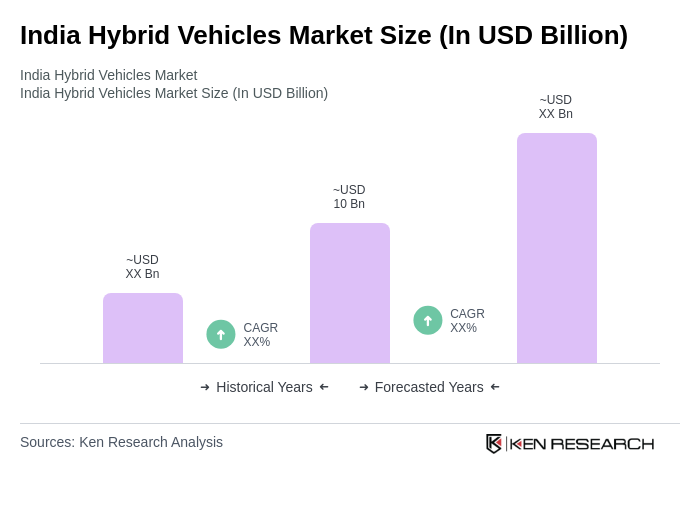
- The India Hybrid Vehicles Market is valued at USD 10 billion, based on a five-year historical analysis. This value aligns with recent industry reporting that places the market around USD 10.30 billion, reflecting strong adoption of strong-hybrid (HEV) models in passenger vehicles. Growth is driven by rising fuel prices, stricter emissions norms (e.g., BS6 Phase II), and consumer preference for improved fuel efficiency and lower total cost of ownership, alongside growing availability of strong-hybrid models from leading OEMs.
- Key demand centers include major urban markets such as Delhi NCR, Mumbai Metropolitan Region, and Bengaluru, where high population density and pollution concerns drive adoption of cleaner vehicle technologies; state-level incentives like registration fee waivers for strong hybrids (e.g., Uttar Pradesh) and urban policy focus on air quality have further supported city-led uptake.
- In 2023, the Indian government continued its transition from FAME II to newer targeted schemes; while the Faster Adoption and Manufacturing of Hybrid and Electric Vehicles program historically supported electrification, subsequent measures like EMPS 2024 focused on two- and three-wheelers and excluded electric passenger vehicles, and strong-hybrids do not receive central purchase subsidies; however, select state incentives (e.g., registration relief) have benefited strong hybrids.
India Hybrid Vehicles Market Segmentation
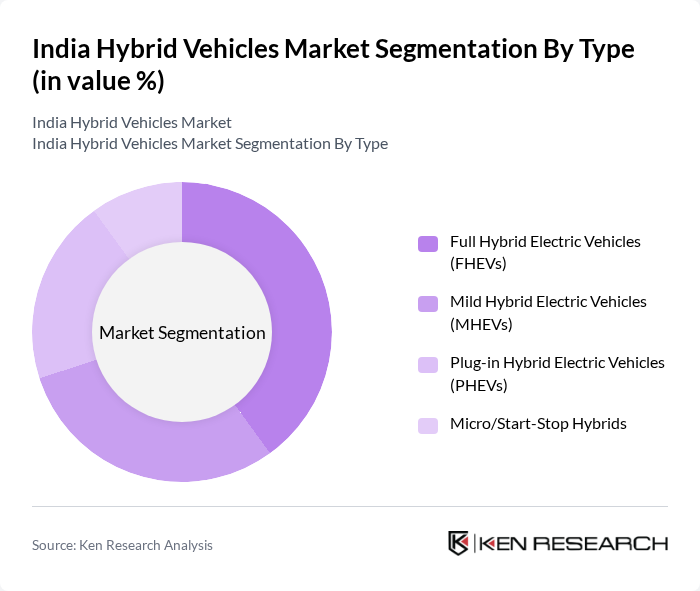
By Type:The hybrid vehicles market can be segmented into various types, including Full Hybrid Electric Vehicles (FHEVs), Mild Hybrid Electric Vehicles (MHEVs), Plug-in Hybrid Electric Vehicles (PHEVs), and Micro/Start-Stop Hybrids. Each of these sub-segments caters to different consumer needs and preferences, with varying levels of hybridization and electric assistance.
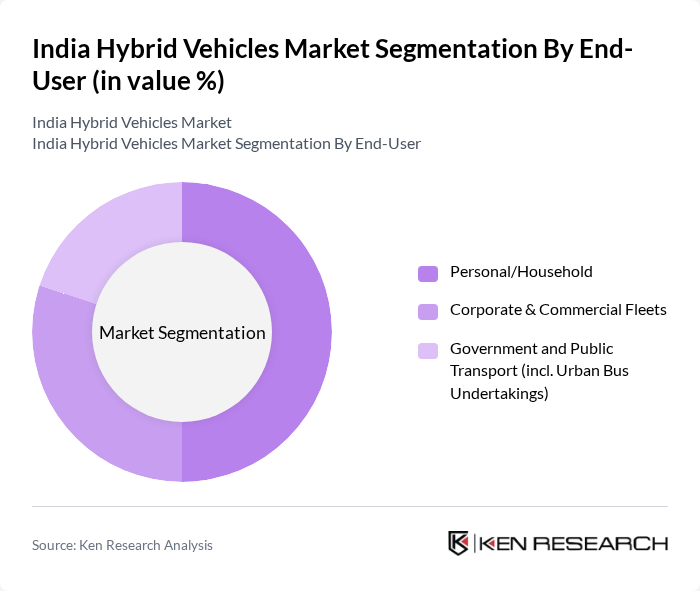
By End-User:The end-user segmentation includes Personal/Household, Corporate & Commercial Fleets, and Government and Public Transport (including Urban Bus Undertakings). Each segment reflects different usage patterns and purchasing motivations, with personal users often prioritizing fuel efficiency and environmental impact, while corporate fleets focus on cost savings and sustainability.
India Hybrid Vehicles Market Competitive Landscape
The India Hybrid Vehicles Market is characterized by a dynamic mix of regional and international players. Leading participants such as Toyota Kirloskar Motor Pvt. Ltd., Maruti Suzuki India Ltd., Honda Cars India Ltd., Hyundai Motor India Ltd., Kia India Pvt. Ltd., Tata Motors Ltd., Mahindra & Mahindra Ltd., MG Motor India Pvt. Ltd., BYD India Pvt. Ltd., Nissan Motor India Pvt. Ltd., Volkswagen India Pvt. Ltd., Skoda Auto Volkswagen India Pvt. Ltd., BMW India Pvt. Ltd., Mercedes-Benz India Pvt. Ltd., Audi India Pvt. Ltd. contribute to innovation, geographic expansion, and service delivery in this space.
India Hybrid Vehicles Market Industry Analysis
Growth Drivers
- Increasing Environmental Awareness:The Indian government reported a 30% increase in public awareness regarding environmental issues from 2020 to 2023. This growing consciousness has led to a surge in demand for hybrid vehicles, as consumers seek eco-friendly alternatives. The Ministry of Environment, Forest and Climate Change noted that urban air pollution levels reached 123 µg/m³ in future, prompting citizens to consider cleaner transportation options. This trend is expected to continue driving hybrid vehicle adoption in India.
- Government Incentives and Subsidies:The Indian government approved total outlay of ?100 billion (approximately $1.2 billion) for the FAME II scheme in future, aimed at promoting electric and hybrid vehicles. This initiative provides substantial subsidies for consumers purchasing hybrid vehicles, making them more financially accessible. Additionally, various state governments have introduced their own incentives, further enhancing the attractiveness of hybrid vehicles. These financial supports are crucial in stimulating market growth and encouraging consumer adoption.
- Technological Advancements in Battery Technology:The battery technology landscape in India has seen significant advancements, with lithium-ion battery costs dropping by 90% since 2010. In future, the average cost of lithium-ion batteries was around ?10,000 ($120) per kWh, making hybrid vehicles more affordable. Furthermore, research institutions are developing solid-state batteries, which promise higher efficiency and safety. These innovations are expected to enhance the performance and appeal of hybrid vehicles, driving market growth.
Market Challenges
- High Initial Costs:Despite government incentives, the initial purchase price of hybrid vehicles remains a significant barrier. In future, the average cost of a hybrid vehicle in India was approximately ?2.5 million ($30,000), which is considerably higher than conventional vehicles. This price disparity discourages many potential buyers, particularly in a price-sensitive market. As a result, manufacturers must find ways to reduce costs to enhance market penetration and consumer acceptance.
- Limited Charging Infrastructure:As of future, India had only about 1,800 public charging stations for electric and hybrid vehicles, which is insufficient for a country with over 1.4 billion people. This lack of infrastructure creates range anxiety among consumers, deterring them from purchasing hybrid vehicles. The government aims to increase this number significantly, but the current shortfall remains a critical challenge that must be addressed to facilitate market growth.
India Hybrid Vehicles Market Future Outlook
The future of the hybrid vehicle market in India appears promising, driven by increasing environmental awareness and supportive government policies. As urbanization accelerates, the demand for sustainable transportation solutions will likely rise. Additionally, advancements in battery technology and the expansion of charging infrastructure are expected to enhance the viability of hybrid vehicles. With ongoing collaborations between automakers and technology firms, the market is poised for significant growth, aligning with global sustainability goals and consumer preferences for greener options.
Market Opportunities
- Expansion of Charging Networks:The Indian government plans to increase the number of public charging stations to 10,000 by future. This expansion will alleviate range anxiety and encourage more consumers to consider hybrid vehicles. Enhanced charging infrastructure will also support the growth of electric vehicles, creating a more robust market ecosystem for hybrid solutions.
- Growth in E-commerce Delivery Vehicles:The e-commerce sector in India is projected to reach ?7.5 trillion ($90 billion) by future. This growth presents a significant opportunity for hybrid vehicles in last-mile delivery services. Companies are increasingly adopting hybrid solutions to reduce operational costs and meet sustainability goals, thereby driving demand in this segment.
Scope of the Report
| Segment | Sub-Segments |
|---|---|
| By Type | Full Hybrid Electric Vehicles (FHEVs) Mild Hybrid Electric Vehicles (MHEVs) Plug-in Hybrid Electric Vehicles (PHEVs) Micro/Start-Stop Hybrids |
| By End-User | Personal/Household Corporate & Commercial Fleets Government and Public Transport (incl. Urban Bus Undertakings) |
| By Region | North India South India East India West India |
| By Vehicle Size | Hatchbacks & Compact Cars Sedans SUVs & MPVs Buses and Light Commercial Vehicles |
| By Fuel Type | Petrol Hybrid Diesel Hybrid CNG Hybrid |
| By Sales Channel | Franchised Dealerships Company-Owned Showrooms Online/Digital Retail |
| By Price Range | Entry (INR 8–15 lakh) Mid (INR 15–30 lakh) Premium (INR 30–60 lakh) Luxury (Above INR 60 lakh) |
Key Target Audience
Investors and Venture Capitalist Firms
Government and Regulatory Bodies (e.g., Ministry of Heavy Industries and Public Enterprises, Ministry of Road Transport and Highways)
Automobile Manufacturers and Producers
Battery Manufacturers and Suppliers
Charging Infrastructure Providers
Automotive Component Suppliers
Industry Associations (e.g., Society of Indian Automobile Manufacturers)
Financial Institutions and Banks
Players Mentioned in the Report:
Toyota Kirloskar Motor Pvt. Ltd.
Maruti Suzuki India Ltd.
Honda Cars India Ltd.
Hyundai Motor India Ltd.
Kia India Pvt. Ltd.
Tata Motors Ltd.
Mahindra & Mahindra Ltd.
MG Motor India Pvt. Ltd.
BYD India Pvt. Ltd.
Nissan Motor India Pvt. Ltd.
Volkswagen India Pvt. Ltd.
Skoda Auto Volkswagen India Pvt. Ltd.
BMW India Pvt. Ltd.
Mercedes-Benz India Pvt. Ltd.
Audi India Pvt. Ltd.
Table of Contents
Market Assessment Phase
1. Executive Summary and Approach
2. India Hybrid Vehicles Market Overview
2.1 Key Insights and Strategic Recommendations
2.2 India Hybrid Vehicles Market Overview
2.3 Definition and Scope
2.4 Evolution of Market Ecosystem
2.5 Timeline of Key Regulatory Milestones
2.6 Value Chain & Stakeholder Mapping
2.7 Business Cycle Analysis
2.8 Policy & Incentive Landscape
3. India Hybrid Vehicles Market Analysis
3.1 Growth Drivers
3.1.1 Increasing Environmental Awareness
3.1.2 Government Incentives and Subsidies
3.1.3 Rising Fuel Prices
3.1.4 Technological Advancements in Battery Technology
3.2 Market Challenges
3.2.1 High Initial Costs
3.2.2 Limited Charging Infrastructure
3.2.3 Consumer Awareness and Acceptance
3.2.4 Regulatory Hurdles
3.3 Market Opportunities
3.3.1 Expansion of Charging Networks
3.3.2 Collaborations with Tech Companies
3.3.3 Growth in E-commerce Delivery Vehicles
3.3.4 Increasing Urbanization
3.4 Market Trends
3.4.1 Shift Towards Electric and Hybrid Solutions
3.4.2 Integration of Smart Technologies
3.4.3 Focus on Sustainability and Green Initiatives
3.4.4 Rise of Shared Mobility Solutions
3.5 Government Regulation
3.5.1 FAME India Scheme
3.5.2 BS-VI Emission Norms
3.5.3 National Electric Mobility Mission Plan
3.5.4 State-Level Incentives
4. SWOT Analysis
5. Stakeholder Analysis
6. Porter's Five Forces Analysis
7. India Hybrid Vehicles Market Market Size, 2019-2024
7.1 By Value
7.2 By Volume
7.3 By Average Selling Price
8. India Hybrid Vehicles Market Segmentation
8.1 By Type
8.1.1 Full Hybrid Electric Vehicles (FHEVs)
8.1.2 Mild Hybrid Electric Vehicles (MHEVs)
8.1.3 Plug-in Hybrid Electric Vehicles (PHEVs)
8.1.4 Micro/Start-Stop Hybrids
8.2 By End-User
8.2.1 Personal/Household
8.2.2 Corporate & Commercial Fleets
8.2.3 Government and Public Transport (incl. Urban Bus Undertakings)
8.3 By Region
8.3.1 North India
8.3.2 South India
8.3.3 East India
8.3.4 West India
8.4 By Vehicle Size
8.4.1 Hatchbacks & Compact Cars
8.4.2 Sedans
8.4.3 SUVs & MPVs
8.4.4 Buses and Light Commercial Vehicles
8.5 By Fuel Type
8.5.1 Petrol Hybrid
8.5.2 Diesel Hybrid
8.5.3 CNG Hybrid
8.6 By Sales Channel
8.6.1 Franchised Dealerships
8.6.2 Company-Owned Showrooms
8.6.3 Online/Digital Retail
8.7 By Price Range
8.7.1 Entry (INR 8–15 lakh)
8.7.2 Mid (INR 15–30 lakh)
8.7.3 Premium (INR 30–60 lakh)
8.7.4 Luxury (Above INR 60 lakh)
9. India Hybrid Vehicles Market Competitive Analysis
9.1 Market Share of Key Players
9.2 Cross Comparison of Key Players
9.2.1 Company Name
9.2.2 Hybrid Portfolio Breadth (No. of HEV/PHEV/MHEV models on sale)
9.2.3 Annual Hybrid Sales in India (Units)
9.2.4 Hybrid Revenue Share in India (%)
9.2.5 Market Penetration (Hybrid share of OEM’s total India PV sales, %)
9.2.6 Average Fuel-Economy Improvement vs ICE (%)
9.2.7 Battery/Motor Sourcing (In-house, JV, or Imported)
9.2.8 Localisation Level of Hybrid Components (%)
9.2.9 Average Transaction Price for Hybrids (INR lakh)
9.2.10 Network Coverage (No. of cities/dealerships offering hybrids)
9.2.11 After-sales Coverage (No. of service bays certified for hybrids)
9.2.12 R&D/Capex in Electrified Powertrains (INR crore, annual)
9.2.13 Warranty Terms on Hybrid Systems (years/km)
9.2.14 CO2 Emissions Reduction vs Segment Baseline (%)
9.3 SWOT Analysis of Top Players
9.4 Pricing Analysis
9.5 Detailed Profile of Major Companies
9.5.1 Toyota Kirloskar Motor Pvt. Ltd.
9.5.2 Maruti Suzuki India Ltd.
9.5.3 Honda Cars India Ltd.
9.5.4 Hyundai Motor India Ltd.
9.5.5 Kia India Pvt. Ltd.
9.5.6 Tata Motors Ltd.
9.5.7 Mahindra & Mahindra Ltd.
9.5.8 MG Motor India Pvt. Ltd.
9.5.9 BYD India Pvt. Ltd.
9.5.10 Nissan Motor India Pvt. Ltd.
9.5.11 Volkswagen India Pvt. Ltd.
9.5.12 Skoda Auto Volkswagen India Pvt. Ltd.
9.5.13 BMW India Pvt. Ltd.
9.5.14 Mercedes-Benz India Pvt. Ltd.
9.5.15 Audi India Pvt. Ltd.
10. India Hybrid Vehicles Market End-User Analysis
10.1 Procurement Behavior of Key Ministries
10.1.1 Government Fleet Purchases
10.1.2 Policy Compliance Requirements
10.1.3 Budget Allocation Trends
10.2 Corporate Spend on Infrastructure & Energy
10.2.1 Investment in Charging Infrastructure
10.2.2 Corporate Sustainability Initiatives
10.2.3 Partnerships with Hybrid Vehicle Manufacturers
10.3 Pain Point Analysis by End-User Category
10.3.1 Cost of Ownership
10.3.2 Maintenance and Service Availability
10.3.3 Technology Familiarity
10.4 User Readiness for Adoption
10.4.1 Awareness of Hybrid Technology
10.4.2 Financial Incentives
10.4.3 Infrastructure Accessibility
10.5 Post-Deployment ROI and Use Case Expansion
10.5.1 Performance Metrics Tracking
10.5.2 Expansion into New Use Cases
10.5.3 Long-term Cost Savings Analysis
11. India Hybrid Vehicles Market Future Size, 2025-2030
11.1 By Value
11.2 By Volume
11.3 By Average Selling Price
Go-To-Market Strategy Phase
1. Whitespace Analysis + Business Model Canvas
1.1 Market Gaps Identification
1.2 Business Model Framework
2. Marketing and Positioning Recommendations
2.1 Branding Strategies
2.2 Product USPs
3. Distribution Plan
3.1 Urban Retail vs Rural NGO Tie-ups
4. Channel & Pricing Gaps
4.1 Underserved Routes
4.2 Pricing Bands
5. Unmet Demand & Latent Needs
5.1 Category Gaps
5.2 Consumer Segments
6. Customer Relationship
6.1 Loyalty Programs
6.2 After-sales Service
7. Value Proposition
7.1 Sustainability
7.2 Integrated Supply Chains
8. Key Activities
8.1 Regulatory Compliance
8.2 Branding
8.3 Distribution Setup
9. Entry Strategy Evaluation
9.1 Domestic Market Entry Strategy
9.1.1 Product Mix
9.1.2 Pricing Band
9.1.3 Packaging
9.2 Export Entry Strategy
9.2.1 Target Countries
9.2.2 Compliance Roadmap
10. Entry Mode Assessment
10.1 JV
10.2 Greenfield
10.3 M&A
10.4 Distributor Model
11. Capital and Timeline Estimation
11.1 Capital Requirements
11.2 Timelines
12. Control vs Risk Trade-Off
12.1 Ownership vs Partnerships
13. Profitability Outlook
13.1 Breakeven Analysis
13.2 Long-term Sustainability
14. Potential Partner List
14.1 Distributors
14.2 JVs
14.3 Acquisition Targets
15. Execution Roadmap
15.1 Phased Plan for Market Entry
15.1.1 Market Setup
15.1.2 Market Entry
15.1.3 Growth Acceleration
15.1.4 Scale & Stabilize
15.2 Key Activities and Milestones
15.2.1 Activity Timeline
15.2.2 Milestone Tracking
Research Methodology
Phase 1: Approach1
Desk Research
- Analysis of government reports on hybrid vehicle adoption and policies
- Review of industry publications and market analysis reports from automotive associations
- Examination of academic journals focusing on hybrid technology advancements and market trends
Primary Research
- Interviews with automotive industry experts and analysts specializing in hybrid vehicles
- Surveys conducted with consumers to gauge preferences and awareness of hybrid vehicles
- Field interviews with dealership managers to understand sales dynamics and customer feedback
Validation & Triangulation
- Cross-validation of data from multiple sources including government, industry, and consumer insights
- Triangulation of findings from expert interviews and survey results to ensure consistency
- Sanity checks through expert panel reviews to validate assumptions and projections
Phase 2: Market Size Estimation1
Top-down Assessment
- Estimation of total addressable market based on national vehicle sales data and hybrid penetration rates
- Segmentation of market size by vehicle type (e.g., passenger cars, commercial vehicles)
- Incorporation of government incentives and subsidies impacting hybrid vehicle adoption
Bottom-up Modeling
- Collection of sales data from leading hybrid vehicle manufacturers in India
- Estimation of average selling prices and volume sold across different segments
- Analysis of production costs and profit margins to assess market viability
Forecasting & Scenario Analysis
- Multi-factor regression analysis incorporating economic indicators and consumer behavior trends
- Scenario modeling based on potential regulatory changes and technological advancements
- Development of baseline, optimistic, and pessimistic forecasts through 2030
Phase 3: CATI Sample Composition1
| Scope Item/Segment | Sample Size | Target Respondent Profiles |
|---|---|---|
| Consumer Awareness of Hybrid Vehicles | 150 | Car Owners, Potential Buyers |
| Dealership Insights on Hybrid Sales | 100 | Sales Managers, Dealership Owners |
| Government Policy Impact Assessment | 80 | Policy Makers, Regulatory Officials |
| Expert Opinions on Hybrid Technology | 60 | Automotive Engineers, Industry Analysts |
| Market Trends and Consumer Preferences | 120 | Market Researchers, Automotive Consultants |
Frequently Asked Questions
What is the current value of the India Hybrid Vehicles Market?
The India Hybrid Vehicles Market is valued at approximately USD 10 billion, reflecting strong adoption of hybrid models, particularly strong-hybrids, driven by rising fuel prices and stricter emissions norms.
What factors are driving the growth of hybrid vehicles in India?
Which regions in India are the primary demand centers for hybrid vehicles?
What types of hybrid vehicles are available in the Indian market?
Other Regional/Country Reports
Indonesia Hybrid Vehicles Market
Malaysia Hybrid Vehicles Market
KSA Hybrid Vehicles Market
APAC Hybrid Vehicles Market
SEA Hybrid Vehicles Market
Vietnam Hybrid Vehicles Market
Why Buy From Us?

What makes us stand out is that our consultants follow Robust, Refine and Result (RRR) methodology. Robust for clear definitions, approaches and sanity checking, Refine for differentiating respondents' facts and opinions, and Result for presenting data with story.

We have set a benchmark in the industry by offering our clients with syndicated and customized market research reports featuring coverage of entire market as well as meticulous research and analyst insights.

While we don't replace traditional research, we flip the method upside down. Our dual approach of Top Bottom & Bottom Top ensures quality deliverable by not just verifying company fundamentals but also looking at the sector and macroeconomic factors.

With one step in the future, our research team constantly tries to show you the bigger picture. We help with some of the tough questions you may encounter along the way: How is the industry positioned? Best marketing channel? KPI's of competitors? By aligning every element, we help maximize success.

Our report gives you instant access to the answers and sources that other companies might choose to hide. We elaborate each steps of research methodology we have used and showcase you the sample size to earn your trust.

If you need any support, we are here! We pride ourselves on universe strength, data quality, and quick, friendly, and professional service.