About the Report
Base Year 2024Listen to the audio summary
India Maize Seed Market Overview
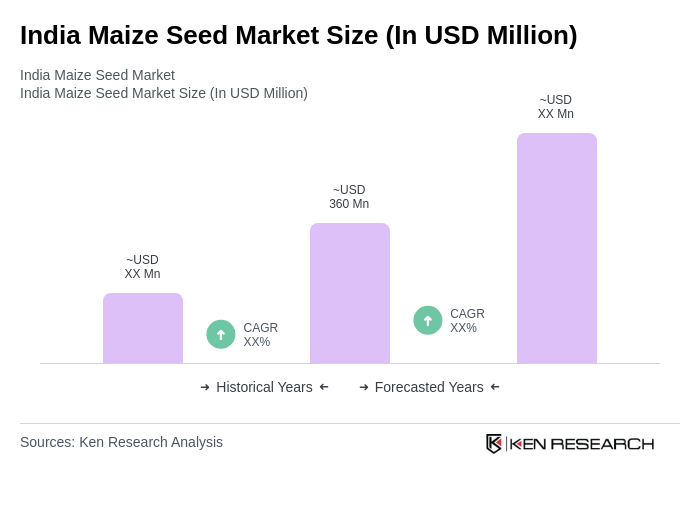
- The India Maize Seed Market is valued at USD 360 million, based on a five-year historical analysis. This growth is primarily driven by the increasing demand for maize as a staple food, animal feed, and for industrial uses such as ethanol production. The rise in population, urbanization, and the expansion of the food processing and animal feed sectors have led to a surge in maize consumption. Additionally, advancements in agricultural practices, adoption of hybrid seeds, and biotechnology integration are further supporting market growth .
- Key regions dominating the market include Karnataka, Madhya Pradesh, Maharashtra, Rajasthan, Bihar, Uttar Pradesh, Telangana, Gujarat, and Tamil Nadu, which collectively account for the majority of maize cultivation in India. These states benefit from favorable agro-climatic conditions, robust agricultural infrastructure, and a high concentration of farmers adopting modern seed technologies, contributing to their market dominance .
- Recent government initiatives have focused on enhancing seed quality and availability, with policies promoting the use of certified seeds and supporting research and development in seed technology. These efforts aim to ensure that farmers have access to high-quality maize seeds, thereby improving yield and productivity .
India Maize Seed Market Segmentation
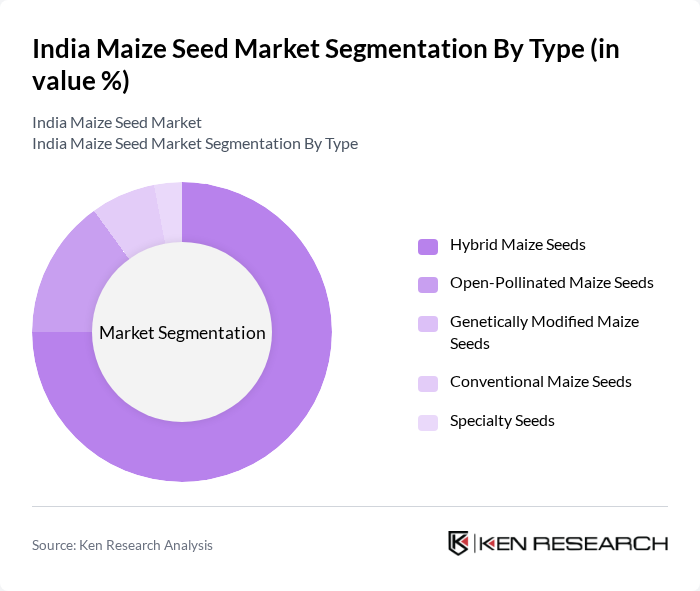
By Type:The maize seed market is segmented into Hybrid Maize Seeds, Open-Pollinated Maize Seeds, and Conventional Maize Seeds. Hybrid Maize Seeds dominate the market due to their higher yield potential, adaptability to diverse agro-climatic zones, and resistance to pests and diseases. Open-pollinated varieties are traditionally grown in specific regions and are preferred for their adaptability to local conditions, though they offer lower yields compared to hybrids. Genetically modified maize seeds are not commercially cultivated in India due to regulatory restrictions, while specialty seeds represent a niche segment focused on specific end-use traits .
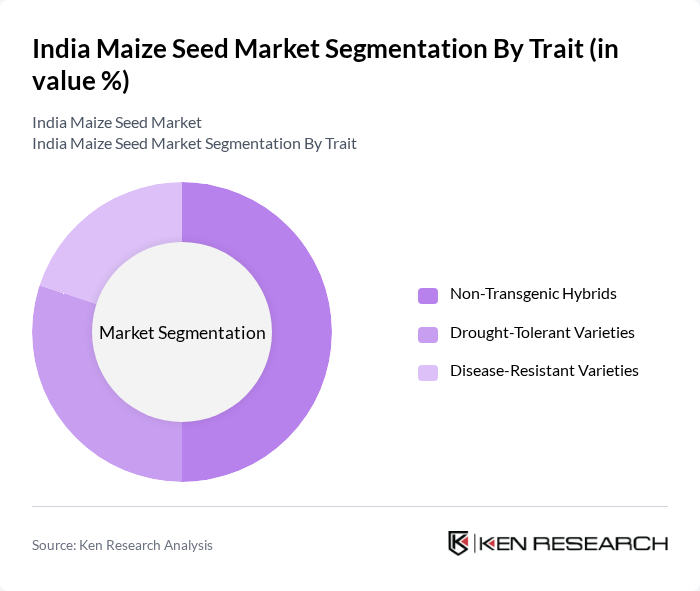
By Trait:The maize seed market is also segmented by trait, including Non-Transgenic Hybrids, Drought-Tolerant Varieties, and Disease-Resistant Varieties. Non-transgenic hybrids are the most widely adopted, driven by regulatory policies and consumer preference. Drought-tolerant and disease-resistant varieties are gaining traction as climate resilience becomes increasingly important for Indian farmers facing erratic weather patterns and pest pressures .
India Maize Seed Market Competitive Landscape
The India Maize Seed Market is characterized by a dynamic mix of regional and international players. Leading participants such as Bayer Crop Science Ltd., Syngenta India Ltd., Corteva Agriscience (formerly DuPont Pioneer), Mahyco (Maharashtra Hybrid Seeds Company Ltd.), Kaveri Seed Company Ltd., Rasi Seeds Pvt. Ltd., Nuziveedu Seeds Ltd., Advanta Seeds (UPL Group), Monsanto India Ltd. (now part of Bayer), SeedWorks International Pvt. Ltd., Indo-American Hybrid Seeds (India) Pvt. Ltd., Prabhat Agri Biotech Ltd., UPL Limited, Bioseed Research India Pvt. Ltd. (DSCL Group), and JK Agri Genetics Ltd. contribute to innovation, geographic expansion, and service delivery in this space .
India Maize Seed Market Industry Analysis
Growth Drivers
- Increasing Demand for Maize in Food and Feed:The demand for maize in India is projected to reach 28 million tons, driven by its essential role in food and animal feed. The livestock sector, which contributes approximately ?1.5 lakh crore to the economy, relies heavily on maize as a primary feed ingredient. Additionally, maize is a staple in various food products, further boosting its demand. This growing consumption is a significant driver for the maize seed market.
- Government Initiatives for Agricultural Development:The Indian government has allocated ?1.5 trillion for agricultural development in the budget, focusing on enhancing seed production and distribution. Initiatives like the Pradhan Mantri Fasal Bima Yojana aim to provide financial support to farmers, encouraging them to adopt high-yield maize varieties. These efforts are expected to increase maize cultivation area by 5% annually, significantly impacting the maize seed market positively.
- Advancements in Seed Technology:The introduction of genetically modified (GM) maize varieties has revolutionized the seed market, with over 1.2 million hectares planted with GM maize. These varieties offer improved resistance to pests and diseases, leading to yield increases of up to 20%. Furthermore, investments in research and development are projected to exceed ?500 crore, fostering innovation in seed technology and enhancing market growth.
Market Challenges
- Climate Change Impact on Crop Yields:Climate change poses a significant threat to maize production, with studies indicating potential yield reductions of 10-20% due to erratic weather patterns. The Indian Meteorological Department forecasts increased frequency of droughts and floods, which can severely affect maize crop health. This unpredictability creates challenges for farmers, impacting their reliance on maize seed and overall market stability.
- High Input Costs for Farmers:The rising costs of fertilizers and pesticides have become a major challenge for maize farmers, with input costs increasing by 15%. Farmers are spending an average of ?20,000 per hectare on inputs, which significantly affects their profit margins. This financial strain can deter farmers from investing in high-quality maize seeds, ultimately impacting the growth of the maize seed market.
India Maize Seed Market Future Outlook
The future of the India maize seed market appears promising, driven by technological advancements and supportive government policies. The increasing focus on sustainable farming practices and the adoption of precision agriculture techniques are expected to enhance productivity. Additionally, the market is likely to benefit from rising investments in agricultural research and development, fostering innovation in seed varieties. As farmers adapt to changing climatic conditions, the demand for resilient maize seeds will continue to grow, shaping the market landscape positively.
Market Opportunities
- Expansion of Organic Maize Seed Production:The organic maize segment is gaining traction, with a projected growth rate of 25%. This shift is driven by increasing consumer demand for organic products, presenting a lucrative opportunity for seed producers to cater to this niche market. Investments in organic seed production can significantly enhance market share and profitability.
- Development of Drought-Resistant Varieties:With climate change impacting traditional farming practices, the development of drought-resistant maize varieties is crucial. Research indicates that these varieties can increase yields by 30% under water-scarce conditions. This innovation not only addresses food security but also opens new avenues for seed companies to meet the evolving needs of farmers.
Scope of the Report
| Segment | Sub-Segments |
|---|---|
| By Type | Hybrid Maize Seeds Open-Pollinated Maize Seeds Genetically Modified Maize Seeds Conventional Maize Seeds Specialty Seeds |
| By Trait | Non-Transgenic Hybrids Drought-Tolerant Varieties Disease-Resistant Varieties |
| By End-Use Application | Food and Beverages Animal Feed Biofuel Production Others |
| By End-User | Farmers Agricultural Cooperatives Seed Distributors |
| By Region | North India South India East India West India Central India |
| By Application | Food Production Animal Feed Industrial Uses |
| By Sales Channel | Direct Sales Retail Outlets Online Sales |
| By Distribution Mode | Wholesale Distribution Retail Distribution Direct-to-Farmer Distribution |
| By Price Range | Low Price Range Mid Price Range High Price Range |
Key Target Audience
Investors and Venture Capitalist Firms
Government and Regulatory Bodies (e.g., Ministry of Agriculture and Farmers' Welfare, Indian Council of Agricultural Research)
Seed Manufacturers and Producers
Agrochemical Companies
Distributors and Retailers
Farm Equipment Manufacturers
Industry Associations (e.g., National Seed Association of India)
Financial Institutions and Banks
Players Mentioned in the Report:
Bayer Crop Science Ltd.
Syngenta India Ltd.
Corteva Agriscience (formerly DuPont Pioneer)
Mahyco (Maharashtra Hybrid Seeds Company Ltd.)
Kaveri Seed Company Ltd.
Rasi Seeds Pvt. Ltd.
Nuziveedu Seeds Ltd.
Advanta Seeds (UPL Group)
Monsanto India Ltd. (now part of Bayer)
SeedWorks International Pvt. Ltd.
Indo-American Hybrid Seeds (India) Pvt. Ltd.
Prabhat Agri Biotech Ltd.
UPL Limited
Bioseed Research India Pvt. Ltd. (DSCL Group)
JK Agri Genetics Ltd.
Table of Contents
Market Assessment Phase
1. Executive Summary and Approach
2. India Maize Seed Market Overview
2.1 Key Insights and Strategic Recommendations
2.2 India Maize Seed Market Overview
2.3 Definition and Scope
2.4 Evolution of Market Ecosystem
2.5 Timeline of Key Regulatory Milestones
2.6 Value Chain & Stakeholder Mapping
2.7 Business Cycle Analysis
2.8 Policy & Incentive Landscape
3. India Maize Seed Market Analysis
3.1 Growth Drivers
3.1.1 Increasing Demand for Maize in Food and Feed
3.1.2 Government Initiatives for Agricultural Development
3.1.3 Advancements in Seed Technology
3.1.4 Rising Export Opportunities
3.2 Market Challenges
3.2.1 Climate Change Impact on Crop Yields
3.2.2 High Input Costs for Farmers
3.2.3 Regulatory Hurdles in Seed Approval
3.2.4 Competition from Alternative Crops
3.3 Market Opportunities
3.3.1 Expansion of Organic Maize Seed Production
3.3.2 Development of Drought-Resistant Varieties
3.3.3 Increasing Investment in Agricultural R&D
3.3.4 Collaborations with Agri-Tech Startups
3.4 Market Trends
3.4.1 Shift Towards Hybrid Seed Varieties
3.4.2 Growing Popularity of Precision Agriculture
3.4.3 Rise in Sustainable Farming Practices
3.4.4 Increased Focus on Seed Quality and Certification
3.5 Government Regulation
3.5.1 Seed Quality Control Regulations
3.5.2 Intellectual Property Rights for Seed Varieties
3.5.3 Subsidy Programs for Seed Production
3.5.4 Compliance with Environmental Standards
4. SWOT Analysis
5. Stakeholder Analysis
6. Porter's Five Forces Analysis
7. India Maize Seed Market Market Size, 2019-2024
7.1 By Value
7.2 By Volume
7.3 By Average Selling Price
8. India Maize Seed Market Segmentation
8.1 By Type
8.1.1 Hybrid Maize Seeds
8.1.2 Open-Pollinated Maize Seeds
8.1.3 Genetically Modified Maize Seeds
8.1.4 Conventional Maize Seeds
8.1.5 Specialty Seeds
8.2 By Trait
8.2.1 Non-Transgenic Hybrids
8.2.2 Drought-Tolerant Varieties
8.2.3 Disease-Resistant Varieties
8.3 By End-Use Application
8.3.1 Food and Beverages
8.3.2 Animal Feed
8.3.3 Biofuel Production
8.3.4 Others
8.4 By End-User
8.4.1 Farmers
8.4.2 Agricultural Cooperatives
8.4.3 Seed Distributors
8.5 By Region
8.5.1 North India
8.5.2 South India
8.5.3 East India
8.5.4 West India
8.5.5 Central India
8.6 By Application
8.6.1 Food Production
8.6.2 Animal Feed
8.6.3 Industrial Uses
8.7 By Sales Channel
8.7.1 Direct Sales
8.7.2 Retail Outlets
8.7.3 Online Sales
8.8 By Distribution Mode
8.8.1 Wholesale Distribution
8.8.2 Retail Distribution
8.8.3 Direct-to-Farmer Distribution
8.9 By Price Range
8.9.1 Low Price Range
8.9.2 Mid Price Range
8.9.3 High Price Range
9. India Maize Seed Market Competitive Analysis
9.1 Market Share of Key Players
9.2 Cross Comparison of Key Players
9.2.1 Company Name
9.2.2 Group Size (Large, Medium, or Small as per industry convention)
9.2.3 Revenue Growth Rate
9.2.4 Market Share in India Maize Seed Segment
9.2.5 Penetration in Key Maize-Producing States
9.2.6 Portfolio of Hybrid and OPV Varieties
9.2.7 R&D Investment as % of Revenue
9.2.8 Distribution Network Strength
9.2.9 Farmer Outreach/Training Initiatives
9.2.10 Product Launch Frequency (Annual)
9.2.11 Brand Recognition Score
9.2.12 Customer Retention Rate
9.3 SWOT Analysis of Top Players
9.4 Pricing Analysis
9.5 Detailed Profile of Major Companies
9.5.1 Bayer Crop Science Ltd.
9.5.2 Syngenta India Ltd.
9.5.3 Corteva Agriscience (formerly DuPont Pioneer)
9.5.4 Mahyco (Maharashtra Hybrid Seeds Company Ltd.)
9.5.5 Kaveri Seed Company Ltd.
9.5.6 Rasi Seeds Pvt. Ltd.
9.5.7 Nuziveedu Seeds Ltd.
9.5.8 Advanta Seeds (UPL Group)
9.5.9 Monsanto India Ltd. (now part of Bayer)
9.5.10 SeedWorks International Pvt. Ltd.
9.5.11 Indo-American Hybrid Seeds (India) Pvt. Ltd.
9.5.12 Prabhat Agri Biotech Ltd.
9.5.13 UPL Limited
9.5.14 Bioseed Research India Pvt. Ltd. (DSCL Group)
9.5.15 JK Agri Genetics Ltd.
10. India Maize Seed Market End-User Analysis
10.1 Procurement Behavior of Key Ministries
10.1.1 Government Procurement Policies
10.1.2 Budget Allocations for Agriculture
10.1.3 Collaboration with Agricultural Research Institutions
10.2 Corporate Spend on Infrastructure & Energy
10.2.1 Investment in Seed Production Facilities
10.2.2 Funding for Agricultural Technology
10.2.3 Expenditure on Supply Chain Optimization
10.3 Pain Point Analysis by End-User Category
10.3.1 Access to Quality Seeds
10.3.2 Price Volatility of Seeds
10.3.3 Availability of Technical Support
10.4 User Readiness for Adoption
10.4.1 Awareness of New Seed Varieties
10.4.2 Training and Support Needs
10.4.3 Adoption of Technology in Farming
10.5 Post-Deployment ROI and Use Case Expansion
10.5.1 Yield Improvement Metrics
10.5.2 Cost-Benefit Analysis of Seed Use
10.5.3 Long-term Sustainability Practices
11. India Maize Seed Market Future Size, 2025-2030
11.1 By Value
11.2 By Volume
11.3 By Average Selling Price
Go-To-Market Strategy Phase
1. Whitespace Analysis + Business Model Canvas
1.1 Market Gaps Identification
1.2 Value Proposition Development
1.3 Revenue Streams Analysis
1.4 Key Partnerships Exploration
1.5 Customer Segmentation
1.6 Cost Structure Assessment
1.7 Channels of Distribution
2. Marketing and Positioning Recommendations
2.1 Branding Strategies
2.2 Product USPs
2.3 Target Market Identification
2.4 Communication Strategy
2.5 Digital Marketing Approaches
3. Distribution Plan
3.1 Urban Retail Strategies
3.2 Rural NGO Tie-ups
3.3 Direct-to-Farmer Initiatives
3.4 E-commerce Integration
4. Channel & Pricing Gaps
4.1 Underserved Routes
4.2 Pricing Bands Analysis
4.3 Competitor Pricing Strategies
5. Unmet Demand & Latent Needs
5.1 Category Gaps Identification
5.2 Consumer Segments Analysis
5.3 Emerging Trends in Consumer Preferences
6. Customer Relationship
6.1 Loyalty Programs
6.2 After-sales Service Enhancements
6.3 Customer Feedback Mechanisms
7. Value Proposition
7.1 Sustainability Initiatives
7.2 Integrated Supply Chains
7.3 Community Engagement Strategies
8. Key Activities
8.1 Regulatory Compliance
8.2 Branding Initiatives
8.3 Distribution Setup
9. Entry Strategy Evaluation
9.1 Domestic Market Entry Strategy
9.1.1 Product Mix Considerations
9.1.2 Pricing Band Strategy
9.1.3 Packaging Innovations
9.2 Export Entry Strategy
9.2.1 Target Countries Identification
9.2.2 Compliance Roadmap Development
10. Entry Mode Assessment
10.1 Joint Ventures
10.2 Greenfield Investments
10.3 Mergers & Acquisitions
10.4 Distributor Model Evaluation
11. Capital and Timeline Estimation
11.1 Capital Requirements Analysis
11.2 Timelines for Market Entry
12. Control vs Risk Trade-Off
12.1 Ownership vs Partnerships
12.2 Risk Mitigation Strategies
13. Profitability Outlook
13.1 Breakeven Analysis
13.2 Long-term Sustainability Considerations
14. Potential Partner List
14.1 Distributors
14.2 Joint Ventures
14.3 Acquisition Targets
15. Execution Roadmap
15.1 Phased Plan for Market Entry
15.1.1 Market Setup
15.1.2 Market Entry
15.1.3 Growth Acceleration
15.1.4 Scale & Stabilize
15.2 Key Activities and Milestones
15.2.1 Milestone Planning
15.2.2 Activity Tracking
Research Methodology
Phase 1: Approach1
Desk Research
- Analysis of agricultural production reports from the Ministry of Agriculture and Farmers' Welfare
- Review of market trends and forecasts from industry publications and agricultural journals
- Examination of seed variety performance data from the Indian Council of Agricultural Research (ICAR)
Primary Research
- Interviews with seed distributors and retailers across various Indian states
- Surveys with farmers to understand preferences and purchasing behavior regarding maize seeds
- Consultations with agronomists and agricultural extension officers for insights on seed performance
Validation & Triangulation
- Cross-validation of findings with historical production and consumption data
- Triangulation of insights from primary interviews with secondary data sources
- Sanity checks through expert panel discussions with industry veterans
Phase 2: Market Size Estimation1
Top-down Assessment
- Estimation of total maize production in India and its correlation with seed demand
- Analysis of market share distribution among different maize seed varieties
- Incorporation of government policies promoting hybrid and genetically modified seeds
Bottom-up Modeling
- Collection of sales data from major seed companies operating in India
- Estimation of average seed prices based on variety and region
- Volume estimates derived from farmer surveys and agricultural extension reports
Forecasting & Scenario Analysis
- Multi-factor regression analysis considering factors like climate change and technological advancements
- Scenario modeling based on potential shifts in consumer preferences and regulatory changes
- Baseline, optimistic, and pessimistic forecasts for maize seed demand through 2030
Phase 3: CATI Sample Composition1
| Scope Item/Segment | Sample Size | Target Respondent Profiles |
|---|---|---|
| Maize Seed Retailers | 100 | Retail Managers, Seed Store Owners |
| Farmers in Major Maize-Producing States | 150 | Smallholder Farmers, Large-scale Farmers |
| Agricultural Extension Officers | 60 | Field Officers, Agricultural Advisors |
| Seed Company Executives | 40 | Product Managers, Sales Directors |
| Research Agronomists | 40 | Crop Scientists, Research Fellows |
Frequently Asked Questions
What is the current value of the India Maize Seed Market?
The India Maize Seed Market is valued at approximately USD 360 million, driven by increasing demand for maize in food, animal feed, and industrial applications such as ethanol production.
Which states dominate maize cultivation in India?
What are the main types of maize seeds available in India?
What traits are considered in maize seed segmentation?
Other Regional/Country Reports
Indonesia Maize Seed Market
Malaysia Maize Seed Market
KSA Maize Seed Market
APAC Maize Seed Market
SEA Maize Seed Market
Vietnam Maize Seed Market
Why Buy From Us?

What makes us stand out is that our consultants follow Robust, Refine and Result (RRR) methodology. Robust for clear definitions, approaches and sanity checking, Refine for differentiating respondents' facts and opinions, and Result for presenting data with story.

We have set a benchmark in the industry by offering our clients with syndicated and customized market research reports featuring coverage of entire market as well as meticulous research and analyst insights.

While we don't replace traditional research, we flip the method upside down. Our dual approach of Top Bottom & Bottom Top ensures quality deliverable by not just verifying company fundamentals but also looking at the sector and macroeconomic factors.

With one step in the future, our research team constantly tries to show you the bigger picture. We help with some of the tough questions you may encounter along the way: How is the industry positioned? Best marketing channel? KPI's of competitors? By aligning every element, we help maximize success.

Our report gives you instant access to the answers and sources that other companies might choose to hide. We elaborate each steps of research methodology we have used and showcase you the sample size to earn your trust.

If you need any support, we are here! We pride ourselves on universe strength, data quality, and quick, friendly, and professional service.