About the Report
Base Year 2024Listen to the audio summary
India Poultry Meat Market Overview
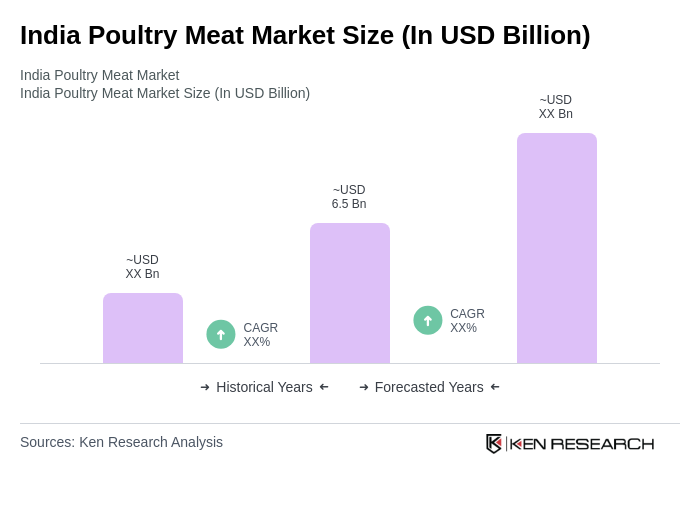
- The India Poultry Meat Market is valued at USD 6.5 billion, based on a five-year historical analysis. This growth is primarily driven by increasing consumer demand for protein-rich diets, urbanization, rising disposable incomes, and the expanding presence of quick-service restaurants and food delivery platforms. The market has seen a significant shift towards poultry as a preferred source of meat due to its affordability, consistent quality, and health benefits compared to red meat.
- Key players in this market include Maharashtra, Andhra Pradesh, and Tamil Nadu, which dominate due to their extensive poultry farming infrastructure, favorable climatic conditions, and high consumption rates. These regions have established themselves as hubs for poultry production, supported by a robust supply chain and processing facilities that cater to both domestic and export markets.
- In 2023, the Indian government implemented the National Livestock Mission, which aims to enhance livestock productivity and promote sustainable practices in poultry farming. This initiative includes financial support for farmers, training programs, and the establishment of veterinary services to ensure the health and welfare of poultry, thereby boosting the overall market.
India Poultry Meat Market Segmentation
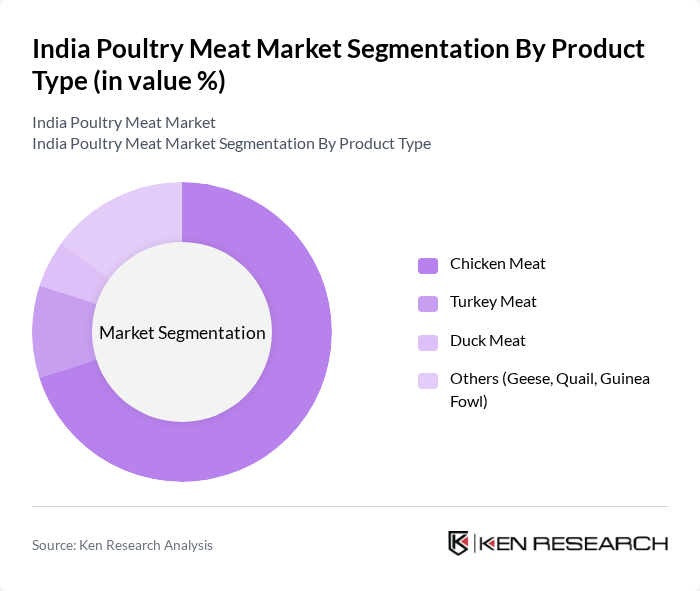
By Product Type:The product type segmentation includes Chicken Meat, Turkey Meat, Duck Meat, and Others (Geese, Quail, Guinea Fowl). Chicken meat is the most consumed and preferred type due to its versatility, affordability, and health benefits. Turkey and duck meat are niche categories, with limited but growing demand in urban centers, while other poultry types cater to specific regional and gourmet preferences.
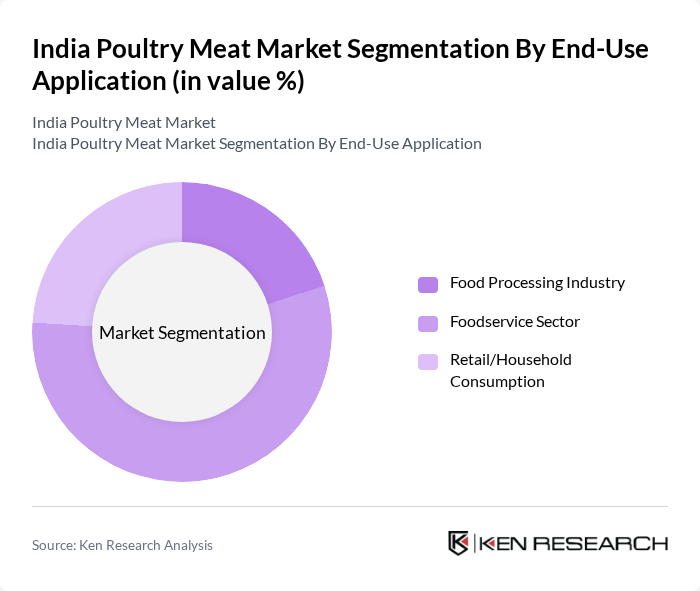
By End-Use Application:The end-use application segmentation includes Food Processing Industry, Foodservice Sector, and Retail/Household Consumption. The foodservice sector is the largest segment, driven by the proliferation of restaurants, cafes, and quick-service outlets, as well as the rising popularity of online food delivery platforms. The food processing industry is also significant, supported by the demand for processed meat products such as nuggets and sausages. Retail and household consumption continues to grow as urban consumers seek convenient and hygienic meal options.
India Poultry Meat Market Competitive Landscape
The India Poultry Meat Market is characterized by a dynamic mix of regional and international players. Leading participants such as Venky's India Ltd., Suguna Foods Pvt. Ltd., Godrej Agrovet Ltd., Skylark Hatcheries Pvt. Ltd., Sneha Farms Pvt. Ltd., IB Group, Srinivasa Farms, Mulpuri Group, RM Hatcheries (RM Group), Simran Farms Ltd., Bharati Poultry Pvt. Ltd., Indbro Research and Breeding Pvt. Ltd., National Egg Coordination Committee (NECC), Hester Biosciences Ltd., CP Group (Charoen Pokphand Foods) contribute to innovation, geographic expansion, and service delivery in this space.
India Poultry Meat Market Industry Analysis
Growth Drivers
- Increasing Demand for Protein-Rich Diets:The per capita consumption of poultry meat in India has risen significantly, reaching approximately 4.5–5 kg in future, driven by a growing population and rising incomes. The World Bank projects India's GDP growth at 6.3% in future, which is expected to further enhance consumer purchasing power. This trend is leading to a higher demand for protein-rich diets, with poultry meat being a preferred choice due to its affordability and nutritional value.
- Urbanization and Changing Consumer Preferences:Urbanization in India is accelerating, with the urban population projected to reach nearly 500 million in future. This demographic shift is influencing dietary habits, as urban consumers increasingly prefer convenient and ready-to-cook poultry products. The rise in disposable incomes, estimated to grow by 8% annually, is also driving demand for diverse poultry offerings, aligning with modern lifestyles and health-conscious choices among urban dwellers.
- Expansion of Fast Food Chains:The fast food industry in India is expected to grow to $25 billion in future, with major chains expanding their menus to include more poultry options. This growth is fueled by changing consumer lifestyles and preferences for quick-service meals. The increasing number of fast food outlets, projected to reach over 50,000 in future, is significantly boosting the demand for chicken and other poultry products, further solidifying their market presence.
Market Challenges
- Disease Outbreaks Affecting Poultry:The poultry industry in India faces significant challenges from disease outbreaks, such as avian influenza, which can lead to substantial production losses. In future, outbreaks resulted in the culling of hundreds of thousands to over 1 million birds, severely impacting supply chains. The economic cost of these outbreaks is estimated at over ?1,000 crores annually, highlighting the vulnerability of the sector to health crises and the need for robust biosecurity measures.
- Price Volatility of Feed Ingredients:The poultry sector is heavily reliant on feed ingredients, with maize and soybean meal constituting about 60–70% of production costs. In future, maize prices surged to ?1,800 per quintal, driven by supply chain disruptions and climatic factors. This volatility poses a significant challenge for poultry farmers, as fluctuating feed costs can erode profit margins and impact overall production sustainability, necessitating strategic sourcing and cost management.
India Poultry Meat Market Future Outlook
The future of the India poultry meat market appears promising, driven by increasing health consciousness and a shift towards sustainable practices. As consumers become more aware of nutrition, the demand for organic and free-range poultry products is expected to rise. Additionally, technological advancements in farming and processing are likely to enhance productivity and efficiency, positioning the industry for growth. The integration of e-commerce platforms will further facilitate access to poultry products, catering to evolving consumer preferences.
Market Opportunities
- Export Potential to International Markets:India has significant potential to expand its poultry exports, with the global poultry market valued at over $300 billion. In future, India exported poultry products worth over ?1,000 crores, indicating a growing interest in Indian poultry in international markets. By enhancing quality standards and meeting international regulations, India can tap into lucrative markets, particularly in the Middle East and Southeast Asia.
- Growth in Organic and Free-Range Poultry Products:The organic poultry segment is gaining traction, with a market size projected to reach ?2,000 crores in future. Increasing consumer awareness about health and sustainability is driving this trend. Producers who invest in organic farming practices can cater to this niche market, capitalizing on the willingness of consumers to pay a premium for ethically sourced and healthier poultry options.
Scope of the Report
| Segment | Sub-Segments |
|---|---|
| By Product Type | Chicken Meat Turkey Meat Duck Meat Others (Geese, Quail, Guinea Fowl) |
| By End-Use Application | Food Processing Industry Foodservice Sector Retail/Household Consumption |
| By Distribution Channel | Traditional Retail Stores Modern Retail Stores Online Retail Others (Specialized Meat Shops, Foodservice Establishments) |
| By Region | Maharashtra Haryana West Bengal Tamil Nadu Andhra Pradesh Uttar Pradesh Telangana Kerala Karnataka Punjab Orissa Bihar Madhya Pradesh Gujarat Rajasthan Others |
| By Product Form | Fresh / Chilled Frozen Processed (Nuggets, Sausages, Deli Meats, Burgers) |
Key Target Audience
Investors and Venture Capitalist Firms
Government and Regulatory Bodies (e.g., Ministry of Animal Husbandry, Dairying and Fisheries)
Manufacturers and Producers
Distributors and Retailers
Poultry Processing Companies
Exporters and Importers
Food Safety and Quality Assurance Agencies (e.g., Food Safety and Standards Authority of India)
Industry Associations (e.g., National Egg Coordination Committee)
Players Mentioned in the Report:
Venky's India Ltd.
Suguna Foods Pvt. Ltd.
Godrej Agrovet Ltd.
Skylark Hatcheries Pvt. Ltd.
Sneha Farms Pvt. Ltd.
IB Group
Srinivasa Farms
Mulpuri Group
RM Hatcheries (RM Group)
Simran Farms Ltd.
Bharati Poultry Pvt. Ltd.
Indbro Research and Breeding Pvt. Ltd.
National Egg Coordination Committee (NECC)
Hester Biosciences Ltd.
CP Group (Charoen Pokphand Foods)
Table of Contents
Market Assessment Phase
1. Executive Summary and Approach
2. India Poultry Meat Market Overview
2.1 Key Insights and Strategic Recommendations
2.2 India Poultry Meat Market Overview
2.3 Definition and Scope
2.4 Evolution of Market Ecosystem
2.5 Timeline of Key Regulatory Milestones
2.6 Value Chain & Stakeholder Mapping
2.7 Business Cycle Analysis
2.8 Policy & Incentive Landscape
3. India Poultry Meat Market Analysis
3.1 Growth Drivers
3.1.1 Increasing Demand for Protein-Rich Diets
3.1.2 Urbanization and Changing Consumer Preferences
3.1.3 Expansion of Fast Food Chains
3.1.4 Government Initiatives for Poultry Development
3.2 Market Challenges
3.2.1 Disease Outbreaks Affecting Poultry
3.2.2 Price Volatility of Feed Ingredients
3.2.3 Regulatory Compliance and Standards
3.2.4 Competition from Other Protein Sources
3.3 Market Opportunities
3.3.1 Export Potential to International Markets
3.3.2 Growth in Organic and Free-Range Poultry Products
3.3.3 Technological Advancements in Poultry Farming
3.3.4 Increasing Health Consciousness Among Consumers
3.4 Market Trends
3.4.1 Rise of E-commerce in Poultry Sales
3.4.2 Shift Towards Sustainable Farming Practices
3.4.3 Increasing Popularity of Ready-to-Cook Products
3.4.4 Growth of Poultry Processing Industry
3.5 Government Regulation
3.5.1 Food Safety and Standards Authority of India (FSSAI) Regulations
3.5.2 Livestock Importation and Quarantine Regulations
3.5.3 Animal Welfare Guidelines
3.5.4 Subsidies for Poultry Farmers
4. SWOT Analysis
5. Stakeholder Analysis
6. Porter's Five Forces Analysis
7. India Poultry Meat Market Market Size, 2019-2024
7.1 By Value
7.2 By Volume
7.3 By Average Selling Price
8. India Poultry Meat Market Segmentation
8.1 By Product Type
8.1.1 Chicken Meat
8.1.2 Turkey Meat
8.1.3 Duck Meat
8.1.4 Others (Geese, Quail, Guinea Fowl)
8.2 By End-Use Application
8.2.1 Food Processing Industry
8.2.2 Foodservice Sector
8.2.3 Retail/Household Consumption
8.3 By Distribution Channel
8.3.1 Traditional Retail Stores
8.3.2 Modern Retail Stores
8.3.3 Online Retail
8.3.4 Others (Specialized Meat Shops, Foodservice Establishments)
8.4 By Region
8.4.1 Maharashtra
8.4.2 Haryana
8.4.3 West Bengal
8.4.4 Tamil Nadu
8.4.5 Andhra Pradesh
8.4.6 Uttar Pradesh
8.4.7 Telangana
8.4.8 Kerala
8.4.9 Karnataka
8.4.10 Punjab
8.4.11 Orissa
8.4.12 Bihar
8.4.13 Madhya Pradesh
8.4.14 Gujarat
8.4.15 Rajasthan
8.4.16 Others
8.5 By Product Form
8.5.1 Fresh / Chilled
8.5.2 Frozen
8.5.3 Processed (Nuggets, Sausages, Deli Meats, Burgers)
9. India Poultry Meat Market Competitive Analysis
9.1 Market Share of Key Players
9.2 KPIs for Cross Comparison of Key Players
9.2.1 Company Name
9.2.2 Group Size (Large, Medium, Small)
9.2.3 Annual Revenue (INR/USD)
9.2.4 Revenue Growth Rate (%)
9.2.5 Market Share (%)
9.2.6 Production Volume (Metric Tons)
9.2.7 Distribution Network Coverage (Number of States/Regions)
9.2.8 Product Portfolio Diversity (Number of SKUs)
9.2.9 Supply Chain Efficiency (Lead Time, Fill Rate)
9.2.10 Customer Retention Rate (%)
9.2.11 Brand Recognition Score (Survey/Index)
9.2.12 Compliance with Food Safety Standards (FSSAI/ISO Certifications)
9.3 SWOT Analysis of Top Players
9.4 Pricing Analysis
9.5 List of Major Companies
9.5.1 Venky's India Ltd.
9.5.2 Suguna Foods Pvt. Ltd.
9.5.3 Godrej Agrovet Ltd.
9.5.4 Skylark Hatcheries Pvt. Ltd.
9.5.5 Sneha Farms Pvt. Ltd.
9.5.6 IB Group
9.5.7 Srinivasa Farms
9.5.8 Mulpuri Group
9.5.9 RM Hatcheries (RM Group)
9.5.10 Simran Farms Ltd.
9.5.11 Bharati Poultry Pvt. Ltd.
9.5.12 Indbro Research and Breeding Pvt. Ltd.
9.5.13 National Egg Coordination Committee (NECC)
9.5.14 Hester Biosciences Ltd.
9.5.15 CP Group (Charoen Pokphand Foods)
10. India Poultry Meat Market End-User Analysis
10.1 Procurement Behavior of Key Ministries
10.1.1 Ministry of Agriculture
10.1.2 Ministry of Food Processing Industries
10.1.3 Ministry of Health and Family Welfare
10.2 Corporate Spend on Infrastructure & Energy
10.2.1 Investment in Cold Chain Infrastructure
10.2.2 Energy Consumption Patterns
10.2.3 Infrastructure Development for Processing Units
10.3 Pain Point Analysis by End-User Category
10.3.1 Supply Chain Disruptions
10.3.2 Quality Assurance Issues
10.3.3 Price Fluctuations
10.4 User Readiness for Adoption
10.4.1 Awareness of Poultry Products
10.4.2 Acceptance of New Product Variants
10.4.3 Readiness for Online Purchases
10.5 Post-Deployment ROI and Use Case Expansion
10.5.1 Evaluation of Cost Savings
10.5.2 Expansion into New Markets
10.5.3 Customer Feedback and Product Improvement
11. India Poultry Meat Market Future Size, 2025-2030
11.1 By Value
11.2 By Volume
11.3 By Average Selling Price
Go-To-Market Strategy Phase
1. Whitespace Analysis + Business Model Canvas
1.1 Market Gaps Identification
1.2 Business Model Framework
2. Marketing and Positioning Recommendations
2.1 Branding Strategies
2.2 Product USPs
3. Distribution Plan
3.1 Urban Retail Strategies
3.2 Rural NGO Tie-Ups
4. Channel & Pricing Gaps
4.1 Underserved Routes
4.2 Pricing Bands Analysis
5. Unmet Demand & Latent Needs
5.1 Category Gaps
5.2 Consumer Segments
6. Customer Relationship
6.1 Loyalty Programs
6.2 After-Sales Service
7. Value Proposition
7.1 Sustainability Initiatives
7.2 Integrated Supply Chains
8. Key Activities
8.1 Regulatory Compliance
8.2 Branding Efforts
8.3 Distribution Setup
9. Entry Strategy Evaluation
9.1 Domestic Market Entry Strategy
9.1.1 Product Mix Considerations
9.1.2 Pricing Band Strategy
9.1.3 Packaging Innovations
9.2 Export Entry Strategy
9.2.1 Target Countries Identification
9.2.2 Compliance Roadmap Development
10. Entry Mode Assessment
10.1 Joint Ventures
10.2 Greenfield Investments
10.3 Mergers & Acquisitions
10.4 Distributor Model Evaluation
11. Capital and Timeline Estimation
11.1 Capital Requirements
11.2 Timelines for Implementation
12. Control vs Risk Trade-Off
12.1 Ownership Considerations
12.2 Partnerships Evaluation
13. Profitability Outlook
13.1 Breakeven Analysis
13.2 Long-Term Sustainability Strategies
14. Potential Partner List
14.1 Distributors
14.2 Joint Ventures
14.3 Acquisition Targets
15. Execution Roadmap
15.1 Phased Plan for Market Entry
15.1.1 Market Setup Activities
15.1.2 Market Entry Steps
15.1.3 Growth Acceleration Tactics
15.1.4 Scale & Stabilize Strategies
15.2 Key Activities and Milestones
15.2.1 Milestone Planning
15.2.2 Activity Tracking
Research Methodology
Phase 1: Approach1
Desk Research
- Analysis of industry reports from the National Egg Coordination Committee (NECC) and Ministry of Agriculture
- Review of market trends and statistics from the Indian Poultry Industry Association
- Examination of consumer behavior studies and dietary trends published by health organizations
Primary Research
- Interviews with poultry farm owners and operators across various states
- Telephonic surveys with distributors and wholesalers in the poultry supply chain
- Field interviews with veterinarians and poultry nutritionists to gather insights on health and feed trends
Validation & Triangulation
- Cross-validation of data through multiple sources including government publications and industry reports
- Triangulation of findings from primary interviews with secondary data trends
- Sanity checks conducted through expert panel reviews comprising industry veterans
Phase 2: Market Size Estimation1
Top-down Assessment
- Estimation of total poultry meat consumption based on national dietary surveys and population growth
- Segmentation of market size by region, type of poultry (broilers, layers), and consumer demographics
- Incorporation of government policies affecting poultry production and trade
Bottom-up Modeling
- Collection of production data from major poultry farms and hatcheries
- Operational cost analysis based on feed prices, labor costs, and veterinary expenses
- Volume x price analysis to determine revenue generation across different poultry segments
Forecasting & Scenario Analysis
- Multi-factor regression analysis incorporating economic indicators, consumer preferences, and health trends
- Scenario modeling based on potential impacts of avian diseases and regulatory changes
- Development of baseline, optimistic, and pessimistic forecasts through 2030
Phase 3: CATI Sample Composition1
| Scope Item/Segment | Sample Size | Target Respondent Profiles |
|---|---|---|
| Poultry Farm Operations | 120 | Poultry Farm Owners, Farm Managers |
| Poultry Feed Suppliers | 60 | Feed Mill Managers, Sales Representatives |
| Retail Meat Outlets | 50 | Store Managers, Meat Department Supervisors |
| Veterinary Services | 40 | Veterinarians, Animal Health Technicians |
| Consumer Insights | 100 | Household Consumers, Health-Conscious Shoppers |
Frequently Asked Questions
What is the current value of the India Poultry Meat Market?
The India Poultry Meat Market is valued at approximately USD 6.5 billion, driven by increasing consumer demand for protein-rich diets, urbanization, and the growth of quick-service restaurants and food delivery platforms.
Which regions dominate the India Poultry Meat Market?
What are the main drivers of growth in the India Poultry Meat Market?
What challenges does the India Poultry Meat Market face?
Other Regional/Country Reports
Indonesia Poultry Meat Market
Malaysia Poultry Meat Market
KSA Poultry Meat Market
APAC Poultry Meat Market
SEA Poultry Meat Market
Vietnam Poultry Meat Market
Why Buy From Us?

What makes us stand out is that our consultants follow Robust, Refine and Result (RRR) methodology. Robust for clear definitions, approaches and sanity checking, Refine for differentiating respondents' facts and opinions, and Result for presenting data with story.

We have set a benchmark in the industry by offering our clients with syndicated and customized market research reports featuring coverage of entire market as well as meticulous research and analyst insights.

While we don't replace traditional research, we flip the method upside down. Our dual approach of Top Bottom & Bottom Top ensures quality deliverable by not just verifying company fundamentals but also looking at the sector and macroeconomic factors.

With one step in the future, our research team constantly tries to show you the bigger picture. We help with some of the tough questions you may encounter along the way: How is the industry positioned? Best marketing channel? KPI's of competitors? By aligning every element, we help maximize success.

Our report gives you instant access to the answers and sources that other companies might choose to hide. We elaborate each steps of research methodology we have used and showcase you the sample size to earn your trust.

If you need any support, we are here! We pride ourselves on universe strength, data quality, and quick, friendly, and professional service.