India Real Estate Industry Market

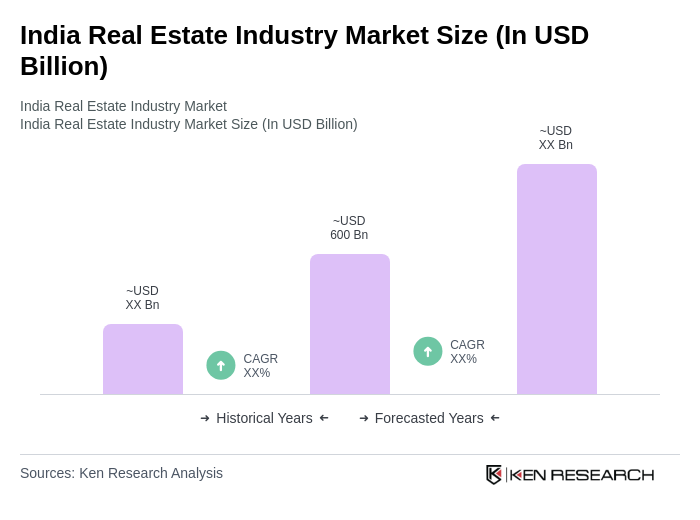
India real estate market, valued at USD 600 billion, is driven by rapid urbanization, government schemes, and increasing demand in key cities like Mumbai and Bengaluru.

Region:Asia

Author(s):Dev

Product Code:KRAC0390

Pages:100

Published On:August 2025
About the Report

Base Year 2024

India Real Estate Industry Market Overview

  • The India Real Estate Industry Market is valued at USD 600 billion, based on a five-year historical analysis. This growth is primarily driven by rapid urbanization, increasing disposable incomes, and government initiatives aimed at boosting housing and infrastructure development. The demand for residential and commercial properties has surged, reflecting the country's economic growth and demographic changes.
  • Key cities dominating the market include Mumbai, Delhi NCR, Bengaluru, and Hyderabad. These cities are preferred due to their robust economic activities, availability of job opportunities, and improved infrastructure. The concentration of IT hubs, financial institutions, and educational centers in these regions further enhances their attractiveness for real estate investments.
  • The Indian government implemented the Real Estate (Regulation and Development) Act (RERA), which aims to protect homebuyers and promote transparency in the real estate sector. This regulation mandates the registration of real estate projects and agents, ensuring timely delivery and quality of construction, thereby enhancing consumer confidence in the market.
India Real Estate Industry Market Size

India Real Estate Industry Market Segmentation

By Type:The market is segmented into various types, including Residential, Commercial, Industrial & Logistics, Retail, Hospitality, Mixed-Use Developments, and Alternative Assets. Each of these segments caters to different consumer needs and investment opportunities, reflecting the diverse nature of the real estate landscape in India.
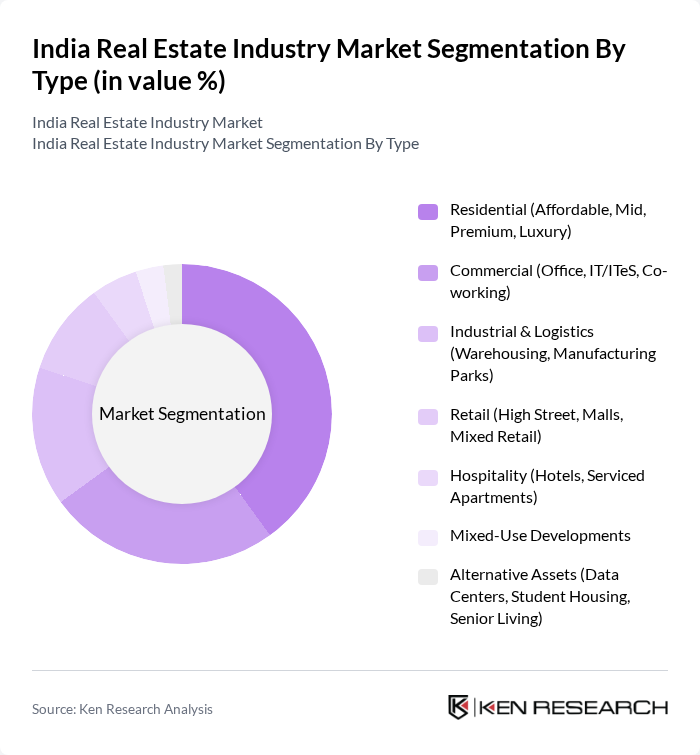
India Real Estate Industry Market segmentation by Type.

By End-User:The end-user segmentation includes Individual Homebuyers & HNIs/NRIs, Corporates & SMEs, Government & Public Sector Undertakings, and Institutional Investors & REITs. This segmentation highlights the diverse customer base and varying requirements in the real estate market.
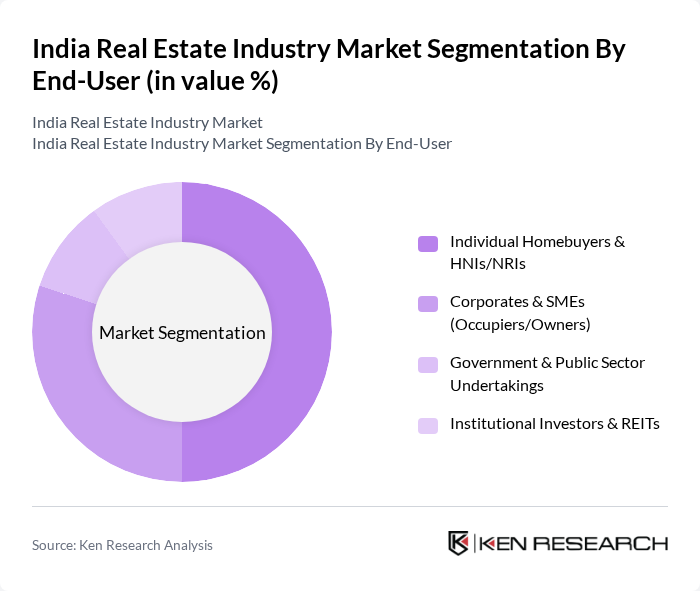
India Real Estate Industry Market segmentation by End-User.

India Real Estate Industry Market Competitive Landscape

The India Real Estate Industry Market is characterized by a dynamic mix of regional and international players. Leading participants such as DLF Limited, Godrej Properties Limited, Oberoi Realty Limited, Brigade Enterprises Limited, Prestige Estates Projects Limited, Sobha Limited, Mahindra Lifespace Developers Limited, Puravankara Limited, Indiabulls Real Estate Limited, Sunteck Realty Limited, K Raheja Corp (and Mindspace Business Parks REIT), Ashiana Housing Limited, Hiranandani Group, The Phoenix Mills Limited, Macrotech Developers Limited (Lodha) contribute to innovation, geographic expansion, and service delivery in this space.

DLF Limited

1946

Gurugram

Godrej Properties Limited

1990

Mumbai

Oberoi Realty Limited

1998

Mumbai

Brigade Enterprises Limited

1986

Bengaluru

Prestige Estates Projects Limited

1986

Bengaluru

Company

Establishment Year

Headquarters

Group Size (Large, Medium, Small)

Revenue Growth Rate (YoY, %)

Pre-sales/Booking Value (INR crore)

Sales Volume (Units sold/Sq ft sold)

Average Realization/Average Selling Price (INR per sq ft)

Construction/Project Completion Cycle (months)

India Real Estate Industry Market Industry Analysis

Growth Drivers

  • Urbanization and Population Growth:India is experiencing rapid urbanization, with the urban population projected to reach 600 million in future, according to the Ministry of Housing and Urban Affairs. This urban influx drives demand for housing, commercial spaces, and infrastructure. The population growth rate is approximately 0.8% annually, leading to increased housing needs. The urban housing shortage is estimated at 10 million units, creating significant opportunities for real estate development in metropolitan areas.
  • Government Initiatives and Schemes:The Indian government has launched several initiatives to boost the real estate sector, including the Pradhan Mantri Awas Yojana (PMAY), which aims to provide affordable housing for all in future. As of 2023, over tens of millions of houses have been sanctioned under this scheme. Additionally, the Smart Cities Mission, with a budget of ?48,000 crore, is enhancing urban infrastructure, further stimulating real estate investments and development across the country.
  • Rising Disposable Incomes:The average disposable income in India has increased significantly, with a rise from ?1.2 lakh to ?2.5 lakh in future, according to the National Statistical Office. This increase in disposable income is driving demand for residential properties, particularly in urban areas. As more individuals can afford homes, the real estate market is expected to see a surge in both demand and investment, particularly in the mid-range and luxury segments.

Market Challenges

  • Regulatory Hurdles:The real estate sector in India faces significant regulatory challenges, including complex land acquisition processes and lengthy approval timelines. According to the World Bank, India ranks 63rd in the Ease of Doing Business index, with real estate development often hampered by bureaucratic delays. These hurdles can lead to increased project costs and deter foreign investment, impacting overall market growth and development timelines.
  • High Interest Rates:The Reserve Bank of India has maintained a repo rate of 6.50% as of early future, contributing to high borrowing costs for homebuyers and developers. This situation has led to a slowdown in mortgage approvals, with a reported decline of 15% in home loan disbursements in future. High interest rates can significantly affect affordability, reducing demand for residential properties and slowing down market momentum.

India Real Estate Industry Market Future Outlook

The future of the India real estate market appears promising, driven by ongoing urbanization and government initiatives aimed at enhancing infrastructure. The focus on affordable housing and smart city projects is expected to attract significant investments. Additionally, the integration of technology in real estate operations is likely to streamline processes and improve customer experiences. As the economy stabilizes and disposable incomes rise, the demand for residential and commercial properties is anticipated to grow, fostering a dynamic market environment.

Market Opportunities

  • Affordable Housing Demand:The demand for affordable housing is projected to remain strong, with an estimated 20 million units needed in future. Government initiatives and private sector participation are expected to drive this segment, providing opportunities for developers to cater to the lower-income demographic, thus enhancing market growth.
  • Technology Integration in Real Estate:The adoption of technology in real estate, such as PropTech solutions, is gaining momentum. With an investment of over $1 billion in PropTech in future, the sector is poised for transformation. This trend offers opportunities for innovation in property management, sales, and customer engagement, enhancing operational efficiency and market competitiveness.

Scope of the Report

SegmentSub-Segments
By Type

Residential (Affordable, Mid, Premium, Luxury)

Commercial (Office, IT/ITeS, Co-working)

Industrial & Logistics (Warehousing, Manufacturing Parks)

Retail (High Street, Malls, Mixed Retail)

Hospitality (Hotels, Serviced Apartments)

Mixed-Use Developments

Alternative Assets (Data Centers, Student Housing, Senior Living)

By End-User

Individual Homebuyers & HNIs/NRIs

Corporates & SMEs (Occupiers/Owners)

Government & Public Sector Undertakings

Institutional Investors & REITs

By Region

North India (Delhi-NCR, Jaipur, Lucknow, Chandigarh)

South India (Bengaluru, Hyderabad, Chennai, Kochi)

East India (Kolkata, Bhubaneswar, Patna)

West India (Mumbai MMR, Pune, Ahmedabad, Goa)

By Investment Source

Domestic Developers & HNIs

Foreign Direct Investment (FDI) & Private Equity

Public-Private Partnerships (PPP)

Government Schemes (PMAY, SWAMIH, Smart Cities)

By Application

Residential Development (New Launches, Redevelopment)

Commercial Leasing & Strata Sales

Industrial & Logistics Parks

Urban Redevelopment & Transit-Oriented Development

By Financing Type

Equity Financing (Developer Equity, PE/VC)

Debt Financing (Bank/NBFC, AIFs)

REITs & InvITs

Crowdfunding & Fractional Ownership

By Policy Support

Subsidies & Interest Subvention for Housing

Tax Incentives & Stamp Duty Rebates

Regulatory Support (RERA, TOD, Ease of Doing Business)

Key Target Audience

Investors and Venture Capitalist Firms

Government and Regulatory Bodies (e.g., Ministry of Housing and Urban Affairs, Real Estate Regulatory Authority)

Real Estate Developers and Builders

Property Management Companies

Construction Firms

Financial Institutions (e.g., Banks, Non-Banking Financial Companies)

Real Estate Investment Trusts (REITs)

Urban Planners and Architects

Players Mentioned in the Report:

DLF Limited

Godrej Properties Limited

Oberoi Realty Limited

Brigade Enterprises Limited

Prestige Estates Projects Limited

Sobha Limited

Mahindra Lifespace Developers Limited

Puravankara Limited

Indiabulls Real Estate Limited

Sunteck Realty Limited

K Raheja Corp (and Mindspace Business Parks REIT)

Ashiana Housing Limited

Hiranandani Group

The Phoenix Mills Limited

Macrotech Developers Limited (Lodha)

Table of Contents

Market Assessment Phase

1. Executive Summary and Approach


2. India Real Estate Industry Market Overview

2.1 Key Insights and Strategic Recommendations

2.2 India Real Estate Industry Market Overview

2.3 Definition and Scope

2.4 Evolution of Market Ecosystem

2.5 Timeline of Key Regulatory Milestones

2.6 Value Chain & Stakeholder Mapping

2.7 Business Cycle Analysis

2.8 Policy & Incentive Landscape


3. India Real Estate Industry Market Analysis

3.1 Growth Drivers

3.1.1 Urbanization and Population Growth
3.1.2 Government Initiatives and Schemes
3.1.3 Rising Disposable Incomes
3.1.4 Infrastructure Development

3.2 Market Challenges

3.2.1 Regulatory Hurdles
3.2.2 Economic Fluctuations
3.2.3 High Interest Rates
3.2.4 Land Acquisition Issues

3.3 Market Opportunities

3.3.1 Affordable Housing Demand
3.3.2 Smart City Initiatives
3.3.3 Green Building Trends
3.3.4 Technology Integration in Real Estate

3.4 Market Trends

3.4.1 Increased Investment in Commercial Real Estate
3.4.2 Rise of Co-Working Spaces
3.4.3 Digital Transformation in Real Estate
3.4.4 Sustainability and Eco-Friendly Developments

3.5 Government Regulation

3.5.1 RERA Implementation
3.5.2 FDI Policy Reforms
3.5.3 GST Impact on Real Estate
3.5.4 Land Use Policy Changes

4. SWOT Analysis


5. Stakeholder Analysis


6. Porter's Five Forces Analysis


7. India Real Estate Industry Market Market Size, 2019-2024

7.1 By Value

7.2 By Volume

7.3 By Average Selling Price


8. India Real Estate Industry Market Segmentation

8.1 By Type

8.1.1 Residential (Affordable, Mid, Premium, Luxury)
8.1.2 Commercial (Office, IT/ITeS, Co-working)
8.1.3 Industrial & Logistics (Warehousing, Manufacturing Parks)
8.1.4 Retail (High Street, Malls, Mixed Retail)
8.1.5 Hospitality (Hotels, Serviced Apartments)
8.1.6 Mixed-Use Developments
8.1.7 Alternative Assets (Data Centers, Student Housing, Senior Living)

8.2 By End-User

8.2.1 Individual Homebuyers & HNIs/NRIs
8.2.2 Corporates & SMEs (Occupiers/Owners)
8.2.3 Government & Public Sector Undertakings
8.2.4 Institutional Investors & REITs

8.3 By Region

8.3.1 North India (Delhi-NCR, Jaipur, Lucknow, Chandigarh)
8.3.2 South India (Bengaluru, Hyderabad, Chennai, Kochi)
8.3.3 East India (Kolkata, Bhubaneswar, Patna)
8.3.4 West India (Mumbai MMR, Pune, Ahmedabad, Goa)

8.4 By Investment Source

8.4.1 Domestic Developers & HNIs
8.4.2 Foreign Direct Investment (FDI) & Private Equity
8.4.3 Public-Private Partnerships (PPP)
8.4.4 Government Schemes (PMAY, SWAMIH, Smart Cities)

8.5 By Application

8.5.1 Residential Development (New Launches, Redevelopment)
8.5.2 Commercial Leasing & Strata Sales
8.5.3 Industrial & Logistics Parks
8.5.4 Urban Redevelopment & Transit-Oriented Development

8.6 By Financing Type

8.6.1 Equity Financing (Developer Equity, PE/VC)
8.6.2 Debt Financing (Bank/NBFC, AIFs)
8.6.3 REITs & InvITs
8.6.4 Crowdfunding & Fractional Ownership

8.7 By Policy Support

8.7.1 Subsidies & Interest Subvention for Housing
8.7.2 Tax Incentives & Stamp Duty Rebates
8.7.3 Regulatory Support (RERA, TOD, Ease of Doing Business)

9. India Real Estate Industry Market Competitive Analysis

9.1 Market Share of Key Players

9.2 Cross Comparison of Key Players

9.2.1 Company Name
9.2.2 Group Size (Large, Medium, Small)
9.2.3 Revenue Growth Rate (YoY, %)
9.2.4 Pre-sales/Booking Value (INR crore)
9.2.5 Sales Volume (Units sold/Sq ft sold)
9.2.6 Average Realization/Average Selling Price (INR per sq ft)
9.2.7 Construction/Project Completion Cycle (months)
9.2.8 Net Debt to Equity (x) and Interest Coverage (x)
9.2.9 Land Reserves/Land Bank (msf or acres)
9.2.10 Project Pipeline/Launches (units or msf)
9.2.11 Occupancy/Leasing Metrics (office/retail %, WALE)
9.2.12 Return on Capital Employed (ROCE, %)
9.2.13 Cash Flow from Operations (INR crore)
9.2.14 Customer Satisfaction/Defect Liability Claims (index or rate)
9.2.15 ESG/Green Certifications (IGBC/LEED projects, % portfolio)

9.3 SWOT Analysis of Top Players

9.4 Pricing Analysis

9.5 Detailed Profile of Major Companies

9.5.1 DLF Limited
9.5.2 Godrej Properties Limited
9.5.3 Oberoi Realty Limited
9.5.4 Brigade Enterprises Limited
9.5.5 Prestige Estates Projects Limited
9.5.6 Sobha Limited
9.5.7 Mahindra Lifespace Developers Limited
9.5.8 Puravankara Limited
9.5.9 Indiabulls Real Estate Limited
9.5.10 Sunteck Realty Limited
9.5.11 K Raheja Corp (and Mindspace Business Parks REIT)
9.5.12 Ashiana Housing Limited
9.5.13 Hiranandani Group
9.5.14 The Phoenix Mills Limited
9.5.15 Macrotech Developers Limited (Lodha)

10. India Real Estate Industry Market End-User Analysis

10.1 Procurement Behavior of Key Ministries

10.1.1 Ministry of Housing and Urban Affairs
10.1.2 Ministry of Finance
10.1.3 Ministry of Environment, Forest and Climate Change

10.2 Corporate Spend on Infrastructure & Energy

10.2.1 Corporate Real Estate Investments
10.2.2 Infrastructure Development Budgets

10.3 Pain Point Analysis by End-User Category

10.3.1 Residential Buyers
10.3.2 Commercial Tenants
10.3.3 Real Estate Developers

10.4 User Readiness for Adoption

10.4.1 Technology Adoption in Real Estate
10.4.2 Sustainability Practices

10.5 Post-Deployment ROI and Use Case Expansion

10.5.1 ROI Measurement Techniques
10.5.2 Use Case Expansion Opportunities

11. India Real Estate Industry Market Future Size, 2025-2030

11.1 By Value

11.2 By Volume

11.3 By Average Selling Price


Go-To-Market Strategy Phase

1. Whitespace Analysis + Business Model Canvas

1.1 Market Gaps Identification

1.2 Business Model Framework


2. Marketing and Positioning Recommendations

2.1 Branding Strategies

2.2 Product USPs


3. Distribution Plan

3.1 Urban Retail Strategies

3.2 Rural NGO Tie-Ups


4. Channel & Pricing Gaps

4.1 Underserved Routes

4.2 Pricing Bands


5. Unmet Demand & Latent Needs

5.1 Category Gaps

5.2 Consumer Segments


6. Customer Relationship

6.1 Loyalty Programs

6.2 After-Sales Service


7. Value Proposition

7.1 Sustainability Initiatives

7.2 Integrated Supply Chains


8. Key Activities

8.1 Regulatory Compliance

8.2 Branding Efforts

8.3 Distribution Setup


9. Entry Strategy Evaluation

9.1 Domestic Market Entry Strategy

9.1.1 Product Mix
9.1.2 Pricing Band
9.1.3 Packaging Strategies

9.2 Export Entry Strategy

9.2.1 Target Countries
9.2.2 Compliance Roadmap

10. Entry Mode Assessment

10.1 Joint Ventures

10.2 Greenfield Investments

10.3 Mergers & Acquisitions

10.4 Distributor Model


11. Capital and Timeline Estimation

11.1 Capital Requirements

11.2 Timelines for Market Entry


12. Control vs Risk Trade-Off

12.1 Ownership vs Partnerships


13. Profitability Outlook

13.1 Breakeven Analysis

13.2 Long-Term Sustainability


14. Potential Partner List

14.1 Distributors

14.2 Joint Ventures

14.3 Acquisition Targets


15. Execution Roadmap

15.1 Phased Plan for Market Entry

15.1.1 Market Setup
15.1.2 Market Entry
15.1.3 Growth Acceleration
15.1.4 Scale & Stabilize

15.2 Key Activities and Milestones

15.2.1 Milestone Planning
15.2.2 Activity Tracking

Research Methodology

ApproachModellingSample

Phase 1: Approach1

Desk Research

  • Analysis of government reports and publications from the Ministry of Housing and Urban Affairs
  • Review of real estate market reports from industry associations like NAREDCO and CREDAI
  • Examination of property price trends and transaction data from online real estate platforms

Primary Research

  • Interviews with real estate developers and builders across major Indian cities
  • Surveys with real estate agents and brokers to gather insights on market dynamics
  • Focus group discussions with homebuyers to understand preferences and buying behavior

Validation & Triangulation

  • Cross-validation of findings with data from financial institutions and housing finance companies
  • Triangulation of insights from primary interviews with secondary data trends
  • Sanity checks through expert panels comprising real estate analysts and economists

Phase 2: Market Size Estimation1

Top-down Assessment

  • Estimation of market size based on GDP contribution from the real estate sector
  • Analysis of housing demand projections based on urbanization rates and population growth
  • Incorporation of government housing schemes and initiatives impacting market size

Bottom-up Modeling

  • Collection of sales data from leading real estate developers and builders
  • Estimation of average selling prices across different property segments (residential, commercial, etc.)
  • Volume estimates based on construction activity and project completions in key regions

Forecasting & Scenario Analysis

  • Multi-factor regression analysis incorporating interest rates, economic indicators, and demographic trends
  • Scenario modeling based on potential regulatory changes and market disruptions
  • Baseline, optimistic, and pessimistic forecasts for the next 5–10 years

Phase 3: CATI Sample Composition1

Scope Item/SegmentSample SizeTarget Respondent Profiles
Residential Real Estate Buyers150First-time Homebuyers, Investors
Commercial Property Developers100Project Managers, Business Development Heads
Real Estate Agents and Brokers80Real Estate Consultants, Sales Executives
Urban Planners and Policymakers60City Planners, Government Officials
Investors in Real Estate Funds70Portfolio Managers, Financial Analysts

Frequently Asked Questions

What is the current value of the India Real Estate Industry Market?

The India Real Estate Industry Market is valued at approximately USD 600 billion, driven by rapid urbanization, increasing disposable incomes, and government initiatives aimed at enhancing housing and infrastructure development.

Which cities are the primary hubs for real estate investment in India?

What is the Real Estate (Regulation and Development) Act (RERA)?

What are the main growth drivers of the India real estate market?

Other Regional/Country Reports

Indonesia Real Estate Industry Market

Malaysia Real Estate Industry Market

KSA Real Estate Industry Market

APAC Real Estate Industry Market

SEA Real Estate Industry Market

Vietnam Real Estate Industry Market

Why Buy From Us?

Refine Robust Result (RRR) Framework

What makes us stand out is that our consultants follow Robust, Refine and Result (RRR) methodology. Robust for clear definitions, approaches and sanity checking, Refine for differentiating respondents' facts and opinions, and Result for presenting data with story.

Our Reach Is Unmatched

We have set a benchmark in the industry by offering our clients with syndicated and customized market research reports featuring coverage of entire market as well as meticulous research and analyst insights.

Shifting the Research Paradigm

While we don't replace traditional research, we flip the method upside down. Our dual approach of Top Bottom & Bottom Top ensures quality deliverable by not just verifying company fundamentals but also looking at the sector and macroeconomic factors.

More Insights-Better Decisions

With one step in the future, our research team constantly tries to show you the bigger picture. We help with some of the tough questions you may encounter along the way: How is the industry positioned? Best marketing channel? KPI's of competitors? By aligning every element, we help maximize success.

Transparency and Trust

Our report gives you instant access to the answers and sources that other companies might choose to hide. We elaborate each steps of research methodology we have used and showcase you the sample size to earn your trust.

Round the Clock Support

If you need any support, we are here! We pride ourselves on universe strength, data quality, and quick, friendly, and professional service.

Why Clients Choose Us?

400000+
Reports in repository
150+
Consulting projects a year
100+
Analysts
8000+
Client Queries in 2022








