About the Report
Base Year 2024India Waste-to-Energy and Circular Waste Management Market Overview
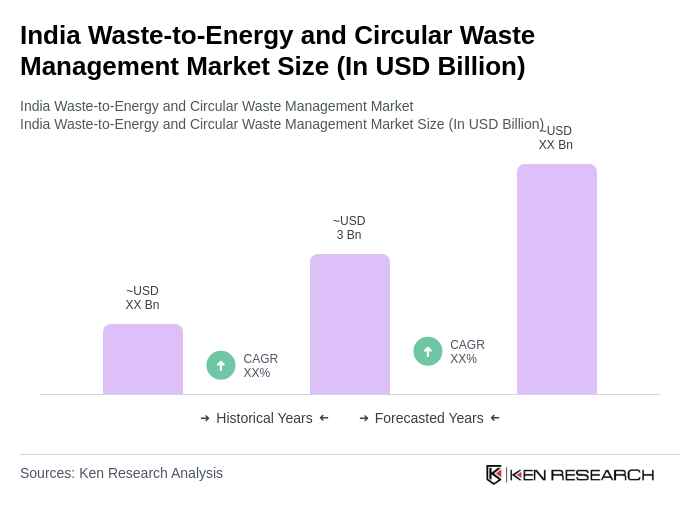
- The India Waste-to-Energy and Circular Waste Management Market is valued at USD 3 billion, based on a five-year historical analysis. This growth is primarily driven by increasing urbanization, rising waste generation, and a strong government focus on renewable energy and sustainable waste management. The demand for sustainable waste management solutions has surged, leading to significant investments in waste-to-energy technologies, such as biomethanation, pyrolysis, and advanced thermal conversion, as well as infrastructure development. Public-private partnerships and technology upgrades are further accelerating market expansion and operational efficiency .
- Key players in this market include metropolitan areas such asDelhi, Mumbai, and Bengaluru, which dominate due to their high population density and substantial waste generation. These cities are at the forefront of implementing innovative waste management practices and technologies, including large-scale biomethanation and waste-to-energy plants, making them critical hubs for waste-to-energy initiatives and circular economy strategies .
- TheSolid Waste Management Rules, 2016issued by the Ministry of Environment, Forest and Climate Change, Government of India, are the binding regulatory framework. These rules mandate segregation of waste at source, promote the establishment of waste-to-energy plants, and require urban local bodies to process and treat waste before disposal. The regulation aims to enhance waste management efficiency, reduce landfill dependency, and foster a more sustainable waste management ecosystem across the country .
India Waste-to-Energy and Circular Waste Management Market Segmentation
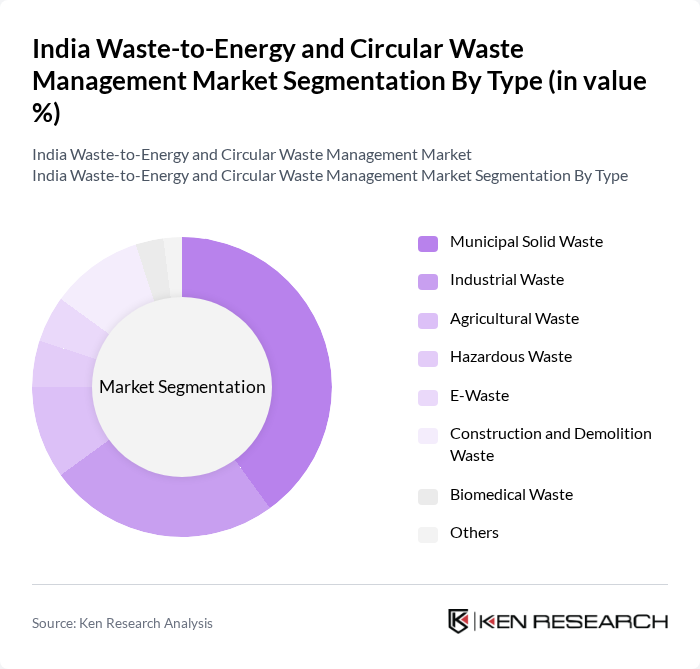
By Type:The market is segmented into various types of waste, including Municipal Solid Waste, Industrial Waste, Agricultural Waste, Hazardous Waste, E-Waste, Construction and Demolition Waste, Biomedical Waste, and Others. Each type plays a crucial role in the overall waste management ecosystem, with specific technologies and processes tailored to handle the unique characteristics of each waste type. Municipal Solid Waste remains the largest segment, driven by urbanization and municipal initiatives, while Industrial and Construction & Demolition Waste are gaining traction due to stricter compliance and recycling mandates. Agricultural and E-Waste segments are also expanding as resource recovery and circular economy models are increasingly adopted .
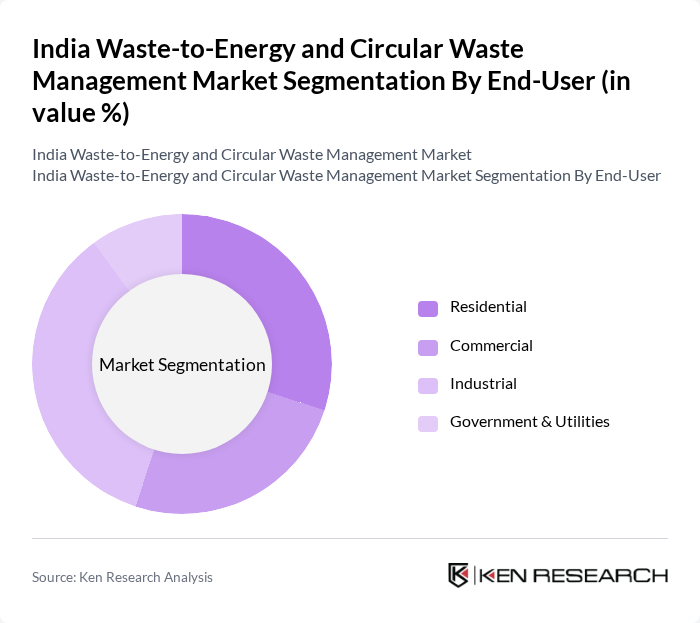
By End-User:The market is segmented by end-users, including Residential, Commercial, Industrial, and Government & Utilities. Each segment has distinct waste management needs and contributes differently to the overall waste-to-energy landscape. The Industrial segment leads due to higher waste generation and regulatory compliance, while the Residential and Commercial segments are rapidly adopting decentralized waste processing and recycling practices. Government & Utilities play a key role in large-scale waste collection and public infrastructure projects .
India Waste-to-Energy and Circular Waste Management Market Competitive Landscape
The India Waste-to-Energy and Circular Waste Management Market is characterized by a dynamic mix of regional and international players. Leading participants such as Tata Power, Ramky Enviro Engineers Limited, GMR Group, Jindal Ecopolis, Abellon Clean Energy, Greenko Group, ReNew Power, SUEZ India, IL&FS Environmental Infrastructure & Services Ltd., Essel Infraprojects, A2Z Group, Antony Lara Enviro Solutions, Eco Green Energy, Hitachi Zosen India, Re Sustainability (formerly Ramky Enviro), Sembcorp Green Infra, Zonta Infratech, Ashoka Biogreen Energy, Tamil Nadu Waste-to-Energy Limited contribute to innovation, geographic expansion, and service delivery in this space.
India Waste-to-Energy and Circular Waste Management Market Industry Analysis
Growth Drivers
- Increasing Urbanization:Urbanization in India is accelerating, with the urban population projected to reach 600 million in future, according to the World Bank. This rapid urban growth leads to increased waste generation, estimated at approximately 150 million tons annually. The demand for efficient waste management solutions, including waste-to-energy technologies, is rising as cities struggle to manage this influx. Urban areas are increasingly adopting circular waste management practices to address these challenges effectively.
- Government Initiatives and Policies:The Indian government has implemented various initiatives to promote waste-to-energy projects, including the Swachh Bharat Mission, which allocated approximately ?62,000 crore (approximately $8 billion) for sanitation and waste management. Additionally, the National Biofuel Policy aims to increase biofuel production to 10% in future, encouraging investments in waste-to-energy technologies. These policies create a favorable environment for market growth, driving innovation and investment in sustainable waste management solutions.
- Rising Energy Demand:India's energy demand is expected to grow by 4.5% annually, reaching 1,500 TWh in future, as per the International Energy Agency. This increasing demand for energy, coupled with the need for sustainable solutions, drives interest in waste-to-energy projects. Converting waste into energy not only addresses waste disposal issues but also contributes to energy security, making it a vital component of India's energy strategy and enhancing the viability of circular waste management practices.
Market Challenges
- High Initial Investment Costs:The capital required for establishing waste-to-energy plants is substantial, often exceeding ?300 crore (approximately $36 million) per facility. This high initial investment poses a significant barrier to entry for many potential investors and operators. Additionally, the long payback periods, often ranging from 7 to 10 years, deter investment in waste management projects, limiting the growth of the sector despite its potential benefits.
- Technological Limitations:The waste-to-energy sector in India faces technological challenges, including the need for advanced processing technologies to efficiently convert diverse waste types into energy. Current technologies may not be suitable for all waste streams, leading to inefficiencies. Moreover, the lack of skilled labor and expertise in operating sophisticated waste-to-energy systems further complicates the implementation of effective solutions, hindering market growth and innovation.
India Waste-to-Energy and Circular Waste Management Market Future Outlook
The future of the waste-to-energy and circular waste management market in India appears promising, driven by increasing urbanization and supportive government policies. As cities expand, the demand for innovative waste management solutions will intensify. Technological advancements and public-private partnerships are expected to play crucial roles in overcoming existing challenges. Furthermore, the integration of smart technologies and a focus on renewable energy sources will enhance operational efficiencies, paving the way for sustainable growth in this sector.
Market Opportunities
- Technological Advancements:Innovations in waste processing technologies, such as anaerobic digestion and gasification, present significant opportunities for enhancing energy recovery from waste. These advancements can improve efficiency and reduce operational costs, making waste-to-energy projects more attractive to investors and municipalities, thereby accelerating market growth.
- Public-Private Partnerships:Collaborations between government entities and private companies can facilitate investment in waste-to-energy projects. By leveraging private sector expertise and funding, these partnerships can enhance project viability and implementation speed, ultimately leading to improved waste management outcomes and increased energy production from waste resources.
Scope of the Report
| Segment | Sub-Segments |
|---|---|
| By Type | Municipal Solid Waste Industrial Waste Agricultural Waste Hazardous Waste E-Waste Construction and Demolition Waste Biomedical Waste Others |
| By End-User | Residential Commercial Industrial Government & Utilities |
| By Region | North India South India East India West India |
| By Technology | Incineration Anaerobic Digestion Gasification Pyrolysis Refuse-Derived Fuel (RDF) Composting |
| By Application | Energy Generation Waste Treatment Material Recovery Landfill Diversion |
| By Investment Source | Domestic FDI PPP Government Schemes |
| By Policy Support | Subsidies Tax Exemptions Renewable Energy Certificates (RECs) |
Key Target Audience
Investors and Venture Capitalist Firms
Government and Regulatory Bodies (e.g., Ministry of Environment, Forest and Climate Change; Central Pollution Control Board)
Waste Management Companies
Energy Producers and Utilities
Municipal Corporations and Local Government Authorities
Environmental NGOs and Advocacy Groups
Technology Providers and Innovators
Infrastructure Development Firms
Players Mentioned in the Report:
Tata Power
Ramky Enviro Engineers Limited
GMR Group
Jindal Ecopolis
Abellon Clean Energy
Greenko Group
ReNew Power
SUEZ India
IL&FS Environmental Infrastructure & Services Ltd.
Essel Infraprojects
A2Z Group
Antony Lara Enviro Solutions
Eco Green Energy
Hitachi Zosen India
Re Sustainability (formerly Ramky Enviro)
Sembcorp Green Infra
Zonta Infratech
Ashoka Biogreen Energy
Tamil Nadu Waste-to-Energy Limited
Table of Contents
Market Assessment Phase
1. Executive Summary and Approach
2. India Waste-to-Energy and Circular Waste Management Market Overview
2.1 Key Insights and Strategic Recommendations
2.2 India Waste-to-Energy and Circular Waste Management Market Overview
2.3 Definition and Scope
2.4 Evolution of Market Ecosystem
2.5 Timeline of Key Regulatory Milestones
2.6 Value Chain & Stakeholder Mapping
2.7 Business Cycle Analysis
2.8 Policy & Incentive Landscape
3. India Waste-to-Energy and Circular Waste Management Market Analysis
3.1 Growth Drivers
3.1.1 Increasing Urbanization
3.1.2 Government Initiatives and Policies
3.1.3 Rising Energy Demand
3.1.4 Environmental Awareness and Sustainability
3.2 Market Challenges
3.2.1 High Initial Investment Costs
3.2.2 Technological Limitations
3.2.3 Regulatory Compliance Issues
3.2.4 Public Resistance to Waste Management Projects
3.3 Market Opportunities
3.3.1 Technological Advancements
3.3.2 Public-Private Partnerships
3.3.3 Expansion of Renewable Energy Sources
3.3.4 International Collaboration and Investment
3.4 Market Trends
3.4.1 Shift Towards Circular Economy
3.4.2 Integration of Smart Technologies
3.4.3 Increased Focus on Waste Segregation
3.4.4 Growth of Biogas and Biomass Solutions
3.5 Government Regulation
3.5.1 Solid Waste Management Rules
3.5.2 National Biofuel Policy
3.5.3 Environmental Protection Act
3.5.4 Renewable Energy Purchase Obligations
4. SWOT Analysis
5. Stakeholder Analysis
6. Porter's Five Forces Analysis
7. India Waste-to-Energy and Circular Waste Management Market Market Size, 2019-2024
7.1 By Value
7.2 By Volume
7.3 By Average Selling Price
8. India Waste-to-Energy and Circular Waste Management Market Segmentation
8.1 By Type
8.1.1 Municipal Solid Waste
8.1.2 Industrial Waste
8.1.3 Agricultural Waste
8.1.4 Hazardous Waste
8.1.5 E-Waste
8.1.6 Construction and Demolition Waste
8.1.7 Biomedical Waste
8.1.8 Others
8.2 By End-User
8.2.1 Residential
8.2.2 Commercial
8.2.3 Industrial
8.2.4 Government & Utilities
8.3 By Region
8.3.1 North India
8.3.2 South India
8.3.3 East India
8.3.4 West India
8.4 By Technology
8.4.1 Incineration
8.4.2 Anaerobic Digestion
8.4.3 Gasification
8.4.4 Pyrolysis
8.4.5 Refuse-Derived Fuel (RDF)
8.4.6 Composting
8.5 By Application
8.5.1 Energy Generation
8.5.2 Waste Treatment
8.5.3 Material Recovery
8.5.4 Landfill Diversion
8.6 By Investment Source
8.6.1 Domestic
8.6.2 FDI
8.6.3 PPP
8.6.4 Government Schemes
8.7 By Policy Support
8.7.1 Subsidies
8.7.2 Tax Exemptions
8.7.3 Renewable Energy Certificates (RECs)
9. India Waste-to-Energy and Circular Waste Management Market Competitive Analysis
9.1 Market Share of Key Players
9.2 Cross Comparison of Key Players
9.2.1 Company Name
9.2.2 Group Size (Large, Medium, or Small as per industry convention)
9.2.3 Revenue (INR Crore/USD Million)
9.2.4 Installed Waste-to-Energy Capacity (MW/TPD)
9.2.5 Number of Operational Projects/Plants
9.2.6 Market Share (%)
9.2.7 Revenue Growth Rate (%)
9.2.8 EBITDA Margin (%)
9.2.9 Return on Capital Employed (ROCE) (%)
9.2.10 Project Pipeline (Upcoming Capacity/Projects)
9.2.11 Technology Portfolio (Thermal, Biochemical, etc.)
9.2.12 Geographic Presence (States/Cities)
9.2.13 Sustainability Metrics (GHG Emissions Avoided, Circularity Index)
9.2.14 Public-Private Partnership (PPP) Engagements
9.2.15 Certifications & Compliance (ISO, SWM Rules, etc.)
9.3 SWOT Analysis of Top Players
9.4 Pricing Analysis
9.5 Detailed Profile of Major Companies
9.5.1 Tata Power
9.5.2 Ramky Enviro Engineers Limited
9.5.3 GMR Group
9.5.4 Jindal Ecopolis
9.5.5 Abellon Clean Energy
9.5.6 Greenko Group
9.5.7 ReNew Power
9.5.8 SUEZ India
9.5.9 IL&FS Environmental Infrastructure & Services Ltd.
9.5.10 Essel Infraprojects
9.5.11 A2Z Group
9.5.12 Antony Lara Enviro Solutions
9.5.13 Eco Green Energy
9.5.14 Hitachi Zosen India
9.5.15 Re Sustainability (formerly Ramky Enviro)
9.5.16 Sembcorp Green Infra
9.5.17 Zonta Infratech
9.5.18 Ashoka Biogreen Energy
9.5.19 Tamil Nadu Waste-to-Energy Limited
10. India Waste-to-Energy and Circular Waste Management Market End-User Analysis
10.1 Procurement Behavior of Key Ministries
10.1.1 Ministry of Environment, Forest and Climate Change
10.1.2 Ministry of Urban Development
10.1.3 Ministry of New and Renewable Energy
10.1.4 Ministry of Agriculture and Farmers' Welfare
10.2 Corporate Spend on Infrastructure & Energy
10.2.1 Investment in Waste Management Infrastructure
10.2.2 Expenditure on Renewable Energy Projects
10.2.3 Budget Allocation for Circular Economy Initiatives
10.3 Pain Point Analysis by End-User Category
10.3.1 Residential Concerns
10.3.2 Commercial Waste Management Issues
10.3.3 Industrial Waste Disposal Challenges
10.3.4 Governmental Regulatory Compliance
10.4 User Readiness for Adoption
10.4.1 Awareness of Waste-to-Energy Solutions
10.4.2 Financial Readiness for Investment
10.4.3 Technical Capability for Implementation
10.5 Post-Deployment ROI and Use Case Expansion
10.5.1 Measurement of Energy Savings
10.5.2 Assessment of Environmental Impact
10.5.3 Expansion into New Use Cases
11. India Waste-to-Energy and Circular Waste Management Market Future Size, 2025-2030
11.1 By Value
11.2 By Volume
11.3 By Average Selling Price
Go-To-Market Strategy Phase
1. Whitespace Analysis + Business Model Canvas
1.1 Market Gaps Identification
1.2 Business Model Framework
2. Marketing and Positioning Recommendations
2.1 Branding Strategies
2.2 Product USPs
3. Distribution Plan
3.1 Urban Retail Strategies
3.2 Rural NGO Tie-ups
4. Channel & Pricing Gaps
4.1 Underserved Routes
4.2 Pricing Bands
5. Unmet Demand & Latent Needs
5.1 Category Gaps
5.2 Consumer Segments
6. Customer Relationship
6.1 Loyalty Programs
6.2 After-sales Service
7. Value Proposition
7.1 Sustainability Initiatives
7.2 Integrated Supply Chains
8. Key Activities
8.1 Regulatory Compliance
8.2 Branding Efforts
8.3 Distribution Setup
9. Entry Strategy Evaluation
9.1 Domestic Market Entry Strategy
9.1.1 Product Mix
9.1.2 Pricing Band
9.1.3 Packaging Strategies
9.2 Export Entry Strategy
9.2.1 Target Countries
9.2.2 Compliance Roadmap
10. Entry Mode Assessment
10.1 Joint Ventures
10.2 Greenfield Investments
10.3 Mergers & Acquisitions
10.4 Distributor Model
11. Capital and Timeline Estimation
11.1 Capital Requirements
11.2 Timelines for Implementation
12. Control vs Risk Trade-Off
12.1 Ownership vs Partnerships
13. Profitability Outlook
13.1 Breakeven Analysis
13.2 Long-term Sustainability
14. Potential Partner List
14.1 Distributors
14.2 Joint Ventures
14.3 Acquisition Targets
15. Execution Roadmap
15.1 Phased Plan for Market Entry
15.1.1 Market Setup
15.1.2 Market Entry
15.1.3 Growth Acceleration
15.1.4 Scale & Stabilize
15.2 Key Activities and Milestones
15.2.1 Milestone Planning
15.2.2 Activity Tracking
Research Methodology
Phase 1: Approach1
Desk Research
- Analysis of government reports on waste management policies and initiatives
- Review of industry publications and white papers on waste-to-energy technologies
- Data collection from environmental agencies regarding waste generation statistics
Primary Research
- Interviews with municipal waste management officials and policymakers
- Surveys with operators of waste-to-energy plants and circular economy startups
- Focus groups with community stakeholders and environmental NGOs
Validation & Triangulation
- Cross-validation of findings with academic research on waste management practices
- Triangulation of data from government, industry, and academic sources
- Sanity checks through expert panels comprising industry veterans and researchers
Phase 2: Market Size Estimation1
Top-down Assessment
- Estimation of total waste generation in India and potential for energy recovery
- Analysis of government funding and incentives for waste-to-energy projects
- Segmentation of market size by technology type and waste source
Bottom-up Modeling
- Collection of operational data from existing waste-to-energy facilities
- Cost analysis based on technology deployment and operational efficiency
- Volume of waste processed and energy produced as a basis for revenue projections
Forecasting & Scenario Analysis
- Scenario modeling based on projected waste generation growth rates
- Impact assessment of regulatory changes on market dynamics
- Development of best-case, worst-case, and most-likely market scenarios through 2030
Phase 3: CATI Sample Composition1
| Scope Item/Segment | Sample Size | Target Respondent Profiles |
|---|---|---|
| Municipal Waste Management | 50 | City Waste Managers, Environmental Officers |
| Waste-to-Energy Plant Operators | 60 | Plant Managers, Technical Directors |
| Circular Economy Startups | 40 | Founders, Business Development Managers |
| Environmental NGOs | 45 | Program Directors, Policy Advocates |
| Government Regulatory Bodies | 55 | Policy Makers, Regulatory Analysts |
Frequently Asked Questions
What is the current value of the India Waste-to-Energy and Circular Waste Management Market?
The India Waste-to-Energy and Circular Waste Management Market is valued at approximately USD 3 billion, driven by urbanization, waste generation, and government initiatives focused on renewable energy and sustainable waste management solutions.
What are the main drivers of growth in the India Waste-to-Energy market?
Which cities are leading in waste-to-energy initiatives in India?
What types of waste are processed in the India Waste-to-Energy market?
Other Regional/Country Reports
Indonesia Waste-to-Energy and Circular Waste Management Market
Malaysia Waste-to-Energy and Circular Waste Management Market
KSA Waste-to-Energy and Circular Waste Management Market
APAC Waste-to-Energy and Circular Waste Management Market
SEA Waste-to-Energy and Circular Waste Management Market
Vietnam Waste-to-Energy and Circular Waste Management Market
Other Adjacent Reports
UAE Biomass Energy Market
Belgium Biofuel Production Market
Qatar Solid Waste Management MarketMexico Recycling Services Market
UAE Environmental Consulting MarketThailand Sustainable Infrastructure Market
Japan Energy Recovery Technologies Market
Vietnam Circular Economy Solutions Market
Brazil Industrial Waste Treatment Market
Why Buy From Us?

What makes us stand out is that our consultants follow Robust, Refine and Result (RRR) methodology. Robust for clear definitions, approaches and sanity checking, Refine for differentiating respondents' facts and opinions, and Result for presenting data with story.

We have set a benchmark in the industry by offering our clients with syndicated and customized market research reports featuring coverage of entire market as well as meticulous research and analyst insights.

While we don't replace traditional research, we flip the method upside down. Our dual approach of Top Bottom & Bottom Top ensures quality deliverable by not just verifying company fundamentals but also looking at the sector and macroeconomic factors.

With one step in the future, our research team constantly tries to show you the bigger picture. We help with some of the tough questions you may encounter along the way: How is the industry positioned? Best marketing channel? KPI's of competitors? By aligning every element, we help maximize success.

Our report gives you instant access to the answers and sources that other companies might choose to hide. We elaborate each steps of research methodology we have used and showcase you the sample size to earn your trust.

If you need any support, we are here! We pride ourselves on universe strength, data quality, and quick, friendly, and professional service.