Region:Asia
Author(s):Geetanshi
Product Code:KRAA1208
Pages:99
Published On:August 2025
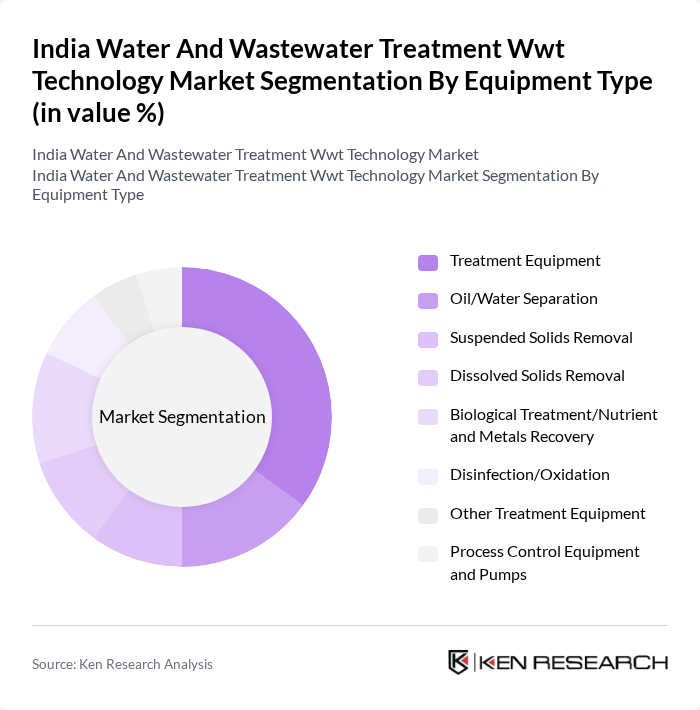
By Equipment Type:The equipment type segmentation includes various subsegments such as Treatment Equipment, Oil/Water Separation, Suspended Solids Removal, Dissolved Solids Removal, Biological Treatment/Nutrient and Metals Recovery, Disinfection/Oxidation, Other Treatment Equipment, and Process Control Equipment and Pumps. Among these, Treatment Equipment is the leading subsegment, driven by the increasing need for efficient and effective water treatment solutions across various industries. The market also sees rising adoption of compact, energy-efficient, and decentralized treatment systems, particularly in urban and industrial clusters .
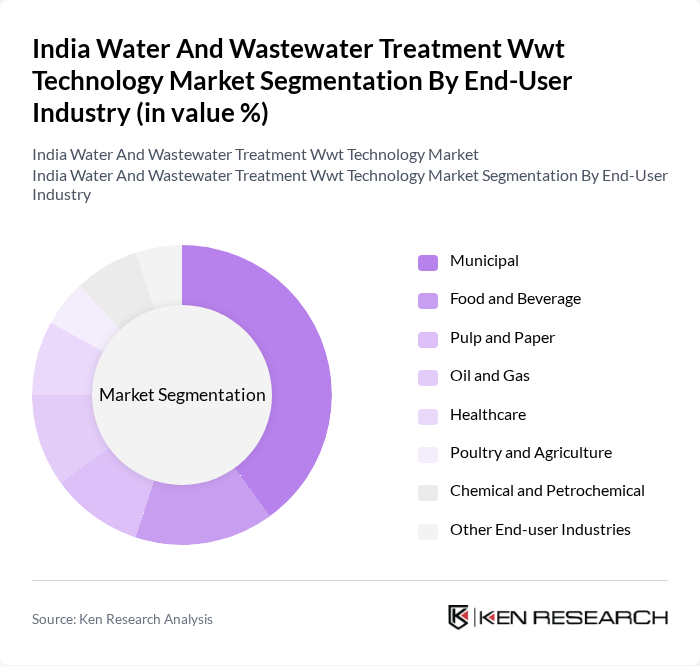
By End-User Industry:The end-user industry segmentation encompasses Municipal, Food and Beverage, Pulp and Paper, Oil and Gas, Healthcare, Poultry and Agriculture, Chemical and Petrochemical, and Other End-user Industries. The Municipal segment is the dominant player in this category, driven by the increasing need for effective wastewater management in urban areas and the government's focus on improving public health through better sanitation and water quality. Industrial end-users, especially in sectors such as textiles, food processing, and chemicals, are increasingly adopting advanced WWT technologies to comply with environmental regulations and to enable water reuse .
The India Water and Wastewater Treatment WWT Technology Market is characterized by a dynamic mix of regional and international players. Leading participants such as Tata Projects Limited, Veolia Water Technologies India, SUEZ India, Thermax Limited, VA Tech WABAG Limited, Ecolab India, Siemens Water Technologies, Aquatech Systems Asia Pvt. Ltd., Pentair Water India, IDE Technologies, KSB Limited, Xylem Water Solutions India, Alfa Laval India, AECOM India, Black & Veatch India contribute to innovation, geographic expansion, and service delivery in this space.
The future of the India water and wastewater treatment market is poised for significant transformation, driven by technological advancements and increasing environmental awareness. The integration of IoT and smart water management solutions is expected to enhance operational efficiency and reduce water wastage. Furthermore, the shift towards decentralized treatment systems will empower local communities, ensuring sustainable water management practices. As public-private partnerships grow, innovative funding models will emerge, facilitating the development of essential infrastructure and services across urban and rural areas.
| Segment | Sub-Segments |
|---|---|
| By Equipment Type | Treatment Equipment Oil/Water Separation Suspended Solids Removal Dissolved Solids Removal Biological Treatment/Nutrient and Metals Recovery Disinfection/Oxidation Other Treatment Equipment Process Control Equipment and Pumps |
| By End-User Industry | Municipal Food and Beverage Pulp and Paper Oil and Gas Healthcare Poultry and Agriculture Chemical and Petrochemical Other End-user Industries |
| By Region | North India South India East India West India |
| By Technology | Activated Sludge Process Membrane Bioreactors Sequencing Batch Reactors Moving Bed Biofilm Reactors Advanced Membrane Filtration Reverse Osmosis Microbial Fuel Cells |
| By Application | Municipal Wastewater Treatment Industrial Wastewater Treatment Water Reuse and Recycling Sludge Treatment |
| By Investment Source | Domestic Investment Foreign Direct Investment (FDI) Public-Private Partnerships (PPP) Government Schemes |
| By Policy Support | Subsidies for Treatment Technologies Tax Exemptions for Water Projects Regulatory Support for Innovations Grants for Research and Development |
| Scope Item/Segment | Sample Size | Target Respondent Profiles |
|---|---|---|
| Municipal Water Treatment Facilities | 100 | Plant Managers, Environmental Engineers |
| Industrial Wastewater Treatment Plants | 80 | Operations Managers, Compliance Officers |
| Technology Providers in Water Treatment | 60 | Product Managers, Sales Directors |
| Government Regulatory Bodies | 40 | Policy Makers, Environmental Scientists |
| Research Institutions and Academia | 50 | Researchers, Professors in Environmental Science |
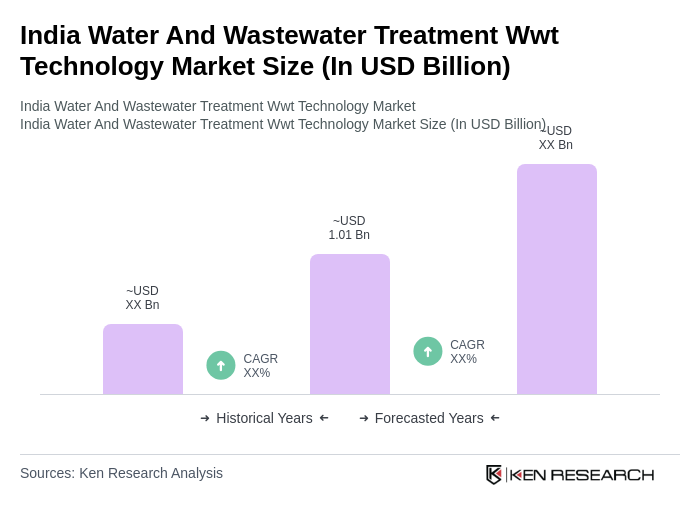
The India Water and Wastewater Treatment (WWT) Technology Market is valued at approximately USD 1.01 billion, driven by urbanization, environmental regulations, and the demand for clean water and effective wastewater management solutions.

What makes us stand out is that our consultants follow Robust, Refine and Result (RRR) methodology. Robust for clear definitions, approaches and sanity checking, Refine for differentiating respondents' facts and opinions, and Result for presenting data with story.

We have set a benchmark in the industry by offering our clients with syndicated and customized market research reports featuring coverage of entire market as well as meticulous research and analyst insights.

While we don't replace traditional research, we flip the method upside down. Our dual approach of Top Bottom & Bottom Top ensures quality deliverable by not just verifying company fundamentals but also looking at the sector and macroeconomic factors.

With one step in the future, our research team constantly tries to show you the bigger picture. We help with some of the tough questions you may encounter along the way: How is the industry positioned? Best marketing channel? KPI's of competitors? By aligning every element, we help maximize success.

Our report gives you instant access to the answers and sources that other companies might choose to hide. We elaborate each steps of research methodology we have used and showcase you the sample size to earn your trust.

If you need any support, we are here! We pride ourselves on universe strength, data quality, and quick, friendly, and professional service.













