








Ken Research Logo

Indonesia Carbon Credit Trading Platform Market Report Size, Share, Growth Drivers, Trends, Opportunities & Forecast 2025–2030

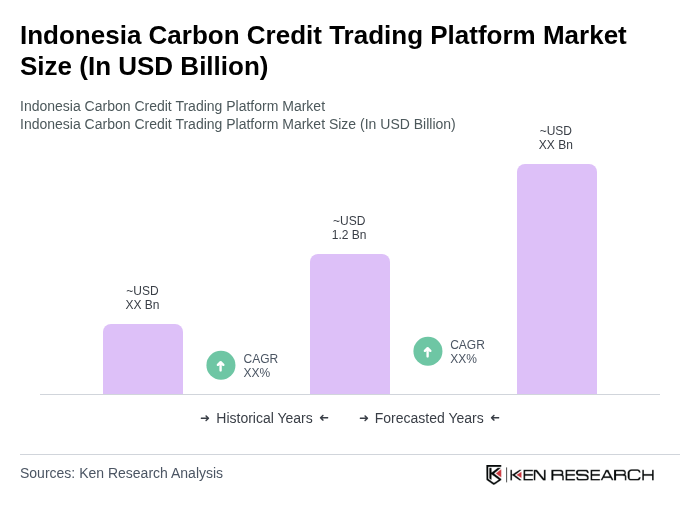
Indonesia Carbon Credit Trading Platform Market at USD 1.2 Bn, fueled by emission regulations and sustainability trends in key sectors like energy and agriculture.

Region:Asia

Author(s):Rebecca

Product Code:KRAD2933

Pages:99

Published On:November 2025
About the Report

Base Year 2024

Indonesia Carbon Credit Trading Platform Market Overview

  • The Indonesia Carbon Credit Trading Platform Market is valued at USD 1.2 billion, based on a five-year historical analysis. This growth is primarily driven by increasing regulatory pressures to reduce greenhouse gas emissions, alongside a growing awareness of climate change among businesses and consumers. The market has seen a surge in participation from various sectors, including energy, manufacturing, and agriculture, as companies seek to offset their carbon footprints. Recent government initiatives and international partnerships have further accelerated market activity, with Indonesia positioning itself as a major supplier of carbon credits in Asia due to its vast forests and renewable energy potential , .
  • Key players in this market include Jakarta, Surabaya, and Bandung, which dominate due to their economic activities and industrial bases. Jakarta, as the capital, is a hub for financial services and corporate headquarters, while Surabaya and Bandung are significant for their manufacturing and agricultural sectors. This concentration of industries creates a robust demand for carbon credits as companies strive to meet sustainability goals. The presence of major carbon exchanges and project developers in these cities further strengthens their influence in the market .
  • In 2023, the Indonesian government implemented the Carbon Pricing Regulation, which mandates that companies exceeding a certain emissions threshold must purchase carbon credits to offset their emissions. This regulation is part of Presidential Regulation No. 110 of 2025 on the Economic Value of Carbon, which formalizes the carbon pricing mechanism and enables both domestic and international trading of carbon credits. The regulation aims to incentivize businesses to adopt cleaner technologies and practices, thereby promoting a transition towards a low-carbon economy , .
Indonesia Carbon Credit Trading Platform Market Size

Indonesia Carbon Credit Trading Platform Market Segmentation

By Credit Type:The market is segmented into Compliance Credits, Voluntary Credits, and Others. Compliance Credits are primarily driven by regulatory requirements, while Voluntary Credits cater to companies looking to enhance their sustainability profiles beyond legal obligations. The Compliance Credits segment is currently leading the market due to stringent government regulations and increasing corporate accountability towards emissions reduction. Indonesia’s national carbon registry, Sistem Registri Nasional (SRN), tracks all compliance and voluntary credits, ensuring transparency and traceability .
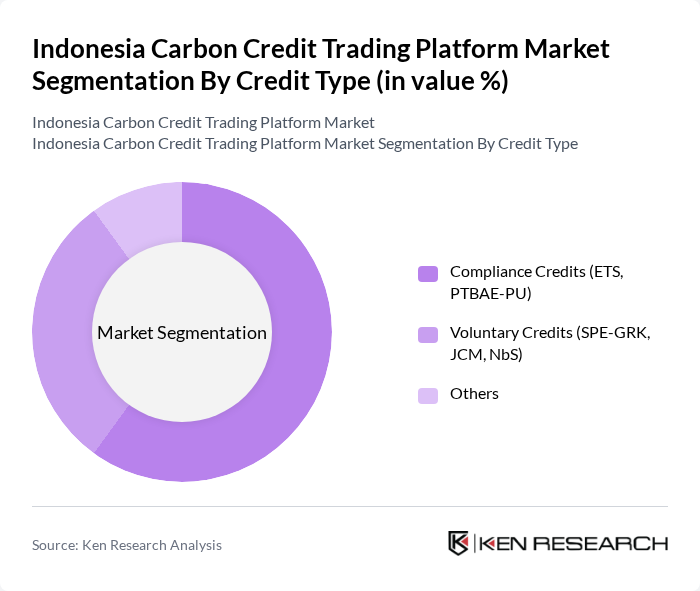
Indonesia Carbon Credit Trading Platform Market segmentation by Credit Type.

By Project Type:The market is categorized into Renewable Energy, Nature-Based Solutions, Industrial Emission Reduction, Waste Management, and Others. Renewable Energy projects, particularly solar and wind, are gaining traction due to government incentives and technological advancements. Nature-Based Solutions are also significant, as they align with global sustainability goals. The Renewable Energy segment is currently the dominant force in the market, driven by increasing investments and public interest in sustainable energy sources. Indonesia’s vast forest and peatland resources also support a growing number of nature-based carbon projects, which are increasingly sought after by international buyers , .
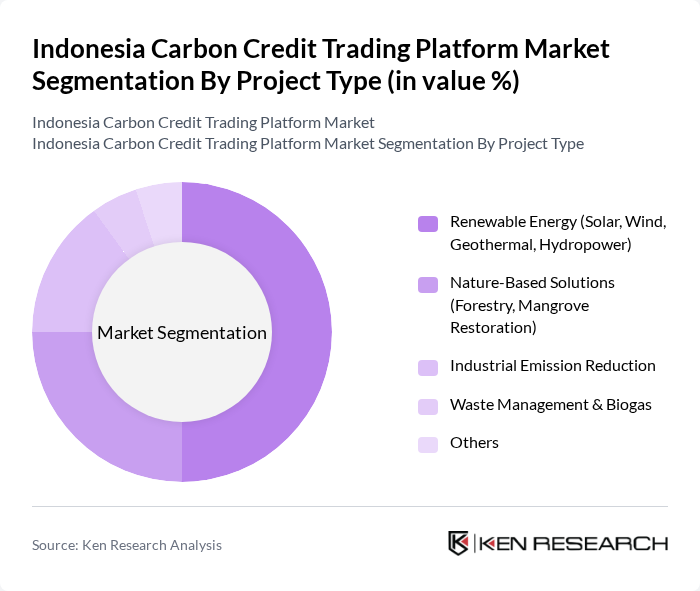
Indonesia Carbon Credit Trading Platform Market segmentation by Project Type.

Indonesia Carbon Credit Trading Platform Market Competitive Landscape

The Indonesia Carbon Credit Trading Platform Market is characterized by a dynamic mix of regional and international players. Leading participants such as IDX Carbon (PT Bursa Efek Indonesia), CarbonX, AirCarbon Exchange (ACX Indonesia), Star Energy Geothermal, PT Pertamina (Persero), PT PLN (Persero), PT Rimba Makmur Utama, PT Mitra Hijau Indonesia, South Pole Indonesia, PT BioFuels Indonesia, PT Dharma Satya Nusantara Tbk, PT Bumi Hijau Lestari, PT Restorasi Ekosistem Riau, PT Indika Energy Tbk, PT Katingan Mentaya Project contribute to innovation, geographic expansion, and service delivery in this space.

IDX Carbon (PT Bursa Efek Indonesia)

1992

Jakarta, Indonesia

CarbonX

2018

Jakarta, Indonesia

AirCarbon Exchange (ACX Indonesia)

2019

Jakarta, Indonesia

Star Energy Geothermal

2007

Jakarta, Indonesia

PT Pertamina (Persero)

1957

Jakarta, Indonesia

Company

Establishment Year

Headquarters

Group Size (Large, Medium, or Small as per industry convention)

Revenue Growth Rate

Market Share (by volume and value of credits traded)

Carbon Credit Volume Traded (tonnes CO?e per year)

Average Transaction Value

Number of Registered Projects

Indonesia Carbon Credit Trading Platform Market Industry Analysis

Growth Drivers

  • Increasing Environmental Awareness:The Indonesian population's environmental awareness has surged, with 75% of citizens recognizing climate change as a critical issue. This awareness drives demand for carbon credits, as individuals and businesses seek to offset their carbon footprints. The government reported a 35% increase in participation in carbon offset programs from the previous year, indicating a growing commitment to sustainable practices and environmental responsibility among both consumers and corporations.
  • Government Initiatives for Carbon Reduction:The Indonesian government has set ambitious targets to reduce greenhouse gas emissions by 29% in future, supported by the Nationally Determined Contributions (NDC). In future, the government allocated IDR 6 trillion (approximately USD 400 million) to fund carbon reduction projects. These initiatives create a favorable regulatory environment for carbon credit trading, encouraging investments in sustainable technologies and practices that align with national goals for climate action.
  • Rising Demand for Sustainable Practices:As global corporations increasingly adopt sustainability goals, Indonesian businesses are following suit. In future, over 65% of large companies in Indonesia reported implementing sustainability initiatives, up from 50% in the previous year. This shift is driven by both consumer demand and international pressure, leading to a significant increase in the purchase of carbon credits to meet corporate social responsibility (CSR) objectives and enhance brand reputation in the global market.

Market Challenges

  • Regulatory Uncertainty:The carbon credit trading landscape in Indonesia faces significant regulatory uncertainty, with frequent changes in policies and guidelines. In future, only 45% of businesses reported a clear understanding of the regulatory framework governing carbon credits. This lack of clarity hampers investment decisions and creates hesitancy among potential market participants, ultimately stifling the growth of the carbon credit trading platform.
  • Infrastructure Limitations:Indonesia's infrastructure for carbon credit trading is still developing, with only 30% of the necessary digital platforms and trading systems in place as of future. This limitation affects the efficiency and accessibility of trading processes, making it challenging for smaller companies to participate. The lack of robust infrastructure also leads to increased transaction costs, further deterring potential investors from entering the market.

Indonesia Carbon Credit Trading Platform Market Future Outlook

The future of the carbon credit trading platform in Indonesia appears promising, driven by increasing environmental awareness and government support for sustainable practices. As more businesses adopt sustainability goals, the demand for carbon credits is expected to rise significantly. Additionally, advancements in technology and digital trading platforms will enhance market accessibility and efficiency, fostering greater participation. Collaborative efforts with international bodies will further strengthen Indonesia's position in the global carbon market, paving the way for innovative solutions and investment opportunities.

Market Opportunities

  • Technological Advancements:The integration of blockchain technology in carbon credit trading can enhance transparency and traceability. In future, it is projected that 20% of carbon transactions in Indonesia will utilize blockchain, improving trust among stakeholders and reducing fraud. This technological shift presents a significant opportunity for new entrants to develop innovative trading platforms that cater to the evolving market needs.
  • Expansion of Carbon Markets:The expansion of regional carbon markets in Southeast Asia presents a unique opportunity for Indonesia. With neighboring countries like Malaysia and Thailand developing their carbon trading systems, Indonesia can leverage this trend to create cross-border trading opportunities. In future, it is anticipated that regional carbon trading could increase by 25%, providing Indonesian companies with access to larger markets and enhanced liquidity.

Scope of the Report

SegmentSub-Segments
By Credit Type (Compliance, Voluntary)

Compliance Credits (ETS, PTBAE-PU)

Voluntary Credits (SPE-GRK, JCM, NbS)

Others

By Project Type (Renewable Energy, Nature-Based Solutions, Industrial, Waste Management)

Renewable Energy (Solar, Wind, Geothermal, Hydropower)

Nature-Based Solutions (Forestry, Mangrove Restoration)

Industrial Emission Reduction

Waste Management & Biogas

Others

By End-User (Utilities, Financial Institutions, Corporates, Government, Others)

Utilities

Financial Institutions

Corporates

Government

Others

By Platform Type (Exchange, OTC, Auction)

Exchange (IDX Carbon)

Over-the-Counter (OTC)

Auction

Others

By Region (Java, Sumatra, Kalimantan, Sulawesi, Bali, Nusa Tenggara)

Java

Sumatra

Kalimantan

Sulawesi

Bali

Nusa Tenggara

By Investment Source (Domestic, FDI, PPP, Government Schemes)

Domestic

Foreign Direct Investment (FDI)

Public-Private Partnerships (PPP)

Government Schemes

Others

By Policy Support (Subsidies, Tax Exemptions, RECs)

Subsidies

Tax Exemptions

Renewable Energy Certificates (RECs)

Others

Key Target Audience

Investors and Venture Capitalist Firms

Government and Regulatory Bodies (e.g., Ministry of Environment and Forestry, Financial Services Authority)

Carbon Credit Project Developers

Environmental NGOs and Advocacy Groups

Corporate Sustainability Officers

Energy Producers and Utilities

Carbon Market Exchanges

Financial Institutions and Banks

Players Mentioned in the Report:

IDX Carbon (PT Bursa Efek Indonesia)

CarbonX

AirCarbon Exchange (ACX Indonesia)

Star Energy Geothermal

PT Pertamina (Persero)

PT PLN (Persero)

PT Rimba Makmur Utama

PT Mitra Hijau Indonesia

South Pole Indonesia

PT BioFuels Indonesia

PT Dharma Satya Nusantara Tbk

PT Bumi Hijau Lestari

PT Restorasi Ekosistem Riau

PT Indika Energy Tbk

PT Katingan Mentaya Project

Table of Contents

Market Assessment Phase

1. Executive Summary and Approach


2. Indonesia Carbon Credit Trading Platform Market Overview

2.1 Key Insights and Strategic Recommendations

2.2 Indonesia Carbon Credit Trading Platform Market Overview

2.3 Definition and Scope

2.4 Evolution of Market Ecosystem

2.5 Timeline of Key Regulatory Milestones

2.6 Value Chain & Stakeholder Mapping

2.7 Business Cycle Analysis

2.8 Policy & Incentive Landscape


3. Indonesia Carbon Credit Trading Platform Market Analysis

3.1 Growth Drivers

3.1.1 Increasing Environmental Awareness
3.1.2 Government Initiatives for Carbon Reduction
3.1.3 Rising Demand for Sustainable Practices
3.1.4 International Market Integration

3.2 Market Challenges

3.2.1 Regulatory Uncertainty
3.2.2 Limited Market Awareness
3.2.3 Infrastructure Limitations
3.2.4 Price Volatility

3.3 Market Opportunities

3.3.1 Technological Advancements
3.3.2 Expansion of Carbon Markets
3.3.3 Collaboration with International Bodies
3.3.4 Development of New Trading Platforms

3.4 Market Trends

3.4.1 Growth of Digital Trading Platforms
3.4.2 Increased Corporate Sustainability Goals
3.4.3 Focus on Renewable Energy Projects
3.4.4 Enhanced Data Analytics for Trading

3.5 Government Regulation

3.5.1 National Carbon Pricing Policy
3.5.2 Emission Reduction Targets
3.5.3 Carbon Credit Certification Standards
3.5.4 Incentives for Green Investments

4. SWOT Analysis


5. Stakeholder Analysis


6. Porter's Five Forces Analysis


7. Indonesia Carbon Credit Trading Platform Market Size, 2019-2024

7.1 By Value

7.2 By Volume

7.3 By Average Selling Price


8. Indonesia Carbon Credit Trading Platform Market Segmentation

8.1 By Credit Type (Compliance, Voluntary)

8.1.1 Compliance Credits (ETS, PTBAE-PU)
8.1.2 Voluntary Credits (SPE-GRK, JCM, NbS)
8.1.3 Others

8.2 By Project Type (Renewable Energy, Nature-Based Solutions, Industrial, Waste Management)

8.2.1 Renewable Energy (Solar, Wind, Geothermal, Hydropower)
8.2.2 Nature-Based Solutions (Forestry, Mangrove Restoration)
8.2.3 Industrial Emission Reduction
8.2.4 Waste Management & Biogas
8.2.5 Others

8.3 By End-User (Utilities, Financial Institutions, Corporates, Government, Others)

8.3.1 Utilities
8.3.2 Financial Institutions
8.3.3 Corporates
8.3.4 Government
8.3.5 Others

8.4 By Platform Type (Exchange, OTC, Auction)

8.4.1 Exchange (IDX Carbon)
8.4.2 Over-the-Counter (OTC)
8.4.3 Auction
8.4.4 Others

8.5 By Region (Java, Sumatra, Kalimantan, Sulawesi, Bali, Nusa Tenggara)

8.5.1 Java
8.5.2 Sumatra
8.5.3 Kalimantan
8.5.4 Sulawesi
8.5.5 Bali
8.5.6 Nusa Tenggara

8.6 By Investment Source (Domestic, FDI, PPP, Government Schemes)

8.6.1 Domestic
8.6.2 Foreign Direct Investment (FDI)
8.6.3 Public-Private Partnerships (PPP)
8.6.4 Government Schemes
8.6.5 Others

8.7 By Policy Support (Subsidies, Tax Exemptions, RECs)

8.7.1 Subsidies
8.7.2 Tax Exemptions
8.7.3 Renewable Energy Certificates (RECs)
8.7.4 Others

9. Indonesia Carbon Credit Trading Platform Market Competitive Analysis

9.1 Market Share of Key Players(Micro, Small, Medium, Large Enterprises)

9.2 KPIs for Cross Comparison of Key Players

9.2.1 Company Name
9.2.2 Group Size (Large, Medium, or Small as per industry convention)
9.2.3 Revenue Growth Rate
9.2.4 Market Share (by volume and value of credits traded)
9.2.5 Carbon Credit Volume Traded (tonnes CO?e per year)
9.2.6 Average Transaction Value
9.2.7 Number of Registered Projects
9.2.8 Customer Base (number of active buyers/sellers)
9.2.9 Compliance Rate with Regulations
9.2.10 Platform Uptime/Transaction Reliability (%)
9.2.11 International Connectivity (number of cross-border transactions)
9.2.12 Customer Acquisition Cost
9.2.13 Customer Retention Rate
9.2.14 Pricing Strategy

9.3 SWOT Analysis of Top Players

9.4 Pricing Analysis(By Class and Payload)

9.5 Detailed Profile of Major Companies

9.5.1 IDX Carbon (PT Bursa Efek Indonesia)
9.5.2 CarbonX
9.5.3 AirCarbon Exchange (ACX Indonesia)
9.5.4 Star Energy Geothermal
9.5.5 PT Pertamina (Persero)
9.5.6 PT PLN (Persero)
9.5.7 PT Rimba Makmur Utama
9.5.8 PT Mitra Hijau Indonesia
9.5.9 South Pole Indonesia
9.5.10 PT BioFuels Indonesia
9.5.11 PT Dharma Satya Nusantara Tbk
9.5.12 PT Bumi Hijau Lestari
9.5.13 PT Restorasi Ekosistem Riau
9.5.14 PT Indika Energy Tbk
9.5.15 PT Katingan Mentaya Project

10. Indonesia Carbon Credit Trading Platform Market End-User Analysis

10.1 Procurement Behavior of Key Ministries

10.1.1 Ministry of Environment and Forestry
10.1.2 Ministry of Energy and Mineral Resources
10.1.3 Ministry of Industry
10.1.4 Ministry of Finance

10.2 Corporate Spend on Infrastructure & Energy

10.2.1 Investment in Renewable Energy Projects
10.2.2 Budget Allocation for Carbon Credits
10.2.3 Expenditure on Sustainability Initiatives
10.2.4 Funding for Research and Development

10.3 Pain Point Analysis by End-User Category

10.3.1 Industrial Sector Challenges
10.3.2 Government Sector Challenges
10.3.3 Commercial Sector Challenges
10.3.4 Residential Sector Challenges

10.4 User Readiness for Adoption

10.4.1 Awareness of Carbon Credit Benefits
10.4.2 Readiness to Invest in Carbon Credits
10.4.3 Training and Education Needs
10.4.4 Technological Adoption Levels

10.5 Post-Deployment ROI and Use Case Expansion

10.5.1 Measurement of Carbon Offset Achievements
10.5.2 Expansion into New Markets
10.5.3 Long-term Sustainability Benefits
10.5.4 Case Studies of Successful Implementations

11. Indonesia Carbon Credit Trading Platform Market Future Size, 2025-2030

11.1 By Value

11.2 By Volume

11.3 By Average Selling Price


Go-To-Market Strategy Phase

1. Whitespace Analysis + Business Model Canvas

1.1 Market Gaps Identification

1.2 Business Model Development


2. Marketing and Positioning Recommendations

2.1 Branding Strategies

2.2 Product USPs


3. Distribution Plan

3.1 Urban Retail vs Rural NGO Tie-ups


4. Channel & Pricing Gaps

4.1 Underserved Routes

4.2 Pricing Bands


5. Unmet Demand & Latent Needs

5.1 Category Gaps

5.2 Consumer Segments


6. Customer Relationship

6.1 Loyalty Programs

6.2 After-sales Service


7. Value Proposition

7.1 Sustainability

7.2 Integrated Supply Chains


8. Key Activities

8.1 Regulatory Compliance

8.2 Branding

8.3 Distribution Setup


9. Entry Strategy Evaluation

9.1 Domestic Market Entry Strategy

9.1.1 Product Mix
9.1.2 Pricing Band
9.1.3 Packaging

9.2 Export Entry Strategy

9.2.1 Target Countries
9.2.2 Compliance Roadmap

10. Entry Mode Assessment

10.1 Joint Ventures

10.2 Greenfield Investments

10.3 Mergers & Acquisitions

10.4 Distributor Model


11. Capital and Timeline Estimation

11.1 Capital Requirements

11.2 Timelines


12. Control vs Risk Trade-Off

12.1 Ownership vs Partnerships


13. Profitability Outlook

13.1 Breakeven Analysis

13.2 Long-term Sustainability


14. Potential Partner List

14.1 Distributors

14.2 Joint Ventures

14.3 Acquisition Targets


15. Execution Roadmap

15.1 Phased Plan for Market Entry

15.1.1 Market Setup
15.1.2 Market Entry
15.1.3 Growth Acceleration
15.1.4 Scale & Stabilize

15.2 Key Activities and Milestones

15.2.1 Milestone Planning
15.2.2 Activity Tracking

Research Methodology

ApproachModellingSample

Phase 1: Approach1

Desk Research

  • Analysis of government publications on carbon credit regulations and policies in Indonesia
  • Review of market reports from environmental NGOs and industry associations
  • Examination of academic journals and white papers on carbon trading mechanisms and market dynamics

Primary Research

  • Interviews with policymakers from the Ministry of Environment and Forestry
  • Surveys with carbon credit project developers and registries
  • Focus groups with corporate sustainability officers from major Indonesian industries

Validation & Triangulation

  • Cross-validation of findings with international carbon market trends and case studies
  • Triangulation of data from regulatory bodies, industry reports, and expert opinions
  • Sanity checks through feedback from a panel of environmental economists

Phase 2: Market Size Estimation1

Top-down Assessment

  • Estimation of total carbon emissions in Indonesia and potential credit generation based on forestry ministry projections of 13.4 billion tonnes CO? equivalent by 2050
  • Analysis of historical trading volumes and pricing trends in existing carbon markets
  • Incorporation of national climate commitments and international agreements affecting market size, including PR 110/2025 framework

Bottom-up Modeling

  • Data collection from carbon credit projects across various sectors (forestry, agriculture, energy) with focus on 40 projects presented at COP30
  • Cost analysis of project implementation and expected revenue from carbon credits with potential annual income ranging from $2.8 billion to $8.6 billion
  • Volume estimates based on project-specific emission reductions and market demand, targeting 90 million credits from certified projects

Forecasting & Scenario Analysis

  • Multi-variable forecasting using economic growth, regulatory changes including PR 110/2025 implementation, and environmental policies
  • Scenario modeling based on varying levels of market participation and international cooperation following the lifting of the four-year international trading ban
  • Development of baseline, optimistic, and pessimistic market projections through 2030

Phase 3: CATI Sample Composition1

Scope Item/SegmentSample SizeTarget Respondent Profiles
Government Policy Makers45Regulatory Officials, Environmental Policy Advisors
Carbon Credit Project Developers38Project Managers, Sustainability Consultants
Corporate Sustainability Officers42CSR Managers, Environmental Compliance Officers
Financial Institutions Involved in Carbon Trading35Investment Analysts, Risk Management Officers
Environmental NGOs and Advocacy Groups28Research Analysts, Program Directors

Frequently Asked Questions

What is the current value of the Indonesia Carbon Credit Trading Platform Market?

The Indonesia Carbon Credit Trading Platform Market is valued at approximately USD 1.2 billion, reflecting significant growth driven by regulatory pressures and increased awareness of climate change among businesses and consumers.

What are the main drivers of growth in the Indonesia Carbon Credit Trading Market?

What types of carbon credits are available in Indonesia?

Which sectors are actively participating in the carbon credit market in Indonesia?

Other Regional/Country Reports

Malaysia Carbon Credit Trading Platform Market

KSA Carbon Credit Trading Platform Market

APAC Carbon Credit Trading Platform Market

SEA Carbon Credit Trading Platform Market

Vietnam Carbon Credit Trading Platform Market

Thailand Carbon Credit Trading Platform Market

Other Adjacent Reports

Oman Renewable Energy Market

Oman Emissions Trading Market

Thailand Sustainability Consulting Market

Malaysia Carbon Offset Project Market

KSA Environmental Monitoring Market

Oman Green Finance Market

Malaysia Climate Adaptation Services Market

South Korea Forestry Management Market

Thailand Clean Technology Market

Japan ESG Reporting Market

Why Buy From Us?

Refine Robust Result (RRR) Framework

What makes us stand out is that our consultants follow Robust, Refine and Result (RRR) methodology. Robust for clear definitions, approaches and sanity checking, Refine for differentiating respondents' facts and opinions, and Result for presenting data with story.

Our Reach Is Unmatched

We have set a benchmark in the industry by offering our clients with syndicated and customized market research reports featuring coverage of entire market as well as meticulous research and analyst insights.

Shifting the Research Paradigm

While we don't replace traditional research, we flip the method upside down. Our dual approach of Top Bottom & Bottom Top ensures quality deliverable by not just verifying company fundamentals but also looking at the sector and macroeconomic factors.

More Insights-Better Decisions

With one step in the future, our research team constantly tries to show you the bigger picture. We help with some of the tough questions you may encounter along the way: How is the industry positioned? Best marketing channel? KPI's of competitors? By aligning every element, we help maximize success.

Transparency and Trust

Our report gives you instant access to the answers and sources that other companies might choose to hide. We elaborate each steps of research methodology we have used and showcase you the sample size to earn your trust.

Round the Clock Support

If you need any support, we are here! We pride ourselves on universe strength, data quality, and quick, friendly, and professional service.

Why Clients Choose Us?

400000+
Reports in repository
150+
Consulting projects a year
100+
Analysts
8000+
Client Queries in 2022