About the Report
Base Year 2024Indonesia Detergent Market Overview
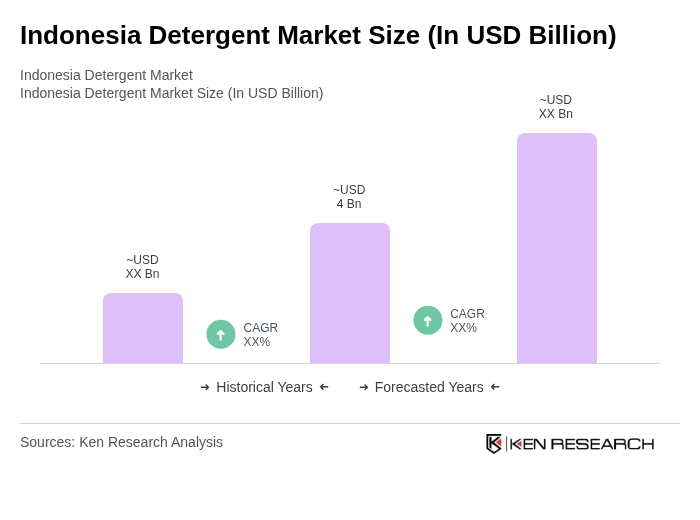
- The Indonesia Detergent Market is valued at USD 4 billion, based on a five-year historical analysis. This growth is primarily driven by increasing urbanization, rising disposable incomes, a growing awareness of hygiene and cleanliness among consumers, and the global expansion of washing machine usage with penetration rates rising annually in developing nations.
- Key cities such as Jakarta, Surabaya, and Bandung dominate the market due to their large populations and significant economic activities. These urban centers have a high concentration of retail outlets and e-commerce platforms, making it easier for consumers to access a wide range of detergent products. The increasing number of households and commercial establishments in these cities further fuels market growth.
- The Ministry of Environment and Forestry Regulation No. P.15/MENLHK/SETJEN/KUM.1/7/2019, issued by the Ministry of Environment and Forestry in 2019, regulates the management of phosphate waste from household and industrial detergents. It mandates phosphate content limits in detergents at no more than 7% by weight for household use and requires manufacturers to obtain environmental permits, conduct waste treatment, and comply with effluent standards for discharge into water bodies to minimize environmental pollution.
Indonesia Detergent Market Segmentation
By Type:The detergent market can be segmented into various types, including Powder Detergents, Liquid Detergents, Bar Detergents, Fabric Softeners & Conditioners, Stain Removers & Bleach, and Laundry Pods and Specialty Products. Among these, Powder Detergents capture maximum volume share due to their cost effectiveness and environmentally friendly packaging, while Liquid Detergents have gained significant popularity due to their convenience and effectiveness, particularly in urban households. The trend towards liquid formulations is driven by consumer preferences for easy-to-use products that dissolve quickly and provide superior cleaning performance.

By End-User:The end-user segmentation includes Residential, Commercial (Laundromats, Hotels, Hospitals), Industrial (Textile, Garment Manufacturing), Institutional (Government, Military, Schools), and Others. The Residential segment is the largest, driven by the increasing number of households, the growing trend of laundry services in urban areas, and consistently improving cleanliness and hygiene standards. Consumers are increasingly opting for convenient and effective cleaning solutions, which has led to a rise in demand for various detergent products tailored for home use.

Indonesia Detergent Market Competitive Landscape
The Indonesia Detergent Market is characterized by a dynamic mix of regional and international players. Leading participants such as Unilever Indonesia (PT. Unilever Indonesia Tbk), Procter & Gamble Indonesia (PT. Procter & Gamble Indonesia), PT. Kao Indonesia, PT. Wings Surya, PT. Reckitt Benckiser Indonesia, PT. Citra Sukses Mandiri, PT. Bina Karya Prima, PT. Darya-Varia Laboratoria Tbk, PT. Sumber Alfaria Trijaya Tbk, PT. Sido Muncul, PT. Bintang Toedjoe, PT. Kimia Farma, PT. Tjiwi Kimia Tbk contribute to innovation, geographic expansion, and service delivery in this space.
Indonesia Detergent Market Industry Analysis
Growth Drivers
- Increasing Urbanization:Indonesia's urban population is projected to reach 56% in future, up from 54% in 2020, according to the World Bank. This urbanization trend drives demand for household products, including detergents, as urban dwellers typically have higher consumption rates. The rise in urban living standards correlates with increased laundry frequency and a preference for convenience, further boosting detergent sales. Urban areas also provide better access to retail channels, enhancing product availability and consumer choice.
- Rising Disposable Income:The World Bank estimates that Indonesia's GDP per capita will increase to approximately $4,500 in future, up from $4,200 in 2020. This rise in disposable income allows consumers to spend more on quality household products, including premium detergents. As families experience improved financial conditions, they are more likely to invest in higher-priced, effective cleaning solutions, thus driving market growth. Increased purchasing power also leads to a shift towards branded products over generic alternatives.
- Growing Awareness of Hygiene:The COVID-19 pandemic has significantly heightened awareness of hygiene practices among Indonesian consumers. A survey by the Indonesian Ministry of Health indicated that 78% of households increased their cleaning routines in future. This heightened focus on cleanliness has led to a surge in detergent consumption, as consumers prioritize products that ensure effective cleaning and sanitation. The demand for specialized detergents, such as antibacterial and hypoallergenic options, is also on the rise, reflecting this trend.
Market Challenges
- Intense Competition:The Indonesian detergent market is characterized by fierce competition, with over 50 brands vying for market share. Major players like Unilever and Procter & Gamble dominate, but numerous local brands also compete aggressively. This saturation leads to price wars, which can erode profit margins. According to industry reports, the top five brands account for only 40% of the market, indicating a fragmented landscape where new entrants can disrupt established players, complicating market dynamics.
- Price Sensitivity Among Consumers:A significant portion of the Indonesian population remains price-sensitive, with approximately 30% of households earning less than $2,000 annually. This economic reality forces consumers to prioritize affordability over brand loyalty. As a result, many consumers opt for lower-priced alternatives, impacting the sales of premium detergent brands. Companies must navigate this challenge by offering competitive pricing strategies while maintaining product quality to retain market share in a cost-conscious environment.
Indonesia Detergent Market Future Outlook
The Indonesian detergent market is poised for continued growth, driven by urbanization, rising incomes, and heightened hygiene awareness. As consumers increasingly seek convenience and quality, brands that innovate and adapt to changing preferences will thrive. The shift towards eco-friendly products and the expansion of e-commerce platforms will further shape the market landscape. Companies that leverage digital marketing and invest in sustainable practices are likely to capture emerging consumer segments, ensuring long-term success in this dynamic environment.
Market Opportunities
- Eco-friendly Product Demand:With growing environmental concerns, the demand for eco-friendly detergents is on the rise. A report from the Indonesian Ministry of Environment indicates that 65% of consumers are willing to pay more for sustainable products. This trend presents a significant opportunity for brands to develop biodegradable and non-toxic detergents, catering to environmentally conscious consumers and enhancing brand loyalty.
- E-commerce Growth:E-commerce in Indonesia is expected to reach $53 billion in future, according to Statista. This rapid growth offers detergent brands a chance to expand their online presence and reach a broader audience. By investing in digital marketing and optimizing online sales channels, companies can tap into the increasing preference for online shopping, particularly among younger consumers who prioritize convenience and accessibility.
Scope of the Report
| Segment | Sub-Segments |
|---|---|
| By Type | Powder Detergents Liquid Detergents Bar Detergents Fabric Softeners & Conditioners Stain Removers & Bleach Laundry Pods and Specialty Products |
| By End-User | Residential Commercial (Laundromats, Hotels, Hospitals) Industrial (Textile, Garment Manufacturing) Institutional (Government, Military, Schools) Others |
| By Packaging Type | Bottles Pouches/Sachets Boxes/Cartons Tubs Others |
| By Distribution Channel | Supermarkets/Hypermarkets Convenience Stores Online Retail/E-commerce Traditional Retail (Warungs, Wet Markets) Direct Sales |
| By Price Range | Economy Mid-range Premium Luxury |
| By Brand Type | National Brands Private Labels Local Brands Others |
| By Product Formulation | Synthetic Detergents Herbal Detergents Organic Detergents Multifunctional Detergents Sensitive Skin Detergents |
Key Target Audience
Investors and Venture Capitalist Firms
Government and Regulatory Bodies (e.g., Badan Pengawas Obat dan Makanan, Kementerian Perindustrian)
Manufacturers and Producers
Distributors and Retailers
Raw Material Suppliers
Packaging Companies
Industry Associations (e.g., Asosiasi Perusahaan Detergen Indonesia)
Financial Institutions
Players Mentioned in the Report:
Unilever Indonesia (PT. Unilever Indonesia Tbk)
Procter & Gamble Indonesia (PT. Procter & Gamble Indonesia)
PT. Kao Indonesia
PT. Wings Surya
PT. Reckitt Benckiser Indonesia
PT. Citra Sukses Mandiri
PT. Bina Karya Prima
PT. Darya-Varia Laboratoria Tbk
PT. Sumber Alfaria Trijaya Tbk
PT. Sido Muncul
PT. Bintang Toedjoe
PT. Kimia Farma
PT. Tjiwi Kimia Tbk
Table of Contents
Market Assessment Phase
1. Executive Summary and Approach
2. Indonesia Detergent Market Overview
2.1 Key Insights and Strategic Recommendations
2.2 Indonesia Detergent Market Overview
2.3 Definition and Scope
2.4 Evolution of Market Ecosystem
2.5 Timeline of Key Regulatory Milestones
2.6 Value Chain & Stakeholder Mapping
2.7 Business Cycle Analysis
2.8 Policy & Incentive Landscape
3. Indonesia Detergent Market Analysis
3.1 Growth Drivers
3.1.1 Increasing Urbanization
3.1.2 Rising Disposable Income
3.1.3 Growing Awareness of Hygiene
3.1.4 Expansion of Retail Channels
3.2 Market Challenges
3.2.1 Intense Competition
3.2.2 Price Sensitivity Among Consumers
3.2.3 Regulatory Compliance Costs
3.2.4 Supply Chain Disruptions
3.3 Market Opportunities
3.3.1 Eco-friendly Product Demand
3.3.2 E-commerce Growth
3.3.3 Product Innovation
3.3.4 Expansion into Rural Markets
3.4 Market Trends
3.4.1 Shift Towards Liquid Detergents
3.4.2 Increased Focus on Sustainability
3.4.3 Rise of Private Label Brands
3.4.4 Digital Marketing Strategies
3.5 Government Regulation
3.5.1 Environmental Protection Standards
3.5.2 Labeling Requirements
3.5.3 Import Tariffs on Raw Materials
3.5.4 Safety Regulations for Chemicals
4. SWOT Analysis
5. Stakeholder Analysis
6. Porter's Five Forces Analysis
7. Indonesia Detergent Market Market Size, 2019-2024
7.1 By Value
7.2 By Volume
7.3 By Average Selling Price
8. Indonesia Detergent Market Segmentation
8.1 By Type
8.1.1 Powder Detergents
8.1.2 Liquid Detergents
8.1.3 Bar Detergents
8.1.4 Fabric Softeners & Conditioners
8.1.5 Stain Removers & Bleach
8.1.6 Laundry Pods and Specialty Products
8.2 By End-User
8.2.1 Residential
8.2.2 Commercial (Laundromats, Hotels, Hospitals)
8.2.3 Industrial (Textile, Garment Manufacturing)
8.2.4 Institutional (Government, Military, Schools)
8.2.5 Others
8.3 By Packaging Type
8.3.1 Bottles
8.3.2 Pouches/Sachets
8.3.3 Boxes/Cartons
8.3.4 Tubs
8.3.5 Others
8.4 By Distribution Channel
8.4.1 Supermarkets/Hypermarkets
8.4.2 Convenience Stores
8.4.3 Online Retail/E-commerce
8.4.4 Traditional Retail (Warungs, Wet Markets)
8.4.5 Direct Sales
8.5 By Price Range
8.5.1 Economy
8.5.2 Mid-range
8.5.3 Premium
8.5.4 Luxury
8.6 By Brand Type
8.6.1 National Brands
8.6.2 Private Labels
8.6.3 Local Brands
8.6.4 Others
8.7 By Product Formulation
8.7.1 Synthetic Detergents
8.7.2 Herbal Detergents
8.7.3 Organic Detergents
8.7.4 Multifunctional Detergents
8.7.5 Sensitive Skin Detergents
9. Indonesia Detergent Market Competitive Analysis
9.1 Market Share of Key Players
9.2 Cross Comparison of Key Players
9.2.1 Company Name
9.2.2 Group Size (Large, Medium, or Small as per industry convention)
9.2.3 Revenue Growth Rate (Year-on-Year %)
9.2.4 Market Share (%)
9.2.5 Distribution Network Coverage (Urban/Rural Penetration %)
9.2.6 Product Portfolio Breadth (Number of SKUs)
9.2.7 E-commerce Sales Contribution (%)
9.2.8 Pricing Strategy (Economy/Mid-range/Premium positioning)
9.2.9 Brand Awareness Score (Consumer Recognition %)
9.2.10 Innovation Index (New Product Launches per Year)
9.3 SWOT Analysis of Top Players
9.4 Pricing Analysis
9.5 Detailed Profile of Major Companies
9.5.1 Unilever Indonesia (PT. Unilever Indonesia Tbk)
9.5.2 Procter & Gamble Indonesia (PT. Procter & Gamble Indonesia)
9.5.3 PT. Kao Indonesia
9.5.4 PT. Wings Surya
9.5.5 PT. Reckitt Benckiser Indonesia
9.5.6 PT. Citra Sukses Mandiri
9.5.7 PT. Bina Karya Prima
9.5.8 PT. Darya-Varia Laboratoria Tbk
9.5.9 PT. Sumber Alfaria Trijaya Tbk
9.5.10 PT. Sido Muncul
9.5.11 PT. Bintang Toedjoe
9.5.12 PT. Kimia Farma
9.5.13 PT. Tjiwi Kimia Tbk
10. Indonesia Detergent Market End-User Analysis
10.1 Procurement Behavior of Key Ministries
10.1.1 Key Procurement Processes
10.1.2 Budget Allocation Trends
10.1.3 Supplier Selection Criteria
10.1.4 Contract Management Practices
10.2 Corporate Spend on Infrastructure & Energy
10.2.1 Investment Trends
10.2.2 Budget Prioritization
10.2.3 Cost Management Strategies
10.2.4 Future Spending Projections
10.3 Pain Point Analysis by End-User Category
10.3.1 Residential Users
10.3.2 Commercial Users
10.3.3 Industrial Users
10.3.4 Institutional Users
10.4 User Readiness for Adoption
10.4.1 Awareness Levels
10.4.2 Adoption Barriers
10.4.3 Training Needs
10.4.4 Support Requirements
10.5 Post-Deployment ROI and Use Case Expansion
10.5.1 ROI Measurement Techniques
10.5.2 Use Case Success Stories
10.5.3 Expansion Opportunities
10.5.4 Feedback Mechanisms
11. Indonesia Detergent Market Future Size, 2025-2030
11.1 By Value
11.2 By Volume
11.3 By Average Selling Price
Go-To-Market Strategy Phase
1. Whitespace Analysis + Business Model Canvas
1.1 Market Gaps Identification
1.2 Business Model Framework
2. Marketing and Positioning Recommendations
2.1 Branding Strategies
2.2 Product USPs
3. Distribution Plan
3.1 Urban Retail Strategies
3.2 Rural NGO Tie-ups
4. Channel & Pricing Gaps
4.1 Underserved Routes
4.2 Pricing Bands Analysis
5. Unmet Demand & Latent Needs
5.1 Category Gaps
5.2 Consumer Segments
6. Customer Relationship
6.1 Loyalty Programs
6.2 After-sales Service
7. Value Proposition
7.1 Sustainability Initiatives
7.2 Integrated Supply Chains
8. Key Activities
8.1 Regulatory Compliance
8.2 Branding Efforts
8.3 Distribution Setup
9. Entry Strategy Evaluation
9.1 Domestic Market Entry Strategy
9.1.1 Product Mix Considerations
9.1.2 Pricing Band Strategy
9.1.3 Packaging Innovations
9.2 Export Entry Strategy
9.2.1 Target Countries Analysis
9.2.2 Compliance Roadmap
10. Entry Mode Assessment
10.1 Joint Ventures
10.2 Greenfield Investments
10.3 Mergers & Acquisitions
10.4 Distributor Model
11. Capital and Timeline Estimation
11.1 Capital Requirements
11.2 Timelines for Implementation
12. Control vs Risk Trade-Off
12.1 Ownership Considerations
12.2 Partnerships Evaluation
13. Profitability Outlook
13.1 Breakeven Analysis
13.2 Long-term Sustainability Strategies
14. Potential Partner List
14.1 Distributors
14.2 Joint Ventures
14.3 Acquisition Targets
15. Execution Roadmap
15.1 Phased Plan for Market Entry
15.1.1 Market Setup
15.1.2 Market Entry
15.1.3 Growth Acceleration
15.1.4 Scale & Stabilize
15.2 Key Activities and Milestones
Research Methodology
Phase 1: Approach1
Desk Research
- Analysis of industry reports from the Indonesian Chemical Association and relevant government publications
- Review of market trends and consumer behavior studies published by local research firms
- Examination of trade statistics and import/export data from the Central Bureau of Statistics of Indonesia
Primary Research
- Interviews with key stakeholders in the detergent manufacturing sector, including production managers and marketing directors
- Surveys conducted with retailers and distributors to understand market dynamics and consumer preferences
- Focus group discussions with end-users to gather insights on product usage and brand perception
Validation & Triangulation
- Cross-validation of findings through comparison with historical sales data and market reports
- Triangulation of insights from primary interviews with secondary data sources to ensure consistency
- Sanity checks through expert reviews from industry veterans and academic professionals
Phase 2: Market Size Estimation1
Top-down Assessment
- Estimation of total market size based on national consumption data and demographic trends
- Segmentation of the market by product type (liquid, powder, and bar detergents) and end-user applications
- Incorporation of growth rates from related sectors such as household cleaning and personal care
Bottom-up Modeling
- Collection of sales volume data from leading detergent manufacturers operating in Indonesia
- Analysis of pricing strategies and average selling prices across different product categories
- Estimation of market share distribution among key players based on sales and distribution channels
Forecasting & Scenario Analysis
- Development of forecasting models using historical growth rates and market trends
- Scenario analysis based on potential regulatory changes and shifts in consumer preferences towards eco-friendly products
- Creation of multiple growth scenarios (baseline, optimistic, and pessimistic) to project market size through 2030
Phase 3: CATI Sample Composition1
| Scope Item/Segment | Sample Size | Target Respondent Profiles |
|---|---|---|
| Household Detergent Usage | 150 | Household Decision Makers, Consumers |
| Retail Distribution Insights | 100 | Retail Managers, Store Owners |
| Manufacturing Process Feedback | 80 | Production Supervisors, Quality Control Managers |
| Brand Perception Studies | 120 | Marketing Executives, Brand Managers |
| Eco-friendly Product Preferences | 90 | Environmentally Conscious Consumers, Sustainability Advocates |
Frequently Asked Questions
What is the current value of the Indonesia Detergent Market?
The Indonesia Detergent Market is valued at approximately USD 4 billion, driven by factors such as urbanization, rising disposable incomes, and increased awareness of hygiene among consumers. This market is expected to continue growing as washing machine usage expands in the region.
What are the main types of detergents available in Indonesia?
Which cities are the largest markets for detergents in Indonesia?
What regulatory measures affect the detergent industry in Indonesia?
Other Regional/Country Reports
Malaysia Detergent Market Size, Share, Growth Drivers, Trends, Opportunities & Forecast 2025–2030
KSA Detergent Market Size, Share, Growth Drivers, Trends, Opportunities & Forecast 2025–2030
APAC Detergent Market Size, Share, Growth Drivers, Trends, Opportunities & Forecast 2025–2030
SEA Detergent Market Size, Share, Growth Drivers, Trends, Opportunities & Forecast 2025–2030
Vietnam Detergent Market Size, Share, Growth Drivers, Trends, Opportunities & Forecast 2025–2030
Other Adjacent Reports
Germany Fabric Softener Market
Malaysia Laundry Additive Market
Germany Household Cleaner Market
Indonesia Personal Hygiene Product Market
Egypt Surfactant Chemical Market
South Africa Enzyme Ingredient Market
Belgium Packaging Material Market
Brazil E-commerce Retail Market
Mexico Sustainable Product Market
KSA Industrial Cleaning Market
Why Buy From Us?

What makes us stand out is that our consultants follow Robust, Refine and Result (RRR) methodology. Robust for clear definitions, approaches and sanity checking, Refine for differentiating respondents' facts and opinions, and Result for presenting data with story.

We have set a benchmark in the industry by offering our clients with syndicated and customized market research reports featuring coverage of entire market as well as meticulous research and analyst insights.

While we don't replace traditional research, we flip the method upside down. Our dual approach of Top Bottom & Bottom Top ensures quality deliverable by not just verifying company fundamentals but also looking at the sector and macroeconomic factors.

With one step in the future, our research team constantly tries to show you the bigger picture. We help with some of the tough questions you may encounter along the way: How is the industry positioned? Best marketing channel? KPI's of competitors? By aligning every element, we help maximize success.

Our report gives you instant access to the answers and sources that other companies might choose to hide. We elaborate each steps of research methodology we have used and showcase you the sample size to earn your trust.

If you need any support, we are here! We pride ourselves on universe strength, data quality, and quick, friendly, and professional service.