About the Report
Base Year 2024Listen to the audio summary
Indonesia Diesel Particulate Filter Market Overview
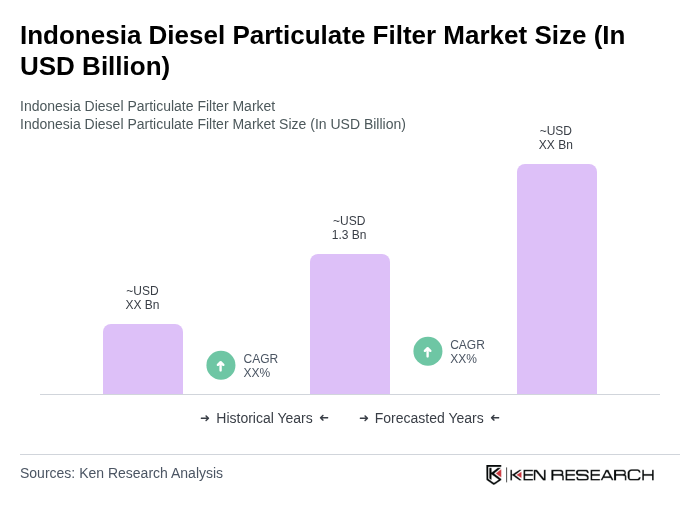
- The Indonesia Diesel Particulate Filter market is valued at approximately USD 1.3 billion, based on a five-year historical analysis. This growth is primarily driven by increasing environmental regulations aimed at reducing emissions from diesel engines, coupled with a rise in vehicle ownership and industrial activities. The demand for diesel particulate filters is further supported by advancements in technology that enhance the efficiency and effectiveness of these systems in capturing harmful particulates, with Asia Pacific regions experiencing substantial expansion due to stricter emission standards implementation.
- Key cities such as Jakarta, Surabaya, and Bandung dominate the market due to their high population density and significant industrial activities. Jakarta, being the capital, has a higher concentration of vehicles and industries, leading to increased demand for diesel particulate filters. Additionally, the government's focus on improving air quality in urban areas has further propelled the adoption of these filters in major cities.
- The Indonesian government has implemented stricter emission standards for diesel vehicles, mandating the installation of diesel particulate filters in new vehicles. This regulation aims to reduce air pollution and improve public health, reflecting the government's commitment to environmental sustainability and compliance with international standards. Diesel particulate filters can remove more than 85 percent of soot (black carbon) when in good operating order, and advanced technologies can trap and reduce particulate matter mass by over 95 percent.
Indonesia Diesel Particulate Filter Market Segmentation
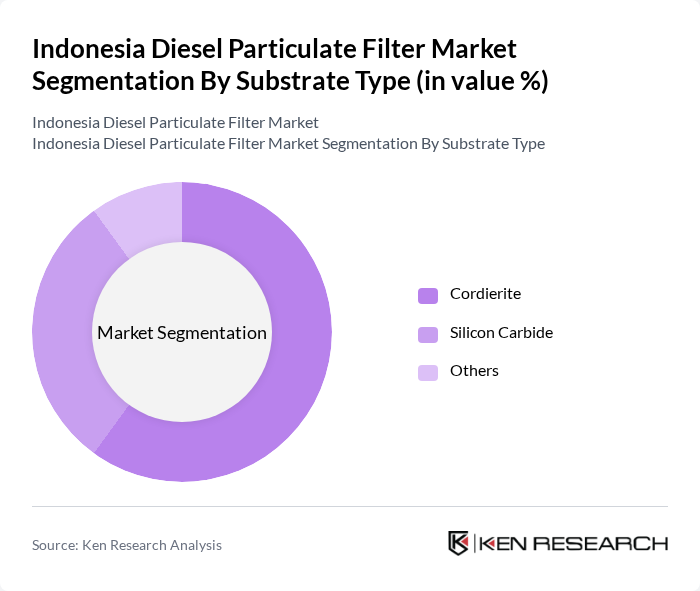
By Substrate Type:The substrate type segment includes Cordierite, Silicon Carbide, and Others. Cordierite is widely used due to its thermal stability and cost-effectiveness, making it the leading subsegment. Silicon Carbide, while more expensive, offers superior performance in high-temperature applications, appealing to premium vehicle manufacturers. The "Others" category includes various alternative materials that are gaining traction but currently hold a smaller market share.
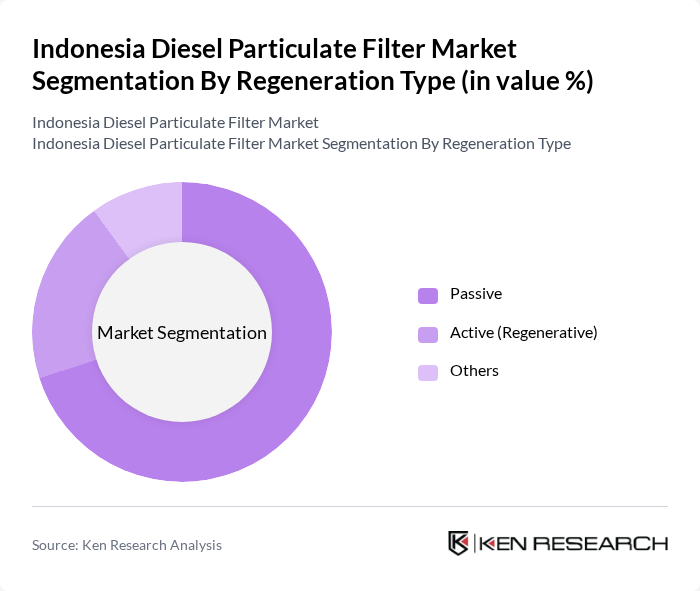
By Regeneration Type:The regeneration type segment consists of Passive, Active (Regenerative), and Others. Passive regeneration is the most common method, as it utilizes exhaust heat to burn off particulates, making it suitable for many diesel engines. Active regeneration, while more efficient, requires additional fuel and control systems, which limits its adoption primarily to newer models. The "Others" category includes various innovative regeneration technologies that are emerging but are not yet widely adopted.
Indonesia Diesel Particulate Filter Market Competitive Landscape
The Indonesia Diesel Particulate Filter Market is characterized by a dynamic mix of regional and international players. Leading participants such as PT. Cipta Kridatama, PT. Astra International Tbk, PT. Wahana Duta Jaya Rucika, PT. Indomobil Sukses Internasional Tbk, PT. Pindad (Persero), PT. Toyota Motor Manufacturing Indonesia, PT. Hino Motors Manufacturing Indonesia, PT. Mitsubishi Motors Krama Yudha Indonesia, PT. Suzuki Indomobil Motor, PT. Nissan Motor Indonesia, PT. Isuzu Astra Motor Indonesia, PT. Hyundai Motor Manufacturing Indonesia, PT. Daihatsu Motor Indonesia, PT. Honda Prospect Motor, PT. Chandra Asri Petrochemical Tbk contribute to innovation, geographic expansion, and service delivery in this space.
Indonesia Diesel Particulate Filter Market Industry Analysis
Growth Drivers
- Increasing Environmental Regulations:Indonesia's commitment to reducing air pollution has led to stricter environmental regulations. The government aims to cut particulate matter emissions by 30% in the future, as outlined in the National Air Quality Management Plan. This regulatory framework is driving the adoption of diesel particulate filters (DPFs) across various sectors, including transportation and industry, as companies seek compliance with these standards to avoid penalties and enhance their sustainability profiles.
- Rising Demand for Clean Diesel Technologies:The Indonesian automotive sector is projected to produce over 1.7 million vehicles in the future, with a significant shift towards clean diesel technologies. This demand is fueled by consumer preferences for fuel-efficient vehicles that meet environmental standards. The introduction of Euro 4 emission standards in the future will further necessitate the integration of DPFs in new diesel vehicles, thereby expanding the market for these technologies significantly.
- Growth in Automotive and Industrial Sectors:Indonesia's automotive industry is expected to grow at a rate of 5.5% annually, driven by increasing urbanization and disposable income. Concurrently, the industrial sector, particularly manufacturing, is projected to contribute 22% to the GDP in the future. This growth in both sectors is creating a higher demand for diesel engines, which in turn drives the need for effective diesel particulate filters to mitigate emissions and comply with environmental regulations.
Market Challenges
- High Initial Investment Costs:The adoption of diesel particulate filters involves significant upfront costs, often exceeding IDR 12 million (approximately USD 800) per vehicle. This financial barrier can deter small and medium enterprises from investing in DPF technology, limiting market penetration. Additionally, the high costs associated with retrofitting existing diesel engines with DPFs further complicate the transition to cleaner technologies, hindering overall market growth.
- Limited Awareness Among End-Users:Despite the environmental benefits, there remains a lack of awareness regarding diesel particulate filters among end-users in Indonesia. A survey conducted by the Ministry of Environment in the future indicated that only 40% of diesel vehicle owners understood the importance of DPFs in reducing emissions. This knowledge gap poses a challenge for manufacturers and policymakers aiming to promote cleaner technologies and achieve compliance with environmental regulations.
Indonesia Diesel Particulate Filter Market Future Outlook
The future of the Indonesia diesel particulate filter market appears promising, driven by increasing regulatory pressures and a growing emphasis on sustainability. As the government implements stricter emission standards, the demand for DPFs is expected to rise significantly. Additionally, advancements in filter technology and the integration of smart monitoring systems will enhance the efficiency and effectiveness of DPFs, making them more appealing to manufacturers and consumers alike. The market is poised for growth as awareness and adoption of clean technologies expand.
Market Opportunities
- Expansion of Manufacturing Facilities:The Indonesian government is investing IDR 6 trillion (approximately USD 400 million) in the development of manufacturing facilities for clean technologies. This initiative presents a significant opportunity for DPF manufacturers to establish local production, reducing costs and improving supply chain efficiency while meeting domestic demand for cleaner diesel solutions.
- Collaborations with Automotive Manufacturers:Strategic partnerships with local automotive manufacturers can enhance the market presence of DPF technologies. Collaborations can lead to joint ventures that focus on developing tailored solutions for the Indonesian market, leveraging the growing automotive production to integrate DPFs into new vehicle models, thereby expanding market reach and driving sales.
Scope of the Report
| Segment | Sub-Segments |
|---|---|
| By Substrate Type | Cordierite Silicon Carbide Others |
| By Regeneration Type | Passive Active (Regenerative) Others |
| By Vehicle Type | Passenger Cars Light Commercial Vehicles Medium & Heavy Commercial Vehicles Off-Highway Vehicles Others |
| By Material Type | Ceramic Silicon Carbide Metallic Others |
| By Installation Type | OEM Installations Aftermarket Installations Others |
| By Region | Java Sumatra Kalimantan Sulawesi Others |
Key Target Audience
Investors and Venture Capitalist Firms
Government and Regulatory Bodies (e.g., Ministry of Environment and Forestry, Ministry of Transportation)
Manufacturers and Producers of Diesel Particulate Filters
Distributors and Retailers of Automotive Components
Automotive OEMs (Original Equipment Manufacturers)
Technology Providers for Emission Control Solutions
Industry Associations (e.g., Indonesian Automotive Industry Association)
Financial Institutions and Banks Financing Automotive Projects
Players Mentioned in the Report:
PT. Cipta Kridatama
PT. Astra International Tbk
PT. Wahana Duta Jaya Rucika
PT. Indomobil Sukses Internasional Tbk
PT. Pindad (Persero)
PT. Toyota Motor Manufacturing Indonesia
PT. Hino Motors Manufacturing Indonesia
PT. Mitsubishi Motors Krama Yudha Indonesia
PT. Suzuki Indomobil Motor
PT. Nissan Motor Indonesia
PT. Isuzu Astra Motor Indonesia
PT. Hyundai Motor Manufacturing Indonesia
PT. Daihatsu Motor Indonesia
PT. Honda Prospect Motor
PT. Chandra Asri Petrochemical Tbk
Table of Contents
Market Assessment Phase
1. Executive Summary and Approach
2. Indonesia Diesel Particulate Filter Market Overview
2.1 Key Insights and Strategic Recommendations
2.2 Indonesia Diesel Particulate Filter Market Overview
2.3 Definition and Scope
2.4 Evolution of Market Ecosystem
2.5 Timeline of Key Regulatory Milestones
2.6 Value Chain & Stakeholder Mapping
2.7 Business Cycle Analysis
2.8 Policy & Incentive Landscape
3. Indonesia Diesel Particulate Filter Market Analysis
3.1 Growth Drivers
3.1.1 Increasing Environmental Regulations
3.1.2 Rising Demand for Clean Diesel Technologies
3.1.3 Growth in Automotive and Industrial Sectors
3.1.4 Government Initiatives for Pollution Control
3.2 Market Challenges
3.2.1 High Initial Investment Costs
3.2.2 Limited Awareness Among End-Users
3.2.3 Technological Limitations in Existing Systems
3.2.4 Competition from Alternative Technologies
3.3 Market Opportunities
3.3.1 Expansion of Manufacturing Facilities
3.3.2 Collaborations with Automotive Manufacturers
3.3.3 Development of Advanced Filter Technologies
3.3.4 Increasing Export Potential to Neighboring Countries
3.4 Market Trends
3.4.1 Shift Towards Electrification in Vehicles
3.4.2 Adoption of Smart Technologies in Filters
3.4.3 Growing Focus on Sustainability Practices
3.4.4 Integration of IoT in Monitoring Systems
3.5 Government Regulation
3.5.1 Implementation of Euro Emission Standards
3.5.2 Incentives for Clean Technology Adoption
3.5.3 Regulations on Industrial Emissions
3.5.4 Policies Supporting Research and Development
4. SWOT Analysis
5. Stakeholder Analysis
6. Porter's Five Forces Analysis
7. Indonesia Diesel Particulate Filter Market Market Size, 2019-2024
7.1 By Value
7.2 By Volume
7.3 By Average Selling Price
8. Indonesia Diesel Particulate Filter Market Segmentation
8.1 By Substrate Type
8.1.1 Cordierite
8.1.2 Silicon Carbide
8.1.3 Others
8.2 By Regeneration Type
8.2.1 Passive
8.2.2 Active (Regenerative)
8.2.3 Others
8.3 By Vehicle Type
8.3.1 Passenger Cars
8.3.2 Light Commercial Vehicles
8.3.3 Medium & Heavy Commercial Vehicles
8.3.4 Off-Highway Vehicles
8.3.5 Others
8.4 By Material Type
8.4.1 Ceramic
8.4.2 Silicon Carbide
8.4.3 Metallic
8.4.4 Others
8.5 By Installation Type
8.5.1 OEM Installations
8.5.2 Aftermarket Installations
8.5.3 Others
8.6 By Region
8.6.1 Java
8.6.2 Sumatra
8.6.3 Kalimantan
8.6.4 Sulawesi
8.6.5 Others
9. Indonesia Diesel Particulate Filter Market Competitive Analysis
9.1 Market Share of Key Players
9.2 Cross Comparison of Key Players
9.2.1 Company Name
9.2.2 Market Capitalization (USD Billion)
9.2.3 Revenue Growth Rate (CAGR %)
9.2.4 Market Share (%)
9.2.5 EBITDA Margin (%)
9.2.6 Return on Equity (ROE %)
9.2.7 Production Capacity (Units)
9.2.8 R&D Investment (% of Revenue)
9.2.9 Patent Portfolio Size
9.2.10 Global Presence (Countries)
9.3 SWOT Analysis of Top Players
9.4 Pricing Analysis
9.5 Detailed Profile of Major Companies
9.5.1 PT. Cipta Kridatama
9.5.2 PT. Astra International Tbk
9.5.3 PT. Wahana Duta Jaya Rucika
9.5.4 PT. Indomobil Sukses Internasional Tbk
9.5.5 PT. Pindad (Persero)
9.5.6 PT. Toyota Motor Manufacturing Indonesia
9.5.7 PT. Hino Motors Manufacturing Indonesia
9.5.8 PT. Mitsubishi Motors Krama Yudha Indonesia
9.5.9 PT. Suzuki Indomobil Motor
9.5.10 PT. Nissan Motor Indonesia
9.5.11 PT. Isuzu Astra Motor Indonesia
9.5.12 PT. Hyundai Motor Manufacturing Indonesia
9.5.13 PT. Daihatsu Motor Indonesia
9.5.14 PT. Honda Prospect Motor
9.5.15 PT. Chandra Asri Petrochemical Tbk
10. Indonesia Diesel Particulate Filter Market End-User Analysis
10.1 Procurement Behavior of Key Ministries
10.1.1 Ministry of Transportation
10.1.2 Ministry of Environment and Forestry
10.1.3 Ministry of Industry
10.1.4 Ministry of Energy and Mineral Resources
10.2 Corporate Spend on Infrastructure & Energy
10.2.1 Investment in Clean Technologies
10.2.2 Budget Allocation for Pollution Control
10.2.3 Expenditure on Vehicle Upgrades
10.2.4 Funding for Research and Development
10.3 Pain Point Analysis by End-User Category
10.3.1 Automotive Sector
10.3.2 Industrial Sector
10.3.3 Government Sector
10.3.4 Commercial Sector
10.4 User Readiness for Adoption
10.4.1 Awareness Levels
10.4.2 Financial Readiness
10.4.3 Technical Capability
10.4.4 Regulatory Compliance
10.5 Post-Deployment ROI and Use Case Expansion
10.5.1 Performance Metrics
10.5.2 Cost Savings Analysis
10.5.3 User Feedback and Adaptation
10.5.4 Future Expansion Opportunities
11. Indonesia Diesel Particulate Filter Market Future Size, 2025-2030
11.1 By Value
11.2 By Volume
11.3 By Average Selling Price
Go-To-Market Strategy Phase
1. Whitespace Analysis + Business Model Canvas
1.1 Market Gaps Identification
1.2 Value Proposition Development
1.3 Revenue Streams Analysis
1.4 Cost Structure Evaluation
1.5 Key Partnerships Exploration
1.6 Customer Segmentation
1.7 Channels and Customer Relationships
2. Marketing and Positioning Recommendations
2.1 Branding Strategies
2.2 Product USPs
2.3 Target Market Identification
2.4 Communication Strategy
2.5 Digital Marketing Approach
2.6 Trade Show Participation
2.7 Customer Engagement Initiatives
3. Distribution Plan
3.1 Urban Retail Strategies
3.2 Rural NGO Tie-Ups
3.3 E-commerce Integration
3.4 Logistics and Supply Chain Management
3.5 Distribution Partnerships
3.6 Inventory Management
3.7 Customer Service Framework
4. Channel & Pricing Gaps
4.1 Underserved Routes
4.2 Pricing Bands Analysis
4.3 Competitor Pricing Strategies
4.4 Value-Based Pricing Models
4.5 Discount and Promotion Strategies
4.6 Price Sensitivity Assessment
4.7 Channel Conflict Resolution
5. Unmet Demand & Latent Needs
5.1 Category Gaps Identification
5.2 Consumer Segments Analysis
5.3 Product Development Opportunities
5.4 Service Gaps Exploration
5.5 Market Entry Barriers
5.6 Customer Feedback Mechanisms
5.7 Future Trends Anticipation
6. Customer Relationship
6.1 Loyalty Programs
6.2 After-sales Service
6.3 Customer Feedback Loops
6.4 Community Engagement
6.5 Customer Education Initiatives
6.6 Relationship Management Tools
6.7 Customer Satisfaction Metrics
7. Value Proposition
7.1 Sustainability Initiatives
7.2 Integrated Supply Chains
7.3 Cost Efficiency
7.4 Quality Assurance
7.5 Innovation and Technology
7.6 Customer-Centric Approach
7.7 Competitive Advantage
8. Key Activities
8.1 Regulatory Compliance
8.2 Branding Initiatives
8.3 Distribution Setup
8.4 Market Research Activities
8.5 Training and Development
8.6 Performance Monitoring
8.7 Stakeholder Engagement
9. Entry Strategy Evaluation
9.1 Domestic Market Entry Strategy
9.1.1 Product Mix
9.1.2 Pricing Band
9.1.3 Packaging
9.2 Export Entry Strategy
9.2.1 Target Countries
9.2.2 Compliance Roadmap
10. Entry Mode Assessment
10.1 Joint Ventures
10.2 Greenfield Investments
10.3 Mergers & Acquisitions
10.4 Distributor Model
10.5 Risk Assessment
10.6 Strategic Fit Evaluation
10.7 Exit Strategy Considerations
11. Capital and Timeline Estimation
11.1 Capital Requirements
11.2 Timelines
11.3 Funding Sources
11.4 Financial Projections
11.5 Budget Allocation
11.6 Milestone Tracking
11.7 Contingency Planning
12. Control vs Risk Trade-Off
12.1 Ownership vs Partnerships
12.2 Risk Mitigation Strategies
12.3 Control Mechanisms
12.4 Performance Monitoring
12.5 Decision-Making Framework
12.6 Stakeholder Influence
12.7 Long-term Sustainability
13. Profitability Outlook
13.1 Breakeven Analysis
13.2 Long-term Sustainability
13.3 Profit Margin Projections
13.4 Revenue Growth Forecast
13.5 Cost Management Strategies
13.6 Financial Health Indicators
13.7 Investment Returns
14. Potential Partner List
14.1 Distributors
14.2 Joint Ventures
14.3 Acquisition Targets
14.4 Strategic Alliances
14.5 Research Collaborations
14.6 Technology Partners
14.7 Government Partnerships
15. Execution Roadmap
15.1 Phased Plan for Market Entry
15.1.1 Market Setup
15.1.2 Market Entry
15.1.3 Growth Acceleration
15.1.4 Scale & Stabilize
15.2 Key Activities and Milestones
15.2.1 Activity Planning
15.2.2 Milestone Tracking
15.2.3 Performance Evaluation
15.2.4 Resource Allocation
Research Methodology
Phase 1: Approach1
Desk Research
- Analysis of industry reports from government agencies and environmental organizations
- Review of academic journals and publications on diesel particulate filters and emissions control technologies
- Examination of market trends and forecasts from trade associations and industry publications
Primary Research
- Interviews with key stakeholders in the automotive and industrial sectors, including fleet managers and equipment operators
- Surveys conducted with manufacturers of diesel particulate filters to gather insights on production capacities and market dynamics
- Field interviews with environmental regulators and policy makers to understand regulatory impacts on the market
Validation & Triangulation
- Cross-validation of findings through multiple data sources, including trade statistics and expert opinions
- Triangulation of market data with insights from industry conferences and workshops
- Sanity checks through expert panel reviews comprising industry veterans and academic experts
Phase 2: Market Size Estimation1
Top-down Assessment
- Estimation of the market size based on national diesel consumption and emissions regulations
- Segmentation of the market by application areas, including automotive, marine, and industrial sectors
- Incorporation of government initiatives aimed at reducing emissions and promoting cleaner technologies
Bottom-up Modeling
- Collection of sales data from leading manufacturers of diesel particulate filters
- Estimation of market share based on production volumes and sales figures
- Analysis of pricing strategies and cost structures of diesel particulate filter products
Forecasting & Scenario Analysis
- Development of forecasting models based on historical sales data and projected regulatory changes
- Scenario analysis considering various factors such as economic growth, fuel prices, and technological advancements
- Creation of baseline, optimistic, and pessimistic market projections through 2030
Phase 3: CATI Sample Composition1
| Scope Item/Segment | Sample Size | Target Respondent Profiles |
|---|---|---|
| Automotive Sector Diesel Particulate Filters | 100 | Fleet Managers, Automotive Engineers |
| Industrial Equipment Emission Controls | 80 | Plant Managers, Environmental Compliance Officers |
| Marine Applications of Diesel Filters | 60 | Marine Engineers, Vessel Operators |
| Regulatory Impact Assessment | 50 | Policy Makers, Environmental Consultants |
| Market Trends and Innovations | 70 | R&D Managers, Product Development Specialists |
Frequently Asked Questions
What is the current value of the Indonesia Diesel Particulate Filter market?
The Indonesia Diesel Particulate Filter market is valued at approximately USD 1.3 billion, driven by increasing environmental regulations, rising vehicle ownership, and industrial activities. This growth reflects a commitment to reducing emissions from diesel engines across various sectors.
What factors are driving the growth of the Diesel Particulate Filter market in Indonesia?
Which cities in Indonesia are leading in Diesel Particulate Filter demand?
What are the main types of substrates used in Diesel Particulate Filters?
Other Regional/Country Reports
Other Adjacent Reports
Philippines Automotive Emission Control Market
Philippines Exhaust Aftertreatment Systems Market
Germany Catalytic Converter Market
Oman Selective Catalytic Reduction Market
Thailand Diesel Engine Components Market
United States Industrial Filtration MarketMexico Air Pollution Control Equipment Market
Indonesia Vehicle Exhaust Systems Market
Japan Clean Diesel Technology Market
Indonesia Automotive Manufacturing Market Outlook to 2030Why Buy From Us?

What makes us stand out is that our consultants follow Robust, Refine and Result (RRR) methodology. Robust for clear definitions, approaches and sanity checking, Refine for differentiating respondents' facts and opinions, and Result for presenting data with story.

We have set a benchmark in the industry by offering our clients with syndicated and customized market research reports featuring coverage of entire market as well as meticulous research and analyst insights.

While we don't replace traditional research, we flip the method upside down. Our dual approach of Top Bottom & Bottom Top ensures quality deliverable by not just verifying company fundamentals but also looking at the sector and macroeconomic factors.

With one step in the future, our research team constantly tries to show you the bigger picture. We help with some of the tough questions you may encounter along the way: How is the industry positioned? Best marketing channel? KPI's of competitors? By aligning every element, we help maximize success.

Our report gives you instant access to the answers and sources that other companies might choose to hide. We elaborate each steps of research methodology we have used and showcase you the sample size to earn your trust.

If you need any support, we are here! We pride ourselves on universe strength, data quality, and quick, friendly, and professional service.