














Region:Asia
Author(s):Geetanshi
Product Code:KRAD5916
Pages:97
Published On:December 2025
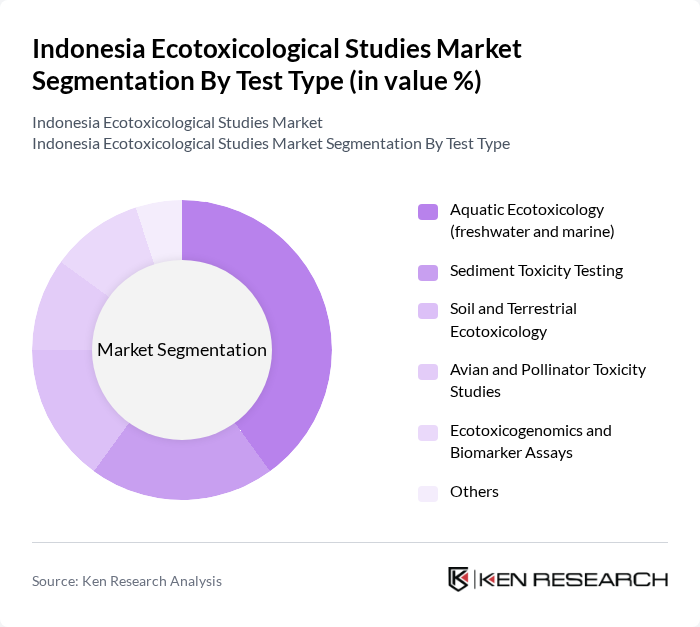
By Test Type:The test type segmentation includes various methodologies used to assess the ecological impact of contaminants. The subsegments are Aquatic Ecotoxicology (freshwater and marine), Sediment Toxicity Testing, Soil and Terrestrial Ecotoxicology, Avian and Pollinator Toxicity Studies, Ecotoxicogenomics and Biomarker Assays, and Others. Among these, Aquatic Ecotoxicology is the leading subsegment, which is consistent with global trends where aquatic ecotoxicology holds the largest share, driven by wastewater, effluent, and surface water quality regulations and the strong focus on protecting aquatic ecosystems. Indonesia’s extensive reliance on coastal and inland water resources for fisheries, drinking water, and industry, combined with rising pollution levels in rivers, estuaries, and marine environments, has heightened the need for thorough aquatic toxicity and bioassay assessments, making this subsegment crucial for regulatory compliance and environmental protection.
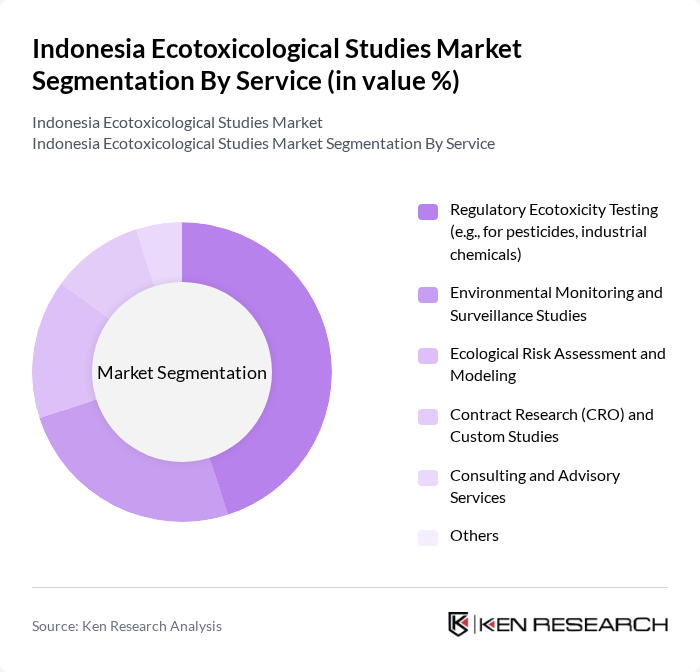
By Service:The service segmentation encompasses various offerings related to ecotoxicological assessments. This includes Regulatory Ecotoxicity Testing (e.g., for pesticides, industrial chemicals), Environmental Monitoring and Surveillance Studies, Ecological Risk Assessment and Modeling, Contract Research (CRO) and Custom Studies, Consulting and Advisory Services, and Others. Regulatory Ecotoxicity Testing is the dominant service, in line with global patterns where regulatory-driven testing for agrochemicals, industrial chemicals, pharmaceuticals, and biocides forms the largest revenue share, supported by guidelines from organizations such as OECD and by national chemical and pesticide registration requirements. In Indonesia, companies are increasingly seeking these services to support AMDAL documentation, permit renewals, wastewater discharge compliance, and chemical registration, as well as to mitigate risks associated with chemical exposure in sensitive ecosystems.
The Indonesia Ecotoxicological Studies Market is characterized by a dynamic mix of regional and international players. Leading participants such as PT Intertek Utama Services (Intertek Indonesia), PT SGS Indonesia, PT Sucofindo (Persero), PT Surveyor Indonesia, PT Bureau Veritas Indonesia, PT Eurofins Indonesia (Eurofins Scientific), ALS Indonesia (ALS Limited), PT Anindya Wiraputra Konsult (Anindya Laboratory), Badan Riset dan Inovasi Nasional (BRIN) – Environmental and Ecotoxicology Labs, Center for Pesticide and Ecotoxicology Studies, IPB University (Bogor Agricultural University), Environmental Research Center, Universitas Indonesia, Environmental and Ecotoxicology Laboratory, Gadjah Mada University, Indonesian Institute of Sciences (LIPI) – Marine and Freshwater Ecotoxicology Units, PT Unilever Indonesia Tbk – Environmental Safety & Ecotoxicology Programs, PT Pupuk Indonesia (Persero) – Agrochemical and Environmental Testing Facilities contribute to innovation, geographic expansion, and service delivery in this space.
The future of the Indonesia ecotoxicological studies market appears promising, driven by increasing environmental regulations and a growing emphasis on sustainability. As industries adapt to stricter compliance requirements, the demand for innovative testing methods and advanced analytical techniques will rise. Furthermore, public-private partnerships are expected to enhance research capabilities, fostering collaboration that can lead to significant advancements in ecotoxicology. This collaborative approach will likely address existing challenges and create a more robust framework for environmental protection in Indonesia.
| Segment | Sub-Segments |
|---|---|
| By Test Type | Aquatic Ecotoxicology (freshwater and marine) Sediment Toxicity Testing Soil and Terrestrial Ecotoxicology Avian and Pollinator Toxicity Studies Ecotoxicogenomics and Biomarker Assays Others |
| By Service | Regulatory Ecotoxicity Testing (e.g., for pesticides, industrial chemicals) Environmental Monitoring and Surveillance Studies Ecological Risk Assessment and Modeling Contract Research (CRO) and Custom Studies Consulting and Advisory Services Others |
| By End-User | Government and Regulatory Agencies Academic and Public Research Institutes Contract Research Organizations and Testing Laboratories Agrochemical and Pesticide Manufacturers Mining, Oil & Gas, and Energy Companies NGOs and Multilateral Organizations Others |
| By Technology / Methodology | In Vivo Organism-Based Studies In Vitro and Cell-Based Assays High-Throughput and Automated Screening Modeling and Simulation (e.g., QSAR, ecological modeling) Omics-Based Approaches (genomics, proteomics, metabolomics) Others |
| By Contaminant Class | Pesticides and Agrochemicals Industrial and Specialty Chemicals Heavy Metals and Metalloid Contaminants Pharmaceuticals and Personal Care Products (PPCPs) Microplastics and Nanomaterials Others |
| By Geographic Focus | Java (including Greater Jakarta) Sumatra Kalimantan (Borneo) Sulawesi Papua and Maluku Others |
| By Funding Source | National Government Budget and Grants Provincial and Local Government Programs Private Sector and Corporate ESG Budgets International Donors and Development Agencies University and Competitive Research Grants Others |
| Scope Item/Segment | Sample Size | Target Respondent Profiles |
|---|---|---|
| Academic Research Institutions | 100 | Ecotoxicologists, Environmental Researchers |
| Government Regulatory Bodies | 80 | Environmental Policy Makers, Compliance Officers |
| Industry Stakeholders in Agriculture | 70 | Agricultural Scientists, Crop Protection Specialists |
| Environmental NGOs | 60 | Project Managers, Advocacy Coordinators |
| Chemical Manufacturing Sector | 90 | Environmental Health and Safety Managers, R&D Directors |
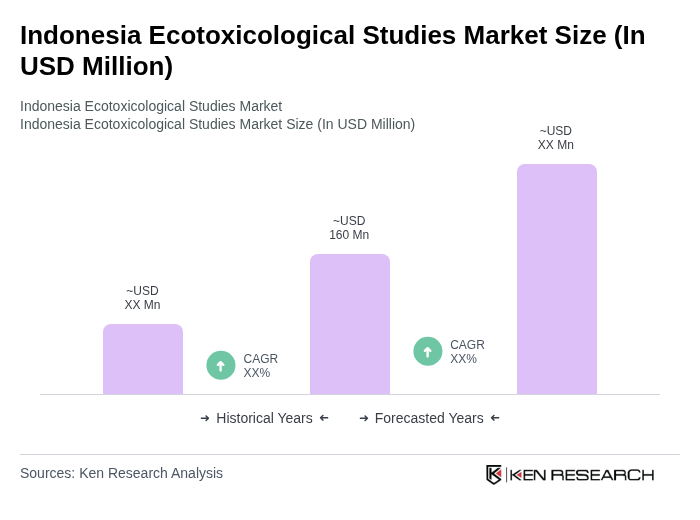
The Indonesia Ecotoxicological Studies Market is valued at approximately USD 160 million, reflecting its growth driven by stringent environmental regulations and increased awareness of ecological impacts across various industries such as chemicals, agriculture, and manufacturing.

What makes us stand out is that our consultants follow Robust, Refine and Result (RRR) methodology. Robust for clear definitions, approaches and sanity checking, Refine for differentiating respondents' facts and opinions, and Result for presenting data with story.

We have set a benchmark in the industry by offering our clients with syndicated and customized market research reports featuring coverage of entire market as well as meticulous research and analyst insights.

While we don't replace traditional research, we flip the method upside down. Our dual approach of Top Bottom & Bottom Top ensures quality deliverable by not just verifying company fundamentals but also looking at the sector and macroeconomic factors.

With one step in the future, our research team constantly tries to show you the bigger picture. We help with some of the tough questions you may encounter along the way: How is the industry positioned? Best marketing channel? KPI's of competitors? By aligning every element, we help maximize success.

Our report gives you instant access to the answers and sources that other companies might choose to hide. We elaborate each steps of research methodology we have used and showcase you the sample size to earn your trust.

If you need any support, we are here! We pride ourselves on universe strength, data quality, and quick, friendly, and professional service.