About the Report
Base Year 2024Indonesia Edible Cosmetics Market Overview
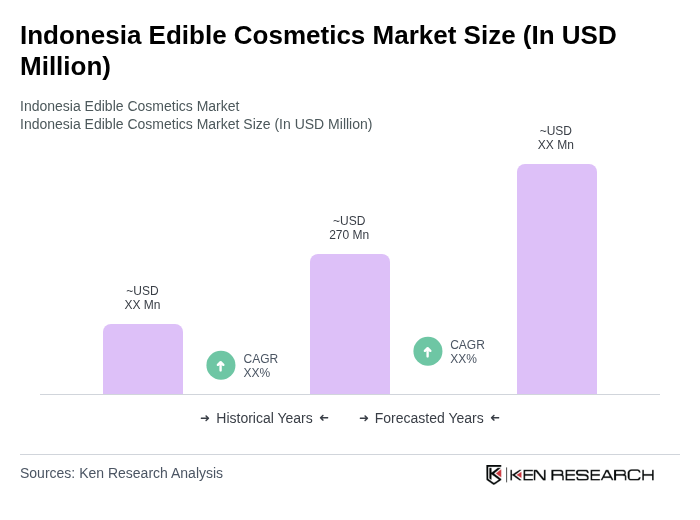
- The Indonesia Edible Cosmetics Market is valued at USD 270 million, based on a five-year historical analysis. This growth is primarily driven by consumers increasingly embracing clean-label beauty solutions that merge wellness with aesthetics, leading to rising demand for ingestible skincare and beauty products. Additional momentum comes from advances in food-grade formulations, expanding e-commerce reach, innovation in product formats like gummies, liquids, and powders that cater to convenience and health-oriented lifestyles, and rising demand for natural and organic ingredients such as ceramide, niacinamide, and hyaluronic acid.
- Key cities such as Jakarta, Surabaya, and Bandung dominate the market due to their high population density, urbanization, and increasing disposable income levels. These cities serve as major hubs for beauty and wellness trends, with consumers actively seeking innovative and health-conscious products. The growing awareness of the benefits of edible cosmetics among urban consumers further fuels market growth in these regions.
- The Regulation of Cosmetics No. 18/2024 issued by the National Agency of Drug and Food Control (BPOM) requires cosmetics to be classified distinctly from food products, mandating accurate labelling that prohibits ingestion claims and specifying compliance through notification requirements and safety assessments for topical use only. This regulation ensures product safety by setting standards for ingredients, manufacturing practices, and advertising to prevent misleading health claims.
Indonesia Edible Cosmetics Market Segmentation
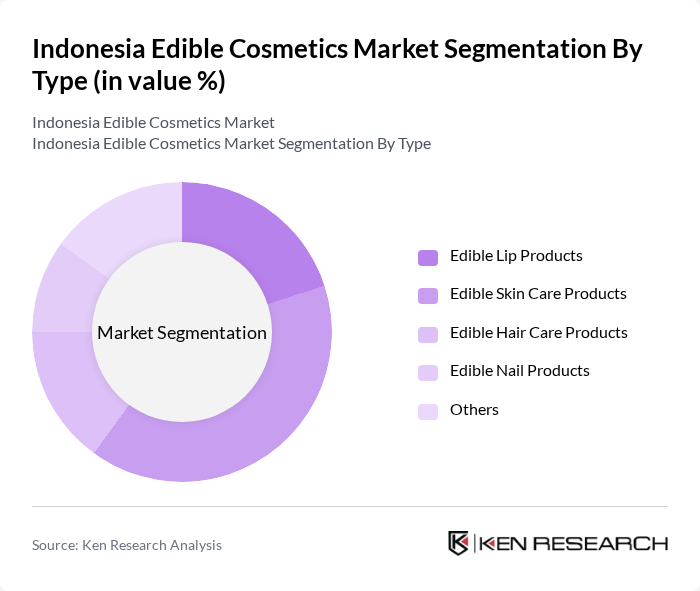
By Type:The edible cosmetics market is segmented into various types, including edible lip products, edible skin care products, edible hair care products, edible nail products, and others. Among these, edible skin care products are leading the market due to the increasing consumer preference for products that offer both beauty and health benefits. The trend towards natural and organic ingredients in skin care is also driving growth in this segment.
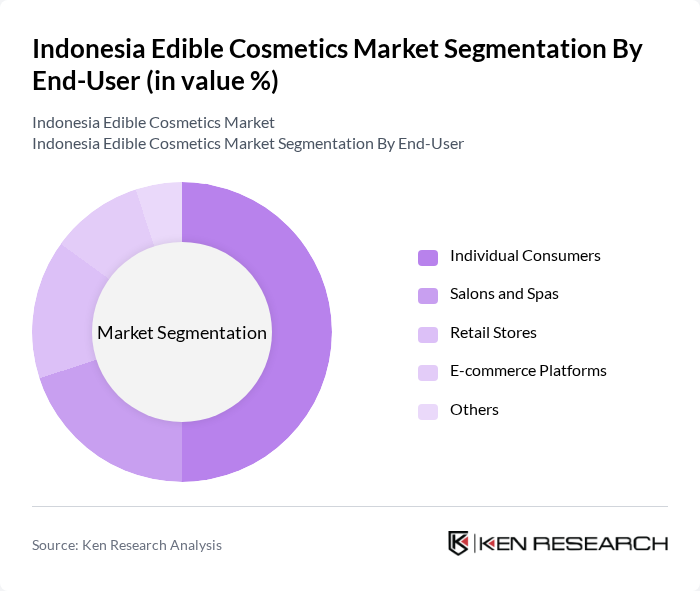
By End-User:The market is also segmented by end-user, which includes individual consumers, salons and spas, retail stores, e-commerce platforms, and others. Individual consumers dominate this segment as they increasingly seek personalized beauty solutions that align with their health and wellness goals. The rise of e-commerce platforms has further facilitated access to a wider range of edible cosmetics, enhancing consumer choice.
Indonesia Edible Cosmetics Market Competitive Landscape
The Indonesia Edible Cosmetics Market is characterized by a dynamic mix of regional and international players. Leading participants such as PT. Mustika Ratu Tbk, PT. Citra Nusa Insani, PT. Natura Indonesia, PT. Sariayu Martha Tilaar, PT. Unilever Indonesia Tbk, PT. L'Oreal Indonesia, PT. P&G Indonesia, PT. Oriflame Indonesia, PT. Avoskin, PT. Wardah Cosmetics, PT. Emina Cosmetics, PT. Sensatia Botanicals, PT. The Body Shop Indonesia, PT. Bio Beauty, and PT. Ristra Cosmetics contribute to innovation, geographic expansion, and service delivery in this space.
Indonesia Edible Cosmetics Market Industry Analysis
Growth Drivers
- Strong GDP Growth:Indonesia’s nominal GDP reached USD 4,500 billion in future, reflecting a robust economic environment. This growth supports increased consumer spending, particularly in niche markets like edible cosmetics. As disposable incomes rise, consumers are more willing to invest in innovative beauty products that align with their health and wellness values, driving demand for edible cosmetics. The expanding middle class, projected to reach 140 million in future, further fuels this trend.
- High Internet Penetration and Digital Infrastructure Investment:With internet penetration at 79.5 percent, approximately 221.5 million users in future, Indonesia's digital landscape is thriving. The government allocated IDR 75 trillion (around USD 4.6 billion) for digital infrastructure from 2019 to 2022, enhancing online sales channels for edible cosmetics. This digital accessibility allows brands to effectively market and distribute their products, catering to a tech-savvy consumer base increasingly seeking convenience and variety in their beauty purchases.
- Rising Investment and Infrastructure Projects:Investment growth in Indonesia reached 4.61 percent year-on-year in future, the highest in six years. This surge in investment fosters a favorable business environment for cosmetic manufacturers, including those specializing in edible cosmetics. Enhanced infrastructure, such as improved transportation and logistics, facilitates the distribution of these products, making them more accessible to consumers across urban and rural areas, thus expanding market reach.
Market Challenges
- Strict Regulatory Oversight:The Indonesian government enforces stringent regulations on cosmetics, particularly edible products. In future, BPOM revoked permits for four edible cosmetic products due to non-compliance with Regulation No. 18/2024, which mandates strict labeling and safety standards. This regulatory environment creates significant hurdles for new entrants and existing brands, as compliance requires substantial investment in product reformulation and marketing strategies.
- Labeling and Advertising Enforcement:Regulation No. 18/2024 introduced detailed labeling requirements, including mandatory elements such as product name, net weight, and batch number. Non-compliance can lead to severe penalties, including permit revocations. This regulatory landscape poses a challenge for companies aiming to market edible cosmetics, as they must navigate complex compliance issues while ensuring their products meet consumer expectations for transparency and safety.
Indonesia Edible Cosmetics Market Future Outlook
The future of the Indonesia edible cosmetics market appears promising, driven by ongoing digital transformation and increased consumer interest in health-conscious products. Companies are expected to leverage advancements in AI and cloud infrastructure to enhance product development and marketing strategies. Additionally, as regulatory compliance becomes more stringent, brands that prioritize transparency and sustainability in their formulations will likely gain a competitive edge, appealing to the growing segment of environmentally conscious consumers.
Market Opportunities
- Leveraging Digital Channels:With 221.5 million internet users in future, the potential for online sales and digital marketing in the edible cosmetics sector is immense. Companies can utilize targeted digital campaigns to reach health-conscious consumers, capitalizing on the growing trend of e-commerce in Indonesia, which is projected to continue expanding rapidly.
- Regional Expansion Through Investment Zones:Indonesia's allocation of Rp 1,650 trillion in investment for future, with a focus on Special Economic Zones, presents significant opportunities for edible cosmetics manufacturers. These zones may offer incentives for production and export, enabling companies to scale operations and tap into new markets, thereby enhancing their competitive positioning.
Scope of the Report
| Segment | Sub-Segments |
|---|---|
| By Type | Edible Lip Products Edible Skin Care Products Edible Hair Care Products Edible Nail Products Others |
| By End-User | Individual Consumers Salons and Spas Retail Stores E-commerce Platforms Others |
| By Distribution Channel | Online Retail Offline Retail Direct Sales Specialty Stores Others |
| By Ingredient Type | Natural Ingredients Synthetic Ingredients Organic Ingredients Others |
| By Packaging Type | Bottles Jars Tubes Others |
| By Price Range | Premium Mid-range Budget Others |
| By Consumer Demographics | Age Group Gender Income Level Others |
Key Target Audience
Investors and Venture Capitalist Firms
Government and Regulatory Bodies (e.g., Badan Pengawas Obat dan Makanan - BPOM)
Manufacturers and Producers
Distributors and Retailers
Natural Ingredient Suppliers
Beauty and Personal Care Brands
Industry Associations (e.g., Asosiasi Kosmetik Indonesia)
Financial Institutions
Players Mentioned in the Report:
PT. Mustika Ratu Tbk
PT. Citra Nusa Insani
PT. Natura Indonesia
PT. Sariayu Martha Tilaar
PT. Unilever Indonesia Tbk
PT. L'Oreal Indonesia
PT. P&G Indonesia
PT. Oriflame Indonesia
PT. Avoskin
PT. Wardah Cosmetics
PT. Emina Cosmetics
PT. Sensatia Botanicals
PT. The Body Shop Indonesia
PT. Bio Beauty
PT. Ristra Cosmetics
Table of Contents
Market Assessment Phase
1. Executive Summary and Approach
2. Indonesia Edible Cosmetics Market Overview
2.1 Key Insights and Strategic Recommendations
2.2 Indonesia Edible Cosmetics Market Overview
2.3 Definition and Scope
2.4 Evolution of Market Ecosystem
2.5 Timeline of Key Regulatory Milestones
2.6 Value Chain & Stakeholder Mapping
2.7 Business Cycle Analysis
2.8 Policy & Incentive Landscape
3. Indonesia Edible Cosmetics Market Analysis
3.1 Growth Drivers
3.1.1 Increasing consumer awareness of natural ingredients
3.1.2 Rising demand for multifunctional products
3.1.3 Growth of the e-commerce sector
3.1.4 Influence of social media on beauty trends
3.2 Market Challenges
3.2.1 Regulatory hurdles in product approval
3.2.2 High competition from established brands
3.2.3 Consumer skepticism towards new products
3.2.4 Limited distribution channels in rural areas
3.3 Market Opportunities
3.3.1 Expansion into untapped rural markets
3.3.2 Development of organic and vegan product lines
3.3.3 Collaborations with local influencers
3.3.4 Increasing interest in sustainable packaging
3.4 Market Trends
3.4.1 Shift towards personalized beauty products
3.4.2 Growth of clean beauty movements
3.4.3 Rise in DIY edible cosmetics
3.4.4 Integration of technology in product development
3.5 Government Regulation
3.5.1 Stricter labeling requirements
3.5.2 Guidelines for safety testing of edible cosmetics
3.5.3 Import regulations for raw materials
3.5.4 Incentives for local production
4. SWOT Analysis
5. Stakeholder Analysis
6. Porter's Five Forces Analysis
7. Indonesia Edible Cosmetics Market Market Size, 2019-2024
7.1 By Value
7.2 By Volume
7.3 By Average Selling Price
8. Indonesia Edible Cosmetics Market Segmentation
8.1 By Type
8.1.1 Edible Lip Products
8.1.2 Edible Skin Care Products
8.1.3 Edible Hair Care Products
8.1.4 Edible Nail Products
8.1.5 Others
8.2 By End-User
8.2.1 Individual Consumers
8.2.2 Salons and Spas
8.2.3 Retail Stores
8.2.4 E-commerce Platforms
8.2.5 Others
8.3 By Distribution Channel
8.3.1 Online Retail
8.3.2 Offline Retail
8.3.3 Direct Sales
8.3.4 Specialty Stores
8.3.5 Others
8.4 By Ingredient Type
8.4.1 Natural Ingredients
8.4.2 Synthetic Ingredients
8.4.3 Organic Ingredients
8.4.4 Others
8.5 By Packaging Type
8.5.1 Bottles
8.5.2 Jars
8.5.3 Tubes
8.5.4 Others
8.6 By Price Range
8.6.1 Premium
8.6.2 Mid-range
8.6.3 Budget
8.6.4 Others
8.7 By Consumer Demographics
8.7.1 Age Group
8.7.2 Gender
8.7.3 Income Level
8.7.4 Others
9. Indonesia Edible Cosmetics Market Competitive Analysis
9.1 Market Share of Key Players
9.2 Cross Comparison of Key Players
9.2.1 Company Name
9.2.2 Group Size (Large, Medium, or Small as per industry convention)
9.2.3 Revenue Growth Rate
9.2.4 Market Penetration Rate
9.2.5 Customer Retention Rate
9.2.6 Product Diversification Index
9.2.7 Pricing Strategy
9.2.8 Brand Recognition Score
9.2.9 Distribution Efficiency
9.2.10 Customer Satisfaction Index
9.3 SWOT Analysis of Top Players
9.4 Pricing Analysis
9.5 Detailed Profile of Major Companies
9.5.1 PT. Mustika Ratu Tbk
9.5.2 PT. Citra Nusa Insani
9.5.3 PT. Natura Indonesia
9.5.4 PT. Sariayu Martha Tilaar
9.5.5 PT. Unilever Indonesia Tbk
9.5.6 PT. L'Oreal Indonesia
9.5.7 PT. P&G Indonesia
9.5.8 PT. Oriflame Indonesia
9.5.9 PT. Avoskin
9.5.10 PT. Wardah Cosmetics
9.5.11 PT. Emina Cosmetics
9.5.12 PT. Sensatia Botanicals
9.5.13 PT. The Body Shop Indonesia
9.5.14 PT. Bio Beauty
9.5.15 PT. Ristra Cosmetics
10. Indonesia Edible Cosmetics Market End-User Analysis
10.1 Procurement Behavior of Key Ministries
10.1.1 Government procurement policies
10.1.2 Budget allocation for edible cosmetics
10.1.3 Supplier selection criteria
10.1.4 Compliance with local regulations
10.2 Corporate Spend on Infrastructure & Energy
10.2.1 Investment in sustainable practices
10.2.2 Budget for R&D in edible cosmetics
10.2.3 Spending on marketing and branding
10.2.4 Allocation for training and development
10.3 Pain Point Analysis by End-User Category
10.3.1 Quality concerns
10.3.2 Price sensitivity
10.3.3 Availability of products
10.3.4 Lack of awareness
10.4 User Readiness for Adoption
10.4.1 Awareness of edible cosmetics
10.4.2 Willingness to pay for premium products
10.4.3 Interest in product trials
10.4.4 Feedback mechanisms
10.5 Post-Deployment ROI and Use Case Expansion
10.5.1 Measurement of customer satisfaction
10.5.2 Analysis of repeat purchases
10.5.3 Expansion into new product lines
10.5.4 Long-term customer engagement strategies
11. Indonesia Edible Cosmetics Market Future Size, 2025-2030
11.1 By Value
11.2 By Volume
11.3 By Average Selling Price
Go-To-Market Strategy Phase
1. Whitespace Analysis + Business Model Canvas
1.1 Market gaps identification
1.2 Value proposition development
1.3 Revenue model exploration
1.4 Key partnerships
1.5 Customer segments
1.6 Cost structure analysis
1.7 Channels of distribution
2. Marketing and Positioning Recommendations
2.1 Branding strategies
2.2 Product USPs
2.3 Target audience identification
2.4 Communication strategies
2.5 Digital marketing tactics
3. Distribution Plan
3.1 Urban retail strategies
3.2 Rural NGO tie-ups
3.3 E-commerce strategies
3.4 Logistics and supply chain management
4. Channel & Pricing Gaps
4.1 Underserved routes
4.2 Pricing bands analysis
4.3 Competitor pricing strategies
4.4 Consumer price sensitivity
5. Unmet Demand & Latent Needs
5.1 Category gaps identification
5.2 Consumer segments analysis
5.3 Product innovation opportunities
5.4 Market entry strategies
6. Customer Relationship
6.1 Loyalty programs
6.2 After-sales service
6.3 Customer feedback mechanisms
6.4 Community engagement strategies
7. Value Proposition
7.1 Sustainability initiatives
7.2 Integrated supply chains
7.3 Unique selling propositions
7.4 Customer-centric approaches
8. Key Activities
8.1 Regulatory compliance
8.2 Branding efforts
8.3 Distribution setup
8.4 Marketing campaigns
9. Entry Strategy Evaluation
9.1 Domestic Market Entry Strategy
9.1.1 Product mix considerations
9.1.2 Pricing band strategies
9.1.3 Packaging innovations
9.2 Export Entry Strategy
9.2.1 Target countries analysis
9.2.2 Compliance roadmap development
10. Entry Mode Assessment
10.1 Joint Ventures
10.2 Greenfield investments
10.3 Mergers & Acquisitions
10.4 Distributor Model evaluation
11. Capital and Timeline Estimation
11.1 Capital requirements analysis
11.2 Timelines for market entry
12. Control vs Risk Trade-Off
12.1 Ownership considerations
12.2 Partnerships evaluation
13. Profitability Outlook
13.1 Breakeven analysis
13.2 Long-term sustainability strategies
14. Potential Partner List
14.1 Distributors identification
14.2 Joint Ventures opportunities
14.3 Acquisition targets
15. Execution Roadmap
15.1 Phased Plan for Market Entry
15.1.1 Market Setup
15.1.2 Market Entry
15.1.3 Growth Acceleration
15.1.4 Scale & Stabilize
15.2 Key Activities and Milestones
15.2.1 Milestone tracking
15.2.2 Activity scheduling
Research Methodology
Phase 1: Approach1
Desk Research
- Analysis of market reports from industry associations and trade publications related to edible cosmetics
- Review of consumer behavior studies and trends in the Indonesian beauty and personal care market
- Examination of regulatory frameworks and guidelines from Indonesian health authorities regarding edible cosmetics
Primary Research
- Interviews with product development managers at leading edible cosmetics manufacturers
- Surveys with beauty product retailers to understand consumer preferences and purchasing behavior
- Focus group discussions with consumers to gather insights on perceptions and acceptance of edible cosmetics
Validation & Triangulation
- Cross-validation of findings through comparison with international market trends in edible cosmetics
- Triangulation of data from consumer surveys, expert interviews, and secondary research findings
- Sanity checks conducted through expert panel reviews comprising industry veterans and market analysts
Phase 2: Market Size Estimation1
Top-down Assessment
- Estimation of market size based on overall growth trends in the Indonesian beauty and personal care sector
- Segmentation of the market by product type, including edible lip care, skincare, and hair care products
- Incorporation of demographic data to assess potential market reach among different consumer segments
Bottom-up Modeling
- Collection of sales data from key players in the edible cosmetics market to establish baseline figures
- Estimation of average selling prices and volume sold across various product categories
- Analysis of distribution channels and their impact on market penetration and growth
Forecasting & Scenario Analysis
- Utilization of time series analysis to project future market growth based on historical data
- Scenario modeling based on potential regulatory changes and shifts in consumer preferences towards natural products
- Development of multiple growth scenarios (baseline, optimistic, and pessimistic) through 2030
Phase 3: CATI Sample Composition1
| Scope Item/Segment | Sample Size | Target Respondent Profiles |
|---|---|---|
| Consumer Preferences for Edible Cosmetics | 120 | Beauty Enthusiasts, Health-Conscious Consumers |
| Retail Insights on Edible Cosmetics | 100 | Store Managers, Beauty Product Buyers |
| Manufacturers' Perspectives on Market Trends | 80 | Product Development Managers, Marketing Directors |
| Regulatory Compliance Insights | 50 | Regulatory Affairs Specialists, Quality Assurance Managers |
| Distribution Channel Effectiveness | 70 | Logistics Managers, Supply Chain Coordinators |
Frequently Asked Questions
What is the current value of the Indonesia Edible Cosmetics Market?
The Indonesia Edible Cosmetics Market is valued at approximately USD 270 million, reflecting a growing trend towards clean-label beauty solutions that combine wellness and aesthetics, particularly in urban areas with higher disposable incomes.
What are the main drivers of growth in the Indonesia Edible Cosmetics Market?
Which cities are leading in the Indonesia Edible Cosmetics Market?
What types of products are included in the Indonesia Edible Cosmetics Market?
Other Regional/Country Reports
Malaysia Edible Cosmetics Market
KSA Edible Cosmetics Market
APAC Edible Cosmetics Market
SEA Edible Cosmetics Market
Vietnam Edible Cosmetics Market
Thailand Edible Cosmetics Market
Other Adjacent Reports
Belgium Beauty Supplement Market
Germany Skincare Product MarketMexico Organic Cosmetics Market
Philippines Wellness Product Market
Japan Dietary Supplement Market
UAE Functional Food MarketGlobal Personal Care Market Outlook to 2030Saudi Arabia cosmeceutical market size, share, growth drivers, trends, opportunities & forecast 2025–2030Brazil Health Food Market
Why Buy From Us?

What makes us stand out is that our consultants follow Robust, Refine and Result (RRR) methodology. Robust for clear definitions, approaches and sanity checking, Refine for differentiating respondents' facts and opinions, and Result for presenting data with story.

We have set a benchmark in the industry by offering our clients with syndicated and customized market research reports featuring coverage of entire market as well as meticulous research and analyst insights.

While we don't replace traditional research, we flip the method upside down. Our dual approach of Top Bottom & Bottom Top ensures quality deliverable by not just verifying company fundamentals but also looking at the sector and macroeconomic factors.

With one step in the future, our research team constantly tries to show you the bigger picture. We help with some of the tough questions you may encounter along the way: How is the industry positioned? Best marketing channel? KPI's of competitors? By aligning every element, we help maximize success.

Our report gives you instant access to the answers and sources that other companies might choose to hide. We elaborate each steps of research methodology we have used and showcase you the sample size to earn your trust.

If you need any support, we are here! We pride ourselves on universe strength, data quality, and quick, friendly, and professional service.