About the Report
Base Year 2024Listen to the audio summary
Indonesia Enterprise Platform Market Overview
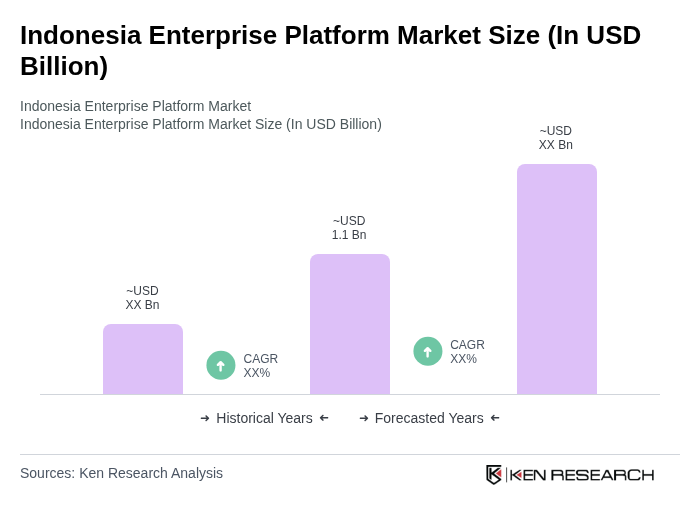
- The Indonesia Enterprise Platform Market is valued at USD 1.1 billion, based on a five-year historical analysis. This growth is primarily driven by the increasing adoption of digital transformation initiatives among businesses, the rise of cloud computing, the expanding construction sector with government infrastructure investments, digitalization in healthcare, and the need for integrated solutions to enhance operational efficiency. The market has witnessed a surge in demand for enterprise applications that streamline processes and improve decision-making capabilities.
- Key cities such as Jakarta, Surabaya, and Bandung dominate the Indonesia Enterprise Platform Market due to their robust economic activities and concentration of businesses. Jakarta, being the capital, serves as a hub for technology and innovation, while Surabaya and Bandung are emerging as significant centers for startups and SMEs, contributing to the overall growth of the enterprise platform ecosystem.
- The Ministry of Public Works and Housing issued Government Regulation No. 16 of 2018 on Electronic-Based Government Systems (SPBE), which mandates central and local governments to implement integrated digital platforms for public services. This regulation requires compliance through phased adoption of enterprise systems for data management, service delivery, and inter-agency coordination, with standards for interoperability and security applicable to all government entities.
Indonesia Enterprise Platform Market Segmentation
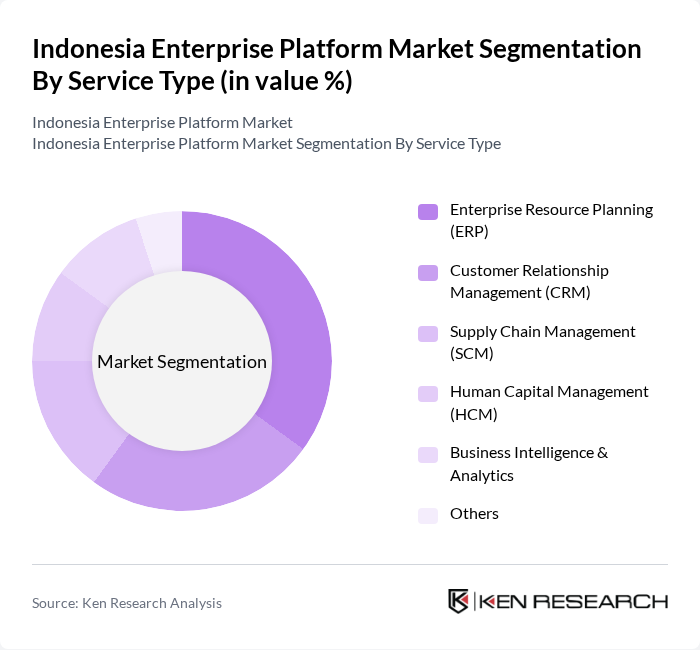
By Service Type:The service type segmentation includes various subsegments such as Enterprise Resource Planning (ERP), Customer Relationship Management (CRM), Supply Chain Management (SCM), Human Capital Management (HCM), Business Intelligence & Analytics, and Others. Among these, ERP solutions are leading the market due to their comprehensive capabilities in integrating core business processes, which are essential for large enterprises seeking operational efficiency. The increasing complexity of business operations and the need for real-time data access are driving the demand for ERP systems.
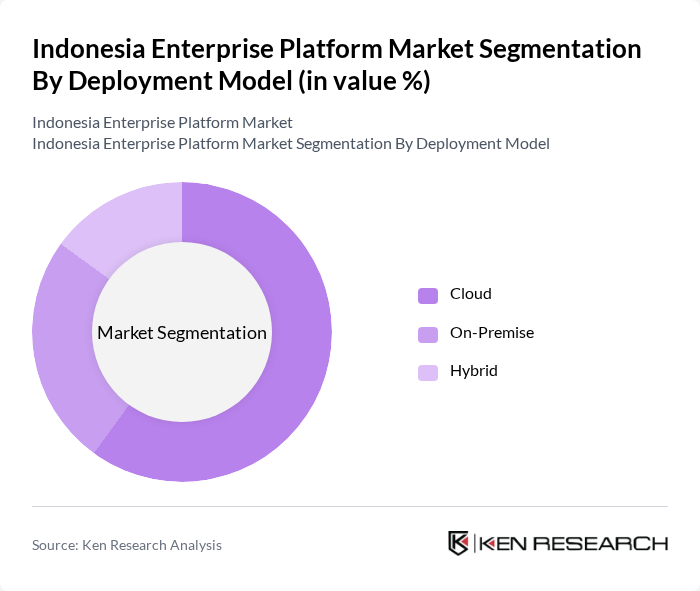
By Deployment Model:The deployment model segmentation includes Cloud, On-Premise, and Hybrid. The Cloud deployment model is dominating the market due to its flexibility, scalability, and cost-effectiveness, making it an attractive option for businesses of all sizes. The increasing trend of remote work and the need for accessible solutions have further accelerated the adoption of cloud-based enterprise platforms.
Indonesia Enterprise Platform Market Competitive Landscape
The Indonesia Enterprise Platform Market is characterized by a dynamic mix of regional and international players. Leading participants such as SAP SE, Microsoft Corporation, Oracle NetSuite, ECOUNT Co., Ltd., Odoo, SYSPRO, Infor, Epicor Software Corp., Ruangguru, HarukaEdu, IndonesiaX, Gojek, Tokopedia, Traveloka, Grab contribute to innovation, geographic expansion, and service delivery in this space.
Indonesia Enterprise Platform Market Industry Analysis
Growth Drivers
- Increasing Digital Transformation Initiatives:The Indonesian government has allocated approximately IDR 1.5 trillion (USD 100 million) for digital transformation projects in future. This funding aims to enhance the digital infrastructure across various sectors, including healthcare and education. As businesses increasingly adopt digital tools, the demand for enterprise platforms is expected to rise significantly, with over 70% of companies planning to invest in digital solutions to improve operational efficiency and customer engagement.
- Rising Demand for Cloud-Based Solutions:The cloud computing market in Indonesia is projected to reach IDR 20 trillion (USD 1.4 billion) by future, driven by the growing need for scalable and flexible IT solutions. With over 60% of enterprises indicating a preference for cloud services, the shift from on-premises to cloud-based platforms is accelerating. This trend is further supported by the increasing internet penetration rate, which is expected to exceed 75% in future, facilitating broader access to cloud technologies.
- Enhanced Focus on Data Analytics:In future, the data analytics market in Indonesia is anticipated to grow to IDR 5 trillion (USD 350 million), reflecting a heightened focus on data-driven decision-making. Companies are investing in analytics tools to gain insights into consumer behavior and operational performance. Approximately 65% of businesses are expected to implement data analytics solutions, which will drive the demand for enterprise platforms that integrate advanced analytics capabilities, enhancing overall business intelligence.
Market Challenges
- High Initial Investment Costs:The upfront costs associated with implementing enterprise platforms can be a significant barrier for many Indonesian businesses. For instance, the average initial investment for a comprehensive enterprise solution can range from IDR 500 million to IDR 1 billion (USD 35,000 to USD 70,000). This financial burden is particularly challenging for small and medium-sized enterprises (SMEs), which often operate on limited budgets and may lack access to financing options.
- Data Security Concerns:With the increasing reliance on digital platforms, data security has become a pressing issue for Indonesian enterprises. In future, cyberattacks in Indonesia rose by 30%, leading to significant financial losses estimated at IDR 2 trillion (USD 140 million). The lack of robust cybersecurity measures and awareness among businesses poses a challenge, as companies must invest in secure systems to protect sensitive data and comply with regulations, which can deter platform adoption.
Indonesia Enterprise Platform Market Future Outlook
The future of the Indonesia enterprise platform market appears promising, driven by ongoing digital transformation and technological advancements. As businesses increasingly prioritize customer experience and operational efficiency, the integration of AI and machine learning into enterprise solutions is expected to gain traction. Additionally, the rise of hybrid cloud solutions will enable organizations to balance flexibility and security, fostering a conducive environment for innovation and growth in the enterprise platform sector.
Market Opportunities
- Expansion of E-commerce Platforms:The e-commerce sector in Indonesia is projected to reach IDR 500 trillion (USD 35 billion) by future, creating significant opportunities for enterprise platforms that support online retail operations. Companies can leverage these platforms to enhance supply chain management, customer engagement, and payment processing, driving overall growth in the digital economy.
- Growth in Mobile Application Development:With over 200 million smartphone users in Indonesia, the demand for mobile applications is surging. By future, the mobile app market is expected to exceed IDR 10 trillion (USD 700 million). This growth presents opportunities for enterprise platforms that facilitate mobile app development, enabling businesses to reach a broader audience and enhance user engagement through innovative mobile solutions.
Scope of the Report
| Segment | Sub-Segments |
|---|---|
| By Service Type | Enterprise Resource Planning (ERP) Customer Relationship Management (CRM) Supply Chain Management (SCM) Human Capital Management (HCM) Business Intelligence & Analytics Others |
| By Deployment Model | Cloud On-Premise Hybrid |
| By End-User | Large Enterprises Small and Medium Enterprises (SMEs) Government Agencies Others |
| By Industry Vertical | Financial Services & Banking Healthcare Retail & Distribution Manufacturing Construction IT & Telecom Government Others |
Key Target Audience
Investors and Venture Capitalist Firms
Government and Regulatory Bodies (e.g., Ministry of Communication and Information Technology, Financial Services Authority)
Large Enterprises and Corporations
Small and Medium Enterprises (SMEs)
Technology Providers and Software Developers
Telecommunications Companies
Industry Associations and Trade Organizations
Financial Institutions and Banks
Players Mentioned in the Report:
SAP SE
Microsoft Corporation
Oracle NetSuite
ECOUNT Co., Ltd.
Odoo
SYSPRO
Infor
Epicor Software Corp.
Ruangguru
HarukaEdu
IndonesiaX
Gojek
Tokopedia
Traveloka
Grab
Table of Contents
Market Assessment Phase
1. Executive Summary and Approach
2. Indonesia Enterprise Platform Market Overview
2.1 Key Insights and Strategic Recommendations
2.2 Indonesia Enterprise Platform Market Overview
2.3 Definition and Scope
2.4 Evolution of Market Ecosystem
2.5 Timeline of Key Regulatory Milestones
2.6 Value Chain & Stakeholder Mapping
2.7 Business Cycle Analysis
2.8 Policy & Incentive Landscape
3. Indonesia Enterprise Platform Market Analysis
3.1 Growth Drivers
3.1.1 Increasing Digital Transformation Initiatives
3.1.2 Rising Demand for Cloud-Based Solutions
3.1.3 Enhanced Focus on Data Analytics
3.1.4 Government Support for Technology Adoption
3.2 Market Challenges
3.2.1 High Initial Investment Costs
3.2.2 Limited Awareness Among SMEs
3.2.3 Data Security Concerns
3.2.4 Regulatory Compliance Issues
3.3 Market Opportunities
3.3.1 Expansion of E-commerce Platforms
3.3.2 Growth in Mobile Application Development
3.3.3 Increasing Adoption of AI and Machine Learning
3.3.4 Collaboration with Local Startups
3.4 Market Trends
3.4.1 Shift Towards Hybrid Cloud Solutions
3.4.2 Rise of Low-Code Development Platforms
3.4.3 Emphasis on Customer Experience Management
3.4.4 Integration of IoT with Enterprise Solutions
3.5 Government Regulation
3.5.1 Data Protection Regulations
3.5.2 E-commerce Law Compliance
3.5.3 Tax Incentives for Tech Investments
3.5.4 Local Content Requirements
4. SWOT Analysis
5. Stakeholder Analysis
6. Porter's Five Forces Analysis
7. Indonesia Enterprise Platform Market Market Size, 2019-2024
7.1 By Value
7.2 By Volume
7.3 By Average Selling Price
8. Indonesia Enterprise Platform Market Segmentation
8.1 By Service Type
8.1.1 Enterprise Resource Planning (ERP)
8.1.2 Customer Relationship Management (CRM)
8.1.3 Supply Chain Management (SCM)
8.1.4 Human Capital Management (HCM)
8.1.5 Business Intelligence & Analytics
8.1.6 Others
8.2 By Deployment Model
8.2.1 Cloud
8.2.2 On-Premise
8.2.3 Hybrid
8.3 By End-User
8.3.1 Large Enterprises
8.3.2 Small and Medium Enterprises (SMEs)
8.3.3 Government Agencies
8.3.4 Others
8.4 By Industry Vertical
8.4.1 Financial Services & Banking
8.4.2 Healthcare
8.4.3 Retail & Distribution
8.4.4 Manufacturing
8.4.5 Construction
8.4.6 IT & Telecom
8.4.7 Government
8.4.8 Others
9. Indonesia Enterprise Platform Market Competitive Analysis
9.1 Market Share of Key Players
9.2 Cross Comparison of Key Players
9.2.1 Company Name
9.2.2 Market Position (Leader, Challenger, Niche Player)
9.2.3 Revenue Growth Rate (YoY %)
9.2.4 Customer Base Size
9.2.5 Market Penetration Rate (%)
9.2.6 Average Contract Value (ACV)
9.2.7 Customer Retention Rate
9.2.8 Product Innovation Index
9.2.9 Pricing Strategy (Freemium, Subscription, Enterprise)
9.2.10 Customer Satisfaction Score (NPS/CSAT)
9.3 SWOT Analysis of Top Players
9.4 Pricing Analysis
9.5 Detailed Profile of Major Companies
9.5.1 SAP SE
9.5.2 Microsoft Corporation
9.5.3 Oracle NetSuite
9.5.4 ECOUNT Co., Ltd.
9.5.5 Odoo
9.5.6 SYSPRO
9.5.7 Infor
9.5.8 Epicor Software Corp.
9.5.9 Ruangguru
9.5.10 HarukaEdu
9.5.11 IndonesiaX
9.5.12 Gojek
9.5.13 Tokopedia
9.5.14 Traveloka
9.5.15 Grab
10. Indonesia Enterprise Platform Market End-User Analysis
10.1 Procurement Behavior of Key Ministries
10.1.1 Ministry of Communication and Information Technology
10.1.2 Ministry of Finance
10.1.3 Ministry of Industry
10.1.4 Ministry of Trade
10.2 Corporate Spend on Infrastructure & Energy
10.2.1 IT Infrastructure Investments
10.2.2 Cloud Services Expenditure
10.2.3 Cybersecurity Investments
10.2.4 Software Licensing Costs
10.3 Pain Point Analysis by End-User Category
10.3.1 SMEs
10.3.2 Large Corporations
10.3.3 Government Agencies
10.3.4 Non-Profits
10.4 User Readiness for Adoption
10.4.1 Training and Support Needs
10.4.2 Technology Literacy Levels
10.4.3 Infrastructure Readiness
10.4.4 Budget Allocations
10.5 Post-Deployment ROI and Use Case Expansion
10.5.1 Performance Metrics
10.5.2 User Feedback Mechanisms
10.5.3 Scalability Assessments
10.5.4 Future Use Case Identification
11. Indonesia Enterprise Platform Market Future Size, 2025-2030
11.1 By Value
11.2 By Volume
11.3 By Average Selling Price
Go-To-Market Strategy Phase
1. Whitespace Analysis + Business Model Canvas
1.1 Market Gaps Identification
1.2 Business Model Framework
2. Marketing and Positioning Recommendations
2.1 Branding Strategies
2.2 Product USPs
3. Distribution Plan
3.1 Urban Retail Strategies
3.2 Rural NGO Tie-ups
4. Channel & Pricing Gaps
4.1 Underserved Routes
4.2 Pricing Bands
5. Unmet Demand & Latent Needs
5.1 Category Gaps
5.2 Consumer Segments
6. Customer Relationship
6.1 Loyalty Programs
6.2 After-sales Service
7. Value Proposition
7.1 Sustainability Initiatives
7.2 Integrated Supply Chains
8. Key Activities
8.1 Regulatory Compliance
8.2 Branding Efforts
8.3 Distribution Setup
9. Entry Strategy Evaluation
9.1 Domestic Market Entry Strategy
9.1.1 Product Mix Considerations
9.1.2 Pricing Band Analysis
9.1.3 Packaging Strategies
9.2 Export Entry Strategy
9.2.1 Target Countries
9.2.2 Compliance Roadmap
10. Entry Mode Assessment
10.1 Joint Ventures
10.2 Greenfield Investments
10.3 Mergers & Acquisitions
10.4 Distributor Model
11. Capital and Timeline Estimation
11.1 Capital Requirements
11.2 Timelines for Implementation
12. Control vs Risk Trade-Off
12.1 Ownership Considerations
12.2 Partnerships Evaluation
13. Profitability Outlook
13.1 Breakeven Analysis
13.2 Long-term Sustainability
14. Potential Partner List
14.1 Distributors
14.2 Joint Ventures
14.3 Acquisition Targets
15. Execution Roadmap
15.1 Phased Plan for Market Entry
15.1.1 Market Setup
15.1.2 Market Entry
15.1.3 Growth Acceleration
15.1.4 Scale & Stabilize
15.2 Key Activities and Milestones
15.2.1 Milestone Planning
15.2.2 Activity Tracking
Research Methodology
Phase 1: Approach1
Desk Research
- Analysis of industry reports from government agencies and market research firms
- Review of published articles and white papers on enterprise platform trends in Indonesia
- Examination of financial reports and press releases from key players in the enterprise platform market
Primary Research
- Interviews with IT decision-makers in large enterprises across various sectors
- Surveys targeting software developers and system integrators in the enterprise space
- Focus groups with end-users to understand platform usability and feature requirements
Validation & Triangulation
- Cross-validation of findings through multiple data sources including industry publications and expert opinions
- Triangulation of quantitative data from surveys with qualitative insights from interviews
- Sanity checks conducted through expert panel reviews to ensure data reliability
Phase 2: Market Size Estimation1
Top-down Assessment
- Estimation of total addressable market (TAM) based on national IT spending trends
- Segmentation of the market by industry verticals such as finance, healthcare, and manufacturing
- Incorporation of growth rates from government digital transformation initiatives
Bottom-up Modeling
- Collection of data on software adoption rates from leading enterprise platform providers
- Estimation of average revenue per user (ARPU) across different platform offerings
- Calculation of market size based on user base growth and pricing models
Forecasting & Scenario Analysis
- Multi-variable forecasting using economic indicators and technology adoption rates
- Scenario analysis based on potential regulatory changes and market disruptions
- Development of baseline, optimistic, and pessimistic growth projections through 2030
Phase 3: CATI Sample Composition1
| Scope Item/Segment | Sample Size | Target Respondent Profiles |
|---|---|---|
| Enterprise Resource Planning (ERP) Users | 120 | IT Managers, CFOs, Operations Directors |
| Customer Relationship Management (CRM) Solutions | 100 | Sales Managers, Marketing Directors, Customer Service Heads |
| Supply Chain Management (SCM) Platforms | 80 | Supply Chain Managers, Procurement Officers |
| Human Resource Management Systems (HRMS) | 70 | HR Managers, Talent Acquisition Specialists |
| Business Intelligence (BI) Tools | 90 | Data Analysts, Business Analysts, IT Directors |
Frequently Asked Questions
What is the current value of the Indonesia Enterprise Platform Market?
The Indonesia Enterprise Platform Market is valued at approximately USD 1.1 billion, reflecting significant growth driven by digital transformation initiatives, cloud computing adoption, and the need for integrated solutions across various sectors.
Which cities are key players in the Indonesia Enterprise Platform Market?
What are the main drivers of growth in the Indonesia Enterprise Platform Market?
What challenges does the Indonesia Enterprise Platform Market face?
Other Regional/Country Reports
Other Adjacent Reports
Thailand Human Capital Management Market
Global Business Intelligence Market Size, Share & Forecast, By Solution Type, Deployment Model & End-Use Industry, 2026-2031Middle East & Africa Data Analytics Market Size, Share & Forecast, By Solution Type, Deployment Model & End-Use Industry, 2025-2032Indonesia Cybersecurity Market Size, Share & Forecast, By Solution Type, Deployment Model & End-Use Industry, 2025-2032India E-commerce MarketOman Mobile Application Market Report Size, Share, Growth Drivers, Trends, Opportunities & Forecast 2025–2030Why Buy From Us?

What makes us stand out is that our consultants follow Robust, Refine and Result (RRR) methodology. Robust for clear definitions, approaches and sanity checking, Refine for differentiating respondents' facts and opinions, and Result for presenting data with story.

We have set a benchmark in the industry by offering our clients with syndicated and customized market research reports featuring coverage of entire market as well as meticulous research and analyst insights.

While we don't replace traditional research, we flip the method upside down. Our dual approach of Top Bottom & Bottom Top ensures quality deliverable by not just verifying company fundamentals but also looking at the sector and macroeconomic factors.

With one step in the future, our research team constantly tries to show you the bigger picture. We help with some of the tough questions you may encounter along the way: How is the industry positioned? Best marketing channel? KPI's of competitors? By aligning every element, we help maximize success.

Our report gives you instant access to the answers and sources that other companies might choose to hide. We elaborate each steps of research methodology we have used and showcase you the sample size to earn your trust.

If you need any support, we are here! We pride ourselves on universe strength, data quality, and quick, friendly, and professional service.