About the Report
Base Year 2024Indonesia Food Trucks Market Overview
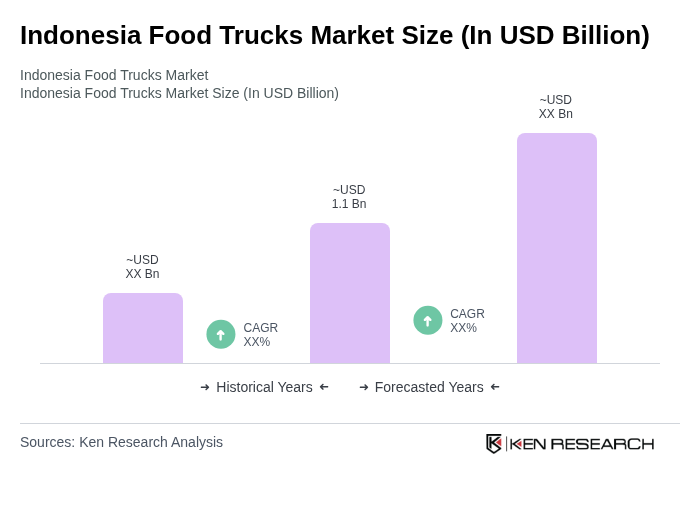
- The Indonesia Food Trucks Market is valued at USD 1.1 billion, based on a five-year historical analysis of Indonesia’s role within the rapidly expanding Asia–Pacific and global food truck industry. This growth is primarily driven by increasing urbanization, changing consumer preferences towards convenient street food, the expansion of food delivery and online ordering, and the popularity of pop-up culinary events in major Indonesian cities. The market has seen a surge in demand for diverse and affordable food options, particularly in urban areas, as consumers seek convenience, cashless payment options, and unique culinary experiences such as fusion menus and specialty beverages.
- Key cities such as Jakarta, Bandung, and Surabaya dominate the market due to their high population density, concentration of middle-income consumers, and vibrant street food culture. Jakarta, being the capital, serves as a hub for food innovation and entrepreneurship with frequent events, night markets, and corporate activations, while Bandung and Surabaya attract food enthusiasts with their local delicacies, creative culinary concepts, and food festivals, further driving the food truck trend. The dominance of Java in Indonesia’s broader food service revenues reinforces the role of these cities as primary clusters for mobile food businesses.
- In 2023, the Indonesian government strengthened regulations relevant to mobile food operators and street vendors through instruments such as Government Regulation No. 5 of 2021 on the Implementation of Risk-Based Business Licensing and its implementing regulations under the Online Single Submission (OSS) system, issued by the Government of Indonesia. These rules streamline and digitize licensing for micro and small food service enterprises, including food trucks, by simplifying business identification number (NIB) issuance, integrating food safety and hygiene requirements, and aligning local permits (location, public space use, and health certification) to promote entrepreneurship and formalization of mobile food businesses across the country.
Indonesia Food Trucks Market Segmentation
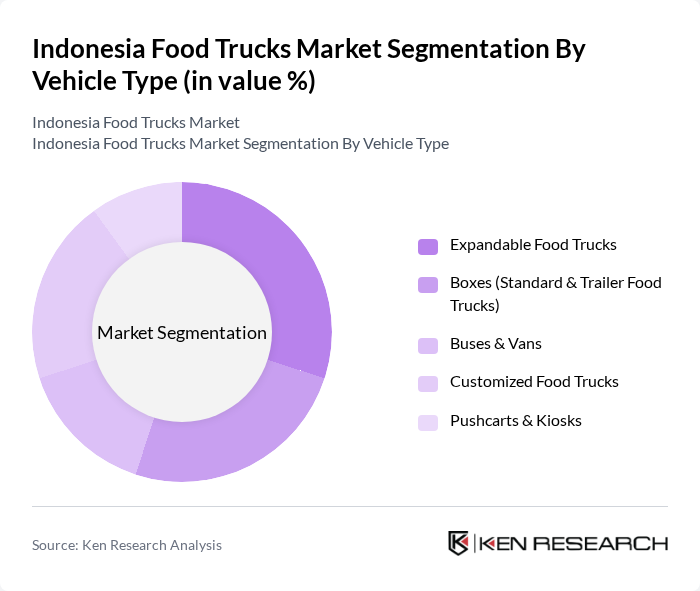
By Vehicle Type:The vehicle type segmentation includes various categories such as Expandable Food Trucks, Boxes (Standard & Trailer Food Trucks), Buses & Vans, Customized Food Trucks, and Pushcarts & Kiosks. This structure is broadly consistent with how global food truck studies classify the market by truck body and configuration. Among these, Expandable Food Trucks are gaining popularity for events, exhibitions, and brand activations due to their versatility, ability to accommodate larger cooking and serving areas, and better customer flow management. The demand for Customized Food Trucks is also on the rise as entrepreneurs and brands seek to create distinctive concepts, integrate digital menu boards, and optimize layouts for specific cuisines or beverage-focused offerings.
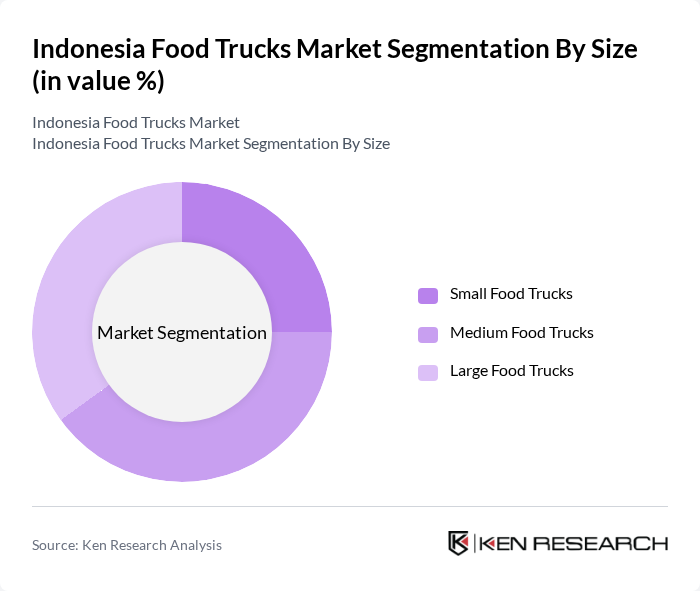
By Size:The size segmentation categorizes food trucks into Small, Medium, and Large Food Trucks, which aligns with common global segmentation by vehicle length and kitchen capacity. Small Food Trucks are particularly favored by new entrepreneurs due to lower startup costs, easier parking, and higher route flexibility, especially in dense urban neighborhoods. Medium Food Trucks are popular for their balance between capacity and maneuverability and are often used by branded concepts or multi-unit operators, while Large Food Trucks cater to established businesses and corporate or event catering that require more space for equipment, storage, and multiple staff. The trend towards food trucks that can serve larger crowds at events, festivals, and corporate gatherings is supporting the growth of Medium and Large Food Trucks, alongside rising demand for mobile kitchens capable of handling delivery and online orders.
Indonesia Food Trucks Market Competitive Landscape
The Indonesia Food Trucks Market is characterized by a dynamic mix of regional and international players. Leading participants such as Kebab Turki Baba Rafi (PT Baba Rafi Indonesia), Loket Food Truck Jakarta, Jakarta Food Truck Community (JFTC), Monas Food Truck Area (Cluster of Licensed Operators), Eat & Go Food Truck, Food Truck Bandung Community, Burger Bangor Food Truck, Roti Bakar Food Truck (Various Local Operators), Kopi Kenangan Mobile Truck, Janji Jiwa Coffee Truck, Dapur Keliling UMKM Jakarta, Street Food Truck Surabaya Collective, Pizza & Pasta Mobile (Independent Operators), Corporate-Branded Trucks (e.g., Burger King Indonesia Food Truck), Event & Festival Food Truck Operators (e.g., Jakpreneur, MSME Programs) contribute to innovation, geographic expansion, and service delivery in this space.
Indonesia Food Trucks Market Industry Analysis
Growth Drivers
- Increasing Urbanization:Indonesia's urban population is projected to reach 60% in future, up from approximately 54% in the recent past, according to the World Bank. This rapid urbanization drives demand for convenient dining options, such as food trucks, which cater to busy city dwellers. The urban middle class, estimated at 170 million, increasingly seeks diverse culinary experiences, further propelling the food truck sector. As cities expand, food trucks become essential in meeting the growing appetite for accessible street food.
- Rising Demand for Street Food:The street food market in Indonesia is valued at approximately IDR 250 trillion (around USD 17.5 billion), reflecting a significant cultural preference for affordable and diverse food options. Food trucks, offering gourmet and traditional dishes, are well-positioned to capitalize on this trend. The increasing popularity of street food among younger consumers, who prioritize unique dining experiences, further supports the growth of food trucks in urban areas across Indonesia.
- Low Entry Barriers for Entrepreneurs:Starting a food truck business in Indonesia requires relatively low initial investment, with costs ranging from IDR 60 million to IDR 180 million (USD 4,200 to USD 12,600). This accessibility encourages aspiring entrepreneurs to enter the market, fostering innovation and competition. The government’s support for small businesses, including simplified licensing processes, further enhances the appeal of food trucks as a viable entrepreneurial venture, contributing to market growth.
Market Challenges
- Regulatory Compliance Issues:Food truck operators in Indonesia face complex regulatory frameworks, including health and safety standards, which can vary significantly by region. Compliance with local regulations often requires substantial time and financial investment, with fines for non-compliance reaching IDR 15 million (USD 1,050). These challenges can deter new entrants and hinder the operational efficiency of existing food trucks, impacting overall market growth.
- High Competition in Urban Areas:The food truck market in major Indonesian cities, such as Jakarta and Surabaya, is characterized by intense competition, with over 6,000 food trucks operating in these regions. This saturation leads to price wars and reduced profit margins, making it difficult for new entrants to establish a foothold. As established brands dominate the market, smaller operators may struggle to differentiate themselves, posing a significant challenge to market expansion.
Indonesia Food Trucks Market Future Outlook
The future of the food truck market in Indonesia appears promising, driven by evolving consumer preferences and technological advancements. As urbanization continues, food trucks are likely to become integral to the culinary landscape, offering diverse and innovative dining experiences. Additionally, the integration of mobile ordering apps and contactless payment systems will enhance customer convenience, further boosting sales. Sustainability practices, such as eco-friendly packaging, will also gain traction, aligning with consumer demand for responsible dining options.
Market Opportunities
- Expansion into Untapped Regions:Many rural areas in Indonesia remain underserved by food services, presenting a significant opportunity for food trucks. By targeting these regions, operators can establish a loyal customer base and fill the gap in the local food market, potentially increasing revenues by up to 35% in less competitive environments.
- Collaboration with Local Events:Partnering with local festivals and events can significantly enhance visibility and sales for food trucks. With over 1,200 annual cultural events across Indonesia, food trucks can leverage these gatherings to reach new customers, potentially increasing daily sales by 60% during peak event seasons.
Scope of the Report
| Segment | Sub-Segments |
|---|---|
| By Vehicle Type | Expandable Food Trucks Boxes (Standard & Trailer Food Trucks) Buses & Vans Customized Food Trucks Pushcarts & Kiosks |
| By Size | Small Food Trucks Medium Food Trucks Large Food Trucks |
| By Food Type | Fast Food Trucks Barbecue & Grilled Food Trucks Bakery & Dessert Trucks Beverage & Coffee Trucks Other Applications (Vegan, Ethnic, Fusion, etc.) |
| By Location | Central Business Districts (CBDs) Residential & Suburban Areas Tourist Attractions & Coastal Areas Events, Festivals & Night Markets Educational & Office Complexes |
| By Ownership Model | Independent Owner-Operators Franchised Food Trucks Corporate-Branded Food Trucks Community / MSME Collectives Others |
| By Service & Sales Channel | On-Site Over-the-Counter Sales Online Aggregators & Delivery Platforms Pre-Order & Pickup Event Catering Services Corporate & Institutional Contracts |
| By Region | Java Sumatra Kalimantan Sulawesi Bali & Nusa Tenggara Other Regions (Maluku & Papua) |
Key Target Audience
Investors and Venture Capitalist Firms
Government and Regulatory Bodies (e.g., Ministry of Trade, Ministry of Tourism and Creative Economy)
Food Truck Manufacturers and Equipment Suppliers
Local Entrepreneurs and Small Business Owners
Food and Beverage Distributors
Event Organizers and Festival Planners
Real Estate Developers and Property Managers
Marketing and Advertising Agencies
Players Mentioned in the Report:
Kebab Turki Baba Rafi (PT Baba Rafi Indonesia)
Loket Food Truck Jakarta
Jakarta Food Truck Community (JFTC)
Monas Food Truck Area (Cluster of Licensed Operators)
Eat & Go Food Truck
Food Truck Bandung Community
Burger Bangor Food Truck
Roti Bakar Food Truck (Various Local Operators)
Kopi Kenangan Mobile Truck
Janji Jiwa Coffee Truck
Dapur Keliling UMKM Jakarta
Street Food Truck Surabaya Collective
Pizza & Pasta Mobile (Independent Operators)
Corporate-Branded Trucks (e.g., Burger King Indonesia Food Truck)
Event & Festival Food Truck Operators (e.g., Jakpreneur, MSME Programs)
Table of Contents
Market Assessment Phase
1. Executive Summary and Approach
2. Indonesia Food Trucks Market Overview
2.1 Key Insights and Strategic Recommendations
2.2 Indonesia Food Trucks Market Overview
2.3 Definition and Scope
2.4 Evolution of Market Ecosystem
2.5 Timeline of Key Regulatory Milestones
2.6 Value Chain & Stakeholder Mapping
2.7 Business Cycle Analysis
2.8 Policy & Incentive Landscape
3. Indonesia Food Trucks Market Analysis
3.1 Growth Drivers
3.1.1 Increasing Urbanization
3.1.2 Rising Demand for Street Food
3.1.3 Low Entry Barriers for Entrepreneurs
3.1.4 Growing Popularity of Food Festivals
3.2 Market Challenges
3.2.1 Regulatory Compliance Issues
3.2.2 High Competition in Urban Areas
3.2.3 Limited Access to Financing
3.2.4 Seasonal Demand Fluctuations
3.3 Market Opportunities
3.3.1 Expansion into Untapped Regions
3.3.2 Collaboration with Local Events
3.3.3 Introduction of Health-Conscious Menus
3.3.4 Leveraging Social Media for Marketing
3.4 Market Trends
3.4.1 Rise of Gourmet Food Trucks
3.4.2 Integration of Technology in Operations
3.4.3 Focus on Sustainability and Eco-Friendly Practices
3.4.4 Increasing Popularity of Mobile Apps for Ordering
3.5 Government Regulation
3.5.1 Licensing and Permitting Requirements
3.5.2 Health and Safety Standards
3.5.3 Zoning Laws for Food Trucks
3.5.4 Taxation Policies for Mobile Vendors
4. SWOT Analysis
5. Stakeholder Analysis
6. Porter's Five Forces Analysis
7. Indonesia Food Trucks Market Market Size, 2019-2024
7.1 By Value
7.2 By Volume
7.3 By Average Selling Price
8. Indonesia Food Trucks Market Segmentation
8.1 By Vehicle Type
8.1.1 Expandable Food Trucks
8.1.2 Boxes (Standard & Trailer Food Trucks)
8.1.3 Buses & Vans
8.1.4 Customized Food Trucks
8.1.5 Pushcarts & Kiosks
8.2 By Size
8.2.1 Small Food Trucks
8.2.2 Medium Food Trucks
8.2.3 Large Food Trucks
8.3 By Food Type
8.3.1 Fast Food Trucks
8.3.2 Barbecue & Grilled Food Trucks
8.3.3 Bakery & Dessert Trucks
8.3.4 Beverage & Coffee Trucks
8.3.5 Other Applications (Vegan, Ethnic, Fusion, etc.)
8.4 By Location
8.4.1 Central Business Districts (CBDs)
8.4.2 Residential & Suburban Areas
8.4.3 Tourist Attractions & Coastal Areas
8.4.4 Events, Festivals & Night Markets
8.4.5 Educational & Office Complexes
8.5 By Ownership Model
8.5.1 Independent Owner-Operators
8.5.2 Franchised Food Trucks
8.5.3 Corporate-Branded Food Trucks
8.5.4 Community / MSME Collectives
8.5.5 Others
8.6 By Service & Sales Channel
8.6.1 On-Site Over-the-Counter Sales
8.6.2 Online Aggregators & Delivery Platforms
8.6.3 Pre-Order & Pickup
8.6.4 Event Catering Services
8.6.5 Corporate & Institutional Contracts
8.7 By Region
8.7.1 Java
8.7.2 Sumatra
8.7.3 Kalimantan
8.7.4 Sulawesi
8.7.5 Bali & Nusa Tenggara
8.7.6 Other Regions (Maluku & Papua)
9. Indonesia Food Trucks Market Competitive Analysis
9.1 Market Share of Key Players
9.2 Cross Comparison of Key Players
9.2.1 Company Name
9.2.2 Fleet Size (Number of Trucks / Mobile Units)
9.2.3 Geographic Coverage (Number of Cities / Provinces)
9.2.4 Annual Revenue & Revenue Growth Rate
9.2.5 Average Daily Transactions per Truck
9.2.6 Average Ticket Size / Order Value
9.2.7 Share of Sales via Digital Channels (%)
9.2.8 Utilization Rate (Operating Days per Month)
9.2.9 Customer Repeat Visit Rate / Loyalty
9.2.10 EBITDA Margin & Payback Period per Truck
9.3 SWOT Analysis of Top Players
9.4 Pricing Analysis
9.5 Detailed Profile of Major Companies
9.5.1 Kebab Turki Baba Rafi (PT Baba Rafi Indonesia)
9.5.2 Loket Food Truck Jakarta
9.5.3 Jakarta Food Truck Community (JFTC)
9.5.4 Monas Food Truck Area (Cluster of Licensed Operators)
9.5.5 Eat & Go Food Truck
9.5.6 Food Truck Bandung Community
9.5.7 Burger Bangor Food Truck
9.5.8 Roti Bakar Food Truck (Various Local Operators)
9.5.9 Kopi Kenangan Mobile Truck
9.5.10 Janji Jiwa Coffee Truck
9.5.11 Dapur Keliling UMKM Jakarta
9.5.12 Street Food Truck Surabaya Collective
9.5.13 Pizza & Pasta Mobile (Independent Operators)
9.5.14 Corporate-Branded Trucks (e.g., Burger King Indonesia Food Truck)
9.5.15 Event & Festival Food Truck Operators (e.g., Jakpreneur, MSME Programs)
10. Indonesia Food Trucks Market End-User Analysis
10.1 Procurement Behavior of Key Ministries
10.1.1 Ministry of Tourism
10.1.2 Ministry of Trade
10.1.3 Ministry of Health
10.1.4 Ministry of Transportation
10.2 Corporate Spend on Infrastructure & Energy
10.2.1 Investment in Food Truck Infrastructure
10.2.2 Expenditure on Marketing and Promotions
10.2.3 Budget Allocation for Events
10.2.4 Spending on Compliance and Licensing
10.3 Pain Point Analysis by End-User Category
10.3.1 Quality of Ingredients
10.3.2 Pricing Concerns
10.3.3 Accessibility of Food Trucks
10.3.4 Variety of Menu Options
10.4 User Readiness for Adoption
10.4.1 Awareness of Food Truck Options
10.4.2 Willingness to Try New Cuisines
10.4.3 Acceptance of Mobile Ordering
10.4.4 Interest in Food Truck Events
10.5 Post-Deployment ROI and Use Case Expansion
10.5.1 Customer Feedback Mechanisms
10.5.2 Repeat Customer Rates
10.5.3 Expansion into New Locations
10.5.4 Menu Diversification Strategies
11. Indonesia Food Trucks Market Future Size, 2025-2030
11.1 By Value
11.2 By Volume
11.3 By Average Selling Price
Go-To-Market Strategy Phase
1. Whitespace Analysis + Business Model Canvas
1.1 Market Gaps Identification
1.2 Business Model Framework
2. Marketing and Positioning Recommendations
2.1 Branding Strategies
2.2 Product USPs
3. Distribution Plan
3.1 Urban Retail vs Rural NGO Tie-Ups
4. Channel & Pricing Gaps
4.1 Underserved Routes
4.2 Pricing Bands
5. Unmet Demand & Latent Needs
5.1 Category Gaps
5.2 Consumer Segments
6. Customer Relationship
6.1 Loyalty Programs
6.2 After-Sales Service
7. Value Proposition
7.1 Sustainability
7.2 Integrated Supply Chains
8. Key Activities
8.1 Regulatory Compliance
8.2 Branding
8.3 Distribution Setup
9. Entry Strategy Evaluation
9.1 Domestic Market Entry Strategy
9.1.1 Product Mix
9.1.2 Pricing Band
9.1.3 Packaging
9.2 Export Entry Strategy
9.2.1 Target Countries
9.2.2 Compliance Roadmap
10. Entry Mode Assessment
10.1 JV
10.2 Greenfield
10.3 M&A
10.4 Distributor Model
11. Capital and Timeline Estimation
11.1 Capital Requirements
11.2 Timelines
12. Control vs Risk Trade-Off
12.1 Ownership vs Partnerships
13. Profitability Outlook
13.1 Breakeven Analysis
13.2 Long-Term Sustainability
14. Potential Partner List
14.1 Distributors
14.2 JVs
14.3 Acquisition Targets
15. Execution Roadmap
15.1 Phased Plan for Market Entry
15.1.1 Market Setup
15.1.2 Market Entry
15.1.3 Growth Acceleration
15.1.4 Scale & Stabilize
15.2 Key Activities and Milestones
15.2.1 Milestone Planning
15.2.2 Activity Tracking
Research Methodology
Phase 1: Approach1
Desk Research
- Analysis of industry reports from local food and beverage associations
- Review of government publications on food truck regulations and permits
- Examination of market trends through online databases and food industry journals
Primary Research
- Interviews with food truck owners and operators across major cities in Indonesia
- Surveys conducted with consumers to understand preferences and spending habits
- Focus group discussions with food truck enthusiasts and local community members
Validation & Triangulation
- Cross-validation of findings with data from food service industry experts
- Triangulation of consumer insights with sales data from food truck operators
- Sanity check through expert panel reviews including chefs and food critics
Phase 2: Market Size Estimation1
Top-down Assessment
- Estimation of market size based on national food service industry revenue
- Segmentation by food types offered and geographical distribution of food trucks
- Incorporation of growth rates from related sectors such as street food and catering
Bottom-up Modeling
- Collection of sales data from a sample of food trucks across various regions
- Operational cost analysis including food sourcing, labor, and vehicle maintenance
- Volume x average transaction value calculations to derive revenue estimates
Forecasting & Scenario Analysis
- Multi-factor regression analysis considering urbanization rates and tourism growth
- Scenario modeling based on potential regulatory changes and consumer trends
- Baseline, optimistic, and pessimistic projections through 2030
Phase 3: CATI Sample Composition1
| Scope Item/Segment | Sample Size | Target Respondent Profiles |
|---|---|---|
| Food Truck Operators | 100 | Owners, Managers, and Chefs |
| Consumer Preferences | 120 | Food Enthusiasts, Regular Customers |
| Regulatory Insights | 50 | Local Government Officials, Regulatory Bodies |
| Market Trends | 80 | Industry Analysts, Food Critics |
| Supply Chain Stakeholders | 70 | Food Suppliers, Logistics Managers |
Frequently Asked Questions
What is the current value of the Indonesia Food Trucks Market?
The Indonesia Food Trucks Market is valued at approximately USD 1.1 billion, reflecting significant growth driven by urbanization, changing consumer preferences, and the popularity of street food and culinary events in major cities.
What factors are driving the growth of food trucks in Indonesia?
Which cities are the primary markets for food trucks in Indonesia?
What types of food trucks are popular in Indonesia?
Other Regional/Country Reports
Malaysia Food Trucks Market
KSA Food Trucks Market
APAC Food Trucks Market
SEA Food Trucks Market
Vietnam Food Trucks Market
Other Adjacent Reports
Japan Food Delivery Services Market
Philippines Street Food Vendors Market
South Africa Mobile Catering Services Market
Europe Quick Service Restaurants Market Size, Share & Forecast, By Service Type, Customer Type & Distribution Channel, 2026-2031UAE Event Catering Market
Philippines Beverage Vending Market
Egypt Food Packaging Solutions Market
Oman Restaurant Supply Chain Market
Saudi Arabia Culinary Tourism Market Report Size, Share, Growth Drivers, Trends, Opportunities & Forecast 2025–2030Vietnam Food Franchise Market
Why Buy From Us?

What makes us stand out is that our consultants follow Robust, Refine and Result (RRR) methodology. Robust for clear definitions, approaches and sanity checking, Refine for differentiating respondents' facts and opinions, and Result for presenting data with story.

We have set a benchmark in the industry by offering our clients with syndicated and customized market research reports featuring coverage of entire market as well as meticulous research and analyst insights.

While we don't replace traditional research, we flip the method upside down. Our dual approach of Top Bottom & Bottom Top ensures quality deliverable by not just verifying company fundamentals but also looking at the sector and macroeconomic factors.

With one step in the future, our research team constantly tries to show you the bigger picture. We help with some of the tough questions you may encounter along the way: How is the industry positioned? Best marketing channel? KPI's of competitors? By aligning every element, we help maximize success.

Our report gives you instant access to the answers and sources that other companies might choose to hide. We elaborate each steps of research methodology we have used and showcase you the sample size to earn your trust.

If you need any support, we are here! We pride ourselves on universe strength, data quality, and quick, friendly, and professional service.