About the Report
Base Year 2024Listen to the audio summary
Saudi Arabia Culinary Tourism Market Overview
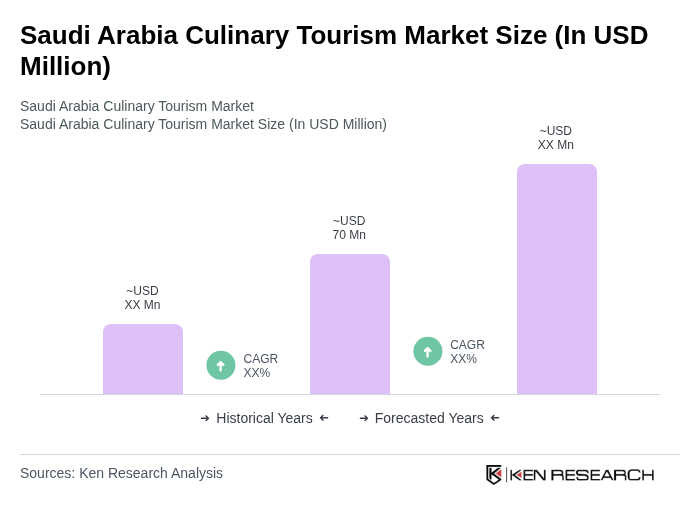
- The Saudi Arabia Culinary Tourism Market is valued at USD 70 million, based on a five-year historical analysis. This growth is primarily driven by the increasing interest in authentic culinary experiences, the rise of food festivals, and the government's initiatives to promote tourism as part of Vision 2030. The market has seen a surge in both domestic and international tourists seeking unique food experiences that reflect the rich cultural heritage of the region.
- Key cities dominating the culinary tourism market include Riyadh, Jeddah, and AlUla. Riyadh is the capital and a major business hub, attracting culinary enthusiasts with its diverse dining options. Jeddah, known for its coastal cuisine and vibrant food scene, draws both local and international tourists. AlUla, with its historical significance and unique dining experiences, is becoming a culinary hotspot, particularly with events like Winter at Tantora.
- The Food Safety Law, 2022 issued by the Saudi Food and Drug Authority (SFDA), governs food safety and quality standards in the culinary tourism sector. This law requires all food establishments, including restaurants and catering services, to obtain licenses, implement hazard analysis and critical control points (HACCP) systems, maintain hygiene protocols, and adhere to labeling and traceability standards for ingredients served to tourists and locals.
Saudi Arabia Culinary Tourism Market Segmentation
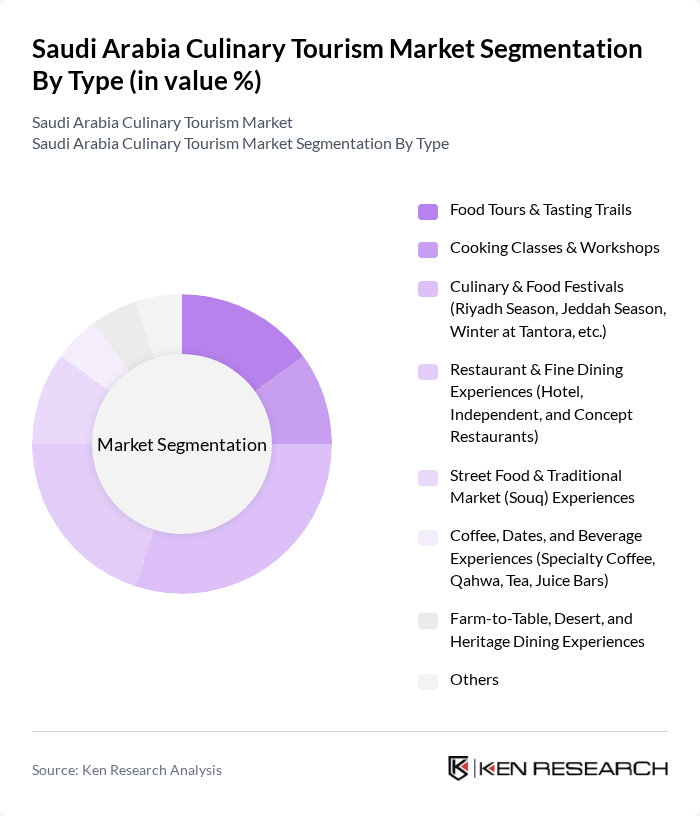
By Type:The culinary tourism market in Saudi Arabia can be segmented into various types, including Food Tours & Tasting Trails, Cooking Classes & Workshops, Culinary & Food Festivals, Restaurant & Fine Dining Experiences, Street Food & Traditional Market Experiences, Coffee, Dates, and Beverage Experiences, Farm-to-Table, Desert, and Heritage Dining Experiences, and Others. Among these, Culinary & Food Festivals are particularly popular, attracting large crowds and showcasing the country's diverse culinary heritage.
By Cuisine:The culinary tourism market can also be segmented by cuisine, including Traditional Saudi Cuisine, Broader Middle Eastern & Levantine Cuisine, International Cuisine, Fusion & Contemporary Saudi Cuisine, Specialty Diet & Wellness Cuisine, and Others. Traditional Saudi Cuisine is the most dominant segment, as it reflects the rich cultural heritage and is a major attraction for both domestic and international tourists.

Saudi Arabia Culinary Tourism Market Competitive Landscape
The Saudi Arabia Culinary Tourism Market is characterized by a dynamic mix of regional and international players. Leading participants such as Saudi Tourism Authority (STA) – Culinary & Events Programs, Royal Commission for AlUla (RCU) – Winter at Tantora & AlUla Moments, General Entertainment Authority (GEA) – Riyadh Season & Jeddah Season Food Experiences, Diriyah Gate Development Authority (DGDA) – Bujairi Terrace Culinary District, Saudi Culinary Arts Commission, Saudi Arabian Airlines (SAUDIA) – SAUDIA Holidays & Culinary Packages, Almosafer & Discover Saudi (Seera Group), Dur Hospitality (Makarem Hotels & other brands), Al Khozama Management Company (e.g., Al Faisaliah, premium F&B concepts), Al Hokair Group for Tourism and Development, Alshaya Group – International Restaurant Franchises in KSA, Riyadh Season F&B Concessionaires & Food Hall Operators, Jeddah Season F&B & Waterfront Restaurant Operators, Boutique Group (Historic Palace Hotels & Dining), NEOM & The Red Sea Global – Destination & Resort Culinary Experiences contribute to innovation, geographic expansion, and service delivery in this space.
Saudi Arabia Culinary Tourism Market Industry Analysis
Growth Drivers
- Increasing Global Interest in Culinary Experiences:The culinary tourism sector in Saudi Arabia is experiencing a surge, with over 50% of travelers expressing a desire to engage in local food experiences. According to the World Tourism Organization, culinary tourism is one of the fastest-growing segments, contributing approximately $160 billion to the global economy in future. This trend is expected to continue, as more tourists seek authentic culinary experiences that reflect local culture and traditions.
- Government Initiatives to Promote Tourism:The Saudi government has allocated $2 billion to enhance tourism infrastructure as part of its Vision 2030 initiative. This includes promoting culinary tourism through various campaigns and events. The Ministry of Tourism reported a 35% increase in culinary-related events in future, showcasing local cuisine and attracting international visitors. Such initiatives are pivotal in positioning Saudi Arabia as a culinary destination on the global stage.
- Rich Cultural Heritage and Diverse Cuisine:Saudi Arabia boasts a rich cultural heritage, with over 15 UNESCO World Heritage Sites and a diverse culinary landscape that includes dishes like Kabsa and Shawarma. The country’s unique blend of flavors and cooking techniques attracts food enthusiasts. In future, culinary tours focusing on traditional Saudi cuisine saw a 45% increase in participation, highlighting the growing interest in the nation’s culinary offerings and cultural experiences.
Market Challenges
- Limited Awareness of Culinary Tourism:Despite the potential, awareness of culinary tourism in Saudi Arabia remains low, with only 30% of potential tourists familiar with the concept. This lack of awareness hinders market growth, as many travelers prioritize destinations with established culinary reputations. Efforts to educate both locals and international tourists about Saudi culinary experiences are essential to overcoming this challenge and attracting more visitors.
- Infrastructure Development Needs:The culinary tourism sector faces significant infrastructure challenges, particularly in rural areas where many culinary experiences are located. According to the Saudi Tourism Authority, 65% of culinary tourism sites lack adequate facilities, impacting visitor experiences. Investments in transportation, accommodation, and dining facilities are crucial to enhance accessibility and ensure a seamless experience for tourists seeking culinary adventures.
Saudi Arabia Culinary Tourism Market Future Outlook
The future of culinary tourism in Saudi Arabia appears promising, driven by increasing global interest and government support. As the nation continues to invest in tourism infrastructure and promote its rich culinary heritage, the sector is expected to attract a growing number of international visitors in future. Additionally, the integration of technology in culinary experiences and a focus on sustainability will likely enhance the appeal of Saudi Arabia as a culinary destination, fostering innovation and growth in the industry.
Market Opportunities
- Development of Culinary Festivals and Events:Organizing culinary festivals can significantly boost tourism, with events like the Riyadh Food Festival attracting over 250,000 visitors in future. Such festivals not only showcase local cuisine but also provide a platform for international chefs, enhancing Saudi Arabia's culinary reputation and drawing food enthusiasts from around the world.
- Collaborations with Local Chefs and Restaurants:Partnering with local chefs and restaurants can create unique culinary experiences that highlight regional flavors. In future, collaborations led to a 40% increase in culinary tour bookings, demonstrating the demand for authentic, locally-driven food experiences. This approach can enhance the overall appeal of Saudi culinary tourism and foster community engagement.
Scope of the Report
| Segment | Sub-Segments |
|---|---|
| By Type | Food Tours & Tasting Trails Cooking Classes & Workshops Culinary & Food Festivals (Riyadh Season, Jeddah Season, Winter at Tantora, etc.) Restaurant & Fine Dining Experiences (Hotel, Independent, and Concept Restaurants) Street Food & Traditional Market (Souq) Experiences Coffee, Dates, and Beverage Experiences (Specialty Coffee, Qahwa, Tea, Juice Bars) Farm?to?Table, Desert, and Heritage Dining Experiences Others |
| By Cuisine | Traditional Saudi Cuisine (Najdi, Hijazi, Asiri, Eastern, Northern, etc.) Broader Middle Eastern & Levantine Cuisine International Cuisine (Western, Asian, African, Latin American, etc.) Fusion & Contemporary Saudi Cuisine Specialty Diet & Wellness Cuisine (Vegan, Organic, Health?focused) Others |
| By Target Audience | Domestic Tourists International Leisure Tourists Religious Tourists & Pilgrims (Mecca & Medina) Business Travelers & MICE Visitors Expat Residents High?Net?Worth & Luxury Travelers Culinary Enthusiasts & Food Bloggers/Influencers Others |
| By Region | Riyadh & Riyadh Province Jeddah & Makkah Province (incl. Mecca) Eastern Province (Dammam, Dhahran, Al?Khobar, Al?Ahsa) Medina Region (incl. Medina City) Al?Ula & Northwestern Region (Tabuk, NEOM, Red Sea) Southern Region (Asir, Jazan, Al?Baha, Najran) Others |
| By Seasonality | Religious Seasons (Ramadan, Hajj, Umrah Peak) National & Festival Seasons (Riyadh Season, Jeddah Season, Winter at Tantora, Saudi National Day, etc.) Peak Leisure Tourism Season Off?Peak Season Others |
| By Booking Channel | Online Travel Agencies & Experience Platforms (Booking, TripAdvisor, Viator, GetYourGuide, etc.) Direct Bookings via Operator or Restaurant (Web, App, Call) Hotel & Tour Operator Packages Social Media & Influencer?Led Bookings Local Travel Agencies & DMCs Others |
| By Experience Type | Guided Group Tours & Experiences Private & Customized Experiences Self?Guided & Digital?App?Based Experiences Event?Based & Pop?Up Culinary Experiences Long?Stay Culinary Programs (Retreats, Courses, Residencies) Others |
Key Target Audience
Investors and Venture Capitalist Firms
Government and Regulatory Bodies (e.g., Saudi Tourism Authority, Ministry of Culture)
Hospitality and Restaurant Operators
Food and Beverage Suppliers
Tourism Boards and Agencies
Event Organizers and Planners
Local Artisans and Craft Producers
Travel Agencies and Tour Operators
Players Mentioned in the Report:
Saudi Tourism Authority (STA) Culinary & Events Programs
Royal Commission for AlUla (RCU) Winter at Tantora & AlUla Moments
General Entertainment Authority (GEA) Riyadh Season & Jeddah Season Food Experiences
Diriyah Gate Development Authority (DGDA) Bujairi Terrace Culinary District
Saudi Culinary Arts Commission
Saudi Arabian Airlines (SAUDIA) SAUDIA Holidays & Culinary Packages
Almosafer & Discover Saudi (Seera Group)
Dur Hospitality (Makarem Hotels & other brands)
Al Khozama Management Company (e.g., Al Faisaliah, premium F&B concepts)
Al Hokair Group for Tourism and Development
Alshaya Group International Restaurant Franchises in KSA
Riyadh Season F&B Concessionaires & Food Hall Operators
Jeddah Season F&B & Waterfront Restaurant Operators
Boutique Group (Historic Palace Hotels & Dining)
NEOM & The Red Sea Global Destination & Resort Culinary Experiences
Table of Contents
Market Assessment Phase
1. Executive Summary and Approach
2. Saudi Arabia Culinary Tourism Market Overview
2.1 Key Insights and Strategic Recommendations
2.2 Saudi Arabia Culinary Tourism Market Overview
2.3 Definition and Scope
2.4 Evolution of Market Ecosystem
2.5 Timeline of Key Regulatory Milestones
2.6 Value Chain & Stakeholder Mapping
2.7 Business Cycle Analysis
2.8 Policy & Incentive Landscape
3. Saudi Arabia Culinary Tourism Market Analysis
3.1 Growth Drivers
3.1.1 Increasing Global Interest in Culinary Experiences
3.1.2 Government Initiatives to Promote Tourism
3.1.3 Rich Cultural Heritage and Diverse Cuisine
3.1.4 Rise of Social Media Influencing Culinary Travel
3.2 Market Challenges
3.2.1 Limited Awareness of Culinary Tourism
3.2.2 Infrastructure Development Needs
3.2.3 Regulatory Barriers for Foreign Operators
3.2.4 Seasonal Fluctuations in Tourist Arrivals
3.3 Market Opportunities
3.3.1 Development of Culinary Festivals and Events
3.3.2 Collaborations with Local Chefs and Restaurants
3.3.3 Eco-Friendly and Sustainable Culinary Practices
3.3.4 Expansion of Culinary Education and Workshops
3.4 Market Trends
3.4.1 Growth of Food Tours and Culinary Classes
3.4.2 Increasing Demand for Authentic Local Experiences
3.4.3 Integration of Technology in Culinary Tourism
3.4.4 Focus on Health and Wellness in Culinary Offerings
3.5 Government Regulation
3.5.1 Licensing Requirements for Culinary Operators
3.5.2 Health and Safety Standards for Food Services
3.5.3 Promotion of Local Ingredients and Sustainability
3.5.4 Support for Culinary Tourism Initiatives
4. SWOT Analysis
5. Stakeholder Analysis
6. Porter's Five Forces Analysis
7. Saudi Arabia Culinary Tourism Market Size, 2019-2024
7.1 By Value
7.2 By Volume
7.3 By Average Selling Price
8. Saudi Arabia Culinary Tourism Market Segmentation
8.1 By Type
8.1.1 Food Tours & Tasting Trails
8.1.2 Cooking Classes & Workshops
8.1.3 Culinary & Food Festivals (Riyadh Season, Jeddah Season, Winter at Tantora, etc.)
8.1.4 Restaurant & Fine Dining Experiences (Hotel, Independent, and Concept Restaurants)
8.1.5 Street Food & Traditional Market (Souq) Experiences
8.1.6 Coffee, Dates, and Beverage Experiences (Specialty Coffee, Qahwa, Tea, Juice Bars)
8.1.7 Farm?to?Table, Desert, and Heritage Dining Experiences
8.1.8 Others
8.2 By Cuisine
8.2.1 Traditional Saudi Cuisine (Najdi, Hijazi, Asiri, Eastern, Northern, etc.)
8.2.2 Broader Middle Eastern & Levantine Cuisine
8.2.3 International Cuisine (Western, Asian, African, Latin American, etc.)
8.2.4 Fusion & Contemporary Saudi Cuisine
8.2.5 Specialty Diet & Wellness Cuisine (Vegan, Organic, Health?focused)
8.2.6 Others
8.3 By Target Audience
8.3.1 Domestic Tourists
8.3.2 International Leisure Tourists
8.3.3 Religious Tourists & Pilgrims (Mecca & Medina)
8.3.4 Business Travelers & MICE Visitors
8.3.5 Expat Residents
8.3.6 High?Net?Worth & Luxury Travelers
8.3.7 Culinary Enthusiasts & Food Bloggers/Influencers
8.3.8 Others
8.4 By Region
8.4.1 Riyadh & Riyadh Province
8.4.2 Jeddah & Makkah Province (incl. Mecca)
8.4.3 Eastern Province (Dammam, Dhahran, Al?Khobar, Al?Ahsa)
8.4.4 Medina Region (incl. Medina City)
8.4.5 Al?Ula & Northwestern Region (Tabuk, NEOM, Red Sea)
8.4.6 Southern Region (Asir, Jazan, Al?Baha, Najran)
8.4.7 Others
8.5 By Seasonality
8.5.1 Religious Seasons (Ramadan, Hajj, Umrah Peak)
8.5.2 National & Festival Seasons (Riyadh Season, Jeddah Season, Winter at Tantora, Saudi National Day, etc.)
8.5.3 Peak Leisure Tourism Season
8.5.4 Off?Peak Season
8.5.5 Others
8.6 By Booking Channel
8.6.1 Online Travel Agencies & Experience Platforms (Booking, TripAdvisor, Viator, GetYourGuide, etc.)
8.6.2 Direct Bookings via Operator or Restaurant (Web, App, Call)
8.6.3 Hotel & Tour Operator Packages
8.6.4 Social Media & Influencer?Led Bookings
8.6.5 Local Travel Agencies & DMCs
8.6.6 Others
8.7 By Experience Type
8.7.1 Guided Group Tours & Experiences
8.7.2 Private & Customized Experiences
8.7.3 Self?Guided & Digital?App?Based Experiences
8.7.4 Event?Based & Pop?Up Culinary Experiences
8.7.5 Long?Stay Culinary Programs (Retreats, Courses, Residencies)
8.7.6 Others
9. Saudi Arabia Culinary Tourism Market Competitive Analysis
9.1 Market Share of Key Players
9.2 Cross Comparison of Key Players
9.2.1 Company Name
9.2.2 Primary Business Model (Tour Operator, DMC, Festival Organizer, Restaurant Group, Hotel Group, Booking Platform)
9.2.3 Group Size (Large, Medium, or Small as per industry convention)
9.2.4 Annual Culinary Tourism Revenue (SAR, latest FY)
9.2.5 Revenue Growth Rate from Culinary Tourism (%)
9.2.6 Number of Culinary Experiences Offered (SKUs / Products)
9.2.7 Geographic Footprint within Saudi Arabia (No. of Cities / Regions Covered)
9.2.8 Share of International vs Domestic Culinary Tourists (%)
9.2.9 Average Booking Value per Culinary Tourist (SAR)
9.2.10 Average Group Size & Capacity Utilization Rate
9.2.11 Customer Satisfaction / Rating Score (e.g., 1–5, NPS)
9.2.12 Repeat Customer / Re?booking Rate (%)
9.2.13 Digital Reach (Social Media Followers, Engagement Rate)
9.2.14 Distribution Mix (Direct vs OTA vs Hotel/Tour Operator %)
9.2.15 Partnerships & Alliances (with hotels, airlines, destinations, chefs)
9.2.16 Price Positioning (Budget / Mid?scale / Premium / Luxury)
9.2.17 Innovation Index (Use of tech, unique concepts, sustainability, IP)
9.3 SWOT Analysis of Top Players
9.4 Pricing Analysis
9.5 Detailed Profile of Major Companies
9.5.1 Saudi Tourism Authority (STA) – Culinary & Events Programs
9.5.2 Royal Commission for AlUla (RCU) – Winter at Tantora & AlUla Moments
9.5.3 General Entertainment Authority (GEA) – Riyadh Season & Jeddah Season Food Experiences
9.5.4 Diriyah Gate Development Authority (DGDA) – Bujairi Terrace Culinary District
9.5.5 Saudi Culinary Arts Commission
9.5.6 Saudi Arabian Airlines (SAUDIA) – SAUDIA Holidays & Culinary Packages
9.5.7 Almosafer & Discover Saudi (Seera Group)
9.5.8 Dur Hospitality (Makarem Hotels & other brands)
9.5.9 Al Khozama Management Company (e.g., Al Faisaliah, premium F&B concepts)
9.5.10 Al Hokair Group for Tourism and Development
9.5.11 Alshaya Group – International Restaurant Franchises in KSA
9.5.12 Riyadh Season F&B Concessionaires & Food Hall Operators
9.5.13 Jeddah Season F&B & Waterfront Restaurant Operators
9.5.14 Boutique Group (Historic Palace Hotels & Dining)
9.5.15 NEOM & The Red Sea Global – Destination & Resort Culinary Experiences
10. Saudi Arabia Culinary Tourism Market End-User Analysis
10.1 Procurement Behavior of Key Ministries
10.1.1 Ministry of Tourism
10.1.2 Ministry of Culture
10.1.3 Ministry of Commerce
10.1.4 Ministry of Health
10.2 Corporate Spend on Infrastructure & Energy
10.2.1 Investment in Culinary Facilities
10.2.2 Funding for Culinary Events
10.2.3 Partnerships with Local Businesses
10.3 Pain Point Analysis by End-User Category
10.3.1 Lack of Awareness
10.3.2 Accessibility Issues
10.3.3 Quality of Culinary Offerings
10.4 User Readiness for Adoption
10.4.1 Interest in Culinary Experiences
10.4.2 Willingness to Pay for Unique Experiences
10.5 Post-Deployment ROI and Use Case Expansion
10.5.1 Measuring Customer Satisfaction
10.5.2 Expanding Culinary Offerings
11. Saudi Arabia Culinary Tourism Market Future Size, 2025-2030
11.1 By Value
11.2 By Volume
11.3 By Average Selling Price
Go-To-Market Strategy Phase
1. Whitespace Analysis + Business Model Canvas
1.1 Market Gaps Identification
1.2 Business Model Development
2. Marketing and Positioning Recommendations
2.1 Branding Strategies
2.2 Product USPs
3. Distribution Plan
3.1 Urban Retail vs Rural NGO Tie-ups
4. Channel & Pricing Gaps
4.1 Underserved Routes
4.2 Pricing Bands
5. Unmet Demand & Latent Needs
5.1 Category Gaps
5.2 Consumer Segments
6. Customer Relationship
6.1 Loyalty Programs
6.2 After-sales Service
7. Value Proposition
7.1 Sustainability
7.2 Integrated Supply Chains
8. Key Activities
8.1 Regulatory Compliance
8.2 Branding
8.3 Distribution Setup
9. Entry Strategy Evaluation
9.1 Domestic Market Entry Strategy
9.1.1 Product Mix
9.1.2 Pricing Band
9.1.3 Packaging
9.2 Export Entry Strategy
9.2.1 Target Countries
9.2.2 Compliance Roadmap
10. Entry Mode Assessment
10.1 JV
10.2 Greenfield
10.3 M&A
10.4 Distributor Model
11. Capital and Timeline Estimation
11.1 Capital Requirements
11.2 Timelines
12. Control vs Risk Trade-Off
12.1 Ownership vs Partnerships
13. Profitability Outlook
13.1 Breakeven Analysis
13.2 Long-term Sustainability
14. Potential Partner List
14.1 Distributors
14.2 JVs
14.3 Acquisition Targets
15. Execution Roadmap
15.1 Phased Plan for Market Entry
15.1.1 Market Setup
15.1.2 Market Entry
15.1.3 Growth Acceleration
15.1.4 Scale & Stabilize
15.2 Key Activities and Milestones
15.2.1 Milestone Planning
Research Methodology
Phase 1: Approach1
Desk Research
- Analysis of tourism statistics from the Saudi Arabian Tourism Authority
- Review of culinary tourism reports and publications from industry associations
- Examination of demographic and economic data from national statistical agencies
Primary Research
- Interviews with culinary tourism experts and local chefs
- Surveys targeting tourists who have experienced culinary offerings in Saudi Arabia
- Focus groups with travel agencies specializing in culinary tours
Validation & Triangulation
- Cross-validation of findings through multiple data sources, including government reports and industry insights
- Triangulation of qualitative insights from interviews with quantitative data from surveys
- Sanity checks conducted through expert panel reviews and feedback sessions
Phase 2: Market Size Estimation1
Top-down Assessment
- Estimation of total tourism revenue attributed to culinary experiences in Saudi Arabia
- Segmentation of market size by region and type of culinary offerings
- Incorporation of growth trends in international tourist arrivals and spending patterns
Bottom-up Modeling
- Collection of data from local restaurants and culinary tour operators on revenue and customer volume
- Estimation of average spending per tourist on culinary experiences
- Analysis of growth rates based on historical data and emerging culinary trends
Forecasting & Scenario Analysis
- Multi-factor regression analysis incorporating factors such as economic growth, cultural events, and marketing initiatives
- Scenario modeling based on potential changes in tourism policies and global travel trends
- Development of baseline, optimistic, and pessimistic forecasts through 2030
Phase 3: CATI Sample Composition1
| Scope Item/Segment | Sample Size | Target Respondent Profiles |
|---|---|---|
| Culinary Tour Participants | 150 | International Tourists, Food Enthusiasts |
| Local Restaurant Owners | 120 | Restaurant Owners, Culinary Entrepreneurs |
| Culinary Event Organizers | 90 | Event Organizers, Marketing Managers |
| Travel Agency Representatives | 80 | Travel Agents, Tour Operators |
| Food Bloggers and Influencers | 60 | Food Bloggers, Social Media Influencers |
Frequently Asked Questions
What is the current value of the Saudi Arabia Culinary Tourism Market?
The Saudi Arabia Culinary Tourism Market is valued at approximately USD 70 million, reflecting a growing interest in authentic culinary experiences and food festivals, supported by government initiatives under Vision 2030 to promote tourism.
Which cities are the main hubs for culinary tourism in Saudi Arabia?
What types of culinary experiences are popular in Saudi Arabia?
What are the main cuisines featured in Saudi Arabia's culinary tourism?
Other Regional/Country Reports
Indonesia Culinary Tourism Market
Malaysia Culinary Tourism Market
KSA Culinary Tourism Market
APAC Culinary Tourism Market
SEA Culinary Tourism Market
Other Adjacent Reports
Indonesia Culinary Education Market
Mexico Food Festival Market
Saudi Arabia Hospitality Market Size, Share & Forecast 2025-2031UAE Travel Agency Market
Bahrain Cultural Tourism Market
Global wellness tourism market Size, Share, Growth Drivers, Trends, Opportunities & Forecast 2025–2030Germany Agri-Tourism Market
Indonesia Beverage Tourism Market
Indonesia Restaurant Market
Mexico Event Planning Market
Why Buy From Us?

What makes us stand out is that our consultants follow Robust, Refine and Result (RRR) methodology. Robust for clear definitions, approaches and sanity checking, Refine for differentiating respondents' facts and opinions, and Result for presenting data with story.

We have set a benchmark in the industry by offering our clients with syndicated and customized market research reports featuring coverage of entire market as well as meticulous research and analyst insights.

While we don't replace traditional research, we flip the method upside down. Our dual approach of Top Bottom & Bottom Top ensures quality deliverable by not just verifying company fundamentals but also looking at the sector and macroeconomic factors.

With one step in the future, our research team constantly tries to show you the bigger picture. We help with some of the tough questions you may encounter along the way: How is the industry positioned? Best marketing channel? KPI's of competitors? By aligning every element, we help maximize success.

Our report gives you instant access to the answers and sources that other companies might choose to hide. We elaborate each steps of research methodology we have used and showcase you the sample size to earn your trust.

If you need any support, we are here! We pride ourselves on universe strength, data quality, and quick, friendly, and professional service.