About the Report
Base Year 2024Indonesia Food Waste Management Market Overview
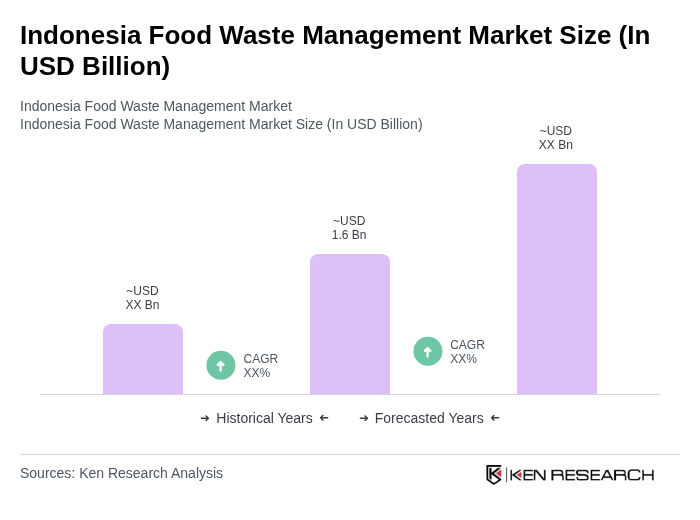
- The Indonesia Food Waste Management Market is valued at USD 1.6 billion, based on a five-year historical analysis and its proportion within the broader Indonesia waste management market, which was valued at about USD 15.11 billion for waste management services including collection, recycling, waste-to-energy, and landfill operations. This growth is primarily driven by increasing urbanization, rising consumer awareness regarding sustainability, and government and development-partner initiatives aimed at reducing food loss and waste along the supply chain, as highlighted by national studies under the Low Carbon Development Indonesia (LCDI) framework. The market is also supported by the growing food and beverage industry and food service sector, which generate significant organic waste that requires collection, treatment, recycling, composting, and valorization solutions.
- Key cities such as Jakarta, Surabaya, and Bandung dominate the market due to their high population density, concentration of supermarkets, hotels, restaurants, catering services, and large wet markets, which together generate high volumes of food and organic waste. These urban centers are also focal points for provincial and city-level waste management policies, including source-separation pilots, community-based composting, and waste-to-energy or co-processing projects implemented with private operators and development agencies, making them critical players in the food waste management landscape.
- In 2021, the Ministry of National Development Planning (BAPPENAS) launched the “Food Loss and Waste Reduction Roadmap (2021–2030)” and associated action plans under Indonesia’s Low Carbon Development Initiative, which guide national and local governments in planning and implementing food loss and waste reduction programs across production, processing, distribution, and consumption stages. In addition, municipal organic and food waste handling is framed within Law No. 18 of 2008 on Waste Management and its implementing Government Regulation No. 81 of 2012 on Management of Household Waste and Waste Similar to Household Waste, which require regional governments to organize waste reduction and handling, including composting and other forms of processing for organic fractions. These policy instruments support Indonesia’s voluntary commitment, announced in international forums, to reduce food loss and waste significantly by the end of this decade through improved collection, recycling, and composting initiatives at municipal level.
Indonesia Food Waste Management Market Segmentation
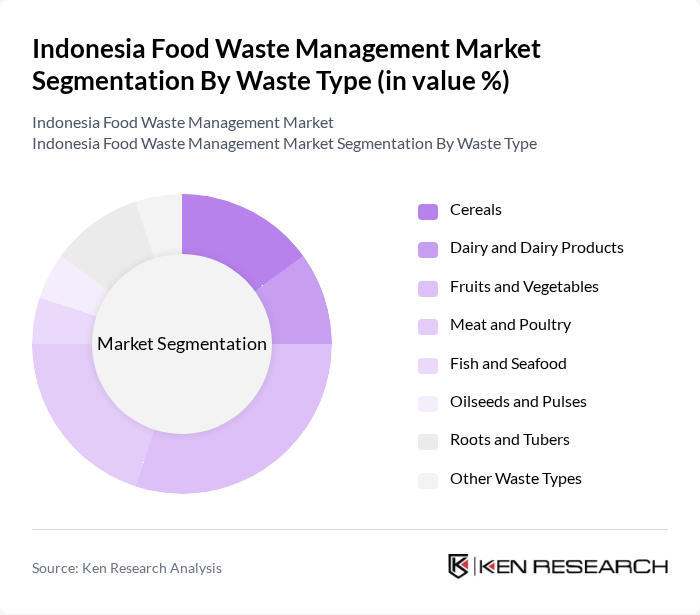
By Waste Type:The food waste management market can be segmented based on the type of waste generated. The primary categories include cereals, dairy and dairy products, fruits and vegetables, meat and poultry, fish and seafood, oilseeds and pulses, roots and tubers, and other waste types. Each of these categories contributes differently to the overall waste generated, with fruits and vegetables, roots and tubers, and cereals typically accounting for a significant portion of edible food loss and waste in Indonesia due to their high consumption volumes and perishability along the supply chain.
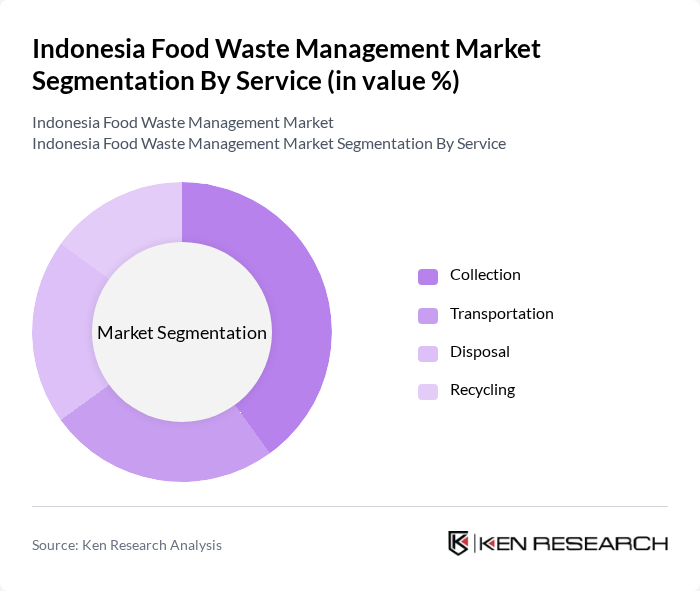
By Service:The market can also be segmented based on the services provided for food waste management, which include collection, transportation, disposal, and recycling. Each service plays a crucial role in the overall waste management process, with collection and recycling being particularly vital for reducing the environmental impact of food waste. Collection and transportation services are increasingly integrated with decentralized solutions such as community composting, small-scale material recovery facilities, and biogas units, while recycling and treatment services cover compost production, animal feed, co-processing in cement kilns, and other waste-to-energy options.
Indonesia Food Waste Management Market Competitive Landscape
The Indonesia Food Waste Management Market is characterized by a dynamic mix of regional and international players. Leading participants such as Waste4Change, Greeneration Indonesia, PT Reciki Solusi Indonesia (Reciki), PT Solusi Cipta Integrasi (EwasteRJ & organic waste services), PT Solusi Bangun Indonesia Tbk (Geocycle Indonesia), PT Pembangunan Jaya Ancol Tbk (Integrated Waste Management & Composting), PT Jakarta Propertindo (Perseroda) – Food and Organic Waste Handling, PT Unilever Indonesia Tbk – Food Waste Reduction & Valorization Programs, PT Nestlé Indonesia – Food Loss and Waste Management Initiatives, PT Indofood Sukses Makmur Tbk – Food Waste Reduction and By?product Utilization, PT Charoen Pokphand Indonesia Tbk – Conversion of Food Waste to Animal Feed, PT Pupuk Kalimantan Timur (Pupuk Kaltim) – Organic Fertilizer from Food and Organic Waste, PT Pupuk Indonesia (Persero) – Compost and Organic Fertilizer Programs, PT Dharma Satya Nusantara Tbk – Biogas and Organic Waste-to-Energy Projects, PT Astra Agro Lestari Tbk – Organic Residue and Food Waste Valorization contribute to innovation, geographic expansion, and service delivery in this space.
Indonesia Food Waste Management Market Industry Analysis
Growth Drivers
- Increasing Urbanization:Indonesia's urban population is projected to reach 70% by in future, up from 57% in in future, according to the World Bank. This rapid urbanization leads to higher food consumption and, consequently, increased food waste. Urban areas generate approximately 60% of the country's total waste, with food waste constituting around 50% of that. The growing urban population necessitates improved waste management solutions, driving demand for effective food waste management systems.
- Government Initiatives for Waste Reduction:The Indonesian government has committed to reducing waste by 30% by in future, as outlined in the National Waste Management Policy. This initiative includes investments of approximately IDR 1 trillion (around USD 70 million) in waste management infrastructure. Such government support fosters the development of food waste management technologies and encourages private sector participation, creating a conducive environment for market growth.
- Rising Environmental Awareness:A significant increase in environmental awareness among Indonesian citizens has been observed, with 65% of the population acknowledging the importance of sustainable practices in waste management. This shift is supported by various campaigns and educational programs, leading to a growing demand for eco-friendly waste management solutions. The heightened awareness is expected to drive investments in food waste management technologies, promoting sustainable practices across urban centers.
Market Challenges
- Lack of Infrastructure:Indonesia faces significant infrastructure challenges in waste management, with only 30% of urban areas equipped with adequate waste collection systems. The absence of proper facilities for food waste processing leads to increased landfill usage, which is projected to rise by 10% annually. This lack of infrastructure hampers effective food waste management and poses a barrier to achieving national waste reduction targets.
- Limited Public Awareness:Despite rising environmental consciousness, public awareness regarding food waste management remains low, with only 40% of the population actively participating in waste segregation practices. This limited engagement results in inefficient waste management processes and contributes to the high volume of food waste ending up in landfills. Addressing this challenge is crucial for improving overall waste management effectiveness in Indonesia.
Indonesia Food Waste Management Market Future Outlook
The future of Indonesia's food waste management market appears promising, driven by increasing urbanization and government initiatives aimed at waste reduction. As the population continues to grow, the demand for innovative waste management solutions will likely rise. Additionally, the integration of smart technologies and sustainable practices will enhance efficiency in waste processing. Collaborative efforts between the government, private sector, and NGOs will be essential in overcoming existing challenges and capitalizing on emerging opportunities in the market.
Market Opportunities
- Expansion of Recycling Programs:The Indonesian government aims to increase recycling rates to 50% by in future, presenting a significant opportunity for businesses involved in food waste recycling. With an estimated 20 million to 30 million tons of food loss and waste generated annually across the supply chain, enhancing recycling initiatives can lead to substantial economic and environmental benefits, fostering a circular economy.
- Development of Waste-to-Energy Projects:Indonesia has the potential to generate approximately 1,000 MW of energy from food waste through waste-to-energy projects. This opportunity aligns with the government's renewable energy targets, encouraging investments in technologies that convert food waste into energy, thus addressing both waste management and energy needs simultaneously.
Scope of the Report
| Segment | Sub-Segments |
|---|---|
| By Waste Type (Cereals, Dairy & Dairy Products, Fruits & Vegetables, Meat & Poultry, Fish & Seafood, Oilseeds & Pulses, Roots & Tubers, Other Waste Types) | Cereals Dairy and Dairy Products Fruits and Vegetables Meat and Poultry Fish and Seafood Oilseeds and Pulses Roots and Tubers Other Waste Types |
| By Service (Collection, Transportation, Disposal and Recycling) | Collection Transportation Disposal Recycling |
| By Source (Residential, Commercial, Industrial) | Residential (Municipalities and Households) Commercial (Food Service Providers, Retail, Hospitality) Industrial (Primary Food Producers and Food Manufacturers) |
| By Application (Animal Feed, Fertilizers, Biofuel, Power Generation, Other Applications) | Animal Feed Fertilizers Biofuel Power Generation Other Applications |
| By Treatment Method (Prevention, Recovery, Recycling) | Prevention Recovery Recycling |
| By Technology (Anaerobic Digestion, Composting, Incineration / Combustion, Landfill, Other Processes) | Anaerobic Digestion Composting Incineration / Combustion Landfill Other Processes |
| By End-User (Primary Food Producers, Food Manufacturers, Food Distributors and Suppliers, Food Service Providers, Municipalities and Households) | Primary Food Producers Food Manufacturers Food Distributors and Suppliers Food Service Providers Municipalities and Households |
Key Target Audience
Investors and Venture Capitalist Firms
Government and Regulatory Bodies (e.g., Ministry of Environment and Forestry, Ministry of Agriculture)
Manufacturers and Producers of Food Products
Waste Management Companies
Food Retail Chains and Supermarkets
Non-Governmental Organizations (NGOs) focused on sustainability
Technology Providers for Waste Management Solutions
Local Government Authorities responsible for waste management
Players Mentioned in the Report:
Waste4Change
Greeneration Indonesia
PT Reciki Solusi Indonesia (Reciki)
PT Solusi Cipta Integrasi (EwasteRJ & organic waste services)
PT Solusi Bangun Indonesia Tbk (Geocycle Indonesia)
PT Pembangunan Jaya Ancol Tbk (Integrated Waste Management & Composting)
PT Jakarta Propertindo (Perseroda) Food and Organic Waste Handling
PT Unilever Indonesia Tbk Food Waste Reduction & Valorization Programs
PT Nestle Indonesia Food Loss and Waste Management Initiatives
PT Indofood Sukses Makmur Tbk Food Waste Reduction and Byproduct Utilization
PT Charoen Pokphand Indonesia Tbk Conversion of Food Waste to Animal Feed
PT Pupuk Kalimantan Timur (Pupuk Kaltim) Organic Fertilizer from Food and Organic Waste
PT Pupuk Indonesia (Persero) Compost and Organic Fertilizer Programs
PT Dharma Satya Nusantara Tbk Biogas and Organic Waste-to-Energy Projects
PT Astra Agro Lestari Tbk Organic Residue and Food Waste Valorization
Table of Contents
Market Assessment Phase
1. Executive Summary and Approach
2. Indonesia Food Waste Management Market Overview
2.1 Key Insights and Strategic Recommendations
2.2 Indonesia Food Waste Management Market Overview
2.3 Definition and Scope
2.4 Evolution of Market Ecosystem
2.5 Timeline of Key Regulatory Milestones
2.6 Value Chain & Stakeholder Mapping
2.7 Business Cycle Analysis
2.8 Policy & Incentive Landscape
3. Indonesia Food Waste Management Market Analysis
3.1 Growth Drivers
3.1.1 Increasing Urbanization
3.1.2 Government Initiatives for Waste Reduction
3.1.3 Rising Environmental Awareness
3.1.4 Technological Advancements in Waste Management
3.2 Market Challenges
3.2.1 Lack of Infrastructure
3.2.2 Limited Public Awareness
3.2.3 Regulatory Compliance Issues
3.2.4 High Initial Investment Costs
3.3 Market Opportunities
3.3.1 Expansion of Recycling Programs
3.3.2 Development of Waste-to-Energy Projects
3.3.3 Partnerships with NGOs
3.3.4 Innovations in Composting Technologies
3.4 Market Trends
3.4.1 Adoption of Smart Waste Management Solutions
3.4.2 Growth of Circular Economy Practices
3.4.3 Increasing Investment in Sustainable Practices
3.4.4 Focus on Food Recovery Initiatives
3.5 Government Regulation
3.5.1 National Waste Management Policy
3.5.2 Local Government Waste Management Regulations
3.5.3 Environmental Protection Laws
3.5.4 Incentives for Waste Reduction Technologies
4. SWOT Analysis
5. Stakeholder Analysis
6. Porter's Five Forces Analysis
7. Indonesia Food Waste Management Market Market Size, 2019-2024
7.1 By Value
7.2 By Volume
7.3 By Average Selling Price
8. Indonesia Food Waste Management Market Segmentation
8.1 By Waste Type (Cereals, Dairy & Dairy Products, Fruits & Vegetables, Meat & Poultry, Fish & Seafood, Oilseeds & Pulses, Roots & Tubers, Other Waste Types)
8.1.1 Cereals
8.1.2 Dairy and Dairy Products
8.1.3 Fruits and Vegetables
8.1.4 Meat and Poultry
8.1.5 Fish and Seafood
8.1.6 Oilseeds and Pulses
8.1.7 Roots and Tubers
8.1.8 Other Waste Types
8.2 By Service (Collection, Transportation, Disposal and Recycling)
8.2.1 Collection
8.2.2 Transportation
8.2.3 Disposal
8.2.4 Recycling
8.3 By Source (Residential, Commercial, Industrial)
8.3.1 Residential (Municipalities and Households)
8.3.2 Commercial (Food Service Providers, Retail, Hospitality)
8.3.3 Industrial (Primary Food Producers and Food Manufacturers)
8.4 By Application (Animal Feed, Fertilizers, Biofuel, Power Generation, Other Applications)
8.4.1 Animal Feed
8.4.2 Fertilizers
8.4.3 Biofuel
8.4.4 Power Generation
8.4.5 Other Applications
8.5 By Treatment Method (Prevention, Recovery, Recycling)
8.5.1 Prevention
8.5.2 Recovery
8.5.3 Recycling
8.6 By Technology (Anaerobic Digestion, Composting, Incineration / Combustion, Landfill, Other Processes)
8.6.1 Anaerobic Digestion
8.6.2 Composting
8.6.3 Incineration / Combustion
8.6.4 Landfill
8.6.5 Other Processes
8.7 By End-User (Primary Food Producers, Food Manufacturers, Food Distributors and Suppliers, Food Service Providers, Municipalities and Households)
8.7.1 Primary Food Producers
8.7.2 Food Manufacturers
8.7.3 Food Distributors and Suppliers
8.7.4 Food Service Providers
8.7.5 Municipalities and Households
9. Indonesia Food Waste Management Market Competitive Analysis
9.1 Market Share of Key Players(Micro, Small, Medium, Large Enterprises)
9.2 Cross Comparison of Key Players
9.2.1 Company Name
9.2.2 Ownership Type (Private, State-owned, Cooperative)
9.2.3 Revenue from Food Waste Management in Indonesia
9.2.4 3-year Revenue CAGR from Food Waste Services
9.2.5 Share of Food Waste Services in Total Revenue
9.2.6 Geographic Coverage within Indonesia (Number of Provinces / Cities Served)
9.2.7 Processing Capacity Installed (Tons of Food Waste per Day)
9.2.8 Share of Food Waste Recovered / Recycled (%)
9.2.9 Number of Treatment Facilities (Composting, Anaerobic Digestion, WtE)
9.2.10 Capital Expenditure on New Facilities (Last 3 Years)
9.2.11 Key Technology Used (In-house vs Licensed)
9.2.12 Average Tipping / Service Fee per Ton
9.2.13 Average Contract Tenure with Municipal / Commercial Clients
9.2.14 Major Customer Segments (Municipal, Commercial, Industrial)
9.2.15 GHG Emissions Avoided per Year (tCO?e)
9.2.16 Certification and Compliance (ISO, PROPER Rating, etc.)
9.3 SWOT Analysis of Top Players
9.4 Pricing Analysis(By Class and Payload)
9.5 Detailed Profile of Major Companies
9.5.1 Waste4Change
9.5.2 Greeneration Indonesia
9.5.3 PT Reciki Solusi Indonesia (Reciki)
9.5.4 PT Solusi Cipta Integrasi (EwasteRJ & organic waste services)
9.5.5 PT Solusi Bangun Indonesia Tbk (Geocycle Indonesia)
9.5.6 PT Pembangunan Jaya Ancol Tbk (Integrated Waste Management & Composting)
9.5.7 PT Jakarta Propertindo (Perseroda) – Food and Organic Waste Handling
9.5.8 PT Unilever Indonesia Tbk – Food Waste Reduction & Valorization Programs
9.5.9 PT Nestlé Indonesia – Food Loss and Waste Management Initiatives
9.5.10 PT Indofood Sukses Makmur Tbk – Food Waste Reduction and By?product Utilization
9.5.11 PT Charoen Pokphand Indonesia Tbk – Conversion of Food Waste to Animal Feed
9.5.12 PT Pupuk Kalimantan Timur (Pupuk Kaltim) – Organic Fertilizer from Food and Organic Waste
9.5.13 PT Pupuk Indonesia (Persero) – Compost and Organic Fertilizer Programs
9.5.14 PT Dharma Satya Nusantara Tbk – Biogas and Organic Waste-to-Energy Projects
9.5.15 PT Astra Agro Lestari Tbk – Organic Residue and Food Waste Valorization
10. Indonesia Food Waste Management Market End-User Analysis
10.1 Procurement Behavior of Key Ministries
10.1.1 Ministry of Environment and Forestry
10.1.2 Ministry of Agriculture
10.1.3 Ministry of Industry
10.1.4 Ministry of Trade
10.2 Corporate Spend on Infrastructure & Energy
10.2.1 Investment in Waste Management Infrastructure
10.2.2 Spending on Renewable Energy Projects
10.3 Pain Point Analysis by End-User Category
10.3.1 Residential Users
10.3.2 Commercial Establishments
10.3.3 Industrial Players
10.3.4 Government Entities
10.4 User Readiness for Adoption
10.4.1 Awareness Levels
10.4.2 Financial Readiness
10.4.3 Technological Adoption
10.5 Post-Deployment ROI and Use Case Expansion
10.5.1 ROI Measurement Techniques
10.5.2 Use Case Scenarios
11. Indonesia Food Waste Management Market Future Size, 2025-2030
11.1 By Value
11.2 By Volume
11.3 By Average Selling Price
Go-To-Market Strategy Phase
1. Whitespace Analysis + Business Model Canvas
1.1 Market Gaps Identification
1.2 Business Model Development
2. Marketing and Positioning Recommendations
2.1 Branding Strategies
2.2 Product USPs
3. Distribution Plan
3.1 Urban Retail vs Rural NGO Tie-ups
4. Channel & Pricing Gaps
4.1 Underserved Routes
4.2 Pricing Bands
5. Unmet Demand & Latent Needs
5.1 Category Gaps
5.2 Consumer Segments
6. Customer Relationship
6.1 Loyalty Programs
6.2 After-sales Service
7. Value Proposition
7.1 Sustainability
7.2 Integrated Supply Chains
8. Key Activities
8.1 Regulatory Compliance
8.2 Branding
8.3 Distribution Setup
9. Entry Strategy Evaluation
9.1 Domestic Market Entry Strategy
9.1.1 Product Mix
9.1.2 Pricing Band
9.1.3 Packaging
9.2 Export Entry Strategy
9.2.1 Target Countries
9.2.2 Compliance Roadmap
10. Entry Mode Assessment
10.1 JV
10.2 Greenfield
10.3 M&A
10.4 Distributor Model
11. Capital and Timeline Estimation
11.1 Capital Requirements
11.2 Timelines
12. Control vs Risk Trade-Off
12.1 Ownership vs Partnerships
13. Profitability Outlook
13.1 Breakeven Analysis
13.2 Long-term Sustainability
14. Potential Partner List
14.1 Distributors
14.2 JVs
14.3 Acquisition Targets
15. Execution Roadmap
15.1 Phased Plan for Market Entry
15.1.1 Market Setup
15.1.2 Market Entry
15.1.3 Growth Acceleration
15.1.4 Scale & Stabilize
15.2 Key Activities and Milestones
15.2.1 Milestone Planning
15.2.2 Activity Tracking
Research Methodology
Phase 1: Approach1
Desk Research
- Analysis of government reports on food waste statistics and management policies in Indonesia
- Review of academic journals and publications focusing on food waste management practices
- Examination of industry reports from NGOs and international organizations addressing food waste issues
Primary Research
- Interviews with key stakeholders in the food supply chain, including producers, distributors, and retailers
- Surveys conducted with consumers to understand attitudes and behaviors towards food waste
- Focus group discussions with community leaders and NGOs involved in food waste reduction initiatives
Validation & Triangulation
- Cross-validation of findings through comparison with existing food waste management frameworks
- Triangulation of data from government, academic, and industry sources to ensure reliability
- Sanity checks through expert panel reviews comprising food waste management specialists
Phase 2: Market Size Estimation1
Top-down Assessment
- Estimation of total food waste generated in Indonesia based on national consumption data
- Segmentation of food waste by source: households, restaurants, and food processing industries
- Incorporation of government initiatives aimed at reducing food waste and promoting recycling
Bottom-up Modeling
- Collection of data on food waste management services offered by local companies
- Operational cost analysis of waste management solutions, including collection and processing
- Volume estimates based on waste generation rates and service uptake in urban vs. rural areas
Forecasting & Scenario Analysis
- Multi-factor regression analysis incorporating economic growth, population trends, and urbanization rates
- Scenario modeling based on potential regulatory changes and public awareness campaigns
- Development of baseline, optimistic, and pessimistic forecasts for the food waste management market through 2030
Phase 3: CATI Sample Composition1
| Scope Item/Segment | Sample Size | Target Respondent Profiles |
|---|---|---|
| Household Food Waste Management | 150 | Homeowners, Renters, Family Heads |
| Restaurant Waste Reduction Practices | 100 | Restaurant Owners, Kitchen Managers |
| Food Processing Industry Waste Management | 90 | Production Managers, Sustainability Officers |
| NGO Initiatives on Food Waste | 70 | Program Directors, Community Outreach Coordinators |
| Government Policy Makers on Food Waste | 60 | Policy Analysts, Environmental Officers |
Frequently Asked Questions
What is the current value of the Indonesia Food Waste Management Market?
The Indonesia Food Waste Management Market is valued at approximately USD 1.6 billion. This valuation is based on a five-year historical analysis and reflects its share within the broader waste management market in Indonesia, which is valued at around USD 15.11 billion.
What factors are driving the growth of the food waste management market in Indonesia?
Which cities in Indonesia are the largest contributors to food waste?
What government initiatives support food waste reduction in Indonesia?
Other Regional/Country Reports
Malaysia Food Waste Management Market
KSA Food Waste Management Market
APAC Food Waste Management Market
SEA Food Waste Management Market
Vietnam Food Waste Management Market
Thailand Food Waste Management Market
Other Adjacent Reports
Brazil Organic Waste Recycling Market
UAE Waste-to-Energy Market
South Korea Composting Equipment Market
Thailand Biogas Production Market
Indonesia Sustainable Packaging Market
Mexico Food Supply Chain Management Market
Bahrain Municipal Solid Waste Management Market
Japan Environmental Services Market
South Korea Biofertilizer Market
Mexico Agricultural Waste Management Market
Why Buy From Us?

What makes us stand out is that our consultants follow Robust, Refine and Result (RRR) methodology. Robust for clear definitions, approaches and sanity checking, Refine for differentiating respondents' facts and opinions, and Result for presenting data with story.

We have set a benchmark in the industry by offering our clients with syndicated and customized market research reports featuring coverage of entire market as well as meticulous research and analyst insights.

While we don't replace traditional research, we flip the method upside down. Our dual approach of Top Bottom & Bottom Top ensures quality deliverable by not just verifying company fundamentals but also looking at the sector and macroeconomic factors.

With one step in the future, our research team constantly tries to show you the bigger picture. We help with some of the tough questions you may encounter along the way: How is the industry positioned? Best marketing channel? KPI's of competitors? By aligning every element, we help maximize success.

Our report gives you instant access to the answers and sources that other companies might choose to hide. We elaborate each steps of research methodology we have used and showcase you the sample size to earn your trust.

If you need any support, we are here! We pride ourselves on universe strength, data quality, and quick, friendly, and professional service.