About the Report
Base Year 2024Indonesia Fructose Market Overview
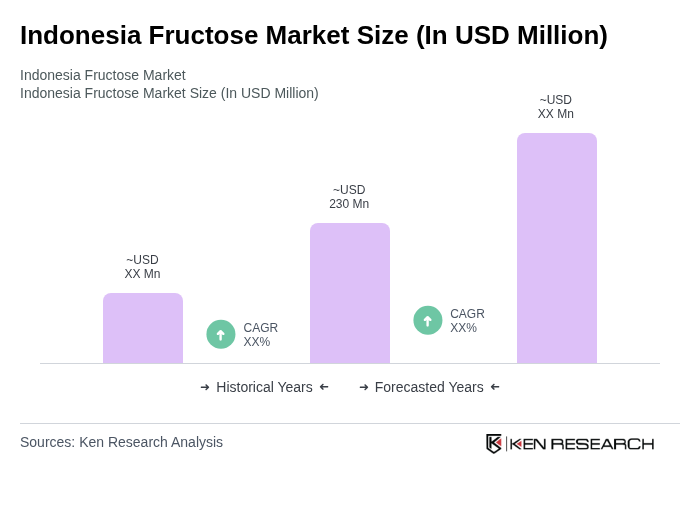
- The Indonesia Fructose Market is valued at USD 230 million, based on a five-year historical analysis. This growth is primarily driven by the increasing demand for natural sweeteners in the food and beverage industry, coupled with a shift towards healthier alternatives to traditional sugars. The rising awareness of health issues related to sugar consumption has led to a surge in the adoption of fructose as a preferred sweetening agent.
- Key players in this market include companies operating in Java and Sumatra, which dominate due to their robust agricultural infrastructure and proximity to major manufacturing hubs. The availability of raw materials such as corn and sugarcane in these regions further enhances their competitive advantage, making them pivotal in the production and distribution of fructose products.
- The Ministry of Finance Regulation No. 126/2020 on the Imposition of Safeguard Duty on Imports of Fructose Syrup, issued by the Ministry of Finance in 2020, governs fructose syrup imports with duties up to 20 percent plus additional safeguards, requiring importers to obtain licenses and comply with volume thresholds to protect domestic producers and support local sweetener manufacturing.
Indonesia Fructose Market Segmentation
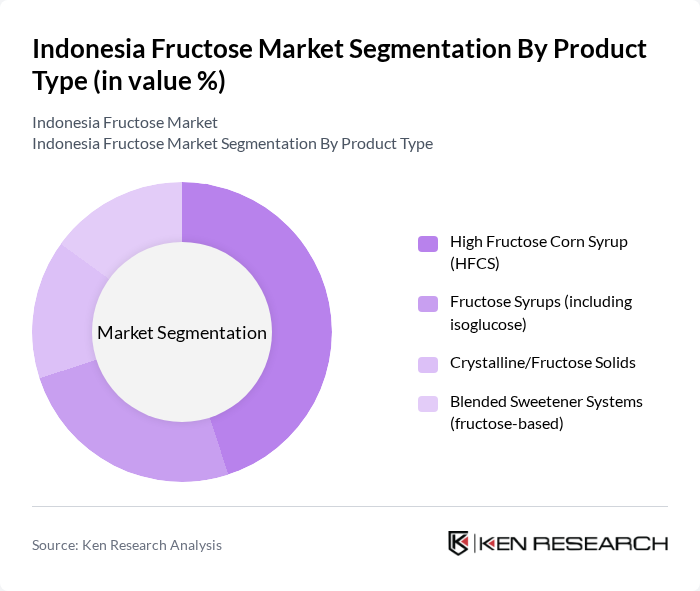
By Product Type:The product type segmentation includes High Fructose Corn Syrup (HFCS), Fructose Syrups (including isoglucose), Crystalline/Fructose Solids, and Blended Sweetener Systems (fructose-based). Among these, High Fructose Corn Syrup (HFCS) is the leading subsegment due to its widespread use in beverages and processed foods, driven by consumer preference for sweeter taste profiles and cost-effectiveness compared to traditional sugars.
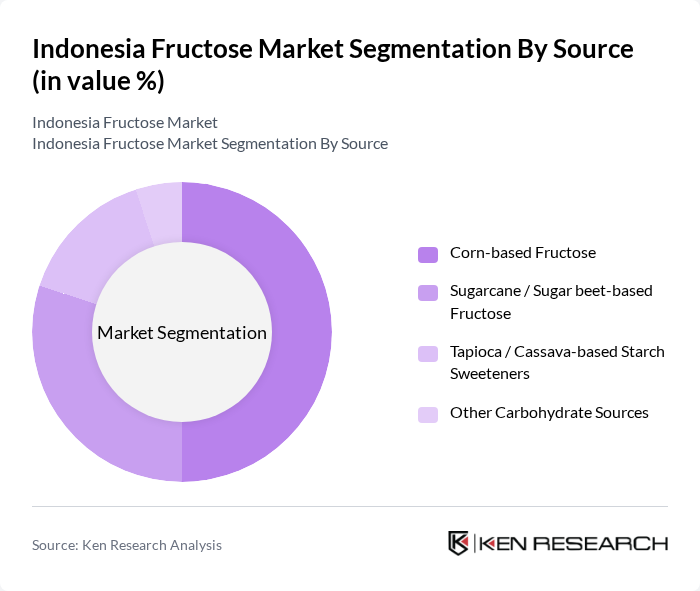
By Source:The source segmentation includes Corn-based Fructose, Sugarcane / Sugar beet-based Fructose, Tapioca / Cassava-based Starch Sweeteners, and Other Carbohydrate Sources. Corn-based Fructose is the dominant subsegment, primarily due to the abundant availability of corn in Indonesia, which supports large-scale production and lower costs, making it a preferred choice for manufacturers.
Indonesia Fructose Market Competitive Landscape
The Indonesia Fructose Market is characterized by a dynamic mix of regional and international players. Leading participants such as PT Budi Starch & Sweetener Tbk, PT Tereos FKS Indonesia, PT Cargill Indonesia, PT Sorini Agro Asia Corporindo Tbk (Cargill), PT Gulaku (Sugar Group Companies), PT Cerestar Indonesia Tbk, PT Wilmar Nabati Indonesia (Wilmar Group), PT Indofood Sukses Makmur Tbk, PT Mayora Indah Tbk, PT Nutrifood Indonesia, PT Garudafood Putra Putri Jaya Tbk, PT Kalbe Farma Tbk, PT Sinar Sosro, PT ABC President Indonesia, PT Sumber Alfaria Trijaya Tbk (Alfamart) contribute to innovation, geographic expansion, and service delivery in this space.
Indonesia Fructose Market Industry Analysis
Growth Drivers
- Increasing Demand for Natural Sweeteners:The Indonesian fructose market is experiencing a surge in demand for natural sweeteners, driven by a consumer shift towards healthier alternatives. In future, the natural sweetener market in Indonesia is projected to reach IDR 5.75 trillion, reflecting a 15% increase from the previous year. This growth is fueled by rising awareness of the health risks associated with artificial sweeteners, prompting manufacturers to incorporate fructose into their products to meet consumer preferences for natural ingredients.
- Rising Health Consciousness Among Consumers:Health consciousness among Indonesian consumers is significantly influencing the fructose market. With obesity rates in Indonesia rising to 29% in future, there is a growing demand for low-calorie sweeteners. This trend is supported by government health initiatives aimed at reducing sugar consumption, which is expected to increase fructose usage in health-oriented products, thereby driving market growth and encouraging manufacturers to innovate healthier formulations.
- Expansion of the Food and Beverage Industry:The food and beverage industry in Indonesia is projected to grow by 10% in future, reaching a market value of IDR 1,320 trillion. This expansion is creating a robust demand for fructose as a sweetening agent in various products, including beverages, snacks, and baked goods. As companies seek to enhance flavor profiles while maintaining health standards, fructose is becoming a preferred choice, further propelling its market presence in the country.
Market Challenges
- Competition from Alternative Sweeteners:The Indonesian fructose market faces significant competition from alternative sweeteners such as stevia and erythritol, which are gaining popularity due to their perceived health benefits. In future, the market for these alternatives is expected to reach IDR 3.45 trillion, posing a challenge for fructose producers. This competition necessitates strategic marketing and product differentiation to maintain market share and consumer interest in fructose-based products.
- Fluctuating Raw Material Prices:The fructose market is challenged by fluctuating prices of raw materials, particularly corn and sugarcane, which are essential for fructose production. In future, corn prices are projected to rise by 12% due to supply chain disruptions and climate impacts. This volatility can lead to increased production costs for fructose manufacturers, potentially affecting pricing strategies and profit margins in a competitive market landscape.
Indonesia Fructose Market Future Outlook
The future of the Indonesian fructose market appears promising, driven by increasing consumer demand for healthier food options and the expansion of the food and beverage sector. Innovations in production technology are expected to enhance efficiency and reduce costs, making fructose more accessible. Additionally, as local farmers collaborate with manufacturers for sustainable sourcing, the market is likely to see a rise in organic fructose products, aligning with global trends towards health and sustainability.
Market Opportunities
- Growth in the Health Food Segment:The health food segment in Indonesia is anticipated to grow significantly, with a projected market value of IDR 57.5 trillion in future. This growth presents an opportunity for fructose producers to develop and market products that cater to health-conscious consumers, leveraging fructose's natural sweetness and lower caloric content to attract a broader customer base.
- Export Potential to Neighboring Countries:Indonesia's strategic location offers substantial export potential for fructose to neighboring countries like Malaysia and Singapore. In future, the export market for fructose is expected to reach IDR 1.15 trillion, driven by increasing demand for natural sweeteners in these regions. This opportunity allows Indonesian producers to expand their market reach and enhance revenue streams through international trade.
Scope of the Report
| Segment | Sub-Segments |
|---|---|
| By Product Type | High Fructose Corn Syrup (HFCS) Fructose Syrups (including isoglucose) Crystalline/Fructose Solids Blended Sweetener Systems (fructose-based) |
| By Source | Corn-based Fructose Sugarcane / Sugar beet-based Fructose Tapioca / Cassava-based Starch Sweeteners Other Carbohydrate Sources |
| By Application | Beverages (carbonated soft drinks, juices, RTD tea/coffee) Bakery & Confectionery Dairy & Frozen Desserts Processed Foods (sauces, condiments, RTE meals) Pharmaceuticals & Nutraceuticals Others |
| By End-Use Industry | Food & Beverage Manufacturers Pharmaceutical Companies Nutraceutical & Health Product Manufacturers Foodservice / HORECA Others |
| By Distribution Channel | Direct Sales to Industrial Users Distributors & Traders Online B2B Platforms Others |
| By Region | Java Sumatra Kalimantan Sulawesi Bali & Nusa Tenggara Others |
| By Packaging Type | Bulk Industrial Packaging (tankers, IBCs, large bags) Small / Retail & Foodservice Packaging Others |
| By Product Form | Liquid Form Dry / Powder Form Others |
Key Target Audience
Investors and Venture Capitalist Firms
Government and Regulatory Bodies (e.g., Ministry of Agriculture, National Food and Drug Monitoring Agency)
Manufacturers and Producers
Distributors and Retailers
Food and Beverage Companies
Health and Nutrition Organizations
Industry Associations (e.g., Indonesian Food and Beverage Association)
Financial Institutions
Players Mentioned in the Report:
PT Budi Starch & Sweetener Tbk
PT Tereos FKS Indonesia
PT Cargill Indonesia
PT Sorini Agro Asia Corporindo Tbk (Cargill)
PT Gulaku (Sugar Group Companies)
PT Cerestar Indonesia Tbk
PT Wilmar Nabati Indonesia (Wilmar Group)
PT Indofood Sukses Makmur Tbk
PT Mayora Indah Tbk
PT Nutrifood Indonesia
PT Garudafood Putra Putri Jaya Tbk
PT Kalbe Farma Tbk
PT Sinar Sosro
PT ABC President Indonesia
PT Sumber Alfaria Trijaya Tbk (Alfamart)
Table of Contents
Market Assessment Phase
1. Executive Summary and Approach
2. Indonesia Fructose Market Overview
2.1 Key Insights and Strategic Recommendations
2.2 Indonesia Fructose Market Overview
2.3 Definition and Scope
2.4 Evolution of Market Ecosystem
2.5 Timeline of Key Regulatory Milestones
2.6 Value Chain & Stakeholder Mapping
2.7 Business Cycle Analysis
2.8 Policy & Incentive Landscape
3. Indonesia Fructose Market Analysis
3.1 Growth Drivers
3.1.1 Increasing demand for natural sweeteners
3.1.2 Rising health consciousness among consumers
3.1.3 Expansion of the food and beverage industry
3.1.4 Government initiatives promoting local agriculture
3.2 Market Challenges
3.2.1 Competition from alternative sweeteners
3.2.2 Fluctuating raw material prices
3.2.3 Regulatory hurdles and compliance issues
3.2.4 Limited consumer awareness of fructose benefits
3.3 Market Opportunities
3.3.1 Growth in the health food segment
3.3.2 Export potential to neighboring countries
3.3.3 Innovations in fructose production technology
3.3.4 Collaborations with local farmers for sustainable sourcing
3.4 Market Trends
3.4.1 Shift towards organic and non-GMO products
3.4.2 Increasing use of fructose in functional foods
3.4.3 Rising popularity of low-calorie sweeteners
3.4.4 Growth of online retail channels for food products
3.5 Government Regulation
3.5.1 Food safety standards and labeling requirements
3.5.2 Import tariffs on fructose products
3.5.3 Subsidies for local fructose production
3.5.4 Environmental regulations affecting production processes
4. SWOT Analysis
5. Stakeholder Analysis
6. Porter's Five Forces Analysis
7. Indonesia Fructose Market Market Size, 2019-2024
7.1 By Value
7.2 By Volume
7.3 By Average Selling Price
8. Indonesia Fructose Market Segmentation
8.1 By Product Type
8.1.1 High Fructose Corn Syrup (HFCS)
8.1.2 Fructose Syrups (including isoglucose)
8.1.3 Crystalline/Fructose Solids
8.1.4 Blended Sweetener Systems (fructose-based)
8.2 By Source
8.2.1 Corn-based Fructose
8.2.2 Sugarcane / Sugar beet-based Fructose
8.2.3 Tapioca / Cassava-based Starch Sweeteners
8.2.4 Other Carbohydrate Sources
8.3 By Application
8.3.1 Beverages (carbonated soft drinks, juices, RTD tea/coffee)
8.3.2 Bakery & Confectionery
8.3.3 Dairy & Frozen Desserts
8.3.4 Processed Foods (sauces, condiments, RTE meals)
8.3.5 Pharmaceuticals & Nutraceuticals
8.3.6 Others
8.4 By End-Use Industry
8.4.1 Food & Beverage Manufacturers
8.4.2 Pharmaceutical Companies
8.4.3 Nutraceutical & Health Product Manufacturers
8.4.4 Foodservice / HORECA
8.4.5 Others
8.5 By Distribution Channel
8.5.1 Direct Sales to Industrial Users
8.5.2 Distributors & Traders
8.5.3 Online B2B Platforms
8.5.4 Others
8.6 By Region
8.6.1 Java
8.6.2 Sumatra
8.6.3 Kalimantan
8.6.4 Sulawesi
8.6.5 Bali & Nusa Tenggara
8.6.6 Others
8.7 By Packaging Type
8.7.1 Bulk Industrial Packaging (tankers, IBCs, large bags)
8.7.2 Small / Retail & Foodservice Packaging
8.7.3 Others
8.8 By Product Form
8.8.1 Liquid Form
8.8.2 Dry / Powder Form
8.8.3 Others
9. Indonesia Fructose Market Competitive Analysis
9.1 Market Share of Key Players
9.2 Cross Comparison of Key Players
9.2.1 Company Name
9.2.2 Indonesia Fructose / Sweetener Revenue (USD, latest year)
9.2.3 Fructose Volume Sold in Indonesia (KT per year)
9.2.4 Revenue Growth Rate in Indonesia Fructose Portfolio
9.2.5 Market Share in Indonesia Industrial Sweeteners / Fructose
9.2.6 Capacity Installed in Indonesia / for Indonesia (KT per year)
9.2.7 Capacity Utilization Rate
9.2.8 Product Mix (HFCS vs syrups vs solids)
9.2.9 Average Realized Price (USD/ton, by key product)
9.2.10 EBITDA Margin on Fructose Business in Indonesia
9.2.11 R&D / Innovation Intensity (new formulations, health-positioned products)
9.2.12 Distribution Network Coverage (regions, key F&B accounts)
9.2.13 Import vs Local Production Dependence
9.2.14 ESG / Sustainability Metrics (sourcing, energy, certifications)
9.3 SWOT Analysis of Top Players
9.4 Pricing Analysis
9.5 Detailed Profile of Major Companies
9.5.1 PT Budi Starch & Sweetener Tbk
9.5.2 PT Tereos FKS Indonesia
9.5.3 PT Cargill Indonesia
9.5.4 PT Sorini Agro Asia Corporindo Tbk (Cargill)
9.5.5 PT Gulaku (Sugar Group Companies)
9.5.6 PT Cerestar Indonesia Tbk
9.5.7 PT Wilmar Nabati Indonesia (Wilmar Group)
9.5.8 PT Indofood Sukses Makmur Tbk
9.5.9 PT Mayora Indah Tbk
9.5.10 PT Nutrifood Indonesia
9.5.11 PT Garudafood Putra Putri Jaya Tbk
9.5.12 PT Kalbe Farma Tbk
9.5.13 PT Sinar Sosro
9.5.14 PT ABC President Indonesia
9.5.15 PT Sumber Alfaria Trijaya Tbk (Alfamart)
10. Indonesia Fructose Market End-User Analysis
10.1 Procurement Behavior of Key Ministries
10.1.1 Ministry of Health
10.1.2 Ministry of Agriculture
10.1.3 Ministry of Trade
10.1.4 Others
10.2 Corporate Spend on Infrastructure & Energy
10.2.1 Food Processing Companies
10.2.2 Beverage Manufacturers
10.2.3 Pharmaceutical Firms
10.2.4 Others
10.3 Pain Point Analysis by End-User Category
10.3.1 Food Manufacturers
10.3.2 Beverage Producers
10.3.3 Health Product Companies
10.3.4 Others
10.4 User Readiness for Adoption
10.4.1 Awareness Levels
10.4.2 Training Needs
10.4.3 Infrastructure Readiness
10.4.4 Others
10.5 Post-Deployment ROI and Use Case Expansion
10.5.1 Case Studies of Successful Implementations
10.5.2 Metrics for Measuring ROI
10.5.3 Potential for Scaling Use Cases
10.5.4 Others
11. Indonesia Fructose Market Future Size, 2025-2030
11.1 By Value
11.2 By Volume
11.3 By Average Selling Price
Go-To-Market Strategy Phase
1. Whitespace Analysis + Business Model Canvas
1.1 Market Gaps Identification
1.2 Business Model Framework
2. Marketing and Positioning Recommendations
2.1 Branding Strategies
2.2 Product USPs
3. Distribution Plan
3.1 Urban Retail Strategies
3.2 Rural NGO Tie-ups
4. Channel & Pricing Gaps
4.1 Underserved Routes
4.2 Pricing Bands
5. Unmet Demand & Latent Needs
5.1 Category Gaps
5.2 Consumer Segments
6. Customer Relationship
6.1 Loyalty Programs
6.2 After-sales Service
7. Value Proposition
7.1 Sustainability Initiatives
7.2 Integrated Supply Chains
8. Key Activities
8.1 Regulatory Compliance
8.2 Branding Efforts
8.3 Distribution Setup
9. Entry Strategy Evaluation
9.1 Domestic Market Entry Strategy
9.1.1 Product Mix
9.1.2 Pricing Band
9.1.3 Packaging
9.2 Export Entry Strategy
9.2.1 Target Countries
9.2.2 Compliance Roadmap
10. Entry Mode Assessment
10.1 Joint Ventures
10.2 Greenfield Investments
10.3 Mergers & Acquisitions
10.4 Distributor Model
11. Capital and Timeline Estimation
11.1 Capital Requirements
11.2 Timelines
12. Control vs Risk Trade-Off
12.1 Ownership vs Partnerships
13. Profitability Outlook
13.1 Breakeven Analysis
13.2 Long-term Sustainability
14. Potential Partner List
14.1 Distributors
14.2 Joint Ventures
14.3 Acquisition Targets
15. Execution Roadmap
15.1 Phased Plan for Market Entry
15.1.1 Market Setup
15.1.2 Market Entry
15.1.3 Growth Acceleration
15.1.4 Scale & Stabilize
15.2 Key Activities and Milestones
15.2.1 Milestone Planning
15.2.2 Activity Tracking
Research Methodology
Phase 1: Approach1
Desk Research
- Analysis of industry reports from the Indonesian Ministry of Trade and Agriculture
- Review of market studies published by local and international research firms
- Examination of trade statistics and import/export data from BPS (Statistics Indonesia)
Primary Research
- Interviews with key stakeholders in the fructose supply chain, including manufacturers and distributors
- Surveys targeting food and beverage companies utilizing fructose in their products
- Field visits to production facilities to gather insights on operational practices and capacity
Validation & Triangulation
- Cross-validation of findings through multiple data sources, including trade associations and government publications
- Triangulation of market data with insights from industry experts and academic research
- Sanity checks conducted through expert panel discussions to ensure data reliability
Phase 2: Market Size Estimation1
Top-down Assessment
- Estimation of the overall fructose market size based on national consumption trends and dietary patterns
- Segmentation of the market by application areas such as food, beverages, and pharmaceuticals
- Incorporation of demographic factors influencing fructose demand, including urbanization and income levels
Bottom-up Modeling
- Collection of production volume data from major fructose manufacturers in Indonesia
- Estimation of average selling prices across different fructose grades and applications
- Calculation of market size based on production volume multiplied by average prices
Forecasting & Scenario Analysis
- Utilization of time-series analysis to project future market trends based on historical data
- Scenario modeling considering factors such as regulatory changes and health trends impacting sugar consumption
- Development of best-case, worst-case, and most-likely scenarios for market growth through 2030
Phase 3: CATI Sample Composition1
| Scope Item/Segment | Sample Size | Target Respondent Profiles |
|---|---|---|
| Food and Beverage Manufacturers | 120 | Product Development Managers, Procurement Officers |
| Retail Sector Insights | 90 | Category Managers, Supply Chain Analysts |
| Health and Nutrition Experts | 60 | Nutritionists, Dietitians |
| Fructose Distributors | 70 | Sales Managers, Logistics Coordinators |
| Regulatory Bodies and Associations | 40 | Policy Makers, Industry Analysts |
Frequently Asked Questions
What is the current value of the Indonesia Fructose Market?
The Indonesia Fructose Market is valued at approximately USD 230 million, reflecting a significant growth trend driven by the increasing demand for natural sweeteners in the food and beverage industry.
What factors are driving the growth of the fructose market in Indonesia?
Which regions in Indonesia dominate the fructose market?
What are the main product types in the Indonesia Fructose Market?
Other Regional/Country Reports
Malaysia Fructose Market
KSA Fructose Market
APAC Fructose Market
SEA Fructose Market
Vietnam Fructose Market
Thailand Fructose Market
Other Adjacent Reports
Japan Sucrose Market
Middle East Glucose Market Report Size Share Growth Drivers Trends Opportunities & Forecast 2025–2030KSA stevia market size, share, growth drivers, trends, opportunities & forecast 2025–2030South Africa Erythritol Market
Indonesia Artificial Sweeteners Market
UAE Natural Sweeteners MarketKuwait Sugar Substitutes Market Size, Share, Growth Drivers, Trends, Opportunities & Forecast 2025–2030UAE Food Additives MarketSouth Korea Beverage Ingredients Market
Why Buy From Us?

What makes us stand out is that our consultants follow Robust, Refine and Result (RRR) methodology. Robust for clear definitions, approaches and sanity checking, Refine for differentiating respondents' facts and opinions, and Result for presenting data with story.

We have set a benchmark in the industry by offering our clients with syndicated and customized market research reports featuring coverage of entire market as well as meticulous research and analyst insights.

While we don't replace traditional research, we flip the method upside down. Our dual approach of Top Bottom & Bottom Top ensures quality deliverable by not just verifying company fundamentals but also looking at the sector and macroeconomic factors.

With one step in the future, our research team constantly tries to show you the bigger picture. We help with some of the tough questions you may encounter along the way: How is the industry positioned? Best marketing channel? KPI's of competitors? By aligning every element, we help maximize success.

Our report gives you instant access to the answers and sources that other companies might choose to hide. We elaborate each steps of research methodology we have used and showcase you the sample size to earn your trust.

If you need any support, we are here! We pride ourselves on universe strength, data quality, and quick, friendly, and professional service.