About the Report
Base Year 2024Indonesia Furniture Exports and Retail Market Overview
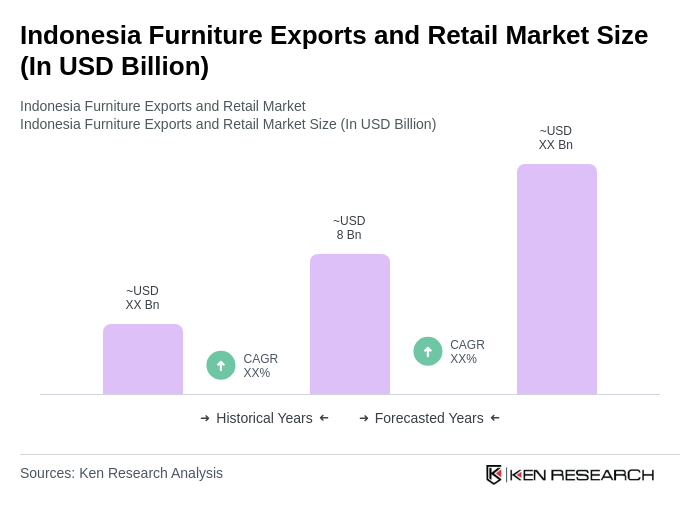
- The Indonesia Furniture Exports and Retail Market is valued at USD 8 billion, based on a five-year historical analysis. This growth is primarily driven by rising demand for sustainable and locally sourced furniture, increasing urbanization, and a growing middle class with higher disposable incomes. The market has seen significant momentum from both domestic consumption and international exports, particularly to the United States and Europe, with Indonesia maintaining a strong position as a global supplier of wooden and rattan furniture .
- Key production and commercial hubs include Jepara, renowned for its traditional wooden furniture craftsmanship, and Jakarta, which serves as a central node for furniture retail and logistics. The prominence of these locations is attributed to their established manufacturing ecosystems, skilled artisan communities, and strategic access to domestic and export markets .
- The Indonesian government enforces sustainable forestry practices in the furniture industry through the Timber Legality Verification System (Sistem Verifikasi Legalitas Kayu, SVLK), established under Ministry of Environment and Forestry Regulation No. P.30/Menlhk/Setjen/PHPL.3/3/2016. This regulation requires all wood used in furniture production for both domestic and export markets to be sourced from certified legal and sustainable forests, ensuring compliance with environmental standards and responsible sourcing throughout the supply chain .
Indonesia Furniture Exports and Retail Market Segmentation
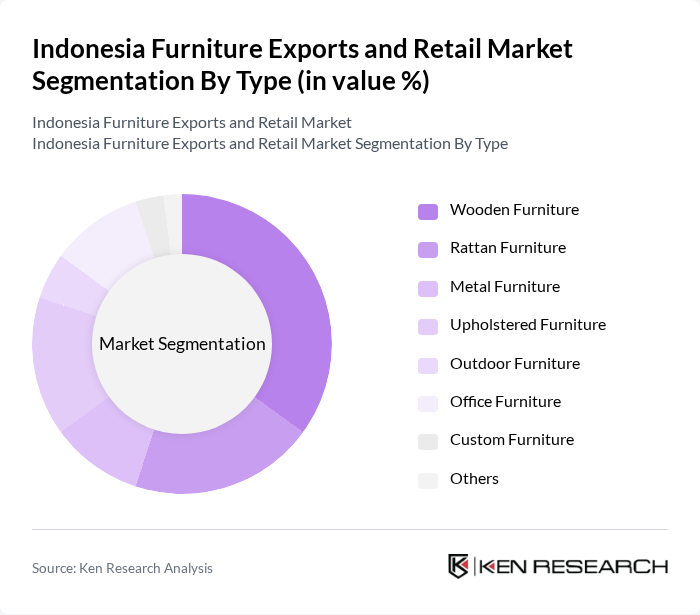
By Type:The furniture market is segmented into wooden furniture, rattan furniture, metal furniture, upholstered furniture, outdoor furniture, office furniture, custom furniture, and others. Wooden furniture remains the most popular segment, favored for its durability, craftsmanship, and aesthetic value. Rattan furniture also holds a significant share, reflecting Indonesia's abundant natural resources and expertise in woven furniture. Metal and upholstered furniture are gaining traction, particularly in urban and commercial settings, while demand for custom and multifunctional furniture is rising as consumers seek personalized and space-efficient solutions .
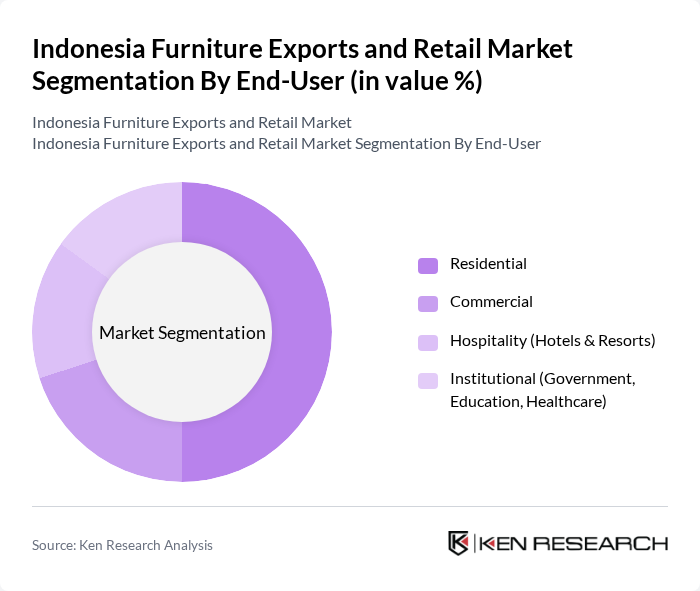
By End-User:The end-user segmentation includes residential, commercial, hospitality (hotels & resorts), and institutional (government, education, healthcare) sectors. The residential segment is the largest, supported by increasing home ownership, urbanization, and consumer preference for personalized and modern living spaces. The commercial and hospitality sectors are expanding, driven by investments in real estate, tourism, and infrastructure, while institutional demand is sustained by ongoing public sector projects .
Indonesia Furniture Exports and Retail Market Competitive Landscape
The Indonesia Furniture Exports and Retail Market is characterized by a dynamic mix of regional and international players. Leading participants such as PT Integra Indocabinet Tbk, PT Chitose Internasional Tbk, PT Home Center Indonesia (Informa), PT Olympic Furniture Group, PT Roda Bangun Mandiri, PT Wirasindo Santakarya (WISANKA), PT Kayu Lapis Indonesia, PT Lion Super Indo (IKEA Indonesia – PT Hero Supermarket Tbk), PT Rattanland Indonesia, PT Wisanka Bali, PT Jati Luhur Agung, PT Kalingga Putra, PT Domicile Interior Indonesia, PT Fabelio, PT VIVERE Multi Kreasi contribute to innovation, geographic expansion, and service delivery in this space.
Indonesia Furniture Exports and Retail Market Industry Analysis
Growth Drivers
- Increasing Global Demand for Sustainable Furniture:The global market for sustainable furniture is projected to reach $400 billion in future, driven by consumer preferences for eco-friendly products. Indonesia, as a leading exporter, benefits from this trend, with exports of sustainable furniture increasing by 15% annually. The country's rich biodiversity and commitment to sustainable practices position it favorably to meet this demand, enhancing its competitive edge in international markets.
- Expansion of E-commerce Platforms:E-commerce sales in Indonesia are expected to surpass $62 billion in future, reflecting a significant increase from previous years. This growth is significantly impacting the furniture retail sector, as more consumers turn to online platforms for purchasing. Local furniture brands are leveraging this trend by establishing robust online presences, thus reaching a broader audience and facilitating easier access to Indonesian-made products globally.
- Government Support for Export Initiatives:The Indonesian government has allocated $1 billion in future to support export initiatives, particularly in the furniture sector. This funding aims to enhance production capabilities and promote Indonesian furniture at international trade fairs. Additionally, the government is simplifying export regulations, which is expected to boost the number of small and medium enterprises (SMEs) entering the export market, further driving growth in the sector.
Market Challenges
- Intense Competition from Regional Players:Indonesia faces stiff competition from neighboring countries like Vietnam and Malaysia, which have established furniture industries. In recent periods, Vietnam's furniture exports have exceeded $14 billion, compared to Indonesia's approximately $2.5 billion. This competitive landscape pressures Indonesian manufacturers to innovate and improve quality while maintaining cost-effectiveness to retain market share in the global arena.
- Fluctuating Raw Material Prices:The volatility of raw material prices, particularly wood and rattan, poses a significant challenge for Indonesian furniture manufacturers. The price of wood has experienced notable increases in recent years due to supply chain disruptions and increased demand. This fluctuation affects production costs and profit margins, compelling manufacturers to adopt more efficient sourcing strategies to mitigate financial risks associated with raw material procurement.
Indonesia Furniture Exports and Retail Market Future Outlook
The future of Indonesia's furniture exports and retail market appears promising, driven by increasing global demand for sustainable products and the rapid growth of e-commerce. As the government continues to support export initiatives, local manufacturers are expected to enhance their production capabilities. Additionally, the integration of smart technology in furniture design will likely attract tech-savvy consumers, further expanding market opportunities. Overall, the sector is poised for significant growth, adapting to evolving consumer preferences and market dynamics.
Market Opportunities
- Growth in Eco-Friendly Furniture Segment:The eco-friendly furniture segment is projected to grow significantly, with an estimated market value of $50 billion in future. This presents a lucrative opportunity for Indonesian manufacturers to capitalize on their sustainable practices and attract environmentally conscious consumers, both domestically and internationally.
- Untapped International Markets:Emerging markets in Africa and South America present untapped opportunities for Indonesian furniture exports. With a combined population of over 1.5 billion, these regions are increasingly seeking affordable and stylish furniture options. Targeting these markets could lead to substantial growth in export volumes and revenue for Indonesian manufacturers.
Scope of the Report
| Segment | Sub-Segments |
|---|---|
| By Type | Wooden Furniture Rattan Furniture Metal Furniture Upholstered Furniture Outdoor Furniture Office Furniture Custom Furniture Others |
| By End-User | Residential Commercial Hospitality (Hotels & Resorts) Institutional (Government, Education, Healthcare) |
| By Sales Channel | Online Retail Offline Retail (Showrooms, Specialty Stores) Wholesale/Distributors Direct Exports |
| By Material | Solid Wood (Teak, Mahogany, etc.) Engineered Wood Rattan & Bamboo Metal Plastic & Synthetics |
| By Price Range | Budget Mid-Range Premium/Luxury |
| By Design Style | Modern Traditional Contemporary Minimalist |
| By Distribution Mode | Direct Distribution Indirect Distribution Franchise/Dealer Network |
Key Target Audience
Investors and Venture Capitalist Firms
Government and Regulatory Bodies (e.g., Ministry of Trade, Ministry of Industry)
Manufacturers and Producers
Distributors and Retailers
Export-Import Agencies
Logistics and Supply Chain Companies
Industry Associations (e.g., Indonesian Furniture Association)
Financial Institutions
Players Mentioned in the Report:
PT Integra Indocabinet Tbk
PT Chitose Internasional Tbk
PT Home Center Indonesia (Informa)
PT Olympic Furniture Group
PT Roda Bangun Mandiri
PT Wirasindo Santakarya (WISANKA)
PT Kayu Lapis Indonesia
PT Lion Super Indo (IKEA Indonesia PT Hero Supermarket Tbk)
PT Rattanland Indonesia
PT Wisanka Bali
PT Jati Luhur Agung
PT Kalingga Putra
PT Domicile Interior Indonesia
PT Fabelio
PT VIVERE Multi Kreasi
Table of Contents
Market Assessment Phase
1. Executive Summary and Approach
2. Indonesia Furniture Exports and Retail Market Overview
2.1 Key Insights and Strategic Recommendations
2.2 Indonesia Furniture Exports and Retail Market Overview
2.3 Definition and Scope
2.4 Evolution of Market Ecosystem
2.5 Timeline of Key Regulatory Milestones
2.6 Value Chain & Stakeholder Mapping
2.7 Business Cycle Analysis
2.8 Policy & Incentive Landscape
3. Indonesia Furniture Exports and Retail Market Analysis
3.1 Growth Drivers
3.1.1 Increasing Global Demand for Sustainable Furniture
3.1.2 Expansion of E-commerce Platforms
3.1.3 Government Support for Export Initiatives
3.1.4 Rising Middle-Class Population in Indonesia
3.2 Market Challenges
3.2.1 Intense Competition from Regional Players
3.2.2 Fluctuating Raw Material Prices
3.2.3 Regulatory Compliance Issues
3.2.4 Supply Chain Disruptions
3.3 Market Opportunities
3.3.1 Growth in Eco-Friendly Furniture Segment
3.3.2 Untapped International Markets
3.3.3 Technological Advancements in Manufacturing
3.3.4 Increasing Investment in Home Renovation
3.4 Market Trends
3.4.1 Shift Towards Customization and Personalization
3.4.2 Integration of Smart Technology in Furniture
3.4.3 Rise of Online Furniture Retailing
3.4.4 Focus on Sustainable and Ethical Sourcing
3.5 Government Regulation
3.5.1 Export Tax Incentives
3.5.2 Quality Standards for Furniture Exports
3.5.3 Environmental Regulations on Manufacturing
3.5.4 Trade Agreements with Key Markets
4. SWOT Analysis
5. Stakeholder Analysis
6. Porter's Five Forces Analysis
7. Indonesia Furniture Exports and Retail Market Market Size, 2019-2024
7.1 By Value
7.2 By Volume
7.3 By Average Selling Price
8. Indonesia Furniture Exports and Retail Market Segmentation
8.1 By Type
8.1.1 Wooden Furniture
8.1.2 Rattan Furniture
8.1.3 Metal Furniture
8.1.4 Upholstered Furniture
8.1.5 Outdoor Furniture
8.1.6 Office Furniture
8.1.7 Custom Furniture
8.1.8 Others
8.2 By End-User
8.2.1 Residential
8.2.2 Commercial
8.2.3 Hospitality (Hotels & Resorts)
8.2.4 Institutional (Government, Education, Healthcare)
8.3 By Sales Channel
8.3.1 Online Retail
8.3.2 Offline Retail (Showrooms, Specialty Stores)
8.3.3 Wholesale/Distributors
8.3.4 Direct Exports
8.4 By Material
8.4.1 Solid Wood (Teak, Mahogany, etc.)
8.4.2 Engineered Wood
8.4.3 Rattan & Bamboo
8.4.4 Metal
8.4.5 Plastic & Synthetics
8.5 By Price Range
8.5.1 Budget
8.5.2 Mid-Range
8.5.3 Premium/Luxury
8.6 By Design Style
8.6.1 Modern
8.6.2 Traditional
8.6.3 Contemporary
8.6.4 Minimalist
8.7 By Distribution Mode
8.7.1 Direct Distribution
8.7.2 Indirect Distribution
8.7.3 Franchise/Dealer Network
9. Indonesia Furniture Exports and Retail Market Competitive Analysis
9.1 Market Share of Key Players
9.2 Cross Comparison of Key Players
9.2.1 Company Name
9.2.2 Group Size (Large, Medium, or Small as per industry convention)
9.2.3 Export Revenue (USD)
9.2.4 Domestic Revenue (USD)
9.2.5 Revenue Growth Rate (%)
9.2.6 Export Market Penetration (No. of Countries)
9.2.7 Domestic Market Share (%)
9.2.8 Customer Segmentation (B2B/B2C/B2G)
9.2.9 Average Order Value (USD)
9.2.10 Product Portfolio Breadth (No. of SKUs)
9.2.11 Supply Chain Efficiency (Lead Time, Inventory Turnover)
9.2.12 ESG/Sustainability Certifications (SVLK, FSC, etc.)
9.2.13 Digitalization Level (E-commerce, ERP, Automation)
9.2.14 Brand Recognition (Domestic/International Awards, Rankings)
9.3 SWOT Analysis of Top Players
9.4 Pricing Analysis
9.5 Detailed Profile of Major Companies
9.5.1 PT Integra Indocabinet Tbk
9.5.2 PT Chitose Internasional Tbk
9.5.3 PT Home Center Indonesia (Informa)
9.5.4 PT Olympic Furniture Group
9.5.5 PT Roda Bangun Mandiri
9.5.6 PT Wirasindo Santakarya (WISANKA)
9.5.7 PT Kayu Lapis Indonesia
9.5.8 PT Lion Super Indo (IKEA Indonesia – PT Hero Supermarket Tbk)
9.5.9 PT Rattanland Indonesia
9.5.10 PT Wisanka Bali
9.5.11 PT Jati Luhur Agung
9.5.12 PT Kalingga Putra
9.5.13 PT Domicile Interior Indonesia
9.5.14 PT Fabelio
9.5.15 PT VIVERE Multi Kreasi
10. Indonesia Furniture Exports and Retail Market End-User Analysis
10.1 Procurement Behavior of Key Ministries
10.1.1 Key Procurement Trends
10.1.2 Budget Allocation Insights
10.1.3 Preferred Suppliers
10.2 Corporate Spend on Infrastructure & Energy
10.2.1 Investment Trends
10.2.2 Major Projects
10.2.3 Spending Patterns
10.3 Pain Point Analysis by End-User Category
10.3.1 Common Challenges Faced
10.3.2 Feedback from End-Users
10.3.3 Areas for Improvement
10.4 User Readiness for Adoption
10.4.1 Adoption Barriers
10.4.2 Training Needs
10.4.3 Support Requirements
10.5 Post-Deployment ROI and Use Case Expansion
10.5.1 ROI Measurement Techniques
10.5.2 Success Stories
10.5.3 Future Use Cases
11. Indonesia Furniture Exports and Retail Market Future Size, 2025-2030
11.1 By Value
11.2 By Volume
11.3 By Average Selling Price
Go-To-Market Strategy Phase
1. Whitespace Analysis + Business Model Canvas
1.1 Market Gaps Identification
1.2 Business Model Framework
2. Marketing and Positioning Recommendations
2.1 Branding Strategies
2.2 Product USPs
3. Distribution Plan
3.1 Urban Retail vs Rural NGO Tie-ups
4. Channel & Pricing Gaps
4.1 Underserved Routes
4.2 Pricing Bands
5. Unmet Demand & Latent Needs
5.1 Category Gaps
5.2 Consumer Segments
6. Customer Relationship
6.1 Loyalty Programs
6.2 After-sales Service
7. Value Proposition
7.1 Sustainability
7.2 Integrated Supply Chains
8. Key Activities
8.1 Regulatory Compliance
8.2 Branding
8.3 Distribution Setup
9. Entry Strategy Evaluation
9.1 Domestic Market Entry Strategy
9.1.1 Product Mix
9.1.2 Pricing Band
9.1.3 Packaging
9.2 Export Entry Strategy
9.2.1 Target Countries
9.2.2 Compliance Roadmap
10. Entry Mode Assessment
10.1 JV
10.2 Greenfield
10.3 M&A
10.4 Distributor Model
11. Capital and Timeline Estimation
11.1 Capital Requirements
11.2 Timelines
12. Control vs Risk Trade-Off
12.1 Ownership vs Partnerships
13. Profitability Outlook
13.1 Breakeven Analysis
13.2 Long-term Sustainability
14. Potential Partner List
14.1 Distributors
14.2 JVs
14.3 Acquisition Targets
15. Execution Roadmap
15.1 Phased Plan for Market Entry
15.1.1 Market Setup
15.1.2 Market Entry
15.1.3 Growth Acceleration
15.1.4 Scale & Stabilize
15.2 Key Activities and Milestones
15.2.1 Milestone Planning
15.2.2 Activity Tracking
Research Methodology
Phase 1: Approach1
Desk Research
- Analysis of trade statistics from the Indonesian Ministry of Trade and international trade databases
- Review of industry reports from furniture associations and market research firms
- Examination of government publications on export regulations and tariffs affecting the furniture sector
Primary Research
- Interviews with key stakeholders in the furniture manufacturing sector, including factory owners and export managers
- Surveys conducted with retailers in major urban centers to understand consumer preferences and purchasing behavior
- Focus group discussions with interior designers and architects to gauge trends in furniture design and functionality
Validation & Triangulation
- Cross-validation of findings through comparison with historical export data and market trends
- Triangulation of insights from primary interviews with secondary data sources to ensure consistency
- Sanity checks through expert panel reviews involving industry veterans and market analysts
Phase 2: Market Size Estimation1
Top-down Assessment
- Estimation of total market size based on national export figures and domestic consumption rates
- Segmentation of the market by product categories such as wooden furniture, upholstered furniture, and decorative items
- Incorporation of growth projections based on economic indicators and consumer spending trends
Bottom-up Modeling
- Collection of sales data from leading furniture manufacturers and retailers to establish baseline figures
- Analysis of production capacity and operational efficiencies within the furniture manufacturing sector
- Estimation of market share for various players based on sales volume and distribution channels
Forecasting & Scenario Analysis
- Development of forecasting models using historical growth rates and market dynamics
- Scenario analysis based on potential changes in trade policies and global economic conditions
- Creation of multiple growth scenarios (baseline, optimistic, and pessimistic) through 2030
Phase 3: CATI Sample Composition1
| Scope Item/Segment | Sample Size | Target Respondent Profiles |
|---|---|---|
| Exporting Furniture Manufacturers | 60 | Factory Owners, Export Managers |
| Retail Furniture Outlets | 50 | Store Managers, Sales Executives |
| Interior Design Firms | 40 | Designers, Project Managers |
| Consumer Preferences in Urban Areas | 100 | Homeowners, Renters |
| Trade Associations and Regulatory Bodies | 40 | Policy Makers, Industry Analysts |
Frequently Asked Questions
What is the current value of the Indonesia Furniture Exports and Retail Market?
The Indonesia Furniture Exports and Retail Market is valued at approximately USD 8 billion, driven by increasing demand for sustainable furniture, urbanization, and a growing middle class with higher disposable incomes.
Which regions are the primary export destinations for Indonesian furniture?
What types of furniture are most popular in Indonesia?
How does the Indonesian government support the furniture industry?
Other Regional/Country Reports
Malaysia Furniture Exports and Retail Market
KSA Furniture Exports and Retail Market
APAC Furniture Exports and Retail Market
SEA Furniture Exports and Retail Market
Vietnam Furniture Exports and Retail Market
Thailand Furniture Exports and Retail Market
Other Adjacent Reports
Thailand Wooden Furniture Manufacturing Market
Brazil Rattan Products Market
Mexico Home Decor Accessories Market
UAE Interior Design Services MarketBelgium E-commerce Retail Market
Kuwait Sustainable Materials Supply Market
Qatar Office Furniture Market Report Size Share Growth Drivers Trends Opportunities & Forecast 2025–2030Thailand Hospitality Furnishings Market
Brazil Timber Processing Market
Singapore Export Logistics Market
Why Buy From Us?

What makes us stand out is that our consultants follow Robust, Refine and Result (RRR) methodology. Robust for clear definitions, approaches and sanity checking, Refine for differentiating respondents' facts and opinions, and Result for presenting data with story.

We have set a benchmark in the industry by offering our clients with syndicated and customized market research reports featuring coverage of entire market as well as meticulous research and analyst insights.

While we don't replace traditional research, we flip the method upside down. Our dual approach of Top Bottom & Bottom Top ensures quality deliverable by not just verifying company fundamentals but also looking at the sector and macroeconomic factors.

With one step in the future, our research team constantly tries to show you the bigger picture. We help with some of the tough questions you may encounter along the way: How is the industry positioned? Best marketing channel? KPI's of competitors? By aligning every element, we help maximize success.

Our report gives you instant access to the answers and sources that other companies might choose to hide. We elaborate each steps of research methodology we have used and showcase you the sample size to earn your trust.

If you need any support, we are here! We pride ourselves on universe strength, data quality, and quick, friendly, and professional service.