About the Report
Base Year 2024Indonesia Oxygen Concentrator Market Overview
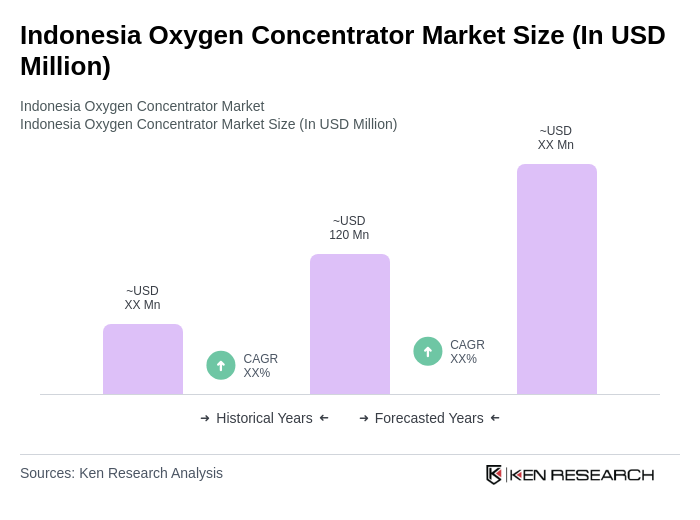
- The Indonesia Oxygen Concentrator Market is valued at USD 120 million, based on a five-year historical analysis. This growth is primarily driven by the increasing prevalence of respiratory diseases such as COPD and asthma, a growing aging population, and the rising demand for home healthcare solutions. The market has seen a significant uptick in demand due to the COVID-19 pandemic, which highlighted the need for accessible oxygen therapy. Additionally, rising consumer awareness, government spending on healthcare infrastructure, and increased investment by manufacturers in homecare items are accelerating market expansion .
- Key cities such as Jakarta, Surabaya, and Bandung dominate the market due to their high population density and advanced healthcare infrastructure. Jakarta, being the capital, has a concentration of hospitals and healthcare facilities, while Surabaya and Bandung serve as major urban centers with increasing healthcare demands, contributing to the overall growth of the oxygen concentrator market .
- In 2023, the Indonesian government implemented the “Regulation of the Minister of Health of the Republic of Indonesia Number 62 of 2017 on the Distribution of Medical Devices,” which mandates that all medical devices, including oxygen concentrators, must be registered with the Ministry of Health. This regulation ensures that only certified products meeting safety and efficacy standards are permitted for sale and use in healthcare settings, thereby enhancing consumer trust and promoting the use of approved devices .
Indonesia Oxygen Concentrator Market Segmentation
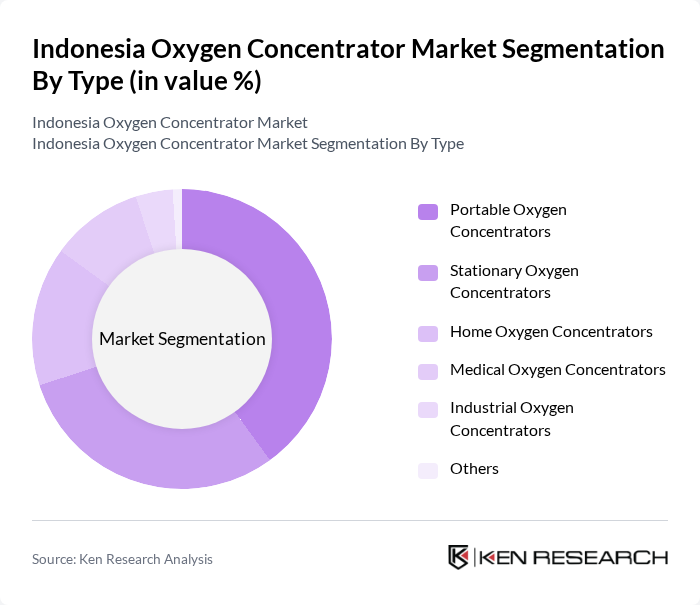
By Type:The market is segmented into various types of oxygen concentrators, including Portable Oxygen Concentrators, Stationary Oxygen Concentrators, Home Oxygen Concentrators, Medical Oxygen Concentrators, Industrial Oxygen Concentrators, and Others. Among these, Portable Oxygen Concentrators are gaining traction due to their convenience, lightweight design, and mobility, making them popular among patients requiring oxygen therapy on the go. Stationary Oxygen Concentrators remain significant, particularly in hospital and clinical settings where continuous oxygen supply is essential. The adoption of advanced technologies, such as energy-efficient and connected devices, is further driving market growth in both portable and stationary segments .
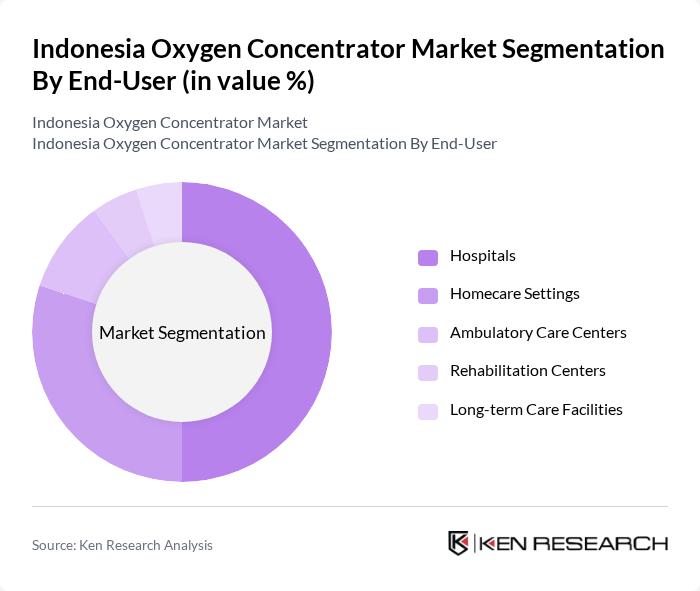
By End-User:The end-user segmentation includes Hospitals, Homecare Settings, Ambulatory Care Centers, Rehabilitation Centers, and Long-term Care Facilities. Hospitals are the leading end-users due to the high demand for oxygen therapy in critical care and emergency units. Homecare settings are witnessing robust growth as more patients prefer receiving treatment at home, supported by increased adoption of portable devices and telemedicine. The expansion of rehabilitation centers and long-term care facilities, driven by the aging population and chronic disease management, further supports the demand for oxygen concentrators .
Indonesia Oxygen Concentrator Market Competitive Landscape
The Indonesia Oxygen Concentrator Market is characterized by a dynamic mix of regional and international players. Leading participants such as Philips Healthcare, Invacare Corporation, OxyGo LLC, Drive DeVilbiss Healthcare, Nidek Medical Products, AirSep Corporation (a CAIRE Inc. company), CAIRE Inc., Precision Medical Inc., Inogen Inc., GCE Group, Chart Industries, Airox Technologies, Yuwell Medical Equipment Co., Ltd., PT. Mega Andalan Kalasan (Indonesia), PT. Jayamas Medica Industri (Indonesia) contribute to innovation, geographic expansion, and service delivery in this space.
Indonesia Oxygen Concentrator Market Industry Analysis
Growth Drivers
- Increasing Prevalence of Respiratory Diseases:The rise in respiratory diseases, such as chronic obstructive pulmonary disease (COPD) and asthma, is a significant growth driver for the oxygen concentrator market in Indonesia. According to the World Health Organization, approximately 3.6 million Indonesians suffer from COPD, leading to a growing demand for oxygen therapy. The increasing pollution levels, with Jakarta being one of the most polluted cities globally, further exacerbate respiratory issues, necessitating the use of oxygen concentrators for effective management.
- Rising Aging Population:Indonesia's aging population is projected to reach 11.2% of the total population in future, according to the United Nations. This demographic shift is associated with a higher incidence of chronic respiratory diseases, driving the demand for oxygen concentrators. The elderly population often requires long-term oxygen therapy, which is expected to increase the market's growth as healthcare providers focus on improving the quality of life for older adults through accessible home healthcare solutions.
- Growing Healthcare Infrastructure:Indonesia's healthcare infrastructure is expanding, with government initiatives aimed at improving access to medical services. The Ministry of Health reported a 20% increase in healthcare facilities, enhancing the distribution of medical devices, including oxygen concentrators. This growth is crucial for meeting the rising demand for respiratory care, particularly in urban areas where healthcare access is improving, thus supporting the market's expansion.
Market Challenges
- High Initial Costs of Oxygen Concentrators:The high initial costs associated with purchasing oxygen concentrators pose a significant challenge in Indonesia. Prices can range from IDR 12 million to IDR 28 million (approximately USD 800 to USD 1,900), making them unaffordable for many households. This financial barrier limits access to essential respiratory care, particularly in lower-income regions, hindering market growth despite the increasing demand for oxygen therapy.
- Limited Access in Rural Areas:Access to oxygen concentrators is significantly limited in rural areas of Indonesia, where healthcare infrastructure is often underdeveloped. According to the Indonesian Health Ministry, only 35% of rural health facilities are equipped with essential medical devices, including oxygen concentrators. This disparity in healthcare access creates a challenge for market penetration, as many patients in these regions cannot obtain necessary respiratory support, impacting overall market growth.
Indonesia Oxygen Concentrator Market Future Outlook
The future of the oxygen concentrator market in Indonesia appears promising, driven by increasing healthcare investments and a growing focus on home-based healthcare solutions. As telehealth services expand, patients will have better access to respiratory care, facilitating the adoption of oxygen concentrators. Additionally, technological advancements in device portability and efficiency will likely enhance user experience, making oxygen therapy more accessible and effective for patients across various demographics, particularly the elderly and those in rural areas.
Market Opportunities
- Expansion of Telehealth Services:The growth of telehealth services presents a significant opportunity for the oxygen concentrator market. With an estimated 60% increase in telehealth consultations in future, healthcare providers can offer remote monitoring and support for patients using oxygen therapy, enhancing adherence and improving health outcomes, thus driving demand for oxygen concentrators.
- Partnerships with Local Healthcare Providers:Collaborating with local healthcare providers can enhance market penetration for oxygen concentrators. By establishing partnerships, manufacturers can improve distribution channels and ensure that devices reach underserved populations, particularly in rural areas, thereby increasing accessibility and fostering growth in the market.
Scope of the Report
| Segment | Sub-Segments |
|---|---|
| By Type | Portable Oxygen Concentrators Stationary Oxygen Concentrators Home Oxygen Concentrators Medical Oxygen Concentrators Industrial Oxygen Concentrators Others |
| By End-User | Hospitals Homecare Settings Ambulatory Care Centers Rehabilitation Centers Long-term Care Facilities |
| By Application | Chronic Obstructive Pulmonary Disease (COPD) Sleep Apnea Asthma COVID-19 and Acute Respiratory Conditions Other Respiratory Conditions |
| By Distribution Channel | Direct Sales Online Retail Medical Supply Stores Hospitals and Clinics |
| By Price Range | Budget Mid-range Premium |
| By Brand | Leading International Brands Local Manufacturers (e.g., PT. Mega Andalan Kalasan, PT. Jayamas Medica Industri) Emerging Brands |
| By Policy Support | Subsidies for Medical Equipment Tax Incentives for Manufacturers Government Procurement Policies |
Key Target Audience
Investors and Venture Capitalist Firms
Government and Regulatory Bodies (e.g., Ministry of Health, National Agency of Drug and Food Control)
Manufacturers and Producers
Distributors and Retailers
Healthcare Providers and Hospitals
Non-Governmental Organizations (NGOs) focused on health
Insurance Companies
Pharmaceutical Companies
Players Mentioned in the Report:
Philips Healthcare
Invacare Corporation
OxyGo LLC
Drive DeVilbiss Healthcare
Nidek Medical Products
AirSep Corporation (a CAIRE Inc. company)
CAIRE Inc.
Precision Medical Inc.
Inogen Inc.
GCE Group
Chart Industries
Airox Technologies
Yuwell Medical Equipment Co., Ltd.
PT. Mega Andalan Kalasan (Indonesia)
PT. Jayamas Medica Industri (Indonesia)
Table of Contents
Market Assessment Phase
1. Executive Summary and Approach
2. Indonesia Oxygen Concentrator Market Overview
2.1 Key Insights and Strategic Recommendations
2.2 Indonesia Oxygen Concentrator Market Overview
2.3 Definition and Scope
2.4 Evolution of Market Ecosystem
2.5 Timeline of Key Regulatory Milestones
2.6 Value Chain & Stakeholder Mapping
2.7 Business Cycle Analysis
2.8 Policy & Incentive Landscape
3. Indonesia Oxygen Concentrator Market Analysis
3.1 Growth Drivers
3.1.1 Increasing prevalence of respiratory diseases
3.1.2 Rising aging population
3.1.3 Growing healthcare infrastructure
3.1.4 Increased awareness of home healthcare solutions
3.2 Market Challenges
3.2.1 High initial costs of oxygen concentrators
3.2.2 Limited access in rural areas
3.2.3 Regulatory hurdles
3.2.4 Competition from alternative oxygen delivery systems
3.3 Market Opportunities
3.3.1 Expansion of telehealth services
3.3.2 Partnerships with local healthcare providers
3.3.3 Development of portable oxygen concentrators
3.3.4 Government initiatives for healthcare funding
3.4 Market Trends
3.4.1 Shift towards home-based healthcare
3.4.2 Technological advancements in oxygen concentrators
3.4.3 Increasing demand for rental services
3.4.4 Focus on sustainability and eco-friendly products
3.5 Government Regulation
3.5.1 Standards for medical devices
3.5.2 Import regulations for healthcare equipment
3.5.3 Licensing requirements for manufacturers
3.5.4 Health insurance coverage policies
4. SWOT Analysis
5. Stakeholder Analysis
6. Porter's Five Forces Analysis
7. Indonesia Oxygen Concentrator Market Market Size, 2019-2024
7.1 By Value
7.2 By Volume
7.3 By Average Selling Price
8. Indonesia Oxygen Concentrator Market Segmentation
8.1 By Type
8.1.1 Portable Oxygen Concentrators
8.1.2 Stationary Oxygen Concentrators
8.1.3 Home Oxygen Concentrators
8.1.4 Medical Oxygen Concentrators
8.1.5 Industrial Oxygen Concentrators
8.1.6 Others
8.2 By End-User
8.2.1 Hospitals
8.2.2 Homecare Settings
8.2.3 Ambulatory Care Centers
8.2.4 Rehabilitation Centers
8.2.5 Long-term Care Facilities
8.3 By Application
8.3.1 Chronic Obstructive Pulmonary Disease (COPD)
8.3.2 Sleep Apnea
8.3.3 Asthma
8.3.4 COVID-19 and Acute Respiratory Conditions
8.3.5 Other Respiratory Conditions
8.4 By Distribution Channel
8.4.1 Direct Sales
8.4.2 Online Retail
8.4.3 Medical Supply Stores
8.4.4 Hospitals and Clinics
8.5 By Price Range
8.5.1 Budget
8.5.2 Mid-range
8.5.3 Premium
8.6 By Brand
8.6.1 Leading International Brands
8.6.2 Local Manufacturers (e.g., PT. Mega Andalan Kalasan, PT. Jayamas Medica Industri)
8.6.3 Emerging Brands
8.7 By Policy Support
8.7.1 Subsidies for Medical Equipment
8.7.2 Tax Incentives for Manufacturers
8.7.3 Government Procurement Policies
9. Indonesia Oxygen Concentrator Market Competitive Analysis
9.1 Market Share of Key Players
9.2 Cross Comparison of Key Players
9.2.1 Company Name
9.2.2 Group Size (Large, Medium, or Small as per industry convention)
9.2.3 Revenue (USD, Indonesia-specific where available)
9.2.4 Revenue Growth Rate (YoY %)
9.2.5 Market Share in Indonesia (%)
9.2.6 Installed Base (Units Deployed in Indonesia)
9.2.7 Product Portfolio Breadth (No. of Models/Variants)
9.2.8 Distribution Network Coverage (No. of Cities/Provinces)
9.2.9 After-Sales Service Availability (No. of Service Centers in Indonesia)
9.2.10 Regulatory Compliance (BPOM/Ministry of Health Approvals)
9.2.11 Pricing Strategy (Relative to Market Average)
9.2.12 Brand Recognition Score (Indonesia Market)
9.2.13 Customer Satisfaction Index (Indonesia Market)
9.3 SWOT Analysis of Top Players
9.4 Pricing Analysis
9.5 Detailed Profile of Major Companies
9.5.1 Philips Healthcare
9.5.2 Invacare Corporation
9.5.3 OxyGo LLC
9.5.4 Drive DeVilbiss Healthcare
9.5.5 Nidek Medical Products
9.5.6 AirSep Corporation (a CAIRE Inc. company)
9.5.7 CAIRE Inc.
9.5.8 Precision Medical Inc.
9.5.9 Inogen Inc.
9.5.10 GCE Group
9.5.11 Chart Industries
9.5.12 Airox Technologies
9.5.13 Yuwell Medical Equipment Co., Ltd.
9.5.14 PT. Mega Andalan Kalasan (Indonesia)
9.5.15 PT. Jayamas Medica Industri (Indonesia)
10. Indonesia Oxygen Concentrator Market End-User Analysis
10.1 Procurement Behavior of Key Ministries
10.1.1 Government procurement processes
10.1.2 Budget allocation for healthcare
10.1.3 Evaluation criteria for suppliers
10.1.4 Collaboration with NGOs
10.2 Corporate Spend on Infrastructure & Energy
10.2.1 Investment in healthcare facilities
10.2.2 Funding for medical equipment
10.2.3 Partnerships with private sector
10.3 Pain Point Analysis by End-User Category
10.3.1 Accessibility issues in rural areas
10.3.2 Affordability concerns for patients
10.3.3 Maintenance and service challenges
10.4 User Readiness for Adoption
10.4.1 Awareness of oxygen concentrators
10.4.2 Training needs for users
10.4.3 Support systems for new users
10.5 Post-Deployment ROI and Use Case Expansion
10.5.1 Cost savings from home healthcare
10.5.2 Increased patient satisfaction
10.5.3 Opportunities for service expansion
11. Indonesia Oxygen Concentrator Market Future Size, 2025-2030
11.1 By Value
11.2 By Volume
11.3 By Average Selling Price
Go-To-Market Strategy Phase
1. Whitespace Analysis + Business Model Canvas
1.1 Market gaps identification
1.2 Value proposition development
1.3 Revenue model exploration
1.4 Customer segmentation analysis
1.5 Competitive landscape overview
1.6 Key partnerships identification
1.7 Operational framework design
2. Marketing and Positioning Recommendations
2.1 Branding strategies
2.2 Product USPs
2.3 Target audience identification
2.4 Communication channels
2.5 Marketing budget allocation
3. Distribution Plan
3.1 Urban retail strategies
3.2 Rural NGO tie-ups
3.3 Online distribution channels
3.4 Partnerships with healthcare providers
4. Channel & Pricing Gaps
4.1 Underserved routes
4.2 Pricing bands analysis
4.3 Competitor pricing strategies
4.4 Customer willingness to pay
5. Unmet Demand & Latent Needs
5.1 Category gaps identification
5.2 Consumer segments analysis
5.3 Emerging trends in consumer behavior
6. Customer Relationship
6.1 Loyalty programs
6.2 After-sales service strategies
6.3 Customer feedback mechanisms
7. Value Proposition
7.1 Sustainability initiatives
7.2 Integrated supply chains
7.3 Unique selling points
8. Key Activities
8.1 Regulatory compliance
8.2 Branding efforts
8.3 Distribution setup
9. Entry Strategy Evaluation
9.1 Domestic Market Entry Strategy
9.1.1 Product mix considerations
9.1.2 Pricing band strategies
9.1.3 Packaging options
9.2 Export Entry Strategy
9.2.1 Target countries analysis
9.2.2 Compliance roadmap development
10. Entry Mode Assessment
10.1 Joint Ventures
10.2 Greenfield investments
10.3 Mergers & Acquisitions
10.4 Distributor Model
11. Capital and Timeline Estimation
11.1 Capital requirements
11.2 Timelines for market entry
12. Control vs Risk Trade-Off
12.1 Ownership considerations
12.2 Partnerships evaluation
13. Profitability Outlook
13.1 Breakeven analysis
13.2 Long-term sustainability strategies
14. Potential Partner List
14.1 Distributors
14.2 Joint Ventures
14.3 Acquisition targets
15. Execution Roadmap
15.1 Phased Plan for Market Entry
15.1.1 Market Setup
15.1.2 Market Entry
15.1.3 Growth Acceleration
15.1.4 Scale & Stabilize
15.2 Key Activities and Milestones
15.2.1 Milestone tracking
15.2.2 Activity scheduling
Research Methodology
Phase 1: Approach1
Desk Research
- Analysis of industry reports from health organizations and market research firms
- Review of government publications and health ministry data on oxygen concentrator usage
- Examination of academic journals and articles related to respiratory health and medical devices
Primary Research
- Interviews with healthcare professionals, including pulmonologists and respiratory therapists
- Surveys with hospital procurement managers and medical equipment distributors
- Focus groups with patients and caregivers using oxygen concentrators
Validation & Triangulation
- Cross-validation of findings through multiple expert interviews and stakeholder feedback
- Triangulation of data from primary and secondary sources to ensure consistency
- Sanity checks through comparative analysis with similar markets in Southeast Asia
Phase 2: Market Size Estimation1
Top-down Assessment
- Estimation of total healthcare expenditure in Indonesia and its allocation to respiratory care
- Analysis of demographic trends and prevalence rates of respiratory diseases
- Incorporation of government health initiatives promoting oxygen therapy
Bottom-up Modeling
- Collection of sales data from leading oxygen concentrator manufacturers and distributors
- Estimation of average selling prices based on product specifications and market segments
- Volume estimates derived from hospital and homecare usage patterns
Forecasting & Scenario Analysis
- Multi-variable forecasting using population growth, aging demographics, and disease prevalence
- Scenario analysis based on potential regulatory changes and healthcare funding shifts
- Development of baseline, optimistic, and pessimistic market growth projections through 2030
Phase 3: CATI Sample Composition1
| Scope Item/Segment | Sample Size | Target Respondent Profiles |
|---|---|---|
| Hospital Procurement Departments | 100 | Procurement Managers, Medical Equipment Buyers |
| Homecare Oxygen Therapy Users | 80 | Patients, Caregivers, Homecare Providers |
| Healthcare Professionals | 70 | Pulmonologists, Respiratory Therapists |
| Medical Equipment Distributors | 50 | Sales Managers, Distribution Coordinators |
| Government Health Officials | 40 | Policy Makers, Health Program Managers |
Frequently Asked Questions
What is the current value of the Indonesia Oxygen Concentrator Market?
The Indonesia Oxygen Concentrator Market is valued at approximately USD 120 million, driven by the increasing prevalence of respiratory diseases, an aging population, and a growing demand for home healthcare solutions, particularly highlighted during the COVID-19 pandemic.
What factors are driving the growth of the oxygen concentrator market in Indonesia?
Which cities in Indonesia are leading in the oxygen concentrator market?
What regulations govern the distribution of oxygen concentrators in Indonesia?
Other Regional/Country Reports
Malaysia Oxygen Concentrator Market
KSA Oxygen Concentrator Market
APAC Oxygen Concentrator Market
SEA Oxygen Concentrator Market
Vietnam Oxygen Concentrator Market
Other Adjacent Reports
Mexico Respiratory Devices Market
Saudi Arabia Africa Home Healthcare Market Report Size Share Growth Drivers Trends Opportunities & Forecast 2025–2030Japan Medical Oxygen Supply Market
Qatar Portable Oxygen Therapy Market
KSA Chronic Respiratory Disease Management Market
Ksa Telehealth Services Market Report Size, Share, Growth Drivers, Trends, Opportunities & Forecast 2025–2030Egypt Aging Population Care Market
UAE Hospital Equipment Market Size, Share, Growth Drivers, Trends, Opportunities & Forecast 2025–2030Germany Medical Device Distribution Market
Malaysia Healthcare Infrastructure Development Market
Why Buy From Us?

What makes us stand out is that our consultants follow Robust, Refine and Result (RRR) methodology. Robust for clear definitions, approaches and sanity checking, Refine for differentiating respondents' facts and opinions, and Result for presenting data with story.

We have set a benchmark in the industry by offering our clients with syndicated and customized market research reports featuring coverage of entire market as well as meticulous research and analyst insights.

While we don't replace traditional research, we flip the method upside down. Our dual approach of Top Bottom & Bottom Top ensures quality deliverable by not just verifying company fundamentals but also looking at the sector and macroeconomic factors.

With one step in the future, our research team constantly tries to show you the bigger picture. We help with some of the tough questions you may encounter along the way: How is the industry positioned? Best marketing channel? KPI's of competitors? By aligning every element, we help maximize success.

Our report gives you instant access to the answers and sources that other companies might choose to hide. We elaborate each steps of research methodology we have used and showcase you the sample size to earn your trust.

If you need any support, we are here! We pride ourselves on universe strength, data quality, and quick, friendly, and professional service.