About the Report
Base Year 2024Indonesia Process Piping Market Overview
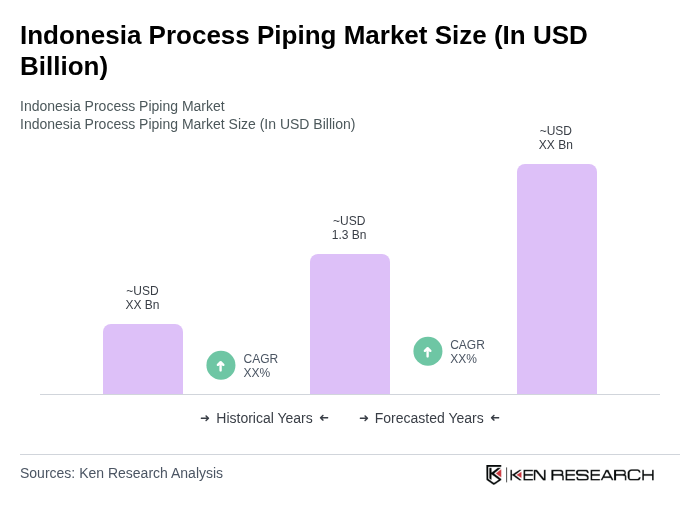
- The Indonesia Process Piping Market is valued at USD 1.3 billion, based on a five-year historical analysis of the broader Indonesia pipe and plastic pipe markets and the share attributable to industrial and process applications. This growth is primarily driven by the increasing demand for efficient and reliable piping systems in oil and gas, petrochemicals, power generation, and other process industries, supported by sustained investment in pipelines, refineries, petrochemical complexes, and utility networks. The expansion of infrastructure projects, rising urbanization, and the need for modernization and debottlenecking of existing industrial facilities have further fueled the market's growth.
- Key regions dominating the market include Java, particularly Jakarta and surrounding industrial corridors, due to their status as the economic and manufacturing hub of Indonesia, and Sumatra, which is rich in oil, gas, and other natural resources. The concentration of refineries, petrochemical plants, power plants, and infrastructure projects in these areas, along with major urban centers such as Jakarta, Surabaya, and Bandung, has led to a higher demand for process piping solutions, making these regions critical to market demand.
- In 2024, the Indonesian government strengthened requirements on the use of environmentally friendly and resource?efficient materials in construction and utility piping, including incentives for recycled and low?impact plastics, building on circular economy policies such as Presidential Regulation No. 83 of 2018 on the Handling of Marine Plastic Waste and related implementing measures. These frameworks encourage the use of recyclable and low?emission pipe materials, energy?efficient manufacturing processes, and higher environmental performance in industrial and construction piping systems, influencing material selection and technology adoption in the process piping market.
Indonesia Process Piping Market Segmentation
By Type:
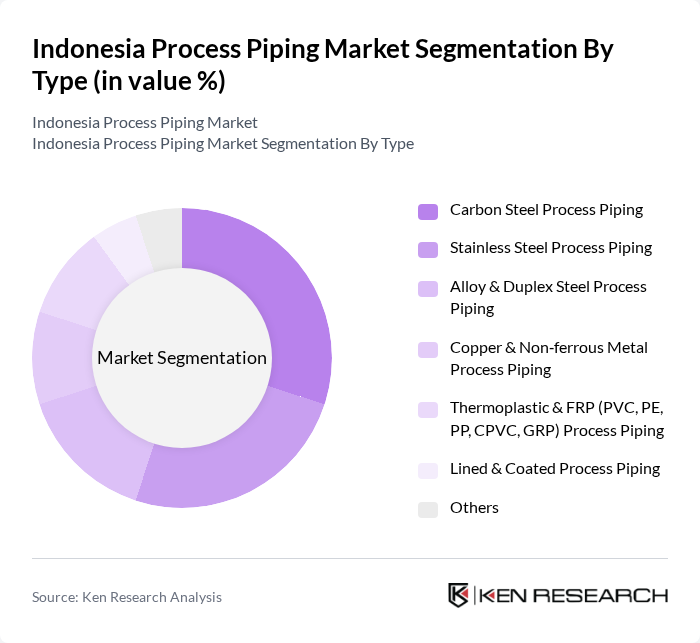
The type segmentation aligns with the broader Indonesia pipe and plastic pipe markets, where plastic/thermoplastic systems (PVC, HDPE, PP, CPVC, GRP) are gaining share in water, wastewater, and building services due to corrosion resistance and ease of installation, while carbon steel, stainless steel, and alloy piping remain dominant in high?pressure, high?temperature, and hydrocarbon service typical of oil and gas, petrochemical, and power plants.
By End-User:
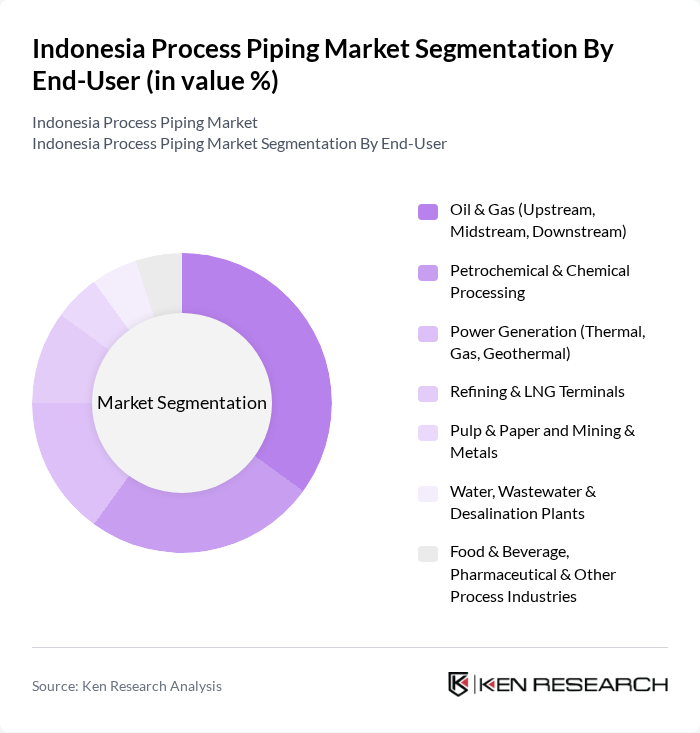
The end?user structure is consistent with Indonesia’s industrial profile, where oil and gas (including upstream fields, transmission pipelines, and refineries), petrochemicals, fertilizers, and power generation are major consumers of process piping, while water and wastewater infrastructure, mining, pulp and paper, and fast?growing food and beverage and pharmaceutical facilities contribute steadily to demand.
Indonesia Process Piping Market Competitive Landscape
The Indonesia Process Piping Market is characterized by a dynamic mix of regional and international players. Leading participants such as PT Waskita Karya (Persero) Tbk – Industrial & Process Piping EPC, PT Wijaya Karya (Persero) Tbk (WIKA) – Industrial & Energy Piping Solutions, PT Rekayasa Industri – EPC for Oil, Gas, Petrochemical & Power Process Piping, PT Pupuk Kujang / Pupuk Indonesia Group – Fertilizer & Chemical Plant Piping Assets, PT Pertamina (Persero) – Refinery, Petrochemical & Pipeline Process Piping, PT Krakatau Steel (Persero) Tbk – Carbon & Alloy Steel Pipe Supply for Process Industries, PT Citra Tubindo Tbk – OCTG & Industrial Seamless Pipe for Oil & Gas Process Piping, PT Gunung Raja Paksi Tbk – Steel Pipes & Structural Products for Industrial Piping, PT Rucika (Wahana Duta Jaya Rucika) – uPVC, PE & Specialty Plastic Process Piping, PT Pralon – PVC & CPVC Industrial and Building Services Piping, Vinilon Group (PT Rusli Vinilon Sakti) – Thermoplastic Industrial Piping Systems, PT Maspion Kencana Mulia – Plastic & Metal Pipes for Infrastructure and Industry, PT Pipa Industri Ofindo – Steel & Industrial Pipes for Oil, Gas & Utilities, PT Steel Pipe Industry of Indonesia Tbk (SPINDO) – ERW & SSAW Pipes for Process & Energy, PT Bakrie Pipe Industries – Steel Line Pipe & Process Piping for Oil, Gas & Water contribute to innovation, geographic expansion, and service delivery in this space.
Indonesia Process Piping Market Industry Analysis
Growth Drivers
- Increasing Industrialization:Indonesia's industrial sector is projected to contribute approximately IDR 3,800 trillion (USD 250 billion) to the national GDP in future, driven by manufacturing and construction activities. This surge in industrialization necessitates robust process piping systems to support production processes. The government’s focus on enhancing industrial output, particularly in sectors like food processing and chemicals, is expected to further stimulate demand for advanced piping solutions, thereby driving market growth significantly.
- Rising Demand for Energy Efficiency:The Indonesian government aims to reduce energy consumption by 20% in future, promoting energy-efficient technologies across industries. This initiative is expected to increase the demand for process piping systems that optimize energy use. For instance, the implementation of energy-efficient piping solutions can lead to savings of up to IDR 50 trillion (USD 3.5 billion) annually, making it a critical driver for the market as industries seek to comply with these regulations and reduce operational costs.
- Government Infrastructure Projects:The Indonesian government has allocated IDR 4,000 trillion (USD 270 billion) for infrastructure development in future, focusing on transportation, utilities, and industrial parks. These projects will require extensive process piping systems for water supply, waste management, and energy distribution. The commitment to infrastructure development not only enhances the market landscape but also creates a favorable environment for investments in advanced piping technologies, thereby driving growth in the process piping sector.
Market Challenges
- Regulatory Compliance Issues:Navigating Indonesia's complex regulatory landscape poses significant challenges for process piping manufacturers. Compliance with environmental regulations, such as the Ministry of Environment and Forestry's standards, can incur costs exceeding IDR 10 billion (USD 700,000) for companies. These compliance requirements can delay project timelines and increase operational costs, hindering market growth and discouraging new entrants in the process piping industry.
- High Initial Investment Costs:The capital required for establishing process piping systems can be substantial, often exceeding IDR 100 billion (USD 7 million) for large-scale projects. This high initial investment can deter small and medium enterprises from entering the market. Additionally, fluctuating material costs and the need for advanced technology further exacerbate the financial burden, limiting the growth potential of the process piping market in Indonesia.
Indonesia Process Piping Market Future Outlook
The future of the Indonesia process piping market appears promising, driven by ongoing industrialization and government initiatives aimed at enhancing energy efficiency. As industries increasingly adopt smart technologies and sustainable practices, the demand for innovative piping solutions is expected to rise. Furthermore, the integration of IoT in piping systems will facilitate real-time monitoring and maintenance, improving operational efficiency. These trends indicate a dynamic market landscape, with significant opportunities for growth and development in the coming years.
Market Opportunities
- Expansion in Renewable Energy Projects:Indonesia's commitment to increasing renewable energy sources to 23% of the energy mix in future presents a significant opportunity for process piping manufacturers. Investments in solar, wind, and geothermal projects will require specialized piping solutions, potentially generating IDR 50 trillion (USD 3.5 billion) in new market opportunities, fostering innovation and growth in the sector.
- Adoption of Smart Piping Technologies:The growing trend towards automation and smart technologies in industrial processes is creating opportunities for advanced piping solutions. The integration of IoT and AI can enhance monitoring and predictive maintenance, potentially reducing operational costs by up to 15%. This shift towards smart piping technologies is expected to attract investments and drive market growth significantly in the coming years.
Scope of the Report
| Segment | Sub-Segments |
|---|---|
| By Type | Carbon Steel Process Piping Stainless Steel Process Piping Alloy & Duplex Steel Process Piping Copper & Non?ferrous Metal Process Piping Thermoplastic & FRP (PVC, PE, PP, CPVC, GRP) Process Piping Lined & Coated Process Piping Others |
| By End-User | Oil & Gas (Upstream, Midstream, Downstream) Petrochemical & Chemical Processing Power Generation (Thermal, Gas, Geothermal) Refining & LNG Terminals Pulp & Paper and Mining & Metals Water, Wastewater & Desalination Plants Food & Beverage, Pharmaceutical & Other Process Industries |
| By Application | Process & Utility Fluid Transport (Steam, Chemicals, Hydrocarbons) High?Pressure & High?Temperature Services Corrosive & Abrasive Media Handling Fire Protection & Safety Systems (Sprinkler, Deluge) HVAC & Chilled Water Piping in Industrial Facilities Instrumentation & Control Piping Others |
| By Material | Carbon Steel Stainless & Alloy Steel Thermoplastics (PVC, PE, PP, CPVC) Thermoset & Composite (FRP/GRP, RTR) Non?ferrous Metals (Copper, Nickel Alloys) Others |
| By Diameter | Small Diameter (? 2 Inches) Medium Diameter (> 2 – 12 Inches) Large Diameter (> 12 Inches) Others |
| By Installation Type | Above Ground Process Piping Underground & Buried Process Piping Modular / Prefabricated Skid?Mounted Piping Others |
| By Region | Java (Jakarta, West Java, Banten, Central & East Java) Sumatra (Riau, North Sumatra, South Sumatra, Others) Kalimantan (Including New Capital Nusantara) Sulawesi & Eastern Indonesia (Maluku, Papua, Nusa Tenggara) Others |
Key Target Audience
Investors and Venture Capitalist Firms
Government and Regulatory Bodies (e.g., Ministry of Energy and Mineral Resources, Ministry of Industry)
Manufacturers and Producers
Oil and Gas Companies
Construction and Engineering Firms
Utility Companies
Industry Associations (e.g., Indonesian Petroleum Association)
Financial Institutions
Players Mentioned in the Report:
PT Waskita Karya (Persero) Tbk Industrial & Process Piping EPC
PT Wijaya Karya (Persero) Tbk (WIKA) Industrial & Energy Piping Solutions
PT Rekayasa Industri EPC for Oil, Gas, Petrochemical & Power Process Piping
PT Pupuk Kujang / Pupuk Indonesia Group Fertilizer & Chemical Plant Piping Assets
PT Pertamina (Persero) Refinery, Petrochemical & Pipeline Process Piping
PT Krakatau Steel (Persero) Tbk Carbon & Alloy Steel Pipe Supply for Process Industries
PT Citra Tubindo Tbk OCTG & Industrial Seamless Pipe for Oil & Gas Process Piping
PT Gunung Raja Paksi Tbk Steel Pipes & Structural Products for Industrial Piping
PT Rucika (Wahana Duta Jaya Rucika) uPVC, PE & Specialty Plastic Process Piping
PT Pralon PVC & CPVC Industrial and Building Services Piping
Vinilon Group (PT Rusli Vinilon Sakti) Thermoplastic Industrial Piping Systems
PT Maspion Kencana Mulia Plastic & Metal Pipes for Infrastructure and Industry
PT Pipa Industri Ofindo Steel & Industrial Pipes for Oil, Gas & Utilities
PT Steel Pipe Industry of Indonesia Tbk (SPINDO) ERW & SSAW Pipes for Process & Energy
PT Bakrie Pipe Industries Steel Line Pipe & Process Piping for Oil, Gas & Water
Table of Contents
Market Assessment Phase
1. Executive Summary and Approach
2. Indonesia Process Piping Market Overview
2.1 Key Insights and Strategic Recommendations
2.2 Indonesia Process Piping Market Overview
2.3 Definition and Scope
2.4 Evolution of Market Ecosystem
2.5 Timeline of Key Regulatory Milestones
2.6 Value Chain & Stakeholder Mapping
2.7 Business Cycle Analysis
2.8 Policy & Incentive Landscape
3. Indonesia Process Piping Market Analysis
3.1 Growth Drivers
3.1.1 Increasing industrialization
3.1.2 Rising demand for energy efficiency
3.1.3 Government infrastructure projects
3.1.4 Technological advancements in piping materials
3.2 Market Challenges
3.2.1 Regulatory compliance issues
3.2.2 High initial investment costs
3.2.3 Supply chain disruptions
3.2.4 Limited skilled labor availability
3.3 Market Opportunities
3.3.1 Expansion in renewable energy projects
3.3.2 Adoption of smart piping technologies
3.3.3 Growth in the oil and gas sector
3.3.4 Increasing foreign investments
3.4 Market Trends
3.4.1 Shift towards sustainable materials
3.4.2 Integration of IoT in piping systems
3.4.3 Focus on maintenance and lifecycle management
3.4.4 Customization of piping solutions
3.5 Government Regulation
3.5.1 Environmental protection regulations
3.5.2 Safety standards for industrial piping
3.5.3 Incentives for local manufacturing
3.5.4 Compliance with international standards
4. SWOT Analysis
5. Stakeholder Analysis
6. Porter's Five Forces Analysis
7. Indonesia Process Piping Market Market Size, 2019-2024
7.1 By Value
7.2 By Volume
7.3 By Average Selling Price
8. Indonesia Process Piping Market Segmentation
8.1 By Type
8.1.1 Carbon Steel Process Piping
8.1.2 Stainless Steel Process Piping
8.1.3 Alloy & Duplex Steel Process Piping
8.1.4 Copper & Non?ferrous Metal Process Piping
8.1.5 Thermoplastic & FRP (PVC, PE, PP, CPVC, GRP) Process Piping
8.1.6 Lined & Coated Process Piping
8.1.7 Others
8.2 By End-User
8.2.1 Oil & Gas (Upstream, Midstream, Downstream)
8.2.2 Petrochemical & Chemical Processing
8.2.3 Power Generation (Thermal, Gas, Geothermal)
8.2.4 Refining & LNG Terminals
8.2.5 Pulp & Paper and Mining & Metals
8.2.6 Water, Wastewater & Desalination Plants
8.2.7 Food & Beverage, Pharmaceutical & Other Process Industries
8.3 By Application
8.3.1 Process & Utility Fluid Transport (Steam, Chemicals, Hydrocarbons)
8.3.2 High?Pressure & High?Temperature Services
8.3.3 Corrosive & Abrasive Media Handling
8.3.4 Fire Protection & Safety Systems (Sprinkler, Deluge)
8.3.5 HVAC & Chilled Water Piping in Industrial Facilities
8.3.6 Instrumentation & Control Piping
8.3.7 Others
8.4 By Material
8.4.1 Carbon Steel
8.4.2 Stainless & Alloy Steel
8.4.3 Thermoplastics (PVC, PE, PP, CPVC)
8.4.4 Thermoset & Composite (FRP/GRP, RTR)
8.4.5 Non?ferrous Metals (Copper, Nickel Alloys)
8.4.6 Others
8.5 By Diameter
8.5.1 Small Diameter (? 2 Inches)
8.5.2 Medium Diameter (> 2 – 12 Inches)
8.5.3 Large Diameter (> 12 Inches)
8.5.4 Others
8.6 By Installation Type
8.6.1 Above Ground Process Piping
8.6.2 Underground & Buried Process Piping
8.6.3 Modular / Prefabricated Skid?Mounted Piping
8.6.4 Others
8.7 By Region
8.7.1 Java (Jakarta, West Java, Banten, Central & East Java)
8.7.2 Sumatra (Riau, North Sumatra, South Sumatra, Others)
8.7.3 Kalimantan (Including New Capital Nusantara)
8.7.4 Sulawesi & Eastern Indonesia (Maluku, Papua, Nusa Tenggara)
8.7.5 Others
9. Indonesia Process Piping Market Competitive Analysis
9.1 Market Share of Key Players
9.2 Cross Comparison of Key Players
9.2.1 Company Name
9.2.2 Group Size (Large, Medium, or Small as per industry convention)
9.2.3 Indonesia Process Piping Revenue (IDR Million / USD Million)
9.2.4 3?Year Revenue CAGR in Indonesia Process Piping
9.2.5 Order Backlog in Process & Industrial Projects (Months of Revenue)
9.2.6 Market Share in Key End?Use Segments (Oil & Gas, Power, Chemical)
9.2.7 Project Win Ratio in Public & Private Tenders
9.2.8 Installed Process Piping Capacity (km / ton per year)
9.2.9 Share of EPC / Turnkey Contracts vs Supply?Only
9.2.10 Average EBITDA Margin from Process Piping Business
9.2.11 Capex Intensity (Capex / Sales) in Last 3 Years
9.2.12 Geographic Penetration within Indonesia (No. of Provinces / Project Sites)
9.2.13 On?Time Project Delivery Rate
9.2.14 HSE Performance (TRIR / Lost Time Injury Frequency in Projects)
9.2.15 Share of Sales from High?Value / Engineered Piping Systems
9.3 SWOT Analysis of Top Players
9.4 Pricing Analysis
9.5 Detailed Profile of Major Companies
9.5.1 PT Waskita Karya (Persero) Tbk – Industrial & Process Piping EPC
9.5.2 PT Wijaya Karya (Persero) Tbk (WIKA) – Industrial & Energy Piping Solutions
9.5.3 PT Rekayasa Industri – EPC for Oil, Gas, Petrochemical & Power Process Piping
9.5.4 PT Pupuk Kujang / Pupuk Indonesia Group – Fertilizer & Chemical Plant Piping Assets
9.5.5 PT Pertamina (Persero) – Refinery, Petrochemical & Pipeline Process Piping
9.5.6 PT Krakatau Steel (Persero) Tbk – Carbon & Alloy Steel Pipe Supply for Process Industries
9.5.7 PT Citra Tubindo Tbk – OCTG & Industrial Seamless Pipe for Oil & Gas Process Piping
9.5.8 PT Gunung Raja Paksi Tbk – Steel Pipes & Structural Products for Industrial Piping
9.5.9 PT Rucika (Wahana Duta Jaya Rucika) – uPVC, PE & Specialty Plastic Process Piping
9.5.10 PT Pralon – PVC & CPVC Industrial and Building Services Piping
9.5.11 Vinilon Group (PT Rusli Vinilon Sakti) – Thermoplastic Industrial Piping Systems
9.5.12 PT Maspion Kencana Mulia – Plastic & Metal Pipes for Infrastructure and Industry
9.5.13 PT Pipa Industri Ofindo – Steel & Industrial Pipes for Oil, Gas & Utilities
9.5.14 PT Steel Pipe Industry of Indonesia Tbk (SPINDO) – ERW & SSAW Pipes for Process & Energy
9.5.15 PT Bakrie Pipe Industries – Steel Line Pipe & Process Piping for Oil, Gas & Water
10. Indonesia Process Piping Market End-User Analysis
10.1 Procurement Behavior of Key Ministries
10.1.1 Ministry of Energy and Mineral Resources
10.1.2 Ministry of Public Works and Housing
10.1.3 Ministry of Industry
10.1.4 Ministry of Environment and Forestry
10.2 Corporate Spend on Infrastructure & Energy
10.2.1 Investment Trends in Infrastructure
10.2.2 Energy Sector Expenditure
10.2.3 Budget Allocation for Piping Projects
10.3 Pain Point Analysis by End-User Category
10.3.1 Industrial Sector Challenges
10.3.2 Government Sector Challenges
10.3.3 Utility Sector Challenges
10.4 User Readiness for Adoption
10.4.1 Awareness of New Technologies
10.4.2 Training and Skill Development Needs
10.5 Post-Deployment ROI and Use Case Expansion
10.5.1 Measurement of ROI in Projects
10.5.2 Case Studies of Successful Implementations
11. Indonesia Process Piping Market Future Size, 2025-2030
11.1 By Value
11.2 By Volume
11.3 By Average Selling Price
Go-To-Market Strategy Phase
1. Whitespace Analysis + Business Model Canvas
1.1 Market Gaps Identification
1.2 Business Model Development
2. Marketing and Positioning Recommendations
2.1 Branding Strategies
2.2 Product USPs
3. Distribution Plan
3.1 Urban Retail Strategies
3.2 Rural NGO Tie-ups
4. Channel & Pricing Gaps
4.1 Underserved Routes
4.2 Pricing Bands Analysis
5. Unmet Demand & Latent Needs
5.1 Category Gaps
5.2 Consumer Segments
6. Customer Relationship
6.1 Loyalty Programs
6.2 After-sales Service
7. Value Proposition
7.1 Sustainability Initiatives
7.2 Integrated Supply Chains
8. Key Activities
8.1 Regulatory Compliance
8.2 Branding Efforts
8.3 Distribution Setup
9. Entry Strategy Evaluation
9.1 Domestic Market Entry Strategy
9.1.1 Product Mix Considerations
9.1.2 Pricing Band Strategy
9.1.3 Packaging Solutions
9.2 Export Entry Strategy
9.2.1 Target Countries
9.2.2 Compliance Roadmap
10. Entry Mode Assessment
10.1 Joint Ventures
10.2 Greenfield Investments
10.3 Mergers & Acquisitions
10.4 Distributor Model
11. Capital and Timeline Estimation
11.1 Capital Requirements
11.2 Timelines for Implementation
12. Control vs Risk Trade-Off
12.1 Ownership Considerations
12.2 Partnerships Evaluation
13. Profitability Outlook
13.1 Breakeven Analysis
13.2 Long-term Sustainability
14. Potential Partner List
14.1 Distributors
14.2 Joint Ventures
14.3 Acquisition Targets
15. Execution Roadmap
15.1 Phased Plan for Market Entry
15.1.1 Market Setup
15.1.2 Market Entry
15.1.3 Growth Acceleration
15.1.4 Scale & Stabilize
15.2 Key Activities and Milestones
15.2.1 Milestone Planning
15.2.2 Activity Tracking
Research Methodology
Phase 1: Approach1
Desk Research
- Industry reports from the Indonesian Ministry of Industry and Trade
- Market analysis publications from local engineering associations
- Statistical data from the Central Bureau of Statistics (BPS) on industrial output
Primary Research
- Interviews with project managers at major oil and gas companies
- Surveys with engineering firms specializing in process piping
- Field visits to construction sites to gather firsthand insights
Validation & Triangulation
- Cross-validation of data through multiple industry sources and reports
- Triangulation of findings from primary interviews and secondary data
- Sanity checks conducted with industry experts and stakeholders
Phase 2: Market Size Estimation1
Top-down Assessment
- Analysis of national infrastructure spending trends impacting process piping
- Segmentation of the market by end-user industries such as oil & gas, chemicals, and power
- Incorporation of government initiatives promoting industrial growth
Bottom-up Modeling
- Volume estimates based on project pipelines from major construction firms
- Cost analysis derived from historical pricing data of piping materials
- Estimation of market share based on firm-level sales data
Forecasting & Scenario Analysis
- Multi-variable regression analysis considering economic growth and energy demand
- Scenario planning based on regulatory changes and environmental policies
- Development of baseline, optimistic, and pessimistic forecasts through 2030
Phase 3: CATI Sample Composition1
| Scope Item/Segment | Sample Size | Target Respondent Profiles |
|---|---|---|
| Oil & Gas Process Piping Projects | 45 | Project Engineers, Procurement Managers |
| Chemical Manufacturing Installations | 40 | Operations Managers, Safety Officers |
| Power Generation Facilities | 35 | Facility Managers, Maintenance Supervisors |
| Water Treatment Plants | 30 | Environmental Engineers, Project Managers |
| Construction and Engineering Firms | 40 | Business Development Managers, Technical Directors |
Frequently Asked Questions
What is the current value of the Indonesia Process Piping Market?
The Indonesia Process Piping Market is valued at approximately USD 1.3 billion, driven by the demand for efficient piping systems in various industries, including oil and gas, petrochemicals, and power generation.
What factors are driving the growth of the Indonesia Process Piping Market?
Which regions in Indonesia dominate the Process Piping Market?
What types of materials are commonly used in Indonesia's Process Piping?
Other Regional/Country Reports
Malaysia Process Piping Market
KSA Process Piping Market
APAC Process Piping Market
SEA Process Piping Market
Vietnam Process Piping Market
Thailand Process Piping Market
Other Adjacent Reports
Bahrain Petrochemical Equipment Market
South Africa Power Generation Infrastructure Market
KSA Water and Wastewater Treatment Market
Philippines Fertilizer Production Market
Global Mining Equipment MarketBelgium Pulp and Paper Processing Market
Mexico Food and Beverage Processing Market
New Zealand Pharmaceutical Manufacturing Market Report Size, Share, Growth Drivers, Trends, Opportunities & Forecast 2025–2030Thailand Industrial Valve and Fitting Market
Why Buy From Us?

What makes us stand out is that our consultants follow Robust, Refine and Result (RRR) methodology. Robust for clear definitions, approaches and sanity checking, Refine for differentiating respondents' facts and opinions, and Result for presenting data with story.

We have set a benchmark in the industry by offering our clients with syndicated and customized market research reports featuring coverage of entire market as well as meticulous research and analyst insights.

While we don't replace traditional research, we flip the method upside down. Our dual approach of Top Bottom & Bottom Top ensures quality deliverable by not just verifying company fundamentals but also looking at the sector and macroeconomic factors.

With one step in the future, our research team constantly tries to show you the bigger picture. We help with some of the tough questions you may encounter along the way: How is the industry positioned? Best marketing channel? KPI's of competitors? By aligning every element, we help maximize success.

Our report gives you instant access to the answers and sources that other companies might choose to hide. We elaborate each steps of research methodology we have used and showcase you the sample size to earn your trust.

If you need any support, we are here! We pride ourselves on universe strength, data quality, and quick, friendly, and professional service.