















APAC Alternative Proteins Market Outlook to 2030
Region:Asia
Author(s):Shubham Kashyap
Product Code:KROD4551
December 2024
89
About the Report
APAC Alternative Proteins Market Overview
- The APAC Alternative Proteins Market is currently experiencing rapid growth, currently valued at USD 78 Tn, driven by rising consumer demand for sustainable and plant-based food options. As of 2023, the market is driven by increasing awareness of environmental sustainability, health-consciousness, and ethical concerns over traditional meat production. The regions diverse dietary habits, coupled with rising urbanization and income levels, are contributing to the widespread adoption of alternative protein products such as plant-based meat, cultured meat, and insect protein. Countries such as China, Japan, and Singapore are leading the market with investments in alternative protein technologies and innovation hubs.
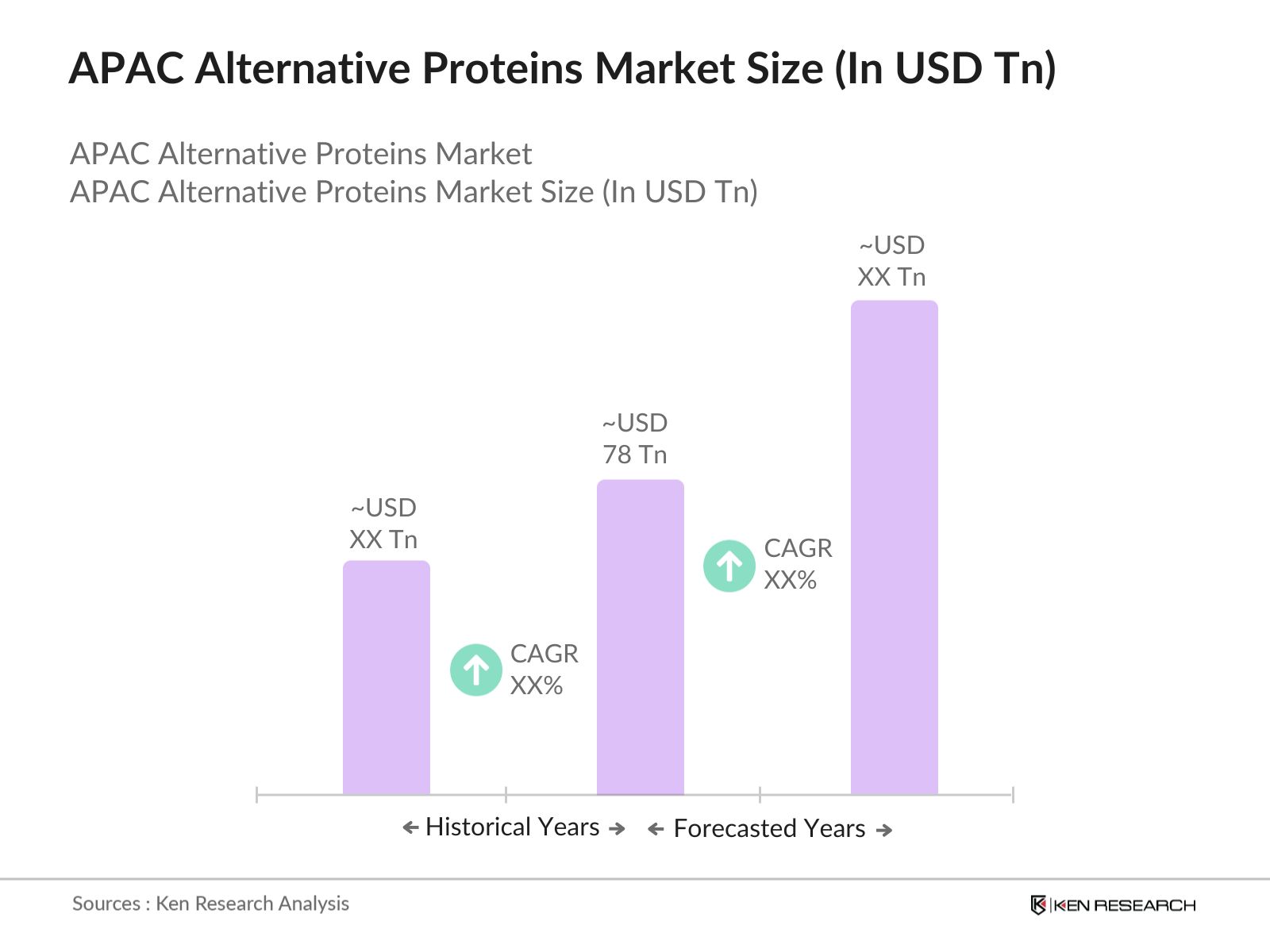
- Countries such as China, Singapore, and Australia dominate the alternative proteins market in APAC due to strong government support, regulatory frameworks, and high consumer demand for sustainable food products. In Singapore, the government's progressive regulatory stance on cultured meat has positioned the country as a global hub for alternative protein innovation. Meanwhile, Chinas focus on food security and reducing dependency on traditional meat imports has led to increased investments in plant-based proteins, making these nations key players in the market.
- Governments across the APAC region are actively promoting the alternative proteins industry. Singapore has introduced regulatory frameworks that support the development and commercialization of cultured meat and other alternative proteins, making it the first country in the world to approve lab-grown meat for public consumption. Similarly, China is embracing alternative proteins as part of its food security strategy, encouraging investments in plant-based and cultivated meat production to reduce reliance on traditional meat imports.
APAC Alternative Proteins Market Segmentation
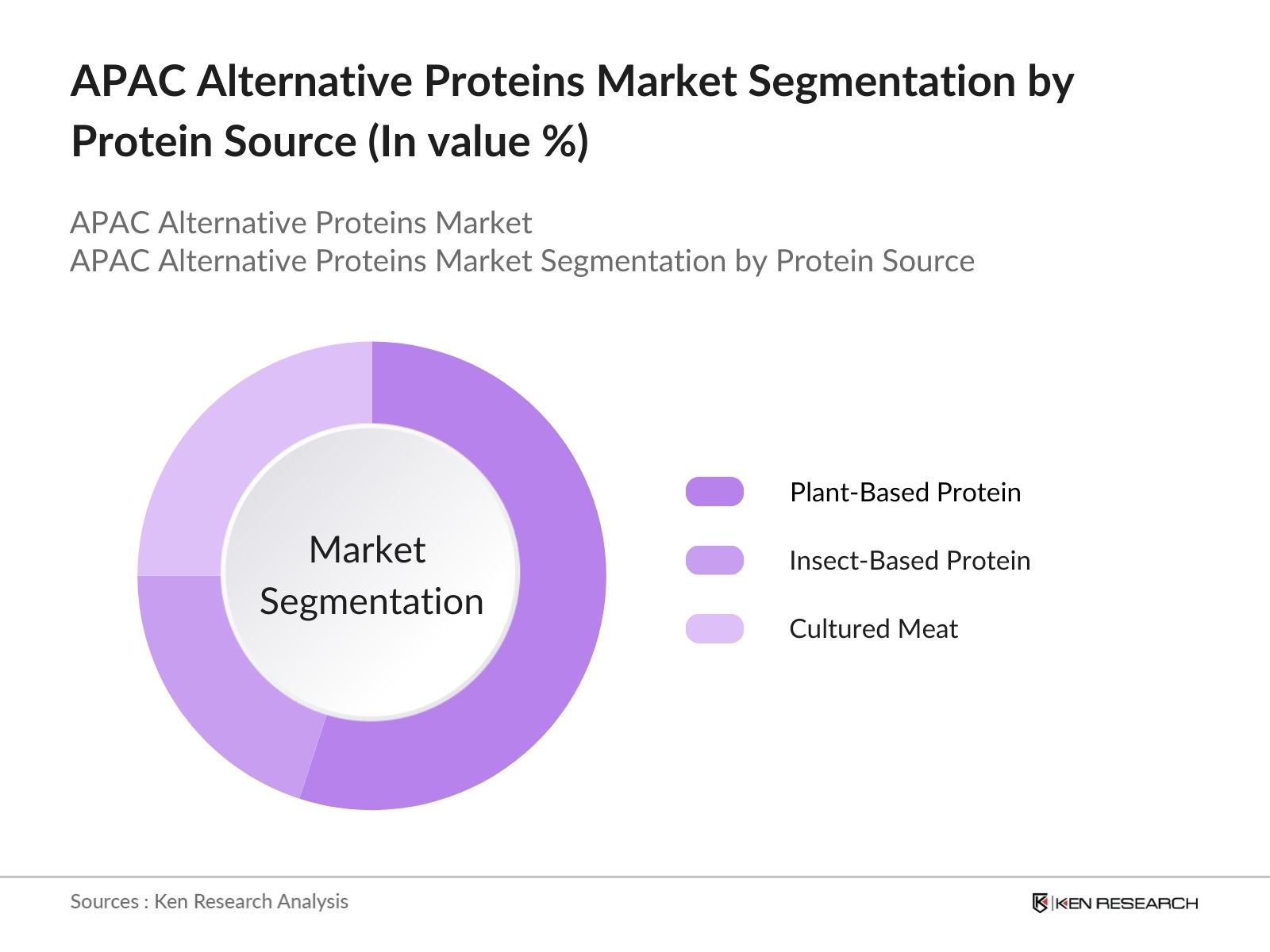
- By Protein Source: The market is segmented by protein source into plant-based protein, insect-based protein, and cultured meat. Plant-based protein dominates the market due to its widespread acceptance, affordability, and availability. Products like soy, pea, and wheat protein are commonly used in various food products, from plant-based burgers to dairy alternatives. Insect-based protein is gaining momentum, especially in Southeast Asia, where insects are traditionally consumed as a food source. Cultured meat, although in the nascent stage, is anticipated to grow substantially, particularly in countries like Singapore, which has already approved the sale of lab-grown meat.
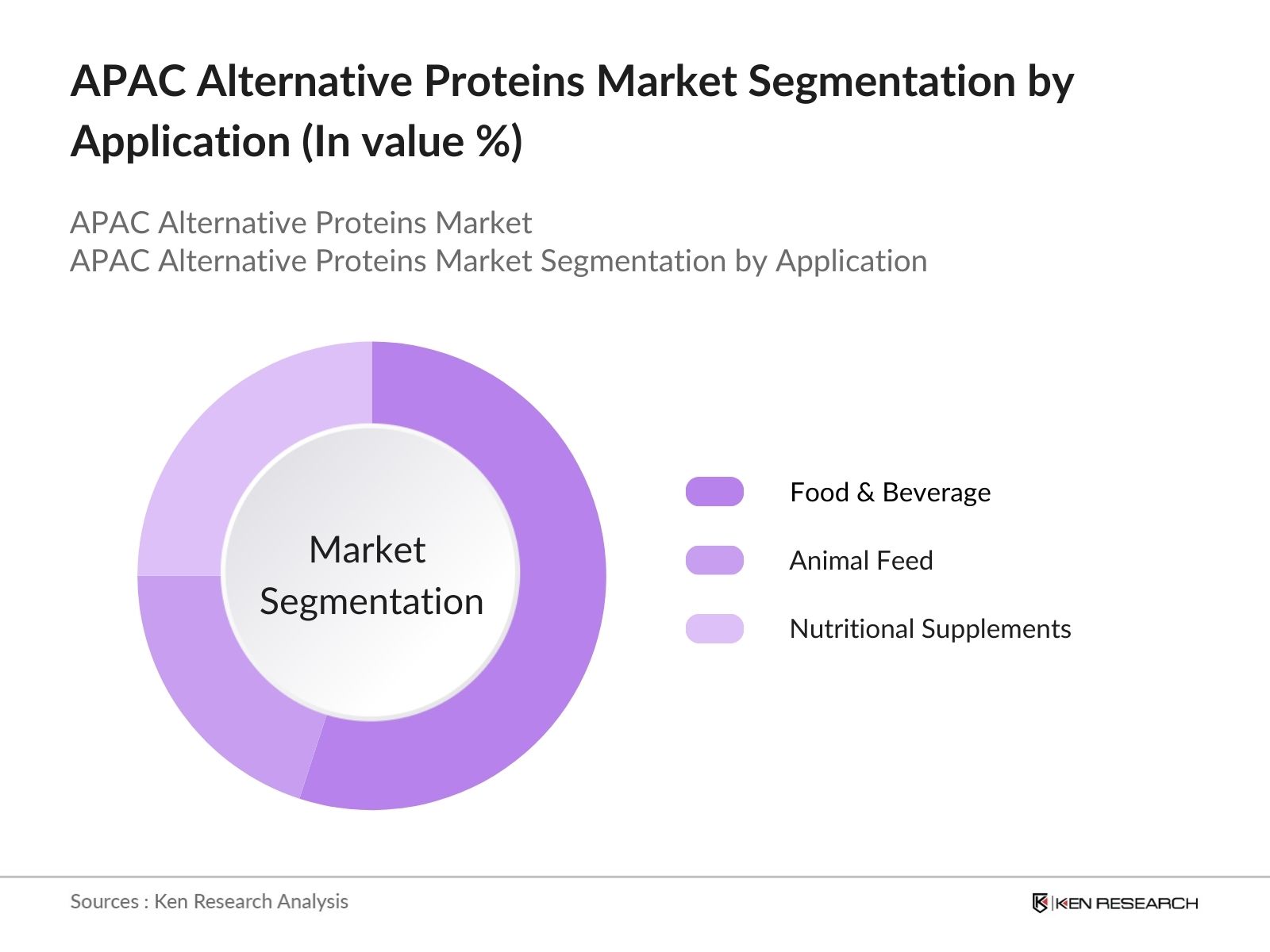
- By Application: The Market is further segmented by application into food and beverage, animal feed, and nutritional supplements. The food and beverage sector represents the largest segment, driven by the increasing popularity of meat substitutes and dairy alternatives. The demand for alternative proteins in animal feed is also on the rise, particularly as livestock producers seek to improve sustainability in their operations. Nutritional supplements that incorporate alternative proteins, such as protein powders and bars, are gaining popularity among health-conscious consumers looking for plant-based or eco-friendly options.
APAC Alternative Proteins Market Competitive Landscape
The APAC Alternative Proteins Market is highly competitive, with both global and regional players focusing on innovation and sustainability. Leading companies such as Beyond Meat, Impossible Foods, and Nestl are investing in R&D to enhance the taste, texture, and nutritional profile of alternative protein products. Additionally, regional companies like Zhenmeat in China and Next Meats in Japan are rapidly gaining market share by catering to local tastes and preferences.
|
Company Name |
Establishment Year |
Headquarters |
Key Products |
Revenue (2023) |
Major Partnerships |
Focus Markets |
|
Beyond Meat |
2009 |
Los Angeles, USA |
||||
|
Impossible Foods |
2011 |
Redwood City, USA |
||||
|
Zhenmeat |
2018 |
Beijing, China |
||||
|
Next Meats |
2017 |
Tokyo, Japan |
||||
|
Eat Just |
2011 |
San Francisco, USA |
APAC Alternative Proteins Industry Analysis
Growth Drivers
- Rising Environmental Concerns: With the food sector being a key contributor to greenhouse gas emissions, the environmental impact of traditional meat production is pushing consumers and governments to explore alternative proteins. According to the Food and Agriculture Organization, the livestock industry contributes 11% of global greenhouse gas emissions, and APAC is responsible for a portion of meat consumption. Governments in APAC are promoting sustainable food systems, with countries like Singapore investing in clean and alternative protein production. In 2022, Singapore allocated over USD 55 million to food sustainability research, focusing on lab-grown and plant-based alternatives.
- Rising Consumer Demand for Plant-Based Proteins: Consumer demand for plant-based proteins in the APAC region is rising due to health awareness and lifestyle changes. In 2023, countries like China and Japan saw a surge in plant-based alternatives consumption. The increasing middle-class population in APAC, which grew to over 2.1 billion in 2022, is playing a role in driving this demand. Japan and South Korea have also seen growth in plant-based meat purchases, driven by a portion of urban populations that are looking for healthier and environmentally friendly options. Government bodies like the Ministry of Agriculture in Singapore are actively promoting plant-based food options as part of a sustainability initiative.
- Health-Conscious Consumer Trends: Health-conscious consumers in APAC are increasingly turning to alternative proteins due to their perceived health benefits, including lower fat content and higher nutritional value. In 2023, Chinas health-driven food market reached all-time high as a result of growth of proteins market in the region. Consumers are shifting away from red meat due to concerns about cholesterol and heart disease, particularly in countries like Australia and New Zealand. This shift is encouraging companies to innovate with plant-based and cultured meats, supported by government initiatives that promote public health.
Market Challenges
- High Production Costs: Cultured meat and fermentation-based alternatives require investment in bioreactors, cell culture technologies, and scale-up processes. In APAC, production costs remain a major hurdle, with cultured meat still costing several hundred dollars per kilogram in 2023. The high cost is further exacerbated by expensive biotechnological equipment, particularly in countries like Japan, where imports of specialized equipment are taxed heavily. Despite government support, such as Singapores substantial investment in lowering production costs, profitability remains a challenge for most startups in this sector.
- Supply Chain Constraints: The alternative proteins market in APAC faces supply chain constraints, particularly in the distribution of raw materials needed for plant-based and lab-grown foods. In 2022, APACs food production and distribution systems struggled with disruptions due to geopolitical tensions and the lingering effects of COVID-19. Countries like Indonesia, which rely on imports for certain plant-based raw materials, have experienced delays and increased transportation costs, making the supply chain less efficient. These constraints are affecting product availability and increasing the overall cost of alternative proteins in the region.
APAC Alternative Proteins Market Future Outlook
The APAC Alternative Proteins Market is expected to witness robust growth over the next five years, driven by rising consumer awareness of sustainability, health benefits, and ethical considerations. Government support in the form of favorable regulations and investments in R&D will further fuel the markets expansion. The growing adoption of alternative proteins in food and beverage, as well as in animal feed, will create opportunities for both established players and startups in the region.
Future Market Opportunities
- Expansion into Emerging APAC Markets: India and Southeast Asia present growth opportunities for the alternative proteins market due to their large populations and changing consumer preferences. In India, where the population surpassed 1.4 billion in 2023, there is a growing middle class that is increasingly interested in plant-based products. Southeast Asian countries like Thailand and Indonesia have also seen rising consumer interest in alternative proteins due to increasing health awareness. Governments in these regions are encouraging investment in food innovation, with India announcing a substantial investment to boost its plant-based food sector in 2024.
- Partnerships and Collaborations in R&D: Collaborations between government agencies, research institutions, and private companies are driving innovation in the alternative proteins market in APAC. In 2023, South Korea's Ministry of Agriculture, Food, and Rural Affairs launched a public-private partnership aimed at developing affordable cultured meat technologies. Similarly, Singapore has created a Food Tech Research & Development Hub, which has attracted international companies to collaborate with local startups. These partnerships are essential for reducing the cost of production and accelerating the commercialization of alternative proteins in the region.
Scope of the Report
|
By Protein Source |
Plant-Based Protein Insect-Based Protein Cultured Meat Fermentation-Based Protein |
|
By Application |
Food & Beverage Animal Feed Nutritional Supplements Other (Pharmaceutical, Cosmetics) |
|
By Distribution Channel |
Online Retail Supermarkets & Hypermarkets Specialty Stores Foodservice |
|
By End-User |
Consumers Food Manufacturers Pet Food Manufacturers |
|
By Country |
China Japan India Australia Rest of the APAC |
Products
Key Target Audience
Investors and Venture Capitalist Firms
Government and Regulatory Bodies (Singapore Food Agency, China Food and Drug Administration)
Food and Beverage Manufacturers
Livestock and Animal Feed Producers
Nutritional Supplement Producers
Retailers (Supermarkets, Hypermarkets, Specialty Stores)
Foodservice Providers
Sustainability and Environmental Agencies
Banks and Financial Institutions
Companies
Major Players Mentioned in the Report
Beyond Meat
Impossible Foods
Zhenmeat
Next Meats
Eat Just
V2food
Green Monday
Perfect Day
Meatable
Shiok Meats
Future Meat Technologies
Avant Meats
Turtletree Labs
InnovoPro
Nestl
Table of Contents
01 APAC Alternative Proteins Market Overview
1.1. Definition and Scope
1.2. Market Taxonomy
1.3. Key Drivers of Growth (Consumer Awareness, Sustainability Trends, Ethical Consumption)
1.4. Market Segmentation Overview
02 APAC Alternative Proteins Market Size (In USD Mn)
2.1. Historical Market Size
2.2. Year-On-Year Growth Analysis
2.3. Key Market Developments (Product Launches, Government Support)
03 APAC Alternative Proteins Market Analysis
3.1. Growth Drivers
3.1.1. Rising Consumer Demand for Plant-Based Proteins
3.1.2. Sustainability and Environmental Concerns
3.1.3. Health-Conscious Consumer Trends
3.1.4. Investments in R&D and Innovation
3.2. Market Challenges
3.2.1. High Production Costs (Cultured Meat, Fermentation-Based Alternatives)
3.2.2. Supply Chain Constraints
3.2.3. Consumer Acceptance and Preference (Traditional Diet Preferences)
3.2.4. Regulatory Challenges
3.3. Opportunities
3.3.1. Expansion into Emerging APAC Markets (India, Southeast Asia)
3.3.2. Partnerships and Collaborations in R&D
3.3.3. Government Support and Investment Initiatives
3.3.4. Development of Insect-Based Protein as a Mainstream Option
3.4. Trends
3.4.1. Growth in Plant-Based Alternatives
3.4.2. Cultured Meat Advancements (Singapores Regulatory Leadership)
3.4.3. Fermentation-Based Protein Innovations
3.4.4. Integration of Alternative Proteins in Mainstream Diets
04 APAC Alternative Proteins Market Regulatory Framework
4.1. Government Regulations for Alternative Proteins (Food Safety, Labeling Requirements)
4.2. Environmental and Sustainability Certifications
4.3. Food Safety and Hygiene Standards (Cultured Meat)
4.4. Approval Processes for Novel Foods
05 APAC Alternative Proteins Market Segmentation
5.1. By Protein Source
5.1.1. Plant-Based Protein (Soy, Pea, Wheat)
5.1.2. Insect-Based Protein
5.1.3. Cultured Meat
5.1.4. Fermentation-Based Protein
5.2. By Application
5.2.1. Food & Beverage (Meat Alternatives, Dairy Alternatives)
5.2.2. Animal Feed (Pet Food, Livestock Feed)
5.2.3. Nutritional Supplements (Protein Powders, Bars)
5.2.4. Other (Pharmaceutical, Cosmetics)
5.3. By Distribution Channel
5.3.1. Online Retail
5.3.2. Supermarkets & Hypermarkets
5.3.3. Specialty Stores
5.3.4. Foodservice
5.4. By Region
5.4.1. China
5.4.2. Japan
5.4.3. India
5.4.4. Australia & New Zealand
5.4.5. Southeast Asia
5.5. By End-User
5.5.1. Consumers
5.5.2. Food Manufacturers
5.5.3. Pet Food Manufacturers
06 APAC Alternative Proteins Market Competitive Analysis
6.1. Detailed Profiles of Major Companies
6.1.1. Beyond Meat
6.1.2. Impossible Foods
6.1.3. Nestl
6.1.4. Zhenmeat
6.1.5. Next Meats
6.1.6. Eat Just
6.1.7. V2food
6.1.8. Green Monday
6.1.9. Perfect Day
6.1.10. Meatable
6.1.11. Shiok Meats
6.1.12. Future Meat Technologies
6.1.13. Avant Meats
6.1.14. Turtletree Labs
6.1.15. InnovoPro
6.2. Cross Comparison Parameters (R&D Investments, Product Portfolio, Regional Presence, Strategic Partnerships)
6.3. Market Share Analysis
6.4. Strategic Initiatives (Partnerships, Joint Ventures, R&D Investments)
6.5. Mergers & Acquisitions
6.6. Investment Analysis
6.7. Government Funding and Grants
07 APAC Alternative Proteins Future Market Size (In USD Mn)
7.1. Future Market Size Projections
7.2. Key Factors Driving Future Market Growth (Consumer Preferences, Technology Advancements)
08 APAC Alternative Proteins Future Market Segmentation
8.1. By Protein Source (Plant-Based, Insect-Based, Cultured, Fermentation-Based)
8.2. By Application (Food & Beverage, Animal Feed, Nutritional Supplements)
8.3. By Distribution Channel (Online Retail, Supermarkets, Specialty Stores)
8.4. By Region (China, Japan, India, Southeast Asia)
8.5. By End-User (Consumers, Manufacturers)
09 APAC Alternative Proteins Market Analysts Recommendations
9.1. TAM/SAM/SOM Analysis
9.2. Consumer Demographics Analysis
9.3. Strategic Expansion Opportunities
9.4. White Space Analysis
Research Methodology
Step 1: Identification of Key Variables
The initial phase involves constructing a comprehensive ecosystem of stakeholders within the APAC Alternative Proteins Market. This involves extensive desk research, utilizing both secondary data and proprietary databases to gather detailed insights into industry-level metrics. The primary objective is to identify critical variables influencing market dynamics, such as sustainability trends, consumer health preferences, and regulatory frameworks.
Step 2: Market Analysis and Construction
In this phase, historical data for the APAC Alternative Proteins Market is compiled and analyzed. The analysis focuses on market penetration by product type and application, as well as an evaluation of consumption trends and revenue generation across the region. This stage also involves assessing market saturation and identifying high-growth sub-segments within the protein source and application categories.
Step 3: Hypothesis Validation and Expert Consultation
Industry hypotheses are developed and validated through interviews with industry experts using computer-assisted telephone interviews (CATIs). These consultations provide key insights into operational and financial aspects of alternative protein production, helping refine market estimates and predictions. Expert opinions further validate emerging trends and strategic market moves.
Step 4: Research Synthesis and Final Output
The final phase includes engagement with manufacturers of alternative proteins across the APAC region to collect detailed data on product segmentation, market performance, and consumer preferences. This information serves to corroborate and complement the bottom-up analysis, ensuring the research findings are both accurate and comprehensive.
Frequently Asked Questions
01. How big is the APAC Alternative Proteins Market?
The APAC Alternative Proteins Market is valued at USD 78 Tillion, driven by rising consumer demand for sustainable and healthier food options. The market has witnessed strong growth due to innovations in plant-based, cultured, and insect-based proteins.
02. What are the challenges in the APAC Alternative Proteins Market?
Challenges in the APAC Alternative Proteins market include high production costs, particularly for cultured meat, and the need for consumer acceptance, especially in countries where traditional diets dominate. Regulatory hurdles also present barriers to market entry in some regions.
03. Who are the major players in the APAC Alternative Proteins Market?
Key players in the APAC Alternative Proteins market include Beyond Meat, Impossible Foods, Zhenmeat, Next Meats, and Eat Just. These companies are leading the market through strong innovation, partnerships, and sustainability initiatives.
04. What are the growth drivers of the APAC Alternative Proteins Market?
The APAC Alternative Proteins market is driven by increasing consumer awareness of sustainability, health consciousness, and government support for alternative proteins. Technological advancements in food production, particularly cultured meat, are also key drivers.
Why Buy From Us?

What makes us stand out is that our consultants follows Robust, Refine and Result (RRR) methodology. i.e. Robust for clear definitions, approaches and sanity checking, Refine for differentiating respondents facts and opinions and Result for presenting data with story

We have set a benchmark in the industry by offering our clients with syndicated and customized market research reports featuring coverage of entire market as well as meticulous research and analyst insights.

While we don't replace traditional research, we flip the method upside down. Our dual approach of Top Bottom & Bottom Top ensures quality deliverable by not just verifying company fundamentals but also looking at the sector and macroeconomic factors.

With one step in the future, our research team constantly tries to show you the bigger picture. We help with some of the tough questions you may encounter along the way: How is the industry positioned? Best marketing channel? KPI's of competitors? By aligning every element, we help maximize success.

Our report gives you instant access to the answers and sources that other companies might choose to hide. We elaborate each steps of research methodology we have used and showcase you the sample size to earn your trust.

If you need any support, we are here! We pride ourselves on universe strength, data quality, and quick, friendly, and professional service.