















APAC BIM Market Outlook to 2030
Region:Asia
Author(s):Shubham Kashyap
Product Code:KROD3548
November 2024
89
About the Report
APAC BIM Market Overview
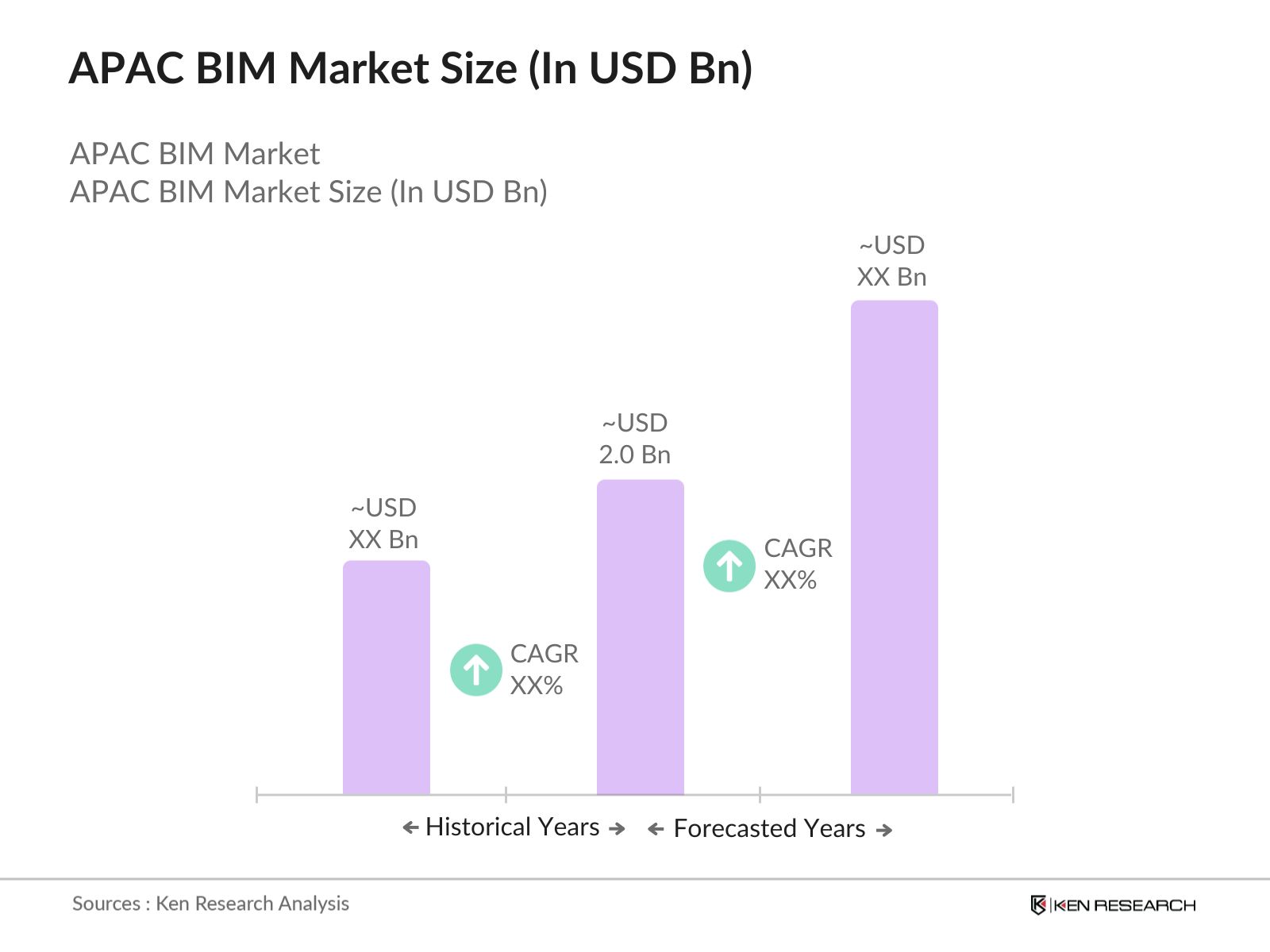
- The APAC BIM (Building Information Modeling) market is currently experiencing growth, reaching a market size of USD 2.0 Bn, driven by the increasing adoption of digital construction technologies across the region. BIM technology is transforming the construction industry by enabling better planning, design, and management of building projects. The market's expansion is supported by government initiatives promoting the use of BIM for infrastructure projects and stringent regulations requiring digital project management to improve efficiency, reduce costs, and enhance sustainability.
- Countries like China, Japan, and South Korea are at the forefront of BIM adoption, thanks to their robust construction sectors and government mandates. In China, the government has made BIM a mandatory requirement for major public infrastructure projects, further accelerating market growth. South Korea is also pushing for the widespread use of BIM, particularly in public infrastructure and large-scale urban development projects.
- In Southeast Asia, markets such as Singapore, Malaysia, and Indonesia are witnessing a surge in BIM adoption, driven by the construction of smart cities and infrastructure. Singapore's Building and Construction Authority (BCA) has been actively promoting BIM through its "BIM Roadmap" to drive the construction industry towards greater digitalization. Meanwhile, Malaysia's construction industry is increasingly using BIM to comply with international standards and improve project coordination.
APAC BIM Market Segmentation
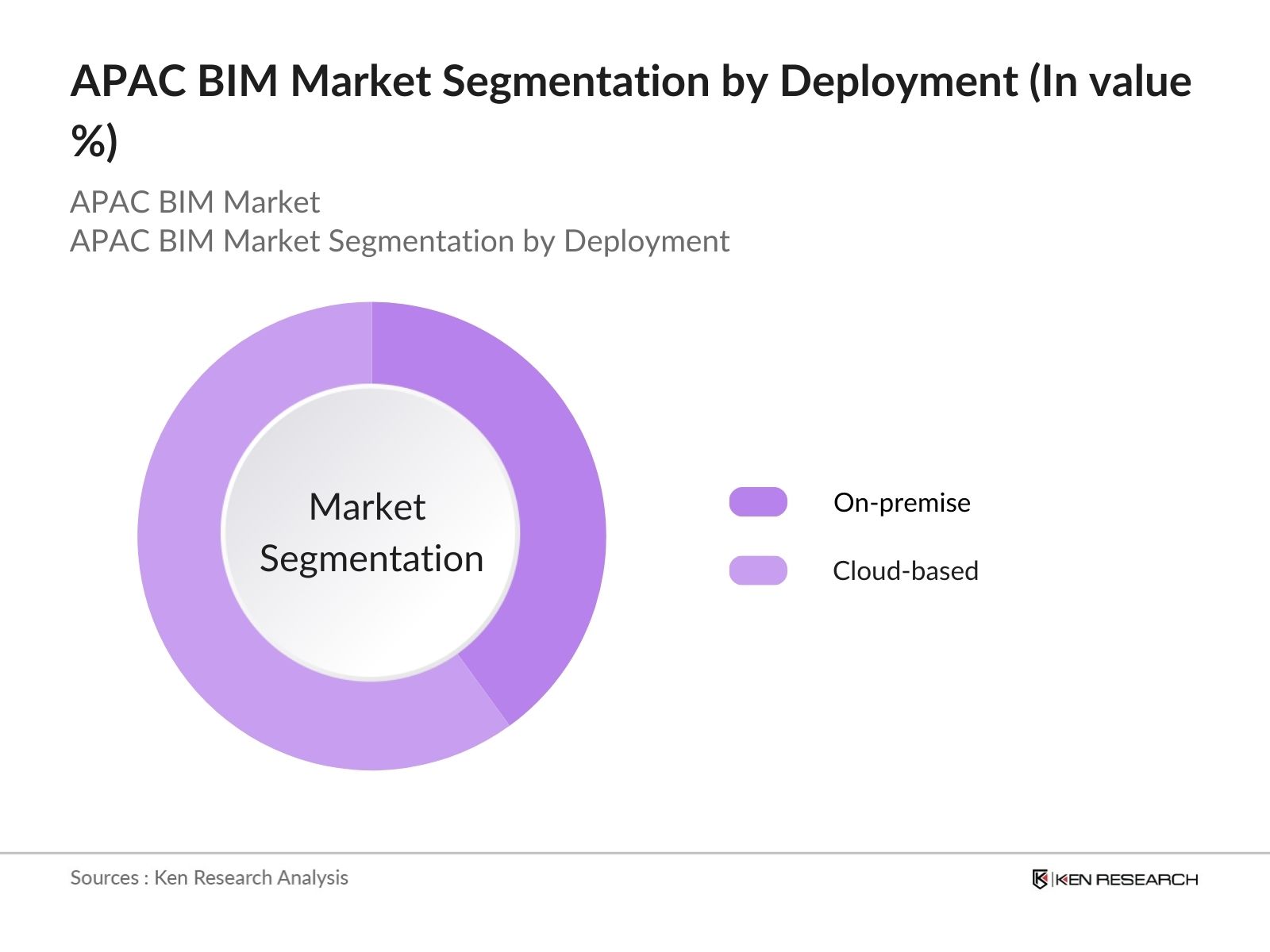
- By Deployment Type: The market is segmented by deployment type into on-premises and cloud-based solutions. On-premises BIM solutions are favored by large enterprises and government entities for major infrastructure projects where data security and control are paramount. However, cloud-based BIM solutions are gaining popularity due to their scalability, real-time collaboration capabilities, and cost-effectiveness. Cloud BIM is increasingly used by small and medium-sized construction firms across the region, particularly in countries like Vietnam and Thailand, where cloud infrastructure is growing rapidly.
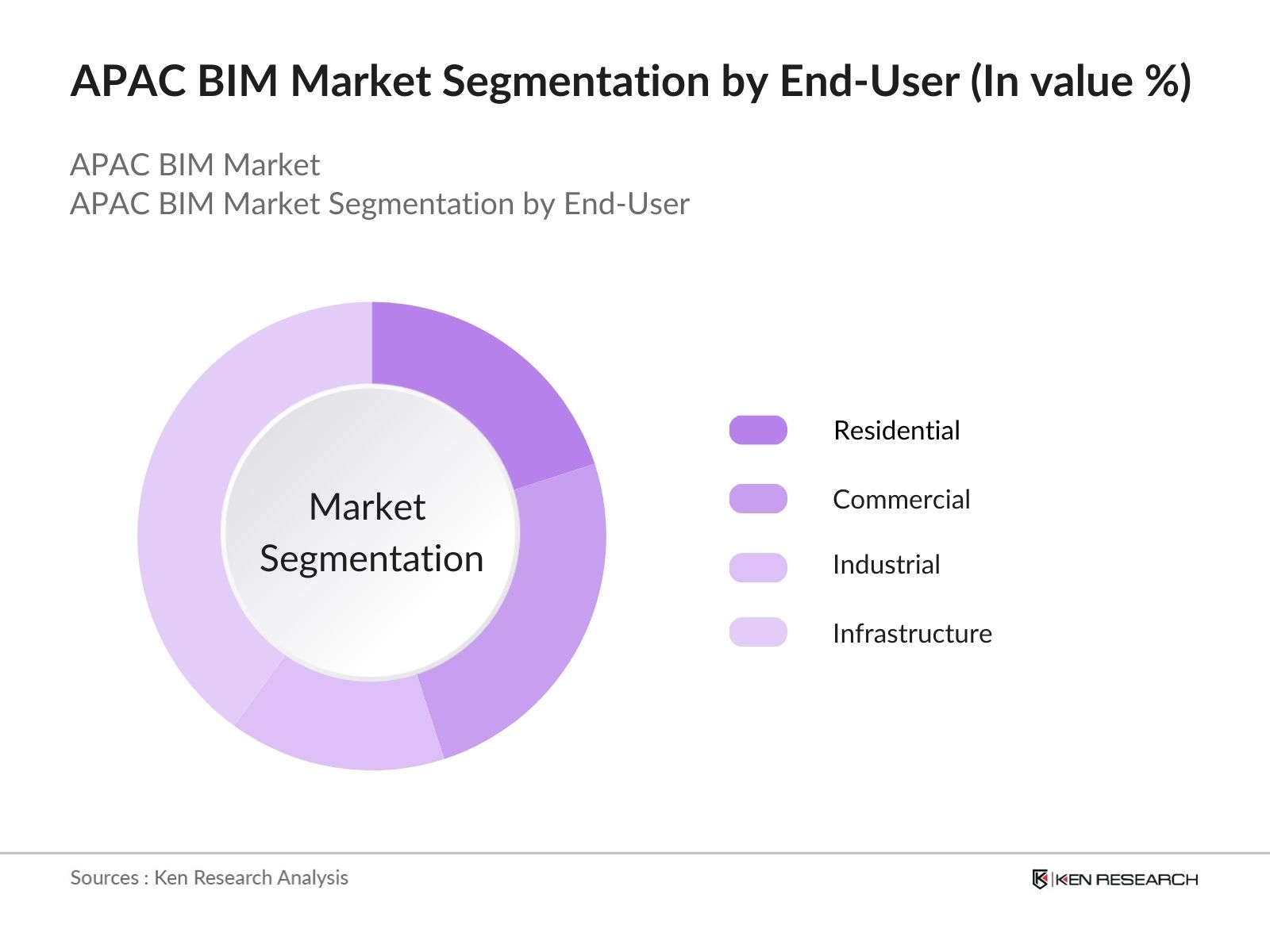
- By End-User: The market is further segmented by end-user industry into residential, commercial, industrial, and infrastructure construction. The infrastructure segment is the largest, driven by government investments in smart cities and public infrastructure projects. Residential and commercial sectors are also witnessing increased BIM adoption, particularly in countries like Japan and South Korea, where urbanization and real estate development are on the rise.
APAC BIM Market Competitive Landscape
The APAC BIM market is highly competitive, with both international and regional players striving to capture market share through the development of advanced BIM tools and software. Major companies like Autodesk, Bentley Systems, and Nemetschek Group dominate the market with their comprehensive BIM platforms, offering solutions for design, construction, and project management.
|
Company Name |
Establishment Year |
Headquarters |
Key BIM Products |
Revenue (2023) |
R&D Investment |
Key Projects |
Global Presence |
Partnerships |
|
Autodesk Inc. |
1982 |
San Rafael, USA |
Revit, BIM 360 |
|||||
|
Bentley Systems |
1984 |
Exton, USA |
OpenBuildings, SYNCHRO |
|||||
|
Nemetschek Group |
1963 |
Munich, Germany |
Allplan, Bluebeam |
|||||
|
Trimble Inc. |
1978 |
Westminster, USA |
Tekla, Trimble Connect |
|||||
|
Dassault Systmes |
1981 |
Vlizy-Villacoublay, FR |
CATIA, SolidWorks |
APAC BIM Industry Analysis
Growth Drivers
- Government Initiatives and Mandates: Governments across the Asia-Pacific region have been increasingly adopting Building Information Modeling (BIM) mandates in public infrastructure projects to improve construction efficiencies. For instance, countries like Singapore, South Korea, and China require the use of BIM for large-scale public projects, particularly those exceeding a certain budget threshold. In 2024, China's construction sector is expected to remain robust, backed by government-led urban infrastructure initiatives valued at USD 4 trillion. This demand is pushing public projects to adopt BIM to ensure accurate designs and minimize delays, boosting the market's relevance.
- Rising Urbanization and Smart Cities Development: Rising urbanization in Asia-Pacific, coupled with smart city development, is driving the demand for advanced construction technologies like BIM. Asia is home to over 2.3 billion urban residents, and this number is steadily increasing, resulting in more infrastructure projects. Governments in countries like India and China are launching smart city projects, which prioritize efficiency and sustainability. Indias "Smart Cities Mission" covers over 100 cities, with USD 30 billion allocated towards urban infrastructure, promoting BIM adoption to streamline project workflows.
- Cost Efficiency and Project Management: BIM improves project management and reduces delays in construction by detecting errors early in the design phase. This technology minimizes rework and optimizes resource allocation. In 2024, construction project delays in the Asia-Pacific region account for 25% of cost overruns due to poor planning and mismanagement. BIM helps lower these delays by up to 40%, contributing to a surge in its adoption, especially in large projects where timely completion is critical. The cost of errors in megaprojects like Chinas $200 billion Greater Bay Area is pushing contractors to invest in BIM tools.
Market Challenges
- High Implementation Costs: The adoption of BIM faces challenges due to high implementation costs, including software licensing, training for professionals, and the necessary hardware infrastructure. In developing countries like Vietnam and Indonesia, construction companies face higher costs for BIM adoption compared to traditional methods. These costs limit the use of BIM technology, especially among small and medium-sized firms. The financial burden of implementing BIM can act as a barrier to widespread adoption, making it more difficult for companies to justify the transition from traditional construction methods to BIM systems in the Asia-Pacific market.
- Lack of Standardization: A challenge in the BIM market is the lack of standardized regulations across Asia-Pacific. Countries like Japan and Australia have well-established BIM guidelines, while emerging markets like Vietnam and the Philippines lack a unified framework. This inconsistency hampers collaboration on cross-border projects. For instance, in 2024, international contractors working on large infrastructure projects in the region face compliance issues due to differing BIM standards, resulting in higher project costs and delays. This regulatory fragmentation poses a hurdle to the seamless adoption of BIM
APAC BIM Market Future Outlook
The APAC BIM market is expected to witness robust growth over the next five years, driven by increased government support, the rise of smart city projects, and advancements in digital construction technologies. As more countries in the region mandate the use of BIM for public and private infrastructure projects, the market will continue to expand, with growing opportunities in emerging economies like Vietnam, Thailand, and Indonesia.
Future Market Opportunities
- Expansion into Emerging Markets: Emerging markets such as Vietnam, Thailand, and Indonesia present growth opportunities for BIM solutions. Vietnams construction sector is projected to grow at a rate of over $60 billion in the next five years, with infrastructure projects dominating the pipeline. These countries are beginning to recognize the efficiency of BIM in managing large infrastructure projects, and the government-backed initiatives are opening up opportunities for the expansion of BIM adoption. In Thailand, the government is focusing on infrastructure development worth over $45 billion by 2025, pushing demand for advanced BIM tools.
- Integration with Advanced Technologies: The integration of BIM with advanced technologies such as AI, ML, and IoT offers growth potential for the APAC market. By leveraging these technologies, construction firms can enhance project management, reduce risks, and optimize resource allocation. The adoption of AI-driven BIM tools is expected to accelerate in countries like Japan and South Korea, where the construction industry is increasingly focused on innovation and sustainability.
Scope of the Report
|
By Deployment Type |
On-premises Cloud-based |
|
By End-User Industry |
Residential Commercial Industrial Infrastructure |
|
By Project Type |
Small-Scale Projects Large-Scale Projects |
|
By Application |
Architecture MEP Structural Engineering Construction Management |
|
By Country |
China Japan South Korea Singapore India Rest of the APAC |
Products
Key Target Audience
Construction Companies
Infrastructure Development Agencies
Government and Regulatory Bodies (Ministry of Housing and Urban Development, BCA Singapore)
Architects and Engineers
Technology Providers
Investors and Venture Capitalist Firms
Public and Private Infrastructure Planners
Smart City Planners
Banks and Financial Institutions
Companies
Major Players Mentioned in the Report
Autodesk Inc.
Bentley Systems
Nemetschek Group
Trimble Inc.
Dassault Systmes
Hexagon AB
RIB Software
Asite Solutions
AVEVA Group
Allplan GmbH
Graphisoft SE
Vectorworks, Inc.
Siemens Digital Industries Software
Oracle Corporation
Aconex Ltd.
Table of Contents
1. APAC BIM Market Overview
1.1. Definition and Scope
1.2. Market Taxonomy
1.3. Market Growth Rate
1.4. Market Segmentation Overview
2. APAC BIM Market Size (In USD Bn)
2.1. Historical Market Size
2.2. Year-On-Year Growth Analysis
2.3. Key Market Developments and Milestones
3. APAC BIM Market Analysis
3.1. Growth Drivers
3.1.1. Government Infrastructure Mandates (BIM adoption in public projects)
3.1.2. Rising Urbanization and Smart Cities Development (Demand for efficient construction methods)
3.1.3. Cost Efficiency and Project Management (Reduction in project delays and errors)
3.1.4. Technological Advancements (Integration of BIM with AI, IoT, and machine learning)
3.2. Market Challenges
3.2.1. High Implementation Costs (BIM software, training, and hardware expenses)
3.2.2. Lack of Standardization (Absence of uniform BIM regulations across APAC)
3.2.3. Shortage of Skilled Professionals (Difficulty in operating BIM tools in emerging markets)
3.3. Opportunities
3.3.1. Expansion in Emerging Markets (Vietnam, Thailand, Indonesia)
3.3.2. Integration with Advanced Technologies (AI, IoT, and predictive analytics)
3.3.3. Investment in BIM Infrastructure (Development of BIM-centric projects)
3.4. Trends
3.4.1. Cloud-based BIM Solutions (Increasing use of scalable cloud platforms)
3.4.2. BIM for Sustainability (Green building certifications and energy-efficient designs)
3.4.3. BIM in Prefabrication and Modular Construction (Streamlining off-site construction)
3.5. Government Regulation
3.5.1. National BIM Mandates (Governments requiring BIM for large public projects)
3.5.2. BIM Standards and Certification (Compliance with international BIM standards)
3.5.3. Public-Private Partnerships (Collaborations for BIM adoption)
3.6. SWOT Analysis
3.7. Stakeholder Ecosystem
3.8. Porters Five Forces
3.9. Competitive Ecosystem
4. APAC BIM Market Segmentation
4.1. By Deployment Type (In Value %)
4.1.1. On-premise
4.1.2. Cloud-based
4.2. By End-User Industry (In Value %)
4.2.1. Residential
4.2.2. Commercial
4.2.3. Industrial
4.2.4. Infrastructure
4.3. By Project Type (In Value %)
4.3.1. Small-Scale Projects
4.3.2. Large-Scale Projects
4.4. By Application (In Value %)
4.4.1. Architecture
4.4.2. Mechanical, Electrical, and Plumbing (MEP)
4.4.3. Structural Engineering
4.4.4. Construction Management
4.5. By Country (In Value %)
4.5.1. China
4.5.2. Japan
4.5.3. South Korea
4.5.4. Singapore
4.5.5. India
5. APAC BIM Market Competitive Analysis
5.1. Detailed Profiles of Major Companies
5.1.1. Autodesk Inc.
5.1.2. Bentley Systems
5.1.3. Nemetschek Group
5.1.4. Trimble Inc.
5.1.5. Dassault Systmes
5.1.6. Hexagon AB
5.1.7. RIB Software
5.1.8. Asite Solutions
5.1.9. AVEVA Group
5.1.10. Allplan GmbH
5.1.11. Graphisoft SE
5.1.12. Vectorworks, Inc.
5.1.13. Siemens Digital Industries Software
5.1.14. Oracle Corporation
5.1.15. Aconex Ltd.
5.2. Cross Comparison Parameters (Revenue, Employees, Headquarters, Inception Year, R&D Investment, Market Share, Global Presence, Key Partnerships)
5.3. Market Share Analysis
5.4. Strategic Initiatives
5.5. Mergers and Acquisitions
5.6. Investment Analysis
5.7. Venture Capital Funding
5.8. Government Grants
5.9. Private Equity Investments
6. APAC BIM Market Regulatory Framework
6.1. BIM Compliance Standards
6.2. Certification Processes (BIM Level 2 and Level 3)
6.3. BIM Implementation Guidelines
6.4. Environmental Standards for Sustainable Construction
7. APAC BIM Future Market Size (In USD Bn)
7.1. Future Market Size Projections
7.2. Key Factors Driving Future Market Growth
8. APAC BIM Future Market Segmentation
8.1. By Deployment Type (In Value %)
8.2. By End-User Industry (In Value %)
8.3. By Project Type (In Value %)
8.4. By Application (In Value %)
8.5. By Country (In Value %)
9. APAC BIM Market Analysts Recommendations
9.1. TAM/SAM/SOM Analysis
9.2. Customer Cohort Analysis
9.3. Marketing Initiatives
9.4. White Space Opportunity Analysis
Research Methodology
Step 1: Identification of Key Variables
The initial phase involves constructing an ecosystem map encompassing all major stakeholders within the APAC BIM Market. This step is underpinned by extensive desk research, utilizing a combination of secondary and proprietary databases to gather comprehensive industry-level information. The primary objective is to identify and define the critical variables that influence market dynamics.
Step 2: Market Analysis and Construction
In this phase, we will compile and analyze historical data pertaining to the APAC BIM Market. This includes assessing market penetration, the ratio of software solutions to project management providers, and the resultant revenue generation. Furthermore, an evaluation of software performance statistics will be conducted to ensure the reliability and accuracy of the revenue estimates.
Step 3: Hypothesis Validation and Expert Consultation
Market hypotheses will be developed and subsequently validated through computer-assisted telephone interviews (CATIs) with industry experts representing a diverse array of companies. These consultations will provide valuable operational and financial insights directly from industry practitioners, which will be instrumental in refining and corroborating the market data.
Step 4: Research Synthesis and Final Output
The final phase involves direct engagement with multiple BIM software providers to acquire detailed insights into product segments, sales performance, consumer preferences, and other pertinent factors. This interaction will serve to verify and complement the statistics derived from the bottom-up approach, thereby ensuring a comprehensive, accurate, and validated analysis of the APAC BIM Market.
Frequently Asked Questions
01. How big is the APAC BIM Market?
The APAC BIM market is valued at USD 2.0 billion, driven by government mandates, the expansion of smart city projects, and increasing adoption of digital construction solutions in key countries like China, Japan, and Singapore.
02. What are the challenges in the APAC BIM Market?
Challenges in the APAC BIM market include high implementation costs, lack of standardized regulations across countries, and a shortage of skilled professionals to operate BIM software, especially in developing markets.
03. Who are the major players in the APAC BIM Market?
Key players in the APAC BIM market include Autodesk Inc., Bentley Systems, Nemetschek Group, Trimble Inc., and Dassault Systmes, which dominate due to their strong product offerings, global presence, and partnerships with key construction firms.
04. What are the growth drivers of the APAC BIM Market?
The APAC BIM market is propelled by government initiatives mandating BIM use in public projects, advancements in digital construction technologies, and the rising demand for smart and efficient project management solutions.
Why Buy From Us?

What makes us stand out is that our consultants follows Robust, Refine and Result (RRR) methodology. i.e. Robust for clear definitions, approaches and sanity checking, Refine for differentiating respondents facts and opinions and Result for presenting data with story

We have set a benchmark in the industry by offering our clients with syndicated and customized market research reports featuring coverage of entire market as well as meticulous research and analyst insights.

While we don't replace traditional research, we flip the method upside down. Our dual approach of Top Bottom & Bottom Top ensures quality deliverable by not just verifying company fundamentals but also looking at the sector and macroeconomic factors.

With one step in the future, our research team constantly tries to show you the bigger picture. We help with some of the tough questions you may encounter along the way: How is the industry positioned? Best marketing channel? KPI's of competitors? By aligning every element, we help maximize success.

Our report gives you instant access to the answers and sources that other companies might choose to hide. We elaborate each steps of research methodology we have used and showcase you the sample size to earn your trust.

If you need any support, we are here! We pride ourselves on universe strength, data quality, and quick, friendly, and professional service.