
APAC Building Information Modeling Market Outlook to 2030
Region:Asia
Author(s):Paribhasha Tiwari
Product Code:KROD4617
December 2024
90
About the Report
APAC Building Information Modeling (BIM) Market Overview
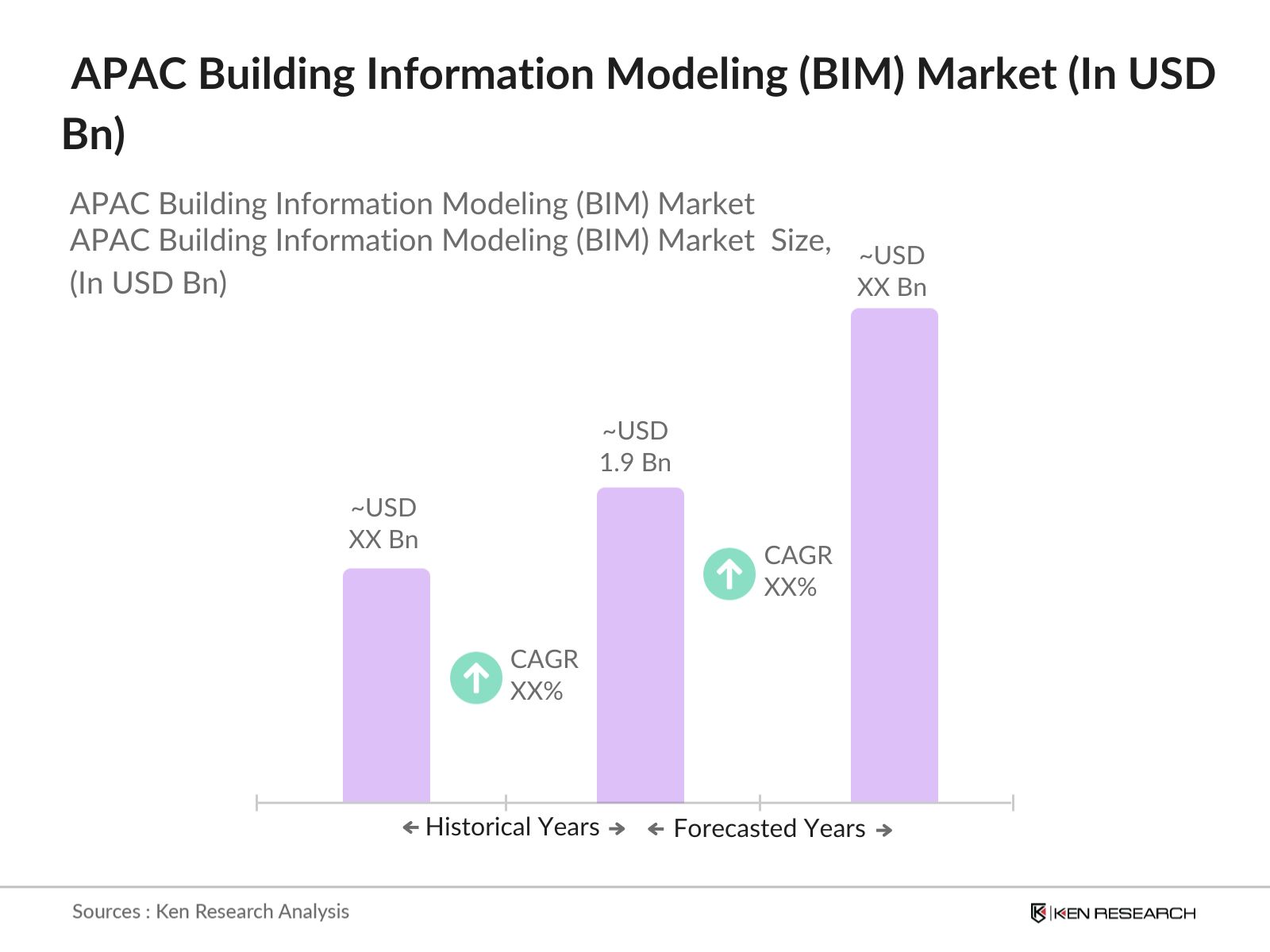
- The APAC Building Information Modeling (BIM) market is valued at USD 1.9 billion, based on a five-year historical analysis. This growth is driven by the increasing digitalization of the construction industry, growing investments in infrastructure projects, and government mandates promoting the use of BIM technology. Countries such as China and Japan have been pivotal in driving the adoption of BIM in the region due to their substantial infrastructure projects and initiatives towards smart cities.
- Dominant markets like China, Japan, and South Korea lead the BIM market because of their advanced technological ecosystems and government policies mandating the use of BIM in public projects. China's dominance stems from its aggressive urbanization and construction projects. Meanwhile, Japan and South Korea benefit from a high degree of digital adoption and integration of BIM within their large-scale projects, including transportation, smart cities, and large commercial constructions.
- The Singaporean government has been at the forefront of promoting BIM adoption through its Smart Nation initiative, which integrates digital technologies in public infrastructure. By 2023, the Building and Construction Authority (BCA) had mandated the use of BIM in all public-sector projects, with the aim of creating smarter, more sustainable urban developments. This initiative is supported by a $20 billion fund for digital construction tools and infrastructure improvements, positioning Singapore as a leader in the regions BIM market.
APAC Building Information Modeling (BIM) Market Segmentation
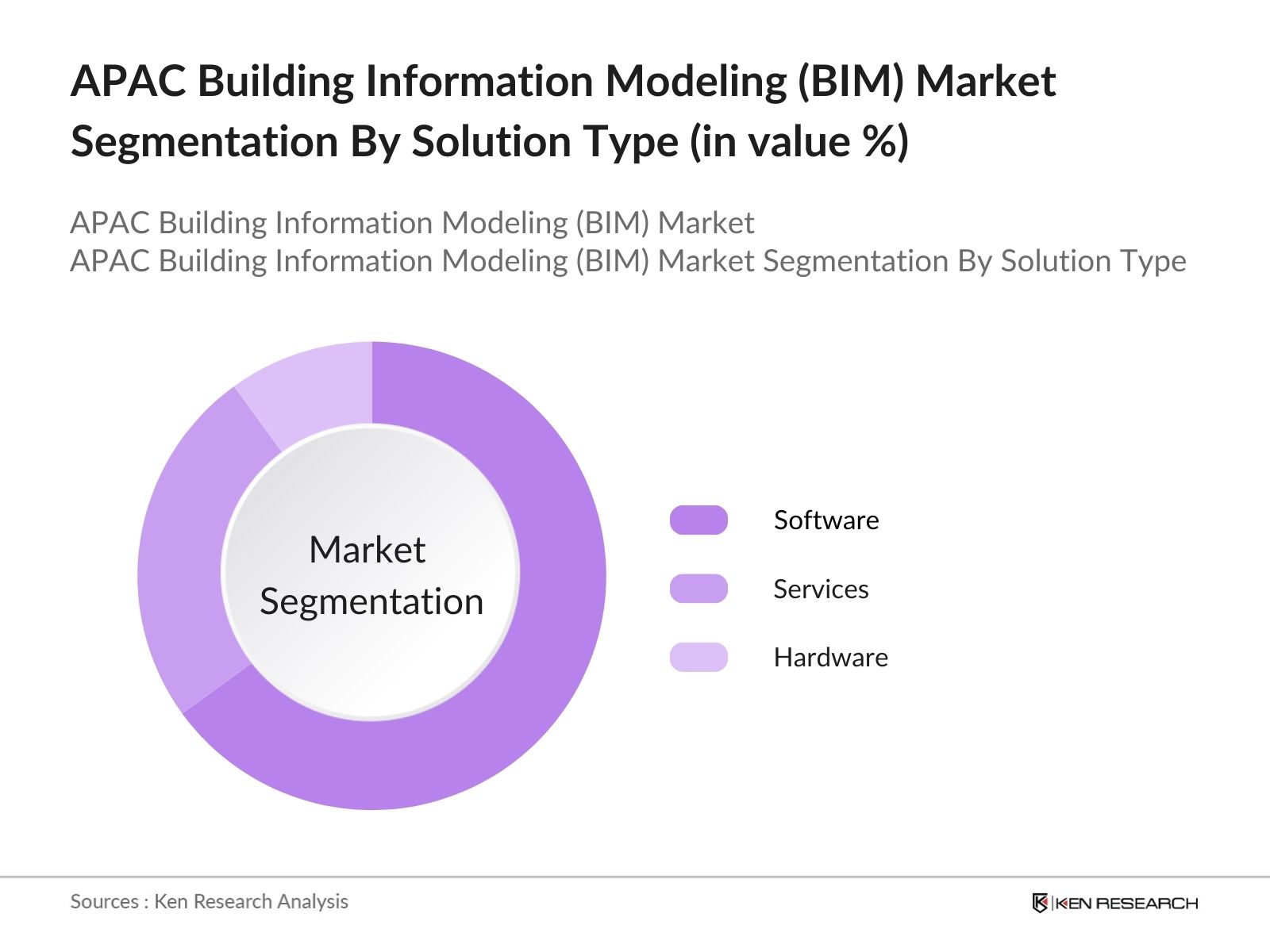
By Solution Type: The APAC BIM market is segmented by solution type into software, services, and hardware. Recently, BIM software has dominated the market due to the growing need for efficient planning, design, and management of construction projects. Companies are investing heavily in 3D and 4D modeling, cloud-based platforms, and AI-integrated tools to enhance project accuracy and reduce operational costs, further propelling softwares share.
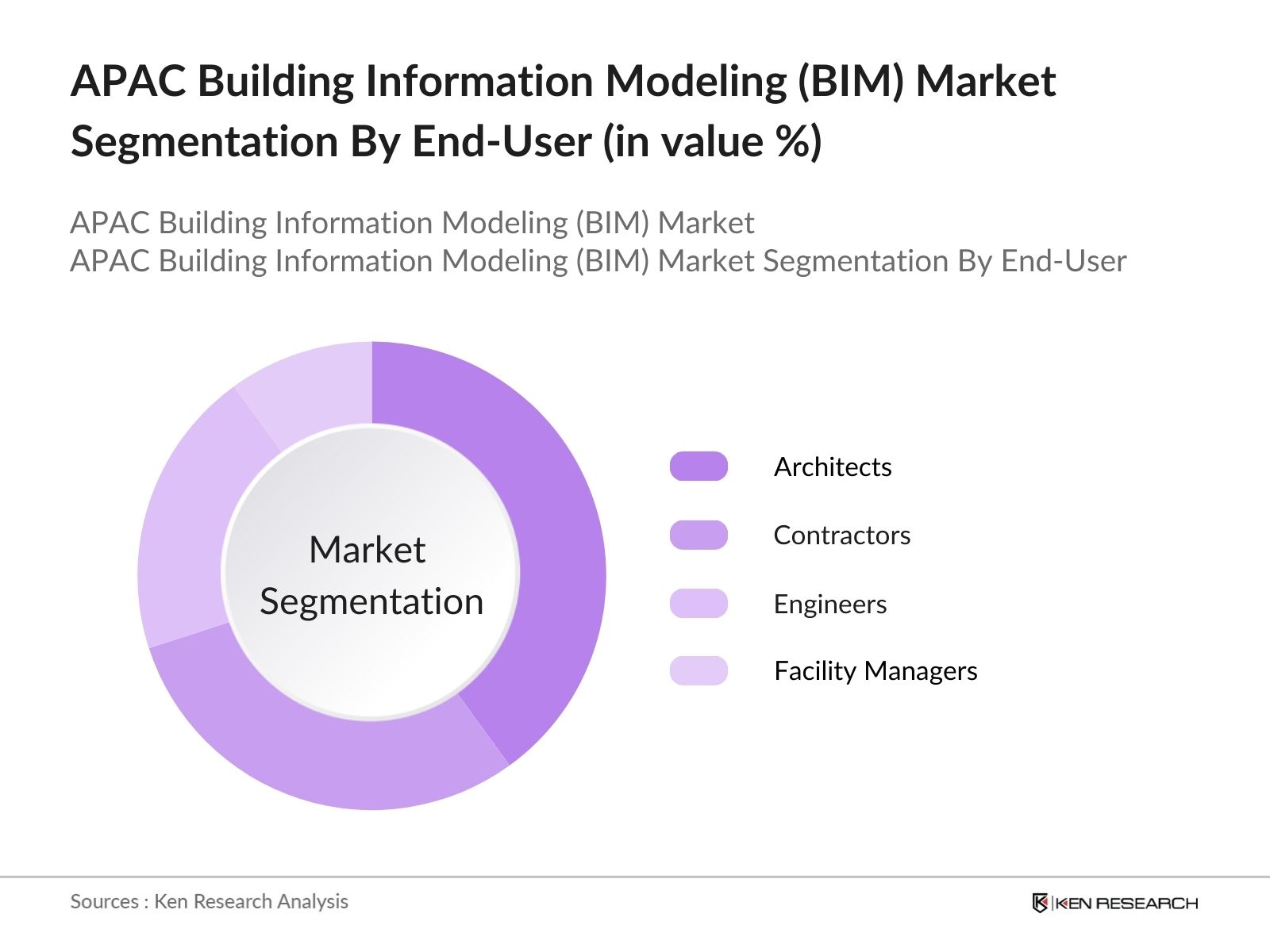
By End-User: The market is segmented by end-users into architects, contractors, engineers, and facility managers. Among these, architects hold the dominant share, as they are the primary users of BIM software for designing and planning. The rising complexity of construction projects and the demand for precise design modeling have driven architects to adopt advanced BIM solutions, especially in regions where large infrastructure projects are underway.
APAC Building Information Modeling (BIM) Market Competitive Landscape
The APAC BIM market is dominated by several key players. These companies provide comprehensive solutions and have a strong market presence due to their technological expertise, regional expansion strategies, and partnerships with construction firms and government bodies. Some global and regional players are also involved in mergers and acquisitions to strengthen their market position.
|
Company |
Establishment Year |
Headquarters |
Revenue (USD Bn) |
Employees |
R&D Investment |
Regional Presence |
Key Partnerships |
|
Autodesk Inc. |
1982 |
USA |
- | - | - | - | - |
|
Bentley Systems |
1984 |
USA |
- | - | - | - | - |
|
Glodon Company |
1998 |
China |
- | - | - | - | - |
|
Trimble Inc. |
1978 |
USA |
- | - | - | - | - |
|
RIB Software |
1961 |
Germany |
- | - | - | - | - |
APAC Building Information Modeling (BIM) Market Analysis
Growth Drivers
- Increasing Infrastructure Investments by APAC Governments: The APAC region is experiencing a massive increase in infrastructure investments, which is a major driver for BIM adoption. In 2023, India invested $200 billion into its National Infrastructure Pipeline (NIP) to boost connectivity and urban infrastructure. Indonesia is also investing heavily in projects, including a $35 billion capital relocation initiative. These large-scale projects necessitate the use of BIM to improve project efficiency and reduce delays. According to the World Bank, infrastructure development remains crucial for APAC's economic growth, with $3 trillion being funneled into regional construction efforts by 2024.
- Government Mandates for Digital Construction Technologies: Several APAC governments have mandated the use of BIM for public infrastructure projects, pushing the construction industry toward digital transformation. For example, Singapores Building and Construction Authority (BCA) mandated BIM for public projects exceeding $30 million in 2023. Similarly, South Korea has incorporated BIM into all major public infrastructure projects since 2022. These mandates have accelerated BIM adoption, making it a critical part of construction workflows. With national construction sectors contributing hundreds of billions to GDP, these government policies are creating a robust foundation for BIM growth in APAC.
- Growing Construction Workforce in Developing APAC Countries: Developing countries in APAC, such as Vietnam and the Philippines, are experiencing rapid growth in their construction workforce, which is helping drive BIM adoption. As of 2023, Vietnams construction sector employed over 4 million workers, up from previous years, and continues to expand as the country pushes ahead with infrastructure modernization projects valued at $60 billion. This growth in the construction workforce is coupled with efforts to upskill workers with BIM proficiency, ensuring that the workforce can meet the demands of digital construction practices in an evolving industry.
Market Challenges
- High Costs of BIM Software and Implementation: One of the significant challenges in the APAC market is the high cost of BIM software and implementation. While large firms can afford the investment, small and medium enterprises (SMEs) often struggle to allocate the necessary funds. SMEs contributed around $120 billion to the APAC construction sector in 2023, but many faces financial hurdles when adopting BIM. This is exacerbated by the cost of specialized training required for BIM proficiency, creating a barrier for broader adoption.
- Lack of Skilled BIM Professionals: A shortage of BIM-skilled professionals across the APAC region remains a major challenge. As of 2023, countries like Indonesia, Malaysia, and Vietnam are experiencing a critical skills gap, with fewer than 30% of the construction workforce trained in BIM technologies. The lack of skilled labor creates bottlenecks in project completion, particularly in large-scale infrastructure projects where BIM is critical. Government and industry players are focusing on workforce development, but it will take time to fill the skills gap.
APAC Building Information Modeling (BIM) Market Future Outlook
Over the next five years, the APAC BIM market is expected to show significant growth driven by continuous digital transformation, advancements in cloud-based and AI-integrated BIM software, and increasing government mandates for the adoption of BIM technology in public construction projects. Expanding smart city initiatives across APAC countries and rising infrastructure development in emerging markets like India, Malaysia, and Vietnam will also fuel future growth.
Market Opportunities
- Integration of BIM with AI and Machine Learning: The integration of BIM with emerging technologies such as artificial intelligence (AI) and machine learning (ML) presents a significant opportunity for the APAC market. By leveraging AI, BIM tools can predict potential design errors and optimize resource allocation in real-time, leading to improved project outcomes. South Koreas Ministry of Land reported that AI-enhanced BIM reduced project delays by 15% in public infrastructure projects completed in 2023. The IMF notes that with APACs construction sector contributing over $3 trillion to regional GDP, the adoption of AI-integrated BIM solutions is set to enhance operational efficiency across the industry.
- Adoption in Small and Medium Enterprises (SMEs): MEs represent a key growth opportunity for BIM in the APAC market. While larger firms have adopted BIM, SMEs have lagged due to cost and training barriers. However, with governments providing financial incentives and subsidies, there is an increasing trend of SMEs adopting BIM technology. In 2023, Australias government launched a $1.5 billion infrastructure innovation fund, part of which is allocated to helping SMEs adopt digital construction tools. With SMEs contributing $500 billion to the APAC construction sector, their integration into the BIM ecosystem could lead to broader market growth.
Scope of the Report
|
By Solution Type |
Software Services Hardware |
|
By End-User |
Architects Contractors Engineers Facility Managers |
|
By Project Lifecycle Phase |
Pre-construction Construction Post-construction |
|
By Deployment Mode |
On-Premises Cloud-Based |
|
By Region |
China Japan South Korea Australia Southeast Asia |
Products
Key Target Audience
Construction and Infrastructure Companies
Architects and Design Firms
Engineering and Contracting Companies
Real Estate Developers
Investors and Venture Capitalist Firms
IT and Technology Service Providers
Smart City Planners
Government and Regulatory Bodies (e.g., Ministry of Urban Development, Construction Industry Development Board)
Companies
Players Mentioned in the Report:
Autodesk Inc.
Bentley Systems
Trimble Inc.
Nemetschek Group
Glodon Company Limited
RIB Software
Dassault Systmes
Hexagon AB
Aveva Group PLC
Aconex (Oracle)
Table of Contents
1. APAC Building Information Modeling (BIM) Market Overview
1.1. Definition and Scope
1.2. Market Taxonomy
1.3. Market Growth Rate
1.4. Market Segmentation Overview
2. APAC Building Information Modeling (BIM) Market Size (In USD Bn)
2.1. Historical Market Size
2.2. Year-On-Year Growth Analysis
2.3. Key Market Developments and Milestones
3. APAC Building Information Modeling (BIM) Market Analysis
3.1. Growth Drivers
3.1.1. Digital Transformation in Construction
3.1.2. Government Mandates for BIM Adoption
3.1.3. Increasing Infrastructure Projects
3.1.4. Demand for Cost and Time Efficiency
3.2. Market Challenges
3.2.1. High Initial Investment in Software and Training
3.2.2. Resistance to Change in Traditional Construction Methods
3.2.3. Lack of Skilled BIM Professionals
3.3. Opportunities
3.3.1. Integration of BIM with AI and Machine Learning
3.3.2. Adoption in Small and Medium Enterprises (SMEs)
3.3.3. Expansion into Emerging APAC Markets
3.4. Trends
3.4.1. Cloud-Based BIM Solutions
3.4.2. 5D and 6D BIM Adoption
3.4.3. Use of Digital Twins and IoT in Construction
3.5. Government Regulation
3.5.1. BIM Mandates Across APAC Countries
3.5.2. Construction Industry Digitalization Initiatives
3.5.3. Public-Private Partnerships for Infrastructure Development
3.6. SWOT Analysis
3.6.1. Strengths
3.6.2. Weaknesses
3.6.3. Opportunities
3.6.4. Threats
3.7. Stakeholder Ecosystem
3.8. Porters Five Forces Analysis
3.9. Competition Ecosystem
4. APAC Building Information Modeling (BIM) Market Segmentation
4.1. By Solution Type (In Value %)
4.1.1. Software
4.1.2. Services
4.1.3. Hardware
4.2. By End-User (In Value %)
4.2.1. Architects
4.2.2. Contractors
4.2.3. Engineers
4.2.4. Facility Managers
4.3. By Project Lifecycle Phase (In Value %)
4.3.1. Pre-construction (Design & Planning)
4.3.2. Construction
4.3.3. Post-construction (Operations & Maintenance)
4.4. By Deployment Mode (In Value %)
4.4.1. On-Premises
4.4.2. Cloud-Based
4.5. By Region (In Value %)
4.5.1. China
4.5.2. Japan
4.5.3. South Korea
4.5.4. Australia
4.5.5. Southeast Asia
5. APAC Building Information Modeling (BIM) Market Competitive Analysis
5.1. Detailed Profiles of Major Competitors
5.1.1. Autodesk, Inc.
5.1.2. Bentley Systems
5.1.3. Trimble Inc.
5.1.4. Nemetschek Group
5.1.5. Dassault Systmes
5.1.6. Hexagon AB
5.1.7. RIB Software
5.1.8. Asite Solutions
5.1.9. Aveva Group PLC
5.1.10. Archidata Inc.
5.1.11. Graphisoft
5.1.12. Synchro Software
5.1.13. Glodon Company Limited
5.1.14. Aconex (Oracle)
5.1.15. PlanGrid
5.2. Cross Comparison Parameters (No. of Employees, Headquarters, Inception Year, Revenue, R&D Investment, Regional Market Presence, Innovation Index, Partnerships)
5.3. Market Share Analysis
5.4. Strategic Initiatives
5.5. Mergers And Acquisitions
5.6. Investment Analysis
5.7. Venture Capital Funding
5.8. Government Grants
5.9. Private Equity Investments
6. APAC Building Information Modeling (BIM) Market Regulatory Framework
6.1. BIM Standards and Certifications
6.2. Compliance Requirements Across APAC
6.3. Data Security and Privacy Regulations
7. APAC Building Information Modeling (BIM) Future Market Size (In USD Bn)
7.1. Future Market Size Projections
7.2. Key Factors Driving Future Market Growth
8. APAC Building Information Modeling (BIM) Future Market Segmentation
8.1. By Solution Type (In Value %)
8.2. By End-User (In Value %)
8.3. By Project Lifecycle Phase (In Value %)
8.4. By Deployment Mode (In Value %)
8.5. By Region (In Value %)
9. APAC Building Information Modeling (BIM) Market Analysts Recommendations
9.1. TAM/SAM/SOM Analysis
9.2. Customer Cohort Analysis
9.3. Marketing Initiatives
9.4. White Space Opportunity Analysis
Research Methodology
Step 1: Identification of Key Variables
This initial phase involves mapping the APAC Building Information Modeling (BIM) market ecosystem, covering all relevant stakeholders such as software providers, construction companies, and government bodies. Extensive desk research and proprietary databases were used to identify the key drivers, challenges, and opportunities within the BIM ecosystem.
Step 2: Market Analysis and Construction
In this step, historical market data was compiled and analyzed to assess the BIM market's growth trajectory. This includes market penetration, revenue generation, and construction project data. The analysis also covered service quality and the impact of technological advancements.
Step 3: Hypothesis Validation and Expert Consultation
Market hypotheses were developed and validated through interviews with industry professionals, including BIM software developers and construction firms. These insights helped in corroborating the data collected and refining the market model.
Step 4: Research Synthesis and Final Output
The final phase of the research process involved synthesizing data gathered through primary and secondary research methods. Insights from key stakeholders, including manufacturers and service providers, were integrated to create a comprehensive market analysis.
Frequently Asked Questions
01. How big is the APAC Building Information Modeling (BIM) market?
The APAC BIM market is valued at USD 1.9 billion, driven by increasing digitalization in construction and government mandates across the region.
02. What are the major challenges in the APAC BIM market?
Challenges in the APAC BIM market include high initial investment in BIM software and hardware, lack of skilled professionals, and resistance to adopting new technologies in traditional construction sectors.
03. Who are the key players in the APAC BIM market?
Key players in the APAC BIM market include Autodesk Inc., Bentley Systems, Trimble Inc., Glodon Company Limited, and RIB Software, which dominate due to their technological expertise and strong regional presence.
04. What factors are driving growth in the APAC BIM market?
Key growth drivers in the APAC BIM market include the adoption of cloud-based BIM solutions, government mandates, and the increasing complexity of construction projects requiring precise design and planning.
Why Buy From Us?

What makes us stand out is that our consultants follows Robust, Refine and Result (RRR) methodology. i.e. Robust for clear definitions, approaches and sanity checking, Refine for differentiating respondents facts and opinions and Result for presenting data with story

We have set a benchmark in the industry by offering our clients with syndicated and customized market research reports featuring coverage of entire market as well as meticulous research and analyst insights.

While we don't replace traditional research, we flip the method upside down. Our dual approach of Top Bottom & Bottom Top ensures quality deliverable by not just verifying company fundamentals but also looking at the sector and macroeconomic factors.

With one step in the future, our research team constantly tries to show you the bigger picture. We help with some of the tough questions you may encounter along the way: How is the industry positioned? Best marketing channel? KPI's of competitors? By aligning every element, we help maximize success.

Our report gives you instant access to the answers and sources that other companies might choose to hide. We elaborate each steps of research methodology we have used and showcase you the sample size to earn your trust.

If you need any support, we are here! We pride ourselves on universe strength, data quality, and quick, friendly, and professional service.