















APAC Commercial Services Market Outlook to 2030
Region:Asia
Author(s):Shambhavi
Product Code:KROD9897
November 2024
82
About the Report
APAC Commercial Services Market Overview
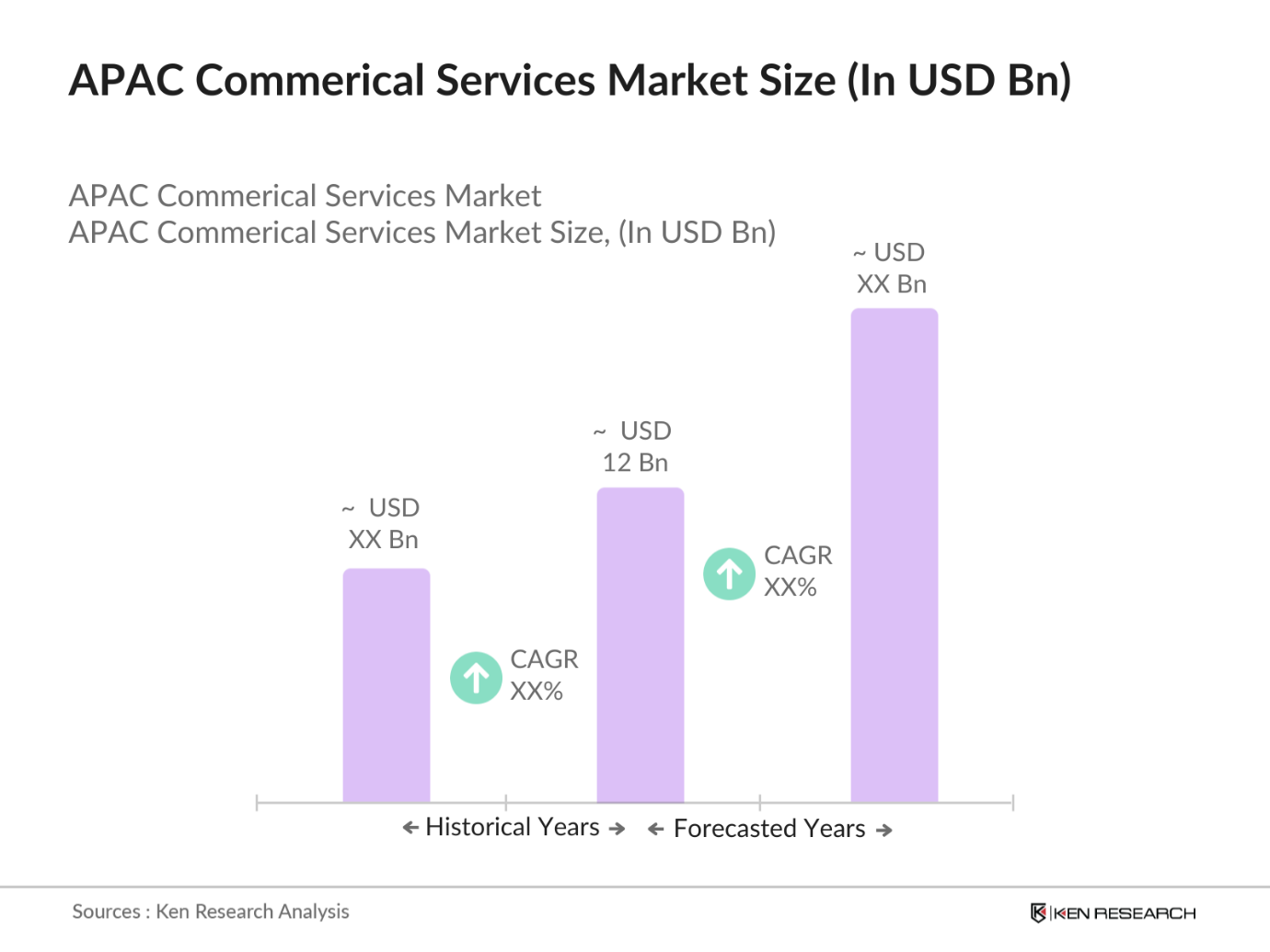
- The APAC Commercial Services market, based on recent analysis, is valued at USD 12 billion. This substantial valuation is driven by rapid economic growth, increased urbanization, and a growing number of businesses in sectors such as real estate, finance, logistics, and retail services. Moreover, digital transformation initiatives, particularly in countries like China and India, have boosted demand for advanced business services. Additionally, government policies favoring infrastructure development have created new avenues for commercial services expansion, particularly in metropolitan hubs.
- Key countries driving the APAC Commercial Services market include China, Japan, and Australia, with Singapore emerging as a major hub for finance and logistics. Chinas dominance stems from its expansive economy and extensive industrial base, fostering a need for logistics, financial, and operational services. Japans commercial sector benefits from a high demand for innovative business solutions and an established technology base. Australia and Singapore, with their stable business environments and strategic locations, serve as major operational centers for international corporations entering the APAC market.
- The APAC commercial services market benefits significantly from regional trade agreements that ease cross-border service provision. The Regional Comprehensive Economic Partnership (RCEP), comprising 15 Asia-Pacific nations, has facilitated reduced tariffs and simplified regulatory procedures. This agreement has increased trade by nearly $100 billion within APAC in 2024, making it more feasible for businesses to expand operations across borders and serve diverse markets with less regulatory friction.
APAC Commercial Services Market Segmentation
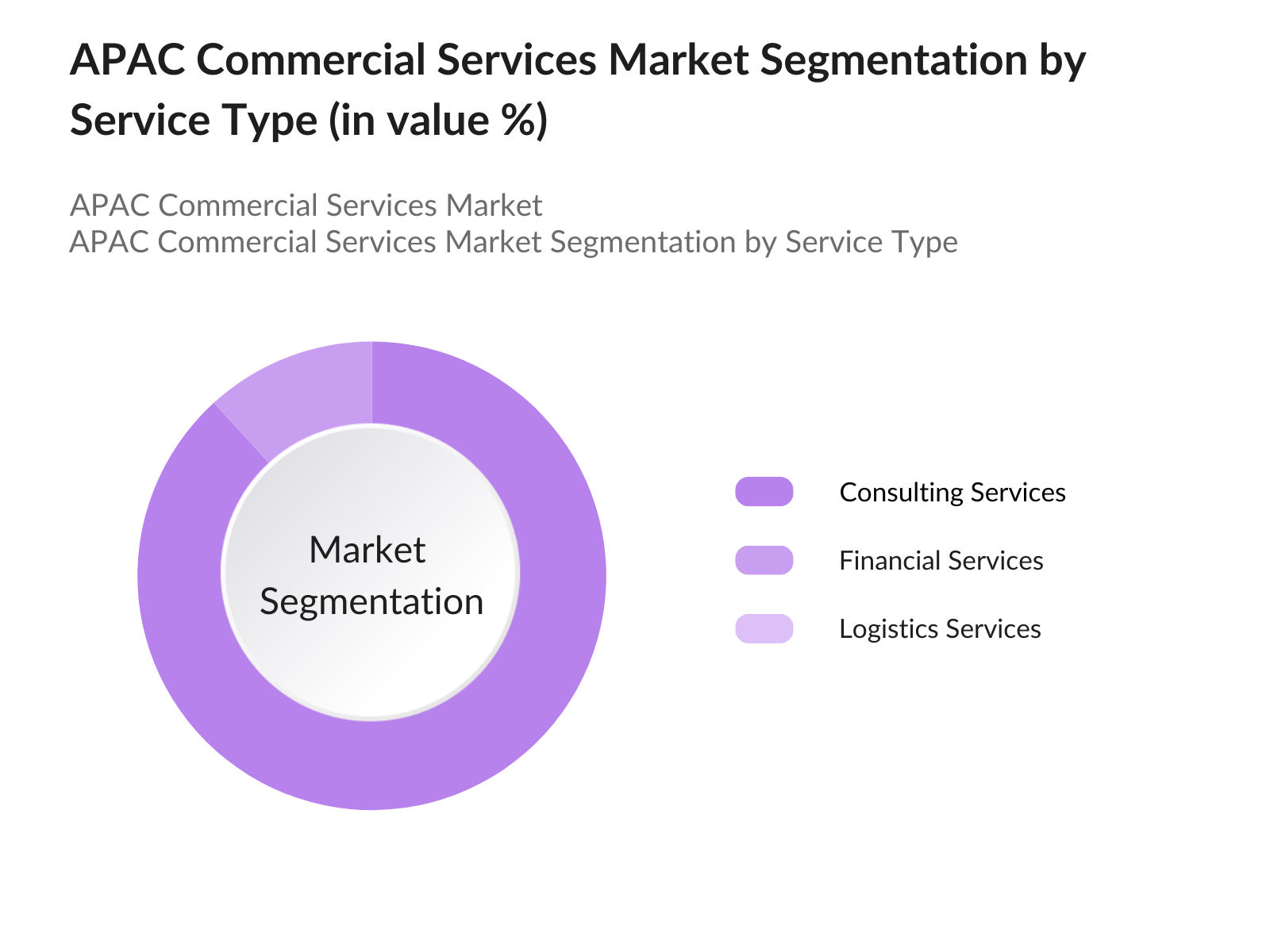
By Service Type: The APAC Commercial Services market is segmented by service type into Consulting Services, Financial Services, and Logistics Services. Consulting services hold a dominant position in the market due to rising demand for professional expertise in business strategy, digital transformation, and compliance across diverse industries. Companies increasingly rely on consulting services for efficient market entry strategies, especially in high-growth markets like China and India, where navigating regulatory landscapes requires expert knowledge.
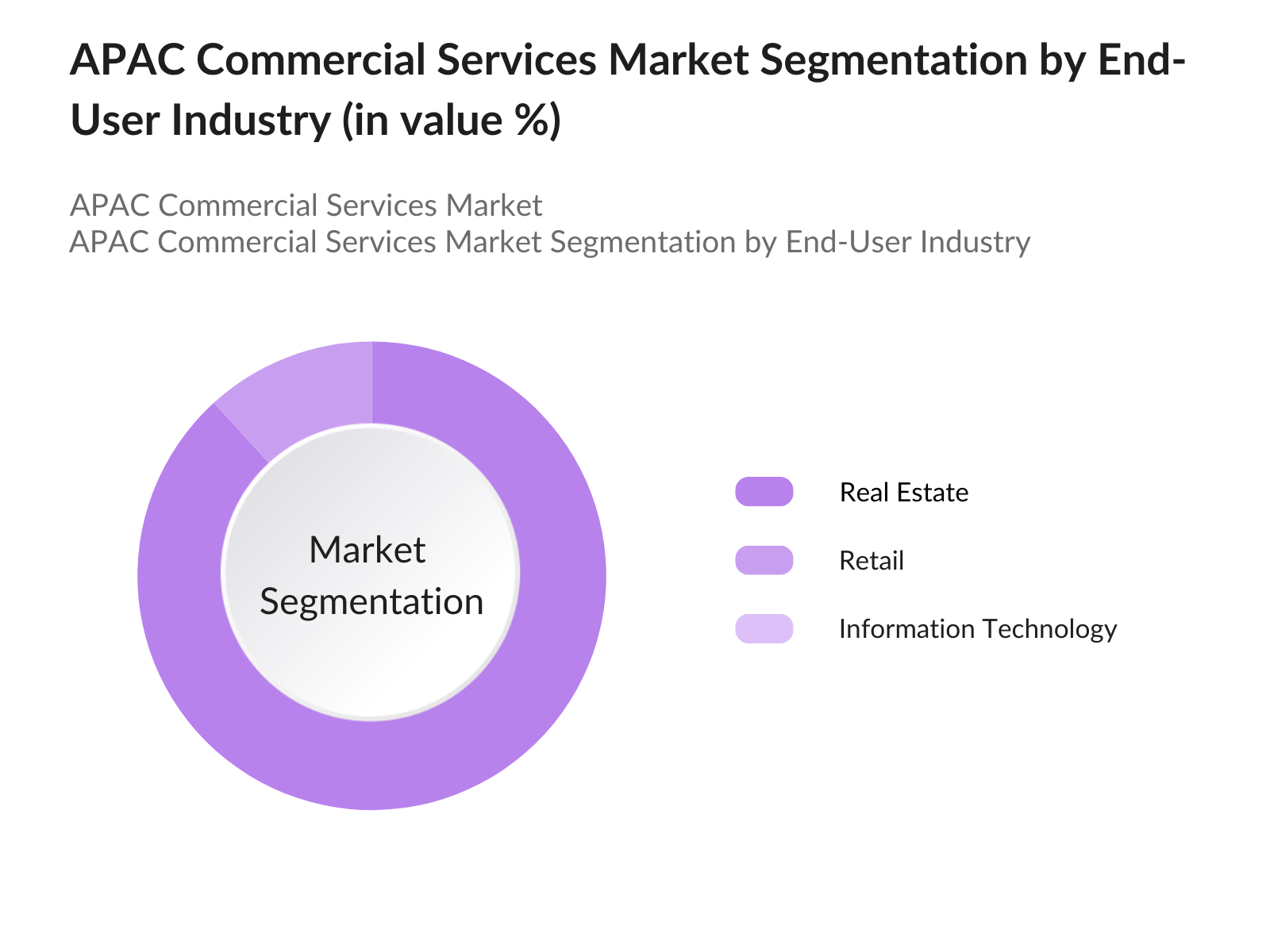
By End-User Industry: The APAC Commercial Services market is further segmented by end-user industry into Retail, Real Estate, and Information Technology. The retail industry shows a high demand for logistics and supply chain solutions, largely driven by the e-commerce boom in APAC regions. Major players in e-commerce, such as Alibaba and Flipkart, require extensive logistics and warehousing services, which contributes to the dominance of logistics within the retail segment.
APAC Commercial Services Market Competitive Landscape
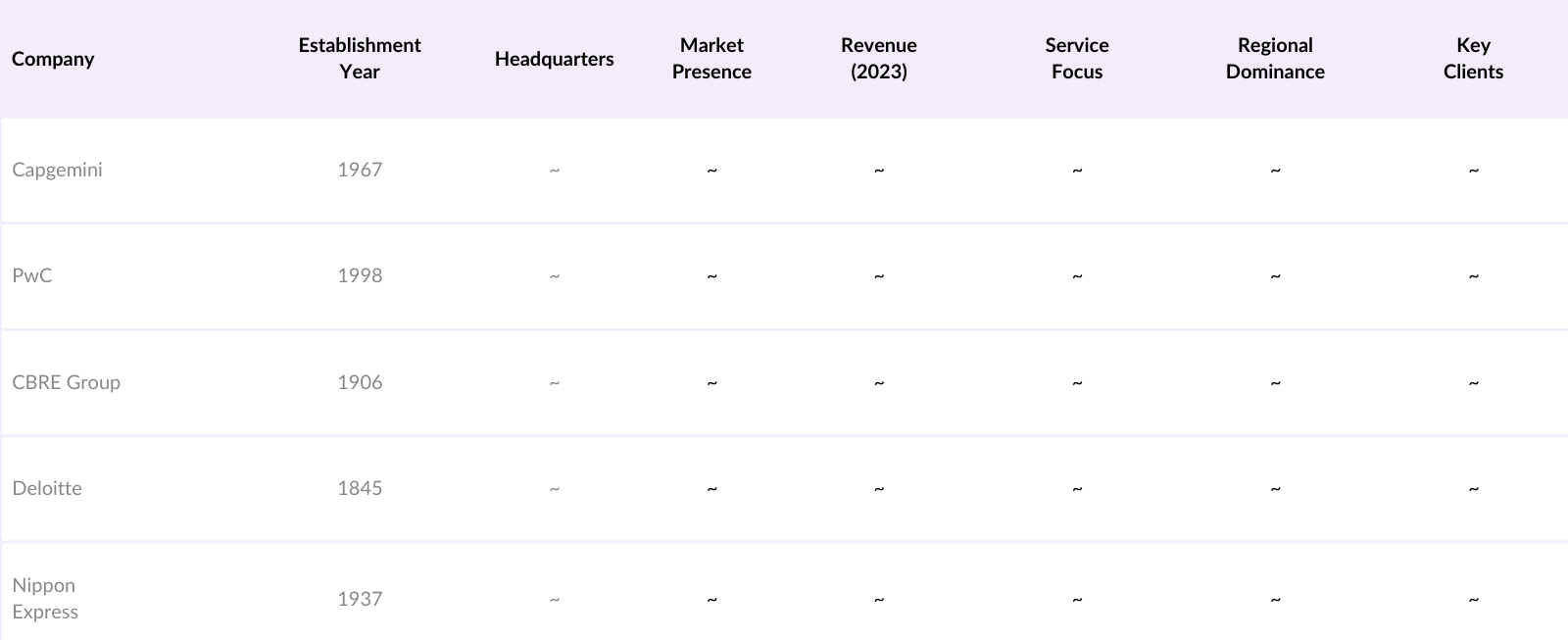
The APAC Commercial Services market is characterized by a competitive landscape led by major players with substantial expertise in diverse service areas. This concentration of industry leaders underscores the significant influence these companies wield over market trends.
APAC Commercial Services Market Analysis
Growth Drivers
- Urbanization and Economic Expansion: The Asia-Pacific region is experiencing unprecedented urbanization, with a reported increase in urban population reaching 1.5 billion in 2024, driven largely by migration to cities in countries like China and India. This movement has led to substantial demand for commercial services such as facility management, logistics, and consulting services to support infrastructure, business, and housing needs. According to the World Bank, the economic output from urban areas in APAC countries contributes approximately $18 trillion to the regions GDP, reflecting the sector's substantial growth potential as urban populations continue expanding rapidly.
- Digital Transformation: As of 2024, over 70% of companies across the Asia-Pacific region are actively implementing digital solutions such as AI-driven data analytics, IoT, and cloud-based platforms to optimize service delivery, especially in commercial support and BPO services. Governments and private entities have invested close to $50 billion in digital infrastructure across the region, fostering a more competitive and digitally enabled commercial services landscape. This investment includes the establishment of digital payment systems and automation in customer service and logistics.
- Government Initiatives: Governments in APAC are driving the expansion of the commercial services sector with multiple national programs designed to enhance service sector resilience and economic contributions. For instance, Japan has allocated $5 billion in subsidies for SMEs focused on professional and technical services, while Indias "Digital India" initiative has boosted digital service adoption. Additionally, agreements such as the Regional Comprehensive Economic Partnership (RCEP) are streamlining regulatory barriers, facilitating increased cross-border service provisions.
Market Challenges
- Regulatory Hurdles: Diverse regulatory requirements across countries within APAC significantly impact commercial service providers, particularly multinational firms. For example, data localization laws in China require firms to store certain types of data within national borders, affecting service delivery models. Similar regulations are emerging in other countries, adding operational complexity. These regulatory challenges add approximately 10-15% to the compliance costs for international service providers in the region
- Talent Shortage: The commercial services sector in APAC faces a significant workforce gap, with a reported shortfall of 47 million skilled workers as of 2024. This shortage, especially in specialized fields like IT services, consultancy, and engineering, is impacting growth and service quality. For instance, countries like the Philippines and India, major outsourcing hubs, are finding it increasingly challenging to meet global demand due to talent constraints. The IMF highlights that overcoming this gap will require a strategic focus on education and vocational training in these sectors .
APAC Commercial Services Market Future Outlook
Over the next five years, the APAC Commercial Services market is expected to grow considerably, driven by ongoing digital innovation, increased trade activities, and the rise of service-based economies. Countries across the region are anticipated to witness enhanced service demand as digital infrastructure and business sophistication progress.
Opportunities
- Expansion into Emerging Markets: Emerging markets within APAC, such as Vietnam, Indonesia, and the Philippines, are seeing a rise in disposable income and consumer demand for commercial services, especially in sectors like facility management and consulting. Vietnam alone has seen a $10 billion growth in commercial services demand from 2022 to 2024, a trend mirrored in other emerging markets. This demand growth creates substantial opportunities for both local and international service providers to expand their footprint
- Integration of Advanced Technologies: Advanced technologies like AI, big data, and IoT are increasingly being incorporated within APAC's commercial services sector. Over 60% of companies are now leveraging AI for enhanced service automation, particularly in customer service, logistics, and facility management. The technology investment in commercial services in APAC reached $30 billion in 2024, creating growth opportunities for firms that specialize in tech-driven service solutions
Scope of the Report
|
Product Type |
Casual Wear |
|
Distribution Channel |
Online Retail |
|
End-User Demographics |
Men |
|
Fabric Type |
Cotton |
|
Region |
Java |
Products
Key Target Audience
Investor and venture capitalist firms
Government and regulatory bodies (e.g., APAC Trade and Industry Ministries)
Real estate developers and management firms
Retail and e-commerce enterprises
Logistics and transportation companies
Financial services providers
Consulting agencies in business strategy and transformation
Technology and digital transformation service providers
Companies
Players mentioned in the report
Capgemini
PwC
CBRE Group
Deloitte
Nippon Express
KPMG
Ernst & Young
Jones Lang LaSalle
Accenture
Cushman & Wakefield
DHL Express
Knight Frank
Savills
Knight Frank
McKinsey & Company
Table of Contents
1. APAC Commercial Services Market Overview
1.1. Definition and Scope
1.2. Market Taxonomy
1.3. Market Growth Rate
1.4. Market Segmentation Overview
2. APAC Commercial Services Market Size (In USD Billion)
2.1. Historical Market Size
2.2. Year-On-Year Growth Analysis
2.3. Key Market Developments and Milestones
3. APAC Commercial Services Market Analysis
3.1. Growth Drivers
3.1.1. Urbanization and Economic Expansion
3.1.2. Digital Transformation
3.1.3. Government Initiatives
3.2. Market Challenges
3.2.1. Regulatory Hurdles
3.2.2. Talent Shortage
3.2.3. Technological Disparities
3.3. Opportunities
3.3.1. Expansion into Emerging Markets
3.3.2. Integration of Advanced Technologies
3.3.3. Strategic Partnerships
3.4. Trends
3.4.1. Shift Towards Digital Services
3.4.2. Emphasis on Sustainability
3.4.3. Customization and Personalization
3.5. Government Regulations
3.5.1. Trade Agreements
3.5.2. Data Protection Laws
3.5.3. Labor Laws
3.6. SWOT Analysis
3.7. Stakeholder Ecosystem
3.8. Porters Five Forces Analysis
3.9. Competitive Landscape
4. APAC Commercial Services Market Segmentation
4.1. By Service Type (In Value)
4.1.1. Business Support Services
4.1.2. Facility Management Services
4.1.3. Employment Services
4.1.4. Travel and Reservation Services
4.1.5. Waste Management Services
4.2. By End-User Industry (In Value)
4.2.1. Manufacturing
4.2.2. Healthcare
4.2.3. Retail
4.2.4. IT and Telecommunications
4.2.5. Hospitality
4.3. By Delivery Mode (In Value)
4.3.1. Online
4.3.2. Offline
4.4. By Organization Size (In Value)
4.4.1. Small and Medium Enterprises (SMEs)
4.4.2. Large Enterprises
4.5. By Country (In Value)
4.5.1. China
4.5.2. India
4.5.3. Japan
4.5.4. Australia
4.5.5. South Korea
5. APAC Commercial Services Market Competitive Analysis
5.1. Detailed Profiles of Major Companies
5.1.1. Accenture PLC
5.1.2. Tata Consultancy Services
5.1.3. Capgemini SE
5.1.4. Infosys Limited
5.1.5. Wipro Limited
5.1.6. Fujitsu Limited
5.1.7. NEC Corporation
5.1.8. HCL Technologies
5.1.9. Tech Mahindra
5.1.10. Cognizant Technology Solutions
5.1.11. DXC Technology
5.1.12. NTT Data Corporation
5.1.13. IBM Corporation
5.1.14. SAP SE
5.1.15. Oracle Corporation
5.2. Cross Comparison Parameters (Number of Employees, Headquarters, Inception Year, Revenue, Service Portfolio, Market Presence, Client Base, Innovation Initiatives)
5.3. Market Share Analysis
5.4. Strategic Initiatives
5.5. Mergers and Acquisitions
5.6. Investment Analysis
5.7. Venture Capital Funding
5.8. Government Grants
5.9. Private Equity Investments
6. APAC Commercial Services Market Regulatory Framework
6.1. Compliance Requirements
6.2. Certification Processes
6.3. Environmental Standards
7. APAC Commercial Services Future Market Size (In USD Billion)
7.1. Future Market Size Projections
7.2. Key Factors Driving Future Market Growth
8. APAC Commercial Services Future Market Segmentation
8.1. By Service Type (In Value)
8.2. By End-User Industry (In Value)
8.5. By Country (In Value)
9. APAC Commercial Services Market Analysts Recommendations
9.1. TAM/SAM/SOM Analysis (Total Addressable Market, Serviceable Available Market, Serviceable Obtainable Market)
9.2. Customer Cohort Analysis
9.3. Marketing Initiatives
9.4. White Space Opportunity Analysis
Disclaimer
Contact Us
Research Methodology
Step 1: Identification of Key Variables
The first step involves mapping the ecosystem of the APAC Commercial Services Market. Desk research, using credible sources, helps in identifying critical variables such as demand drivers and emerging industry trends that influence the market.
Step 2: Market Analysis and Construction
Historical data from 2018 onward is analyzed to evaluate market penetration, sectoral distribution, and regional influences. Quantitative data analysis underpins the determination of accurate market share percentages for each segment.
Step 3: Hypothesis Validation and Expert Consultation
Market hypotheses are validated through consultations with key industry experts and stakeholders. Their insights provide essential data regarding service trends, regional influences, and service popularity across industries.
Step 4: Research Synthesis and Final Output
The final step synthesizes findings into a comprehensive report, utilizing primary data from interviews and secondary sources to ensure an accurate and validated analysis.
Frequently Asked Questions
01. How big is the APAC Commercial Services Market?
The APAC Commercial Services market is valued at around USD 400 billion, driven by strong economic growth and demand for consulting, financial, and logistics services across rapidly growing economies.
02. What are the challenges in the APAC Commercial Services Market?
Key challenges include regulatory complexities, high competition, and the need for continuous adaptation to technological advancements.
03. Who are the major players in the APAC Commercial Services Market?
Notable players include Capgemini, PwC, CBRE Group, Deloitte, and Nippon Express, with each offering specialized services and maintaining strong market presence in the region.
04. What are the growth drivers of the APAC Commercial Services Market?
Growth is propelled by factors such as digital transformation, rising demand for financial services, and increased e-commerce activities driving logistics and supply chain services.
05. What is the future of the APAC Commercial Services Market?
Future growth is expected to be driven by service innovations in digital, logistics, and financial sectors, with expanding opportunities in consulting and compliance services.
Why Buy From Us?

What makes us stand out is that our consultants follows Robust, Refine and Result (RRR) methodology. i.e. Robust for clear definitions, approaches and sanity checking, Refine for differentiating respondents facts and opinions and Result for presenting data with story

We have set a benchmark in the industry by offering our clients with syndicated and customized market research reports featuring coverage of entire market as well as meticulous research and analyst insights.

While we don't replace traditional research, we flip the method upside down. Our dual approach of Top Bottom & Bottom Top ensures quality deliverable by not just verifying company fundamentals but also looking at the sector and macroeconomic factors.

With one step in the future, our research team constantly tries to show you the bigger picture. We help with some of the tough questions you may encounter along the way: How is the industry positioned? Best marketing channel? KPI's of competitors? By aligning every element, we help maximize success.

Our report gives you instant access to the answers and sources that other companies might choose to hide. We elaborate each steps of research methodology we have used and showcase you the sample size to earn your trust.

If you need any support, we are here! We pride ourselves on universe strength, data quality, and quick, friendly, and professional service.