
APAC Dolomite Powder Market Outlook to 2030
Region:Asia
Author(s):Vijay Kumar
Product Code:KROD10040
November 2024
85
About the Report
APAC Dolomite Powder Market Overview
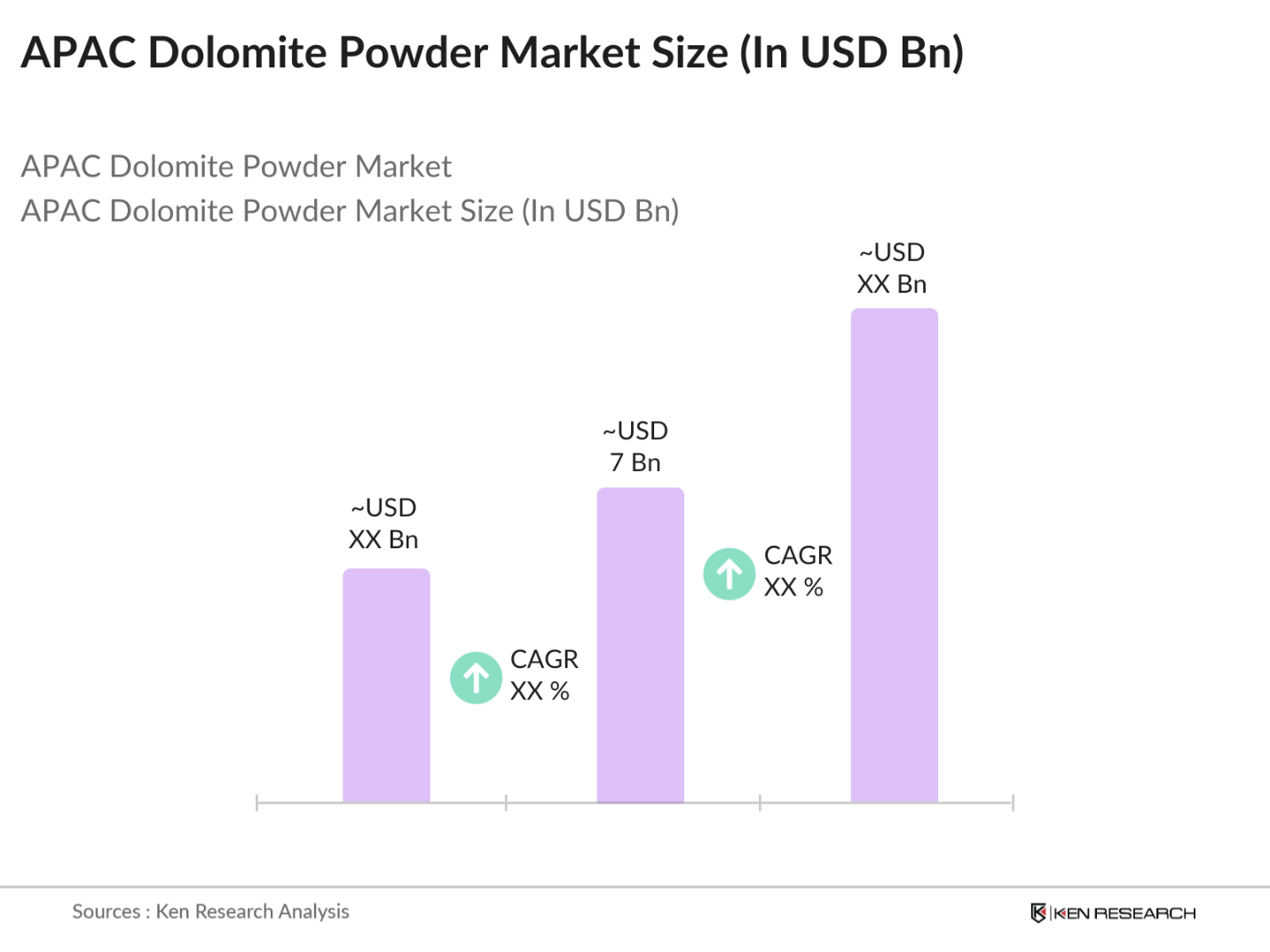
- The APAC Dolomite Powder market is valued at USD 7 billion, with a five-year historical trend showing robust demand from industries like steelmaking, construction, and agriculture. This growth is primarily driven by the extensive use of dolomite powder in steel production, where it plays a crucial role in furnace linings and slag processing. Additionally, the rise in construction projects and urbanization boosts demand for cement and other aggregates, further expanding the market for dolomite powder.
- China and India dominate the APAC dolomite powder market due to their extensive construction and steel production activities. Both countries benefit from high-volume infrastructure projects and large steel manufacturing industries, positioning them as the primary consumers of dolomite powder. Additionally, their respective industrial landscapes have allowed them to develop substantial production capabilities and networks, further solidifying their dominance within the APAC region.
- In response to stricter emission controls, Chinese dolomite powder producers are adopting sustainable practices. China's Ministry of Ecology and Environment reported a notable reduction in emissions from mineral processing sectors in 2023, reflecting improvements in environmental standards and a shift toward cleaner production practices across the industry.
APAC Dolomite Powder Market Segmentation
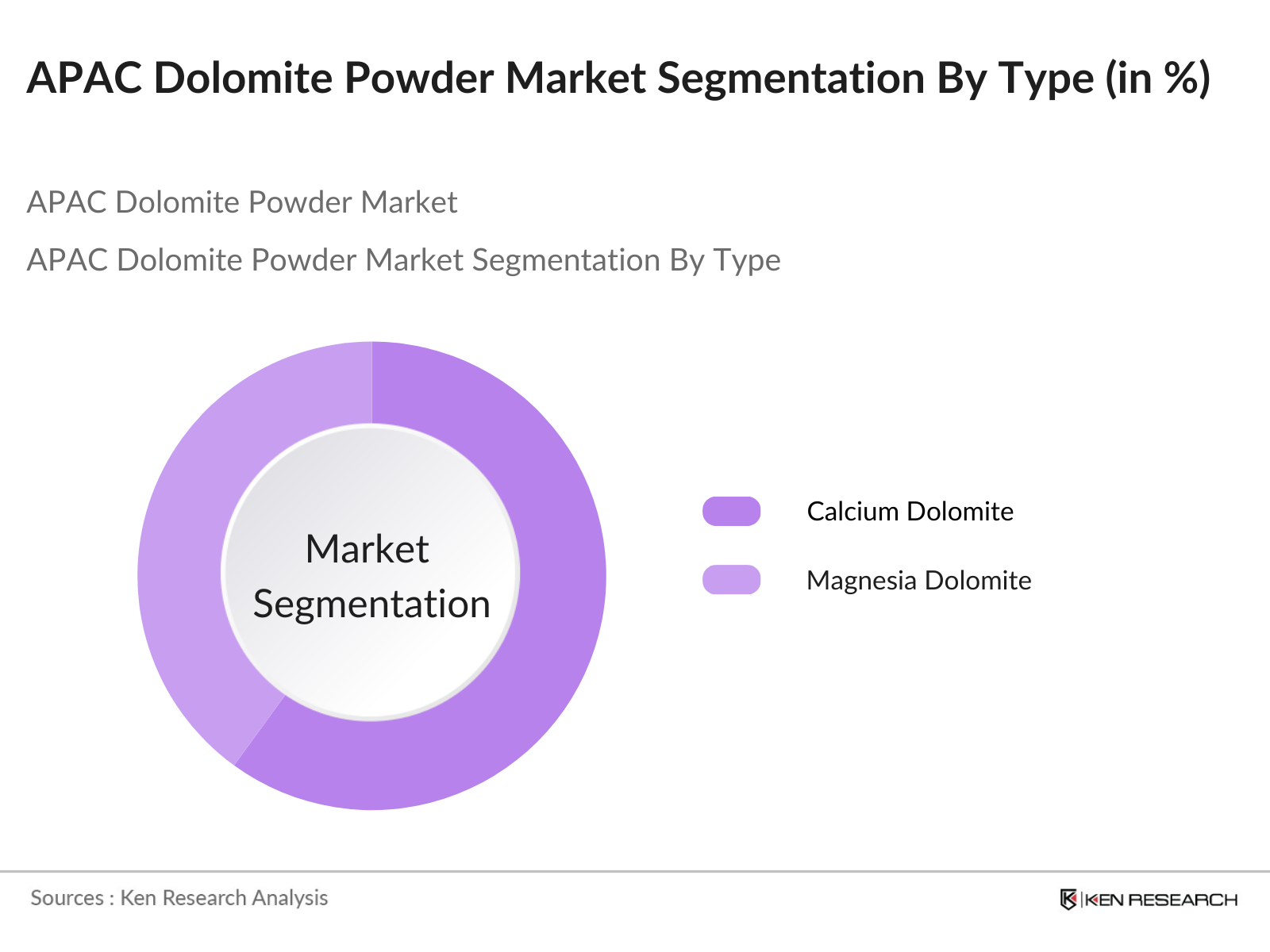
By Type: The market is segmented by type into calcium dolomite and magnesia dolomite. Calcium dolomite holds a dominant market share, primarily due to its widespread application in steel and cement production. Its high calcium content is crucial for applications requiring a fluxing agent to remove impurities in steel production and as an aggregate in cement. This has solidified calcium dolomites position as the preferred choice across steel and cement industries in APAC, driving its market dominance.
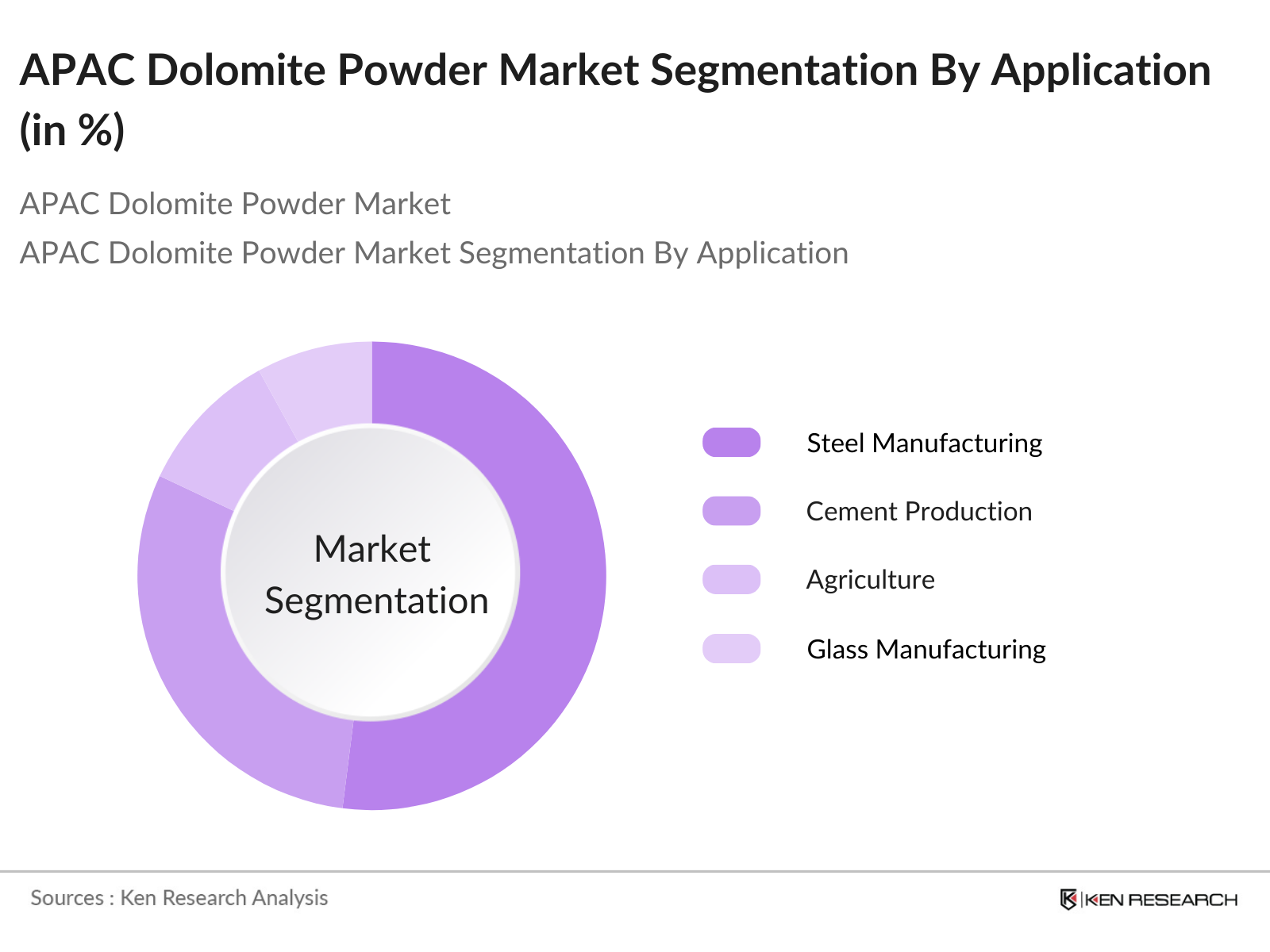
By Application: APAC dolomite powder applications span multiple industries, including steel manufacturing, cement production, agriculture, glass manufacturing, and ceramics. Steel manufacturing dominates the market due to its reliance on dolomite powder as a fluxing agent, essential for refining processes and ensuring quality. The industrys growth, especially in China and India, sustains demand for dolomite powder as a crucial input, establishing it as the leading application segment.
APAC Dolomite Powder Market Competitive Landscape
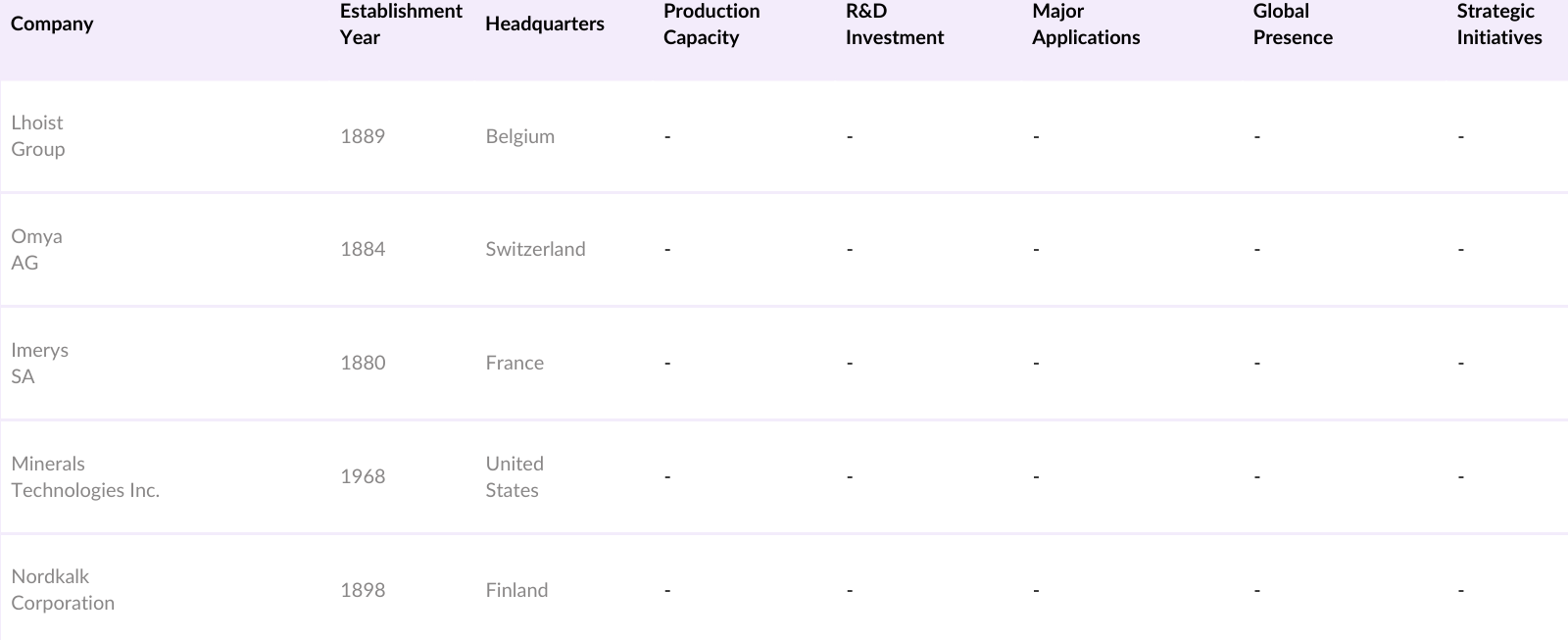
The APAC dolomite powder market is primarily led by regional and global players, who leverage extensive manufacturing capabilities and strategic partnerships. Dominant players include Lhoist Group, Omya AG, and Imerys SA, all of whom have established robust distribution networks across APAC to meet the growing demand. This competitive landscape is marked by both collaborative initiatives and targeted investments to increase production and maintain market relevance.
APAC Dolomite Powder Industry Analysis
Growth Drivers
- Construction Sector Demand: In the APAC region, the construction sector is expanding steadily, driven by urbanization and economic growth. Key players such as Indonesia and Malaysia are experiencing increased demand in the sector, with Indonesias construction output valued at USD 300 billion in 2024, reflecting ongoing investments in residential and commercial projects. Government projects to develop affordable housing and transport infrastructure are significant drivers in countries like Vietnam, where urban population growth has spurred construction output growth by approximately 5% annually since 2022.
- Steel Manufacturing Growth: Steel production, a major consumer of dolomite, remains crucial in APAC economies. Chinas steel production reached 1,033 million metric tons in early 2024, supporting industries from construction to automotive manufacturing. Meanwhile, India's steel output stands at around 120 million metric tons as of 2024, reflecting heightened investment in infrastructure and energy projects. These factors solidify dolomite's role as a key additive in steel production.
- Infrastructure Developments: Infrastructure projects across APAC, particularly in China, Japan, and ASEAN economies, are expanding to meet population and economic demands. Chinas Belt and Road Initiative continues to push infrastructure spending across the region, with over USD 50 billion allocated to energy and transport projects across Southeast Asia. The increase in infrastructure projects directly impacts dolomite powder demand for concrete and road construction.
Market Challenges
- Environmental and Health Concerns: Environmental regulations are tightening across APAC, with countries like China setting limits on emissions from mineral industries. In 2023, the Chinese government reported a 12% decrease in pollution incidents in the mining sector, reflecting stricter enforcement of air quality standards. Such measures impact dolomite powder production costs as companies must invest in cleaner technology.
- Raw Material Price Volatility: Commodity prices, including dolomite, are experiencing fluctuations due to global supply chain disruptions and geopolitical tensions. APAC regions reliant on imports are impacted by price shifts, with Indias import costs for raw materials increasing by 7% in 2023, affecting the overall dolomite industry. Price volatility poses a challenge for small manufacturers unable to absorb these costs.
APAC Dolomite Powder Market Future Outlook
Over the next five years, the APAC dolomite powder market is expected to exhibit steady growth driven by urbanization, government-led infrastructure initiatives, and the expansion of steel and cement industries. The region's construction boom, coupled with advances in dolomite applications, will likely support sustained demand. Continued investments in research and development will further enable companies to improve dolomite extraction and processing, thereby enhancing market competitiveness and operational efficiency.
Market Opportunities
- Innovations in Applications: Technological advancements are opening new applications for dolomite powder. For example, in ceramics manufacturing, high-purity dolomite is increasingly used for enhancing strength. In Japan, research into dolomite-derived materials for sustainable products could lead to broader market adoption in various sectors.
- Industrial Sector Growth: APACs industrial sector, especially manufacturing in countries like Thailand and Indonesia, is expanding, spurred by regional trade agreements. Indonesia's industrial output grew by 4.9% in 2024, driven by heavy investments in manufacturing and export goods. As the sector grows, the demand for dolomite powder in industrial applications continues to rise.
Scope of the Report
|
Type |
Calcium Dolomite |
|
Application |
Steel Manufacturing |
|
End-User Industry |
Construction |
|
Region |
China |
Products
Key Target Audience
Dolomite Powder Manufacturers
Steel Manufacturers
Cement Manufacturers
Glass Manufacturers
Agriculture Industry Players
Construction Companies
Investment and Venture Capital Firms
Government and Regulatory Bodies (e.g., Ministry of Industry and Information Technology, APAC Environmental Regulatory Council)
Companies
Players Mentioned in the Report
Lhoist Group
SCR-Sibelco NV
Imerys SA
Minerals Technologies Inc.
Omya AG
Carmeuse
Arihant MinChem
Nordkalk Corporation
Longcliffe Quarries Ltd.
Shanghai Hy-Sailing Chemical Tech. Co., Ltd.
Table of Contents
1. APAC Dolomite Powder Market Overview
1.1 Definition and Scope
1.2 Market Taxonomy
1.3 Market Growth Rate
1.4 Market Segmentation Overview
2. APAC Dolomite Powder Market Size (In USD Billion)
2.1 Historical Market Size
2.2 Year-On-Year Growth Analysis
2.3 Key Market Milestones and Developments
3. APAC Dolomite Powder Market Analysis
3.1 Growth Drivers
3.1.1 Construction Sector Demand
3.1.2 Steel Manufacturing Growth
3.1.3 Infrastructure Developments
3.1.4 Rising Agricultural Usage
3.2 Market Challenges
3.2.1 Environmental and Health Concerns
3.2.2 Raw Material Price Volatility
3.2.3 Competitive Pressures
3.3 Opportunities
3.3.1 Innovations in Applications
3.3.2 Emerging Economies Expansion
3.3.3 Industrial Sector Growth
3.4 Trends
3.4.1 Increased Cement Industry Utilization
3.4.2 Polymer Composite Applications
3.4.3 Technological Advancements in Processing
3.5 Regulatory Landscape
3.5.1 Emission Control Regulations
3.5.2 Industry Safety Standards
3.5.3 Government Infrastructure Projects
3.6 Competitive Ecosystem
3.7 Porters Five Forces Analysis
4. APAC Dolomite Powder Market Segmentation
4.1 By Type (Market Share in Volume %)
4.1.1 Calcium Dolomite
4.1.2 Magnesia Dolomite
4.2 By Application (Market Share in Volume %)
4.2.1 Steel Manufacturing
4.2.2 Cement Production
4.2.3 Agriculture
4.2.4 Glass Manufacturing
4.2.5 Ceramics and Rubber Production
4.3 By End-User Industry
4.3.1 Construction
4.3.2 Automotive
4.3.3 Industrial Manufacturing
4.4 By Region (Market Share in Volume %)
4.4.1 China
4.4.2 India
4.4.3 Japan
4.4.4 South Korea
4.4.5 Rest of Asia-Pacific
5. Competitive Analysis
5.1 Profiles of Key Market Players
5.1.1 Lhoist Group
5.1.2 SCR-Sibelco NV
5.1.3 Imerys S.A.
5.1.4 Minerals Technologies Inc.
5.1.5 Omya AG
5.1.6 Carmeuse
5.1.7 Arihant MinChem
5.1.8 Nordkalk Corporation
5.1.9 Longcliffe Quarries Ltd.
5.1.10 Shanghai Hy-Sailing Chemical Tech. Co., Ltd.
5.1.11 JFE Mineral & Alloy Company Ltd.
5.1.12 RHI Magnesita
5.1.13 Beihai Group
5.1.14 Dolomitic Corporation
5.1.15 Tata Chemicals
5.2 Cross-Comparison Parameters (Revenue, Production Capacity, Headquarters, Established Year, Market Share %, Product Portfolio, Key Applications, Strategic Initiatives)
5.3 Market Share Analysis
5.4 Strategic Initiatives and Investments
5.5 Mergers and Acquisitions
5.6 Government and Private Funding
6. APAC Dolomite Powder Market Regulatory Framework
6.1 Industrial Emission Standards
6.2 Compliance Requirements
6.3 Environmental Protection Policies
7. APAC Dolomite Powder Future Market Size (In USD Billion)
7.1 Future Market Size Projections
7.2 Growth Factors Driving Future Market Size
8. Future Market Segmentation
8.1 By Type (In Volume %)
8.2 By Application (In Volume %)
8.3 By End-User Industry (In Volume %)
8.4 By Region (In Volume %)
9. Analyst Recommendations for APAC Dolomite Powder Market
9.1 TAM/SAM/SOM Analysis
9.2 Customer Analysis
9.3 Strategic Initiatives
9.4 White Space Opportunity Analysis
Disclaimer Contact UsResearch Methodology
Step 1: Identification of Key Variables
In this initial phase, key variables impacting the APAC dolomite powder market are identified by constructing an ecosystem map. This map incorporates major stakeholders and industry participants, drawing on secondary and proprietary databases to gather comprehensive data.
Step 2: Market Analysis and Construction
Historical data is compiled and analyzed, focusing on market penetration, revenue generation, and the distribution of dolomite powder across end-user industries. This phase also includes service quality assessments for accurate market size estimation.
Step 3: Hypothesis Validation and Expert Consultation
Hypotheses based on preliminary data are validated through consultations with industry experts. These discussions, conducted through interviews, provide insights into market operations and trends, contributing to the accuracy of data projections.
Step 4: Research Synthesis and Final Output
The final step involves direct interaction with leading manufacturers to acquire data on product segments, consumer demand, and sales performance. These insights validate bottom-up data, ensuring an accurate and reliable analysis of the APAC dolomite powder market.
Frequently Asked Questions
1. How big is the APAC Dolomite Powder Market?
The APAC Dolomite Powder market is valued at USD 7 billion, with a five-year historical trend showing robust demand from industries like steelmaking, construction, and agriculture.
2. What are the main applications of dolomite powder in the APAC region?
Dolomite powder is predominantly used in steel manufacturing as a fluxing agent and in cement production, where it enhances the durability and quality of the final product.
3. Who are the major players in the APAC Dolomite Powder Market?
Key players include Lhoist Group, Omya AG, Imerys SA, and Carmeuse, known for their robust distribution networks and high production capacities across APAC.
4. What factors are driving growth in the APAC Dolomite Powder Market?
Growth is propelled by infrastructure development, urbanization, and increasing steel and cement demand, particularly in China and India.
Why Buy From Us?

What makes us stand out is that our consultants follows Robust, Refine and Result (RRR) methodology. i.e. Robust for clear definitions, approaches and sanity checking, Refine for differentiating respondents facts and opinions and Result for presenting data with story

We have set a benchmark in the industry by offering our clients with syndicated and customized market research reports featuring coverage of entire market as well as meticulous research and analyst insights.

While we don't replace traditional research, we flip the method upside down. Our dual approach of Top Bottom & Bottom Top ensures quality deliverable by not just verifying company fundamentals but also looking at the sector and macroeconomic factors.

With one step in the future, our research team constantly tries to show you the bigger picture. We help with some of the tough questions you may encounter along the way: How is the industry positioned? Best marketing channel? KPI's of competitors? By aligning every element, we help maximize success.

Our report gives you instant access to the answers and sources that other companies might choose to hide. We elaborate each steps of research methodology we have used and showcase you the sample size to earn your trust.

If you need any support, we are here! We pride ourselves on universe strength, data quality, and quick, friendly, and professional service.