















APAC Electric Vehicle Charging Stations Market Outlook to 2030
Region:Asia
Author(s):Shubham
Product Code:KROD2633
October 2024
90
About the Report
APAC Electric Vehicle Charging Stations Market Overview
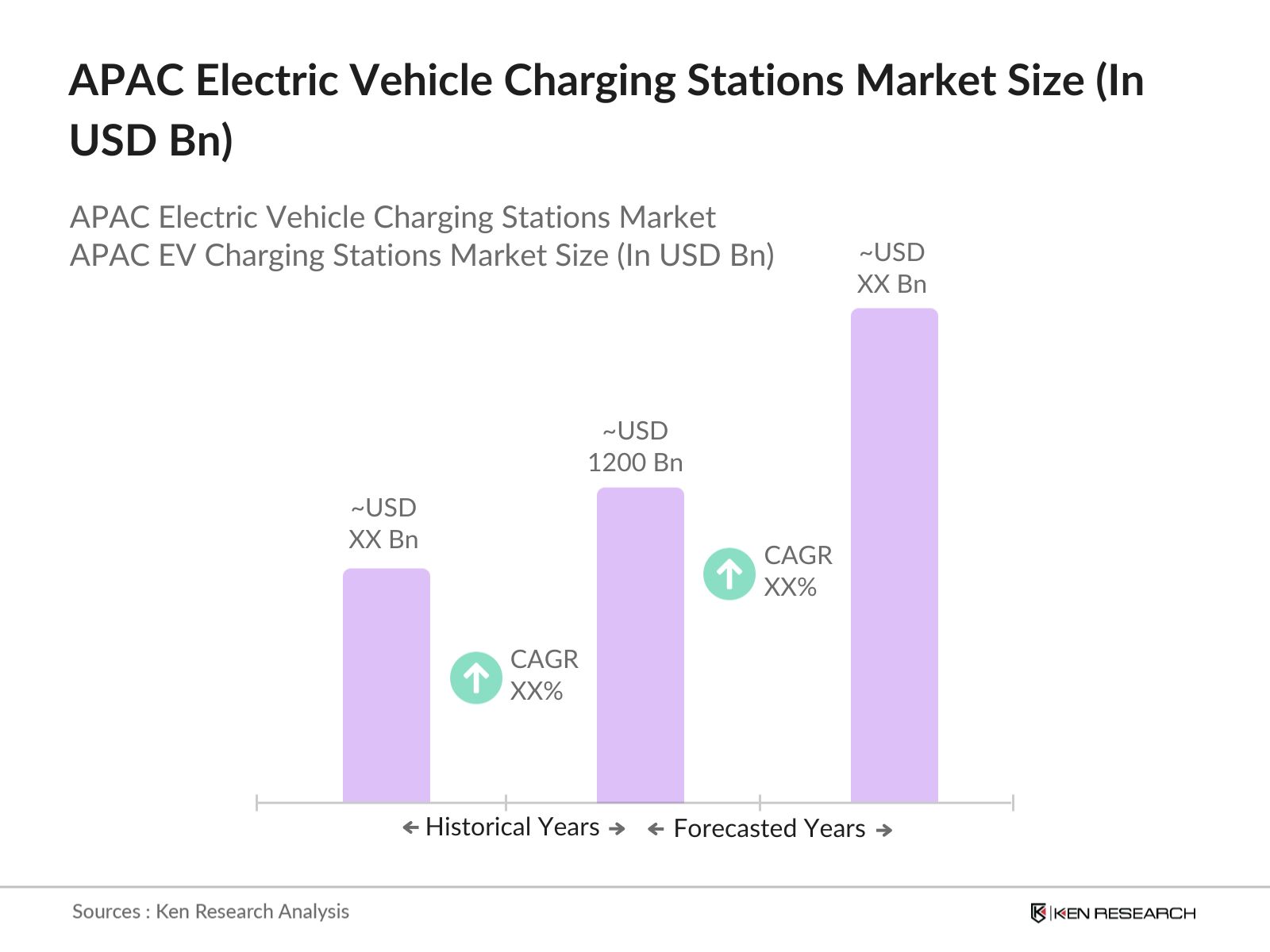
- The APAC electric vehicle (EV) charging stations market was valued at USD 1200 billion, based on a five-year historical analysis. The rapid adoption of electric vehicles in countries such as China, Japan, and South Korea, driven by government incentives and environmental regulations, has significantly propelled the demand for EV charging infrastructure. The increasing focus on reducing carbon emissions and promoting green transportation solutions is expected to continue driving the market, especially in urban areas where EV ownership is growing rapidly.
- The market's growth is concentrated in major metropolitan regions such as Beijing, Shanghai, Tokyo, and Seoul, where government-led initiatives to increase EV penetration are most prominent. These areas offer advanced infrastructure, large-scale government subsidies, and strong demand from both private and commercial EV owners. China, the largest EV market globally, is at the forefront, with government mandates pushing for the deployment of charging stations in residential areas, highways, and public spaces.
- Governments across the region have established stringent guidelines and subsidies to promote the development of EV infrastructure. In South Korea, the government offers subsidies covering up to 50% of the installation costs for public charging stations under its National EV Deployment Plan. Japan provides tax credits for businesses that install charging infrastructure, with additional incentives for those using renewable energy sources. Additionally, various government policies offer financial support for the installation of both residential and public charging stations.
APAC Electric Vehicle Charging Stations Market Segmentation
- By Charger Type: The market is segmented by charger type into Level 1 (AC), Level 2 (AC), and DC Fast Chargers. DC fast chargers dominate the market, particularly in urban areas and highways, due to their ability to charge vehicles quickly and efficiently. With the rise of long-range EV models, fast chargers are essential for reducing charging times, thus driving their adoption in public and commercial spaces. Major players like BYD, ABB, and Delta Electronics are investing heavily in the development and deployment of DC fast chargers across the region.

- By Application: The market is segmented by application into residential, commercial, and public charging stations. Commercial charging stations, particularly those in public locations like shopping malls, office buildings, and parking lots, hold the largest market share due to the increasing number of EVs used for commercial purposes like ride-hailing and delivery services. As cities like Beijing and Tokyo push for electric-only fleets by 2030, the need for commercial charging infrastructure is set to expand rapidly.

APAC Electric Vehicle Charging Stations Market Competitive Landscape
The market is characterized by intense competition, with both global and regional players vying for dominance. Major players include BYD, ABB, Delta Electronics, and State Grid Corporation of China, all of which are investing heavily in expanding their charging infrastructure networks. These companies are focused on innovation, with an emphasis on developing fast and ultra-fast charging technologies to meet growing consumer demands.
|
Company Name |
Establishment Year |
Headquarters |
Revenue (USD Mn) |
Number of Employees |
Key Product |
R&D Investment |
Certifications |
Strategic Partnerships |
Customer Base |
|
Thorne Research |
1984 |
New York, USA |
|||||||
|
Jarrow Formulas |
1977 |
California, USA |
|||||||
|
NOW Foods |
1968 |
Illinois, USA |
|||||||
|
Pure Encapsulations |
1991 |
Massachusetts, USA |
|||||||
|
Life Extension |
1980 |
Florida, USA |
APAC Electric Vehicle Charging Stations Industry Analysis
Growth Drivers
- Government Incentives and Subsidies (Subsidy Programs, EV Adoption Policies): Government incentives play a key role in the rapid expansion of electric vehicle (EV) charging stations across Asia-Pacific. China, has committed over USD 6 billion between 2020-2024 towards EV infrastructure under its New Energy Vehicle Industry Development Plan. India has allocated approximately USD 1.4 billion for electric vehicle infrastructure as part of its Faster Adoption and Manufacturing of Hybrid and Electric Vehicles (FAME) initiative. These programs include subsidies for both EV purchases and the installation of public charging stations. Such incentives significantly reduce capital expenditure barriers for businesses entering the charging station marketng Electric Vehicle Adoption (EV Penetration Rate) The rising adoption of electric vehicles (EVs) is driving the demand for charging infrastructure.
- En and Carbon Emission Reduction Goals (Country-Specific Regulations): Governments in Asia-Pacific are accelerating EV adoption as part of their carbon emission reduction goals. For instance, Japans Green Growth Strategy aims to eliminate gasoline vehicle sales by 2035, pushing the expansion of EV infrastructure. In South Korea, the governments plan to achieve net-zero emissions by 2050 is supported by initiatives to deploy 500,000 charging stations nationwide. These environmental goals, aligned with global climate agreements, necessitate a robust charging infrastructure to accommodate the shift from conventional fuel to electricity.
- Technological Advancing (DC Fast Charging Infrastructure Growth): Technological advancements, particularly in direct current (DC) fast charging, are transforming the electric vehicle market. By 2024, China aims to install over 800,000 DC fast chargers to support high-capacity EVs. South Korea is also planning to boost its fast-charging network by establishing 15,000 public fast-charging stations. These chargers allow for a 20-minute charging time, addressing key concerns around the long wait times associated with slower charging options. The shift to fast charging infrastructure improves consumer confidence, further driving EV adoption in the region.
Market Challenges
- High Installation and Infrastructure Costs (Cost of Fast Chargers, Installation Barriers): The installation of fast chargers is a significant investment, with prices varying based on the technology and geographic location. These costs include both the physical infrastructure and the technical expertise required for deployment. The challenge is more pronounced for smaller enterprises that may not have the capital to bear such heavy expenditures. In India, government initiatives like FAME II aim to reduce these costs, but financial barriers continue to slow the pace of infrastructure development, particularly in less affluent or remote regions where fewer subsidies are available.
- Limited Charging Infrastructure in Rural Areas: Rural regions across the Asia-Pacific lag in EV infrastructure development, as most charging networks are concentrated in urban areas. This discrepancy stems from logistical challenges such as the higher cost of building infrastructure in remote areas, compounded by a lower density of EV users. Countries like Indonesia and South Korea face challenges in expanding their networks beyond major cities, limiting rural adoption of electric vehicles. As a result, non-urban populations often struggle to access adequate charging facilities, hindering widespread EV adoption across diverse regions.
APAC Electric Vehicle Charging Stations Market Future Outlook
The APAC electric vehicle charging stations market is expected to witness substantial growth over the next five years, driven by government mandates, rising EV adoption, and advancements in charging technology. Fast and ultra-fast chargers will play a key role in this expansion, particularly as long-range electric vehicles become more popular. Collaboration between public and private sectors is crucial in ensuring the rapid development of charging infrastructure across the region.
Market Opportunities
- Expansion of Public-Private Partnerships (Collaborations in Charging Network Development): Public-private partnerships (PPPs) are emerging as a key driver in the expansion of EV charging infrastructure. Japan aims to have a total of 150,000 EV charging stations by 2030, with various initiatives to enhance public charging availability, including those from private companies like Tokyo Electric Power (Tepco), which plans to establish 1,000 rapid charging stations by 2025. These partnerships enable cost-sharing and help accelerate infrastructure development, especially in areas where the private sector alone may not see immediate returns.
- Integration of Renewable Energy (Solar-Powered Charging Stations): The integration of renewable energy sources, such as solar power, into EV charging stations offers a sustainable solution to power electric vehicles. In India, EV manufacturer Hero Electric announced plans to set up 10,000 EV charging stations across India over the next five years, some of which may utilize solar power, reducing reliance on conventional energy sources. China is also piloting solar-powered EV charging hubs in urban areas, with Shenzhen being one of the key cities experimenting with this technology. These initiatives align with the regions broader goals of achieving energy independence and reducing carbon footprints.
Scope of the Report
|
By Charger |
Level 1 (AC) Chargers Level 2 (AC) Chargers DC Fast Chargers |
|
By Application |
Residential Charging Commercial Charging Public Charging |
|
By Connector |
Commercial Charging Public Charging CHAdeMO Combined Charging System (CCS) Tesla Supercharger |
|
By Power Output |
Up to 22 kW 22-100 kW More than 100 kW |
|
By Region |
China Japan South Korea India Rest of Asia-Pacific |
Products
Key Target Audience
EV Manufacturers
Electric Utility Companies
Public Transport Authorities
Logistics and Fleet Operators
Commercial Property Owners
Investments and Venture Capitalist Firms
Banks and Financial Institutes
Government and Regulatory Bodies (Ministry of Energy, National Development and Reform Commission of China)
Automotive OEMs
Companies
Major Players in the Market
-
BYD
ABB
Delta Electronics
State Grid Corporation of China
Tata Power
Siemens AG
Schneider Electric
Hitachi Energy
Shell Recharge
ChargePoint
EVBox
NIO Power
Fastned
Envision Digital
Hyundai Motor Company
Table of Contents
1. APAC Electric Vehicle Charging Stations Market Overview
1.1. Definition and Scope
1.2. Market Taxonomy
1.3. Market Growth Rate (Charging Station Growth Trends, EV Adoption Rate)
1.4. Market Segmentation Overview (Charger Type, Application, Connector Type, Power Output, Country)
2. APAC Electric Vehicle Charging Stations Market Size (In USD Bn)
2.1. Historical Market Size (EV Charging Infrastructure Growth, Historical EV Sales)
2.2. Year-On-Year Growth Analysis (Y-o-Y Growth in Charging Stations and EVs)
2.3. Key Market Developments and Milestones (Key Government Policies, Subsidy Programs, Charging Network Expansion)
3. APAC Electric Vehicle Charging Stations Market Analysis
3.1. Growth Drivers
3.1.1. Government Incentives and Subsidies (Subsidy Programs, EV Adoption Policies)
3.1.2. Rising Electric Vehicle Adoption (EV Penetration Rate)
3.1.3. Environmental Concerns and Carbon Emission Reduction Goals (Country-Specific Regulations)
3.1.4. Technological Advancements in Fast Charging (DC Fast Charging Infrastructure Growth)
3.2. Market Challenges
3.2.1. High Installation and Infrastructure Costs (Cost of Fast Chargers, Installation Barriers)
3.2.2. Limited Charging Infrastructure in Rural Areas (Rural Penetration of Charging Networks)
3.2.3. Compatibility Issues with Charging Connectors (Standardization of Connectors)
3.3. Opportunities
3.3.1. Expansion of Public-Private Partnerships (Collaborations in Charging Network Development)
3.3.2. Integration of Renewable Energy (Solar-Powered Charging Stations)
3.3.3. EV Fleet Charging Solutions for Commercial Vehicles (Fleet Adoption of EVs)
3.4. Trends
3.4.1. Development of Ultra-Fast Charging Solutions (More Than 150kW Chargers)
3.4.2. Mobile and Portable Charging Stations (Mobile Charging Units for Remote Areas)
3.4.3. Integration with Smart Grid Technologies (Smart Charging Solutions and Grid Stability)
3.5. Government Regulations
3.5.1. National Electric Vehicle Policies (EV Charging Infrastructure Policies by Country)
3.5.2. Incentives for Charging Station Deployment (Government Support Programs)
3.5.3. Compliance with Safety and Performance Standards (Safety Regulations for Chargers)
3.6. SWOT Analysis
3.7. Stake Ecosystem (Public Sector, Private Charging Providers, OEMs)
3.8. Porters Five Forces (Supplier Power, Buyer Power, Barriers to Entry, Rivalry, Substitutes)
3.9. Competition Ecosystem (Charging Station Market Dynamics, Competitive Landscape)
4. APAC Electric Vehicle Charging Stations Market Segmentation
4.1. By Charger Type (In Value %)
4.1.1. Level 1 (AC) Chargers
4.1.2. Level 2 (AC) Chargers
4.1.3. DC Fast Chargers
4.2. By Application (In Value %)
4.2.1. Residential Charging
4.2.2. Commercial Charging
4.2.3. Public Charging
4.3. By Connector Type (In Value %)
4.3.1. CHAdeMO
4.3.2. Combined Charging System (CCS)
4.3.3. Tesla Supercharger
4.4. By Power Output (In Value %)
4.4.1. Up to 22 kW
4.4.2. 22-100 kW
4.4.3. More than 100 kW
4.5. By Country (In Value %)
4.5.1. China
4.5.2. Japan
4.5.3. South Korea
4.5.4. India
4.5.5. Rest of APAC
5. APAC Electric Vehicle Charging Stations Market Competitive Analysis
5.1. Detailed Profiles of Major Companies
5.1.1. ABB
5.1.2. BYD
5.1.3. Delta Electronics
5.1.4. State Grid Corporation of China
5.1.5. Siemens AG
5.1.6. Schneider Electric
5.1.7. Eaton Corporation
5.1.8. Shell Recharge
5.1.9. Tata Power
5.1.10. Hitachi Energy
5.1.11. ChargePoint
5.1.12. EVBox
5.1.13. NIO Power
5.1.14. Fastned
5.1.15. Envision Digital
5.2. Cross Comparison Parameters (No. of Employees, Headquarters, Inception Year, Revenue, Market Share, Installed Charging Stations, Key Products, Geographical Presence)
5.3. Market Share Analysis (Top 10 Companies, Market Concentration)
5.4. Strategic Initiatives (Key Partnerships, Collaborations, Government Contracts)
5.5. Mergers and Acquisitions (Notable M&A in the Sector)
5.6. Investment Analysis (Key Investments by Major Players)
5.7. Venture Capital Funding (Startup Investments in Charging Technology)
5.8. Government Grants (Government Grants for Charging Infrastructure)
5.9. Private Equity Investments (Private Sector Investments in Charging Solutions)
6. APAC Electric Vehicle Charging Stations Market Regulatory Framework
6.1. Environmental Standards (Country-Specific Emission Targets)
6.2. Compliance Requirements (Regulations on Charging Equipment Safety and Performance)
6.3. Certification Processes (Approval Processes for Charging Stations)
7. APAC Electric Vehicle Charging Stations Future Market Size (In USD Bn)
7.1. Future Market Size Projections (Forecasted Growth in EV Charging Stations)
7.2. Key Factors Driving Future Market Growth (EV Sales Growth, Government Support, Technological Advancements)
8. APAC Electric Vehicle Charging Stations Future Market Segmentation
8.1. By Charger Type (In Value %)
8.2. By Application (In Value %)
8.3. By Connector Type (In Value %)
8.4. By Power Output (In Value %)
8.5. By Country (In Value %)
9. APAC Electric Vehicle Charging Stations Market Analysts Recommendations
9.1. TAM/SAM/SOM Analysis (Total Addressable Market, Serviceable Available Market, Serviceable Obtainable Market)
9.2. Customer Cohort Analysis (EV Drivers, Fleet Operators, Commercial Property Owners)
9.3. Marketing Initiatives (Promotional Strategies for Charging Infrastructure Providers)
9.4. White Space Opportunity Analysis (Untapped Markets and Opportunities in EV Charging)
Research Methodology
Step 1: Identification of Key Variables
The initial phase involved constructing an ecosystem map encompassing all major stakeholders within the Asia-Pacific Electric Vehicle Charging Stations Market. This step is underpinned by extensive desk research, utilizing a combination of secondary and proprietary databases to gather comprehensive industry-level information. The primary objective is to identify and define the critical variables that influence market dynamics.
Step 2: Market Analysis and Construction
In this phase, we compiled and analyzed historical data pertaining to the Asia-Pacific Electric Vehicle Charging Stations Market. This included assessing market penetration, the ratio of charging stations to EVs, and revenue generation from commercial charging stations. We further evaluated infrastructure development statistics to ensure the reliability and accuracy of the revenue estimates.
Step 3: Hypothesis Validation and Expert Consultation
Market hypotheses were developed and subsequently validated through computer-assisted telephone interviews (CATIS) with industry experts representing a diverse array of companies. These consultations provided valuable operational and financial insights directly from industry practitioners, which were instrumental in refining and corroborating the market data.
Step 4: Research Synthesis and Final Output
The final phase involved direct engagement with multiple charging station providers to acquire detailed insights into product segments, sales performance, and charging technology preferences. This interaction served to verify and complement the statistics derived from the bottom-up approach, thereby ensuring a comprehensive, accurate, and validated analysis of the Asia-Pacific Electric Vehicle Charging Stations Market.
Frequently Asked Questions
01. How big is the Asia-Pacific Electric Vehicle Charging Stations Market?
The Asia-Pacific electric vehicle charging stations market is valued at USD 1190 billion, driven by government initiatives to support EV adoption and the increasing demand for efficient charging infrastructure.
02. What are the challenges in the Asia-Pacific Electric Vehicle Charging Stations Market?
Challenges include high installation costs for charging infrastructure, especially fast chargers, and the lack of charging stations in rural areas, which hampers widespread EV adoption.
03. Who are the major players in the Asia-Pacific Electric Vehicle Charging Stations Market?
Key players include BYD, ABB, Delta Electronics, State Grid Corporation of China, and Tata Power, all of which are investing heavily in expanding charging infrastructure across the region.
04. What are the growth drivers of the Asia-Pacific Electric Vehicle Charging Stations Market?
The market is driven by strong government support, rising EV adoption, technological advancements in fast charging, and an increasing focus on sustainability and carbon reduction across major economies like China and Japan.
Why Buy From Us?

What makes us stand out is that our consultants follows Robust, Refine and Result (RRR) methodology. i.e. Robust for clear definitions, approaches and sanity checking, Refine for differentiating respondents facts and opinions and Result for presenting data with story

We have set a benchmark in the industry by offering our clients with syndicated and customized market research reports featuring coverage of entire market as well as meticulous research and analyst insights.

While we don't replace traditional research, we flip the method upside down. Our dual approach of Top Bottom & Bottom Top ensures quality deliverable by not just verifying company fundamentals but also looking at the sector and macroeconomic factors.

With one step in the future, our research team constantly tries to show you the bigger picture. We help with some of the tough questions you may encounter along the way: How is the industry positioned? Best marketing channel? KPI's of competitors? By aligning every element, we help maximize success.

Our report gives you instant access to the answers and sources that other companies might choose to hide. We elaborate each steps of research methodology we have used and showcase you the sample size to earn your trust.

If you need any support, we are here! We pride ourselves on universe strength, data quality, and quick, friendly, and professional service.