















APAC Electrostatic Precipitators Market Outlook to 2030
Region:Asia
Author(s):Shubham Kashyap
Product Code:KROD2126
October 2024
102
About the Report
APAC Electrostatic Precipitators Market Overview
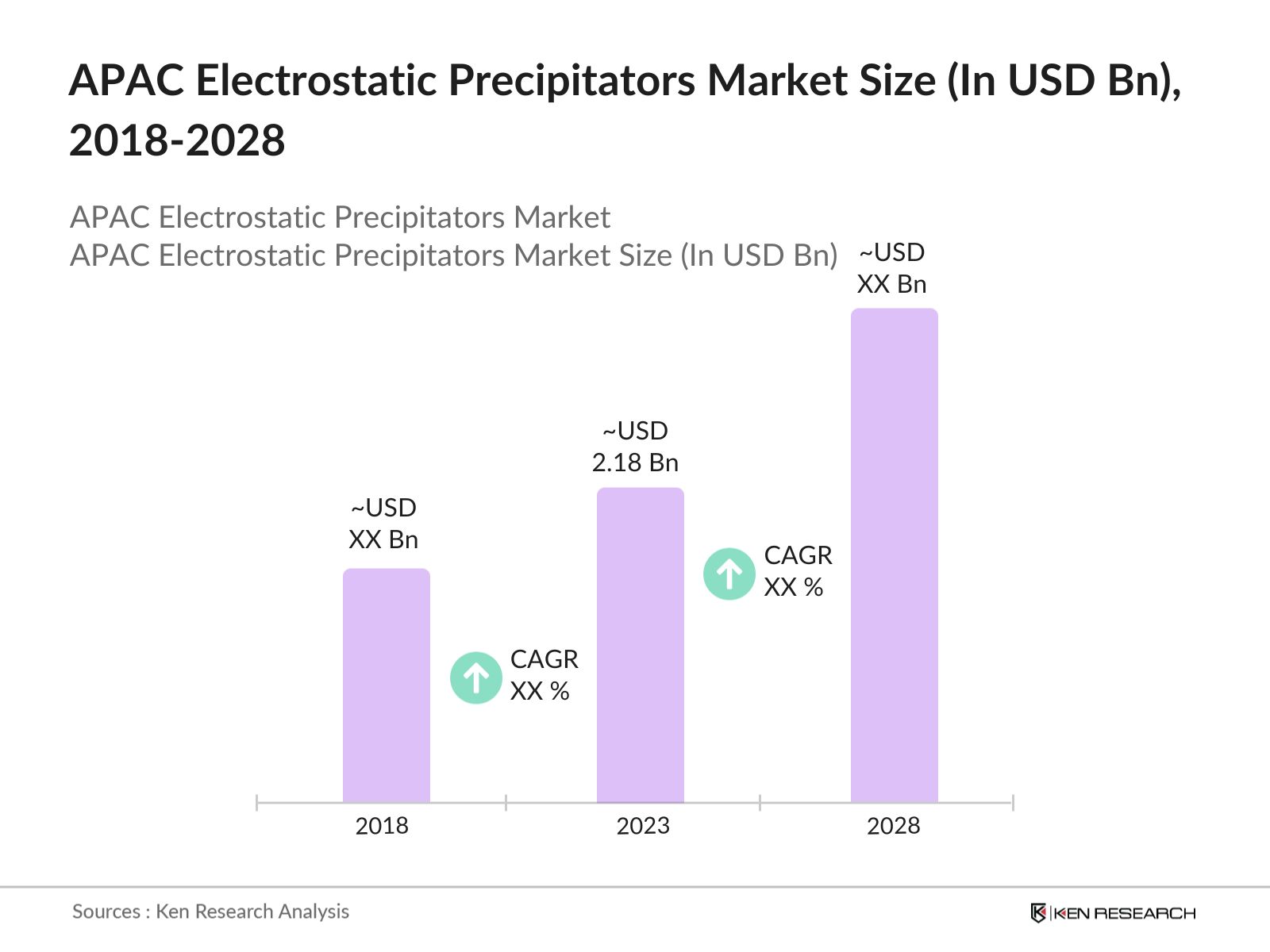
- The Asia Pacific (APAC) Electrostatic Precipitators Market was valued at USD 2.18 billion, driven by the region's growing industrialization, rising environmental regulations, and increasing need for air pollution control measures. Countries such as China, India, and Japan are investing significantly in pollution control technologies, which are the key drivers of this market.
- Key players in the APAC Electrostatic Precipitators market include GEA Group, Babcock & Wilcox, Mitsubishi Hitachi Power Systems, Siemens AG, and Fujian Longking Co., Ltd. These companies focus on developing innovative electrostatic precipitator (ESP) solutions tailored to meet stringent emission regulations.
- Major urban centers propelling the market in the APAC region include Beijing, New Delhi, and Tokyo, where rapid industrialization and environmental concerns demand effective pollution control solutions. The increasing industrial emissions and enforcement of strict emission regulations are driving the adoption of ESPs in these regions.
- GEA Group, recently announced the installation of a high-efficiency Electrostatic Precipitator (ESP) system at a large cement plant in India. This installation is designed to help the cement plant meet the latest emission norms imposed by the Indian government, specifically the Bharat Stage VI (BS6) norms that took effect in April 2023.
APAC Electrostatic Precipitators Market Segmentation
The APAC Electrostatic Precipitators Market can be segmented based on type, application, and region:
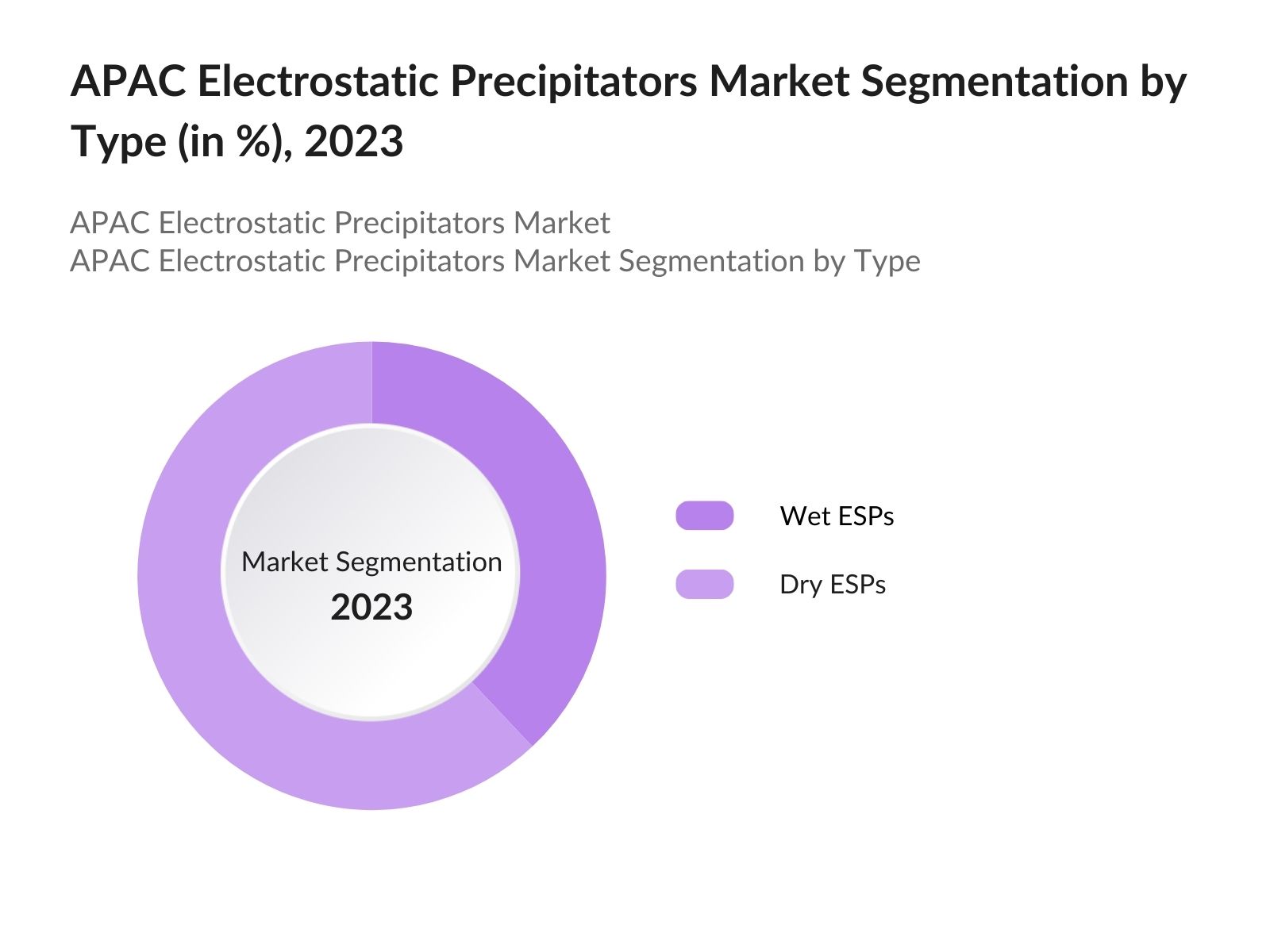
- By Type: The market is segmented into wet ESPs and dry ESPs. In 2023, the dry ESP segment held a dominant market share due to its widespread usage in high-temperature industries like power generation and cement. Dry ESPs are favored for their efficiency in handling large volumes of flue gases with high particulate concentrations, making them an essential solution for industries that need to comply with strict emission standards.
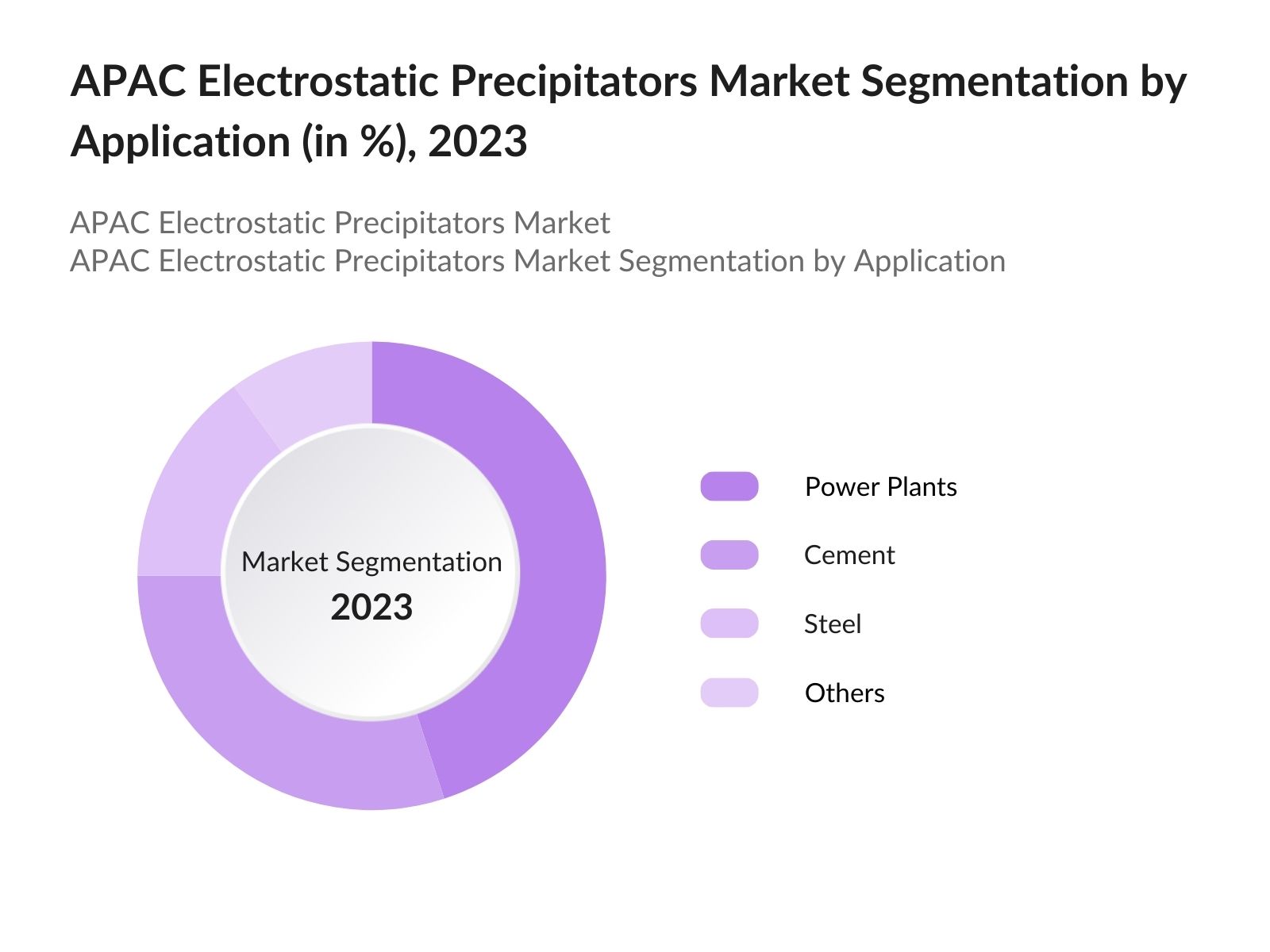
- By Application: The market is segmented by application into power plants, cement, steel, and others. The power plants segment dominated the market in 2023 due to the growing number of coal-fired power plants across the APAC region, particularly in China and India. These power plants require ESP systems to reduce particulate emissions and comply with government regulations.
- By Region: The APAC market is segmented by country into China, India, Japan, South Korea, and Australia. In 2023, China led the market with the highest share due to the countrys rapid industrialization and strict emission control regulations. The countrys increasing investments in power generation, cement, and steel industries are contributing to the growing demand for ESPs.
APAC Electrostatic Precipitators Market Competitive Landscape
|
Company Name |
Establishment Year |
Headquarters |
|
GEA Group |
1881 |
Dsseldorf, Germany |
|
Babcock & Wilcox |
1867 |
Akron, USA |
|
Mitsubishi Hitachi Power |
1964 |
Tokyo, Japan |
|
Siemens AG |
1847 |
Munich, Germany |
|
Fujian Longking Co., Ltd |
1970 |
Longyan, China |
- Siemens AG: In July 2024, Siemens inaugurated a new Center of Competence for Data Centers at the Global Infocity Park in Chennai, India.This 6,000m2 facility serves as a regional innovation hub, uniting over 200 designers, planners, engineers and project managers to facilitate greater innovation in scalable and modular data center solutions across the Asia-Pacific (APAC) region.
- Fujian Longking Co., Ltd: In 2021, Fujian Longking was awarded a contract to supply ESPs for a major coal-fired power plant project in Vietnam. This project highlights the company's growing presence in the Southeast Asian market. The company has also been actively participating in India's efforts to upgrade ESP systems at thermal power plants to meet stricter emission norms.
APAC Electrostatic Precipitators Industry Analysis
Growth Drivers:
- Stringent Environmental Regulations: In 2023, the APAC region has seen the implementation of stricter environmental regulations aimed at reducing industrial emissions. Chinas Blue Sky initiative, launched in 2023 aims to reduce PM2.5 density in cities at the prefecture level and above by 10% by 2025 compared to 2020 levels. Similarly, Indias National Clean Air Program (NCAP) targets a reducing particulate matter (both PM10 and PM2.5) levels by 20-30% by 2024, using 2017 as the base year for comparison. These regulations have created a surge in demand for electrostatic precipitators (ESPs), particularly in industries such as power generation, cement, and steel, where particulate emissions are high.
- Industrial Expansion in Emerging Economies: The rapid industrial expansion in emerging economies like India, Vietnam, and Indonesia is a significant driver for the APAC Electrostatic Precipitators market. India's industrial production, as measured by the Index of Industrial Production (IIP), grew by 3.8% in December 2023 compared to the same month in 2022, with sectors such as power, steel, and cement accounting for a major share of this growth.
- Investments in Cleaner Energy Solutions: Governments across APAC are investing heavily in cleaner energy technologies, which indirectly boosts the demand for ESPs. In February 2021, the South Korean government planned to invest around USD 43.2 billion in the construction of an 8.2 GW offshore wind project by 2030. Similarly, Japans Ministry of Environment has allocated substantial amount to its Clean Air Initiative, which mandates the adoption of advanced ESP systems in coal-fired power plants and industrial sectors by 2025.
Challenges:
- High Installation and Maintenance Costs: One of the primary challenges faced by the APAC Electrostatic Precipitators market is the high cost of installation and ongoing maintenance. The installation of an industrial ESP can be expensive, depending on the size and industry, and smaller companies, particularly in developing economies, often struggle to afford these high upfront costs.
- Emerging Alternatives to Electrostatic Precipitators: A challenge to the APAC Electrostatic Precipitators market is the increasing use of alternative air pollution control technologies like baghouse filters and fabric filters. These alternatives offer comparable or better particulate removal efficiency and often have lower operational costs. As a result, industries in sectors such as power generation and cement are increasingly adopting these technologies to meet emissions regulations.
Government Initiatives:
- Chinas Air Pollution Control Program: On November 30, 2023, China published its third air pollution control plan, which aims to further reduce airborne pollutants and transition toward clean industry. The plan emphasizes reducing emissions of nitrogen oxides (NOx) and volatile organic compounds (VOCs) and sets specific targets for PM2.5 pollution reduction by 2025.
- Indias National Clean Air Program (NCAP): The NCAP was launched in January 2019 and initially aimed for a 20-30% reduction in PM levels by 2024. However, this target has since been revised to a 40% reduction by 2025-26. The program covers 132 non-attainment cities, which are cities that have consistently failed to meet national air quality standards, not just over 100 cities.
APAC Electrostatic Precipitators Market Future Outlook
The APAC Electrostatic Precipitators Market is expected to witness substantial growth from 2023 to 2028, driven by increasing industrial activities, rising environmental awareness, and stringent emission regulations.
Future Market Trends:
- Integration of Smart Technologies in ESPs: Over the next five years, the integration of smart monitoring systems in ESPs is expected to increase. These systems will enable real-time monitoring of emission levels, thereby enhancing operational efficiency and helping industries meet regulatory requirements.
- Advancement in Hybrid ESP Technologies: Over the next five years, the market is expected to witness significant advancements in hybrid ESP technologies, combining ESP with fabric filters to improve particulate removal efficiency. By 2028, hybrid ESPs are projected to become a preferred choice in sectors like cement and power generation, particularly in regions like South Korea and Japan.
Scope of the Report
|
By Type |
Dry ESPs Wet ESPs |
|
By Application |
Power Plants Cement Steel Others |
|
By End-User |
Power Generation Cement Industry Metals & Mining Others |
|
By Offering |
Hardware Software Services |
|
By Region |
China India Japan South Korea Australia |
Products
Key Target Audience Organizations and Entities Who Can Benefit by Subscribing to This Report:
Electrostatic Precipitator Manufacturers
Air Pollution Control Technology Providers
Power Generation Companies
Cement and Steel Manufacturers
Utility Service Providers
Industrial Equipment Suppliers
Energy Sector Companies
Government and Regulatory Bodies (Ministry of Environment and Forests and China Ministry of Ecology and Environment)
Investments and Venture Capitalist Firms
Banks and financial institute
Time Period Captured in the Report:
Historical Period: 2018-2023
Base Year: 2023
Forecast Period: 2023-2028
Companies
Players Mentioned in the Report:
GEA Group
Babcock & Wilcox
Mitsubishi Hitachi Power Systems
Siemens AG
Fujian Longking Co., Ltd
Thermax Limited
Balcke-Drr GmbH
Ducon Technologies
Hamon Research-Cottrell
Trion IAQ
Alstom SA
KC Cottrell Co., Ltd
Bionomic Industries Inc.
Envirosystems Manufacturing
FL Smidth & Co. A/S
Table of Contents
APAC Electrostatic Precipitators Market Overview
- 1.1. Definition and Scope
- 1.2. Market Taxonomy
- 1.3. Market Growth Rate
- 1.4. Market Segmentation Overview
APAC Electrostatic Precipitators Market Size (in USD Mn), 2018-2023
- 2.1. Historical Market Size
- 2.2. Year-on-Year Growth Analysis
- 2.3. Key Market Developments and Milestones
APAC Electrostatic Precipitators Market Analysis
- 3.1. Growth Drivers
- 3.1.1. Stringent Environmental Regulations
- 3.1.2. Industrial Expansion in Emerging Economies
- 3.1.3. Investments in Cleaner Energy Solutions
- 3.2. Challenges
- 3.2.1. High Installation and Maintenance Costs
- 3.2.2. Emerging Alternatives to Electrostatic Precipitators
- 3.2.3. Technical Limitations of Existing ESP Systems
- 3.3. Opportunities
- 3.3.1. Technological Advancements in ESP Design
- 3.3.2. Increasing Demand for Retrofit Solutions
- 3.3.3. Expansion of Industrial Sectors in APAC
- 3.4. Trends
- 3.4.1. Integration of Smart Technologies in ESPs
- 3.4.2. Advancement in Hybrid ESP Technologies
- 3.4.3. Growing Focus on Low-Emission Technologies
- 3.5. Government Initiatives
- 3.5.1. Chinas Air Pollution Control Program
- 3.5.2. Indias National Clean Air Program (NCAP)
- 3.5.3. South Koreas Green New Deal Initiative
APAC Electrostatic Precipitators Market Segmentation, 2023
- 4.1. By Type (in Value %)
- 4.1.1. Wet ESPs
- 4.1.2. Dry ESPs
- 4.2. By Application (in Value %)
- 4.2.1. Power Plants
- 4.2.2. Cement
- 4.2.3. Steel
- 4.2.4. Others
- 4.3. By Region (in Value %)
- 4.3.1. China
- 4.3.2. India
- 4.3.3. Japan
- 4.3.4. South Korea
- 4.3.5. Australia
- 4.4. By End-User (in Value %)
- 4.4.1. Power Generation
- 4.4.2. Cement Industry
- 4.4.3. Metals & Mining
- 4.4.4. Others
- 4.5. By Offering (in Value %)
- 4.5.1. Hardware
- 4.5.2. Software
- 4.5.3. Services
APAC Electrostatic Precipitators Market Cross Comparison
- 5.1. Detailed Profiles of Major Companies
- 5.2. Cross Comparison Parameters (Establishment Year, Headquarters, Market Presence, Strategic Initiatives)
APAC Electrostatic Precipitators Market Competitive Landscape
- 6.1. Market Share Analysis
- 6.2. Strategic Initiatives
- 6.3. Mergers and Acquisitions
- 6.4. Investment Analysis
- 6.4.1. Venture Capital Funding
- 6.4.2. Government Grants
- 6.4.3. Private Equity Investments
APAC Electrostatic Precipitators Market Regulatory Framework
- 7.1. Regulatory Policies
- 7.2. Compliance Requirements
- 7.3. Certification Processes
APAC Electrostatic Precipitators Market Future Size (in USD Mn), 2023-2028
- 8.1. Future Market Size Projections
- 8.2. Key Factors Driving Future Market Growth
APAC Electrostatic Precipitators Market Future Segmentation, 2028
- 9.1. By Type (in Value %)
- 9.2. By Application (in Value %)
- 9.3. By Region (in Value %)
- 9.4. By End-User (in Value %)
- 9.5. By Offering (in Value %)
APAC Electrostatic Precipitators Market Analysts’ Recommendations
- 10.1. TAM/SAM/SOM Analysis
- 10.2. Customer Cohort Analysis
- 10.3. Marketing Initiatives
- 10.4. White Space Opportunity Analysis
Research Methodology
Step: 1 Identifying Key Variables
Ecosystem creation for all the major entities and referring to multiple secondary and proprietary databases to perform desk research around market to collate industry level information.
Step: 2 Market Building
Collating statistics on APAC electrostatic precipitators market over the years, penetration of marketplaces and service providers ratio to compute revenue generated for APAC electrostatic precipitators market. We will also review service quality statistics to understand revenue generated which can ensure accuracy behind the data points shared.
Step: 3 Validating and Finalizing
Building market hypothesis and conducting CATIs with industry experts belonging to different companies to validate statistics and seek operational and financial information from company representatives.
Step: 4 Research Output
Our team will approach multiple essential OEMs companies and understand nature of product segments and sales, consumer preference and other parameters, which will support us validate statistics derived through bottom to top approach from OEMs companies.
Frequently Asked Questions
01 How big is the APAC Electrostatic Precipitators market?
The APAC Electrostatic Precipitators market was valued at USD 2.18 billion in 2023, driven by growing industrialization and stringent environmental regulations across the region.
02 What are the challenges in the APAC Electrostatic Precipitators market?
Challenges include high installation and maintenance costs, which restrict adoption in smaller firms. Additionally, the increasing preference for alternative air pollution control technologies like baghouse filters poses a significant challenge.
03 Who are the major players in the APAC Electrostatic Precipitators market?
Key players include GEA Group, Babcock & Wilcox, Mitsubishi Hitachi Power Systems, Siemens AG, and Fujian Longking Co., Ltd. These companies are known for their advanced ESP solutions and significant market presence.
04 What are the growth drivers of the APAC Electrostatic Precipitators market?
Growth drivers include stringent environmental regulations such as China's "Blue Sky" initiative and India's National Clean Air Program, which are increasing the demand for ESPs. Additionally, rapid industrial expansion in emerging economies boosts market growth.
Why Buy From Us?

What makes us stand out is that our consultants follows Robust, Refine and Result (RRR) methodology. i.e. Robust for clear definitions, approaches and sanity checking, Refine for differentiating respondents facts and opinions and Result for presenting data with story

We have set a benchmark in the industry by offering our clients with syndicated and customized market research reports featuring coverage of entire market as well as meticulous research and analyst insights.

While we don't replace traditional research, we flip the method upside down. Our dual approach of Top Bottom & Bottom Top ensures quality deliverable by not just verifying company fundamentals but also looking at the sector and macroeconomic factors.

With one step in the future, our research team constantly tries to show you the bigger picture. We help with some of the tough questions you may encounter along the way: How is the industry positioned? Best marketing channel? KPI's of competitors? By aligning every element, we help maximize success.

Our report gives you instant access to the answers and sources that other companies might choose to hide. We elaborate each steps of research methodology we have used and showcase you the sample size to earn your trust.

If you need any support, we are here! We pride ourselves on universe strength, data quality, and quick, friendly, and professional service.