















APAC EV Battery Market Outlook to 2030
Region:Asia
Author(s):Shubham Kashyap
Product Code:KROD3275
November 2024
88
About the Report
APAC EV Battery Market Overview
- The APAC EV battery market is valued at USD 30 billion, following a five-year historical analysis. The growth is primarily driven by increasing demand for electric vehicles (EVs) across major economies in the region, including China, Japan, and South Korea. With government support for clean energy initiatives and environmental regulations pushing for a reduction in carbon emissions, EV adoption has surged, consequently driving the demand for EV batteries. The deployment of fast-charging infrastructure, alongside advancements in battery technology, is expected to fuel market growth over the forecast period.
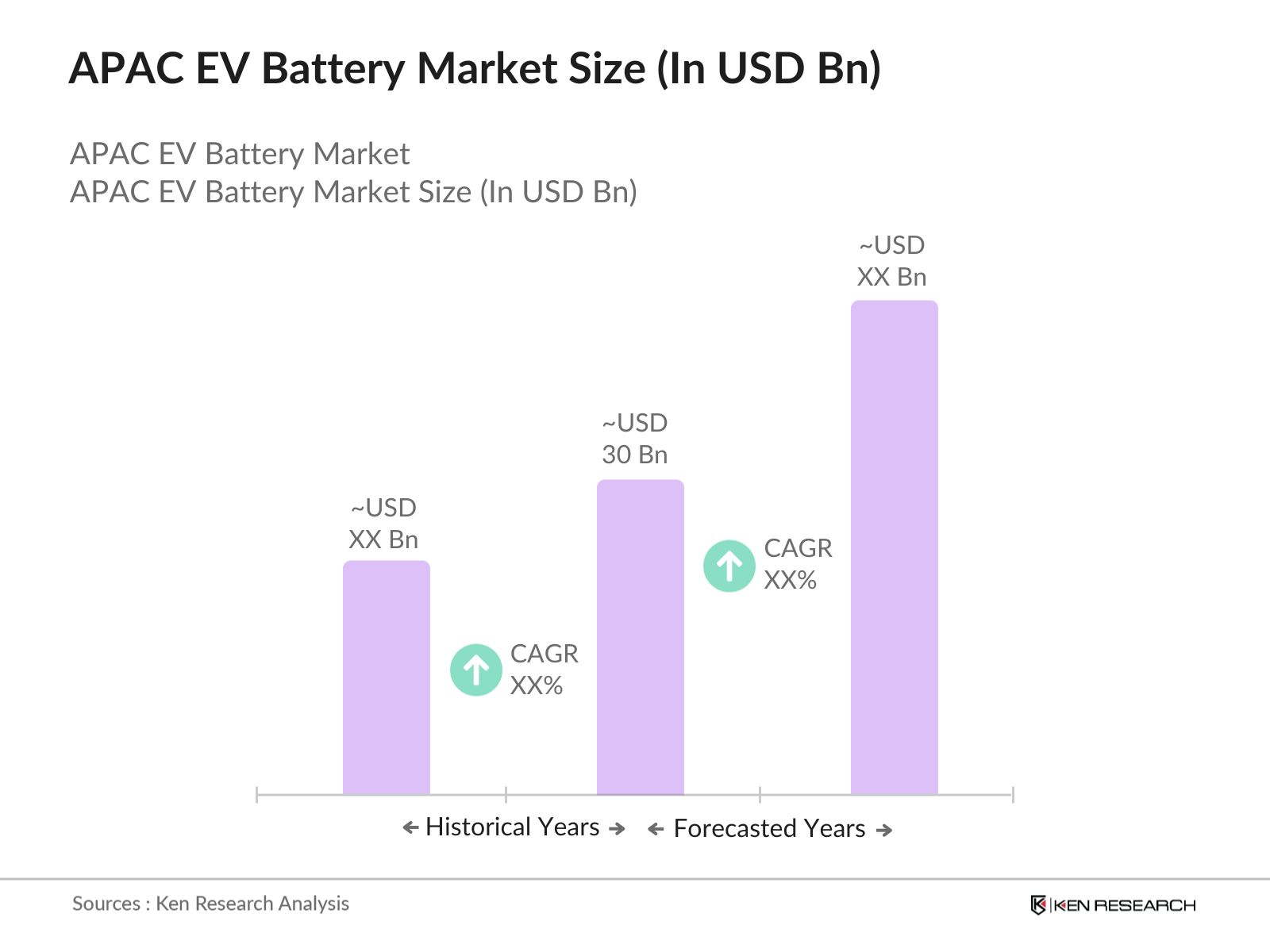
- China dominates the market, being the largest producer and consumer of EV batteries, supported by its robust manufacturing capacity and favorable government policies. Japan and South Korea also play key roles, with companies like Panasonic and LG Energy Solution leading in battery production. Emerging economies in Southeast Asia, such as Thailand and Vietnam, are witnessing significant growth, driven by government initiatives to promote EV adoption and investment in EV battery manufacturing facilities.
- Government policies across APAC are actively promoting EV battery market growth. Chinas New Energy Vehicle (NEV) policies provide subsidies and incentives for EV manufacturers and consumers. South Korea has committed USD 20 billion to battery research and development by 2030, while Japans Ministry of Economy, Trade, and Industry (METI) is actively funding battery technology innovations to secure the countrys leadership in EV battery production.
APAC EV Battery Market Segmentation
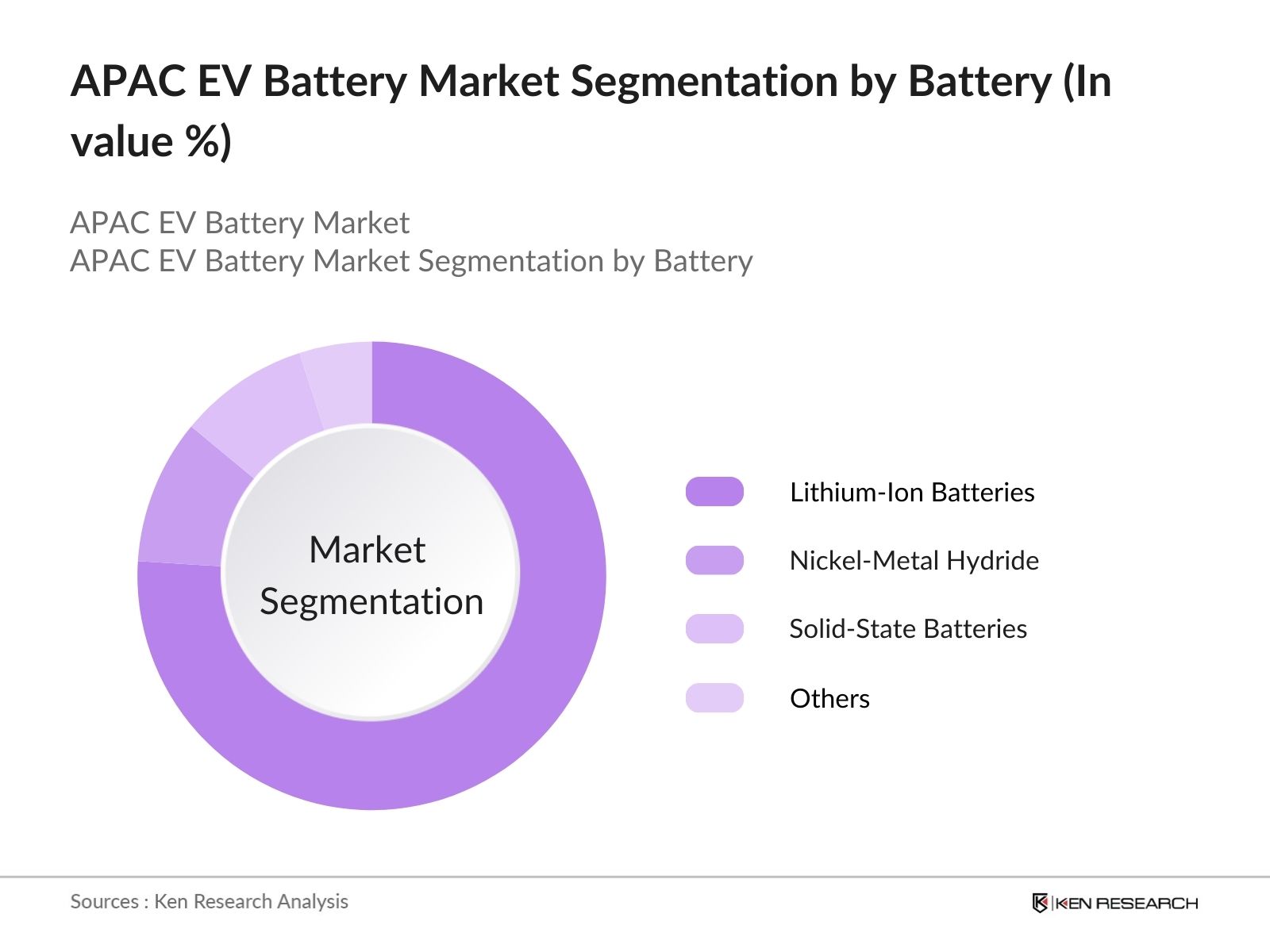
- By Battery Type: The market is segmented by battery type into lithium-ion batteries, nickel-metal hydride batteries, solid-state batteries, and others. Lithium-ion batteries dominate the market due to their high energy density, lightweight nature, and long cycle life, making them the preferred choice for EV manufacturers across the region. Solid-state batteries, though still in the development phase, are gaining attention as they offer enhanced safety and longer lifespans, with several APAC countries investing in research and development of this technology.
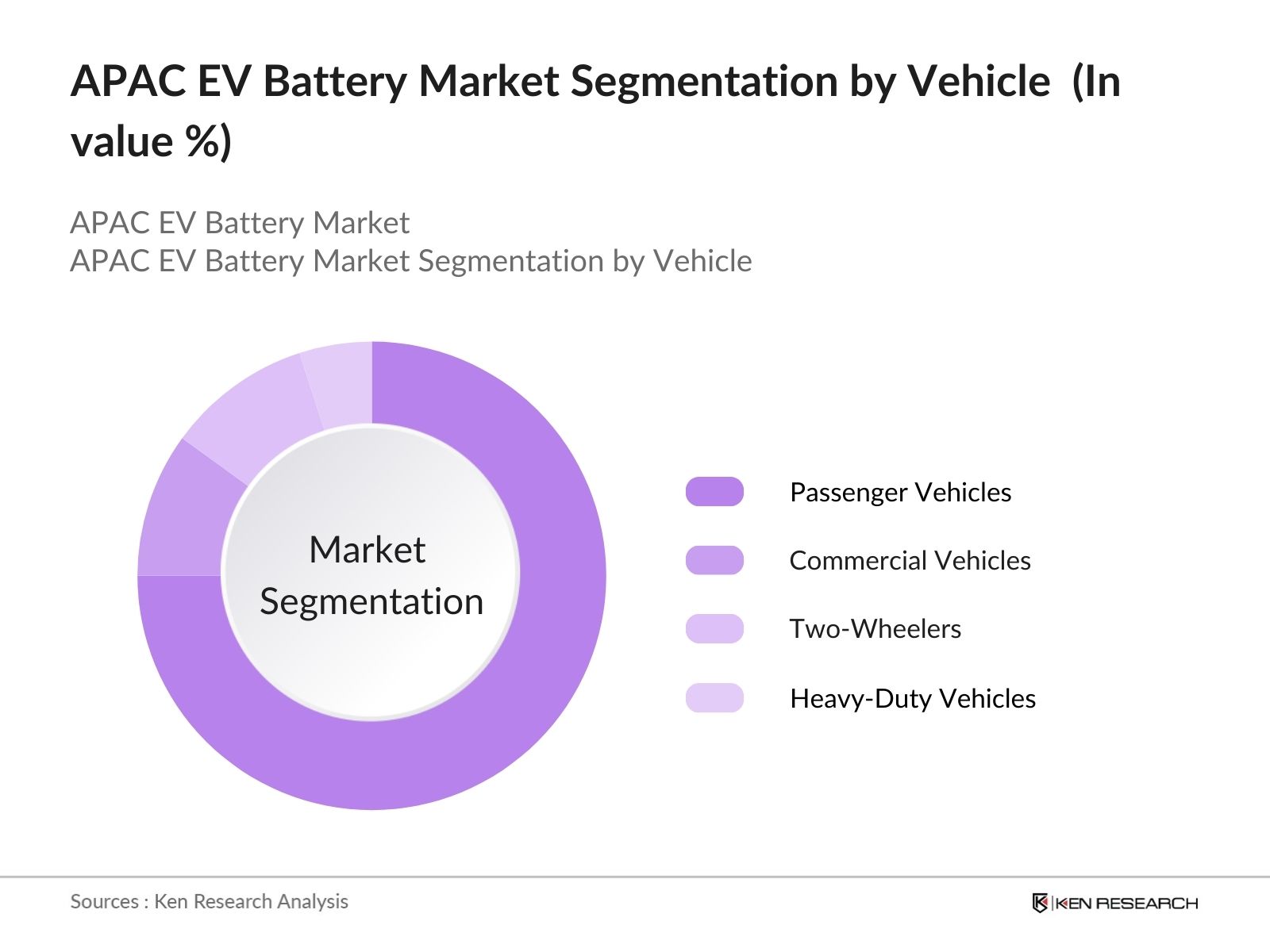
- By Vehicle Type: The EV battery market is further segmented by vehicle type into passenger vehicles, commercial vehicles, heavy duty, and two-wheelers. Passenger vehicles hold the largest market share, with growing consumer demand for electric cars in China, Japan, and South Korea. The two-wheeler segment is particularly prominent in Southeast Asia, where countries like Vietnam and Indonesia are seeing a surge in electric motorcycle adoption due to rising fuel prices and urban mobility challenges.
APAC EV Battery Market Competitive Landscape
The APAC EV battery market is highly competitive, with a mix of global and regional players competing to capture market share through partnerships, technological advancements, and capacity expansions. Leading companies such as Panasonic, CATL, and LG Energy Solution dominate the market, leveraging their strong research and development capabilities and large-scale production facilities.
|
Company Name |
Establishment Year |
Headquarters |
Battery Type |
Production Capacity (GWh) |
Revenue (2023) |
Partnerships |
Market Presence |
R&D Investment |
|
CATL |
2011 |
Ningde, China |
||||||
|
LG Energy Solution |
2020 |
Seoul, South Korea |
||||||
|
Panasonic Corporation |
1918 |
Osaka, Japan |
||||||
|
BYD Company |
1995 |
Shenzhen, China |
||||||
|
Samsung SDI |
1970 |
Seoul, South Korea |
APAC EV Battery Industry Analysis
Growth Drivers
- Government Policies Supporting EV Adoption: Governments across the APAC region have implemented robust policies to accelerate the adoption of electric vehicles (EVs), directly benefiting the EV battery market. China, the largest EV market globally, continues its strong focus on its New Energy Vehicle (NEV) mandate, pushing automakers to ensure 20% of all vehicle sales are electric by 2025. In 2024, China is estimated to produce over 10 million electric vehicles, driving demand for local battery production. Similarly, South Korea has set aside $1.34 billion in 2024 for R&D focused on battery technology and EV adoption, in line with its goal to expand EV use.
- Advances in Battery Technology: Battery technology has seen substantial advancements, with new innovations such as solid-state batteries, which offer greater energy density, faster charging times, and extended lifespan. In 2024, solid-state battery technology in China alone is expected to increase its battery capacity as the is investing overUSD 830 million into R&D. Japanese automakers like Toyota are also investing heavily in solid-state batteries, aiming to commercialize the technology by the end of 2024, directly impacting the demand for higher-performance EV batteries. These advancements are expected to revolutionize EV manufacturing in the APAC region.
- Expansion of Charging Infrastructure: The growth of charging infrastructure plays a pivotal role in the EV battery market. As of 2024, China has installed over 3.2 million public charging stations, making it the largest network globally. India, which is working toward electrifying 30% of its vehicles by 2030, is aggressively expanding its charging infrastructure, adding thousands of stations in 2024 alone. These investments enhance consumer confidence in EVs, stimulating the demand for EV batteries across the region.
Market Challenges
- High Cost of EV Batteries: One of the primary challenges facing the APAC EV battery market is the high cost of battery production. While economies of scale and advancements in production techniques have driven costs down, batteries still account for nearly 30-40% of the total EV cost. Countries like India, where price sensitivity is high, face significant barriers to mass EV adoption due to the elevated cost of batteries. The high costs of raw materials also continue to challenge battery manufacturers, as companies across the region try to reduce production costs while maintaining quality.
- Supply Chain Disruptions: The EV battery market in APAC has experienced disruptions due to supply chain issues, particularly in the sourcing of critical raw materials like lithium, cobalt, and nickel. Geopolitical tensions, particularly between China and other global players, have added to the complexity of maintaining a steady supply of these essential materials. In 2023, several manufacturers in China and Japan reported production delays due to raw material shortages, impacting overall market growth.
APAC EV Battery Market Future Outlook
The APAC EV battery market is expected to witness significant growth over the next five years, driven by increasing EV adoption, continued government support, and advancements in battery technology. As more countries in the region implement stringent emission norms, the demand for EV batteries is projected to rise exponentially. Additionally, the development of solid-state batteries and improvements in battery recycling techniques will open new growth avenues for market players.
Future Market Opportunities
- Expansion of Manufacturing Capacities: Countries like China and South Korea are already global leaders in EV battery production, but there is significant potential for expansion in other APAC markets. Thailand has announced plans to become a regional EV battery production hub by 2025, supported by a USD 2 billion investment in battery manufacturing plants. Similarly, Vietnam and Indonesia are emerging as key players, with substantial foreign direct investment (FDI) flowing into their EV battery sectors.
- Investment in Battery Recycling Technologies: With the rapid increase in EV usage, the need for sustainable battery disposal and recycling solutions has become critical. Japan and South Korea are leading in battery recycling technologies, with both countries investing heavily in recycling plants that recover valuable materials like lithium and cobalt. This trend is expected to gain traction across APAC, offering significant opportunities for companies specializing in battery recycling and sustainable energy solutions.
Scope of the Report
|
By Battery |
Lithium-Ion Batteries Nickel-Metal Hydride Batteries Solid-State Batteries Others |
|
By Vehicle |
Passenger Vehicles Commercial Vehicles Two-Wheelers Heavy-Duty Vehicles |
|
By End-User |
Automotive (EV Manufacturers) Industrial (Grid Storage, Energy Solutions) |
|
By Charging Technology |
Fast-Charging Batteries Conventional Charging Batteries Wireless Charging Batteries |
|
By Region |
China Japan South Korea Rest of APAC |
Products
Key Target Audience
EV Manufacturers
Battery Manufacturers
Investors and Venture Capitalist Firms
Government and Regulatory Bodies (China's Ministry of Industry and Information Technology, South Korea's Ministry of Trade, Industry and Energy)
Automotive OEMs
Energy Storage Solution Providers
Charging Infrastructure Providers
Environmental Agencies
Banks and Financial Institutions
Companies
Major Players Mentioned in the Report
CATL (Contemporary Amperex Technology Co. Limited)
LG Energy Solution
Panasonic Corporation
BYD Company
Samsung SDI
Tesla, Inc.
Envision AESC
Northvolt AB
Farasis Energy
EVE Energy Co.
SVolt Energy Technology Co. Ltd.
CALB (China Aviation Lithium Battery)
A123 Systems
Gotion High-Tech
SK Innovation
Table of Contents
01 APAC EV Battery Market Overview
1.1 Definition and Scope
1.2 Market Taxonomy
1.3 Market Growth Rate
1.4 Market Segmentation Overview
02 APAC EV Battery Market Size (In USD Bn)
2.1 Historical Market Size
2.2 Year-On-Year Growth Analysis
2.3 Key Market Developments and Milestones
03 APAC EV Battery Market Analysis
3.1 Growth Drivers
Government Policies Supporting EV Adoption
Advances in Battery Technology
Expansion of Charging Infrastructure
Rising Environmental Concerns
3.2 Market Challenges
High Manufacturing Costs
Supply Chain Constraints (Lithium, Cobalt, Nickel)
Recycling and Waste Management Challenges
3.3 Opportunities
Emerging Battery Technologies (Solid-State, Fast Charging)
Investment in Battery Recycling Infrastructure
Expansion in Southeast Asian Markets
3.4 Trends
Adoption of Solid-State Batteries
Expansion of Battery as a Service (BaaS)
Growing Investments in Gigafactories
3.5 Government Regulation
Chinas New Energy Vehicle (NEV) Policy
South Koreas Battery R&D Initiative
Japans EV Battery Recycling Regulations
3.6 SWOT Analysis
3.7 Stakeholder Ecosystem (Battery Manufacturers, Suppliers, EV OEMs)
3.8 Porters Five Forces Analysis
3.9 Competitive Landscape
04 APAC EV Battery Market Segmentation
4.1 By Battery Type (In Value %)
Lithium-Ion Batteries
Nickel-Metal Hydride Batteries
Solid-State Batteries
Others
4.2 By Vehicle Type (In Value %)
Passenger Vehicles
Commercial Vehicles
Two-Wheelers
Heavy-Duty Vehicles
4.3 By End-User Application (In Value %)
Automotive (EV Manufacturers)
Industrial (Grid Storage, Energy Solutions)
4.4 By Charging Technology (In Value %)
Fast-Charging Batteries
Conventional Charging Batteries
Wireless Charging Batteries
4.5 By Region (In Value %)
China
Japan
South Korea
Southeast Asia (Thailand, Vietnam, Indonesia)
Rest of APAC
05 APAC EV Battery Market Competitive Analysis
5.1 Detailed Profiles of Major Companies
CATL (Contemporary Amperex Technology Co. Limited)
LG Energy Solution
Panasonic Corporation
Samsung SDI
BYD Company
SK Innovation
Envision AESC
Tesla, Inc.
Gotion High-Tech
Northvolt AB
Farasis Energy
EVE Energy Co.
SVolt Energy Technology Co. Ltd.
CALB (China Aviation Lithium Battery)
A123 Systems
5.2 Cross Comparison Parameters
Headquarters Location
Year of Establishment
Battery Production Capacity
R&D Investment
Revenue (2023)
Global Market Reach (Countries Operated In)
Strategic Partnerships
Number of Patents Held
5.3 Market Share Analysis
5.4 Strategic Initiatives
5.5 Mergers and Acquisitions
5.6 Investment Analysis
5.7 Venture Capital Funding
5.8 Government Grants
5.9 Private Equity Investments
06 APAC EV Battery Market Regulatory Framework
6.1 Emission Standards and Compliance Requirements
6.2 Battery Disposal and Recycling Regulations
6.3 Safety and Quality Certifications (UL, CE)
07 APAC EV Battery Future Market Size (In USD Bn)
7.1 Future Market Size Projections
7.2 Key Factors Driving Future Market Growth
08 APAC EV Battery Future Market Segmentation
8.1 By Battery Type (In Value %)
8.2 By Vehicle Type (In Value %)
8.3 By End-User Application (In Value %)
8.4 By Charging Technology (In Value %)
8.5 By Region (In Value %)
09 APAC EV Battery Market Analysts Recommendations
9.1 TAM/SAM/SOM Analysis
9.2 Customer Cohort Analysis
9.3 Marketing Initiatives
9.4 White Space Opportunity Analysis
Disclaimer Contact UsResearch Methodology
Step 1: Identification of Key Variables
The initial phase involves mapping out the ecosystem of the APAC EV battery market, including key stakeholders such as manufacturers, OEMs, and regulatory bodies. A combination of desk research and proprietary databases is utilized to gather relevant market information, ensuring a comprehensive understanding of market dynamics.
Step 2: Market Analysis and Construction
Historical data regarding the APAC EV battery market is compiled and analyzed, with a focus on production capacity, market penetration, and revenue generation across key regions. This phase includes evaluating industry developments to ensure the accuracy of revenue forecasts and market estimates.
Step 3: Hypothesis Validation and Expert Consultation
Market hypotheses are developed and validated through consultations with industry experts, including executives from EV battery manufacturers and automotive OEMs. These insights help refine the data and provide a more accurate portrayal of market trends.
Step 4: Research Synthesis and Final Output
In this final phase, engagement with EV battery producers and EV manufacturers is undertaken to verify sales data, product innovations, and consumer preferences. This step helps ensure that the final market analysis is comprehensive and validated against industry benchmarks.
Frequently Asked Questions
01. How big is the APAC EV Battery Market?
The APAC EV battery market is valued at USD 30 billion, driven by the rapid adoption of electric vehicles across key markets such as China, Japan, and South Korea, with significant growth expected due to continued government support and technological advancements.
02. What are the challenges in the APAC EV Battery Market?
Challenges in the APAC EV battery market include high manufacturing costs, supply chain disruptions for critical raw materials like lithium and cobalt, and the environmental impact of battery disposal and recycling, which remains a growing concern for governments and manufacturers.
03. Who are the major players in the APAC EV Battery Market?
Major players in the APAC EV battery market include CATL, LG Energy Solution, Panasonic Corporation, BYD Company, and Samsung SDI. These companies dominate the market due to their significant production capacities, technological advancements, and partnerships with global automotive OEMs.
04. What are the growth drivers of the APAC EV Battery Market?
The APAC EV battery market is primarily driven by government incentives promoting electric vehicle adoption, advancements in lithium-ion and solid-state battery technologies, and the expansion of EV charging infrastructure across major economies like China, Japan, and South Korea.
Why Buy From Us?

What makes us stand out is that our consultants follows Robust, Refine and Result (RRR) methodology. i.e. Robust for clear definitions, approaches and sanity checking, Refine for differentiating respondents facts and opinions and Result for presenting data with story

We have set a benchmark in the industry by offering our clients with syndicated and customized market research reports featuring coverage of entire market as well as meticulous research and analyst insights.

While we don't replace traditional research, we flip the method upside down. Our dual approach of Top Bottom & Bottom Top ensures quality deliverable by not just verifying company fundamentals but also looking at the sector and macroeconomic factors.

With one step in the future, our research team constantly tries to show you the bigger picture. We help with some of the tough questions you may encounter along the way: How is the industry positioned? Best marketing channel? KPI's of competitors? By aligning every element, we help maximize success.

Our report gives you instant access to the answers and sources that other companies might choose to hide. We elaborate each steps of research methodology we have used and showcase you the sample size to earn your trust.

If you need any support, we are here! We pride ourselves on universe strength, data quality, and quick, friendly, and professional service.