APAC Frozen Food Market Outlook to 2030

Region:Asia

Author(s):Shubham Kashyap

Product Code:KROD3808

Published On

November 2024

Total pages

100

About the Report

APAC Frozen Food Market Overview

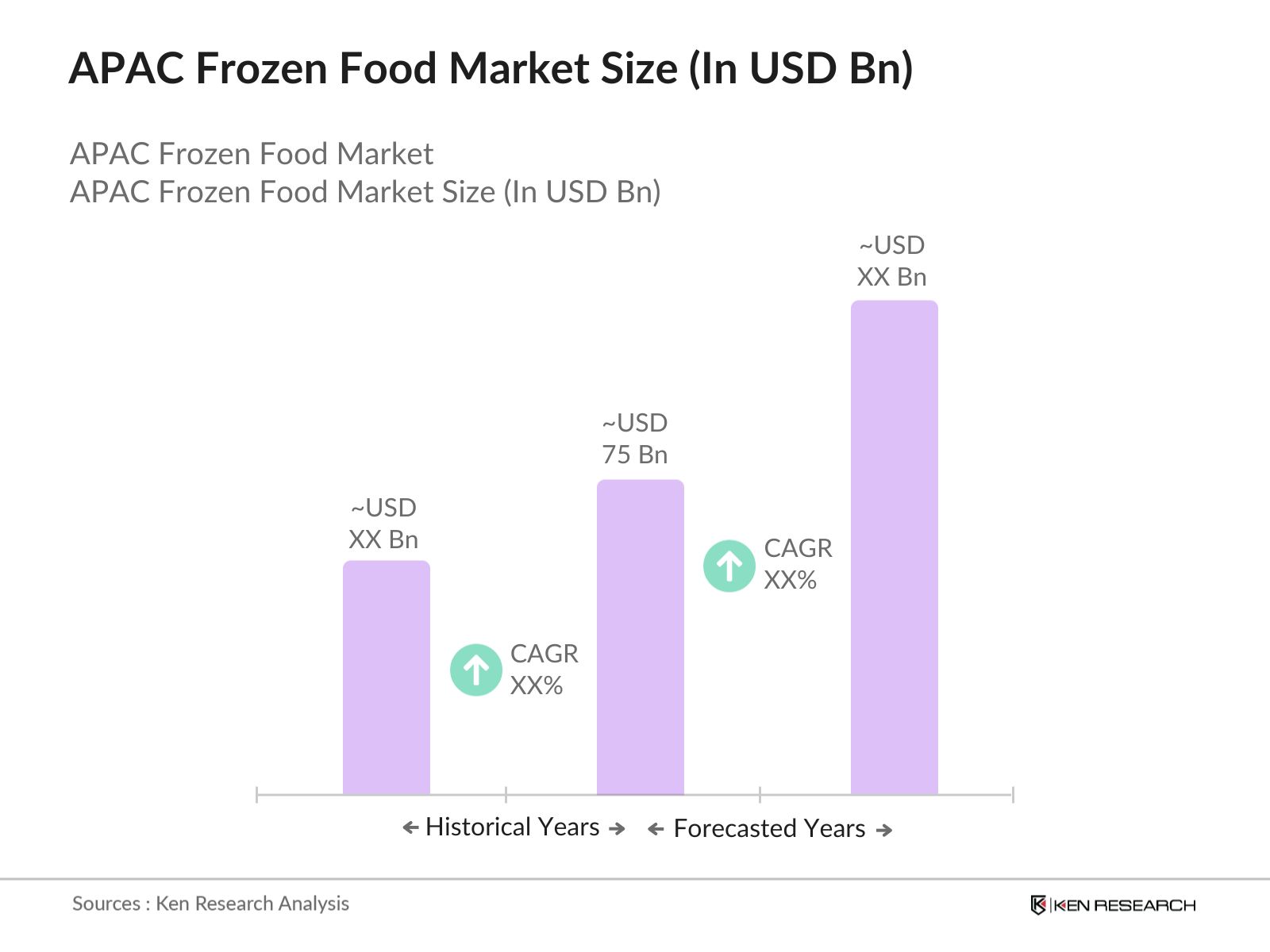
  • The APAC Frozen Food market is experiencing steady growth valued at USD 75 Bn, driven by rising consumer demand for convenient and long-lasting food options across the region. The market is expanding due to an increase in urbanization, busier lifestyles, and the growing penetration of organized retail. Consumers in APAC countries such as China, Japan, South Korea, and India are increasingly opting for frozen food due to the wide variety of products available, ranging from frozen vegetables and fruits to ready-to-eat meals and desserts. The market's growth is further supported by technological advancements in freezing techniques, which have enhanced the quality and shelf life of frozen food products.

APAC Frozen Food Market Size

  • In countries like China and Japan, the frozen food market is highly developed, with consumers regularly purchasing frozen products as part of their weekly shopping routines. South Korea is seeing similar trends, with increasing adoption of Western-style diets and a rising preference for convenience food. In Southeast Asia, countries such as Indonesia, Thailand, and Vietnam are witnessing growing demand for frozen food products due to expanding middle-class populations and the increasing availability of frozen foods in modern trade formats such as supermarkets and hypermarkets.
  • Governments in APAC are enforcing stricter cold storage and food safety standards to protect consumers. In 2023, China updated its frozen food safety standards to include more rigorous inspections of imported goods, with a focus on mitigating contamination risks. India also implemented new guidelines for cold storage facilities under the Food Safety and Standards Authority of India (FSSAI), requiring periodic audits to ensure compliance with temperature control standards.

APAC Frozen Food Market Segmentation

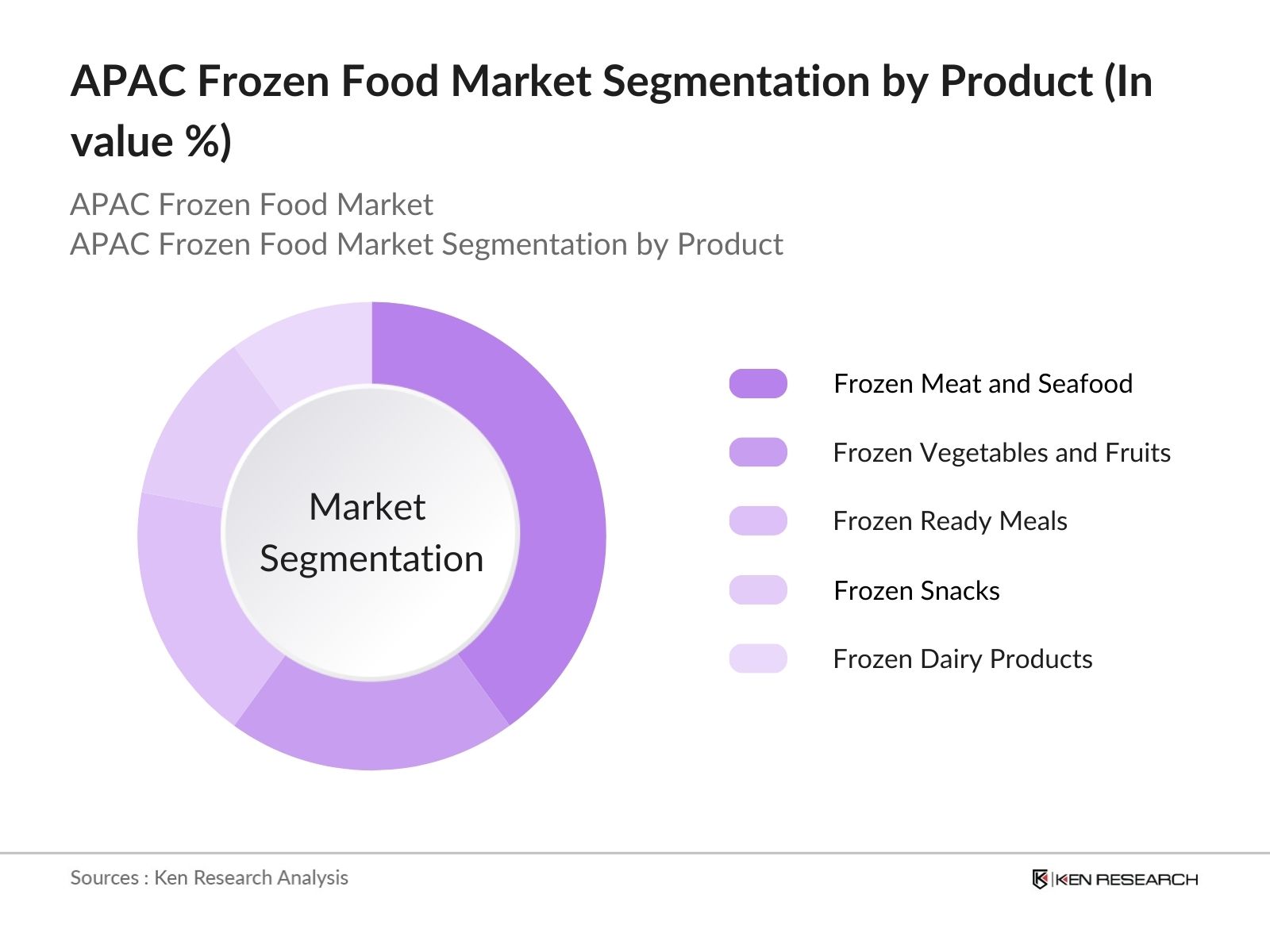
  • By Product Type: The market is segmented by product type into ready meals, frozen fruits and vegetables, frozen meat and seafood, frozen snacks, and others. Frozen meat and seafood dominate the market, driven by the high demand for convenient protein sources, especially in countries like China, South Korea, and Japan. Ready meals are also gaining popularity across the region, particularly in urban areas where consumers seek quick meal solutions. Frozen fruits and vegetables are witnessing increased demand in Southeast Asian markets such as Indonesia and Vietnam, where consumers are increasingly focused on the health benefits of such products.

APAC Frozen Food Market Segmentation by Product

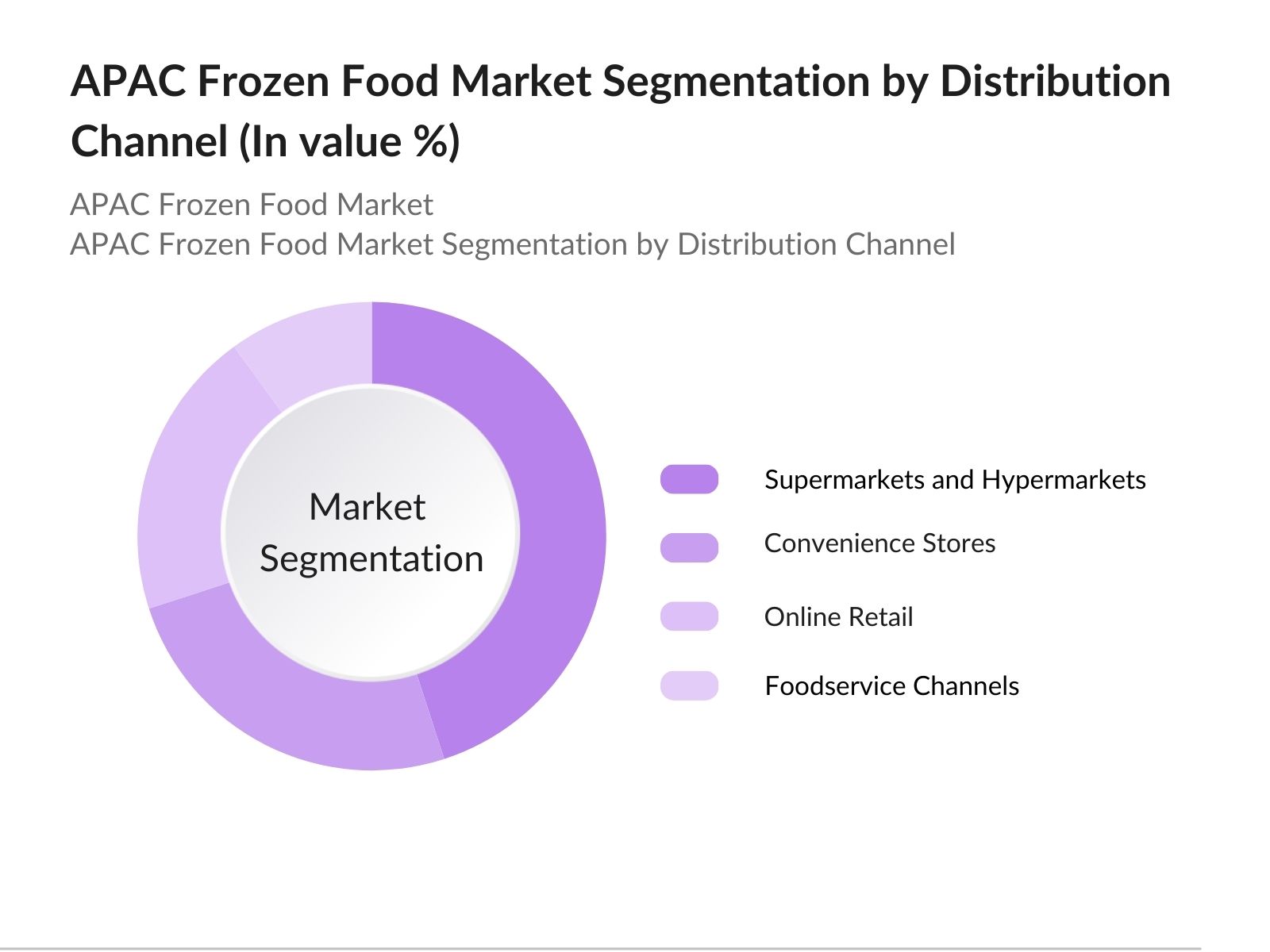
  • By Distribution Channel: The market is further segmented by distribution channels into supermarkets and hypermarkets, convenience stores, online retail, and others. Supermarkets and hypermarkets hold the largest share due to their widespread presence and the availability of a wide variety of frozen products. However, online retail is growing rapidly, driven by the increasing penetration of e-commerce platforms, particularly in urban areas. Countries like China and India are seeing significant growth in online grocery delivery services, making frozen food more accessible to a larger consumer base.

APAC Frozen Food Market Segmentation by Distribution Channel

APAC Frozen Food Market Competitive Landscape

The APAC Frozen Food market is highly competitive, with both international and regional players competing for market share through product innovation and expansion of distribution channels. Leading companies such as Nestl, McCain Foods, and Ajinomoto dominate the market with their extensive portfolios of frozen food products. These companies are continually investing in product development to cater to changing consumer preferences and expanding their presence in emerging markets across APAC.

Company Name

Establishment Year

Headquarters

Key Frozen Food Products

Revenue (2023)

R&D Investment

Key Markets

Global Presence

Nestl

1866

Vevey, Switzerland


McCain Foods

1957

Florenceville, Canada


Ajinomoto

1909

Tokyo, Japan


Simplot

1929

Boise, USA


Nichirei Foods

1942

Tokyo, Japan


APAC Frozen Food Industry Analysis

Growth Drivers

  • Changing Lifestyles and Urbanization: The rise in urbanization across APAC has led to a shift in consumer eating habits. According to World Bank data, urbanization levels in Indonesia and Vietnam exceeded 59% in 2022, contributing to the demand for convenient frozen food products. Increasing time constraints among urban dwellers have spurred the adoption of ready-to-cook and frozen meals. These products provide time-saving solutions while maintaining nutritional value. As of 2024, majority of households in China rely on frozen food, driven by dual-income families seeking convenience in meal preparation. This trend is expected to intensify as urbanization expands.
  • Growing E-Commerce and Modern Retail Penetration: The retail and e-commerce sectors in APAC have grown exponentially. In 2023, APACs e-commerce retail sales exceeded USD 2.5 trillion, according to the International Trade Administration. The rise of online grocery platforms has opened new channels for frozen food distribution, particularly in countries like South Korea and Japan, where digital penetration exceeds 95%. Major online retailers, such as JD.com and Lazada, have launched dedicated frozen food categories, enhancing consumer accessibility. Furthermore, partnerships between food manufacturers and e-commerce platforms have reduced logistics costs, making frozen food more affordable.
  • Increasing Health-Conscious Consumer Preferences: Health-conscious consumers in APAC are gravitating toward frozen foods that align with their dietary preferences. A 2023 study by the Asian Development Bank noted a substantial annual increase in demand for frozen vegetables and fruits across APAC markets, particularly in Singapore, Malaysia, and Japan. This shift is driven by the perception that frozen foods retain essential nutrients better than fresh alternatives. The rise in lifestyle diseases, such as diabetes and cardiovascular ailments, has led to greater consumer interest in healthy frozen options, especially in urbanized markets like South Korea and Taiwan.

Market Challenges

  • Cold Chain Infrastructure Gaps: Despite progress, APAC countries continue to face significant gaps in cold chain infrastructure. A 2023 report by the World Bank indicates that one third of perishable goods are wasted annually in developing nations like India and Bangladesh due to inadequate cold storage. The high cost of cold chain logistics remains a major barrier for small and medium-sized enterprises (SMEs), preventing them from participating in the frozen food market. Furthermore, rural regions in Indonesia and the Philippines still lack access to reliable cold chain networks, limiting market growth.
  • Regulatory and Trade Barriers: Regulatory frameworks across APAC markets are often inconsistent, complicating the trade of frozen foods. Countries such as Vietnam and Indonesia have stringent food safety and labeling regulations that require frequent updates, causing delays in import clearance. In 2023, South Korea imposed additional sanitary regulations on frozen meat imports, leading to a substantial drop in shipments from India. Trade barriers, such as tariffs and import quotas, further complicate market entry, particularly in smaller markets like Laos and Cambodia.

APAC Frozen Food Market Future Outlook

The APAC frozen food market is expected to continue growing over the next five years, driven by rising urbanization, growing e-commerce penetration, and increasing consumer preference for convenience. As more consumers across the region shift towards healthier eating habits, there will be an increasing demand for organic, plant-based, and low-calorie frozen food options. Additionally, advancements in freezing technology and cold storage infrastructure are expected to further support the markets growth.

Future Market Opportunities

  • Growing Demand for Premium and Organic Frozen Food: Demand for premium and organic frozen food is on the rise across APAC. In 2023, Japan and South Korea experienced a noteworhty increase in organic frozen food sales, driven by a growing middle class seeking healthier options. The organic food segment in China, valued at $12 billion in 2023 according to government sources, is expanding, with frozen organic vegetables and fruits gaining traction. Health-conscious consumers are willing to pay a premium for these products, particularly in urban centers like Tokyo and Shanghai, where organic certifications are increasingly trusted by buyers.
  • Emerging Markets in the Region: Emerging markets like Indonesia, Vietnam, and Thailand are showing tremendous potential for frozen food growth. In 2023, Vietnam's frozen food imports rose substantially due to increasing urbanization and a growing middle class. Indonesia, with a population exceeding 270 million, has become a lucrative market for frozen fish and seafood, driven by increased demand in urban areas like Jakarta. Thailand's hospitality and tourism sectors also fuel demand for frozen foods, with the Thai government reporting $500 million in frozen food imports in 2023, primarily for hotel and restaurant use.

Scope of the Report

By Product Type

Frozen Vegetables and Fruits

Frozen Meat and Seafood

Frozen Ready Meals

Frozen Snacks

Frozen Dairy Products

By Distribution Channel

Supermarkets and Hypermarkets

Convenience Stores

Online Retail

Foodservice Channels

By Consumer Type

Retail Consumers

Institutional Buyers

B2B Buyers

By Freezing Technology

Individual Quick Freezing (IQF)

Blast Freezing

Cryogenic Freezing

Other Technologies

By Region

China

Japan

South Korea

Indonesia

Rest of APAC

Products

Key Target Audience

  • Frozen Food Manufacturers

  • Retail Chains and Supermarkets

  • Quick Service Restaurant (QSR) Chains

  • Online Grocery Delivery Platforms

  • Cold Chain and Logistics Providers

  • Investors and Venture Capitalist Firms

  • Government and Regulatory Bodies (Ministries of Agriculture and Food Safety)

  • Packaging and Freezing Technology Providers

  • Banks and Financial Institutions

Companies

Major Players Mentioned in the Report

  • Nestl

  • Ajinomoto Co.

  • McCain Foods

  • Nichirei Foods

  • Conagra Brands

  • Tyson Foods

  • Kraft Heinz

  • General Mills

  • FRoSTA AG

  • Greenyard

  • Simplot Foods

  • Charoen Pokphand Foods

  • Nomad Foods

  • Heinz Frozen Foods

  • JBS Foods International

Table of Contents

01 APAC Frozen Food Market Overview


1.1 Definition and Scope
1.2 Market Taxonomy (Frozen Foods, Supply Chain, Logistics, Cold Storage)
1.3 Market Growth Rate (Market Demand, Consumption, Urbanization)
1.4 Market Segmentation Overview

02 APAC Frozen Food Market Size (In USD Bn)


2.1 Historical Market Size (Consumer Preferences, Retail Growth)
2.2 Year-On-Year Growth Analysis
2.3 Key Market Developments and Milestones (Distribution Expansion, E-Commerce Penetration)

03 APAC Frozen Food Market Analysis


3.1 Growth Drivers
3.1.1 Urbanization and Changing Lifestyles
3.1.2 Expansion of Retail and E-commerce
3.1.3 Technological Advancements in Freezing and Cold Chain Logistics
3.1.4 Increasing Health-Conscious Consumer Preferences
3.2 Market Challenges
3.2.1 Cold Chain Infrastructure Gaps
3.2.2 Regulatory and Trade Barriers
3.2.3 Consumer Perception of Frozen vs. Fresh Food
3.3 Opportunities
3.3.1 Growing Demand for Premium and Organic Frozen Food
3.3.2 Emerging Markets (Indonesia, Vietnam, Thailand)
3.3.3 Innovations in Packaging and Sustainable Practices
3.4 Trends
3.4.1 Rising Demand for Plant-Based Frozen Foods
3.4.2 Growth in Ready-to-Eat Meal Segment
3.4.3 Health & Wellness-Driven Product Development
3.5 Government Regulations
3.5.1 Cold Storage and Food Safety Standards
3.5.2 Import and Export Regulations for Frozen Foods
3.5.3 Public-Private Partnerships for Cold Chain Infrastructure Development
3.6 SWOT Analysis
3.7 Stakeholder Ecosystem
3.8 Porters Five Forces Analysis (Suppliers, Buyers, Competition, New Entrants, Substitutes)
3.9 Competitive Landscape

04 APAC Frozen Food Market Segmentation


4.1 By Product Type (In Value %)
4.1.1 Frozen Vegetables and Fruits
4.1.2 Frozen Meat and Seafood
4.1.3 Frozen Ready Meals
4.1.4 Frozen Snacks
4.1.5 Frozen Dairy Products
4.2 By Distribution Channel (In Value %)
4.2.1 Supermarkets and Hypermarkets
4.2.2 Convenience Stores
4.2.3 Online Retail
4.2.4 Foodservice Channels
4.3 By Consumer Type (In Value %)
4.3.1 Retail Consumers
4.3.2 Institutional Buyers (Hotels, Restaurants, Cafes)
4.3.3 B2B Buyers (Foodservice Distributors, Manufacturers)
4.4 By Freezing Technology (In Value %)
4.4.1 Individual Quick Freezing (IQF)
4.4.2 Blast Freezing
4.4.3 Cryogenic Freezing
4.4.4 Other Technologies
4.5 By Region (In Value %)
4.5.1 China
4.5.2 Japan

4.5.3 South Korea
4.5.4 Indonesia

4.5.5 Rest of APAC

05 APAC Frozen Food Market Competitive Analysis


5.1 Detailed Profiles of Major Competitors
5.1.1 Nestl
5.1.2 McCain Foods
5.1.3 Ajinomoto Co., Inc.
5.1.4 Simplot Foods
5.1.5 Nichirei Foods
5.1.6 CPF Group (Charoen Pokphand Foods)
5.1.7 Conagra Brands, Inc.
5.1.8 General Mills
5.1.9 Greenyard
5.1.10 Heinz Frozen Foods
5.1.11 Kraft Heinz
5.1.12 Nomad Foods
5.1.13 FRoSTA AG
5.1.14 JBS Foods International
5.1.15 Tyson Foods
5.2 Cross Comparison Parameters (Revenue, Headquarters, Market Share, Product Portfolio, Innovation Focus, Freezing Technology Used, Geographic Reach, Expansion Strategies)
5.3 Market Share Analysis (Top 10 Competitors)
5.4 Strategic Initiatives (New Product Launches, Partnerships, Market Expansion)
5.5 Mergers and Acquisitions
5.6 Investment Analysis
5.7 Venture Capital Funding in Frozen Food Industry
5.8 Government Grants for Cold Chain Infrastructure
5.9 Private Equity Investments

06 APAC Frozen Food Market Regulatory Framework


6.1 Cold Chain Storage Standards and Food Safety Regulations
6.2 Compliance Requirements for Imported Frozen Food Products
6.3 Certification Processes for Frozen Food Exports

07 APAC Frozen Food Future Market Size (In USD Bn)


7.1 Future Market Size Projections
7.2 Key Factors Driving Future Market Growth (Changing Dietary Preferences, Retail Expansion, Health-Conscious Products)

08 APAC Frozen Food Future Market Segmentation


8.1 By Product Type (In Value %)
8.2 By Distribution Channel (In Value %)
8.3 By Consumer Type (In Value %)
8.4 By Freezing Technology (In Value %)
8.5 By Region (In Value %)

09 APAC Frozen Food Market Analysts Recommendations


9.1 TAM/SAM/SOM Analysis
9.2 Market Penetration Strategies
9.3 White Space Opportunity Analysis
9.4 Consumer Behavior Trends in APAC

Disclaimer Contact Us

Research Methodology

Step 1: Identification of Key Variables

The initial phase involves constructing a detailed ecosystem of stakeholders within the APAC Frozen Food Market. This step utilizes a combination of secondary research from proprietary databases and primary interviews to gather comprehensive data on market drivers, supply chains, and distribution networks.

Step 2: Market Analysis and Construction

We gather and analyze historical market data, identifying key trends in frozen food consumption, penetration of modern retail, and cold chain infrastructure development. This step also includes the analysis of retail growth in urban and semi-urban regions across APAC.

Step 3: Hypothesis Validation and Expert Consultation

Market hypotheses will be validated through consultations with key players in the frozen food industry. These interviews with manufacturers, retailers, and logistic providers offer insights into sales trends, production capacities, and market challenges, ensuring a reliable data set for further analysis.

Step 4: Research Synthesis and Final Output

In the final phase, comprehensive data from industry sources will be synthesized to produce actionable insights. The data will be cross-verified with market participants to ensure accuracy in reporting. The final output will include detailed market forecasts, key player strategies, and potential opportunities for investment.

Frequently Asked Questions

01. How big is the APAC Frozen Food Market?

The APAC Frozen Food Market was valued at USD 75 billion, driven by rising consumer demand for convenience and long shelf-life food products. The market has seen a robust increase in adoption across urban centers, where consumers seek easy meal solutions.

02. What are the challenges in the APAC Frozen Food Market?

Challenges in the APAC Frozen Food Market include underdeveloped cold chain infrastructure in certain Southeast Asian countries and consumer skepticism regarding the freshness of frozen products compared to fresh alternatives. Regulatory compliance for frozen food imports also poses barriers for smaller players.

03. Who are the major players in the APAC Frozen Food Market?

Key players in the APAC Frozen Food market include Nestl, Ajinomoto Co., McCain Foods, Nichirei Foods, and Conagra Brands. These companies dominate the market due to their extensive distribution networks and innovative product offerings that cater to diverse consumer tastes.

04. What are the growth drivers of the APAC Frozen Food Market?

The growth of the frozen food market is driven by increasing urbanization, rising disposable incomes, and the expansion of retail infrastructure across the region. Additionally, growing consumer awareness of the health benefits and convenience of frozen foods contributes to market growth.

Why Buy From Us?

RRR
Refine Robust Result (RRR) Framework

What makes us stand out is that our consultants follows Robust, Refine and Result (RRR) methodology. i.e. Robust for clear definitions, approaches and sanity checking, Refine for differentiating respondents facts and opinions and Result for presenting data with story

Our Reach Is Unmatched

We have set a benchmark in the industry by offering our clients with syndicated and customized market research reports featuring coverage of entire market as well as meticulous research and analyst insights.

Research
Shifting the Research Paradigm

While we don't replace traditional research, we flip the method upside down. Our dual approach of Top Bottom & Bottom Top ensures quality deliverable by not just verifying company fundamentals but also looking at the sector and macroeconomic factors.

Insite
More Insights-Better Decisions

With one step in the future, our research team constantly tries to show you the bigger picture. We help with some of the tough questions you may encounter along the way: How is the industry positioned? Best marketing channel? KPI's of competitors? By aligning every element, we help maximize success.

Trust
Transparency and Trust

Our report gives you instant access to the answers and sources that other companies might choose to hide. We elaborate each steps of research methodology we have used and showcase you the sample size to earn your trust.

support
Round the Clock Support

If you need any support, we are here! We pride ourselves on universe strength, data quality, and quick, friendly, and professional service.

Why Client Choose Us?

400000+ Reports in repository
150+ Consulting project a year
100+ Analysts
8000+ Client Queries in 2022