
APAC Organic Farming Market Outlook to 2030
Region:Asia
Author(s):Shubham Kashyap
Product Code:KROD9060
December 2024
86
About the Report
APAC Organic Farming Market Overview
- The APAC Organic Farming market is valued at USD 50 billion, primarily driven by increasing consumer awareness regarding health benefits associated with organic products and rising disposable incomes across the region. This growth is further supported by favorable government initiatives promoting sustainable agricultural practices and organic farming. The trend towards healthier lifestyles and sustainable consumption continues to elevate the market's profile, positioning it for robust long-term growth within the APAC region.
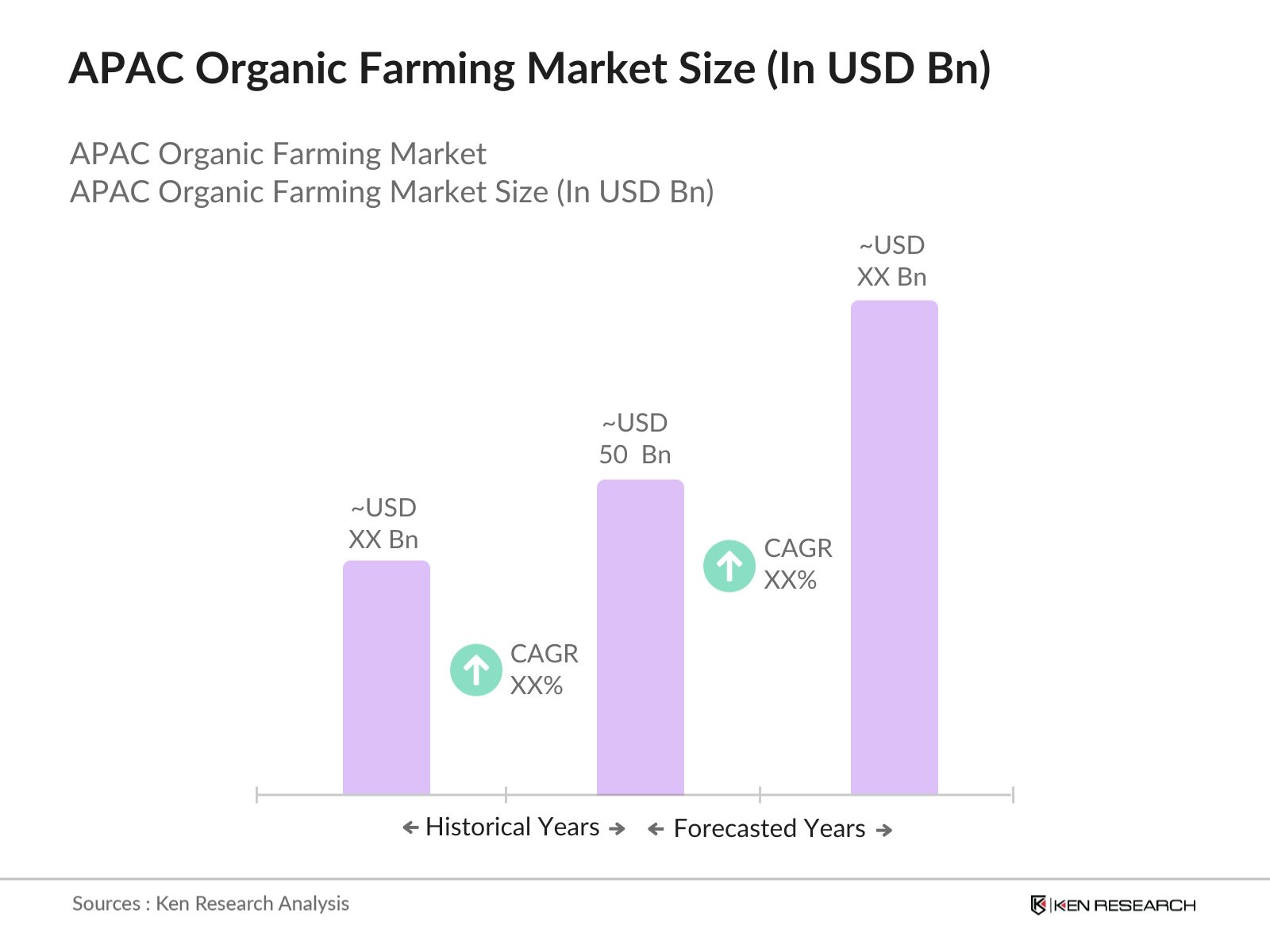
- Major demand centers for organic farming in APAC include China, India, Japan, and Australia. China and India lead due to their vast agricultural resources and government policies encouraging organic farming practices. Japans strong consumer demand for organic products, driven by health consciousness, contributes significantly to its market dominance. Australias extensive organic farmland further enhances its position as a key player in the APAC organic farming landscape, fostering a thriving organic sector.
- Organic certification standards are crucial in regulating the organic farming market in APAC. In 2022, the Australian government implemented stringent certification requirements, with 98% of certified organic operations complying with national standards. These standards ensure the integrity of organic products and foster consumer trust. Furthermore, the Indian government has established the National Programme for Organic Production (NPOP), which certifies over 30,000 organic farms annually.
APAC Organic Farming Market Segmentation
- By Farming Type: The market is segmented by farming type into pure organic farming and integrated organic farming. Recently, integrated organic farming holds a dominant market share within this segmentation. This approach combines traditional organic farming methods with modern agricultural techniques, enhancing productivity and sustainability. Integrated organic farming allows for optimized resource use, improved soil health, and higher yields, making it particularly appealing for farmers looking to increase their profitability while adhering to organic standards.
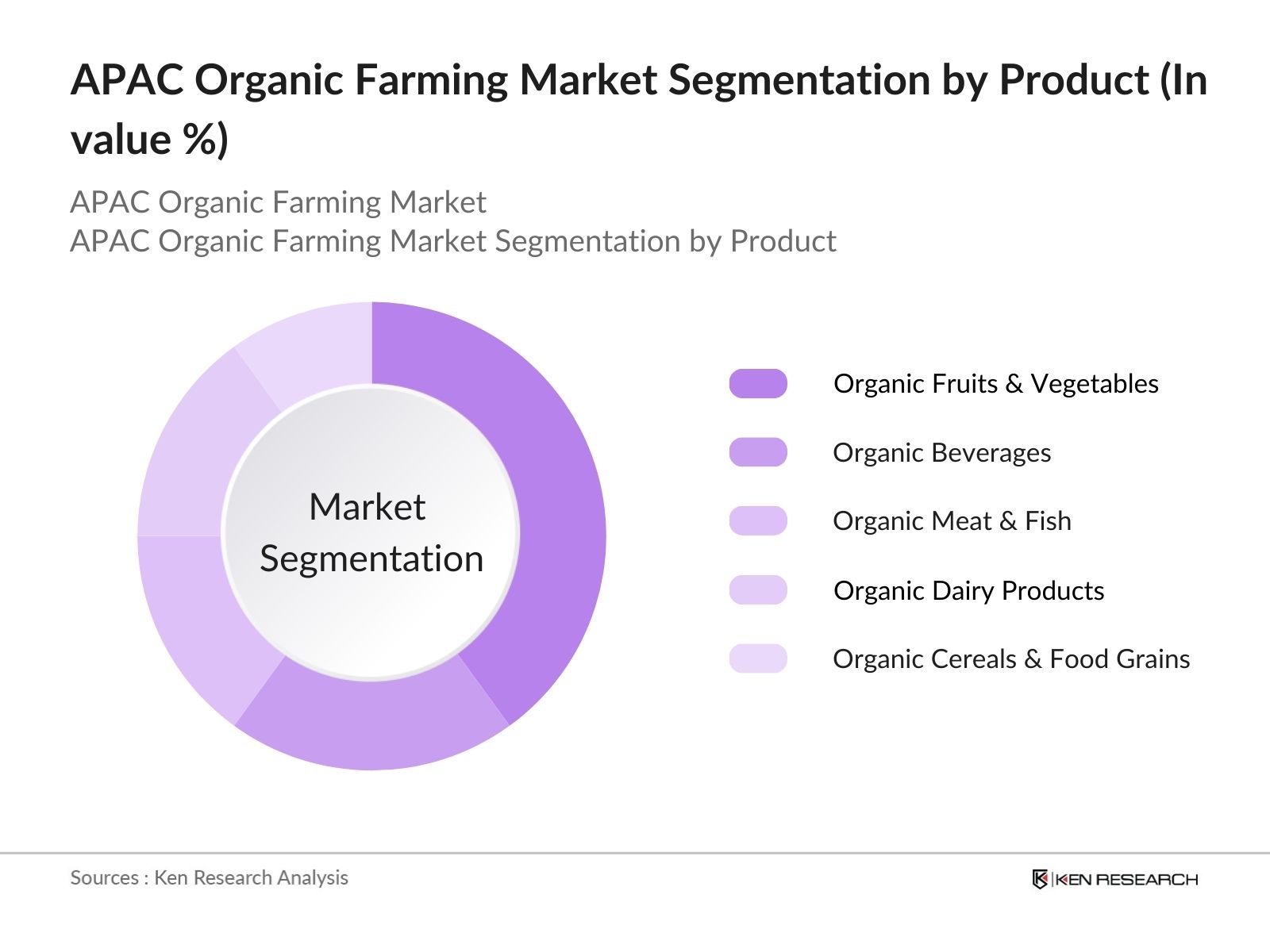
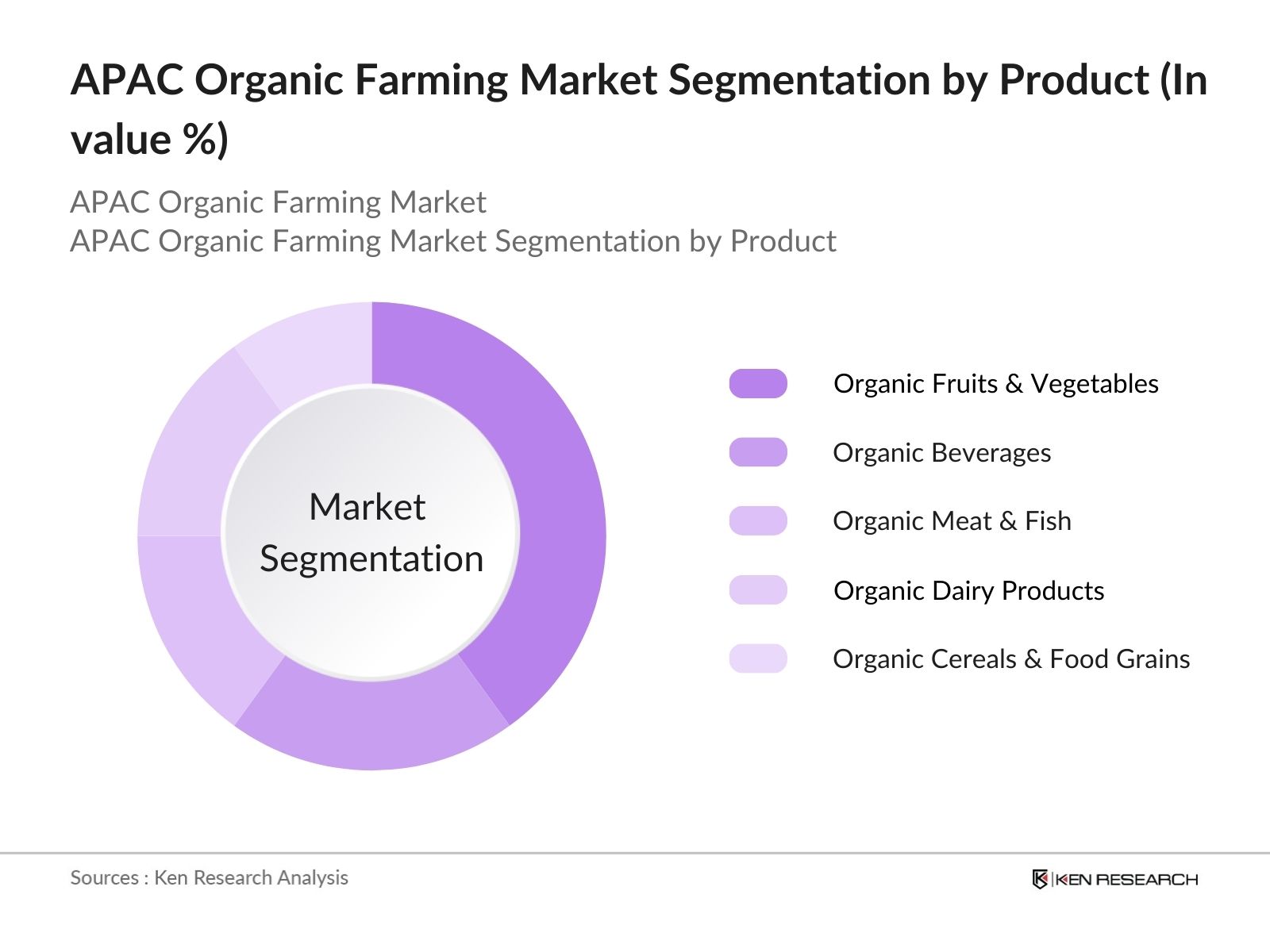
- By Product Type: The market is segmented by product type into organic fruits, organic vegetables, organic beverages, organic meat & fish, organic dairy products, and organic cereals & food grains. Organic fruits and vegetables currently dominate this segment, driven by growing consumer demand for fresh, chemical-free produce. Consumers perceive organic fruits and vegetables as healthier and safer options, which propels their popularity. This segment benefits from the strong consumer trend towards healthy eating and sustainable food sourcing, making it the leading contributor within this product category.
APAC Organic Farming Market Competitive Landscape
The APAC Organic Farming market is dominated by several major players, including Monsanto, KiuShi, Blue Yonder, Vero-Bio, and Sikkim. These companies leverage their strong brand recognition and extensive distribution channels to maintain significant market positions. Their continuous investment in technological innovation and sustainable practices further enhances their competitiveness in the growing organic farming sector. 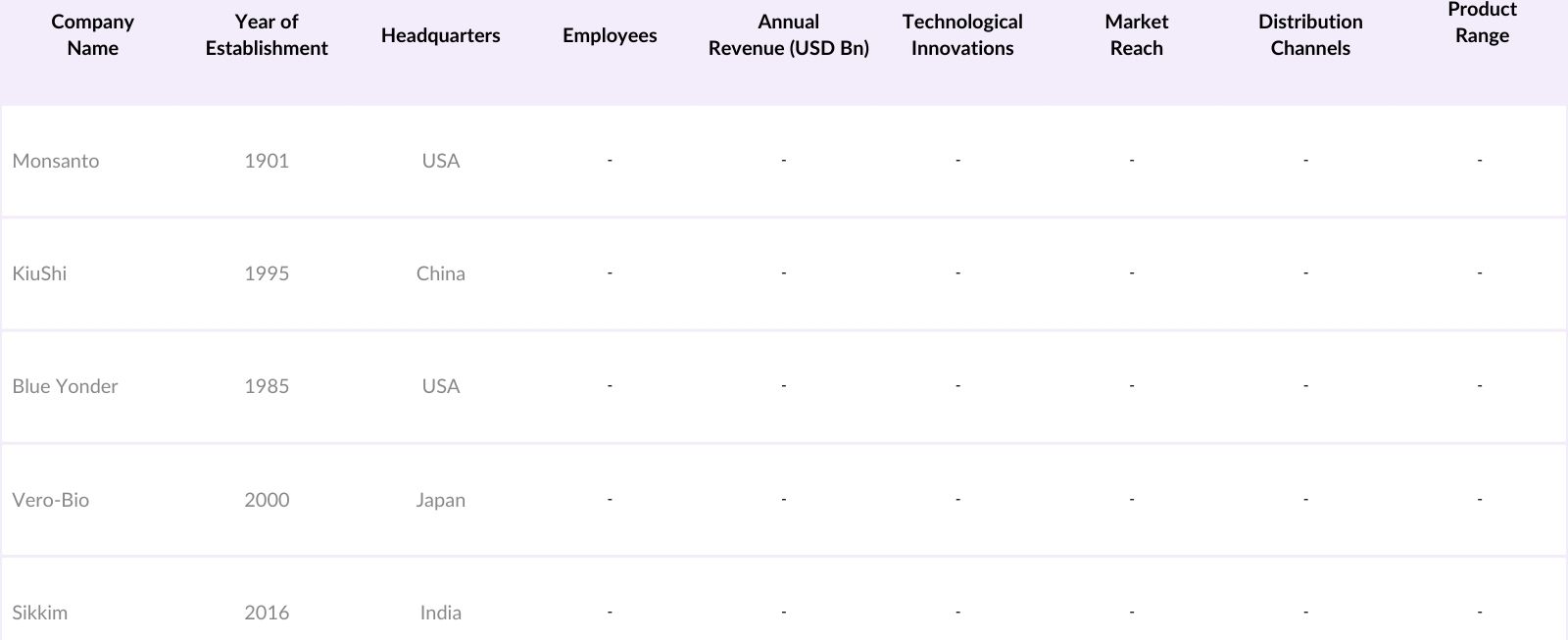
APAC Organic Farming Market Analysis
Growth Drivers
- Rising Health Consciousness: Rising health consciousness among consumers is significantly driving the organic farming market in the APAC region. According to the World Health Organization, non-communicable diseases, largely preventable through healthier diets, accounted for 71% of all global deaths in 2022, highlighting the urgent need for healthier food options. The Asia-Pacific region saw a notable increase in demand for organic products, with countries like Japan witnessing a 12% annual growth in organic food consumption. This shift is fueled by increasing awareness of health risks associated with synthetic pesticides and fertilizers. As of 2023, majority of consumers reported being more mindful of their food choices, directly influencing their purchasing decisions towards organic options.
- Environmental Sustainability Concerns: Environmental sustainability concerns are catalyzing the growth of the organic farming market in APAC. The United Nations Environment Programme reports that agriculture contributes to approximately 24% of global greenhouse gas emissions, prompting a shift towards sustainable practices. In response to climate change, countries in the region are increasingly investing in organic farming. India has pledged to increase its organic farming area to 14 million hectares by 2025, up from 4.73 million hectares in 2022. This commitment reflects a growing awareness of the environmental impact of conventional farming and the need for sustainable alternatives.
- Government Initiatives and Subsidies: Government initiatives and subsidies are pivotal in promoting organic farming in the APAC region. In 2022, the Indian government allocated USD 225 million towards the promotion of organic farming, reflecting a strong commitment to sustainable agricultural practices. Similarly, the Australian government announced a notable funding for organic and regenerative farming projects, aiming to enhance agricultural productivity while preserving natural resources. These initiatives underscore the role of government support in fostering a conducive environment for organic farming, helping to offset production costs and encourage farmers to transition to organic practices.
Challenges
- High Production Costs: High production costs pose a significant challenge to the organic farming market in APAC. Organic farming generally incurs higher production costs compared to conventional farming due to expenses related to organic inputs, certification, and compliance. Farmers often report substantial increases in the cost of organic fertilizers and pest control solutions. This financial burden can deter potential organic farmers and hinder the overall growth of the organic sector, particularly in developing economies where resource allocation is limited.
- Limited Availability of Organic Inputs: The limited availability of organic inputs is a pressing challenge for the organic farming market in APAC. It is estimated that a small percentage of the total agricultural inputs used in the region are certified organic. This scarcity affects the ability of farmers to meet organic standards and achieve consistent yields. Countries such as Vietnam report significant difficulties in sourcing organic seeds and fertilizers, with many farmers relying on imports, which can be costly and logistically challenging. The lack of domestic production capabilities for organic inputs stifles the growth of organic farming and limits market potential.
APAC Organic Farming Market Future Outlook
The APAC Organic Farming market is poised for significant growth in the coming years, driven by an increasing shift towards sustainable agricultural practices and rising consumer demand for organic products. As more consumers prioritize health and sustainability, the market is expected to expand steadily. Innovations in organic farming techniques and technologies, such as precision agriculture, will also play a crucial role in enhancing productivity and efficiency within the sector. The ongoing support from governments and an increasing focus on sustainable development are likely to further strengthen the market's trajectory, making it an attractive area for investment and growth.
Future Market Opportunities
- Expansion into Emerging Markets: The expansion into emerging markets presents a significant opportunity for the organic farming sector in APAC. With a growing middle-class population and increasing disposable incomes, countries like India and Indonesia are seeing a surge in demand for organic products. Additionally, the Indonesian government has launched initiatives to promote organic farming among smallholder farmers, aiming to increase the number of certified organic farms from 250,000 in 2022 to 1 million by 2025. This trend reflects a favorable environment for the expansion of organic farming in these regions.
- Development of Organic Supply Chains: The development of organic supply chains offers substantial growth potential for the organic farming market in APAC. Enhanced supply chains can ensure the availability of organic products in urban areas, where demand is rapidly increasing. In 2022, majority of organic products in APAC were sold through direct-to-consumer channels, highlighting the need for efficient distribution networks. Furthermore, initiatives such as the establishment of organic cooperatives in countries like Thailand are expected to facilitate better access to markets for smallholder farmers, increasing their competitiveness and enhancing the overall supply chain efficiency.
Scope of the Report
|
By Farming Type |
Pure Organic Farming |
|
By Method |
Crop Diversity |
|
By Product Type |
Organic Fruits |
|
By Distribution Channel |
Supermarkets & Hypermarkets Other Distribution Channels |
|
By Region |
China India Japan Australia Rest of APAC |
Products
Key Target Audience
Organic Food Manufacturers
Agricultural Cooperatives
Retailers and Supermarkets
Investors and Venture Capitalist Firms
Banks and Financial Institutions
Government and Regulatory Bodies (e.g., Ministry of Agriculture)
Organic Certification Agencies
Agricultural Equipment Suppliers
Companies
Players Mentioned in the Report
Monsanto
KiuShi
Blue Yonder
Vero-Bio
Sikkim
Amalgamated Plantations
Bunge
DowDuPont
Eden Foods
Organic Valley
General Mills
Nature's Path
Nature's Best
Clif Bar & Company
Hain Celestial Group
Table of Contents
APAC Organic Farming Market Overview
1.1. Definition and Scope
1.2. Market Taxonomy
1.3. Market Growth Rate
1.4. Market Segmentation Overview
APAC Organic Farming Market Size (In USD Million)
2.1. Historical Market Size
2.2. Year-On-Year Growth Analysis
2.3. Key Market Developments and Milestones
APAC Organic Farming Market Analysis
3.1. Growth Drivers
3.1.1. Rising Health Consciousness
3.1.2. Environmental Sustainability Concerns
3.1.3. Government Initiatives and Subsidies
3.1.4. Technological Advancements in Farming Practices
3.2. Market Challenges
3.2.1. High Production Costs
3.2.2. Limited Availability of Organic Inputs
3.2.3. Certification and Compliance Complexities
3.3. Opportunities
3.3.1. Expansion into Emerging Markets
3.3.2. Development of Organic Supply Chains
3.3.3. Consumer Education and Awareness Programs
3.4. Trends
3.4.1. Integration of Digital Farming Solutions
3.4.2. Growth of Urban Organic Farming
3.4.3. Increase in Organic Processed Food Products
3.5. Government Regulations
3.5.1. Organic Certification Standards
3.5.2. Import and Export Policies
3.5.3. Subsidies and Financial Incentives
3.6. SWOT Analysis
3.7. Stakeholder Ecosystem
3.8. Porters Five Forces Analysis
3.9. Competitive Landscape
APAC Organic Farming Market Segmentation
4.1. By Farming Type (In Value %)
4.1.1. Pure Organic Farming
4.1.2. Integrated Organic Farming
4.2. By Method (In Value %)
4.2.1. Crop Diversity
4.2.2. Soil Management
4.2.3. Weed Management
4.2.4. Controlling Other Organisms
4.3. By Product Type (In Value %)
4.3.1. Organic Fruits
4.3.2. Organic Vegetables
4.3.3. Organic Beverages
4.3.4. Organic Meat & Fish
4.3.5. Organic Dairy Products
4.3.6. Organic Cereals & Foodgrains
4.4. By Distribution Channel (In Value %)
4.4.1. Supermarkets & Hypermarkets
4.4.2. Specialty Stores
4.4.3. E-commerce
4.4.4. Other Distribution Channels
4.5. By Country (In Value %)
4.5.1. China
4.5.2. India
4.5.3. Japan
4.5.4. Australia
4.5.5. Rest of APAC
APAC Organic Farming Market Competitive Analysis
5.1. Detailed Profiles of Major Companies
5.1.1. Monsanto
5.1.2. KiuShi
5.1.3. Blue Yonder
5.1.4. Vero-Bio
5.1.5. Sikkim
5.1.6. Amalgamated Plantations
5.1.7. Bunge
5.1.8. DowDuPont
5.1.9. Eden Foods
5.1.10. Organic Valley
5.1.11. General Mills
5.1.12. Nature's Path
5.1.13. Nature's Best
5.1.14. Clif Bar & Company
5.1.15. Hain Celestial Group
5.2. Cross Comparison Parameters (Number of Employees, Headquarters, Inception Year, Revenue, Market Share, Product Portfolio, Regional Presence, Strategic Initiatives)
5.3. Market Share Analysis
5.4. Strategic Initiatives
5.5. Mergers and Acquisitions
5.6. Investment Analysis
5.6.1. Venture Capital Funding
5.6.2. Government Grants
5.6.3. Private Equity Investments
APAC Organic Farming Market Regulatory Framework
6.1. Environmental Standards
6.2. Compliance Requirements
6.3. Certification Processes
APAC Organic Farming Future Market Size (In USD Million)
7.1. Future Market Size Projections
7.2. Key Factors Driving Future Market Growth
APAC Organic Farming Future Market Segmentation
8.1. By Farming Type (In Value %)
8.2. By Method (In Value %)
8.3. By Product Type (In Value %)
8.4. By Distribution Channel (In Value %)
8.5. By Country (In Value %)
APAC Organic Farming Market Analysts Recommendations
9.1. Total Addressable Market (TAM), Serviceable Available Market (SAM), Serviceable Obtainable Market (SOM) Analysis
9.2. Customer Cohort Analysis
9.3. Marketing Initiatives
9.4. White Space Opportunity Analysis
Disclaimer Contact UsResearch Methodology
Step 1: Identification of Key Variables
The initial phase involves constructing an ecosystem map encompassing all major stakeholders within the APAC Organic Farming Market. This step is underpinned by extensive desk research, utilizing a combination of secondary and proprietary databases to gather comprehensive industry-level information. The primary objective is to identify and define the critical variables that influence market dynamics.
Step 2: Market Analysis and Construction
In this phase, we compile and analyze historical data pertaining to the APAC Organic Farming Market. This includes assessing market penetration, the ratio of marketplaces to service providers, and the resultant revenue generation. Furthermore, an evaluation of service quality statistics is conducted to ensure the reliability and accuracy of the revenue estimates.
Step 3: Hypothesis Validation and Expert Consultation
Market hypotheses are developed and subsequently validated through computer-assisted telephone interviews (CATIs) with industry experts representing a diverse array of companies. These consultations provide valuable operational and financial insights directly from industry practitioners, which are instrumental in refining and corroborating the market data.
Step 4: Research Synthesis and Final Output
The final phase involves direct engagement with multiple organic farming entities to acquire detailed insights into product segments, sales performance, consumer preferences, and other pertinent factors. This interaction serves to verify and complement the statistics derived from the bottom-up approach, thereby ensuring a comprehensive, accurate, and validated analysis of the APAC Organic Farming Market.
Frequently Asked Questions
01. How big is the APAC Organic Farming Market?
The APAC Organic Farming market is valued at USD 50 billion, driven by increasing consumer awareness of health benefits associated with organic products and supportive government initiatives promoting sustainable agricultural practices.
02. What are the major growth drivers in the APAC Organic Farming Market?
Key growth drivers in the APAC Organic Farming market include rising health consciousness among consumers and supportive government initiatives that promote sustainable farming practices through subsidies and grants, enhancing market access for organic products.
03. Who are the leading countries in the APAC Organic Farming Market?
China, India, Japan, and Australia are the leading countries in the APAC Organic Farming market. Their dominance is attributed to vast agricultural resources, high consumer demand for organic products, and government policies encouraging organic farming.
04. What are the main challenges faced by the APAC Organic Farming Market?
The APAC Organic Farming market faces challenges such as high costs of organic certification, which can deter smallholder farmers, and market saturation in urban areas, leading to intense competition and potential price wars.
Why Buy From Us?

What makes us stand out is that our consultants follows Robust, Refine and Result (RRR) methodology. i.e. Robust for clear definitions, approaches and sanity checking, Refine for differentiating respondents facts and opinions and Result for presenting data with story

We have set a benchmark in the industry by offering our clients with syndicated and customized market research reports featuring coverage of entire market as well as meticulous research and analyst insights.

While we don't replace traditional research, we flip the method upside down. Our dual approach of Top Bottom & Bottom Top ensures quality deliverable by not just verifying company fundamentals but also looking at the sector and macroeconomic factors.

With one step in the future, our research team constantly tries to show you the bigger picture. We help with some of the tough questions you may encounter along the way: How is the industry positioned? Best marketing channel? KPI's of competitors? By aligning every element, we help maximize success.

Our report gives you instant access to the answers and sources that other companies might choose to hide. We elaborate each steps of research methodology we have used and showcase you the sample size to earn your trust.

If you need any support, we are here! We pride ourselves on universe strength, data quality, and quick, friendly, and professional service.