















APAC Reclaimed Rubber Market Outlook to 2030
Region:Asia
Author(s):Shubham Kashyap
Product Code:KROD3327
November 2024
84
About the Report
APAC Reclaimed Rubber Market Overview
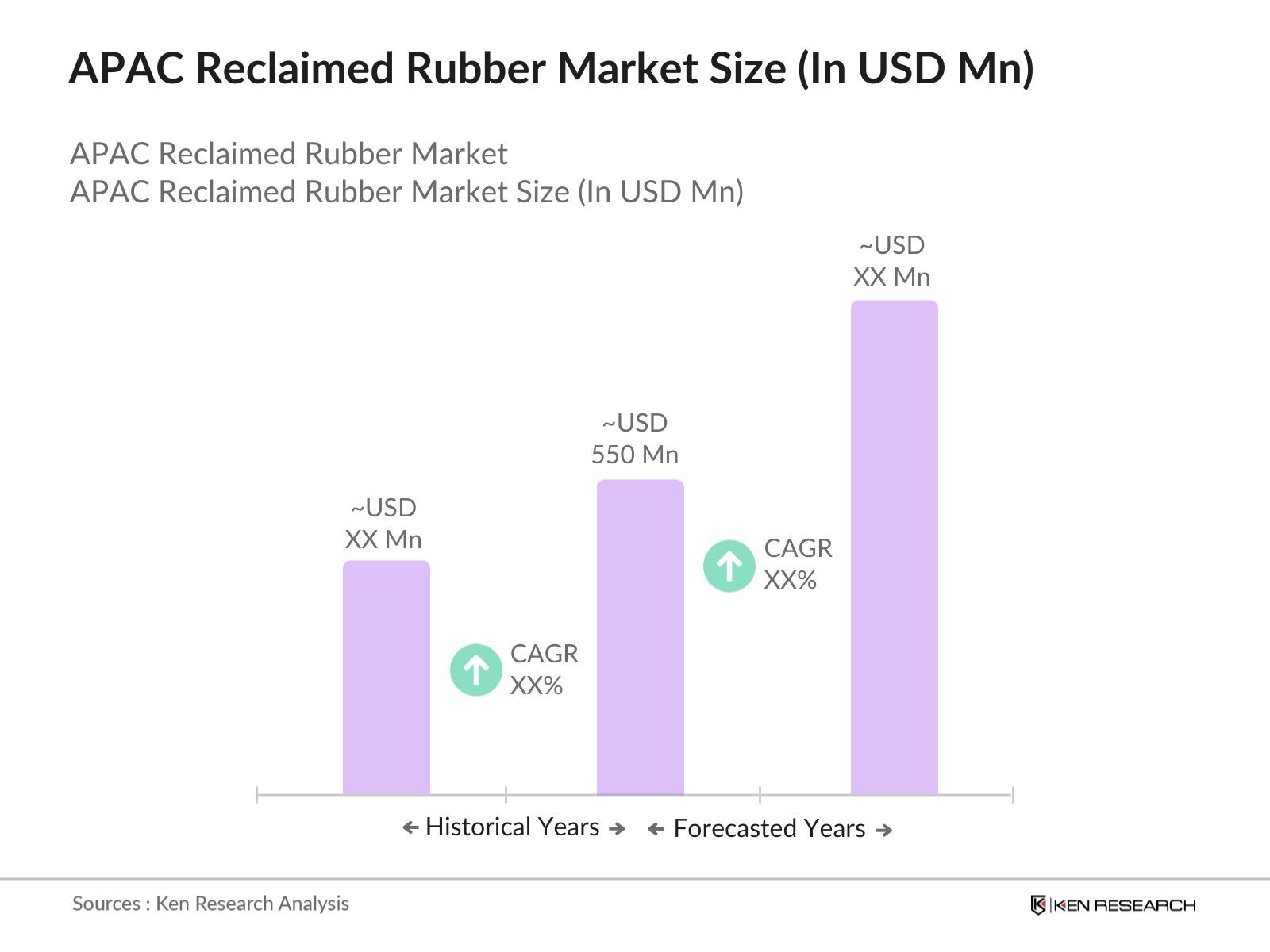
- The APAC Reclaimed Rubber Market is currently valued at USD 550 Million, based on a comprehensive five-year historical analysis. This market is primarily driven by the increasing demand for sustainable and eco-friendly alternatives to virgin rubber in industries such as automotive, construction, and manufacturing. Reclaimed rubber, which is made from recycled rubber materials, offers a cost-effective and environmentally responsible solution, thereby gaining traction in the region. With the rising environmental regulations and growing awareness of resource conservation, the demand for reclaimed rubber is expected to expand across various industries in the APAC region.
- Countries such as China, India, and Japan are the dominant players in the APAC reclaimed rubber market due to their large manufacturing bases and strong industrial demand for sustainable raw materials. China, being the largest producer and consumer of reclaimed rubber, benefits from government policies that promote recycling and sustainable manufacturing practices. India follows closely, where the increasing demand for automotive products and construction materials is fueling the growth of the reclaimed rubber industry.
- Government initiatives across the APAC region are also playing a significant role in the markets expansion. Chinas Five-Year Plan emphasizes the need for green and sustainable growth, including increased recycling of rubber products. India has also introduced regulations to promote the use of recycled materials, which is expected to bolster the demand for reclaimed rubber in the coming years. Additionally, environmental regulations in countries like Japan are encouraging industries to adopt reclaimed rubber as a way to reduce carbon footprints and waste.
APAC Reclaimed Rubber Market Segmentation
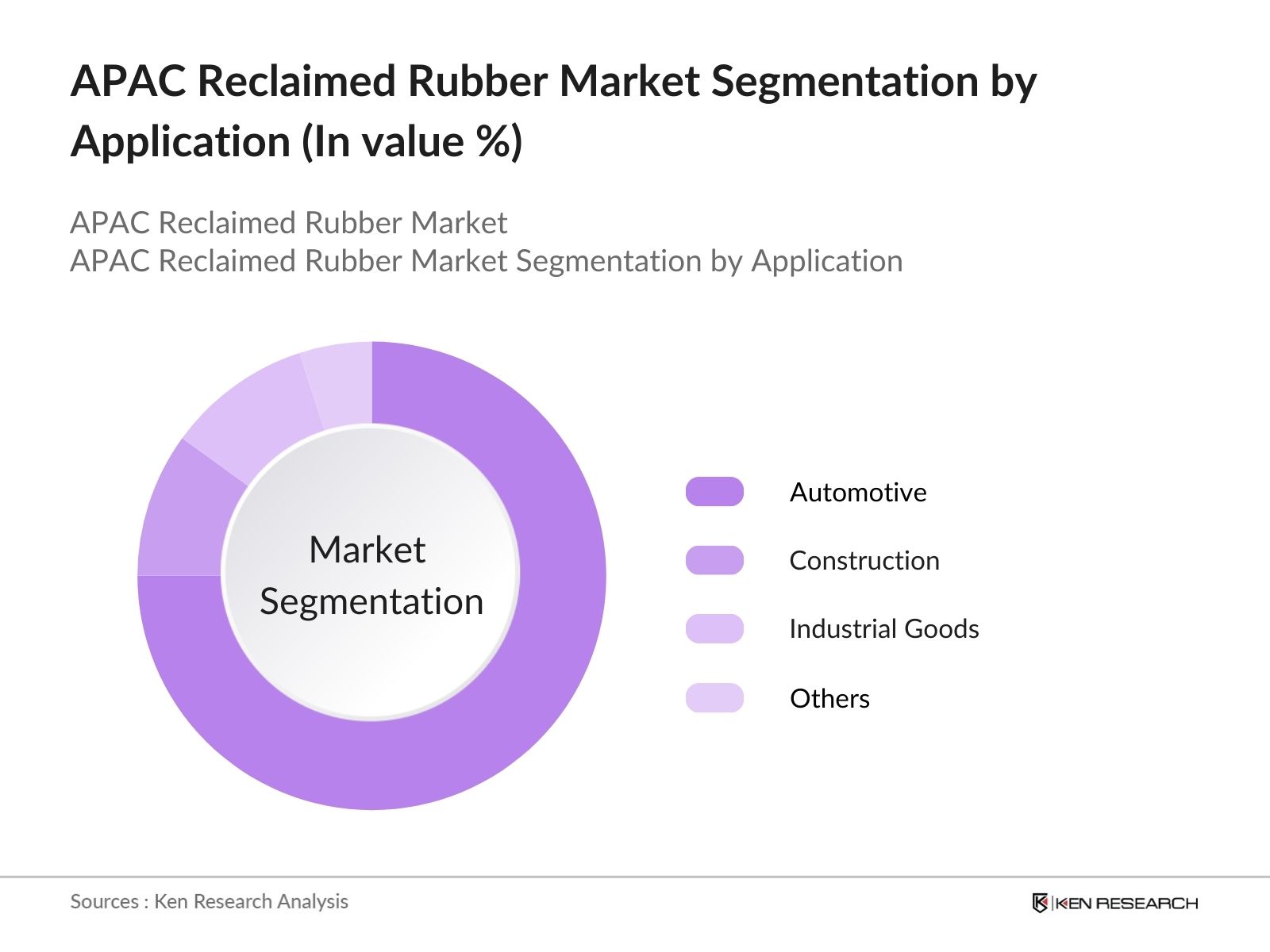
- By Application: The market is segmented by application into automotive, construction, industrial goods, and others. The automotive industry represents the largest application segment, driven by the increasing use of reclaimed rubber in tires, seals, and gaskets. In China and India, the automotive sector's demand for cost-effective and sustainable materials is a major growth driver for reclaimed rubber. The construction sector is also seeing increased adoption of reclaimed rubber, particularly in roofing materials and insulation products. As infrastructure projects grow across Southeast Asia, the construction industrys demand for reclaimed rubber is expected to surge.
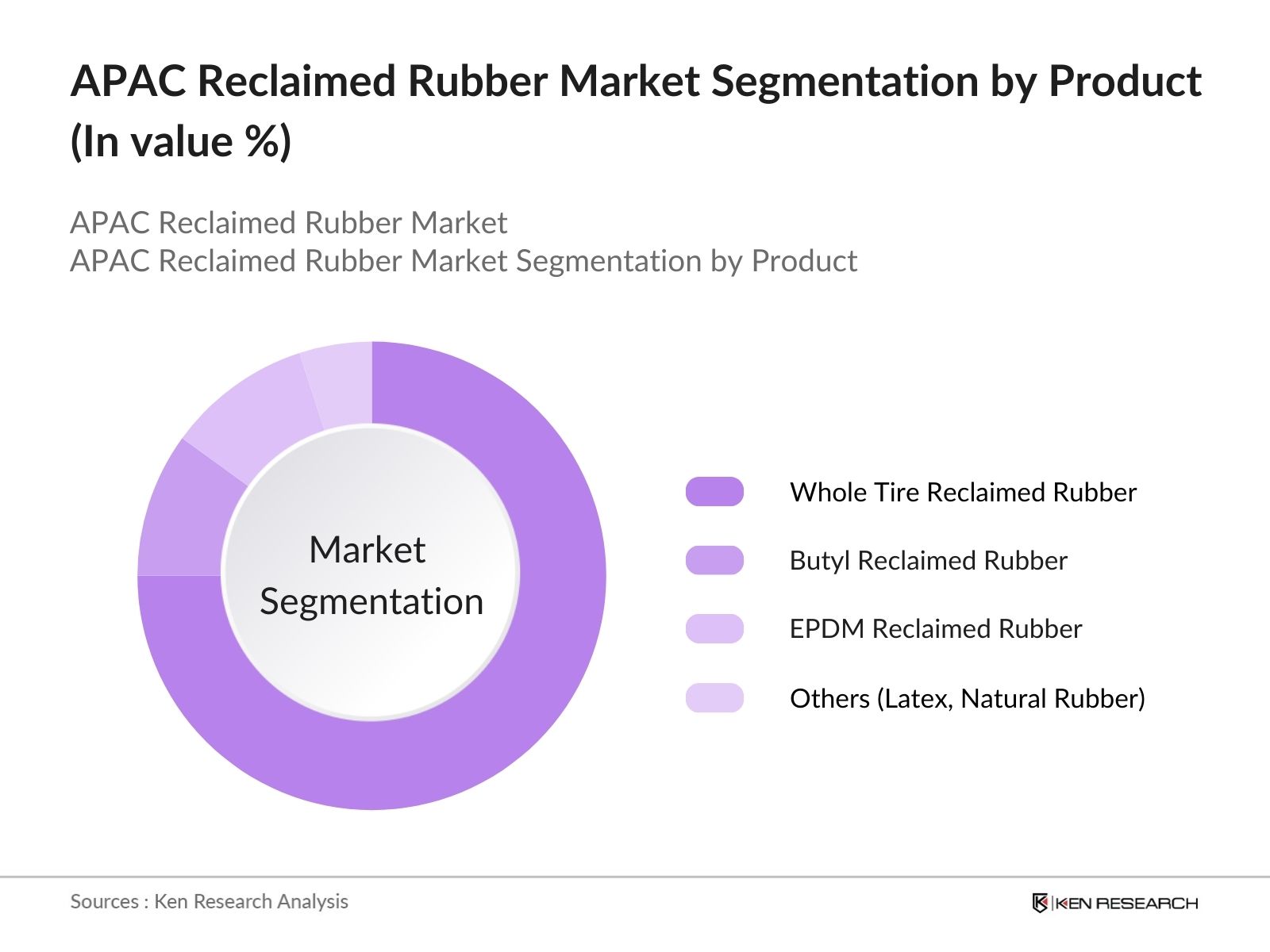
- By Product:The market is segmented by product type into whole tire reclaimed rubber, butyl reclaimed rubber, EPDM reclaimed rubber, and others (latex reclaim, natural rubber reclaim). Whole tire reclaimed rubber currently dominates the product type segment due to its extensive use in the automotive industry, particularly in tire manufacturing. The cost savings associated with using whole tire reclaimed rubber over virgin rubber, combined with growing environmental concerns, make it the preferred choice for manufacturers, especially in countries like China and India, where automotive production is on the rise.
APAC Reclaimed Rubber Market Competitive Landscape
The APAC reclaimed rubber market is highly competitive, with both global and regional players competing for market share through technological innovations, partnerships, and sustainable practices. Leading companies such as GRP Limited, All India Rubber Industries Association (AIRIA), and Oriental Rubber have established a strong presence in the region.
|
Company Name |
Establishment Year |
Headquarters |
Reclamation Capacity |
Sustainability Initiatives |
Key Products |
Regional Reach |
R&D Investment |
Market Share (%) |
|
GRP Limited |
1974 |
Mumbai, India |
||||||
|
Oriental Rubber |
1949 |
Pune, India |
||||||
|
Bridgestone |
1931 |
Tokyo, Japan |
||||||
|
Hainan Rubber Industry |
2005 |
Hainan, China |
||||||
|
Star Polymers |
1990 |
Bangkok, Thailand |
APAC Reclaimed Rubber Industry Analysis
Growth Drivers
- Increasing Demand for Sustainable Materials: The demand for sustainable materials in APAC is driven by stringent environmental regulations. Countries like China and India have implemented circular economy frameworks, mandating the reuse of industrial byproducts like rubber. In 2024, Chinas Five-Year Plan emphasizes recycling initiatives, with a target of reducing carbon emissions by 18% National Recycling Policy is also fostering growth by incentivizing green manufacturing practices, with the rubber industry benefiting from grants for eco-friendly production. Sustainability is generating demand for reclaimed rubber across the region, promoting its use in various sectors like automotive and construction.
- Rising Automotive Production: Automotive production in APAC remains one of the largest industries globally, particularly in China, which produced over 25 million vehicles in 2023, accounting for nearly one-third of global production. With such largeput, the demand for cost-efficient and sustainable materials, such as reclaimed rubber, has increased significantly. Recycled rubber is increasingly being used in tire manufacturing, which accounts for over 50% of reclaimed rubber consumption. Government incentives foo-friendly materials have further boosted this shift. Japan is encouraging tire manufacturers to use more than 40% reclaimed rubber by 2024.
- Cost-Efficiency of Reclaimed Rubber: Reclaimed rubber has emerged as a cost-effective alternative to virgin rubber in APAC due to its lower production costs and high recycling yield. In 2024, the production of reclaimed rubber costs 20-30% less than virgin rubber due to reduced energy and raw material requirements. This cost advantage, coupled with favorable government policies, has accelerated its adoption in various sectors, including automotive, construction, and footwear manufacturing. Indias Rubber Board estimates that reclaimed rubber production is set to increase substantially in 2024, driven by a focus on cost reduction and sustainability initiatives.
Market Challenges
- Inconsistent Quality of Reclaimed Rubber: One of the major challenges in the APAC reclaimed rubber market is the inconsistency in the quality of reclaimed rubber products. Due to variations in the reclamation process and the types of raw materials used, the quality of reclaimed rubber can vary significantly, affecting its performance in certain applications. This challenge is particularly pronounced in emerging markets like Vietnam and Indonesia, where the reclamation process is less standardized.
- Lack of Awareness Among End-Users: Despite the environmental and cost benefits of reclaimed rubber, many end-users, particularly in developing markets, are unaware of its advantages. This lack of awareness is a significant barrier to the widespread adoption of reclaimed rubber, especially in industries like construction and industrial goods. Governments and industry associations in the APAC region are working to raise awareness, but the pace of change remains slow in certain markets. This perception issue is a barrier to wider adoption across industries.
APAC Reclaimed Rubber Market Future Outlook
The APAC reclaimed rubber market is poised for substantial growth over the next five years, driven by increasing environmental awareness, government regulations, and the growing adoption of sustainable materials. With countries like China and India leading the way in recycling and resource conservation, the demand for reclaimed rubber is expected to increase across various industries. As the quality of reclaimed rubber improves and awareness grows, new opportunities will emerge for its use in high-performance applications.
Future Market Opportunities
- Investment in Reclaimed Rubber Processing Facilities: The expansion of reclaimed rubber processing facilities presents a significant growth opportunity in the APAC region. Countries like China and India are investing heavily in recycling infrastructure, with Chinas government committing a substantial amount towards expanding rubber recycling facilities by 2025. These investments are expected to increase the availability of high-quality reclaimed rubber, boosting its adoption across various industries.
- Eco-friendly Product Labeling and Certifications: Eco-friendly product labeling and certifications are becoming increasingly important in the APAC reclaimed rubber market, as consumers and businesses alike prioritize sustainability. In 2024, the Chinese government introduced a new green certification program for recycled materials, including reclaimed rubber, which is expected to boost consumer confidence in eco-friendly products. Similarly, Japans Environmental Labeling Program is providing certifications to companies that meet strict environmental criteria in their production processes. These certifications not only enhance the marketability of reclaimed rubber products but also position them as a sustainable alternative to virgin rubber.
Scope of the Report
|
Product Type |
Whole Tire Reclaimed Rubber Butyl Reclaimed Rubber EPDM Reclaimed Rubber Others (Latex Reclaim, Natural Rubber Reclaim) |
|
Application |
Automotive (Tires, Gaskets, Seals) Construction (Roofing Materials, Insulation) Industrial Goods (Conveyor Belts, Hoses) Footwear (Soles, Specialty Products) Others (Sporting Goods, Agricultural Tools) |
|
Process |
Mechanical Reclamation Thermal Reclamation Chemical Reclamation |
|
Material Source |
Tires Latex Products EPDM Rubber Products Automotive Parts |
|
Region |
China India Japan South Korea Rest of the APAC |
Products
Key Target Audience
Automotive Manufacturers
Tire Manufacturers
Construction Companies
Industrial Goods Manufacturers
Footwear Manufacturers
Government and Regulatory Bodies (China Ministry of Environmental Protection, India Ministry of Environment, Forest, and Climate Change)
Investors and Venture Capitalist Firms
Reclaimed Rubber Producers
Banks and Financial Institutions
Companies
Players Mentioned in the Report
GRP Limited
Oriental Rubber
Bridgestone
Hainan Rubber Industry
Star Polymers
Balaji Rubber
Rolex Reclaim Pvt. Ltd.
Swani Rubber Industries
Genan Holding A/S
Michelin
J. Allcock & Sons Ltd.
Sun Exports
Westmoreland Reclamation
All India Rubber Industries Association
Recyc Rubber
Table of Contents
1. APAC Reclaimed Rubber Market Overview
1.1. Definition and Scope
1.2. Market Taxonomy
1.3. Market Growth Rate
1.4. Market Segmentation Overview
2. APAC Reclaimed Rubber Market Size (In USD Mn)
2.1. Historical Market Size
2.2. Year-On-Year Growth Analysis
2.3. Key Market Developments and Milestones
3. APAC Reclaimed Rubber Market Analysis
3.1. Growth Drivers
3.1.1. Increasing Demand for Sustainable Materials (Environmental Regulations, Green Manufacturing Initiatives)
3.1.2. Rising Automotive Production (Tire Reclamation, Recycled Rubber Use)
3.1.3. Cost-Efficiency of Reclaimed Rubber (Lower Production Costs, High Recycling Yield)
3.1.4. Government Recycling Policies (Chinas Circular Economy, Indias Recycling Laws)
3.2. Market Challenges
3.2.1. Inconsistent Quality of Reclaimed Rubber (Raw Material Variability, Process Efficiency)
3.2.2. Limited Consumer Awareness (Perceived Value, Application Challenges)
3.2.3. High Investment Costs (Reclamation Technology, Process Improvement)
3.2.4. Competitive Pressure from Virgin Rubber (Performance, Supply Chain Advantages)
3.3. Opportunities
3.3.1. Technological Innovations in Reclamation Process (Advanced Techniques, Chemical Reclamation)
3.3.2. Expanding Applications in Non-Automotive Sectors (Construction, Industrial Goods)
3.3.3. Growing Investments in Recycling Infrastructure (Government and Private Funding)
3.3.4. Increased International Collaborations (Joint Ventures, Licensing Agreements)
3.4. Trends
3.4.1. Adoption of Circular Economy Practices (Recycling Initiatives, Closed-Loop Systems)
3.4.2. Integration of IoT in Reclaimed Rubber Production (Process Automation, Efficiency Tracking)
3.4.3. Eco-friendly Product Labeling and Certifications (Green Certifications, Marketing Strategies)
3.4.4. Increased Use of Blended Reclaimed and Virgin Rubber (Hybrid Products, Cost Efficiency)
3.5. Government Regulations
3.5.1. Environmental Compliance Requirements (Emission Standards, Waste Disposal Rules)
3.5.2. Recycled Rubber Certification Standards (Quality Regulations, Material Certifications)
3.5.3. Industry-Specific Reclamation Guidelines (Automotive, Construction Sectors)
3.5.4. Incentives for Green Manufacturing (Subsidies, Tax Breaks for Recycling)
3.6. SWOT Analysis
3.7. Stakeholder Ecosystem
3.8. Porters Five Forces Analysis
3.9. Competition Ecosystem
4. APAC Reclaimed Rubber Market Segmentation
4.1. By Product Type (In Value %)
4.1.1. Whole Tire Reclaimed Rubber
4.1.2. Butyl Reclaimed Rubber
4.1.3. EPDM Reclaimed Rubber
4.1.4. Others (Latex Reclaim, Natural Rubber Reclaim)
4.2. By Application (In Value %)
4.2.1. Automotive (Tires, Gaskets, Seals)
4.2.2. Construction (Roofing Materials, Insulation)
4.2.3. Industrial Goods (Conveyor Belts, Hoses)
4.2.4. Footwear (Soles, Specialty Products)
4.2.5. Others (Sporting Goods, Agricultural Tools)
4.3. By Process (In Value %)
4.3.1. Mechanical Reclamation
4.3.2. Thermal Reclamation
4.3.3. Chemical Reclamation
4.4. By Material Source (In Value %)
4.4.1. Tires
4.4.2. Latex Products
4.4.3. EPDM Rubber Products
4.4.4. Automotive Parts
4.5. By Region (In Value %)
4.5.1. China
4.5.2. India
4.5.3. Japan
4.5.4. Southeast Asia
4.5.5. South Korea
5. APAC Reclaimed Rubber Market Competitive Analysis
5.1. Detailed Profiles of Major Companies
5.1.1. GRP Limited
5.1.2. All India Rubber Industries Association (AIRIA)
5.1.3. Oriental Rubber
5.1.4. Michelin
5.1.5. Bridgestone
5.1.6. Hainan Rubber Industry Group
5.1.7. J. Allcock & Sons Ltd.
5.1.8. Star Polymers
5.1.9. Balaji Rubber
5.1.10. Rolex Reclaim Pvt. Ltd.
5.1.11. Swani Rubber Industries
5.1.12. Genan Holding A/S
5.1.13. Westmoreland Reclamation
5.1.14. Sun Exports
5.1.15. Recyc Rubber
5.2. Cross Comparison Parameters
(Company Revenue, Reclamation Capacity, Product Portfolio, Regional Reach, Material Sourcing, Production Facilities, Sustainability Initiatives, R&D Investment)
5.3. Market Share Analysis
5.4. Strategic Initiatives
5.5. Mergers and Acquisitions
5.6. Investment Analysis
5.7. Venture Capital Funding
5.8. Government Grants
5.9. Private Equity Investments
6. APAC Reclaimed Rubber Market Regulatory Framework
6.1. Reclamation Standards and Certifications
6.2. Compliance with Environmental Policies
6.3. Industry Regulations for Sustainable Manufacturing
7. APAC Reclaimed Rubber Future Market Size (In USD Mn)
7.1. Future Market Size Projections
7.2. Key Factors Driving Future Market Growth
8. APAC Reclaimed Rubber Future Market Segmentation
8.1. By Product Type (In Value %)
8.2. By Application (In Value %)
8.3. By Process (In Value %)
8.4. By Material Source (In Value %)
8.5. By Region (In Value %)
9. APAC Reclaimed Rubber Market Analysts Recommendations
9.1. TAM/SAM/SOM Analysis
9.2. Customer Cohort Analysis
9.3. Marketing Initiatives
9.4. White Space Opportunity Analysis
Research Methodology
Step 1: Identification of Key Variables
The research starts by identifying the main stakeholders and key variables that influence the APAC reclaimed rubber market. Extensive desk research was conducted using proprietary and secondary databases to gather industry-level data and trends. This phase focused on understanding the drivers, challenges, and opportunities specific to the APAC region.
Step 2: Market Analysis and Construction
This phase involves compiling and analyzing historical data from the APAC reclaimed rubber market, focusing on market penetration, production capacities, and revenue generation. Additionally, we assessed environmental and regulatory compliance to ensure the reliability and accuracy of market estimates.
Step 3: Hypothesis Validation and Expert Consultation
Market hypotheses were validated through consultations with industry experts, manufacturers, and associations. These consultations provided critical operational insights, further corroborating the market data and helping refine the estimates.
Step 4: Research Synthesis and Final Output
In the final phase, reclaimed rubber manufacturers were engaged to acquire detailed insights into product segments, sales trends, and customer preferences. The data collected was validated through a bottom-up approach, ensuring a comprehensive and accurate analysis of the APAC reclaimed rubber market.
Frequently Asked Questions
01 How big is the APAC Reclaimed Rubber Market?
The APAC reclaimed rubber market is valued at USD 550 million, driven by rising demand for sustainable materials in automotive and industrial sectors, and supported by strong recycling infrastructure in key countries like China and India.
02 What are the challenges in the APAC Reclaimed Rubber Market?
The APAC reclaimed rubber market faces challenges such as inconsistent quality of reclaimed rubber, lack of consumer awareness in certain regions, and competition from virgin rubber. Additionally, high investment costs in reclamation technologies are a barrier to market growth.
03 Who are the major players in the APAC Reclaimed Rubber Market?
Key players in the APAC reclaimed rubber market include GRP Limited, Oriental Rubber, Bridgestone, Hainan Rubber Industry, and Star Polymers. These companies dominate the market due to their strong production capacities, strategic investments, and focus on sustainability initiatives.
04 What are the growth drivers of the APAC Reclaimed Rubber Market?
The APAC reclaimed rubber market growth is driven by the increasing demand for cost-effective and sustainable alternatives to virgin rubber, strong government regulations promoting recycling, and the booming automotive and construction industries in the region.
Why Buy From Us?

What makes us stand out is that our consultants follows Robust, Refine and Result (RRR) methodology. i.e. Robust for clear definitions, approaches and sanity checking, Refine for differentiating respondents facts and opinions and Result for presenting data with story

We have set a benchmark in the industry by offering our clients with syndicated and customized market research reports featuring coverage of entire market as well as meticulous research and analyst insights.

While we don't replace traditional research, we flip the method upside down. Our dual approach of Top Bottom & Bottom Top ensures quality deliverable by not just verifying company fundamentals but also looking at the sector and macroeconomic factors.

With one step in the future, our research team constantly tries to show you the bigger picture. We help with some of the tough questions you may encounter along the way: How is the industry positioned? Best marketing channel? KPI's of competitors? By aligning every element, we help maximize success.

Our report gives you instant access to the answers and sources that other companies might choose to hide. We elaborate each steps of research methodology we have used and showcase you the sample size to earn your trust.

If you need any support, we are here! We pride ourselves on universe strength, data quality, and quick, friendly, and professional service.