















APAC Static VAR Compensator Market Outlook to 2030
Region:Asia
Author(s):Shubham Kashyap
Product Code:KROD702
October 2024
81
About the Report
APAC Static VAR Compensator Market Overview
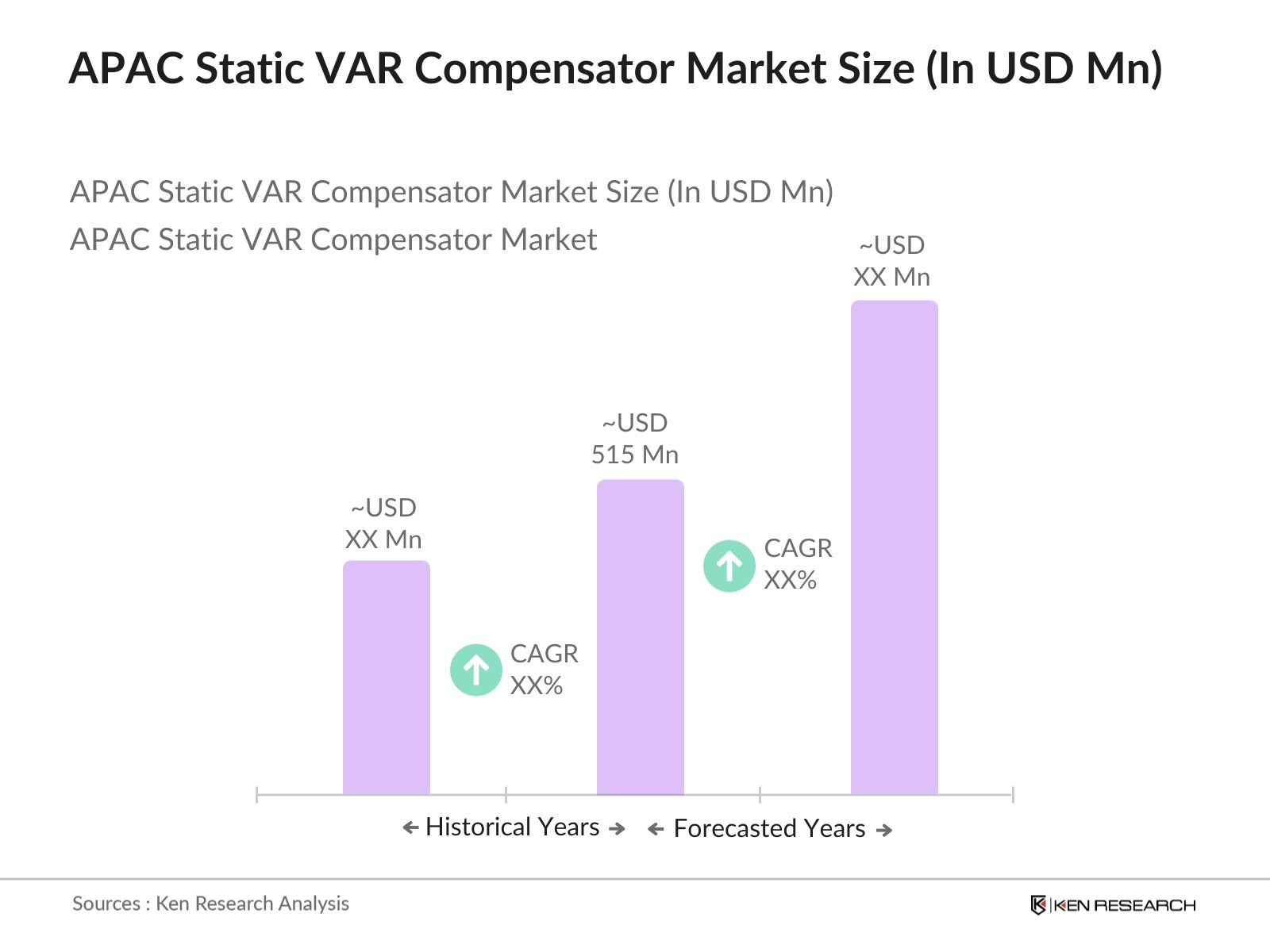
- The APAC Static VAR Compensator Market was valued at USD 515 million in 2023, driven by the increasing demand for reliable power supply, expansion of renewable energy projects, and the growing industrial se ctor. The need for improved power quality and grid stability in countries with aging infrastructure is contributing to the rising adoption of Static VAR Compensators (SVCs).
- Prominent companies in the APAC Static VAR Compensator market include ABB Ltd., Siemens AG, GE Grid Solutions, Mitsubishi Electric Corporation, and Hitachi Energy Ltd. These companies are recognized for their innovative power solutions, extensive R&D capabilities, and strong global presence.
- Major urban centers driving the market in the Asia Pacific region include Shanghai, Tokyo, and Seoul. Shanghai's dominance is supported by China's noteworthy investment in grid infrastructure, while Tokyo benefits from Japan's focus on power reliability and advanced grid technologies.
- In 2023, ABB Ltd. introduced a new SVC solution tailored for high-voltage direct current (HVDC) systems, designed to enhance grid stability and power quality. This innovation highlights ABB's commitment to advancing power technologies and supporting the growing demand for efficient power management solutions in the APAC region.
APAC Static VAR Compensator Market Segmentation
The APAC Static VAR Compensator Market can be segmented based on Component Type, Application, and Region:
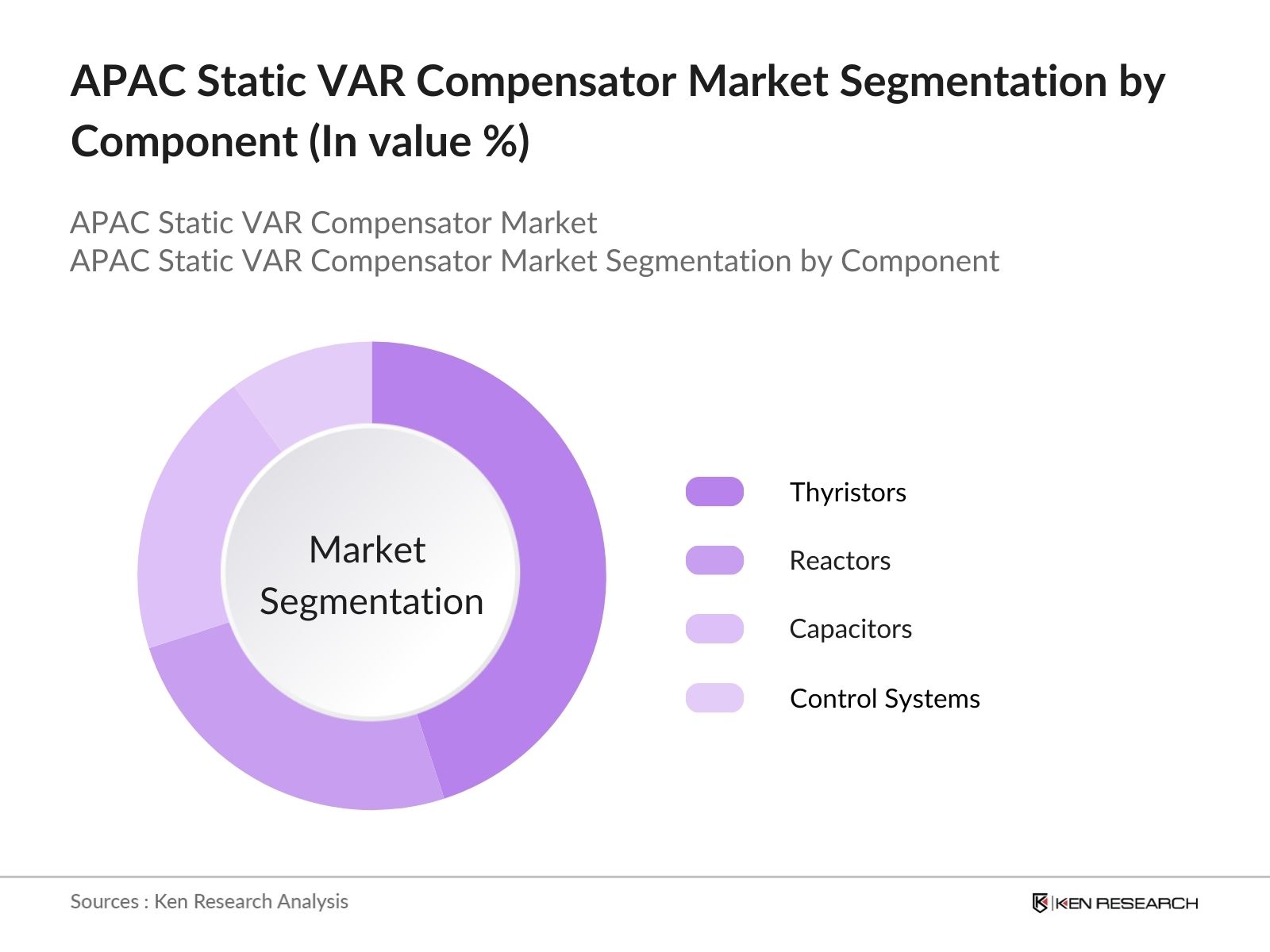
- By Component: The market is segmented by component type into thyristors, reactors, capacitors, and control systems. In 2023, thyristors held the dominant market share due to their critical role in controlling the reactive power flow and their widespread use in high-power Static Var Compensators (SVCs). Thyristors are essential for ensuring efficient energy conversion and managing voltage levels in power transmission.
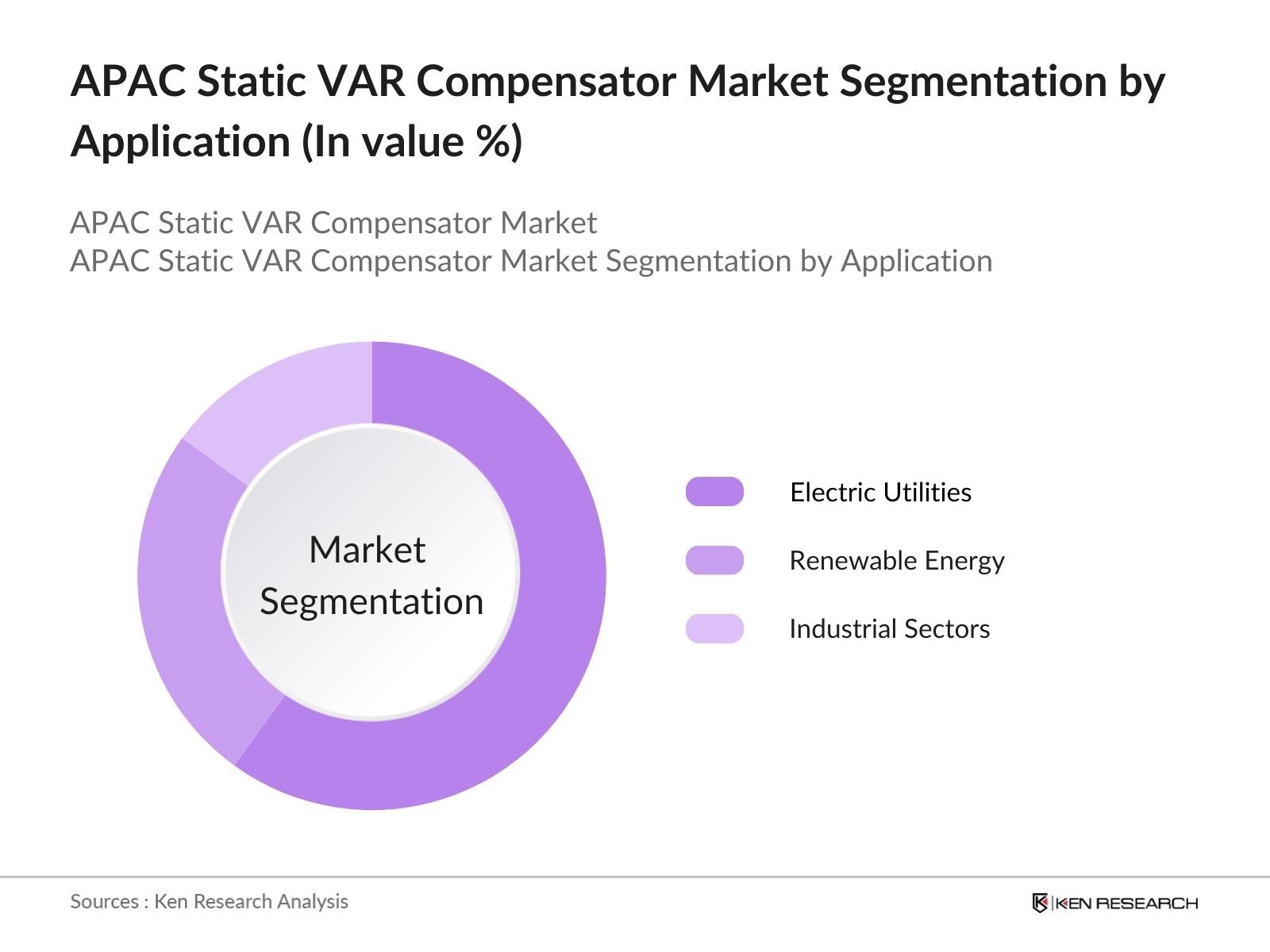
- By Application: The market is segmented by application into electric utilities, renewable energy, and industrial sectors. In 2023, the electric utilities segment dominated the market share, driven by the need for grid stabilization and voltage regulation across extensive power networks. The growing integration of renewable energy sources into the grid has heightened the demand for reliable voltage control solutions.
- By Region: The market is segmented by country into China, India, Japan, South Korea, and others. In 2023, China held the dominant market share, primarily due to its large-scale investments in grid infrastructure and the expansion of renewable energy projects. China's focus on modernizing its power grid to accommodate increasing energy demands and its ambitious goals for renewable energy capacity have propelled the adoption of advanced power control technologies, solidifying its leadership in the market.
APAC Static VAR Compensator Market Competitive Landscape
|
Company Name |
Establishment Year |
Headquarters |
|
ABB Ltd. |
1883 |
Zurich, Switzerland |
|
Siemens AG |
1847 |
Munich, Germany |
|
GE Grid Solutions |
1892 |
Paris, France |
|
Mitsubishi Electric Corporation |
1921 |
Tokyo, Japan |
|
Hitachi Energy Ltd. |
2021 |
Zurich, Switzerland |
- GE Grid Solutions: In 2022, GE successfully completed a major SVC upgrade project for Statnett, Norway's electrical transmission system operator. The project involved enhancing SVCs at two substations, improving the operational efficiency and stability of Norway's AC power system, ensuring better grid reliability and supporting the country's growing energy demands.
- Siemens AG: In 2023, Siemens has developed a groundbreaking technology known as Mobile SVC Plus, designed specifically to enhance grid stability in real-time. This innovative solution is the first of its kind, offering a mobile and flexible Static VAR Compensator (SVC) system that can be rapidly deployed to any location where grid stability is threatened.
APAC Static VAR Compensator Industry Analysis
Growth Drivers:
-
Increasing Demand for Grid Stability and Power Quality: The growing industrialization and urbanization in the APAC region are driving the demand for stable and high-quality power. According to the International Energy Agency (IEA), electricity consumption in the APAC major countries enhanced substantially, China's electricity demand rose by 6.4% in 2023, and India's demand increased by 7% in the same year. This surge in demand has led to a rise in the adoption of Static VAR Compensators (SVCs) to ensure grid stability, particularly in countries like India and China, where power grids are frequently strained by the increasing load.
- Expansion of Renewable Energy Projects: The push towards renewable energy is creating a growing need for SVCs to manage the variability and instability associated with renewable power sources. The IEA report mentions that Asia Pacific renewable capacity is expected to increase by almost 430 GW over 2023-2028, which represents a 73% growth from 2022 levels, necessitating advanced grid solutions like SVCs. Additionally, SVCs are increasingly being deployed to manage the variability and improve the integration of renewable energy into the grid.
- Modernization of Aging Infrastructure: Several APAC countries are investing heavily in upgrading their ageing grid infrastructure to meet current and future power demands. In 2022, China invested USD 166 billion in its transmission grid, which was more than the combined investment of all other countries. This initiative is part of Chinas broader efforts to reduce transmission losses and improve the reliability of the power grid, which has been a key driver for the increased adoption of SVCs across the region.
Challenges:
-
High Initial Costs: The initial capital expenditure for installing SVC systems remains an important challenge for utilities and industries in the APAC region. A report by the Indian Ministry of Power in 2023 highlighted that the average cost of an SVC installation ranges from USD 25 million, depending on the system's complexity and capacity. These high costs can be prohibitive, particularly for smaller utilities or those in developing countries, limiting the widespread adoption of SVC technology.
- Complex Regulatory Frameworks: The deployment of SVC systems in the APAC region is hindered by complex and varying regulatory frameworks across different countries. Japan's Ministry of Economy, Trade, and Industry (METI) introduced stringent grid codes in 2023, requiring SVC systems to undergo rigorous testing and certification before installation. These regulatory requirements can delay project timelines and increase costs, posing a challenge for companies looking to implement SVC solutions in the region.
Government Initiatives:
-
China's National Grid Enhancement Program: In 2023, the Chinese government launched a National Grid Enhancement Program, with an allocation of USD 800 billion to modernize the country's power grid. The program includes substantial investments in advanced SVC systems to improve grid stability and support the integration of renewable energy sources. The National Energy Administration (NEA) of China reported that by 2024, over 20 new SVC installations were completed under this program, enhancing the country's power quality and reliability.
- India's Power Grid Modernization Initiative: The Indian government's 2024 Power Grid Modernization Initiative aims to upgrade the nation's aging power infrastructure to meet rising electricity demands. The initiative includes a substantial portion dedicated to deploying SVCs across key industrial regions. The Ministry of Power (MoP) reported that this initiative is expected to reduce transmission losses substantially by 2025, improving the efficiency and stability of the national grid.
APAC Static VAR Compensator Future Market Outlook
The APAC Static VAR Compensator Market is expected to witness substantial growth during the forecast period of 2023-2028, driven by the continued expansion of renewable energy projects, rising electricity demand, and government initiatives to modernize grid infrastructure.
Future Market Trends:
-
Expansion of SVC Applications in Renewable Energy Integration: Over the next five years, the demand for SVCs is expected to rise remarkably as APAC countries continue to expand their renewable energy capacity. By 2028, it is projected that majority of new grid installations in the region will include SVCs, driven by the need to manage the variability of renewable energy sources. This trend will be particularly strong in countries like China and India, where renewable energy projects are expected to grow by over 30% during the forecast period, supported by government initiatives and increased investments in grid infrastructure.
- Adoption of Digital SVC Solutions: The future of the market will be marked by the increasing adoption of digital SVC solutions, which offer enhanced monitoring and control capabilities. By 2028, digital SVC systems are expected to account one third of the market, driven by advancements in smart grid technologies and the growing need for real-time data analytics in power management. Governments in the region, particularly in Japan and South Korea, are likely to support the adoption of these advanced solutions through regulatory frameworks and financial incentives, further boosting market growth.
Scope of the Report
|
By Component |
Thyristors Reactors Capacitors Control Systems Other Components |
|
By Application |
Electric Utilities Renewable Energy Industrial Sectors Others |
|
By End-User |
Utilities Industrial Commercial Renewable Energy Providers |
|
By Voltage Rating |
Low Voltage (up to 66 kV) Medium Voltage (66 kV to 230 kV) High Voltage (Above 230 kV) |
|
By Region |
China Japan South Korea India others |
Products
Key Target Audience Organizations and Entities Who Can Benefit by Subscribing This Report:
Power Utilities and Transmission Operators
Renewable Energy Companies
Industrial Manufacturing Companies
Grid Infrastructure and EPC Contractors
Data Centers and IT Infrastructure Providers
Electrical Equipment Manufacturers
Investment and Venture Capital Firms
Government and Regulatory Bodies (NEA, MoP, and METI)
Banks and Financial Institutions
Time Period Captured in the Report:
Historical Period: 2018-2023
Base Year: 2023
Forecast Period: 2023-2028
Companies
Players Mentioned in the Report:
ABB Ltd.
Siemens AG
GE Grid Solutions
Mitsubishi Electric Corporation
Hitachi Energy Ltd.
Toshiba Corporation
Alstom SA
Hyosung Heavy Industries
NR Electric Co., Ltd.
Rongxin Power Electronic Co., Ltd.
American Superconductor Corporation
S&C Electric Company
Ingeteam S.A.
Eaton Corporation
Fuji Electric Co., Ltd.
Table of Contents
1. Executive Summary
1.1. APAC Static VAR Compensator Market Overview
1.2. Key Highlights and Trends
1.3. Market Forecast (2023-2028)
2. APAC Overview
2.1. Overview of APAC Economics
2.2. Overview of APAC Power Infrastructure
2.3. APAC Static VAR Compensator Revenue
2.4. APAC Power Grid Modernization
3. APAC Static VAR Compensator Market Overview
3.1. Market Ecosystem
3.2. Value Chain Analysis
3.3. Case Study: Major Industry Implementation
4. APAC Static VAR Compensator Market Size (in USD Bn), 2018-2023
4.1. Historical Market Size
4.2. Year-on-Year Growth Analysis
4.3. Key Market Developments
5. APAC Static VAR Compensator Market Segmentation (in value %), 2018-2023
5.1. By Component Type
5.1.1. Thyristors
5.1.2. Reactors
5.1.3. Capacitors
5.1.4. Control Systems
5.1.5. Other Components
5.2. By Application
5.2.1. Electric Utilities
5.2.2. Renewable Energy
5.2.3. Industrial Sectors
5.2.4. Others
5.3. By End-User
5.3.1. Utilities
5.3.2. Industrial
5.3.3. Commercial
5.3.4. Renewable Energy Providers
5.4. By Voltage Rating
5.4.1. Low Voltage (up to 66 kV)
5.4.2. Medium Voltage (66 kV to 230 kV)
5.4.3. High Voltage (Above 230 kV)
5.5. By Region
5.5.1. China
5.5.2. India
5.5.3. Japan
5.5.4. South Korea
5.5.5. Others (including Australia, Southeast Asia, etc.)
6. APAC Static VAR Compensator Market Competitive Landscape
6.1. Market Share Analysis
6.2. Market Heat Map Analysis (By Component Type)
6.3. Market Heat Map Analysis (By Application)
7. APAC Static VAR Compensator Market Dynamics
7.1. Growth Drivers
7.2. Challenges
7.3. Trends
8. APAC Static VAR Compensator Future Market Size (in USD Bn), 2023-2028
8.1. Future Market Size Projections
8.2. Key Factors Driving Future Market Growth
9. APAC Static VAR Compensator Future Market Segmentation (in value %), 2023-2028
9.1. By Component Type
9.2. By Application
9.3. By End-User
9.4. By Voltage Rating
9.5. By Region
10. Analyst Recommendations
10.1. TAM/SAM/SOM Analysis
10.2. Customer Cohort Analysis
10.3. Strategic Marketing Initiatives
11. Research Methodology
11.1. Market Definitions and Assumptions
11.2. Abbreviations
11.3. Market Sizing Approach
11.4. Consolidated Research Approach
12. Disclaimer
13. Contact Us
Research Methodology
Step: 1 Identifying Key Variables:
Ecosystem creation for all the major entities and referring to multiple secondary and proprietary databases to perform desk research around market to collate industry level information.
Step: 2 Market Building:
Collating statistics on APAC static var compensator market over the years, penetration of marketplaces and service providers ratio to compute revenue generated for APAC static var compensator market. We will also review service quality statistics to understand revenue generated which can ensure accuracy behind the data points shared.
Step: 3 Validating and Finalizing:
Building market hypothesis and conducting CATIs with industry experts belonging to different companies to validate statistics and seek operational and financial information from company representatives.
Step: 4 Research Output:
Our team will approach multiple essential power and energy companies and understand nature of product segments and sales, consumer preference and other parameters, which will support us validate statistics derived through bottom to top approach from power and energy companies.
Frequently Asked Questions
01. How big is the APAC Static VAR Compensator Market?
The APAC Static VAR Compensator market, valued at USD 515 million in 2023, is driven by the increasing demand for reliable power supply, the expansion of renewable energy projects, and the need for improved grid stability and power quality across the region.
02. What are the challenges in the APAC Static VAR Compensator Market?
Challenges in the APAC Static VAR Compensator market include high installation and maintenance costs, complex regulatory frameworks across different countries, and technological integration issues with existing power infrastructure, particularly in regions with outdated grids.
03. Who are the major players in the APAC Static VAR Compensator Market?
Key players in the APAC Static VAR Compensator market include ABB Ltd., Siemens AG, GE Grid Solutions, Mitsubishi Electric Corporation, and Hitachi Energy Ltd. These companies lead the market through their advanced technology solutions and strong regional presence.
04. What are the growth drivers of the APAC Static VAR Compensator Market?
The APAC Static VAR Compensator market is propelled by the rising demand for grid stability and power quality, the expansion of renewable energy projects, and government support for power infrastructure modernization across the region.
Why Buy From Us?

What makes us stand out is that our consultants follows Robust, Refine and Result (RRR) methodology. i.e. Robust for clear definitions, approaches and sanity checking, Refine for differentiating respondents facts and opinions and Result for presenting data with story

We have set a benchmark in the industry by offering our clients with syndicated and customized market research reports featuring coverage of entire market as well as meticulous research and analyst insights.

While we don't replace traditional research, we flip the method upside down. Our dual approach of Top Bottom & Bottom Top ensures quality deliverable by not just verifying company fundamentals but also looking at the sector and macroeconomic factors.

With one step in the future, our research team constantly tries to show you the bigger picture. We help with some of the tough questions you may encounter along the way: How is the industry positioned? Best marketing channel? KPI's of competitors? By aligning every element, we help maximize success.

Our report gives you instant access to the answers and sources that other companies might choose to hide. We elaborate each steps of research methodology we have used and showcase you the sample size to earn your trust.

If you need any support, we are here! We pride ourselves on universe strength, data quality, and quick, friendly, and professional service.