APAC Tabletop Games Market Outlook to 2030

Region:Asia

Author(s):Shubham Kashyap

Product Code:KROD4615

Published On

December 2024

Total pages

87

About the Report

APAC Tabletop Games Market Overview

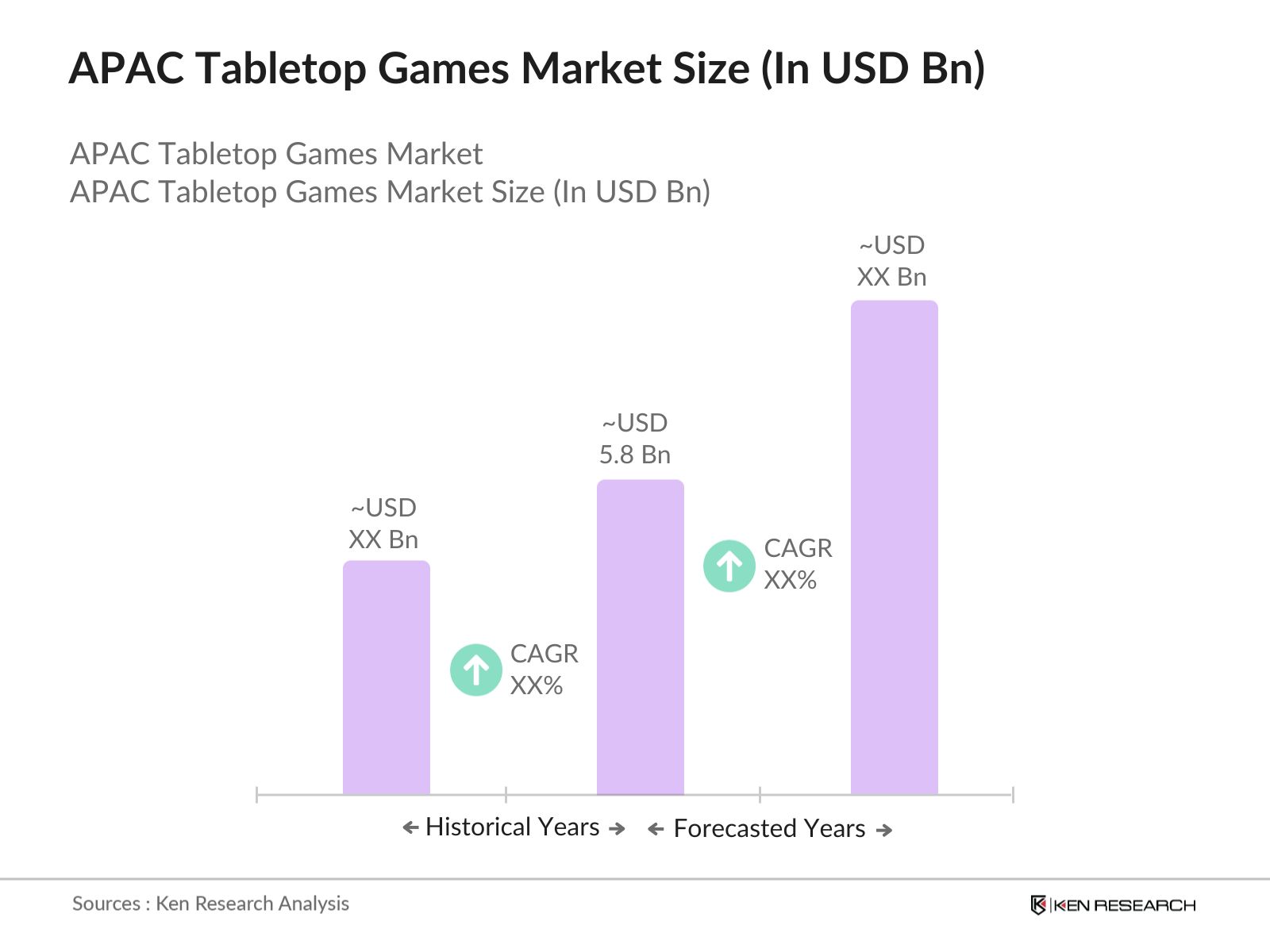
  • The APAC tabletop games market is currently experiencing growth, reaching a market size of USD 5.8 Bn, driven by a rising interest in board games, card games, and strategy games across key countries such as China, Japan, South Korea, and India. The demand is fueled by the increasing popularity of social gaming, coupled with the growing trend of in-person gatherings and game nights, especially after the easing of pandemic-related restrictions. Educational institutions are also incorporating tabletop games for learning purposes, further expanding the market.

APAC Tabletop Games Market Size

  • Key markets such as China and Japan dominate the APAC tabletop games industry, owing to their rich cultural history of traditional board games and strong consumer demand for modern gaming experiences. In countries like South Korea and India, the rising disposable income of millennials and Gen Z, combined with increased internet connectivity, has led to a surge in both offline and online tabletop game sales.
  • Governments in the APAC region are actively supporting the integration of tabletop games into educational settings. In South Korea, the Ministry of Education has allocated USD 50 million to promote the use of board games in schools, particularly to enhance problem-solving and cognitive skills. Similarly, Japans Ministry of Education has introduced pilot programs that use tabletop games as a tool for improving collaboration and strategic thinking among students.

APAC Tabletop Games Market Segmentation

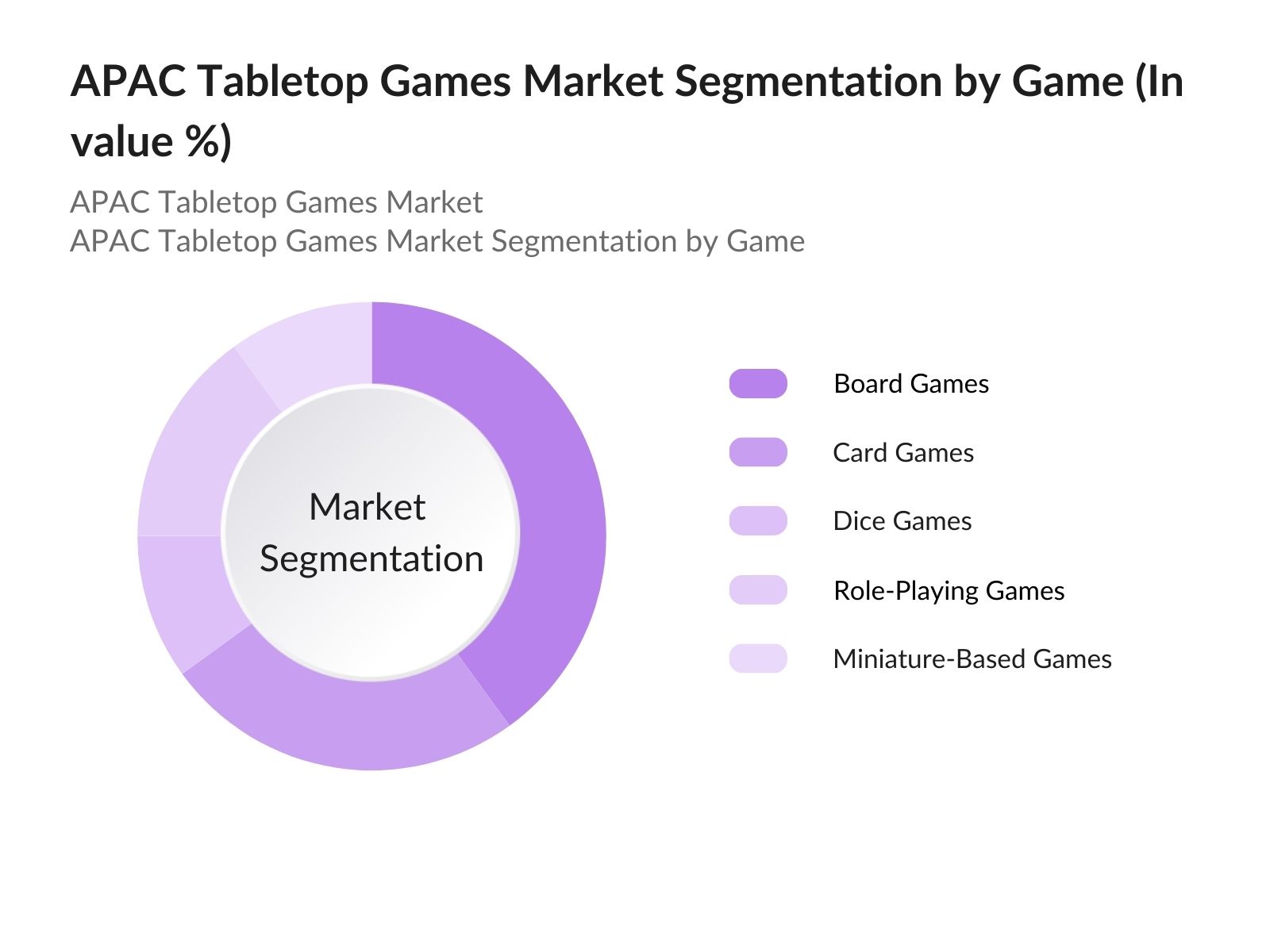
  • By Game Type: The market is segmented by game type into board games, card games, dice games, role play games, and others. Board games dominate the market due to their broad appeal and the rise in thematic, strategy-based, and cooperative games. Games like "Ticket to Ride" and "Catan" have captured the imagination of both casual players and gaming enthusiasts. Card games, including collectible trading card games such as "Magic: The Gathering," also hold a market share, particularly in Japan and China, where competitive tournaments have gained massive followings.

APAC Tabletop Games Market Segmentation by Game Type

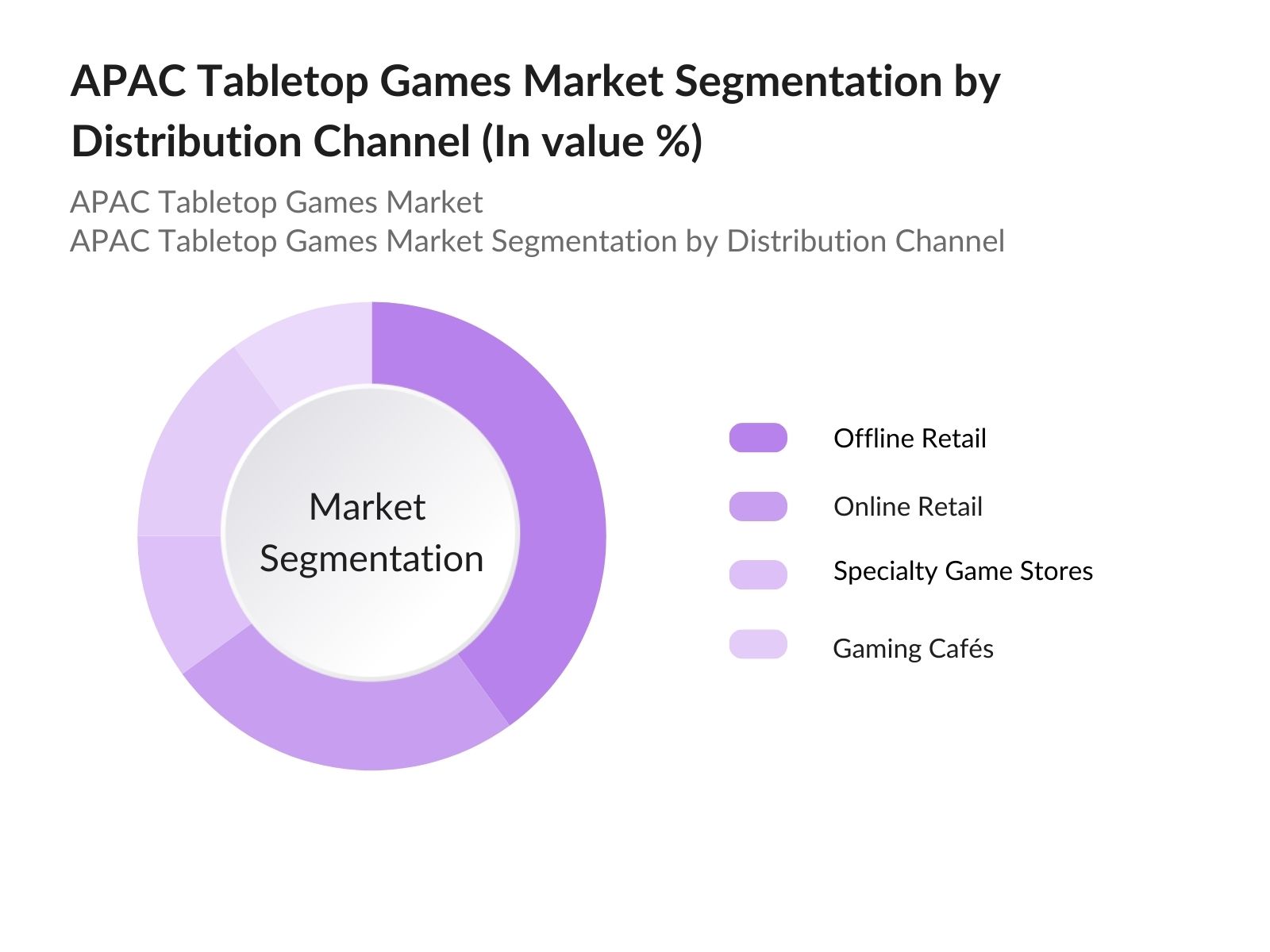
  • By Distribution Channel: The market is further segmented by distribution channels into online retail, offline retail, specialty game stores, and gaming cafs. Offline retail channels hold the largest market share due to their strong presence in countries like Japan and South Korea, where gaming stores and cafs are highly popular. However, the online segment is growing rapidly, driven by e-commerce platforms like Alibaba in China and Flipkart in India, which have made tabletop games more accessible to a wider audience.

APAC Tabletop Games Market Segmentation by Distribution Channel

APAC Tabletop Games Market Competitive Landscape

The APAC tabletop games market is highly competitive, with both global and local players striving to capture market share. Key companies in the market include Hasbro, Mattel, Asmodee Group, and Ravensburger. These companies are focusing on game localization, partnerships with popular franchises, and exploring new themes to appeal to diverse demographics in the APAC region.

Company Name

Establishment Year

Headquarters

Market Focus

Distribution Network

R&D Investment

Franchise Partnerships

Game Localization

Key Markets

Product Innovation

Hasbro

1923

Rhode Island, USA


Asmodee Group

1995

Guyancourt, France


Mattel

1945

El Segundo, USA


CMON Limited

2001

Singapore


Goliath Games

1980

Netherlands


APAC Tabletop Games Industry Analysis

Growth Drivers:

  • Increasing Popularity of Social and Cooperative Games: The rise of social interaction and strategy-based games has boosted demand for tabletop games across the APAC region. In 2023, consumer spending on entertainment and recreation in countries like Japan and South Korea exceeded USD 720 billion, with a noticeable portion allocated to social activities such as board games. This cultural shift toward in-person gatherings and strategic thinking games supports this growing trend. China has seen a substantial increase in the number of dedicated board game cafs, where players gather for social and strategic gaming.
  • Rise in E-Commerce and Online Communities: E-commerce has accelerated the sales of tabletop games in APAC. The robust growth of online marketplaces like Alibaba and Rakuten has transformed the way consumers purchase these games. By 2024, online retail in APAC reached USD 2.8 trillion in sales, supported by a rapidly expanding middle class with increased digital access. In China, millions of users purchased board games online in 2023, highlighting the scale of this transition from physical retail outlets to digital storefronts.
  • Rising Popularity of Traditional Games: The resurgence of traditional games such as "Go" and "Mahjong" in APAC is a growth driver. In 2023, over 60 million players in China alone were actively engaged in these games, with government-supported cultural festivals promoting traditional pastimes. Countries like Japan and South Korea have also integrated such games into popular culture through digital adaptations and social platforms. This trend has contributed to the broader appeal of tabletop gaming in the region .

Market Challenges:

  • High Production Costs for Physical Games: The high costs of production and logistics for tabletop games in the APAC region pose challenges. Many board game manufacturers have experienced sharp rises in raw material costs, such as paper and plastics. The global supply chain disruptions have driven up logistics expenses, impacting the distribution and affordability of board games. This has made it difficult for smaller developers to maintain profitability, particularly in countries like India and Indonesia, where transportation infrastructure remains underdeveloped. The complexity of cross-border shipping and raw material sourcing adds to the burden on manufacturers in this sector.
  • Limited Reach in Rural Markets: Rural markets in APAC remain largely untapped due to logistical challenges and limited infrastructure. Countries like Vietnam and Thailand face barriers to accessing new consumer products such as tabletop games, particularly in rural areas where a large portion of the population resides. In these regions, the supply chain is often fragmented, and distribution networks are concentrated in urban centers. The limited disposable income in these areas also hampers demand for non-essential products like tabletop games, making market penetration difficult for developers and distributors alike.

APAC Tabletop Games Market Future Outlook

The APAC tabletop games market is expected to continue growing steadily over the next five years, driven by rising disposable incomes, increased urbanization, and a growing interest in board and card games. The market will likely see greater innovation in game themes, mechanics, and distribution channels. Government support for educational games will also play a key role in market expansion.

Future Market Opportunities

  • Growth in Online Tabletop Communities: The expansion of online tabletop communities has created new opportunities for game developers. Platforms like Tabletopia and Board Game Arena reported over 10 million active users across the APAC region in 2023. These platforms allow users to play physical board games in a virtual setting, overcoming geographical barriers and logistical challenges. Countries like Japan and South Korea lead in participation rates, with nearly 6 million users combined on these platforms.
  • Integration of Tabletop Games in Educational Curriculums: Tabletop games have gained traction in educational settings, offering opportunities for developers to collaborate with educational institutions. The South Korean governments initiative to incorporate gamified learning into school curricula resulted in hundreds of schools using tabletop games for educational purposes by 2023. With educational spending increasing by USD 300 billion across APAC in 2023, there is a opportunity for tabletop games to be further integrated into learning environments, fostering both cognitive development and social interaction.

Scope of the Report

By Game Type

Board Games

Card Games

Dice Games

Role-Playing Games (RPGs)

Miniature-Based Games

By Distribution Channel

Online Retail

Offline Retail

Specialty Game Stores

Gaming Cafs

By Application

Residential

Educational Institutions

Corporate Training

Hobbyist & Competitive Communities

By End-User Age Group

Children

Teenagers

Adults

Families

By Region

China

Japan

South Korea

India

Australia

Rest of the APAC

Products

Key Target Audience

  • Board Game Manufacturers

  • Game Publishers

  • Retailers and Distributors

  • Investors and Venture Capitalist Firms

  • Government and Regulatory Bodies (e.g., Ministry of Education, Culture Agencies)

  • Online E-Commerce Platforms

  • Toy and Hobby Associations

  • Gaming Caf Owners and Operators

  • Banks and Financial Institutions

Companies

Major Players Mentioneds in the Report

  • Hasbro

  • Asmodee Group

  • Mattel

  • CMON Limited

  • Goliath Games

  • Ravensburger

  • Spin Master

  • IELLO

  • WizKids

  • Kosmos

  • Fantasy Flight Games

  • Days of Wonder

  • Plaid Hat Games

  • Z-Man Games

  • Renegade Game Studios

Table of Contents

1. APAC Tabletop Games Market Overview

1.1. Definition and Scope
1.2. Market Taxonomy
1.3. Market Growth Rate
1.4. Market Segmentation Overview

2. APAC Tabletop Games Market Size (In USD Bn)

2.1. Historical Market Size
2.2. Year-On-Year Growth Analysis
2.3. Key Market Developments and Milestones

3. APAC Tabletop Games Market Analysis

3.1. Growth Drivers (Consumer Spending, Rise of Board Game Cafs, Educational Use)
3.1.1. Rise of Social and Strategy-Based Games
3.1.2. Growth of E-Commerce Platforms in Tabletop Sales
3.1.3. Increasing Popularity of Traditional Games
3.1.4. Educational Institutions Integrating Tabletop Games
3.2. Market Challenges (Piracy, High Production Costs, Supply Chain Disruptions)
3.2.1. High Costs of Production and Logistics
3.2.2. Limited Reach in Rural Markets
3.2.3. Piracy and Unlicensed Game Copies
3.2.4. Competition from Digital Games
3.3. Opportunities (Virtual Tabletop Platforms, Expansion in Emerging Markets)
3.3.1. Growth in Online Tabletop Communities
3.3.2. Integration of Tabletop Games in Educational Curriculums
3.3.3. Collaboration with Entertainment Franchises
3.3.4. Expansion into Tier 2 and 3 Cities
3.4. Trends (Game Mechanics Innovation, Cultural Influence, Customization)
3.4.1. Game Theme and Mechanic Diversification
3.4.2. Emergence of Crowdfunded Tabletop Games
3.4.3. Growing Popularity of Customizable Board Games
3.4.4. Increased Cross-Cultural Game Development
3.5. Government Regulation (Educational Support, Cultural Promotion Initiatives)
3.5.1. Government Support for Educational Games
3.5.2. Cultural Promotion Policies and Traditional Game Preservation
3.5.3. Import and Export Regulations for Tabletop Games
3.5.4. IP Regulations to Combat Piracy
3.6. SWOT Analysis
3.7. Stake Ecosystem
3.8. Porters Five Forces
3.9. Competition Ecosystem

4. APAC Tabletop Games Market Segmentation

4.1. By Game Type (In Value %)
4.1.1. Board Games
4.1.2. Card Games
4.1.3. Dice Games
4.1.4. Role-Playing Games (RPGs)
4.1.5. Miniature-Based Games

4.2. By Distribution Channel (In Value %)
4.2.1. Online Retail
4.2.2. Offline Retail
4.2.3. Specialty Game Stores
4.2.4. Gaming Cafs

4.3. By Application (In Value %)
4.3.1. Residential
4.3.2. Educational Institutions
4.3.3. Corporate Training
4.3.4. Hobbyist & Competitive Communities

4.4. By End-User Age Group (In Value %)
4.4.1. Children
4.4.2. Teenagers
4.4.3. Adults
4.4.4. Families

4.5. By Country (In Value %)
4.5.1. China
4.5.2. Japan
4.5.3. South Korea
4.5.4. India
4.5.5. Australia

5. APAC Tabletop Games Market Competitive Analysis

5.1. Detailed Profiles of Major Companies
5.1.1. Hasbro
5.1.2. Asmodee Group
5.1.3. Mattel
5.1.4. Ravensburger
5.1.5. CMON Limited
5.1.6. Goliath Games
5.1.7. IELLO
5.1.8. Kosmos
5.1.9. WizKids
5.1.10. Days of Wonder
5.1.11. Fantasy Flight Games
5.1.12. Plaid Hat Games
5.1.13. Z-Man Games
5.1.14. Renegade Game Studios
5.1.15. Spin Master

5.2. Cross Comparison Parameters (Revenue, Inception Year, Number of Employees, Regional Presence, R&D Investment, Product Innovation, Strategic Partnerships, Production Capacity)
5.3. Market Share Analysis
5.4. Strategic Initiatives
5.5. Mergers and Acquisitions
5.6. Investment Analysis
5.7. Venture Capital Funding
5.8. Government Grants
5.9. Private Equity Investments

6. APAC Tabletop Games Market Regulatory Framework

6.1. IP Regulations
6.2. Import and Export Policies
6.3. Compliance with Toy Safety Standards
6.4. Educational Game Certifications

7. APAC Tabletop Games Future Market Size (In USD Bn)

7.1. Future Market Size Projections
7.2. Key Factors Driving Future Market Growth

8. APAC Tabletop Games Future Market Segmentation

8.1. By Game Type (In Value %)
8.2. By Distribution Channel (In Value %)
8.3. By Application (In Value %)
8.4. By End-User Age Group (In Value %)
8.5. By Country (In Value %)

9. APAC Tabletop Games Market Analysts Recommendations

9.1. TAM/SAM/SOM Analysis
9.2. Consumer Cohort Analysis
9.3. Marketing Initiatives
9.4. White Space Opportunity Analysis

Disclaimer Contact Us

Research Methodology

Step 1: Identification of Key Variables


The initial phase of the research process involves identifying critical factors influencing the APAC tabletop games market. This includes conducting thorough desk research using secondary sources such as proprietary databases, industry reports, and verified publications. The focus is to map the key variables like consumer preferences, distribution channels, and product innovation trends.

Step 2: Market Analysis and Construction


In this phase, historical data for the APAC tabletop games market is gathered and analyzed. This data includes market penetration rates, distribution network expansion, and overall revenue generation. An analysis of the competitive landscape is also conducted to assess the influence of key players and their market strategies.

Step 3: Hypothesis Validation and Expert Consultation


Market hypotheses are developed and validated through consultations with industry experts. This involves conducting computer-assisted interviews with major market stakeholders, including game manufacturers and distributors. These insights help verify market assumptions and refine the final data.

Step 4: Research Synthesis and Final Output


In the final phase, all gathered data is synthesized and validated through both top-down and bottom-up approaches. Detailed insights on product segmentation, consumer behavior, and competitive strategies are incorporated to ensure the accuracy and comprehensiveness of the final report on the APAC tabletop games market.

Frequently Asked Questions

01. How big is the APAC Tabletop Games Market?

The APAC tabletop games market was valued at USD 5.8 billion. This growth is supported by the increased popularity of board and card games, as well as a rising trend of gaming cafs across key markets like China and Japan.

02. What are the key challenges in the APAC Tabletop Games Market?

Key challenges in the APAC tabletop games market was include the high cost of game production, particularly for physical board games, and the issue of piracy and unlicensed game copies, especially in countries like China and India.

03. Who are the major players in the APAC Tabletop Games Market?

Major players in the APAC tabletop games market include Hasbro, Asmodee Group, Mattel, CMON Limited, and Goliath Games. These companies dominate the market through product innovation and strong brand loyalty.

04. What is driving the growth of the APAC Tabletop Games Market?

The growth of the APAC tabletop games market is driven by rising consumer interest in social and strategy-based games, the proliferation of gaming cafs, and the increasing role of e-commerce platforms in game distribution.

Why Buy From Us?

RRR
Refine Robust Result (RRR) Framework

What makes us stand out is that our consultants follows Robust, Refine and Result (RRR) methodology. i.e. Robust for clear definitions, approaches and sanity checking, Refine for differentiating respondents facts and opinions and Result for presenting data with story

Our Reach Is Unmatched

We have set a benchmark in the industry by offering our clients with syndicated and customized market research reports featuring coverage of entire market as well as meticulous research and analyst insights.

Research
Shifting the Research Paradigm

While we don't replace traditional research, we flip the method upside down. Our dual approach of Top Bottom & Bottom Top ensures quality deliverable by not just verifying company fundamentals but also looking at the sector and macroeconomic factors.

Insite
More Insights-Better Decisions

With one step in the future, our research team constantly tries to show you the bigger picture. We help with some of the tough questions you may encounter along the way: How is the industry positioned? Best marketing channel? KPI's of competitors? By aligning every element, we help maximize success.

Trust
Transparency and Trust

Our report gives you instant access to the answers and sources that other companies might choose to hide. We elaborate each steps of research methodology we have used and showcase you the sample size to earn your trust.

support
Round the Clock Support

If you need any support, we are here! We pride ourselves on universe strength, data quality, and quick, friendly, and professional service.

Why Client Choose Us?

400000+ Reports in repository
150+ Consulting project a year
100+ Analysts
8000+ Client Queries in 2022