
APAC Washing Machine Market Outlook to 2030
Region:Afganistan
Author(s):Meenakshi Bisht
Product Code:KROD9420
Region:Afganistan
Author(s):Meenakshi Bisht
Product Code:KROD9420
December 2024
85
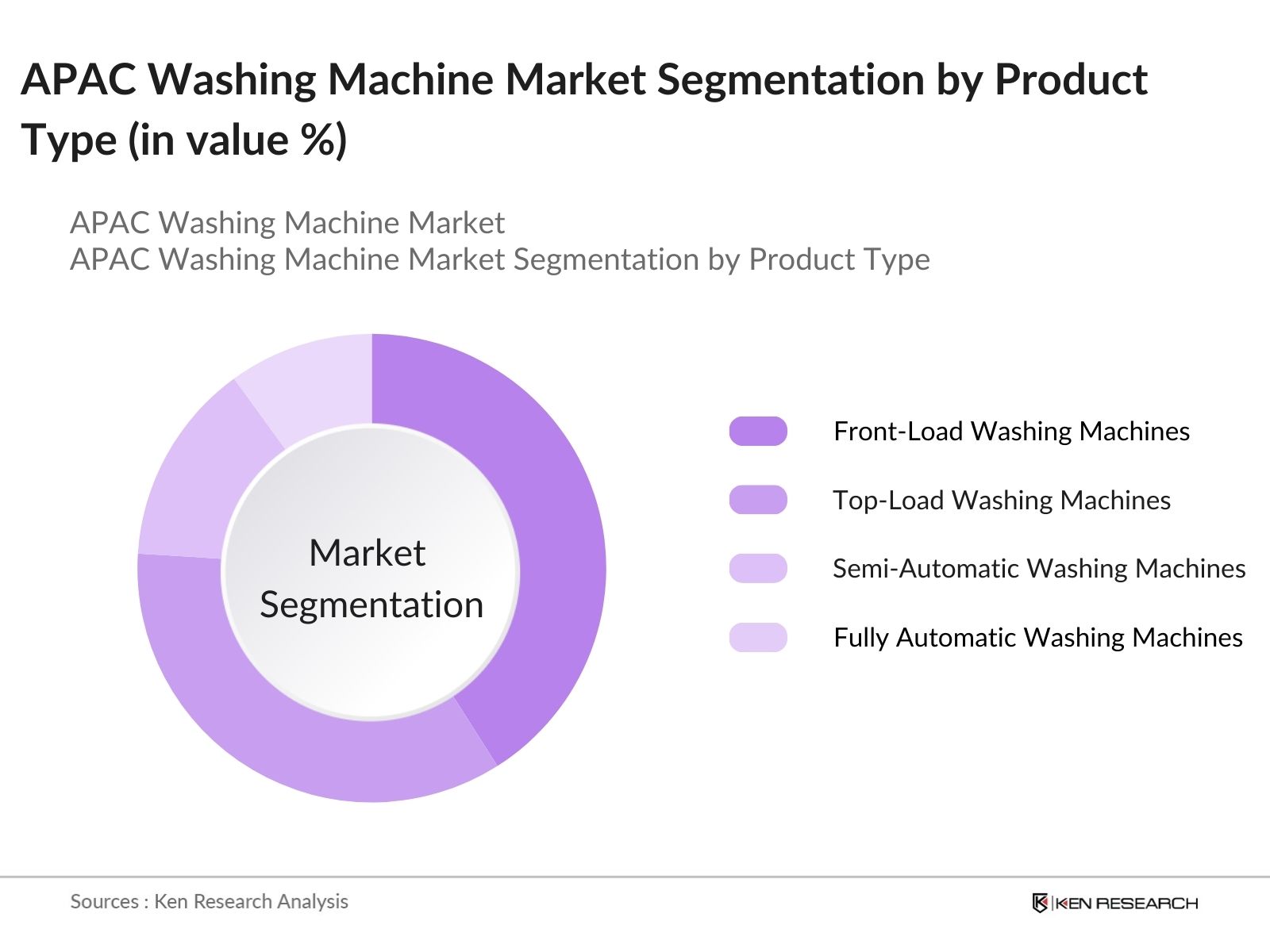
By Product Type: The APAC Washing Machine Market is segmented by product type into front-load, top-load, semi-automatic, and fully automatic washing machines. Recently, front-load washing machines have taken a dominant market share due to their energy and water efficiency. Consumers, especially in urban centers, are becoming increasingly conscious of resource savings, making front-load models more desirable. These machines also offer better cleaning performance, quieter operation, and greater durability compared to top-load models, which has contributed to their rising popularity.
By Technology: The APAC Washing Machine Market is segmented by technology into conventional technology and smart/IoT-enabled technology. Smart/IoT-enabled washing machines are rapidly gaining market share, driven by the increasing adoption of smart home systems and the desire for convenience among tech-savvy consumers. The ability to control and monitor these machines via mobile apps is a key differentiator that appeals to younger, urban populations. This trend is especially strong in countries like Japan and South Korea, where smart technology integration is highly advanced.

The market is dominated by major global and regional players, who have established strong distribution networks and continually invest in product innovation. Companies like LG Electronics and Samsung lead in smart washing machines, while Haier and Whirlpool dominate the mid-range and budget segments. The competitive landscape is characterized by a blend of premium brands that focus on technological innovation and cost-effective brands that cater to the price-sensitive segment.
|
Company |
Establishment Year |
Headquarters |
Product Portfolio |
Revenue (USD Bn) |
Global Presence |
R&D Investment |
Smart Technology Integration |
Sustainability Initiatives |
Customer Satisfaction Ratings |
|
LG Electronics |
1958 |
South Korea |
|||||||
|
Samsung Electronics |
1969 |
South Korea |
|||||||
|
Whirlpool Corporation |
1911 |
USA |
|||||||
|
Haier Group Corporation |
1984 |
China |
|||||||
|
Panasonic Corporation |
1918 |
Japan |
Over the next five years, the APAC Washing Machine Market is expected to experience significant growth, driven by advancements in energy-efficient technologies, rising disposable incomes, and the growing adoption of smart appliances. Government initiatives promoting water conservation and energy-saving measures will further fuel the demand for modern, eco-friendly washing machines.
|
Product Type |
Front-Load Top-Load Semi-Automatic Fully Automatic |
|
Application |
Residential Commercial (Laundry Services, Hospitals, Hotels) |
|
Technology |
Conventional Technology Smart/IoT-Enabled Technology |
|
Distribution Channel |
Offline Retail (Supermarkets, Specialty Stores) Online Retail (E-commerce) |
|
Region |
China Japan India South Korea Southeast Asia |
1.1. Definition and Scope
1.2. Market Taxonomy
1.3. Market Growth Rate
1.4. Market Segmentation Overview
2.1. Historical Market Size
2.2. Year-On-Year Growth Analysis
2.3. Key Market Developments and Milestones
3.1. Growth Drivers
3.1.1. Urbanization and Rise of Middle-Class Income (Consumer Affordability)
3.1.2. Increasing Demand for Energy-Efficient Products (Energy Consumption Parameters)
3.1.3. Government Initiatives for Water and Energy Conservation (Regulatory Impact)
3.1.4. Rising Smart Home Penetration (Smart Technology Integration)
3.2. Market Challenges
3.2.1. High Initial Costs for Smart Washing Machines (Pricing Barrier)
3.2.2. Technical Challenges in Product Differentiation (Innovation Bottlenecks)
3.2.3. Impact of Economic Slowdown in Key Countries (Economic Sensitivity)
3.3. Opportunities
3.3.1. Integration of IoT and AI Technologies (Product Innovation)
3.3.2. Expansion into Rural and Emerging Markets (Geographic Opportunities)
3.3.3. Collaboration with E-commerce Platforms (Sales Channel Optimization)
3.4. Trends
3.4.1. Increased Adoption of Smart Washing Machines (Smart Technology)
3.4.2. Shift Toward Eco-Friendly and Low Water-Usage Products (Sustainability Focus)
3.4.3. Demand for Compact and Space-Saving Washing Machines (Consumer Preference)
3.5. Government Regulation
3.5.1. Energy Labeling and Efficiency Standards (Compliance Framework)
3.5.2. Water Usage Regulations (Regional Regulatory Environment)
3.5.3. Import-Export Policies on Home Appliances (Trade Regulations)
3.5.4. Sustainability Programs by Local Governments (Green Initiatives)
3.6. SWOT Analysis
3.7. Stakeholder Ecosystem
3.8. Porters Five Forces Analysis
3.9. Competitive Landscape and Market Ecosystem
4.1. By Product Type (In Value %)
4.1.1. Front-Load Washing Machines
4.1.2. Top-Load Washing Machines
4.1.3. Semi-Automatic Washing Machines
4.1.4. Fully Automatic Washing Machines
4.2. By Application (In Value %)
4.2.1. Residential
4.2.2. Commercial (Laundry Services, Hospitals, Hotels)
4.3. By Technology (In Value %)
4.3.1. Conventional Technology
4.3.2. Smart/IoT-Enabled Technology
4.4. By Distribution Channel (In Value %)
4.4.1. Offline Retail (Supermarkets, Specialty Stores)
4.4.2. Online Retail (E-commerce)
4.5. By Region (In Value %)
4.5.1. China
4.5.2. Japan
4.5.3. India
4.5.4. South Korea
4.5.5. Southeast Asia
5.1. Detailed Profiles of Major Competitors
5.1.1. LG Electronics Inc.
5.1.2. Samsung Electronics Co., Ltd.
5.1.3. Whirlpool Corporation
5.1.4. Panasonic Corporation
5.1.5. Haier Group Corporation
5.1.6. Midea Group
5.1.7. Hitachi Appliances Inc.
5.1.8. Toshiba Corporation
5.1.9. Electrolux AB
5.1.10. Godrej Appliances
5.1.11. IFB Industries Ltd.
5.1.12. Bosch Siemens Hausgerte (BSH)
5.1.13. Sharp Corporation
5.1.14. Videocon Industries
5.1.15. Arelik A..
5.2. Cross Comparison Parameters (Product Portfolio, Smart Technology Integration, Market Share, Sustainability Initiatives, Revenue, Global Presence, Customer Satisfaction Ratings, R&D Investments)
5.3. Market Share Analysis
5.4. Strategic Initiatives
5.5. Mergers and Acquisitions
5.6. Investment Analysis
5.7. Venture Capital Funding
5.8. Private Equity Investments
6.1. Energy Efficiency Certifications (APAC Regional Standards)
6.2. Compliance with Environmental Regulations (Emissions and Waste Management)
6.3. Consumer Safety Standards (Washing Machine Durability, Electrical Safety)
6.4. Import-Export Tariffs (Trade Impact on Washing Machines)
7.1. Future Market Size Projections
7.2. Key Factors Driving Future Market Growth
8.1. By Product Type (In Value %)
8.2. By Application (In Value %)
8.3. By Technology (In Value %)
8.4. By Distribution Channel (In Value %)
8.5. By Region (In Value %)
9.1. TAM/SAM/SOM Analysis
9.2. Customer Cohort Analysis
9.3. Marketing Initiatives
9.4. White Space Opportunity Analysis
Disclaimer Contact UsThe research begins with the identification of key variables that impact the APAC Washing Machine Market. Extensive desk research using proprietary databases helps in defining the parameters like technological advancements, pricing strategies, and market dynamics that influence market behavior.
Historical market data is analyzed to construct the market landscape, including key drivers and challenges. The historical penetration of smart washing machines and their impact on revenue growth is studied in this phase, along with analysis of consumer preferences.
The hypotheses developed during the research are validated through in-depth interviews with key industry stakeholders, including appliance manufacturers, retailers, and technology integrators. These insights refine the understanding of market dynamics and future growth prospects.
The final step synthesizes all data, including primary and secondary research, into a comprehensive report. Engagement with washing machine manufacturers and distributors helps in validating the product segmentation and performance metrics.
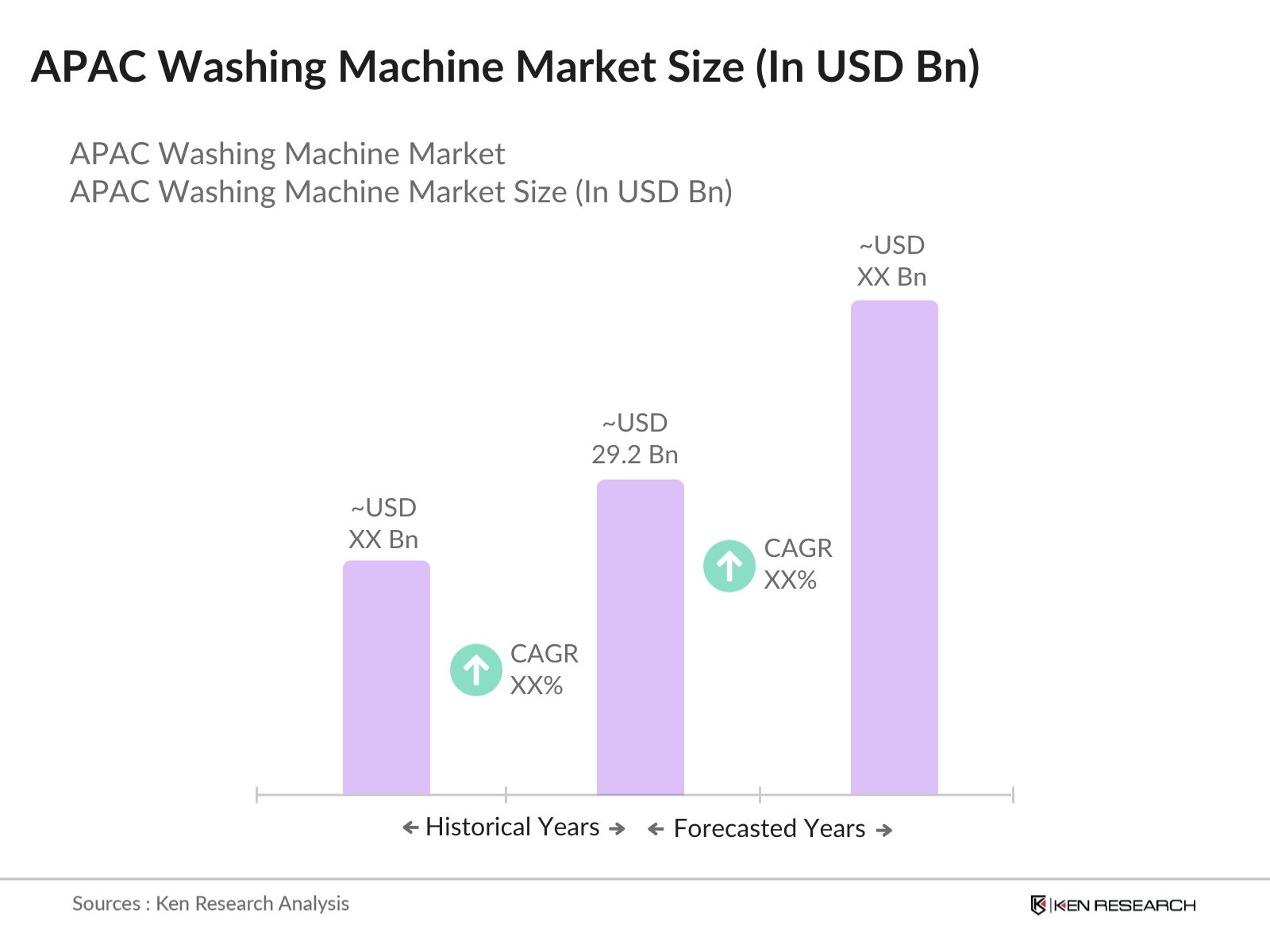
The APAC Washing Machine Market is valued at USD 29.2 billion, driven by rising consumer demand for energy-efficient and smart home appliances, and increased urbanization across major countries like China and India.
Challenges in APAC Washing Machine Market include the high initial costs of smart and energy-efficient washing machines, as well as economic uncertainties in emerging markets that can limit consumer spending on premium home appliances.
Key players in APAC Washing Machine Market include LG Electronics, Samsung, Whirlpool, Haier, and Panasonic. These companies dominate the market due to their extensive product portfolios, strong distribution networks, and continuous focus on product innovation.
The APAC Washing Machine Market is driven by factors such as increasing disposable incomes, rising urbanization, government incentives promoting energy-efficient appliances, and the growing adoption of smart home technologies across the region.

What makes us stand out is that our consultants follows Robust, Refine and Result (RRR) methodology. i.e. Robust for clear definitions, approaches and sanity checking, Refine for differentiating respondents facts and opinions and Result for presenting data with story

We have set a benchmark in the industry by offering our clients with syndicated and customized market research reports featuring coverage of entire market as well as meticulous research and analyst insights.

While we don't replace traditional research, we flip the method upside down. Our dual approach of Top Bottom & Bottom Top ensures quality deliverable by not just verifying company fundamentals but also looking at the sector and macroeconomic factors.

With one step in the future, our research team constantly tries to show you the bigger picture. We help with some of the tough questions you may encounter along the way: How is the industry positioned? Best marketing channel? KPI's of competitors? By aligning every element, we help maximize success.

Our report gives you instant access to the answers and sources that other companies might choose to hide. We elaborate each steps of research methodology we have used and showcase you the sample size to earn your trust.

If you need any support, we are here! We pride ourselves on universe strength, data quality, and quick, friendly, and professional service.