















Asia Pacific Air Purifier Market Outlook to 2030
Region:Asia
Author(s):Shreya
Product Code:KROD3508
November 2024
81
About the Report
Asia Pacific Air Purifier Market Overview
The Asia Pacific Air Purifier Market is valued at USD 18 billion based on historical analysis, driven primarily by increased urbanization and rising pollution levels in major cities. A significant driver for the growth of this market is the increasing awareness of the health hazards posed by indoor and outdoor air pollution. Furthermore, air purifiers have gained popularity due to their ability to reduce exposure to pollutants, allergens, and particulate matter. The shift toward health and wellness, particularly in urban households, has propelled market demand, with air quality concerns playing a critical role. 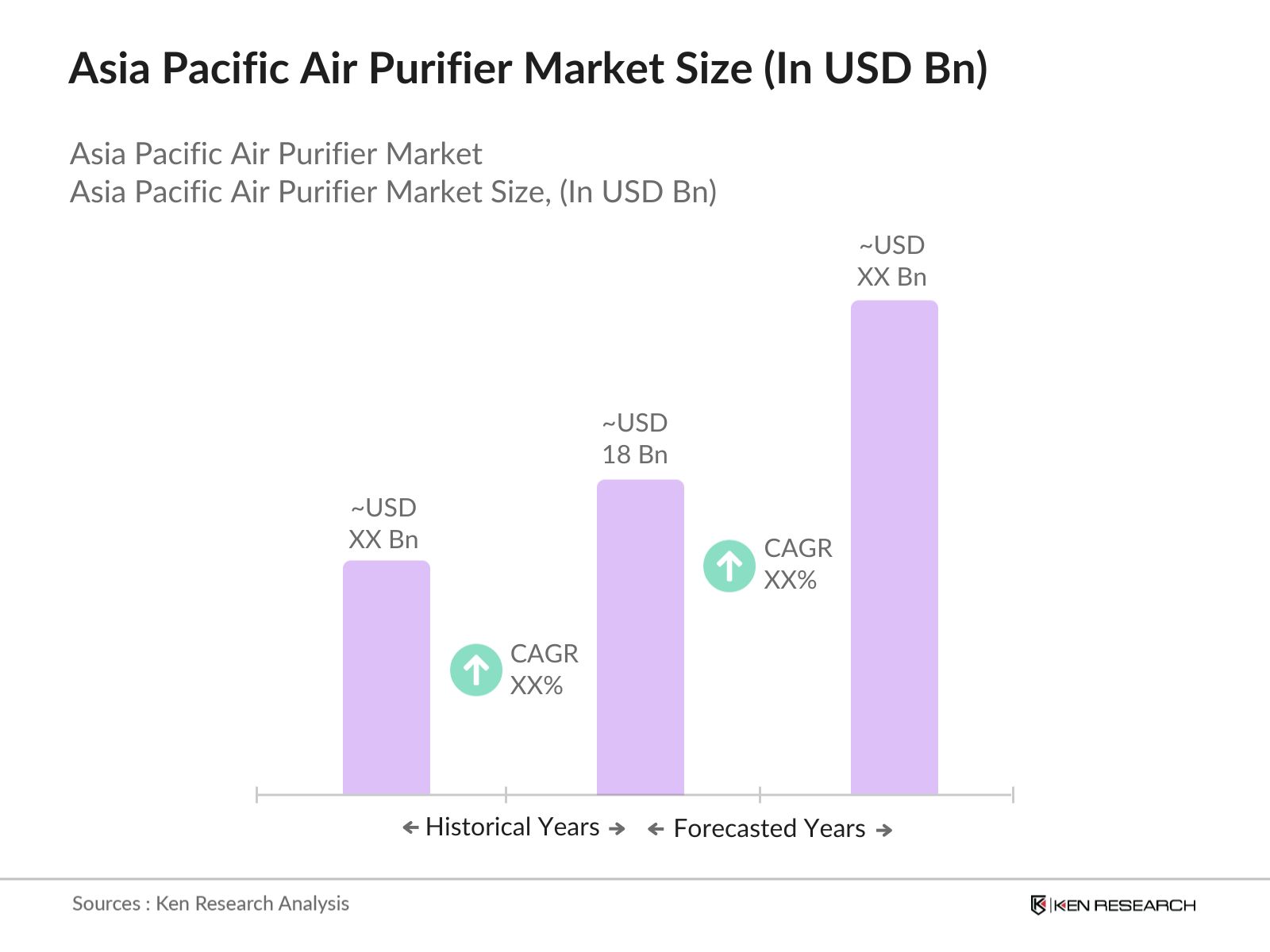
Cities and countries like China, India, and Japan dominate the market due to severe air pollution, high population density, and robust industrial activities. China, for example, faces substantial environmental issues with air quality, and government policies promoting air purification solutions have driven the adoption of air purifiers. Additionally, Japan's focus on health-conscious consumers, coupled with advancements in air filtration technology, has made it a key player in the region. India's growing urban population and deteriorating air quality are also contributing to the rise of air purifiers in the residential segment.
Governments across the Asia Pacific region have established stringent indoor air quality standards. For instance, Japans Ministry of Health mandates that indoor PM2.5 levels must not exceed 15 micrograms per cubic meter. Similarly, China enforces strict indoor air quality regulations that require air purifiers in public spaces such as schools and hospitals to meet high efficiency standards. These regional guidelines are encouraging the widespread adoption of air purifiers, particularly in countries with severe air pollution.
Asia Pacific Air Purifier Market Segmentation
- By Product Type: The market is segmented by product type into HEPA filters, Activated Carbon filters, UV Purifiers, Ionic Air Purifiers, and Ozone Generators. Recently, HEPA filters have dominated the market share due to their widespread effectiveness in removing particulate matter and allergens from the air. The increasing demand for air purifiers capable of tackling high levels of PM2.5 pollution in urban areas has reinforced the popularity of HEPA filters. Additionally, government regulations promoting cleaner indoor air quality have driven the adoption of this technology across both residential and commercial sectors.

- By Application: The market is segmented by application into Residential, Commercial, and Industrial uses. The Residential sector holds the dominant market share, driven by rising health awareness and the deteriorating air quality in urban areas. Households, especially in high-pollution cities like Delhi, Beijing, and Tokyo, are increasingly adopting air purifiers to ensure the health and well-being of residents. The COVID-19 pandemic has also heightened the demand for indoor air purification systems, leading to an increase in residential installations of air purifiers.

Asia Pacific Air Purifier Market Competitive Landscape
The Asia Pacific Air Purifier Market is characterized by the presence of both domestic and international companies. Leading players include established multinational corporations that have leveraged their technological innovations to maintain a competitive edge. These companies dominate the market due to their strong distribution networks, research and development capabilities, and investments in smart and sustainable air purification technologies. Companies like Panasonic and Dyson are known for their continuous focus on advanced technologies, such as integrating IoT with air purifiers.
Competitive Landscape Table
|
Company |
Established |
Headquarters |
Market Reach |
Technological Innovation |
R&D Investment |
Revenue (USD bn) |
Product Range |
Sustainability Initiatives |
|---|---|---|---|---|---|---|---|---|
|
Panasonic Corporation |
1918 |
Osaka, Japan |
||||||
|
Dyson Ltd. |
1993 |
Malmesbury, UK |
||||||
|
Daikin Industries, Ltd. |
1924 |
Osaka, Japan |
||||||
|
Honeywell International |
1906 |
Charlotte, USA |
||||||
|
Xiaomi Corporation |
2010 |
Beijing, China |
Asia Pacific Air Purifier Industry Analysis
Growth Drivers
- Increasing Air Pollution Levels: Air pollution levels in the Asia Pacific region continue to rise due to rapid industrialization and increased vehicle emissions. As per the World Health Organization (WHO), over 90% of the population in Asia Pacific cities is exposed to hazardous levels of air pollution, leading to increased respiratory and cardiovascular diseases. For instance, in India, PM2.5 levels in major cities often exceed 150 micrograms per cubic meter, significantly higher than the WHO guideline of 25 micrograms per cubic meter. This growing health threat has driven demand for air purifiers across urban centers.
- Rising Awareness of Health Hazards: Rising public awareness regarding the health hazards of air pollution, particularly respiratory issues and allergies, has significantly contributed to the air purifier market. In 2022, the World Bank reported a substantial increase in healthcare expenditures related to air pollution in urban regions across Southeast Asia. This has raised awareness and led to higher air purifier adoption rates, especially in cities like Bangkok, where air quality indices have crossed 200 AQI multiple times, impacting human health.
- Government Initiatives for Air Quality Improvement: Governments in the Asia Pacific region have introduced several initiatives to improve air quality. Chinas Blue Sky Protection Campaign and Indias National Clean Air Programme (NCAP) have focused on reducing particulate pollution by over 20% in key cities by 2024. These programs have encouraged the adoption of air purifiers in both residential and commercial spaces to complement government actions. For example, China has set national standards for indoor air quality, mandating businesses and educational institutions to adopt air filtration systems.
Market Challenges
- High Initial Costs and Maintenance: Despite rising demand, the high upfront cost of air purifiers remains a key challenge in the Asia Pacific market. Many advanced models with HEPA or UV-based purification technologies can cost upwards of $500, placing them out of reach for lower-income households. In addition, filter replacement and energy costs contribute to ongoing maintenance expenses, which can range between $50 and $100 per year. This financial burden discourages adoption, especially in developing countries like Indonesia and the Philippines.
- Lack of Awareness in Rural AreasL Air purifier penetration is largely confined to urban centers, with rural areas in the Asia Pacific lagging significantly. According to the World Bank, rural populations, which constitute more than 40% of the total population in the region, often lack awareness of air pollution risks. In 2022, surveys in rural Vietnam and Indonesia indicated that only 15% of households were aware of the potential health risks posed by indoor air pollution. This knowledge gap presents a significant challenge to market expansion in less developed areas.
- Performance Discrepancy in Different Environments: Air purifiers often perform inconsistently in various environments across the Asia Pacific due to fluctuating levels of humidity, temperature, and air quality. For example, in tropical regions such as Thailand, air purifiers equipped with standard filters may struggle to remove fine particulates effectively, particularly in highly humid conditions. This issue has raised concerns over the applicability of existing products in diverse climate zones, leading to a lower perceived value in certain regions.
Asia Pacific Air Purifier Market Future Outlook
Over the next five years, the Asia Pacific Air Purifier market is expected to show significant growth, driven by rising consumer awareness, government regulations for improving air quality, and advancements in air filtration technologies. The increasing number of urban dwellers exposed to harmful levels of air pollution, particularly in developing countries like India and China, will continue to drive demand. Innovations such as smart air purifiers, which can be integrated into home automation systems, and the adoption of eco-friendly and energy-efficient air purification technologies, will further propel the market.
Future Market Opportunities
- Technological Advancements: The integration of Internet of Things (IoT) and smart technologies into air purifiers presents a significant growth opportunity in the Asia Pacific market. For example, air purifiers that connect with home automation systems are becoming increasingly popular. In 2023, approximately 30 million smart homes were equipped with IoT-enabled air purifiers in countries such as Japan and South Korea. These devices allow users to monitor air quality remotely and receive real-time updates via smartphones, enhancing user convenience. This trend is expected to drive further adoption, particularly in tech-savvy urban areas.
- Expansion into Untapped Rural Markets: There is substantial potential for market expansion in rural areas across the Asia Pacific. Government initiatives aimed at improving rural infrastructure and living conditions provide an opportunity for air purifier companies to tap into these regions. For instance, Indias rural electrification program has provided access to electricity for nearly 100 million people since 2020, paving the way for air purifier adoption in rural households. Companies that introduce affordable and energy-efficient models targeting rural consumers stand to benefit from this largely untapped market.
Scope of the Report
|
Segment |
Sub-Segments |
|---|---|
|
Product Type |
HEPA Filters Activated Carbon Filters UV Purifiers Ionic Air Purifiers Ozone Generators |
|
Technology |
Electrostatic Precipitators HEPA Filtration UV Purification Ionic Purification |
|
Application |
Residential Commercial Industrial |
|
Distribution Channel |
Online Retail Offline Retail |
|
Region |
China India Japan South Korea Southeast Asia |
Products
Key Target Audience
Air Purifier Manufacturers
Residential and Commercial Real Estate Developers
Government and Regulatory Bodies (APAC Environmental Standards Committee)
Healthcare Facilities
Banks and Financial institutes
Investments and Venture Capitalist Firms
HVAC System Providers
Public Health Agencies (World Health Organization, National Health Ministries)
Companies
Major Players in the Market
Panasonic Corporation
Honeywell International Inc.
Dyson Ltd.
Daikin Industries, Ltd.
Samsung Electronics
Sharp Corporation
Xiaomi Corporation
LG Electronics
Koninklijke Philips N.V.
Coway Co., Ltd.
Blueair Inc.
IQAir
Camfil AB
Unilever Plc
A.O. Smith Corporation
Table of Contents
1. Asia Pacific Air Purifier Market Overview
1.1. Definition and Scope
1.2. Market Taxonomy
1.3. Market Growth Rate (Factors Influencing Growth: Urbanization, Rising Pollution Levels, Health Consciousness)
1.4. Market Segmentation Overview (By Product Type, Technology, Application, Region, Distribution Channel)
2. Asia Pacific Air Purifier Market Size (In USD Bn)
2.1. Historical Market Size
2.2. Year-On-Year Growth Analysis
2.3. Key Market Developments and Milestones (Launch of Smart Purifiers, Increase in Residential Adoption)
3. Asia Pacific Air Purifier Market Analysis
3.1. Growth Drivers
3.1.1. Increasing Air Pollution Levels
3.1.2. Rising Awareness of Health Hazards
3.1.3. Government Initiatives for Air Quality Improvement
3.1.4. Growing Urbanization and Indoor Air Quality Concerns
3.2. Market Challenges
3.2.1. High Initial Costs and Maintenance
3.2.2. Lack of Awareness in Rural Areas
3.2.3. Performance Discrepancy in Different Environments
3.3. Opportunities
3.3.1. Technological Advancements (Integration with IoT and Smart Devices)
3.3.2. Expansion into Untapped Rural Markets
3.3.3. Growing Demand for Sustainable and Eco-friendly Air Purifiers
3.4. Trends
3.4.1. Adoption of HEPA and UV-based Purification Technologies
3.4.2. Increase in Hybrid Air Purifiers (Air-Purifying and Humidifying Functionality)
3.4.3. Integration with Smart Home Ecosystems
3.5. Government Regulation
3.5.1. Indoor Air Quality Standards by Region (APAC Air Quality Guidelines)
3.5.2. Incentives and Subsidies for Eco-friendly Air Purifiers
3.5.3. Import and Export Regulations for Air Purifiers
3.6. SWOT Analysis
3.7. Stakeholder Ecosystem (Manufacturers, Distributors, Retailers, End-Users)
3.8. Porters Five Forces
3.9. Competition Ecosystem (Market Share, Strategic Initiatives)
4. Asia Pacific Air Purifier Market Segmentation
4.1. By Product Type (In Value %)
4.1.1. HEPA Filters
4.1.2. Activated Carbon Filters
4.1.3. UV Purifiers
4.1.4. Ionic Air Purifiers
4.1.5. Ozone Generators
4.2. By Technology (In Value %)
4.2.1. Electrostatic Precipitators
4.2.2. HEPA Filtration
4.2.3. UV Purification
4.2.4. Ionic Purification
4.3. By Application (In Value %)
4.3.1. Residential
4.3.2. Commercial
4.3.3. Industrial
4.4. By Distribution Channel (In Value %)
4.4.1. Online Retail
4.4.2. Offline Retail
4.5. By Region (In Value %)
4.5.1. China
4.5.2. India
4.5.3. Japan
4.5.4. South Korea
4.5.5. Southeast Asia
5. Asia Pacific Air Purifier Market Competitive Analysis
5.1. Detailed Profiles of Major Companies
5.1.1. Panasonic Corporation
5.1.2. Honeywell International Inc.
5.1.3. Dyson Ltd.
5.1.4. Daikin Industries, Ltd.
5.1.5. Samsung Electronics
5.1.6. Sharp Corporation
5.1.7. Xiaomi Corporation
5.1.8. LG Electronics
5.1.9. Koninklijke Philips N.V.
5.1.10. Coway Co., Ltd.
5.1.11. Blueair Inc.
5.1.12. Unilever Plc
5.1.13. IQAir
5.1.14. Camfil AB
5.1.15. Philips N.V.
5.2. Cross Comparison Parameters (Revenue, R&D Investment, Geographical Reach, Market Share, Distribution Networks, Product Innovations, Technological Adoption, Sustainability Initiatives)
5.3. Market Share Analysis
5.4. Strategic Initiatives (Product Launches, Partnerships)
5.5. Mergers and Acquisitions
5.6. Investment Analysis
5.7. Venture Capital Funding
5.8. Government Grants
5.9. Private Equity Investments
6. Asia Pacific Air Purifier Market Regulatory Framework
6.1. Environmental Standards (Indoor Air Quality Guidelines)
6.2. Compliance Requirements (Air Quality Compliance in APAC Markets)
6.3. Certification Processes (Eco-Friendly Certifications)
7. Asia Pacific Air Purifier Future Market Size (In USD Bn)
7.1. Future Market Size Projections
7.2. Key Factors Driving Future Market Growth
8. Asia Pacific Air Purifier Future Market Segmentation
8.1. By Product Type (In Value %)
8.2. By Technology (In Value %)
8.3. By Application (In Value %)
8.4. By Distribution Channel (In Value %)
8.5. By Region (In Value %)
9. Asia Pacific Air Purifier Market Analysts Recommendations
9.1. TAM/SAM/SOM Analysis
9.2. Customer Cohort Analysis
9.3. Marketing Initiatives
9.4. White Space Opportunity Analysis
Research Methodology
Step 1: Identification of Key Variables
The initial step involves mapping the ecosystem of the Asia Pacific Air Purifier Market, identifying the key variables influencing the market such as environmental factors, consumer awareness, and government regulations. This is done through secondary research from verified sources like industry reports, market surveys, and government databases.
Step 2: Market Analysis and Construction
In this phase, historical data on the Asia Pacific Air Purifier market is compiled and analyzed. This includes the penetration rates of different product types and evaluating performance across residential and commercial segments to estimate overall revenue.
Step 3: Hypothesis Validation and Expert Consultation
Hypotheses regarding the growth trajectory of the market are validated through expert interviews. Industry experts, especially from manufacturers and distributors, provide insight into current trends, challenges, and future developments.
Step 4: Research Synthesis and Final Output
The final step involves synthesizing the gathered data into a coherent, actionable report. This includes verifying figures related to market growth, segment dominance, and competitive positioning, ensuring a comprehensive market overview.
Frequently Asked Questions
1. How big is the Asia Pacific Air Purifier Market?
The Asia Pacific Air Purifier Market is valued at USD 18 billion, driven by growing concerns about indoor air quality and rising pollution levels in key cities like Beijing, Tokyo, and Delhi.
2. What are the challenges in the Asia Pacific Air Purifier Market?
Key challenges in the Asia Pacific Air Purifier Market include high initial costs for air purifiers, lack of awareness in rural regions, and technological limitations in some filtration methods, particularly in capturing certain gaseous pollutants.
3. Who are the major players in the Asia Pacific Air Purifier Market?
Major players in the Asia Pacific Air Purifier Market include Panasonic Corporation, Honeywell International, Dyson Ltd., Daikin Industries, and Xiaomi Corporation. These companies dominate due to their innovative technologies and widespread distribution networks.
4. What are the growth drivers of the Asia Pacific Air Purifier Market?
The Asia Pacific Air Purifier Market is propelled by increasing urbanization, worsening air pollution levels, and growing health awareness among consumers, especially in countries like China and India, where air quality is a major public health concern.
5. Which product segment is dominating the Asia Pacific Air Purifier Market?
HEPA filters dominate the Asia Pacific Air Purifier Market due to their effectiveness in removing fine particulate matter, especially in heavily polluted urban areas, making them a preferred choice for residential use.
Why Buy From Us?

What makes us stand out is that our consultants follows Robust, Refine and Result (RRR) methodology. i.e. Robust for clear definitions, approaches and sanity checking, Refine for differentiating respondents facts and opinions and Result for presenting data with story

We have set a benchmark in the industry by offering our clients with syndicated and customized market research reports featuring coverage of entire market as well as meticulous research and analyst insights.

While we don't replace traditional research, we flip the method upside down. Our dual approach of Top Bottom & Bottom Top ensures quality deliverable by not just verifying company fundamentals but also looking at the sector and macroeconomic factors.

With one step in the future, our research team constantly tries to show you the bigger picture. We help with some of the tough questions you may encounter along the way: How is the industry positioned? Best marketing channel? KPI's of competitors? By aligning every element, we help maximize success.

Our report gives you instant access to the answers and sources that other companies might choose to hide. We elaborate each steps of research methodology we have used and showcase you the sample size to earn your trust.

If you need any support, we are here! We pride ourselves on universe strength, data quality, and quick, friendly, and professional service.