















Asia Pacific Automotive AI Market Outlook to 2030
Region:Asia
Author(s):Abhinav
Product Code:KROD9432
December 2024
88
About the Report
Asia Pacific Automotive AI Market Overview
- The Asia Pacific Automotive AI market is valued at USD 1.3 billion based on historical data analysis. This market's growth is propelled by advancements in AI technologies, rising demand for autonomous vehicles, and enhanced in-vehicle safety systems. Factors like increasing government initiatives to support AI adoption and collaborations between automakers and tech companies have further strengthened the market.
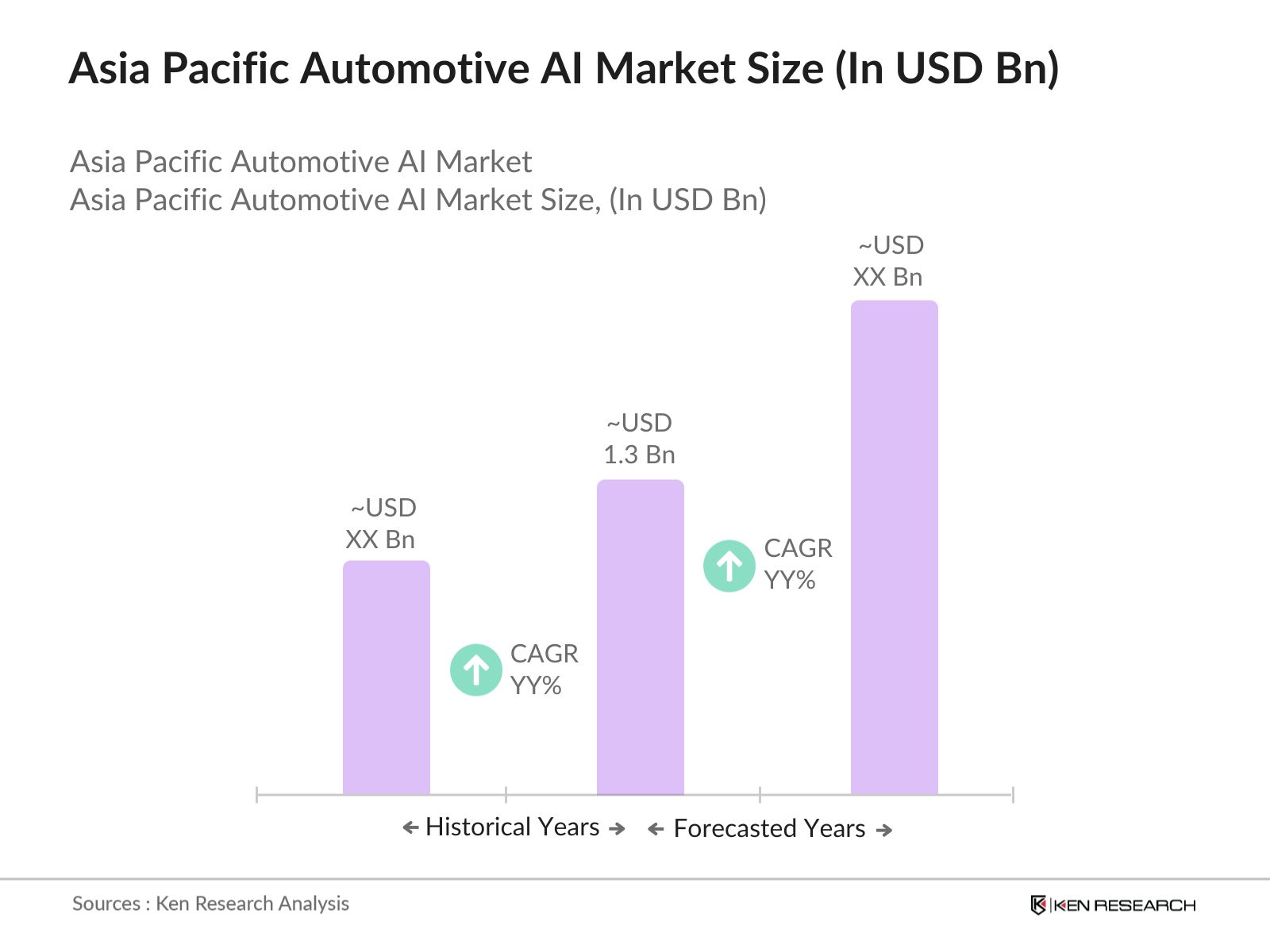
- Countries like China, Japan, and South Korea dominate the market due to their robust automotive manufacturing bases and technological leadership. China benefits from government policies promoting AI and autonomous vehicles, while Japan and South Korea leverage their advanced R&D capabilities and established automotive brands.
- Japan has launched initiatives to integrate AI into its transportation systems, including the development of smart traffic management systems and support for autonomous vehicle testing. The government has allocated funds to support R&D in automotive AI, aiming to enhance road safety and efficiency.
Asia Pacific Automotive AI Market Segmentation
By Component: The market is segmented by component into hardware, software, and services. Recently, software holds a dominant market share in this segment due to its critical role in enabling AI functionalities such as deep learning, computer vision, and natural language processing. Companies are investing heavily in developing AI-driven software to improve vehicle performance, ensure safety, and enhance user experiences. The high adaptability of AI-based software platforms across diverse vehicle types also contributes to their market dominance.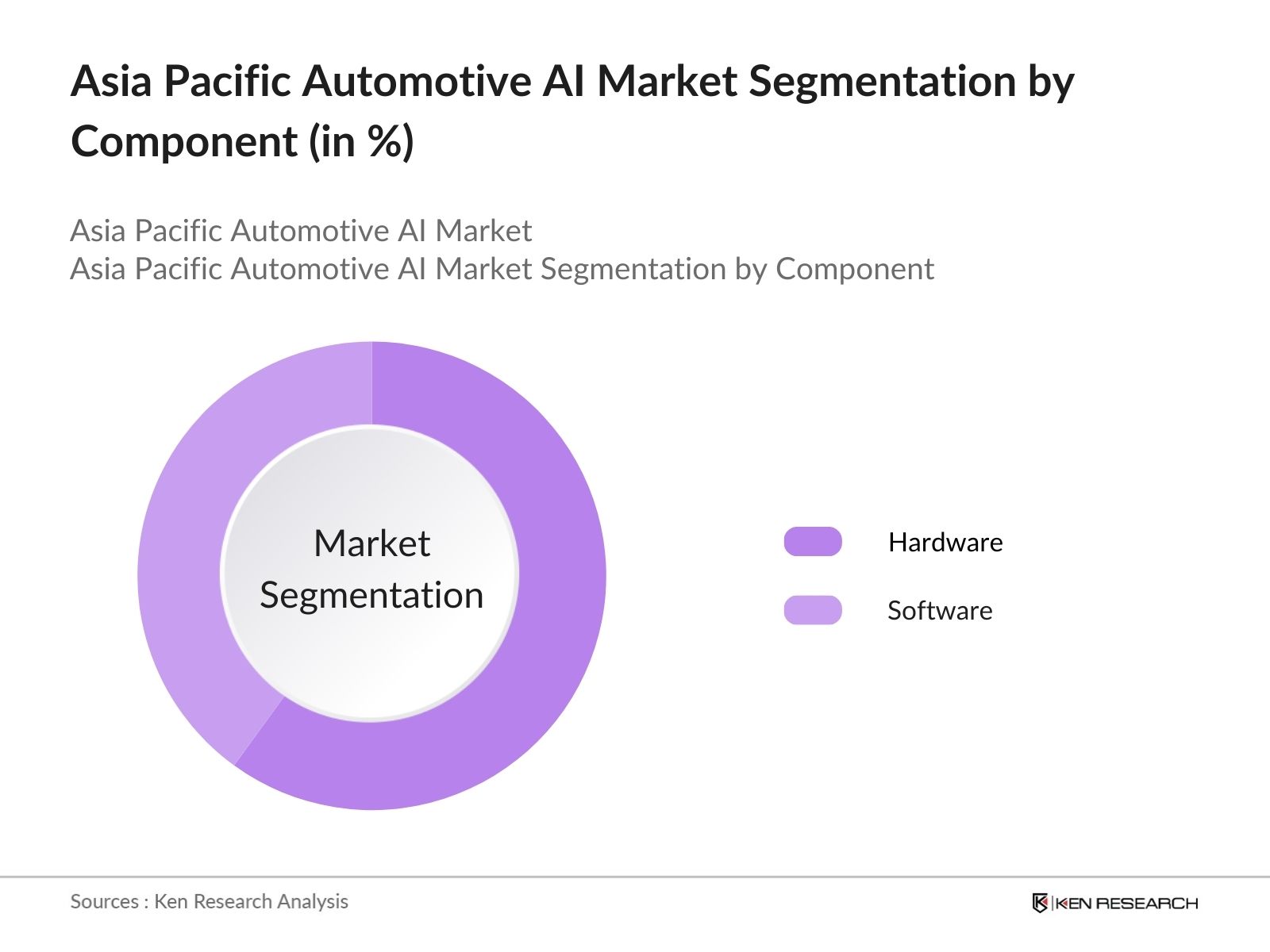
By Application: The market is further segmented by application into semi-autonomous driving, fully autonomous driving, driver monitoring systems, and human-machine interface (HMI). Semi-autonomous driving dominates this segment due to its increasing deployment in mid-range and premium vehicles. Features such as adaptive cruise control, lane-keeping assist, and parking assistance are gaining popularity due to their practical utility and consumer demand. Automakers are integrating these features as a stepping stone toward fully autonomous driving.
Asia Pacific Automotive AI Market Competitive Landscape
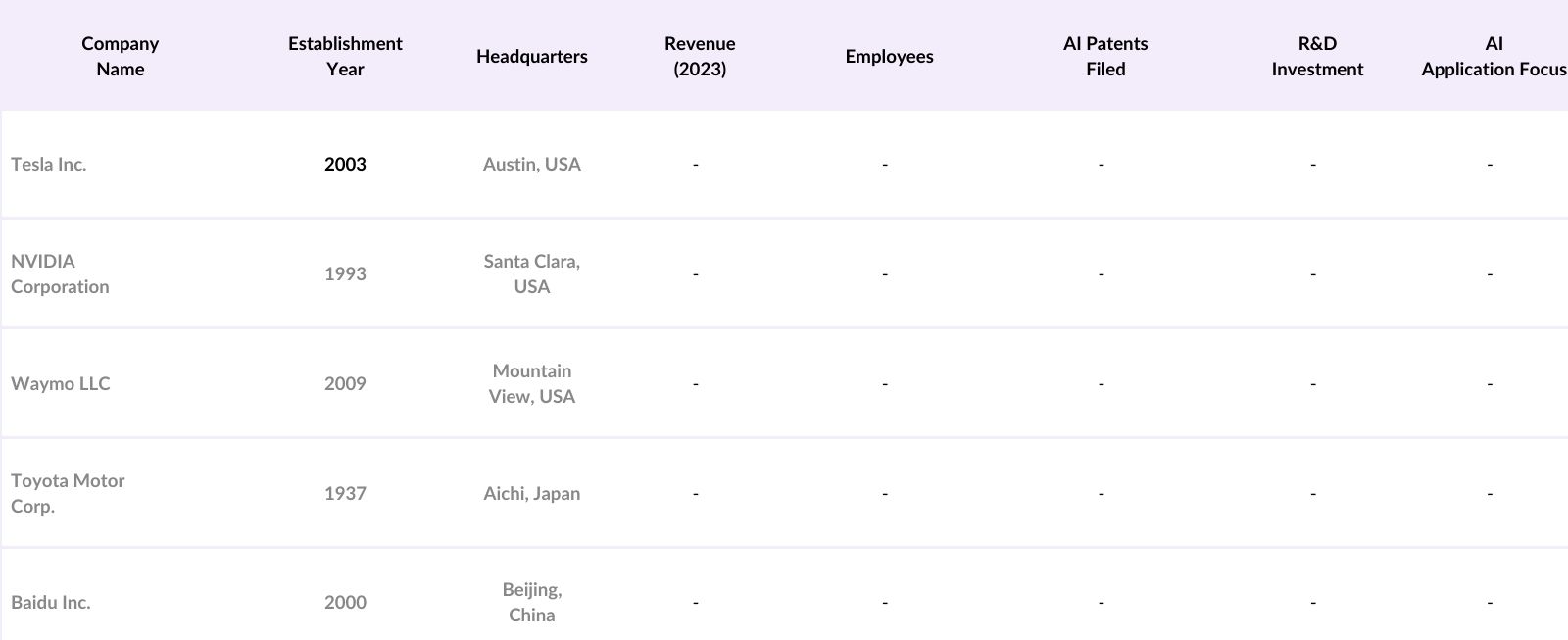
The market is dominated by leading global and regional players. These companies play a pivotal role in shaping the market dynamics through constant innovation and strategic collaborations.
Asia Pacific Automotive AI Market Analysis
Market Growth Drivers
- Surge in Electric Vehicle (EV) Adoption: The Asia Pacific region has witnessed an increase in electric vehicle sales, with China leading the charge. In 2023, China sold over 6 million EVs, accounting for more than half of the global EV sales. This surge is driven by government incentives, advancements in battery technology, and a growing consumer preference for eco-friendly transportation. The proliferation of EVs necessitates advanced AI systems for efficient energy management and autonomous driving capabilities, thereby propelling the automotive AI market.
- Investment in Autonomous Vehicle Research and Development: Major automotive manufacturers and tech companies in the Asia Pacific region are investing heavily in autonomous vehicle R&D. For instance, Baidu's Apollo Go robotaxi service has expanded its operations, deploying a fleet of 300 autonomous vehicles in Wuhan. Such initiatives underscore a commitment to integrating AI into transportation, fostering growth in the automotive AI sector.
- Government Support and Policy Initiatives: Governments across the Asia Pacific are implementing policies to promote AI integration in the automotive industry. China's "Made in China 2025" strategy aims to transform the automotive sector by emphasizing smart and connected vehicles. Similarly, Japan and South Korea have introduced regulations to facilitate autonomous vehicle testing and deployment, creating a conducive environment for automotive AI advancements.
Market Challenges
- High Development and Implementation Costs: The integration of AI technologies into vehicles requires substantial investment in R&D, specialized hardware, and software development. For instance, developing a fully autonomous vehicle can cost manufacturers upwards of USD 1 billion, posing a significant financial challenge, especially for smaller companies.
- Data Privacy and Security Concerns: The deployment of AI in vehicles involves the collection and processing of vast amounts of data, raising concerns about data privacy and cybersecurity. In 2023, there were reports of data breaches in connected vehicles, compromising user information and highlighting the need for robust security measures.
Asia Pacific Automotive AI Market Future Outlook
The Asia Pacific Automotive AI industry is expected to experience remarkable growth due to rising adoption of semi-autonomous and autonomous driving technologies. Continuous technological advancements, growing investments in AI, and expanding infrastructure for autonomous vehicles will drive market development.
Future Market Opportunities
- Foreign Automakers Embracing Local Technology in China: Global automotive companies, including Volkswagen and Toyota, have increased collaborations with Chinese tech firms to integrate local AI technologies into their vehicles. This strategy aims to enhance competitiveness in the Chinese market by leveraging advanced local technologies and catering to consumer preferences.
- China's Advancements in Autonomous Driving Infrastructure: China is rapidly developing infrastructure to support autonomous vehicles, including the construction of new roads tailored for such vehicles and the implementation of supportive regulations. Cities like Shenyang have pledged to create specialized paths for autonomous vehicles, facilitating the growth of the robotaxi industry.
Scope of the Report
|
By Component |
Hardware |
|
Software |
|
|
Services |
|
|
By Technology |
Machine Learning & Deep Learning |
|
Computer Vision |
|
|
Natural Language Processing |
|
|
By Process |
Signal Recognition |
|
Image Recognition |
|
|
Data Mining |
|
|
By Application |
Semi-Autonomous Driving |
|
Fully Autonomous Driving |
|
|
Driver Monitoring Systems |
|
|
Human-Machine Interface |
|
|
By Region |
China |
|
India |
|
|
Japan |
|
|
South Korea |
|
|
Australia |
Products
Key Target Audience Organizations and Entities Who Can Benefit by Subscribing This Report:
Automotive Manufacturers
AI Technology Developers
Automotive Component Suppliers
Regulatory Bodies (e.g., Ministry of Transport in Japan)
Government and Policy Makers (e.g., Ministry of Industry and Information Technology in China)
Investor and Venture Capitalist Firms
Automotive Dealerships and Distributors
AI Startups in the Automotive Sector
Companies
Players Mentioned in the Report:
Tesla Inc.
NVIDIA Corporation
Waymo LLC
Toyota Motor Corporation
Baidu Inc.
BMW Group
Mercedes-Benz Group AG
Hyundai Motor Company
Ford Motor Company
Audi AG
Table of Contents
Asia Pacific Automotive AI Market Overview
1.1. Definition and Scope
1.2. Market Taxonomy
1.3. Market Growth Rate
1.4. Market Segmentation Overview
Asia Pacific Automotive AI Market Size (USD Billion)
2.1. Historical Market Size
2.2. Year-On-Year Growth Analysis
2.3. Key Market Developments and Milestones
Asia Pacific Automotive AI Market Analysis
3.1. Growth Drivers
3.1.1. Rising Demand for Autonomous Vehicles
3.1.2. Advancements in AI Technologies
3.1.3. Government Initiatives and Regulations
3.1.4. Increasing Consumer Preference for Enhanced Safety Features
3.2. Market Challenges
3.2.1. High Development and Implementation Costs
3.2.2. Data Privacy and Security Concerns
3.2.3. Limited Infrastructure for Autonomous Vehicles
3.3. Opportunities
3.3.1. Expansion into Emerging Markets
3.3.2. Integration with Electric Vehicles
3.3.3. Development of AI-Powered Aftermarket Services
3.4. Trends
3.4.1. Adoption of AI in Predictive Maintenance
3.4.2. Collaboration Between Automakers and Tech Companies
3.4.3. Growth of AI-Driven In-Vehicle Personal Assistants
3.5. Government Regulations
3.5.1. Autonomous Vehicle Testing Policies
3.5.2. AI Ethics and Compliance Standards
3.5.3. Data Protection Laws
3.6. SWOT Analysis
3.7. Stakeholder Ecosystem
3.8. Porters Five Forces Analysis
3.9. Competitive Landscape
Asia Pacific Automotive AI Market Segmentation
4.1. By Component (Value %)
4.1.1. Hardware
4.1.2. Software
4.1.3. Services
4.2. By Technology (Value %)
4.2.1. Machine Learning & Deep Learning
4.2.2. Computer Vision
4.2.3. Natural Language Processing
4.3. By Process (Value %)
4.3.1. Signal Recognition
4.3.2. Image Recognition
4.3.3. Data Mining
4.4. By Application (Value %)
4.4.1. Semi-Autonomous Driving
4.4.2. Fully Autonomous Driving
4.4.3. Driver Monitoring Systems
4.4.4. Human-Machine Interface
4.5. By Region (Value %)
4.5.1. China
4.5.2. India
4.5.3. Japan
4.5.4. South Korea
4.5.5. Australia
Asia Pacific Automotive AI Market Competitive Analysis
5.1. Detailed Profiles of Major Companies
5.1.1. Tesla Inc.
5.1.2. NVIDIA Corporation
5.1.3. Waymo LLC
5.1.4. Intel Corporation
5.1.5. Alphabet Inc.
5.1.6. Microsoft Corporation
5.1.7. BMW Group
5.1.8. Mercedes-Benz Group AG
5.1.9. Ford Motor Company
5.1.10. Toyota Motor Corporation
5.1.11. Audi AG
5.1.12. Hyundai Motor Company
5.1.13. Baidu Inc.
5.1.14. Aptiv PLC
5.1.15. Continental AG
5.2. Cross Comparison Parameters (Revenue, Headquarters, No. of Employees, AI Patents Filed, Partnerships, Product Offerings, R&D Investments, Target Markets)
5.3. Market Share Analysis
5.4. Strategic Initiatives
5.5. Mergers and Acquisitions
5.6. Investment Analysis
5.7. Venture Capital Funding
5.8. Government Grants
5.9. Private Equity Investments
Asia Pacific Automotive AI Market Regulatory Framework
6.1. Autonomous Vehicle Compliance Standards
6.2. AI Safety Certification Processes
6.3. Data and Privacy Regulations
Asia Pacific Automotive AI Future Market Size (USD Billion)
7.1. Future Market Size Projections
7.2. Key Factors Driving Future Market Growth
Asia Pacific Automotive AI Future Market Segmentation
8.1. By Component (Value %)
8.2. By Technology (Value %)
8.3. By Process (Value %)
8.4. By Application (Value %)
8.5. By Country (Value %)
Asia Pacific Automotive AI Market Analysts Recommendations
9.1. TAM/SAM/SOM Analysis
9.2. Customer Cohort Analysis
9.3. Marketing Initiatives
9.4. White Space Opportunity Analysis
Disclaimer Contact UsResearch Methodology
Step 1: Identification of Key Variables
The initial phase involves mapping the entire ecosystem of the Asia Pacific Automotive AI Market, considering all stakeholders, such as automakers, technology providers, and regulatory bodies. This step uses secondary research from credible sources, including government publications and industry reports, to define key variables.
Step 2: Market Analysis and Construction
This stage involves gathering and analyzing historical data related to AI integration in the automotive sector. Key areas include AI software revenue, autonomous vehicle penetration, and the distribution of AI hardware components.
Step 3: Hypothesis Validation and Expert Consultation
Market hypotheses are validated through expert consultations with key industry players, AI developers, and automotive manufacturers. Data from interviews provides operational and financial insights, ensuring the reliability of projections.
Step 4: Research Synthesis and Final Output
The final phase synthesizes findings from both primary and secondary research. Data validation with industry leaders ensures that the final report provides a comprehensive and accurate analysis of the market.
Frequently Asked Questions
01. How big is the Asia Pacific Automotive AI Market?
The Asia Pacific Automotive AI market is valued at USD 1.3 billion, driven by increasing adoption of autonomous vehicles, advancements in AI technology, and government support.
02. What are the challenges in the Asia Pacific Automotive AI Market?
Challenges in the Asia Pacific Automotive AI market include high development costs, data privacy concerns, and limited infrastructure for autonomous vehicles. These factors can hinder the pace of AI adoption.
03. Who are the major players in the Asia Pacific Automotive AI Market?
Key players in the Asia Pacific Automotive AI market include Tesla Inc., NVIDIA Corporation, Waymo LLC, Toyota Motor Corporation, and Baidu Inc. Their dominance stems from extensive R&D capabilities and strategic partnerships.
04. What are the growth drivers of the Asia Pacific Automotive AI Market?
The Asia Pacific Automotive AI market is driven by rising demand for autonomous vehicles, integration of AI in electric vehicles, and government incentives supporting AI technology adoption.
05. Which country dominates the Asia Pacific Automotive AI Market?
China leads the Asia Pacific Automotive AI market due to supportive government policies, a strong manufacturing base, and significant investments in AI and autonomous driving technologies.
Why Buy From Us?

What makes us stand out is that our consultants follows Robust, Refine and Result (RRR) methodology. i.e. Robust for clear definitions, approaches and sanity checking, Refine for differentiating respondents facts and opinions and Result for presenting data with story

We have set a benchmark in the industry by offering our clients with syndicated and customized market research reports featuring coverage of entire market as well as meticulous research and analyst insights.

While we don't replace traditional research, we flip the method upside down. Our dual approach of Top Bottom & Bottom Top ensures quality deliverable by not just verifying company fundamentals but also looking at the sector and macroeconomic factors.

With one step in the future, our research team constantly tries to show you the bigger picture. We help with some of the tough questions you may encounter along the way: How is the industry positioned? Best marketing channel? KPI's of competitors? By aligning every element, we help maximize success.

Our report gives you instant access to the answers and sources that other companies might choose to hide. We elaborate each steps of research methodology we have used and showcase you the sample size to earn your trust.

If you need any support, we are here! We pride ourselves on universe strength, data quality, and quick, friendly, and professional service.