















Asia Pacific Beaded Jewelry Market Outlook to 2030
Region:Asia
Author(s):Shreya Garg
Product Code:KROD6036
December 2024
87
About the Report
Asia Pacific Beaded Jewelry Market Overview
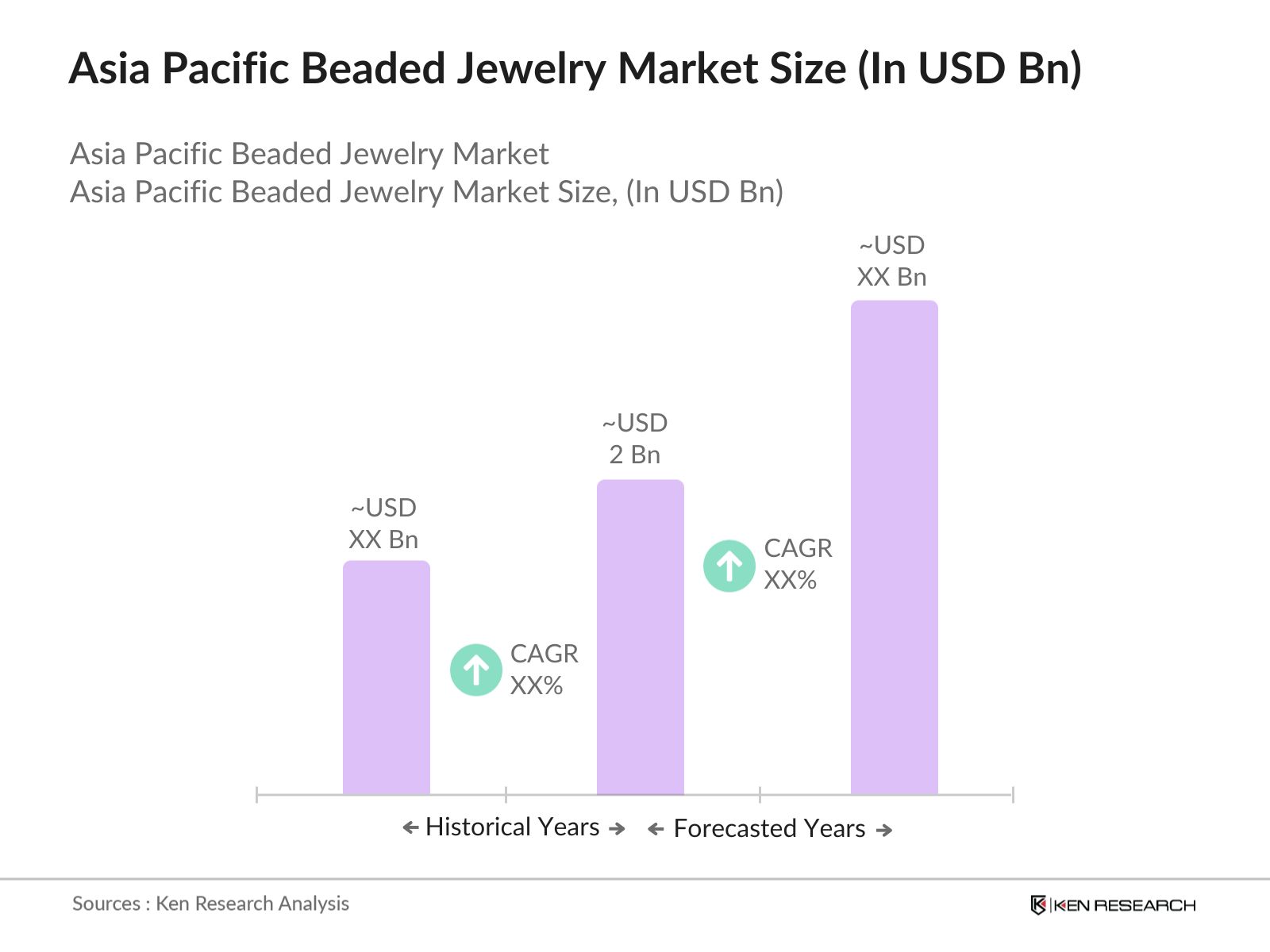
- The Asia Pacific Beaded Jewelry market, valued at USD 2 billion in 2023, has been driven by a combination of factors such as the increasing trend of personalization in jewelry, cultural significance of beaded ornaments, and growing demand for handmade, artisanal products. The market has seen consistent growth due to the rising disposable income of consumers in countries like China and India, alongside a growing preference for ethnic and bohemian fashion styles. The availability of beaded jewelry through various online channels has further accelerated its demand.
- Countries like India and China dominate the Asia Pacific Beaded Jewelry market, owing to their rich cultural heritage and the significance of beaded ornaments in traditional attire. India, being a hub for artisanal and handcrafted jewelry, has a large share of skilled craftsmen, and China benefits from its large manufacturing capabilities and domestic consumption. The rising number of fashion-conscious consumers and the evolving preferences for unique, handmade jewelry have further contributed to the dominance of these nations in the beaded jewelry segment.
- The Indian governments Make in India campaign is providing significant support to the local jewelry industry, including the beaded jewelry segment. Through this initiative, the government promotes domestic production by offering tax incentives and reducing import duties on raw materials. This support is expected to enable more local producers to scale operations, contributing to a 15% increase in local artisanal product availability by 2025.
Asia Pacific Beaded Jewelry Market Segmentation
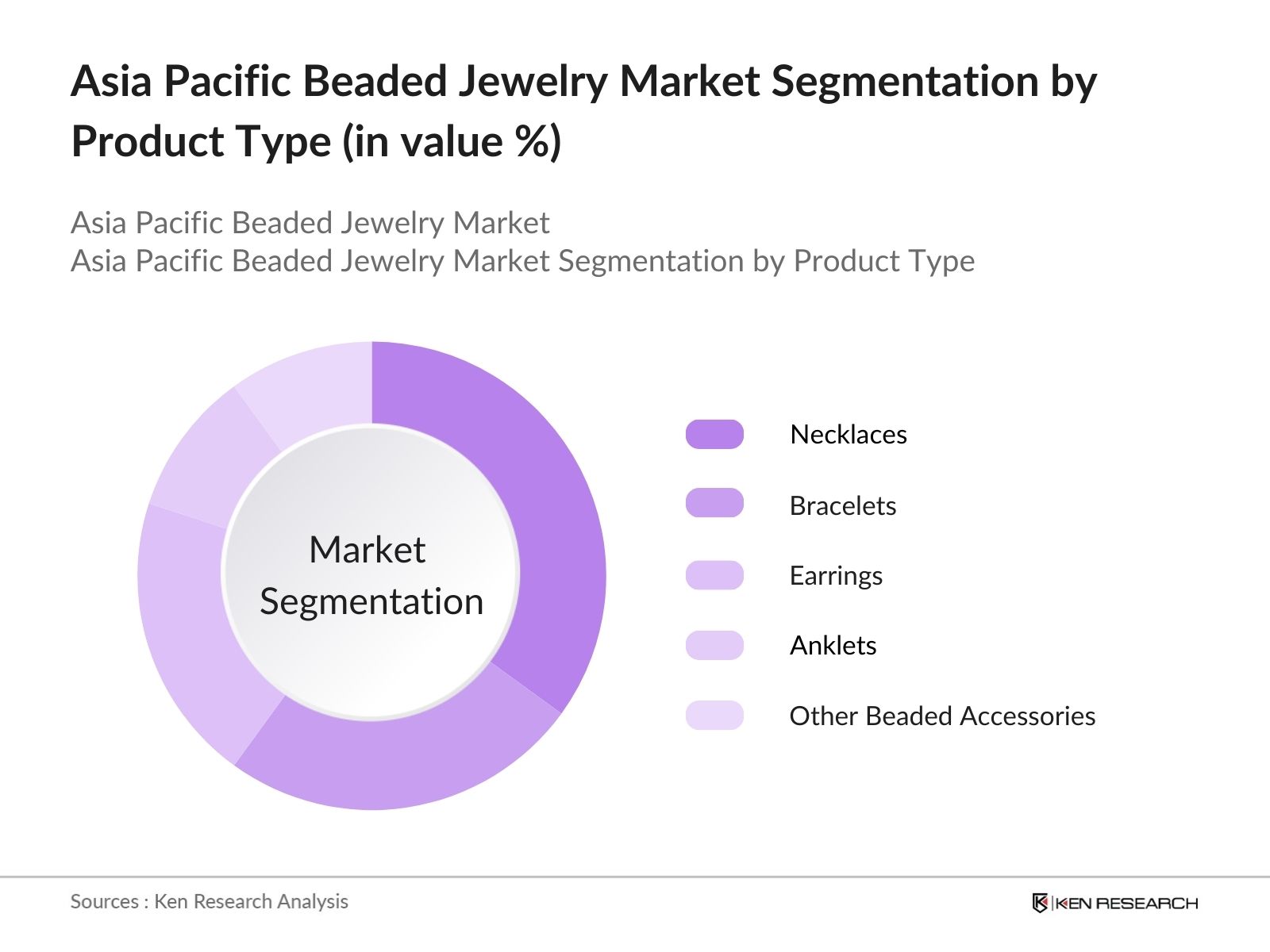
By Product Type: The Asia Pacific Beaded Jewelry market is segmented by product type into necklaces, bracelets, earrings, anklets, and other beaded accessories. Among these, necklaces have maintained a dominant market share due to their universal appeal and widespread usage in both traditional and contemporary fashion. Necklaces, particularly those featuring semi-precious stones and glass beads, are popular due to their versatility and the ability to pair with various outfits. Additionally, the rising trend of statement jewelry in modern fashion has further boosted the demand for beaded necklaces.
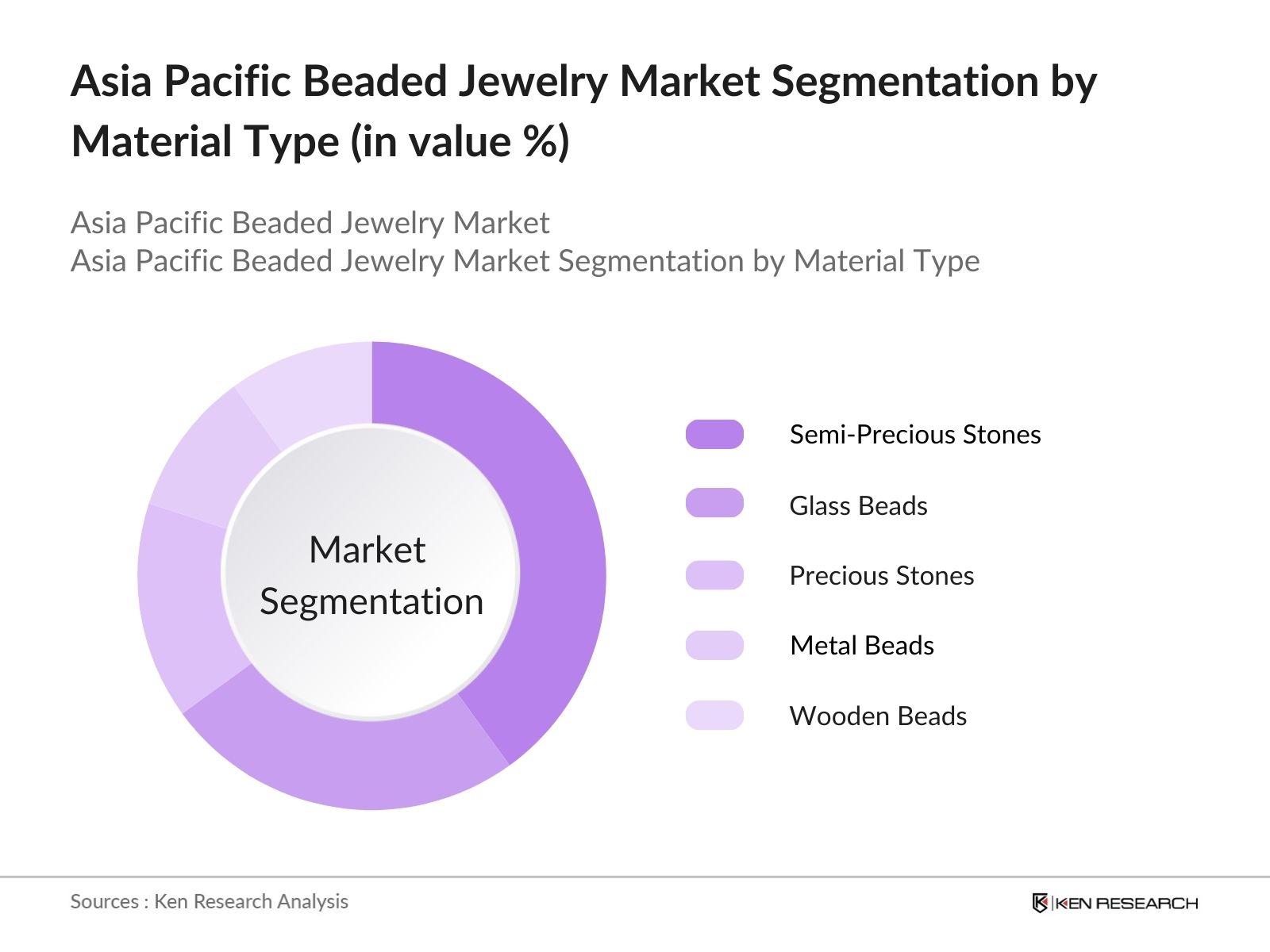
By Material Type: The market is also segmented by material type into precious stones, semi-precious stones, glass beads, metal beads, and wooden beads. Semi-precious stones hold a dominant share in the material type category, mainly due to their affordability compared to precious stones like diamonds and sapphires. Consumers prefer semi-precious stones for their unique colors, therapeutic properties, and symbolic meanings, making them highly sought after in the market. The cost-effectiveness of semi-precious stones also aligns well with the rising demand for customizable and fashionable jewelry.
Asia Pacific Beaded Jewelry Market Competitive Landscape
The Asia Pacific Beaded Jewelry market is characterized by the presence of both local artisans and globally recognized jewelry brands. The market is driven by a combination of long-established players and new entrants focusing on sustainable and ethically sourced products.
|
Company Name |
Year Established |
Headquarters |
Key Markets |
Product Portfolio |
Sustainability Initiatives |
Geographic Reach |
Online Presence |
|
Pandora A/S |
1982 |
Copenhagen, Denmark |
|||||
|
Tiffany & Co. |
1837 |
New York, USA |
|||||
|
Chow Tai Fook Jewellery |
1929 |
Hong Kong |
|||||
|
Swarovski AG |
1895 |
Wattens, Austria |
|||||
|
Malabar Gold & Diamonds |
1993 |
Kozhikode, India |
Asia Pacific Beaded Jewelry Industry Analysis
Growth Drivers
- Cultural and Traditional Influences Boosting Demand for Beaded Jewelry: Cultural festivals, rituals, and ceremonies across Asia-Pacific nations like India, China, and Indonesia drive demand for beaded jewelry. For instance, India's traditional adornment of beaded necklaces during wedding ceremonies creates a steady demand, with festivals like Diwali seeing a surge in purchases. With over 1.4 billion people in India alone, the domestic market's reliance on traditional jewelry remains robust. The expansion of this demand is expected to grow even further, supported by national celebrations that emphasize personal adornment with artisanal pieces.
- Growing Affinity for Customizable and Artisanal Jewelry: Consumers increasingly favor customizable, handmade jewelry, reflecting individual style and identity. This trend is especially notable among millennials and Gen Z populations, who constitute over 1.7 billion people in the region. The appeal of handcrafted beaded jewelry as an expression of personal taste has led to an increasing number of small-scale artisans entering the market. Government-backed initiatives such as "Make in India" also encourage small-scale artisans to craft bespoke designs, increasing their market visibility.
- Expansion of Online Retailing: The rapid growth of e-commerce in the Asia-Pacific region, where the number of internet users surpassed 2.8 billion in 2023, is a significant driver for the beaded jewelry market. Online platforms offer both artisans and larger brands a wider customer reach, making it easier for consumers to access handcrafted jewelry, including beaded pieces. Platforms like Alibaba and Flipkart provide opportunities for local designers to reach a global audience, thereby stimulating the demand for unique, custom-made jewelry pieces.
Market Challenges
- Rising Raw Material Costs Impacting Artisanal Producers: The cost of sourcing high-quality materials like semi-precious stones and metals used in beaded jewelry is rising. With India and China being significant markets for these materials, geopolitical tensions and supply chain disruptions have caused price increases, making it challenging for small artisans to maintain profit margins. For example, the cost of imported gemstones rose by more than 10% in 2023 due to restrictions on global trade and increased tariffs in key countries.
- Counterfeit Products Flooding the Market: The Asia-Pacific region has seen a significant rise in counterfeit jewelry products, particularly in markets like China, where counterfeit luxury and artisanal goods are rampant. This proliferation undermines consumer trust and affects legitimate artisans. Reports estimate that over $500 million worth of counterfeit jewelry is sold annually in the region, diverting revenue away from local producers and brand owners. The lack of stringent regulations on counterfeit goods exacerbates this challenge
Asia Pacific Beaded Jewelry Market Future Outlook
Over the next five years, the Asia Pacific Beaded Jewelry market is expected to witness substantial growth. The market will be driven by evolving consumer preferences for artisanal products, increasing demand for sustainable and ethically sourced jewelry, and the growing prominence of e-commerce platforms. Consumers are likely to shift towards customizable and handcrafted products, offering unique designs that are distinct from mass-produced jewelry. This trend, coupled with the rising popularity of traditional and cultural jewelry in international markets, will further enhance the growth trajectory of the beaded jewelry market.
Future Market Opportunities
- Expansion of E-commerce Platforms Providing Global Reach: The continued expansion of e-commerce platforms across Asia-Pacific offers significant opportunities for beaded jewelry producers to reach international buyers. Platforms like Amazon and Taobao provide small-scale artisans from countries like Indonesia and Vietnam a chance to sell their products globally, expanding their customer base and increasing sales. The cross-border e-commerce market in the region was valued at over $300 billion in 2023, and further growth is expected.
- Collaborations with Fashion Brands and Designers: Partnerships between artisans and fashion brands are creating new avenues for beaded jewelry makers to enter the high-end and luxury markets. For example, local artisans are collaborating with internationally recognized designers to create unique, limited-edition collections. These collaborations not only offer artisans increased visibility but also diversify the products offered by luxury brands. The global fashion industrys demand for unique handcrafted jewelry is expected to bolster these collaborations in the coming years.
Scope of the Report
|
By Product Type |
Necklaces, Bracelets, Earrings, Anklets, Other Beaded Accessories |
|
By Material Type |
Precious Stones, Semi-Precious Stones, Glass Beads, Metal Beads, Wooden Beads |
|
By End-User |
Men, Women, Children |
|
By Distribution Channel |
Online, Offline |
|
By Region |
China, India, Japan, Australia, Southeast Asia |
Products
Key Target Audience
Jewelry Manufacturers
Fashion Retailers
Online Jewelry Marketplaces
Artisanal Jewelry Designers
Investors and Venture Capitalist Firms
Government and Regulatory Bodies (Ministry of Commerce and Industry, Department of Consumer Affairs)
Export and Import Organizations
Jewelry Trade Associations
Companies
Major Players
Pandora A/S
Tiffany & Co.
Chow Tai Fook Jewellery Group Limited
Cartier
Swarovski AG
Malabar Gold & Diamonds
Gitanjali Gems Ltd.
Tanishq (Tata Group)
Kalyan Jewellers
Bluestone
Table of Contents
Asia Pacific Beaded Jewelry Market Overview
1.1. Definition and Scope
1.2. Market Taxonomy
1.3. Market Growth Rate
1.4. Market Segmentation Overview
Asia Pacific Beaded Jewelry Market Size (In USD Bn)
2.1. Historical Market Size
2.2. Year-on-Year Growth Analysis
2.3. Key Market Developments and Milestones
Asia Pacific Beaded Jewelry Market Analysis
3.1. Growth Drivers (e.g., Rising demand for artisanal and customizable jewelry, influence of cultural traditions)
3.2. Market Challenges (e.g., High cost of raw materials, counterfeit products, supply chain disruptions)
3.3. Opportunities (e.g., Expanding e-commerce platforms, partnerships with fashion brands)
3.4. Trends (e.g., Adoption of sustainable practices, integration with modern fashion trends)
3.5. Government Regulations (e.g., Export-import duties, quality control regulations for gemstones)
3.6. SWOT Analysis
3.7. Value Chain Ecosystem
3.8. Porters Five Forces Analysis (e.g., Competitive Rivalry, Supplier Power)
3.9. Competition Ecosystem
Asia Pacific Beaded Jewelry Market Segmentation
Segmentation will be done based on the following criteria, specific to the market.
4.1. By Product Type (In Value %)
4.1.1. Necklaces
4.1.2. Bracelets
4.1.3. Earrings
4.1.4. Anklets
4.1.5. Other Beaded Accessories
4.2. By Material Type (In Value %)
4.2.1. Precious Stones (e.g., Diamonds, Sapphires)
4.2.2. Semi-Precious Stones (e.g., Quartz, Agate)
4.2.3. Glass Beads
4.2.4. Metal Beads (e.g., Gold, Silver)
4.2.5. Wooden Beads
4.3. By End-User (In Value %)
4.3.1. Men
4.3.2. Women
4.3.3. Children
4.4. By Distribution Channel (In Value %)
4.4.1. Online
4.4.2. Offline (e.g., Jewelry Boutiques, Retail Stores)
4.5. By Region (In Value %)
4.5.1. China
4.5.2. India
4.5.3. Japan
4.5.4. Australia
4.5.5. Southeast Asia
Asia Pacific Beaded Jewelry Market Competitive Analysis
5.1. Detailed Profiles of Major Companies
5.1.1. Pandora A/S
5.1.2. Tiffany & Co.
5.1.3. Chow Tai Fook Jewellery Group Limited
5.1.4. Cartier
5.1.5. Swarovski AG
5.1.6. Malabar Gold & Diamonds
5.1.7. Gitanjali Gems Ltd.
5.1.8. Tanishq (Tata Group)
5.1.9. Kalyan Jewellers
5.1.10. Bluestone
5.1.11. Meena Jewellers
5.1.12. Tribe Amrapali
5.1.13. Stone & Strand
5.1.14. Zariin Jewelry
5.1.15. Isharya
5.2. Cross Comparison Parameters
(Employee Count, Revenue, Headquarters, Product Portfolio, Geographic Reach, Marketing Strategies, Partnership Deals, Sustainability Initiatives)
5.3. Market Share Analysis
5.4. Strategic Initiatives
5.5. Mergers & Acquisitions
5.6. Investment Analysis
5.7. Private Equity Investments
Asia Pacific Beaded Jewelry Market Regulatory Framework
6.1. Quality Control Regulations for Gemstones
6.2. Taxation and Duties on Import/Export
6.3. Intellectual Property Rights Protection (Design Protection)
Asia Pacific Beaded Jewelry Market Future Market Size (In USD Bn)
7.1. Market Size Projections
7.2. Key Factors Driving Future Market Growth
Asia Pacific Beaded Jewelry Future Market Segmentation
8.1. By Product Type (In Value %)
8.2. By Material Type (In Value %)
8.3. By End-User (In Value %)
8.4. By Distribution Channel (In Value %)
8.5. By Region (In Value %)
Asia Pacific Beaded Jewelry Market Analysts Recommendations
9.1. TAM/SAM/SOM Analysis
9.2. Market Entry Strategy Recommendations
9.3. Consumer Cohort Analysis
9.4. New Product Development Opportunities
Disclaimer Contact UsResearch Methodology
Step 1: Identification of Key Variables
The initial step involves mapping the ecosystem of the Asia Pacific Beaded Jewelry Market. This includes extensive research using secondary sources like industry reports, government publications, and proprietary databases to identify key stakeholders, market trends, and critical variables influencing the market.
Step 2: Market Analysis and Construction
In this phase, historical data related to the Asia Pacific Beaded Jewelry Market will be compiled and analyzed, focusing on revenue generation, market penetration, and product segmentation. Analyzing consumer behavior and the performance of different product types will provide insight into the market's direction.
Step 3: Hypothesis Validation and Expert Consultation
We will validate market hypotheses through interviews with industry professionals, including jewelry manufacturers, designers, and retailers. This will provide insights into operational and financial performance, which will aid in refining the market analysis.
Step 4: Research Synthesis and Final Output
The final phase involves synthesizing all the research findings into a cohesive report. The collected data will be cross-verified with manufacturers and suppliers to ensure its accuracy and reliability. This step will provide a comprehensive and well-rounded analysis of the Asia Pacific Beaded Jewelry Market.
Frequently Asked Questions
01. How big is the Asia Pacific Beaded Jewelry Market?
The Asia Pacific Beaded Jewelry market was valued at USD 2 billion in 2023, driven by the rising popularity of handmade and customizable jewelry, especially in countries like India and China.
02. What are the challenges in the Asia Pacific Beaded Jewelry Market?
Challenges in this market include the prevalence of counterfeit products, high raw material costs, and supply chain disruptions due to the reliance on artisanal production methods, which can be slow and inconsistent.
03. Who are the major players in the Asia Pacific Beaded Jewelry Market?
Key players include Pandora A/S, Tiffany & Co., Chow Tai Fook Jewellery Group Limited, Cartier, and Swarovski AG, each having a strong presence due to their established brands and extensive product portfolios.
04. What are the growth drivers of the Asia Pacific Beaded Jewelry Market?
Growth in the Asia Pacific Beaded Jewelry Market is driven by increased consumer demand for personalized and artisanal products, along with the expanding middle-class population seeking affordable luxury.
Why Buy From Us?

What makes us stand out is that our consultants follows Robust, Refine and Result (RRR) methodology. i.e. Robust for clear definitions, approaches and sanity checking, Refine for differentiating respondents facts and opinions and Result for presenting data with story

We have set a benchmark in the industry by offering our clients with syndicated and customized market research reports featuring coverage of entire market as well as meticulous research and analyst insights.

While we don't replace traditional research, we flip the method upside down. Our dual approach of Top Bottom & Bottom Top ensures quality deliverable by not just verifying company fundamentals but also looking at the sector and macroeconomic factors.

With one step in the future, our research team constantly tries to show you the bigger picture. We help with some of the tough questions you may encounter along the way: How is the industry positioned? Best marketing channel? KPI's of competitors? By aligning every element, we help maximize success.

Our report gives you instant access to the answers and sources that other companies might choose to hide. We elaborate each steps of research methodology we have used and showcase you the sample size to earn your trust.

If you need any support, we are here! We pride ourselves on universe strength, data quality, and quick, friendly, and professional service.