















Asia Pacific Bitumen Market Outlook to 2030
Region:Asia
Author(s):Sanjna
Product Code:KROD10964
December 2024
93
About the Report
Asia Pacific Bitumen Market Overview
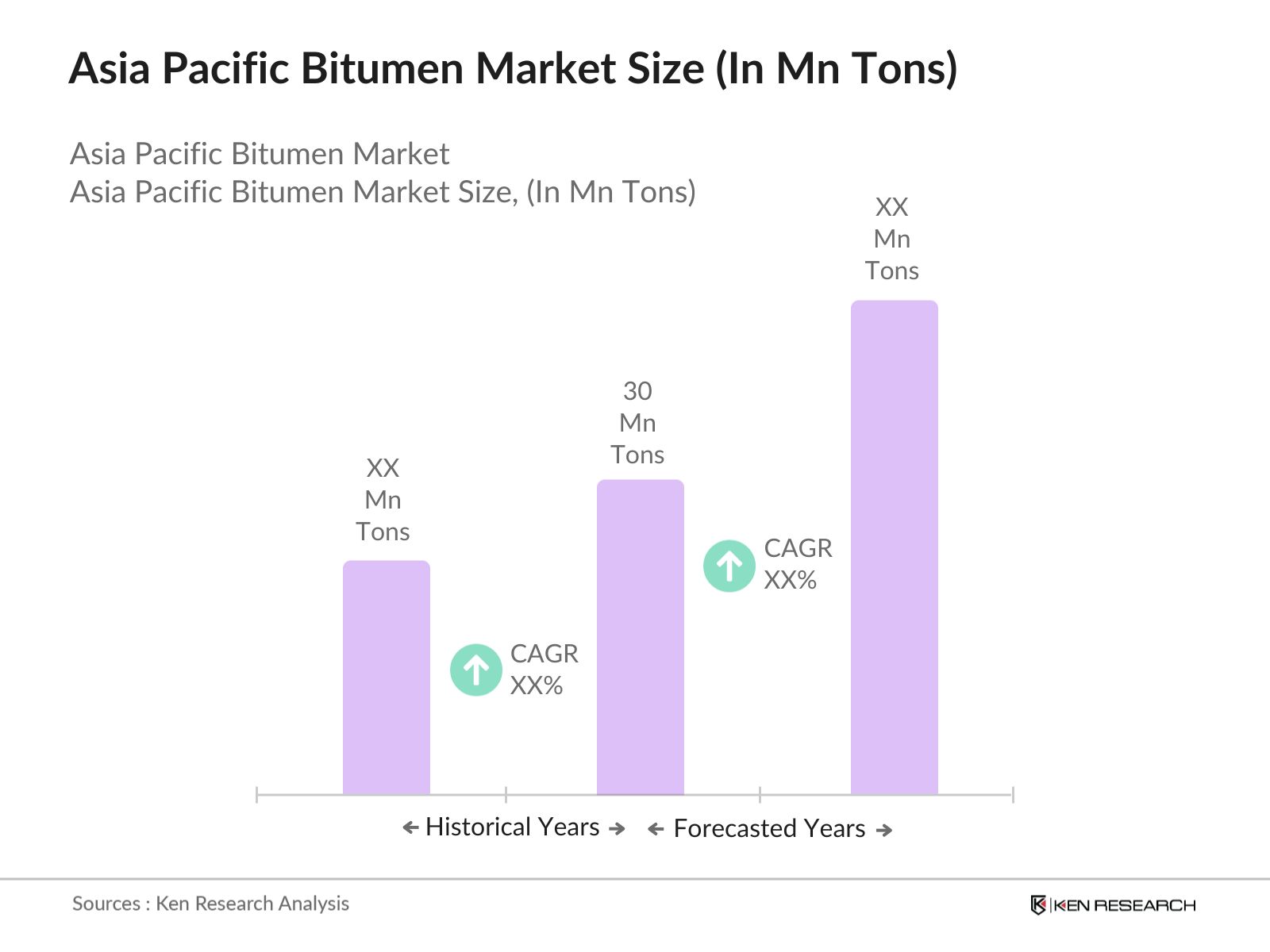
- The Asia Pacific bitumen market, valued at 30 million tons, is primarily driven by accelerated infrastructure development and urbanization efforts, particularly in emerging economies. As governments across the region invest heavily in new roads, highways, and other infrastructure projects, the demand for bitumen, essential for road construction and waterproofing, has increased significantly. Additionally, advancements in bitumen refining techniques are meeting high demand levels by providing quality materials for diverse construction needs.
- Countries like China, India, and Japan dominate the Asia Pacific bitumen market, supported by their large-scale infrastructure initiatives and increasing urban population. China's Belt and Road Initiative has propelled bitumen demand for new transportation networks, while India's urban expansion and Japans consistent maintenance of road infrastructure also contribute to their market leadership. These nations prioritize sustainable and durable infrastructure, bolstering bitumen consumption across construction segments.
- Governments across Asia Pacific have introduced emissions limits on bitumen production, with China enforcing stricter air quality measures and VOC caps in industrial zones. South Koreas regulation enforces stringent pollution control, aligning with its Clean Air Conservation Act. These environmental policies mandate bitumen production facilities to incorporate emission-control technologies, adding compliance costs but advancing sustainable practices within the industry.
Asia Pacific Bitumen Market Segmentation
By Product Type: The Asia Pacific bitumen market is segmented by product type into Paving Grade Bitumen, Polymer Modified Bitumen (PMB), Oxidized Bitumen, Bitumen Emulsion, and Others. Paving grade bitumen holds a dominant market share in the region due to its essential role in constructing highways, roads, and other transport infrastructure. The products durability, heat resistance, and adaptability make it highly suitable for the varying climate and terrain across Asia Pacific, further supporting its demand for essential infrastructure development.

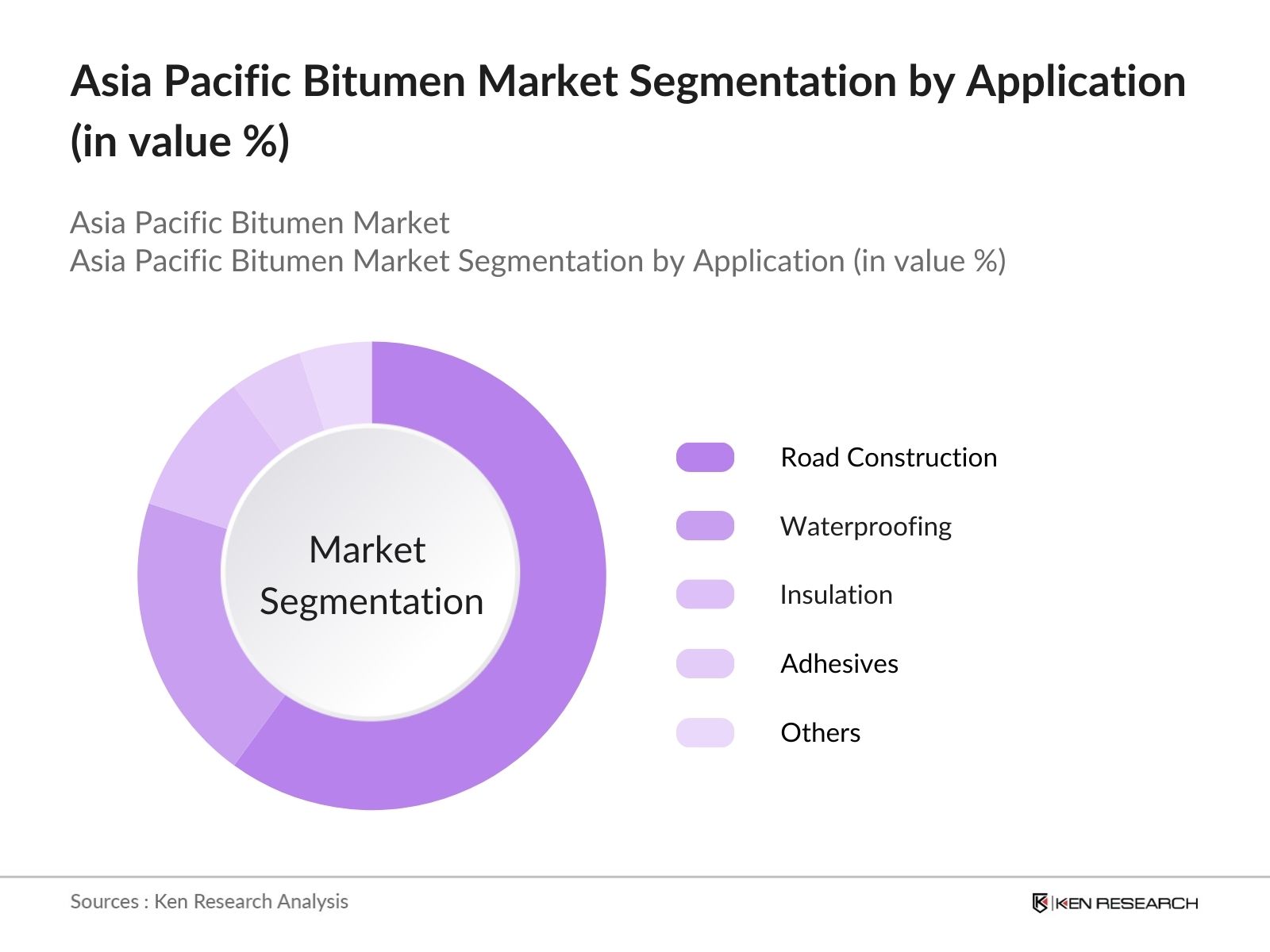
By Application: The market is segmented by application into Road Construction, Waterproofing, Insulation, Adhesives, and Others. Road construction leads in this segment, driven by the ongoing development of new highways, urban road networks, and expressways. Rapidly growing urban centers in countries like India and Indonesia are fueling bitumen demand for durable, high-quality road surfaces, and the frequent maintenance requirements support the continuous growth of this application.
Asia Pacific Bitumen Market Competitive Landscape
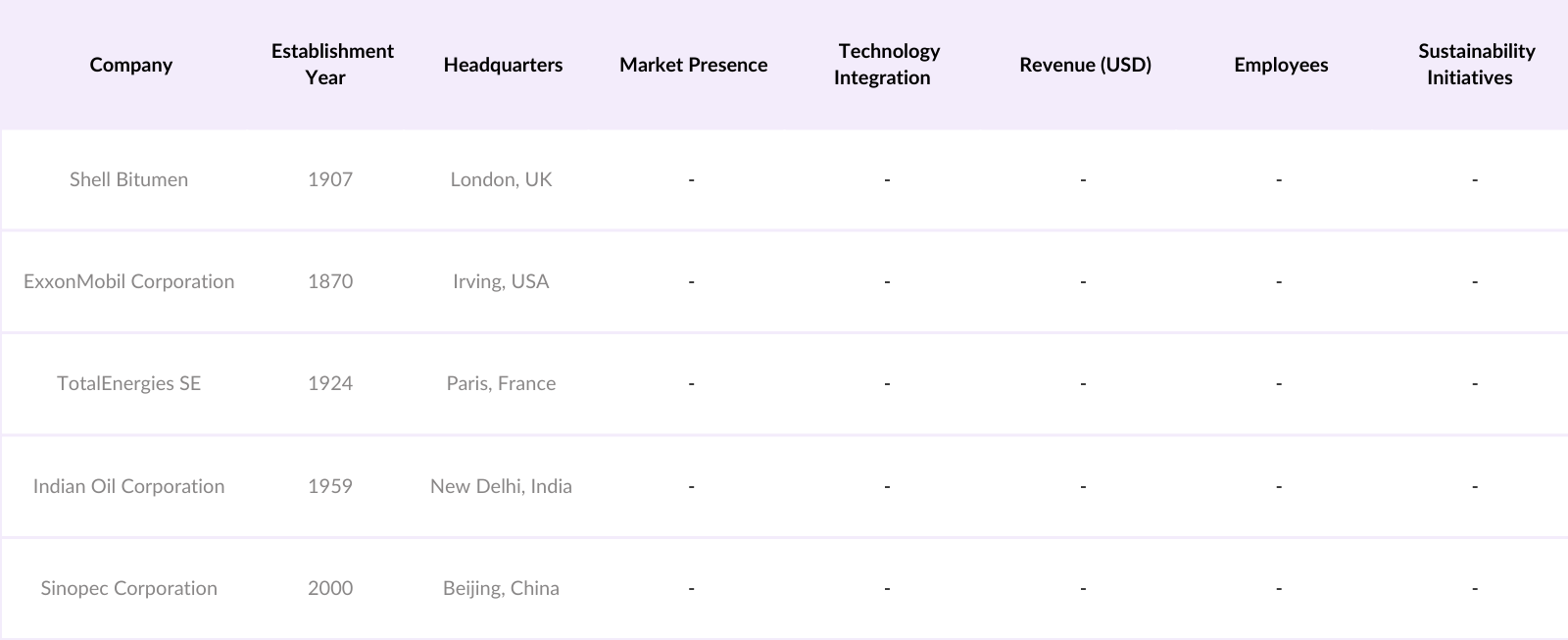
The Asia Pacific bitumen market is dominated by a few major companies with a strong presence across the region. This consolidation includes both global and regional players who benefit from vertical integration, regional manufacturing hubs, and significant investments in R&D. Below are five major companies in the market:
Asia Pacific Bitumen Market Analysis
Growth Drivers
- Infrastructure Development Projects: The Asia Pacific region has seen robust investment in infrastructure development, driven by countries like China and India. China alone has allocated nearly $1.2 trillion for infrastructure projects under the 14th Five-Year Plan, emphasizing transport and urban development sectors. India has committed over $1.4 trillion for its National Infrastructure Pipeline (NIP), with approximately 23% aimed at roads and bridges, creating substantial demand for bitumen. South Korea and Japan are also investing in upgrading highways and urban areas, intensifying regional bitumen requirements. These developments reflect a strong trajectory for bitumen consumption.
- Rising Urbanization and Industrialization: Asia Pacific urban population has increased by nearly 140 million from 2020 to 2024, reaching a total of 2.36 billion people, leading to accelerated infrastructure needs. India's urban growth rate is projected to increase the population in cities to over 600 million by 2025, enhancing demand for residential and commercial infrastructure, thus increasing bitumen requirements for roads and urban construction. Industrial development, notably in Indonesia and Vietnam, also contributes to the rise in bitumen usage, especially for industrial flooring and facilities.
- Investments in Road Construction: Road construction investments have risen substantially, particularly in Southeast Asia, where ASEAN nations allocated $3 billion in 2023 to upgrade critical transportation links. China has invested $44 billion in 2023 alone to improve rural and urban roads under its National Trunk Highway System. The Philippines, under its Build, Build, Build program, allocated $11 billion to road infrastructure, with bitumen being a primary input for road surfacing. The extensive funding across ASIA PACIFIC underlines a robust foundation for sustained bitumen demand in road construction projects.
Challenges
- Environmental Concerns: Bitumen production and application contribute to emissions, impacting air quality and health. Asia Pacific nations have implemented emissions caps; for example, South Korea limited volatile organic compounds in road construction. Chinas Ministry of Ecology and Environment has set restrictions, focusing on emissions from bitumen use. These environmental regulations, coupled with rising sustainability goals, create compliance challenges for bitumen manufacturers and require investment in eco-friendly practices.
- Volatile Raw Material Costs: Bitumen prices fluctuate based on crude oil costs. In 2023, global crude prices spiked due to geopolitical factors, increasing costs for Asia Pacific bitumen producers. For example, South Korea reported a 10% rise in bitumen prices since the start of 2024 due to these price fluctuations. Volatile pricing pressures manufacturers to adjust prices or absorb costs, affecting profitability.
Asia Pacific Bitumen Market Future Outlook
Asia Pacific bitumen market is expected to experience considerable growth fueled by extensive urbanization, an increasing number of infrastructure projects, and advancements in eco-friendly bitumen formulations. Emerging trends such as the adoption of warm mix asphalt and bio-bitumen materials indicate a shift toward sustainability and environmental considerations. Additionally, rising governmental focus on infrastructure modernization and connectivity will likely boost bitumen demand across the region.
Market Opportunities
- Adoption of Recycled Asphalt Pavements: Asia Pacific governments are incentivizing recycled asphalt use to reduce environmental impact and conserve resources. Japan has adopted recycled materials in over 60% of its road projects, reducing new bitumen needs and supporting sustainability goals. South Korea, through its Green New Deal, encourages the recycling of construction materials, creating opportunities for bitumen mixed with recycled asphalt in future projects. This shift towards recycled materials presents a growth pathway for manufacturers offering eco-friendly bitumen solutions.
- Advancements in Polymer-Modified Bitumen: Increased adoption of polymer-modified bitumen (PMB) is gaining traction across Asia Pacific due to its durability benefits in extreme weather conditions. In India, PMB is used in 40% of new highways, reducing maintenance frequency. Thailand and China are advancing their PMB standards to ensure longer road life and cost efficiency. These innovations represent a growing market opportunity for bitumen products capable of meeting enhanced durability needs in infrastructure.
Products
Key Target Audience
Bitumen Manufacturers and Suppliers
Construction Companies and Contractors
Oil Refining Companies
Asphalt Paving and Roofing Companies
Engineering and Infrastructure Consultants
Environmental Agencies (Asia Pacific Environmental Management Bureau, National Roads Authority)
Investors and Venture Capitalist Firms
Government and Regulatory Bodies (Ministries of Transport, Infrastructure Development Authorities)
Companies
Players Mentioned in the Report
Shell Bitumen
ExxonMobil Corporation
TotalEnergies SE
Indian Oil Corporation Ltd.
Sinopec Corporation
BP Bitumen
Nynas AB
Marathon Petroleum Corporation
Gazprom Neft PJSC
JX Nippon Oil & Energy Corporation
Table of Contents
1. Asia Pacific Bitumen Market Overview
1.1 Definition and Scope
1.2 Market Taxonomy
1.3 Market Demand Drivers (Transportation Infrastructure, Urban Development, Oil Refining Industry)
1.4 Market Segmentation Overview
2. Asia Pacific Bitumen Market Size (In USD Mn)
2.1 Historical Market Size
2.2 Year-On-Year Growth Analysis
2.3 Key Market Milestones
3. Asia Pacific Bitumen Market Dynamics
3.1 Growth Drivers
3.1.1 Infrastructure Development Projects
3.1.2 Rising Urbanization and Industrialization
3.1.3 Investments in Road Construction
3.1.4 Increase in Oil Refining Companies in Asia Pacific
3.2 Market Challenges
3.2.1 Environmental Concerns
3.2.2 Volatile Raw Material Costs
3.2.3 Regulatory Constraints
3.3 Opportunities
3.3.1 Adoption of Recycled Asphalt Pavements
3.3.2 Advancements in Polymer-Modified Bitumen
3.3.3 Regional Demand from Emerging Economies
3.4 Market Trends
3.4.1 Increasing Use of Warm Mix Asphalt
3.4.2 Use of Bio-Bitumen and Alternative Materials
3.4.3 Green Construction Practices
3.5 Government Regulation
3.5.1 Environmental Standards for Emission and Pollution
3.5.2 Safety and Compliance Standards
3.5.3 Government Infrastructure Initiatives
3.5.4 Industry-Specific Tax Incentives
3.6 SWOT Analysis
3.7 Supply Chain Analysis
3.8 Porters Five Forces Analysis
3.9 Market Ecosystem
4. Asia Pacific Bitumen Market Segmentation
4.1 By Product Type (In Value %)
4.1.1 Paving Grade Bitumen
4.1.2 Polymer Modified Bitumen (PMB)
4.1.3 Oxidized Bitumen
4.1.4 Bitumen Emulsion
4.1.5 Others
4.2 By Application (In Value %)
4.2.1 Road Construction
4.2.2 Waterproofing
4.2.3 Insulation
4.2.4 Adhesives
4.2.5 Others
4.3 By Industry Vertical (In Value %)
4.3.1 Infrastructure and Construction
4.3.2 Transportation and Logistics
4.3.3 Commercial and Residential Buildings
4.3.4 Mining
4.3.5 Others
4.4 By Source Type (In Value %)
4.4.1 Refined Bitumen
4.4.2 Natural Bitumen
4.4.3 Recycled Bitumen
4.5 By Region (In Value %)
4.5.1 China
4.5.2 India
4.5.3 Japan
4.5.4 Australia
4.5.5 Southeast Asia
5. Asia Pacific Bitumen Market Competitive Analysis
5.1 Detailed Profiles of Major Companies
5.1.1 Shell Bitumen
5.1.2 ExxonMobil Corporation
5.1.3 TotalEnergies SE
5.1.4 BP Bitumen
5.1.5 Indian Oil Corporation Ltd.
5.1.6 Sinopec Corporation
5.1.7 Chevron Corporation
5.1.8 Nynas AB
5.1.9 Marathon Petroleum Corporation
5.1.10 Gazprom Neft PJSC
5.2 Cross Comparison Parameters (No. of Refineries, Headquarters Location, Market Position, Global Presence, Revenue, Workforce Strength, Product Specialization, R&D Spending)
5.3 Market Share Analysis
5.4 Strategic Initiatives and Investments
5.5 Mergers and Acquisitions
5.6 Joint Ventures and Collaborations
6. Asia Pacific Bitumen Market Regulatory Framework
6.1 Emission Standards
6.2 Environmental Impact Regulations
6.3 Compliance Requirements
6.4 Industry Certifications
6.5 Health and Safety Standards
7. Asia Pacific Bitumen Market Future Market Size (In USD Bn)
7.1 Future Market Size Projections
7.2 Key Market Growth Drivers
8. Asia Pacific Bitumen Market Future Market Segmentation
8.1 By Product Type (In Value %)
8.2 By Application (In Value %)
8.3 By Industry Vertical (In Value %)
8.4 By Source Type (In Value %)
8.5 By Region (In Value %)
9. Asia Pacific Bitumen Market Analysts Recommendations
9.1 TAM/SAM/SOM Analysis
9.2 Customer Cohort Analysis
9.3 Key Marketing Strategies
9.4 White Space Analysis
Disclaimer
Contact Us
Research Methodology
Step 1: Identification of Key Variables
The initial phase focuses on mapping the bitumen ecosystem across Asia Pacific, identifying stakeholders from production to end-user applications. This involves extensive desk research utilizing secondary and proprietary sources to outline essential market variables influencing bitumen demand.
Step 2: Market Analysis and Construction
In this step, historical data is gathered and analyzed to assess bitumen market penetration by segment and regional demand. This includes evaluating data on infrastructure projects, urbanization rates, and refineries expansion across Asia Pacific to construct accurate market estimates.
Step 3: Hypothesis Validation and Expert Consultation
Market hypotheses are then validated through consultations with industry experts, including refinery managers and infrastructure development consultants. This provides operational insights and feedback on bitumen trends, supporting the reliability of forecast data.
Step 4: Research Synthesis and Final Output
The final phase includes detailed interactions with bitumen producers and construction firms, gathering insights on product innovation, supply chain dynamics, and customer Asia Pacific bitumen market.
Frequently Asked Questions
01. How big is the Asia Pacific Bitumen Market?
The Asia Pacific bitumen market is valued at 30 million tons, driven by large-scale infrastructure development, especially in road construction and urban expansion.
02. What are the challenges in the Asia Pacific Bitumen Market?
Key challenges in Asia Pacific Bitumen Market include fluctuating raw material costs, environmental impact concerns, and regulatory constraints on bitumen usage due to pollution risks.
03. Who are the major players in the Asia Pacific Bitumen Market?
Asia Pacific Bitumen Market includes major players such as Shell Bitumen, ExxonMobil, TotalEnergies, Indian Oil Corporation, and Sinopec Corporation, known for their robust production capacity and regional influence.
04. What are the growth drivers of the Asia Pacific Bitumen Market?
Growth drivers in Asia Pacific Bitumen Market include the increased demand for durable road networks, rising urbanization, and government investments in infrastructure development, fueling consistent bitumen demand.
Why Buy From Us?

What makes us stand out is that our consultants follows Robust, Refine and Result (RRR) methodology. i.e. Robust for clear definitions, approaches and sanity checking, Refine for differentiating respondents facts and opinions and Result for presenting data with story

We have set a benchmark in the industry by offering our clients with syndicated and customized market research reports featuring coverage of entire market as well as meticulous research and analyst insights.

While we don't replace traditional research, we flip the method upside down. Our dual approach of Top Bottom & Bottom Top ensures quality deliverable by not just verifying company fundamentals but also looking at the sector and macroeconomic factors.

With one step in the future, our research team constantly tries to show you the bigger picture. We help with some of the tough questions you may encounter along the way: How is the industry positioned? Best marketing channel? KPI's of competitors? By aligning every element, we help maximize success.

Our report gives you instant access to the answers and sources that other companies might choose to hide. We elaborate each steps of research methodology we have used and showcase you the sample size to earn your trust.

If you need any support, we are here! We pride ourselves on universe strength, data quality, and quick, friendly, and professional service.