
Asia Pacific Box Truck Market Outlook to 2030
Region:India
Author(s):Yogita Sahu
Product Code:KROD5003
Region:India
Author(s):Yogita Sahu
Product Code:KROD5003
October 2024
84
Listen to the audio summary
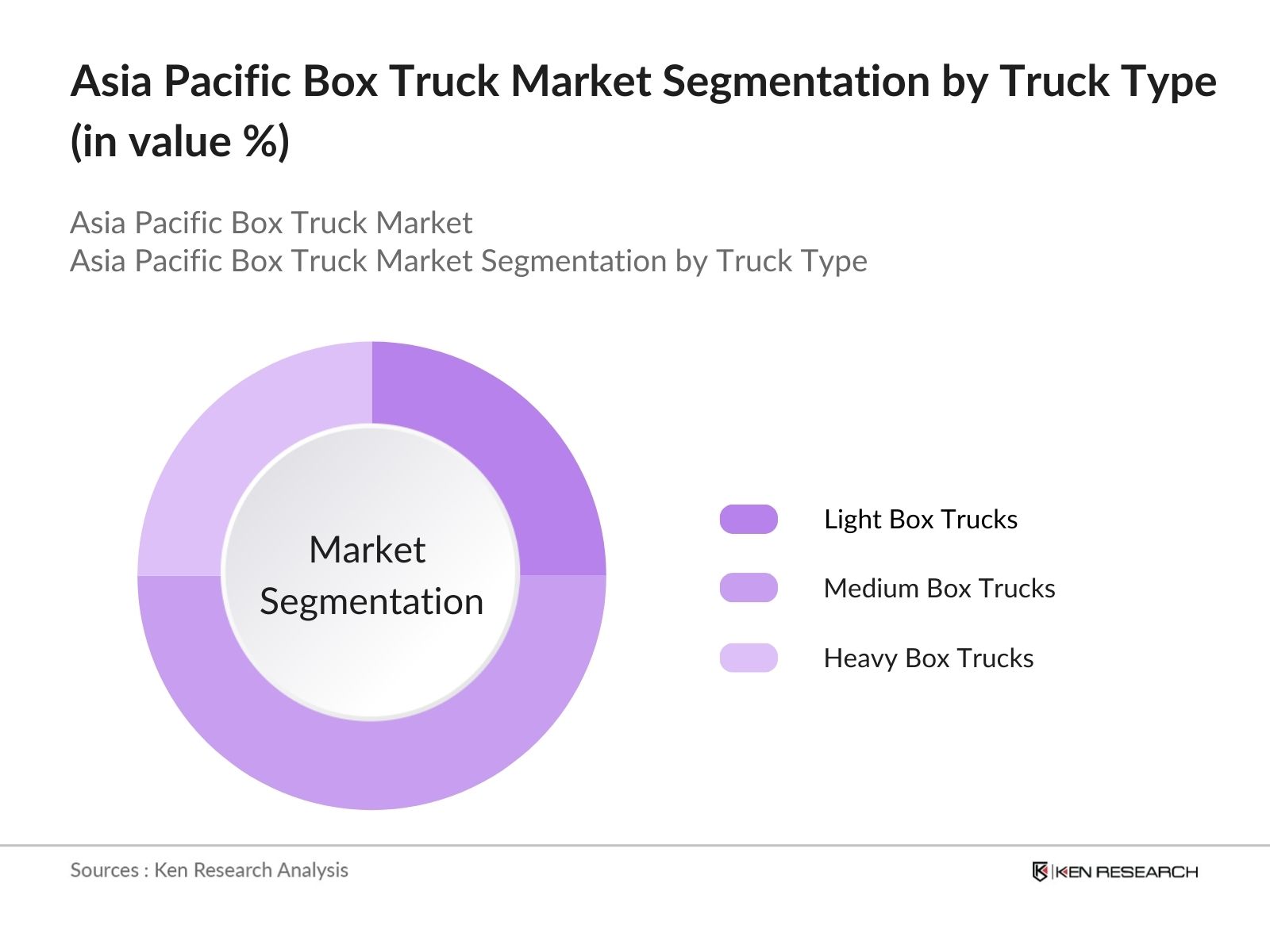
By Truck Type: The market is segmented by truck type into light box trucks, medium box trucks, and heavy box trucks. Recently, medium box trucks have a dominant market share in this region, primarily because of their versatility in handling both urban deliveries and regional transportation. These trucks are favored by e-commerce and logistics companies due to their optimal balance of size, payload, and fuel efficiency.
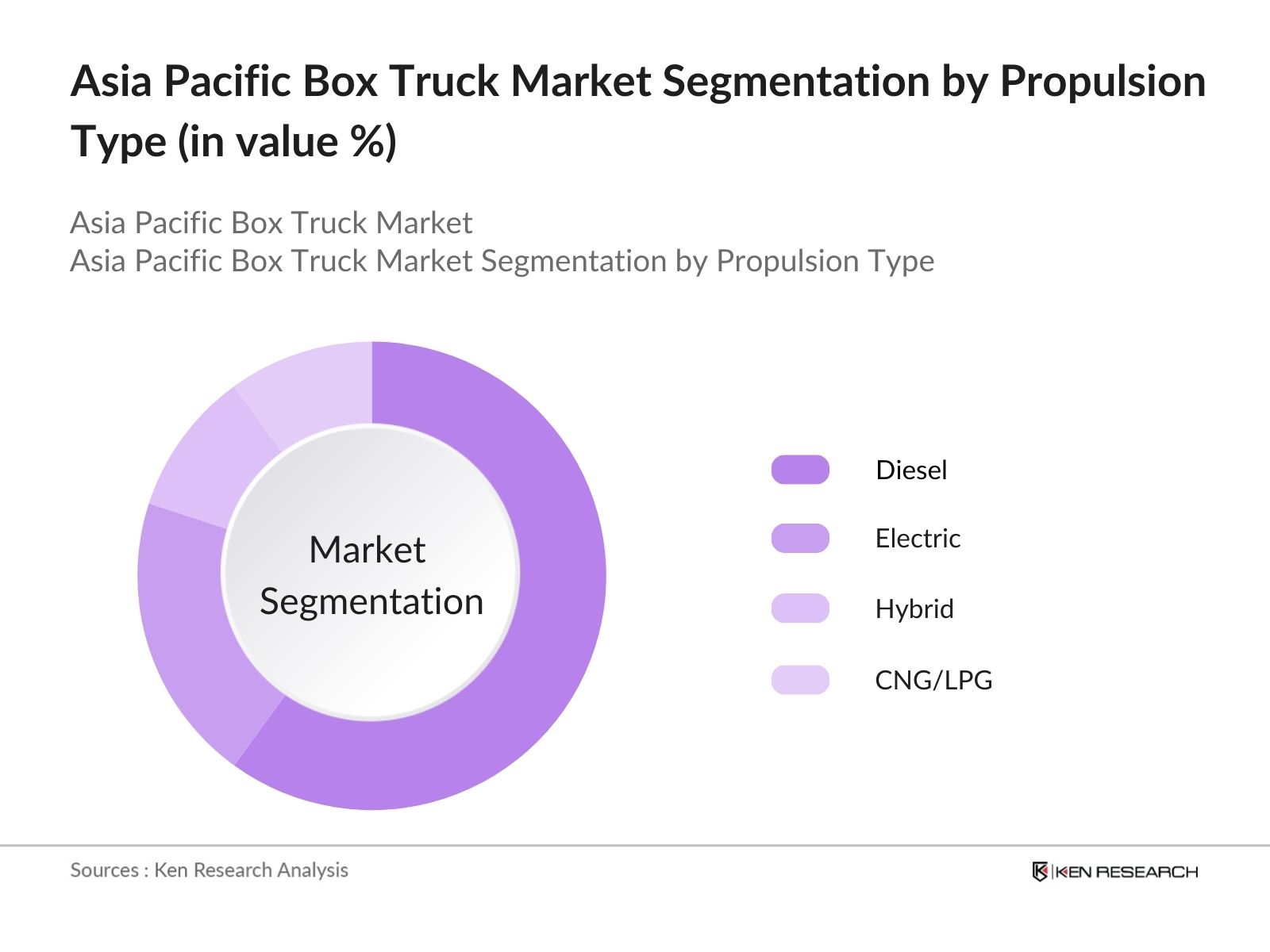
By Propulsion Type: The market is segmented by propulsion type into diesel, electric, hybrid, and CNG/LPG. Diesel trucks continue to hold a share, especially in rural and long-haul transportation, due to their established fueling infrastructure and higher payload capacities. However, electric box trucks are increasingly becoming popular in urban areas.
The market is dominated by key players including global giants like Daimler Trucks Asia and Volvo Group, alongside local manufacturers such as Tata Motors and Isuzu Motors Limited. This market consolidation reflects the significant influence of these companies due to their wide range of truck models, strong distribution networks, and ongoing R&D investments in electric vehicle (EV) technology.
|
Company |
Establishment Year |
Headquarters |
Revenue (USD Bn) |
Market Presence |
EV Fleet Size |
R&D Investments (USD Mn) |
Fleet Expansion Plans |
Sustainability Initiatives |
|
Daimler Trucks Asia |
1936 |
Japan |
||||||
|
Isuzu Motors Limited |
1916 |
Japan |
||||||
|
Tata Motors |
1945 |
India |
||||||
|
BYD Auto Co. Ltd. |
1995 |
China |
||||||
|
Hyundai Motor Company |
1967 |
South Korea |
Over the next five years, the Asia Pacific Box Truck industry is expected to experience growth, driven by the rise in e-commerce, demand for sustainable transport solutions, and advancements in electric and hybrid truck technology. Increasing urbanization, coupled with governmental regulations focusing on emission reduction and clean energy, will further support the market's transition toward electric box trucks.
|
Truck Type |
Light Box Trucks |
|
Medium Box Trucks |
|
|
Heavy Box Trucks |
|
|
Propulsion Type |
Diesel |
|
Electric |
|
|
Hybrid |
|
|
CNG/LPG |
|
|
Application |
E-commerce Logistics |
|
Cold Chain Transport |
|
|
Retail Distribution |
|
|
Industrial Goods Transportation |
|
|
Ownership Type |
Fleet Operators |
|
Individual Operators |
|
|
Logistics Companies |
|
|
Region |
China |
|
India |
|
|
Japan |
|
|
Southeast Asia |
|
|
Australia & New Zealand |
|
|
Rest of APAC |
1.1. Definition and Scope
1.2. Market Taxonomy
1.3. Market Growth Rate
1.4. Market Segmentation Overview
2.1. Historical Market Size
2.2. Year-on-Year Growth Analysis
2.3. Key Market Developments and Milestone
3.1. Growth Driver
3.2. Market Challenges
3.3. Opportunities
3.4. Trends
3.5. Government Regulations
3.6. SWOT Analysis
3.7. Stakeholder Ecosystem
3.8. Porters Five Forces
3.9. Competitive Landscape
4.1. By Truck Type (In Value %)
4.3. By Application (In Value %)
4.4. By Ownership Type (In Value %)
4.5. By Region (In Value %)
5.1. Detailed Profiles of Major Companies
5.1.1. Daimler Trucks Asia
5.1.2. Isuzu Motors Limited
5.1.3. Tata Motors
5.1.4. Mitsubishi Fuso Truck and Bus Corporation
5.1.5. Hino Motors Ltd.
5.1.6. Volvo Group
5.1.7. PACCAR Inc.
5.1.8. BYD Auto Co. Ltd.
5.1.9. Ashok Leyland
5.1.10. JAC Motors
5.1.11. Hyundai Motor Company
5.1.12. Nissan Motors
5.1.13. Shandong Shifeng Group Co., Ltd.
5.1.14. FAW Group Corporation
5.1.15. Shaanxi Automobile Group Co., Ltd.
5.2. Cross Comparison Parameters
5.3. Market Share Analysis
5.4. Strategic Initiatives
5.5. Mergers and Acquisitions
5.6. Investment Analysis
5.7. Government Grant
5.8. Private Equity Investments
6.1. Vehicle Emission Standards
6.2. Weight and Dimension Limits
6.3. Safety Standards
6.4. Certification Processes
7.1. Future Market Size Projections
7.2. Key Factors Driving Future Market Growth
8.1. By Truck Type (In Value %)
8.2. By Propulsion Type (In Value %)
8.3. By Application (In Value %)
8.4. By Ownership Type (In Value %)
8.5. By Region (In Value %)
9.1. TAM/SAM/SOM Analysis
9.2. Customer Cohort Analysis
9.3. Market Penetration Strategies
9.4. White Space Opportunity Analysis
Disclaimer Contact UsThe research process starts with identifying critical variables affecting the Asia Pacific Box Truck Market. This is achieved through extensive desk research, focusing on industry reports, trade journals, and proprietary databases. Key variables such as market size, regulatory policies, and technological advancements are considered.
The next step involves gathering historical data to construct the market outlook. This includes evaluating fleet sizes, market penetration, and revenue contributions of box truck segments. The data is analyzed using both top-down and bottom-up approaches to ensure accuracy.
Market hypotheses are formulated based on the analysis and validated through in-depth interviews with industry experts. These consultations provide insights on operational challenges, market drivers, and emerging trends, allowing for the fine-tuning of data projections.
In the final phase, data is synthesized to present a comprehensive market report. This involves validating findings with box truck manufacturers and logistics operators. The final report reflects a detailed and reliable overview of the Asia Pacific Box Truck Market.
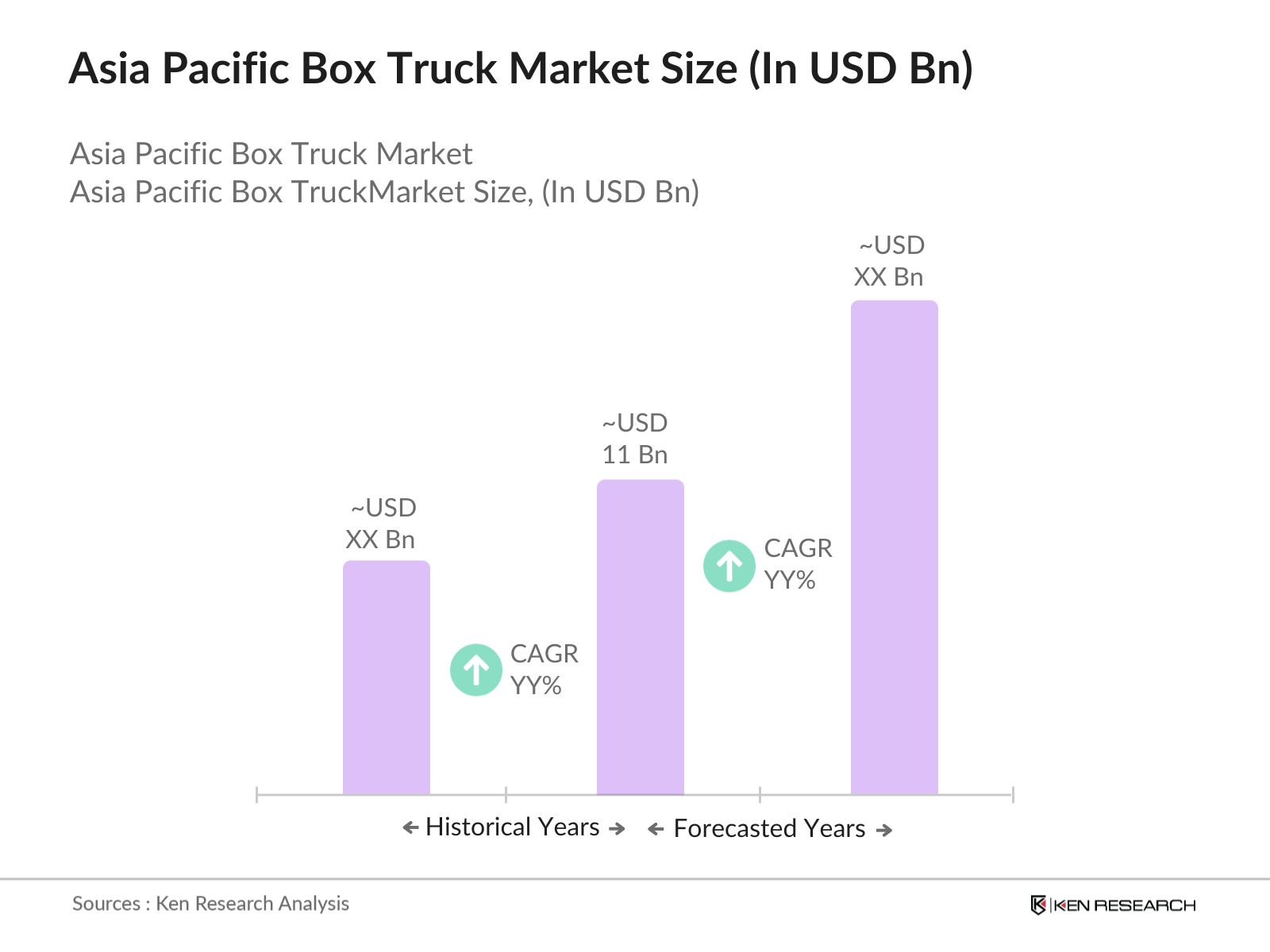
The Asia Pacific Box Truck Market is valued at USD 11 billion, driven by the growing demand for last-mile delivery services, particularly from the booming e-commerce industry.
Key challenges in the Asia Pacific Box Truck Market include high costs associated with electric box trucks, limited charging infrastructure, and fluctuating fuel prices. Additionally, the adoption of emission standards in some countries has made it necessary for fleet operators to upgrade their vehicles.
Major players in the Asia Pacific Box Truck Market include Daimler Trucks Asia, Isuzu Motors Limited, Tata Motors, BYD Auto Co. Ltd., and Hyundai Motor Company. These companies dominate the market due to their advanced technology, strong regional presence, and wide-ranging product portfolios.
Growth in the Asia Pacific Box Truck Market in the Asia Pacific Box Truck Market is primarily driven by the expansion of e-commerce, urbanization, and the rising demand for cold chain logistics. Government policies promoting electric vehicles have also significantly impacted the market.
China, Japan, and India are the dominant regions in the Asia Pacific Box Truck Market. China's dominance is attributed to its large-scale manufacturing capabilities, while Japan benefits from advanced automotive technology, and India's growing e-commerce industry drives demand.

What makes us stand out is that our consultants follows Robust, Refine and Result (RRR) methodology. i.e. Robust for clear definitions, approaches and sanity checking, Refine for differentiating respondents facts and opinions and Result for presenting data with story

We have set a benchmark in the industry by offering our clients with syndicated and customized market research reports featuring coverage of entire market as well as meticulous research and analyst insights.

While we don't replace traditional research, we flip the method upside down. Our dual approach of Top Bottom & Bottom Top ensures quality deliverable by not just verifying company fundamentals but also looking at the sector and macroeconomic factors.

With one step in the future, our research team constantly tries to show you the bigger picture. We help with some of the tough questions you may encounter along the way: How is the industry positioned? Best marketing channel? KPI's of competitors? By aligning every element, we help maximize success.

Our report gives you instant access to the answers and sources that other companies might choose to hide. We elaborate each steps of research methodology we have used and showcase you the sample size to earn your trust.

If you need any support, we are here! We pride ourselves on universe strength, data quality, and quick, friendly, and professional service.