















Asia Pacific Call Center AI Market Outlook to 2030
Region:Asia
Author(s):Shreya Garg
Product Code:KROD9778
December 2024
87
About the Report
Asia Pacific Call Center AI Market Overview
- The Asia Pacific Call Center AI Market is valued at USD 350 Million, driven by rapid advancements in AI technology and the growing need for efficient customer service solutions. The increasing integration of AI in call centers helps in enhancing operational efficiency, reducing costs, and improving customer experience. Key drivers include the surge in demand for automated customer support and the adoption of cloud-based AI solutions, enabling businesses to scale operations cost-effectively.
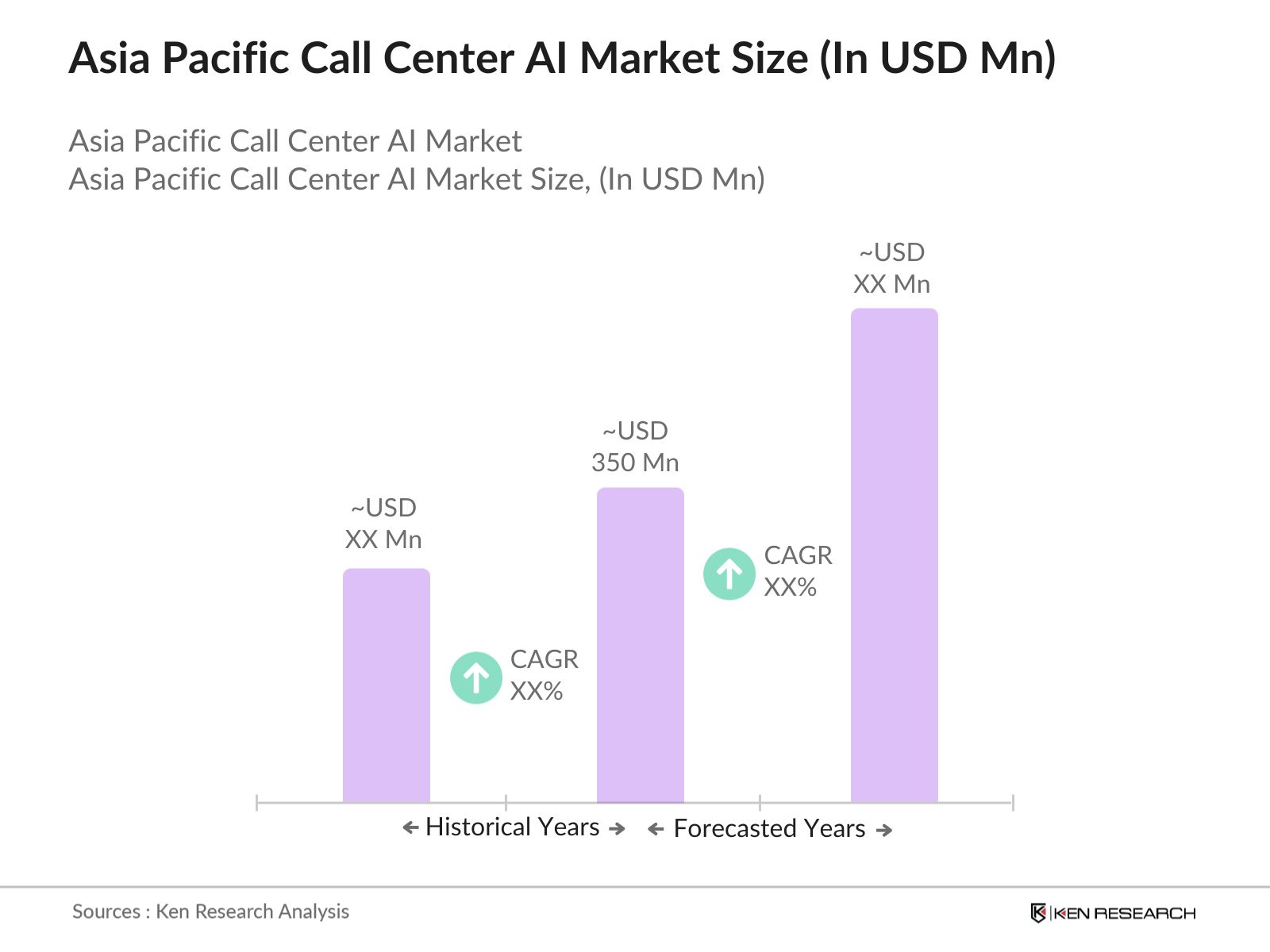
- Countries like India and China dominate the Asia Pacific Call Center AI market due to their large base of contact centers, technological advancements, and availability of a vast skilled workforce. India, with its strong IT services industry, has become a key hub for AI-driven solutions, while China's investments in AI research and technology innovations further enhance its leadership. The market's growth in these regions is primarily due to the rapid adoption of AI-powered chatbots and voice assistants for customer service and support.
- Governments across Asia Pacific are increasingly focusing on establishing ethical standards for AI use in call centers. In 2023, the Singaporean government released its AI Ethics & Governance Code, which outlines principles for transparency, accountability, and fairness in AI deployment. Compliance with these ethical standards is becoming mandatory for businesses utilizing AI in customer service, with over 60% of AI-using companies adopting such practices. These regulations are aimed at preventing misuse of AI technologies and ensuring that AI-driven decisions are free from bias, especially in customer interaction environments.
Asia Pacific Call Center AI Market Segmentation
By Component: The market is segmented by component into AI Solutions (Natural Language Processing, Machine Learning, Speech Recognition) and Services (Managed Services, Professional Services). AI Solutions dominate the market due to their ability to significantly reduce manual intervention and streamline customer support services. Natural Language Processing (NLP) and speech recognition are widely used in automating call routing, real-time transcription, and enhancing the overall quality of interactions. The increasing demand for personalized customer service has accelerated the adoption of AI solutions in call centers.

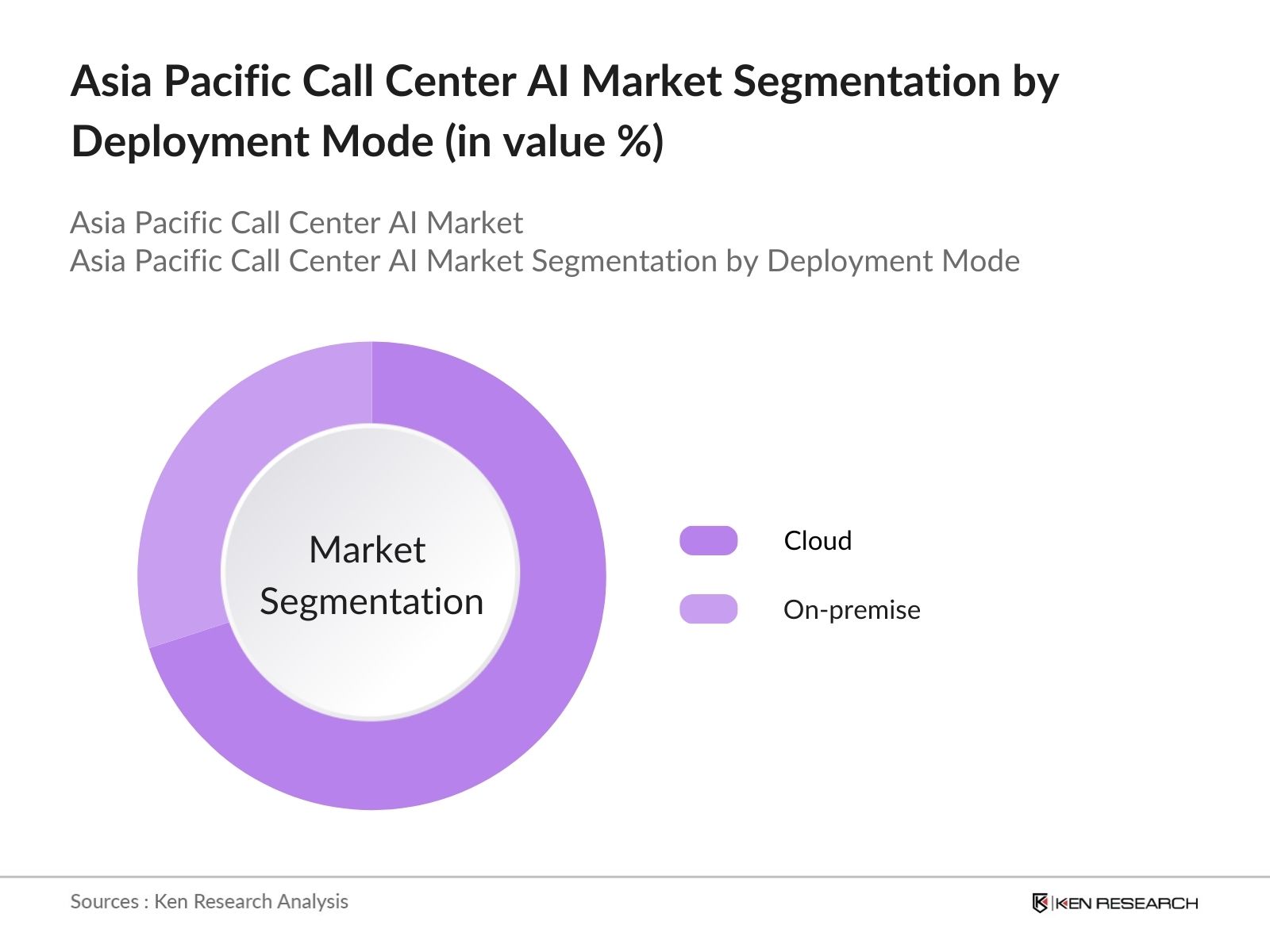
By Deployment Mode: The market is segmented into On-premise and Cloud-based solutions. Cloud deployment leads in market share, driven by the flexibility, scalability, and cost-effectiveness it offers. The cloud-based model allows call centers to quickly implement and scale AI technologies without heavy upfront infrastructure investments. This makes it an attractive option for companies of all sizes, especially small and medium enterprises looking for affordable AI-driven solutions.
Asia Pacific Call Center AI Market Competitive Landscape
The Asia Pacific Call Center AI market is characterized by intense competition among global and regional players. Major companies such as Google, Microsoft, and IBM lead the market due to their innovative AI offerings and extensive R&D investments. At the same time, local players also contribute significantly, offering customized solutions to meet regional demands.
|
Company |
Establishment Year |
Headquarters |
AI Solutions Portfolio |
Cloud Partnerships |
Revenue (2023) |
Customer Base |
R&D Investments |
Market Share (2023) |
|
Google LLC |
1998 |
Mountain View, USA |
||||||
|
Microsoft Corporation |
1975 |
Redmond, USA |
||||||
|
IBM Corporation |
1911 |
Armonk, USA |
||||||
|
Genesys Telecommunications |
1990 |
Daly City, USA |
||||||
|
Zendesk Inc. |
2007 |
San Francisco, USA |
Asia Pacific Call Center AI Industry Analysis
Growth Drivers
- Rising Customer Expectations: The increasing expectations for seamless and real-time customer experiences in the Asia Pacific region are driving the adoption of AI in call centers. The demand for faster query resolution and personalized interactions has led businesses to implement AI-powered solutions. According to the World Bank, the region's internet user base reached 2.5 billion in 2024, fostering an environment for digital service growth. This massive digital population enhances the pressure on companies to optimize customer experiences through AI, which can reduce response times by up to 60%. These AI solutions help companies retain customers and improve service delivery metrics.
- AI-based Automation Efficiency: Automation through AI in call centers significantly boosts efficiency by reducing human error and improving response accuracy. McKinsey estimates that AI can reduce human involvement in repetitive tasks by 85%, allowing call center employees to focus on complex queries. Furthermore, AI-driven automation can handle up to 80% of simple requests without human intervention, leading to a 40% increase in operational efficiency. The rise in cloud infrastructure across Asia Pacific, with more than 65% of businesses migrating to cloud-based AI solutions by 2024, has also facilitated this trend, making AI a core tool for automation.
- Increased Cloud Adoption: Cloud computing has become an essential component in integrating AI solutions for call centers in Asia Pacific. As of 2023, cloud infrastructure spending in the region stood at $109 billion, reflecting a 15% increase compared to 2022, according to the IMF. This growth allows businesses to deploy AI solutions more easily and scale them according to demand. AI capabilities in cloud platforms enable faster deployment and lower maintenance costs, with over 70% of businesses in major economies such as China, India, and Japan relying on cloud-based AI systems to manage customer interactions.
Market Challenges
- High Deployment Costs: While AI solutions offer long-term cost-saving benefits, the initial deployment costs remain a significant challenge for businesses, especially small to medium-sized enterprises (SMEs). In 2024, the average cost of implementing AI-powered systems in a medium-sized call center in Asia Pacific is around $1.5 million, according to the World Bank. This high upfront cost deters many companies from adopting AI, despite the potential for operational savings in the long run. Moreover, 35% of surveyed businesses in the region express concerns about the financial feasibility of transitioning fully to AI-based call center models.
- Privacy and Data Security: Data privacy is a growing concern in the Asia Pacific region, particularly with the increased use of AI systems in handling sensitive customer information. Regulatory frameworks, such as Japans Act on the Protection of Personal Information (APPI) and similar legislation in other countries, impose strict data protection requirements. According to a 2024 IMF report, 40% of companies in the region cite compliance with these regulations as a barrier to adopting AI solutions, fearing penalties for non-compliance. The heightened focus on data breaches also places additional pressure on businesses to ensure that AI systems meet security standards.
Asia Pacific Call Center AI Market Future Outlook
The Asia Pacific Call Center AI market is poised for significant growth over the next five years, driven by the increasing demand for personalized and automated customer support solutions. The expansion of AI technologies such as Natural Language Processing (NLP), predictive analytics, and machine learning will continue to play a pivotal role in transforming customer engagement across various industries. Moreover, as businesses shift towards cloud-based AI solutions, the flexibility and scalability of these technologies will further accelerate market growth.
Future Market Opportunities
- Expansion into SME Call Centers: AIs scalability presents significant growth opportunities for small to medium-sized enterprises (SMEs) in the Asia Pacific call center market. SMEs account for 97% of all businesses in the region, according to the World Bank, but only 30% currently use AI technologies due to perceived cost barriers. As AI becomes more accessible through cloud-based services, it is expected that SME adoption will grow significantly. Cloud AI services can reduce initial investment costs by up to 50%, providing a scalable solution that supports expansion and boosts operational efficiency for smaller call centers.
- AI-driven Workforce Optimization: AI offers substantial opportunities for workforce optimization in call centers, allowing businesses to better manage staffing levels and improve productivity. The automation of routine tasks, which constitute up to 70% of call center interactions, reduces the need for human intervention. In Asia Pacific, it is estimated that AI-driven workforce management can reduce labor costs by 20%, with businesses saving an average of $500,000 annually in operational costs, according to a 2023 report by the IMF. AI also enables better workforce scheduling, ensuring that agents are deployed during peak times, optimizing resource allocation.
Scope of the Report
|
By Component |
AI Solutions (NLP, ML, Speech Recognition) Services (Managed, Professional) |
|
By Deployment Mode |
On-premise Cloud |
|
By Application |
Customer Support Sales & Marketing IT Support |
|
By End-User Industry |
BFSI IT & Telecom Retail & E-Commerce Healthcare Others |
|
By Country/Region |
China India Japan Southeast Asia Australia & New Zealand |
Products
Key Target Audience
AI Solution Providers
Call Center Operators
Large Enterprises (BFSI, IT & Telecom, Retail)
SMEs (Cloud-based Call Centers)
Government and Regulatory Bodies (APPI, GDPR Compliance Authorities)
Investor and Venture Capitalist Firms
Telecom and IT Infrastructure Providers
AI Research and Development Institutions
Companies
Major Players
Google LLC
Microsoft Corporation
IBM Corporation
Genesys Telecommunications
Zendesk Inc.
Amazon Web Services (AWS)
Twilio Inc.
NICE Systems Ltd.
Avaya Inc.
Nuance Communications, Inc.
Salesforce.com, Inc.
Haptik Inc.
Uniphore Technologies Inc.
Inbenta Technologies Inc.
Kore.ai
Table of Contents
Asia Pacific Call Center AI Market Overview
1.1. Definition and Scope
1.2. Market Taxonomy
1.3. Growth Rate of Call Center AI Adoption
1.4. Market Segmentation Overview
Asia Pacific Call Center AI Market Size (in USD Mn)
2.1. Historical Market Size
2.2. Year-On-Year Growth Analysis
2.3. Key Market Developments
Asia Pacific Call Center AI Market Analysis
3.1. Growth Drivers
3.1.1. Rising Customer Expectations (CX Optimization)
3.1.2. AI-based Automation Efficiency
3.1.3. Increased Cloud Adoption (AI in Cloud Infrastructure)
3.1.4. Language and Dialect Recognition Improvements
3.2. Market Challenges
3.2.1. High Deployment Costs (Cost Efficiency Concerns)
3.2.2. Privacy and Data Security (Regulatory Concerns)
3.2.3. Integration Complexity with Existing Systems
3.3. Opportunities
3.3.1. Expansion into SME Call Centers (Scalability)
3.3.2. AI-driven Workforce Optimization
3.3.3. Growth of Multilingual AI Support
3.4. Trends
3.4.1. AI-Powered Conversational Agents (Chatbots & Voicebots)
3.4.2. Sentiment Analysis Integration in AI
3.4.3. Rise of Hybrid AI-human Solutions
3.4.4. Use of Machine Learning in Call Routing (Predictive Routing)
3.5. Government Regulations
3.5.1. Data Privacy Regulations (GDPR, APPI Compliance)
3.5.2. AI Ethical Standards
3.5.3. Government AI Initiatives (AI National Strategies)
3.6. SWOT Analysis
3.7. Stakeholder Ecosystem
3.8. Porters Five Forces Analysis
3.9. Competition Ecosystem
Asia Pacific Call Center AI Market Segmentation
4.1. By Component (in Value %)
4.1.1. AI Solutions (Natural Language Processing, Machine Learning, Speech Recognition)
4.1.2. Services (Managed Services, Professional Services)
4.2. By Deployment Mode (in Value %)
4.2.1. On-premise
4.2.2. Cloud
4.3. By Application (in Value %)
4.3.1. Customer Support
4.3.2. Sales & Marketing
4.3.3. IT Support
4.4. By End-User Industry (in Value %)
4.4.1. BFSI
4.4.2. IT & Telecom
4.4.3. Retail & E-Commerce
4.4.4. Healthcare
4.4.5. Others
4.5. By Country/Region (in Value %)
4.5.1. China
4.5.2. India
4.5.3. Japan
4.5.4. Southeast Asia
4.5.5. Australia & New Zealand
Asia Pacific Call Center AI Market Competitive Analysis
5.1 Detailed Profiles of Major Companies
5.1.1. Google LLC
5.1.2. IBM Corporation
5.1.3. Microsoft Corporation
5.1.4. Amazon Web Services (AWS)
5.1.5. Genesys Telecommunications Laboratories, Inc.
5.1.6. NICE Systems Ltd.
5.1.7. Avaya Inc.
5.1.8. Zendesk Inc.
5.1.9. Salesforce.com, Inc.
5.1.10. Twilio Inc.
5.1.11. Haptik Inc.
5.1.12. Nuance Communications, Inc.
5.1.13. Uniphore Technologies Inc.
5.1.14. Inbenta Technologies Inc.
5.1.15. Kore.ai
5.2 Cross Comparison Parameters (Revenue, AI Product Portfolio, R&D Investment, Cloud Partnerships, Innovation Index, Customer Base, AI Integration Complexity, Market Share)
5.3. Market Share Analysis
5.4. Strategic Initiatives
5.5. Mergers and Acquisitions
5.6. Venture Capital Funding
5.7. Investment Analysis
5.8. Government Grants and AI Innovation Subsidies
5.9. Private Equity Investments
Asia Pacific Call Center AI Market Regulatory Framework
6.1. AI Compliance Regulations (Country Specific)
6.2. Data Security and Privacy Standards
6.3. Certification Processes for AI Implementation
6.4. AI Bias and Ethical Use Guidelines
Asia Pacific Call Center AI Future Market Size (in USD Mn)
7.1. Future Market Size Projections
7.2. Key Factors Driving Future Market Growth
Asia Pacific Call Center AI Future Market Segmentation
8.1. By Component (in Value %)
8.2. By Deployment Mode (in Value %)
8.3. By Application (in Value %)
8.4. By End-User Industry (in Value %)
8.5. By Country/Region (in Value %)
Asia Pacific Call Center AI Market Analysts Recommendations
9.1. TAM/SAM/SOM Analysis
9.2. Customer Segmentation Analysis
9.3. White Space Opportunities
9.4. Market Expansion Strategies
Research Methodology
Step 1: Identification of Key Variables
This step involves creating an ecosystem map encompassing all major stakeholders in the Asia Pacific Call Center AI Market. Extensive desk research was conducted using secondary and proprietary databases to collect industry-level information. The goal is to identify the critical variables that drive the market, such as AI adoption rates, customer engagement trends, and operational efficiencies.
Step 2: Market Analysis and Construction
This phase compiles and analyzes historical data on AI adoption in call centers, penetration rates, and the ratio of AI-driven solutions to traditional services. An analysis of call center performance metrics and revenue trends provides insights into market dynamics.
Step 3: Hypothesis Validation and Expert Consultation
Market hypotheses are validated through computer-assisted interviews with industry experts. These consultations yield valuable insights into operational trends, financial performance, and AI integration experiences, which enhance the reliability of market forecasts.
Step 4: Research Synthesis and Final Output
In this final stage, direct engagement with AI solution providers enables the verification of market statistics. This ensures a comprehensive and accurate analysis of the Asia Pacific Call Center AI market, integrating both top-down and bottom-up approaches.
Frequently Asked Questions
01. How big is the Asia Pacific Call Center AI Market?
The Asia Pacific Call Center AI market is valued at USD 350 Million, driven by the growing need for automation in customer service operations and advancements in AI technologies.
02. What are the key growth drivers for the Asia Pacific Call Center AI Market?
The primary drivers in the Asia Pacific Call Center AI market include increasing demand for automated customer support solutions, AI-based workforce optimization, and the growing adoption of cloud-based AI technologies.
03. Which countries dominate the Asia Pacific Call Center AI Market?
India and China are the dominant countries in the Asia Pacific Call Center AI market, primarily due to their large workforce in call centers, rapid adoption of AI technologies, and significant investments in AI research and development.
04. Who are the major players in the Asia Pacific Call Center AI Market?
Key players in the Asia Pacific Call Center AI market include Google LLC, Microsoft Corporation, IBM Corporation, Genesys Telecommunications, and Zendesk Inc., who lead due to their strong AI offerings and extensive customer base.
05. What are the major challenges in the Asia Pacific Call Center AI Market?
Challenges in the Asia Pacific Call Center AI market include high implementation costs, data privacy concerns, and the complexity of integrating AI solutions with legacy systems. Additionally, regulatory compliance in terms of data privacy is a significant hurdle for many businesses in the region.
Why Buy From Us?

What makes us stand out is that our consultants follows Robust, Refine and Result (RRR) methodology. i.e. Robust for clear definitions, approaches and sanity checking, Refine for differentiating respondents facts and opinions and Result for presenting data with story

We have set a benchmark in the industry by offering our clients with syndicated and customized market research reports featuring coverage of entire market as well as meticulous research and analyst insights.

While we don't replace traditional research, we flip the method upside down. Our dual approach of Top Bottom & Bottom Top ensures quality deliverable by not just verifying company fundamentals but also looking at the sector and macroeconomic factors.

With one step in the future, our research team constantly tries to show you the bigger picture. We help with some of the tough questions you may encounter along the way: How is the industry positioned? Best marketing channel? KPI's of competitors? By aligning every element, we help maximize success.

Our report gives you instant access to the answers and sources that other companies might choose to hide. We elaborate each steps of research methodology we have used and showcase you the sample size to earn your trust.

If you need any support, we are here! We pride ourselves on universe strength, data quality, and quick, friendly, and professional service.