
Asia Pacific Cat Litter Market Outlook to 2030
Region:Afganistan
Author(s):Meenakshi Bisht
Product Code:KROD9756
Region:Afganistan
Author(s):Meenakshi Bisht
Product Code:KROD9756
December 2024
82
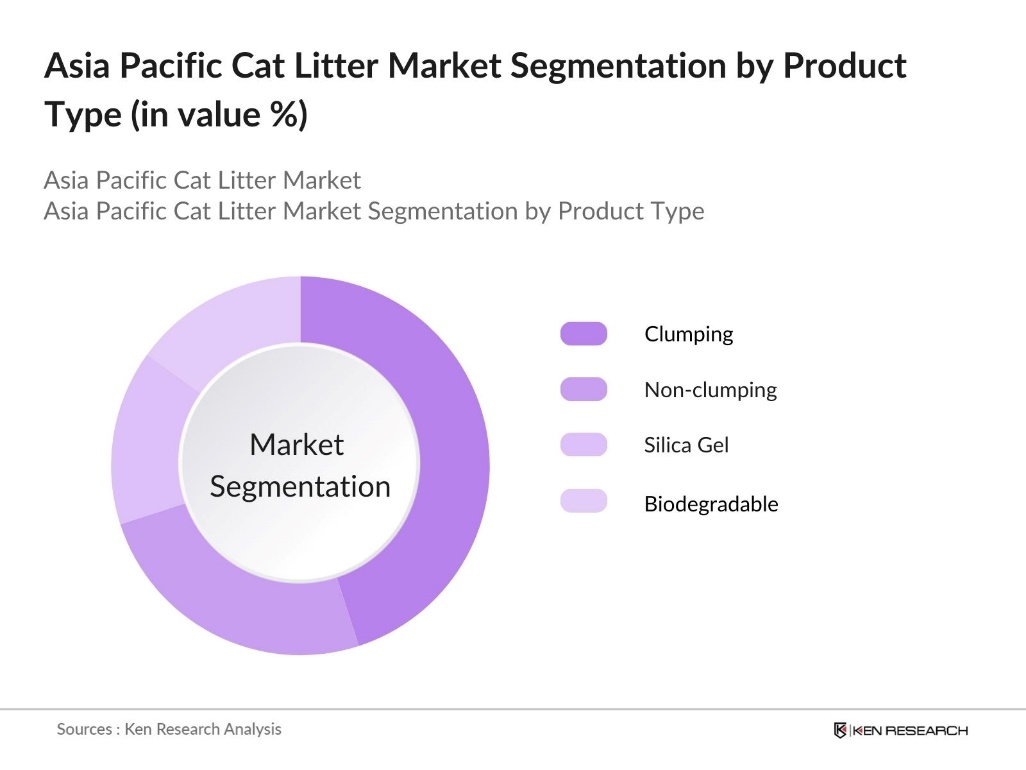
By Product Type: The Asia Pacific Cat Litter market is segmented by product type into clumping, non-clumping, silica gel, and biodegradable litter. Among these, clumping cat litter holds a dominant market share due to its convenience and effectiveness in odor control. Consumers prefer clumping litter as it forms solid clumps when wet, making it easy to scoop and maintain, thus promoting better hygiene in homes. The products affordability, availability, and compatibility with a variety of litter boxes make it the top choice in both urban and semi-urban households.
By Distribution Channel: In terms of distribution channels, the market is segmented into offline (supermarkets, pet specialty stores, and grocery stores) and online (e-commerce platforms and subscription services). The online segment is witnessing rapid growth and currently holds a significant market share. The convenience of doorstep delivery, a wider range of product availability, and the growing popularity of subscription-based services are key factors driving this segment. E-commerce giants like Amazon and regional platforms such as JD.com and Flipkart have expanded their pet care product offerings, leading to an increase in online sales of cat litter.

The Asia Pacific Cat Litter market is dominated by a combination of multinational companies and regional players, each contributing to the highly competitive landscape. Key industry players are leveraging innovations in product formulation, packaging, and distribution to gain market share. For instance, international brands such as Nestl Purina and Mars Petcare dominate the premium and mid-range market segments, while local players focus on economy-grade products and region-specific distribution strategies.
|
Company Name |
Year Established |
Headquarters |
Product Range |
Innovation Focus |
Sustainability Initiatives |
Global Reach |
Key Partnerships |
R&D Investment |
Manufacturing Facilities |
|
Nestl Purina PetCare |
1894 |
St. Louis, USA |
|||||||
|
Mars Petcare |
1930 |
Virginia, USA |
|||||||
|
Church & Dwight Co., Inc. |
1846 |
New Jersey, USA |
|||||||
|
Kent Pet Group |
1927 |
Iowa, USA |
|||||||
|
Healthy Pet |
1985 |
Washington, USA |
Over the next five years, the Asia Pacific Cat Litter market is expected to grow significantly, driven by the increased adoption of pets across urban households, greater awareness of hygiene in pet care, and the rising demand for sustainable products. The growth of e-commerce, coupled with innovative subscription services, is anticipated to revolutionize product distribution in this market. Additionally, the introduction of environmentally friendly cat litter products, such as plant-based or biodegradable options, is expected to further boost demand as consumers become more eco-conscious.
|
Product Type |
Clumping Non-Clumping, Silica Gel Biodegradable |
|
Distribution Channel |
Offline (Supermarkets, Pet Specialty Stores, Grocery Stores) Online (E-commerce Platforms, Subscription Services) |
|
Material Type |
Clay-based Silica-based Plant-based Recycled Paper |
|
Price Range |
Economy Mid-range Premium |
|
Region |
China Japan India Australia Southeast Asia |
1.1 Definition and Scope
1.2 Market Taxonomy
1.3 Market Growth Rate
1.4 Market Segmentation Overview
2.1 Historical Market Size
2.2 Year-On-Year Growth Analysis
2.3 Key Market Developments and Milestones
3.1 Growth Drivers (Demand for eco-friendly products, urbanization, increasing pet adoption rates)
3.1.1 Rising Awareness About Pet Hygiene
3.1.2 Shift Toward Sustainable and Biodegradable Products
3.1.3 Growing Pet Humanization Trend
3.1.4 Expanding Middle-Class Population in APAC
3.2 Market Challenges (High product price, distribution challenges in rural areas, competition from alternative products)
3.2.1 Price Sensitivity in Emerging Markets
3.2.2 Logistics and Supply Chain Issues
3.2.3 Presence of Low-cost Substitutes
3.3 Opportunities (Technological innovations, growth in e-commerce, growing demand for premium products)
3.3.1 Innovations in Clumping and Odor Control Technologies
3.3.2 Rising Popularity of Online Sales Channels
3.3.3 Pet Health Awareness Campaigns Driving Premiumization
3.4 Trends (Demand for natural materials, increased focus on health and wellness, e-commerce growth)
3.4.1 Use of Organic and Natural Materials
3.4.2 Expansion of Subscription-Based Models for Cat Litter Delivery
3.4.3 Sustainability and Recycling Initiatives in Packaging
3.5 Government Regulations (Import tariffs, waste management regulations, sustainability guidelines)
3.5.1 Regional Policies on Biodegradable and Eco-friendly Products
3.5.2 Waste Disposal Regulations in the APAC Region
3.5.3 Tariff and Import Duty Regulations for Raw Materials
3.6 SWOT Analysis
3.7 Stake Ecosystem (Manufacturers, suppliers, distributors, retailers)
3.8 Porters Five Forces (Supplier power, buyer power, industry rivalry, threat of substitutes, threat of new entrants)
3.9 Competition Ecosystem
4.1 By Product Type (In Value %)
4.1.1 Clumping
4.1.2 Non-Clumping
4.1.3 Silica Gel
4.1.4 Biodegradable
4.2 By Distribution Channel (In Value %)
4.2.1 Offline (Supermarkets, Pet Specialty Stores, Grocery Stores)
4.2.2 Online (E-commerce Platforms, Subscription Services)
4.3 By Material Type (In Value %)
4.3.1 Clay-based
4.3.2 Silica-based
4.3.3 Plant-based
4.3.4 Recycled Paper
4.4 By Price Range (In Value %)
4.4.1 Economy
4.4.2 Mid-range
4.4.3 Premium
4.5 By Region (In Value %)
4.5.1 China
4.5.2 Japan
4.5.3 India
4.5.4 Australia
4.5.5 Southeast Asia
5.1 Detailed Profiles of Major Companies
5.1.1 Nestl Purina PetCare
5.1.2 Mars Petcare
5.1.3 Church & Dwight Co., Inc.
5.1.4 Dr. Elseys Cat Products
5.1.5 Kent Pet Group
5.1.6 Oil-Dri Corporation of America
5.1.7 Healthy Pet
5.1.8 Cats Pride
5.1.9 Pettex Ltd.
5.1.10 So Phresh
5.1.11 Feline Pine
5.1.12 Rufus & Coco
5.1.13 Breeder's Choice
5.1.14 Yokohama Co., Ltd.
5.1.15 Absorption Corp
5.2 Cross Comparison Parameters (Revenue, Number of Products, Manufacturing Capacity, Distribution Network, Raw Material Sourcing, Sustainability Initiatives, Online Presence, Key Partnerships)
5.3 Market Share Analysis
5.4 Strategic Initiatives
5.5 Mergers And Acquisitions
5.6 Investment Analysis
5.7 Venture Capital Funding
5.8 Government Grants
5.9 Private Equity Investments
6.1 Waste Management and Disposal Standards
6.2 Environmental Compliance Requirements
6.3 Product Certification Processes
7.1 Future Market Size Projections
7.2 Key Factors Driving Future Market Growth
8.1 By Product Type (In Value %)
8.2 By Distribution Channel (In Value %)
8.3 By Material Type (In Value %)
8.4 By Price Range (In Value %)
8.5 By Region (In Value %)
9.1 TAM/SAM/SOM Analysis
9.2 Consumer Cohort Analysis
9.3 Marketing Strategies
9.4 White Space Opportunity Analysis
Disclaimer Contact UsThe first step involves identifying the critical variables that influence the Asia Pacific Cat Litter market. This includes a thorough evaluation of the supply chain, distribution channels, and key market players through extensive desk research using both proprietary and secondary databases. The goal is to map out the ecosystem and identify key drivers of market growth.
This phase focuses on compiling and analyzing historical data on the Asia Pacific Cat Litter market, including production and distribution statistics. Factors such as market penetration, pricing strategies, and consumer preferences are assessed. The data is used to construct a market model for accurate projections.
Market hypotheses are developed based on the compiled data and then validated through interviews with industry experts, including manufacturers, distributors, and retailers. This step provides qualitative insights to support and refine the quantitative data gathered from secondary sources.
In the final phase, direct engagement with key market players helps to further validate the research findings. This ensures that the final report provides a comprehensive and accurate analysis of the Asia Pacific Cat Litter market, incorporating insights on future trends, consumer behavior, and industry developments.
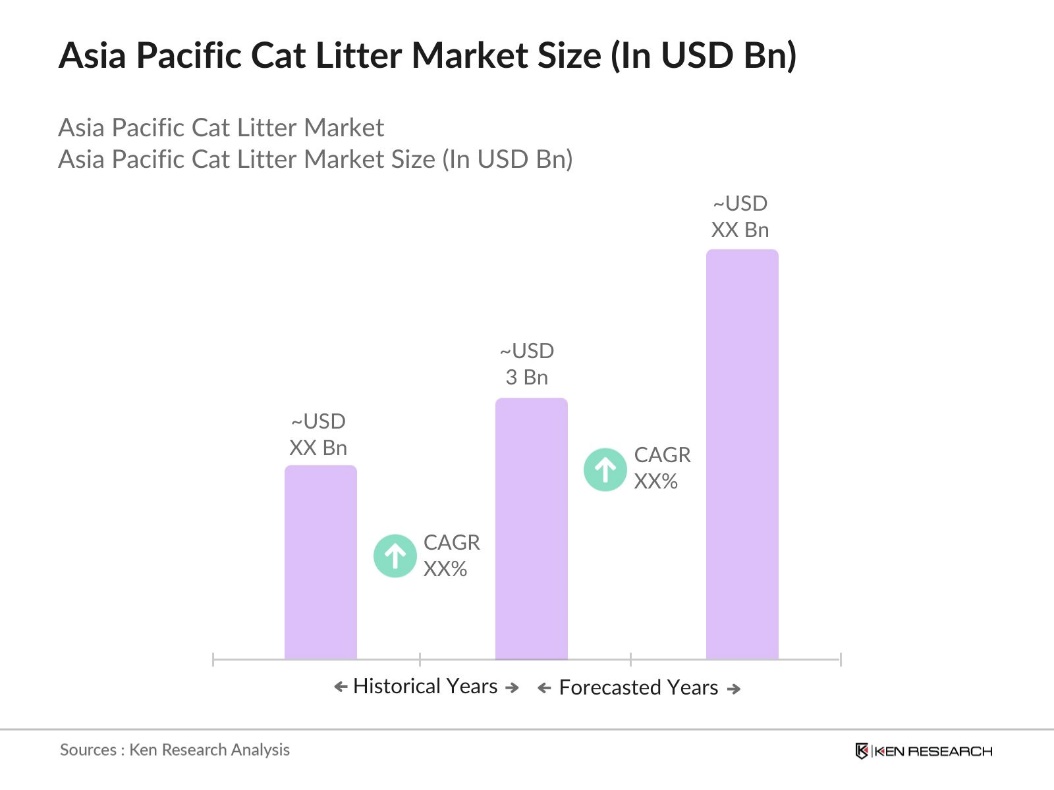
The Asia Pacific Cat Litter Market is valued at USD 3 billion, driven by increasing urbanization and rising demand for premium pet care products, especially in China, Japan, and Australia.
Challenges in Asia Pacific Cat Litter Market include the high cost of premium products, logistics issues in rural areas, and the presence of low-cost alternatives. Companies are also grappling with increasing raw material costs, particularly for biodegradable products.
Key players in Asia Pacific Cat Litter Market include Nestl Purina PetCare, Mars Petcare, Church & Dwight Co., Inc., Kent Pet Group, and Healthy Pet. These companies dominate due to strong distribution networks, continuous product innovation, and strategic partnerships.
The Asia Pacific Cat Litter Market is driven by the rising trend of pet humanization, increasing urbanization, and the growing demand for eco-friendly and premium cat litter products. E-commerce growth also plays a critical role in expanding market access.

What makes us stand out is that our consultants follows Robust, Refine and Result (RRR) methodology. i.e. Robust for clear definitions, approaches and sanity checking, Refine for differentiating respondents facts and opinions and Result for presenting data with story

We have set a benchmark in the industry by offering our clients with syndicated and customized market research reports featuring coverage of entire market as well as meticulous research and analyst insights.

While we don't replace traditional research, we flip the method upside down. Our dual approach of Top Bottom & Bottom Top ensures quality deliverable by not just verifying company fundamentals but also looking at the sector and macroeconomic factors.

With one step in the future, our research team constantly tries to show you the bigger picture. We help with some of the tough questions you may encounter along the way: How is the industry positioned? Best marketing channel? KPI's of competitors? By aligning every element, we help maximize success.

Our report gives you instant access to the answers and sources that other companies might choose to hide. We elaborate each steps of research methodology we have used and showcase you the sample size to earn your trust.

If you need any support, we are here! We pride ourselves on universe strength, data quality, and quick, friendly, and professional service.