















Asia-Pacific Cellular Signal Repeater Market Outlook to 2030
Region:Asia
Author(s):Meenakshi Bisht
Product Code:KROD6448
December 2024
87
About the Report
Asia-Pacific Cellular Signal Repeater Market Overview
- The Asia-Pacific Cellular Signal Repeater Market is valued at USD 160 million, driven primarily by the expanding mobile network infrastructure and growing demand for uninterrupted mobile connectivity. The regions rising smartphone penetration and increased urbanization further amplify the need for signal repeaters, as more users require robust coverage in densely populated areas and high-rise buildings.
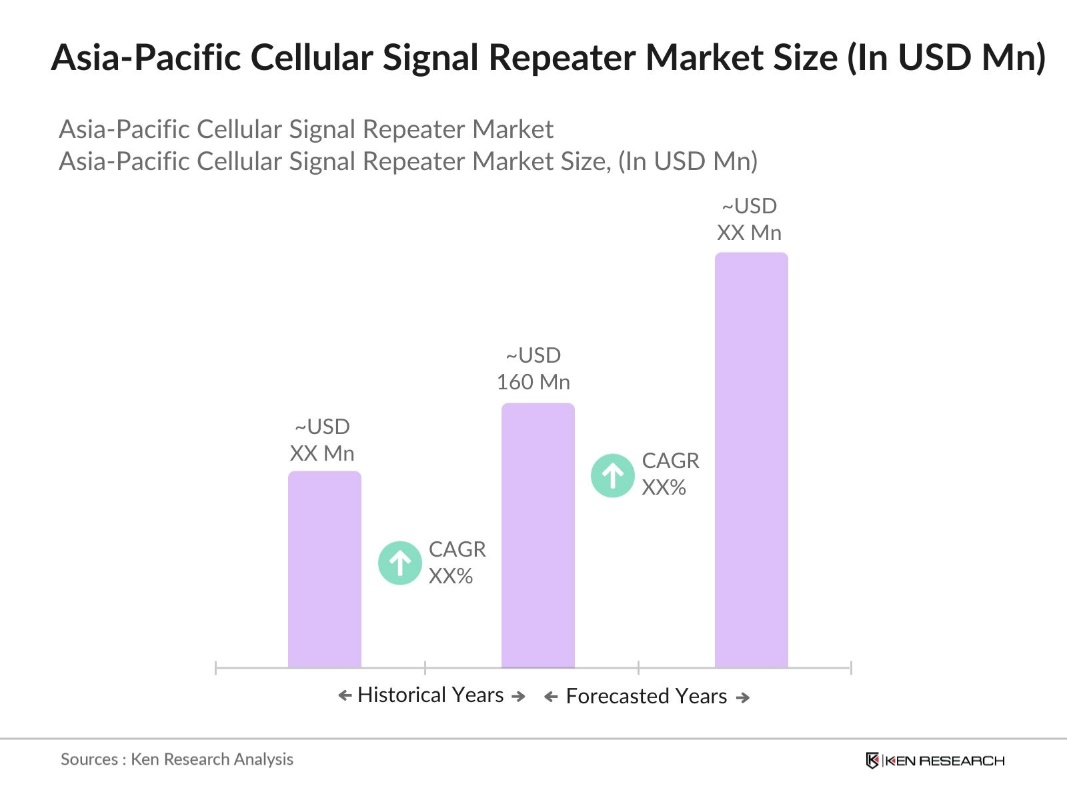
- Countries like China, Japan, and South Korea dominate the Asia-Pacific cellular signal repeater market due to their advanced telecom infrastructure and high penetration of 5G networks. China's extensive investments in expanding rural and urban connectivity, Japans leadership in technology innovation, and South Koreas focus on high-speed internet adoption make these nations leading contributors. Additionally, strong government support for telecommunication projects in these countries drives their market leadership.
- Spectrum allocation policies in Asia-Pacific play a key role in shaping the cellular signal repeater market. Countries like South Korea, China, and India have allocated significant spectrum for 5G network deployment, requiring signal repeaters to ensure broader coverage. In 2024, China added more spectrum bands to support its 5G expansion. These policies provide telecom operators with the necessary bandwidth to improve network efficiency and enhance user experience.
Asia-Pacific Cellular Signal Repeater Market Segmentation
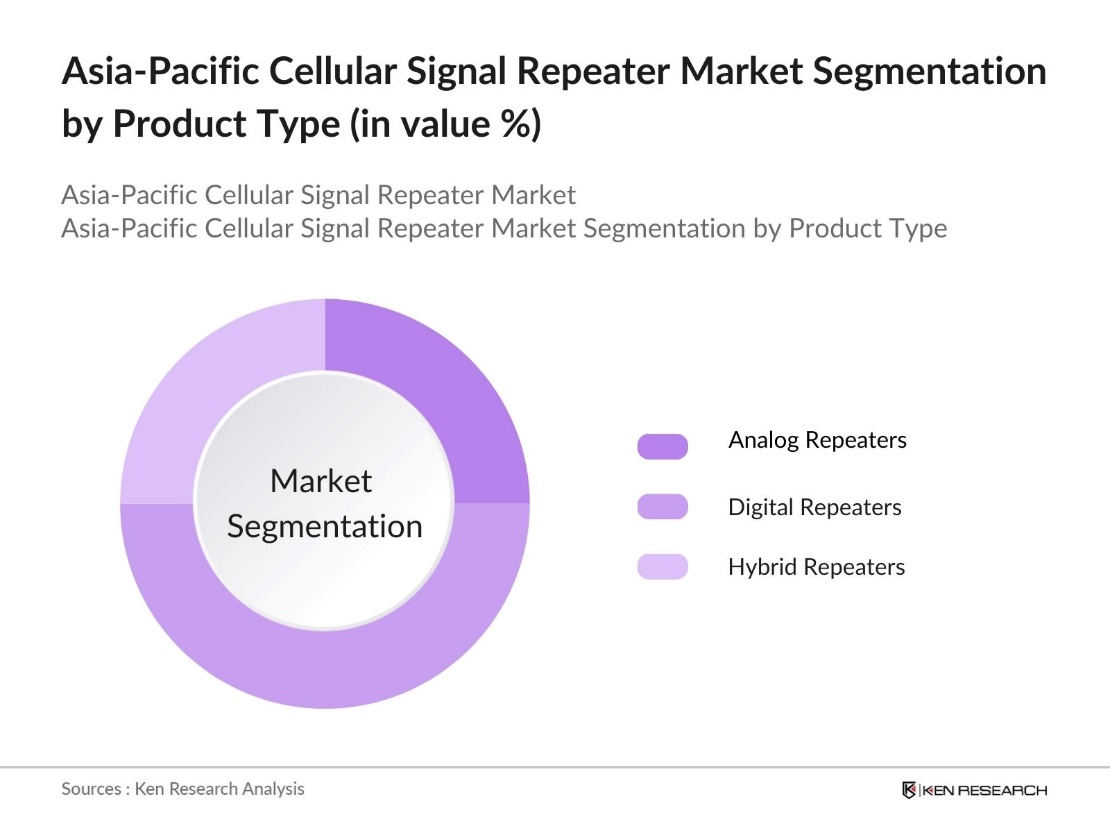
By Product Type: The Asia-Pacific cellular signal repeater market is segmented by product type into analog repeaters, digital repeaters, and hybrid repeaters. Recently, digital repeaters have dominated the market due to their higher efficiency, better signal quality, and ability to support modern mobile networks like 4G LTE and 5G. Their capability to handle multiple frequency bands makes them the preferred choice for telecom providers looking to enhance signal strength in urban environments, office complexes, and commercial hubs. Furthermore, their lower maintenance requirements compared to analog repeaters have fueled their widespread adoption.
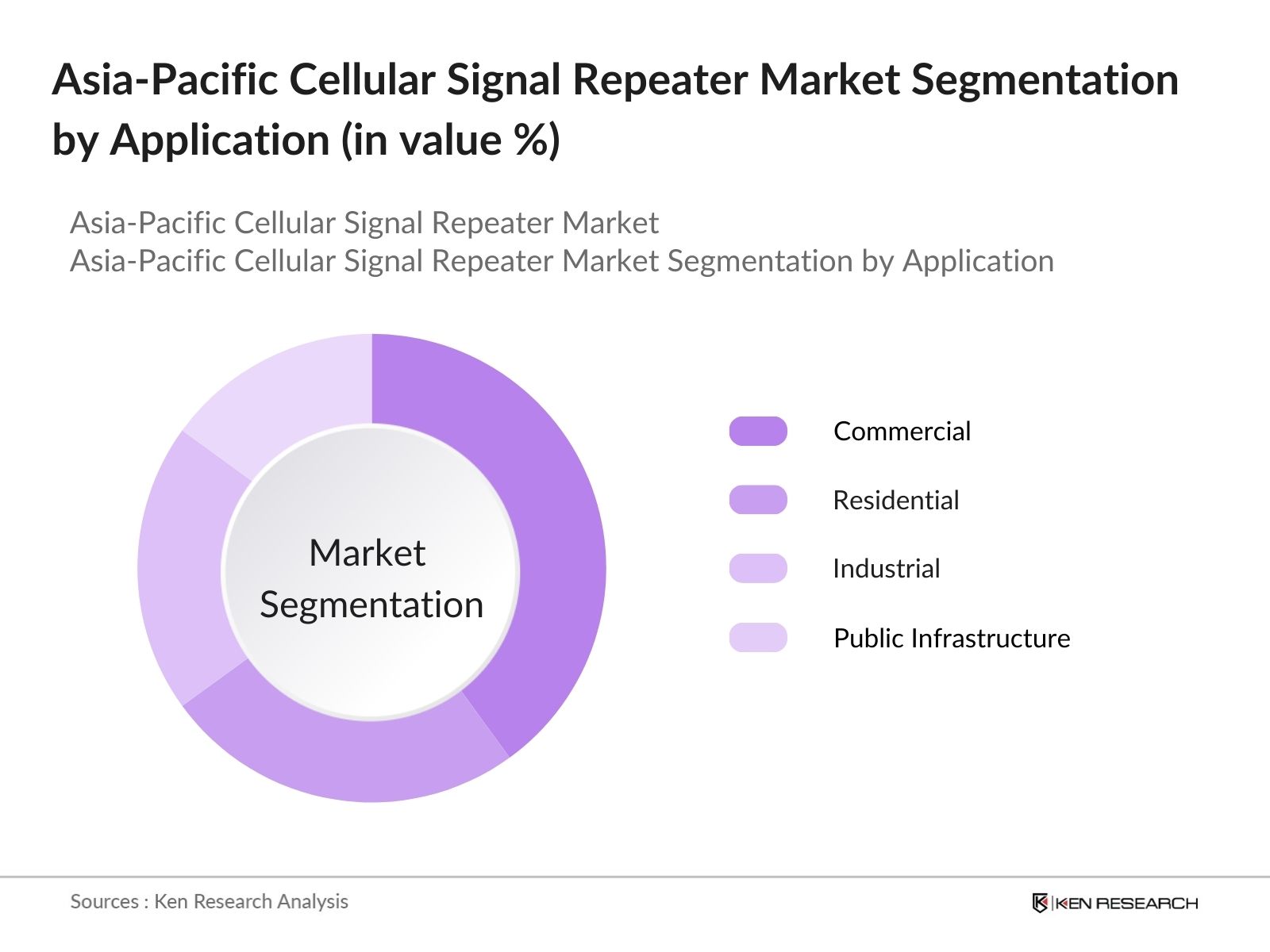
By Application: The Asia-Pacific cellular signal repeater market is also segmented by application into residential, commercial, industrial, and public infrastructure. Commercial applications lead the market due to the increasing need for reliable signal coverage in office buildings, shopping malls, and corporate parks. The proliferation of smart devices and the growing use of high-speed data services within business environments has led to an increased focus on signal enhancement technologies. In large commercial spaces, cellular signal repeaters offer seamless connectivity, thereby boosting productivity and consumer satisfaction.
Asia-Pacific Cellular Signal Repeater Market Competitive Landscape
The market is dominated by several major players, including both regional and global companies. These players compete on various factors such as product innovation, pricing strategies, and regional expansion. The market is moderately consolidated, with a few key players holding significant market shares. Companies are increasingly focusing on developing multi-band repeaters and investing in R&D to enhance signal quality and reduce interference issues.
|
Company |
Establishment Year |
Headquarters |
No. of Employees |
Revenue (USD Mn) |
Technology Focus |
R&D Investments |
Market Share |
Geographical Presence |
|
CommScope Inc. |
1976 |
USA |
||||||
|
Wilson Electronics |
1999 |
USA |
||||||
|
SureCall |
2001 |
USA |
||||||
|
Nextivity Inc. |
2007 |
USA |
||||||
|
Huaptec |
2009 |
China |
Asia-Pacific Cellular Signal Repeater Industry Analysis
Growth Drivers
- Growing Mobile Network Penetration: The Asia-Pacific region has seen a significant increase in mobile network penetration, driven by expanding populations and a growing middle class. As of 2024, there are more than 3.1 billion mobile subscribers in the region, a rise attributed to rapid urbanization and economic development. Countries like India, China, and Indonesia are experiencing higher adoption rates due to government programs aimed at improving digital infrastructure.
- Increasing Demand for Uninterrupted Connectivity: The demand for seamless connectivity in Asia-Pacific has surged due to growing remote work and expanding online services. By early 2024, China alone has around 1.1 billion internet users. Both businesses and consumers increasingly depend on uninterrupted networks for digital services, boosting the need for cellular signal repeaters to enhance network stability and coverage.
- Rising Adoption of Smart Devices: The increasing adoption of smart devices is driving the demand for improved network quality in the Asia-Pacific region. Countries like China and India are leading this growth, with more people using smartphones, IoT devices, and tablets. As network coverage can be inconsistent, particularly in rural areas, cellular signal repeaters play a crucial role in ensuring these devices remain connected. This growing device ecosystem has made network infrastructure a top priority.
Market Challenges
- High Deployment Costs: The high cost of deploying cellular signal repeaters, especially in rural and remote areas, poses a significant challenge. Infrastructure investments required for installation and maintenance are substantial, and despite government efforts to boost connectivity, the financial burden remains high. Countries like India and Indonesia struggle with these costs, making it difficult to expand signal repeater deployment without private sector support.
- Regulatory Barriers: Regulatory complexities across Asia-Pacific hinder the seamless deployment of cellular signal repeaters. Varying telecommunications regulations, spectrum allocation policies, and licensing fees in countries like Japan and South Korea drive up costs and slow infrastructure expansion. These challenges delay the rollout of signal repeaters, impacting market growth.
Asia-Pacific Cellular Signal Repeater Market Future Outlook
Over the next five years, the Asia-Pacific cellular signal repeater market is expected to witness substantial growth, driven by ongoing advancements in mobile network technology, particularly the expansion of 5G. Increasing demand for improved network coverage in rural and urban areas, along with government support for infrastructure development, will continue to propel the market forward.
Market Opportunities
- Expanding 5G Networks: The ongoing expansion of 5G networks in the Asia-Pacific region offers significant growth opportunities for the cellular signal repeater market. Countries like China, South Korea, and Japan are leading large-scale 5G rollouts, creating an increased demand for signal repeaters to ensure reliable coverage, especially in challenging terrains. This network expansion drives the need for advanced repeaters to support 5G connectivity, opening new opportunities for infrastructure development across the region.
- Rising Demand for Private LTE Networks: Private LTE networks are gaining traction among industries like manufacturing, mining, and logistics in the Asia-Pacific. Governments in countries such as Australia and Japan are supporting the adoption of these networks to improve operational efficiency, particularly in remote locations. The rise in private LTE networks has increased the demand for cellular signal repeaters, which are essential for maintaining strong and stable network connectivity in industrial applications.
Scope of the Report
|
Product Type |
Analog Repeaters Digital Repeaters Hybrid Repeaters |
|
Application |
Residential Commercial Industrial Public Infrastructure |
|
Frequency Band |
Single-band Repeaters Dual-band Repeaters Tri-band Repeaters |
|
Technology |
2G/3G Repeaters 4G LTE Repeaters 5G Repeaters |
|
Region |
China Japan South Korea Australia Southeast Asia (Indonesia, Malaysia, Thailand, etc.) |
Products
Key Target Audience
Building Management Companies
Telecom Tower Companies
Telecom Network Infrastructure Leasing Firms
Government and Regulatory Bodies (Telecom Regulatory Authority, Ministry of Communications)
Investors and venture capital Firms
Banks and Financial Institutions
Companies
Players Mentioned in the Report
CommScope Inc.
Wilson Electronics
SureCall
Nextivity Inc.
Huaptec
Smoothtalker
Stella Doradus
Zinwave
Cellphone-Mate (HiBoost)
WeBoost
Table of Contents
1. Asia-Pacific Cellular Signal Repeater Market Overview
1.1. Definition and Scope
1.2. Market Taxonomy
1.3. Market Growth Rate (YoY Growth %, CAGR, Market Dynamics)
1.4. Market Segmentation Overview
2. Asia-Pacific Cellular Signal Repeater Market Size (In USD Mn)
2.1. Historical Market Size (Past Data in USD Bn, Volume Metrics)
2.2. Year-On-Year Growth Analysis (Percentage Growth)
2.3. Key Market Developments and Milestones (Technological Innovation, Major Market Players' Initiatives)
3. Asia-Pacific Cellular Signal Repeater Market Analysis
3.1. Growth Drivers
3.1.1. Growing Mobile Network Penetration
3.1.2. Increasing Demand for Uninterrupted Connectivity
3.1.3. Rising Adoption of Smart Devices
3.1.4. Government Initiatives to Improve Network Infrastructure
3.2. Market Challenges
3.2.1. High Deployment Costs
3.2.2. Regulatory Barriers
3.2.3. Interference Issues with Network Operators
3.3. Opportunities
3.3.1. Expanding 5G Networks
3.3.2. Rising Demand for Private LTE Networks
3.3.3. Growth in Smart City Projects
3.4. Trends
3.4.1. Integration with IoT Devices
3.4.2. Increased Use of Cloud-based Management Systems
3.4.3. Adoption of Compact and Multi-band Repeaters
3.5. Government Regulations
3.5.1. Spectrum Allocation Policies
3.5.2. Network Expansion Programs
3.5.3. Public-Private Partnerships for Telecommunication Infrastructure
3.6. SWOT Analysis
3.7. Stakeholder Ecosystem (Infrastructure Providers, Network Operators, Equipment Manufacturers)
3.8. Porters Five Forces
3.9. Competition Ecosystem
4. Asia-Pacific Cellular Signal Repeater Market Segmentation
4.1. By Product Type (In Value %)
4.1.1. Analog Repeaters
4.1.2. Digital Repeaters
4.1.3. Hybrid Repeaters
4.2. By Application (In Value %)
4.2.1. Residential
4.2.2. Commercial
4.2.3. Industrial
4.2.4. Public Infrastructure
4.3. By Frequency Band (In Value %)
4.3.1. Single-band Repeaters
4.3.2. Dual-band Repeaters
4.3.3. Tri-band Repeaters
4.4. By Technology (In Value %)
4.4.1. 2G/3G Repeaters
4.4.2. 4G LTE Repeaters
4.4.3. 5G Repeaters
4.5. By Region (In Value %)
4.5.1. China
4.5.2. Japan
4.5.3. South Korea
4.5.4. Australia
4.5.5. Southeast Asia (Indonesia, Malaysia, Thailand, etc.)
5. Asia-Pacific Cellular Signal Repeater Market Competitive Analysis
5.1 Detailed Profiles of Major Companies
5.1.1. CommScope Inc.
5.1.2. Wilson Electronics
5.1.3. SureCall
5.1.4. Nextivity Inc.
5.1.5. Smoothtalker
5.1.6. Stella Doradus
5.1.7. Huaptec
5.1.8. Zinwave
5.1.9. Cellphone-Mate (HiBoost)
5.1.10. WeBoost
5.1.11. JDTECK
5.1.12. Phonetone
5.1.13. Shenzhen Slinya Electronics
5.1.14. AMRepeaters
5.1.15. MaxComm
5.2 Cross Comparison Parameters (No. of Employees, Headquarters, Inception Year, Revenue, Technology Portfolio, R&D Investment, Market Share, Key Clients)
5.3. Market Share Analysis
5.4. Strategic Initiatives
5.5. Mergers and Acquisitions
5.6. Investment Analysis
5.7. Venture Capital Funding
5.8. Government Grants
5.9. Private Equity Investments
6. Asia-Pacific Cellular Signal Repeater Market Regulatory Framework
6.1. Telecom Regulatory Policies
6.2. Compliance Requirements
6.3. Certification Processes
6.4. Spectrum Allocation Framework
7. Asia-Pacific Cellular Signal Repeater Future Market Size (In USD Mn)
7.1. Future Market Size Projections
7.2. Key Factors Driving Future Market Growth
8. Asia-Pacific Cellular Signal Repeater Future Market Segmentation
8.1. By Product Type (In Value %)
8.2. By Application (In Value %)
8.3. By Frequency Band (In Value %)
8.4. By Technology (In Value %)
8.5. By Region (In Value %)
9. Asia-Pacific Cellular Signal Repeater Market Analysts Recommendations
9.1. TAM/SAM/SOM Analysis
9.2. Customer Cohort Analysis
9.3. Marketing Initiatives
9.4. White Space Opportunity Analysis
Research Methodology
Step 1: Identification of Key Variables
In this initial step, we mapped the Asia-Pacific Cellular Signal Repeater Market ecosystem, identifying key stakeholders such as network operators, equipment manufacturers, and regulatory bodies. We conducted extensive desk research, leveraging secondary sources such as industry reports and proprietary databases to collect vital industry data.
Step 2: Market Analysis and Construction
We analyzed historical data to examine market trends, market penetration, and revenue generation across various regions and segments. This included a close assessment of service providers and the evolution of network coverage across urban and rural settings, supported by detailed qualitative analysis.
Step 3: Hypothesis Validation and Expert Consultation
The market hypotheses were validated through telephonic interviews with industry professionals and subject matter experts from telecom operators and equipment providers. These consultations helped refine our research and validate key metrics.
Step 4: Research Synthesis and Final Output
In the final stage, we synthesized the research, corroborating our findings with data from manufacturers and key market participants. This step ensured the delivery of accurate, comprehensive insights into the market, highlighting growth opportunities and market dynamics.
Frequently Asked Questions
01. How big is the Asia-Pacific Cellular Signal Repeater Market?
The Asia-Pacific Cellular Signal Repeater Market is valued at USD 160 billion, driven by the rising demand for improved network coverage across both urban and rural areas.
02. What are the key challenges in the Asia-Pacific Cellular Signal Repeater Market?
Challenges in Asia-Pacific Cellular Signal Repeater Market include high deployment costs, regulatory hurdles, and potential interference issues with existing network operators. Overcoming these challenges will be key to ensuring continuous market growth.
03. Who are the major players in the Asia-Pacific Cellular Signal Repeater Market?
Key players in Asia-Pacific Cellular Signal Repeater Market include CommScope Inc., Wilson Electronics, SureCall, Nextivity Inc., and Huaptec. These companies lead the market due to their technological advancements and extensive distribution networks.
04. What are the growth drivers of the Asia-Pacific Cellular Signal Repeater Market?
The Asia-Pacific Cellular Signal Repeater Market is driven by increasing mobile network penetration, the expansion of 5G networks, and government initiatives aimed at improving telecommunication infrastructure in underserved regions.
Why Buy From Us?

What makes us stand out is that our consultants follows Robust, Refine and Result (RRR) methodology. i.e. Robust for clear definitions, approaches and sanity checking, Refine for differentiating respondents facts and opinions and Result for presenting data with story

We have set a benchmark in the industry by offering our clients with syndicated and customized market research reports featuring coverage of entire market as well as meticulous research and analyst insights.

While we don't replace traditional research, we flip the method upside down. Our dual approach of Top Bottom & Bottom Top ensures quality deliverable by not just verifying company fundamentals but also looking at the sector and macroeconomic factors.

With one step in the future, our research team constantly tries to show you the bigger picture. We help with some of the tough questions you may encounter along the way: How is the industry positioned? Best marketing channel? KPI's of competitors? By aligning every element, we help maximize success.

Our report gives you instant access to the answers and sources that other companies might choose to hide. We elaborate each steps of research methodology we have used and showcase you the sample size to earn your trust.

If you need any support, we are here! We pride ourselves on universe strength, data quality, and quick, friendly, and professional service.