















Asia Pacific Ceramic Coating Market Outlook to 2030
Region:Asia
Author(s):Yogita Sahu
Product Code:KROD6715
December 2024
92
About the Report
Asia Pacific Ceramic Coating Market Overview
- The Asia-Pacific Ceramic Coatings market was valued at USD 5.9 billion, driven by increasing demand across various industries such as aerospace, automotive, and healthcare. Ceramic coatings are primarily used for corrosion resistance, friction reduction, and thermal insulation in these industries. The aerospace and defense sector is particularly notable for its high demand for ceramic coatings, driven by their application in aircraft components like engines and turbines, where high durability and temperature resistance are crucial.
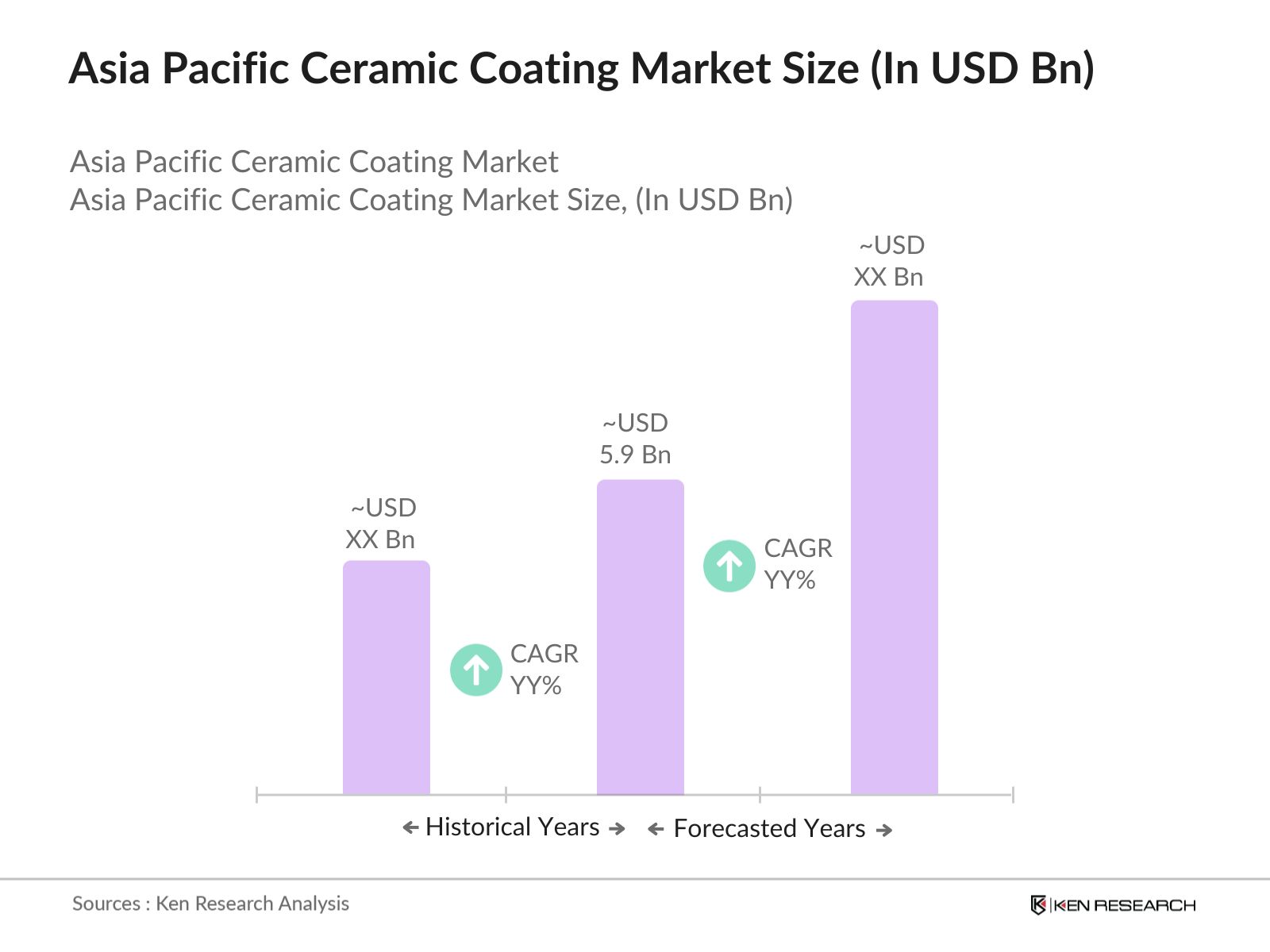
- China dominates the market due to its strong manufacturing capabilities and thriving automotive and aerospace industries. The country's strategic initiatives, such as Made in China 2025, aim to boost high-tech manufacturing, which has increased the demand for advanced materials like ceramic coatings. Additionally, China's vast production base allows for cost-efficient manufacturing, driving the adoption of these coatings across industries. Japan and South Korea are also notable players, focusing on technological advancements in automotive coatings for electric vehicles and aerospace.
- Indias "Make in India" campaign aims to boost domestic manufacturing across various sectors, including aerospace, defense, and automotive. As part of this initiative, the government offers subsidies and tax incentives to companies involved in advanced manufacturing, including the production of high-performance coatings like ceramic coatings.
Asia Pacific Ceramic Coating Market Segmentation
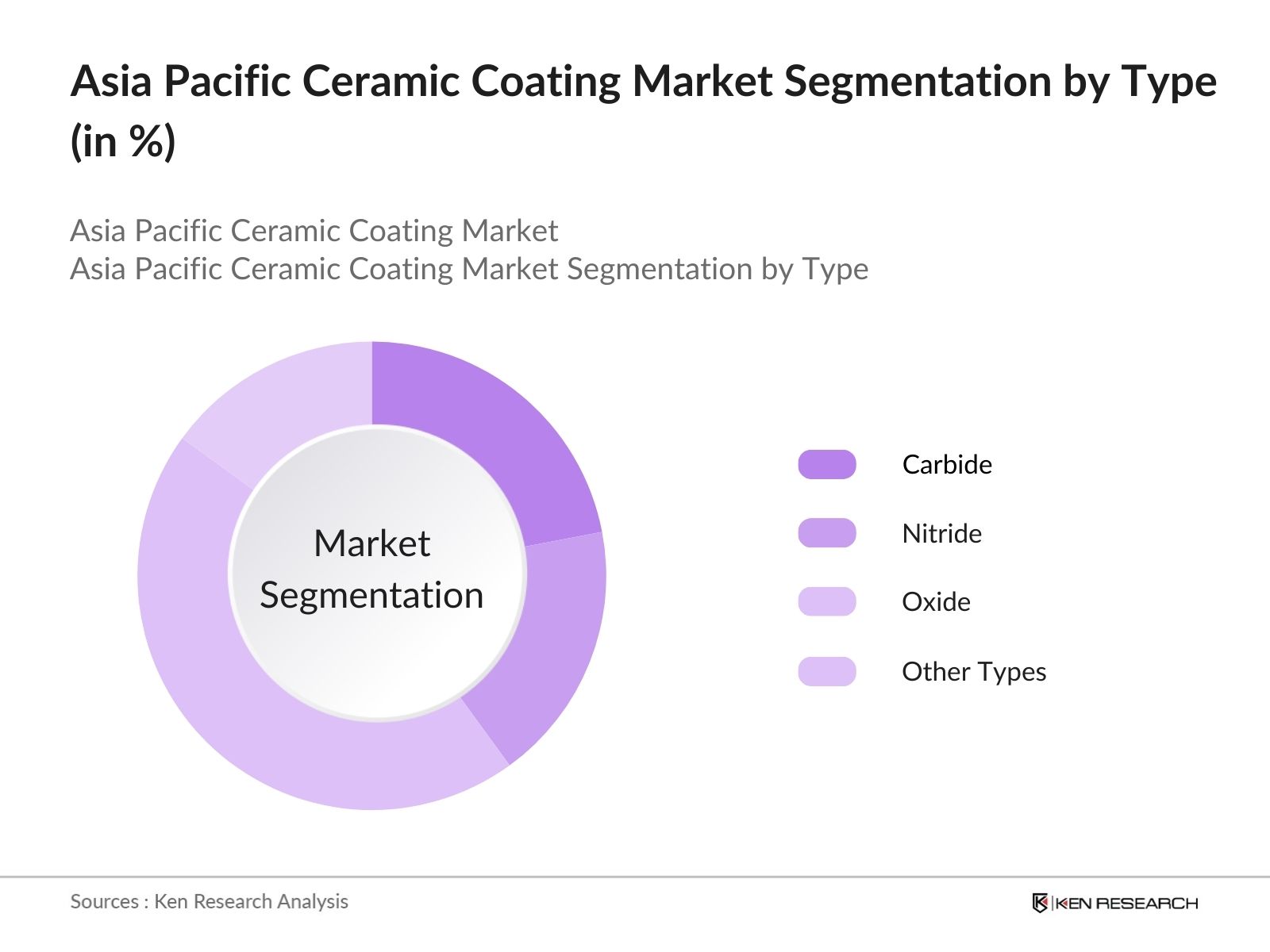
By Type: The market is segmented into Carbide, Nitride, Oxide, and Other Types. Among these, Oxide coatings held a dominant share in 2023, due to their widespread application in the aerospace and healthcare sectors. Oxide coatings provide superior thermal and corrosion resistance, making them ideal for applications in turbine engines and medical devices. The growing demand for such high-performance coatings, particularly in aerospace, has helped Oxide coatings to remain dominant.
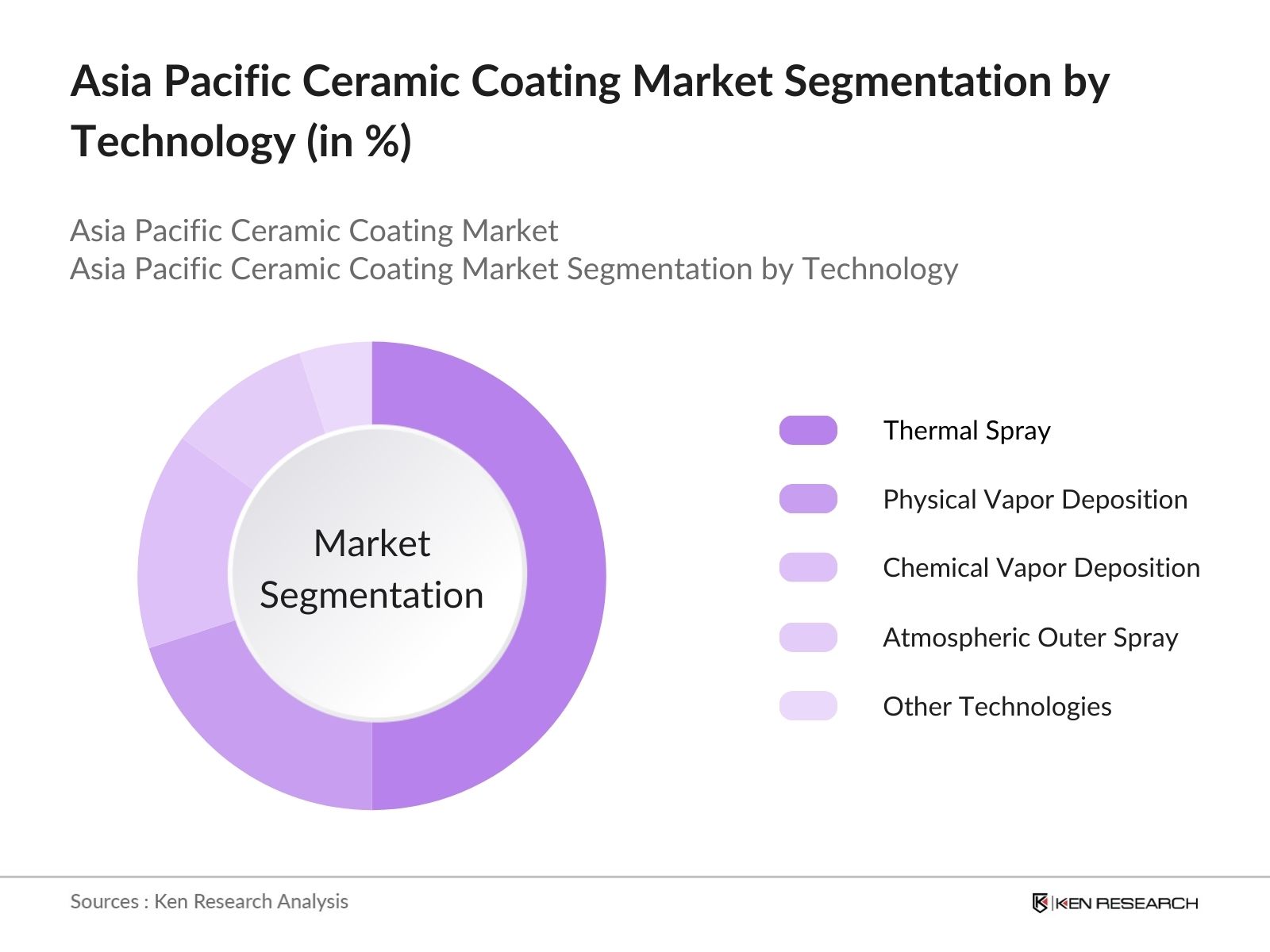
By Technology: Ceramic coatings in the Asia-Pacific market are classified by technology into Thermal Spray, Physical Vapor Deposition (PVD), Chemical Vapor Deposition (CVD), Atmospheric Outer Spray, and Other Technologies. Thermal Spray technology dominated the market in 2023 due to its excellent performance characteristics such as wear and corrosion resistance. It is widely adopted in industries like automotive and aerospace for enhancing the durability and lifespan of components.
Asia Pacific Ceramic Coating Market Competitive Landscape
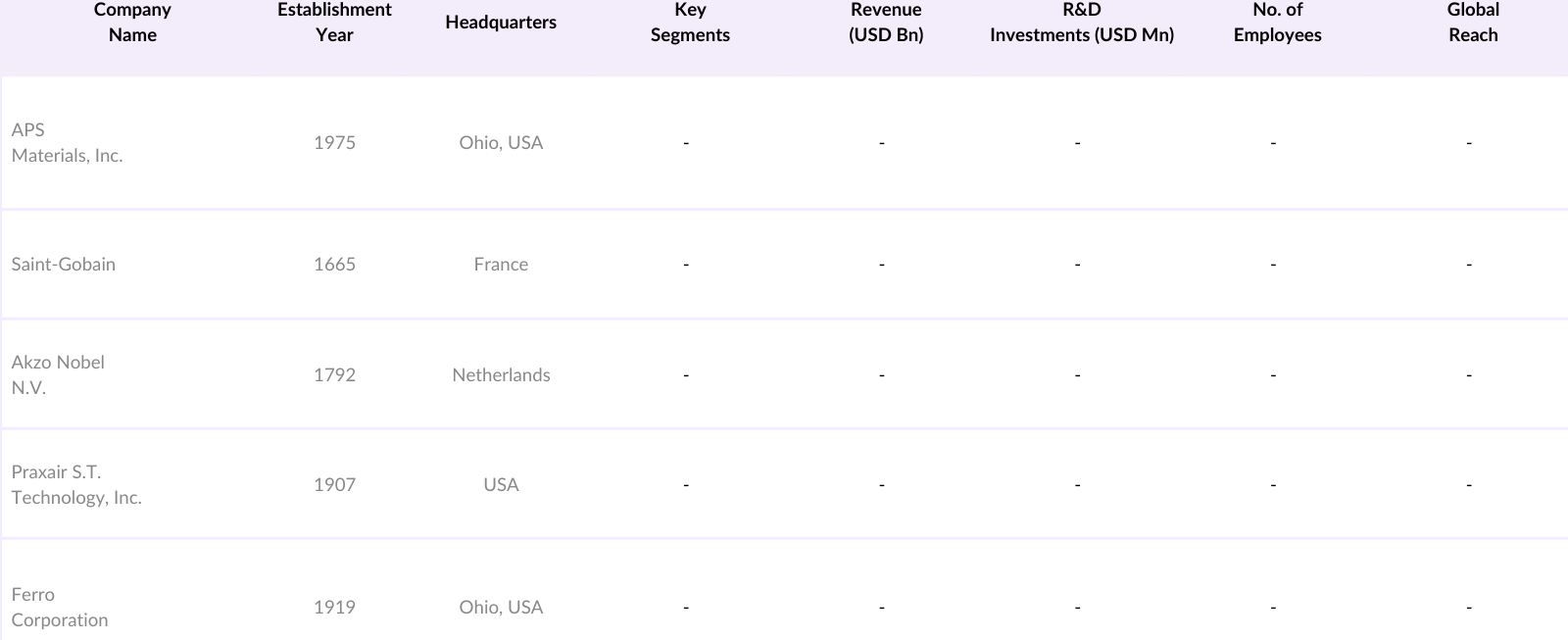
The market is highly consolidated, with a few major players dominating the industry. These companies leverage their extensive research capabilities, broad product portfolios, and established distribution networks to maintain their competitive edge.
Asia Pacific Ceramic Coating Market Analysis
Market Growth Drivers
- Increased Demand in Aerospace and Defense Sector: The aerospace and defense industry in the Asia Pacific region is experiencing growth, driven by increased defense spending and growing demand for aircraft production. The ceramic coating market is benefiting from this surge, as ceramic coatings are used extensively in engine parts, aircraft structures, and missile components due to their ability to withstand high temperatures and resist wear.
- Growing Automotive Industry Expansion: The Asia Pacific region is home to some of the worlds largest automotive manufacturing hubs, including China, Japan, India, and South Korea. Ceramic coatings are gaining popularity in the automotive sector due to their superior corrosion resistance, heat resistance, and durability, especially for vehicle exteriors and engine components. In 2024, the combined automotive production in China and India is expected to exceed 40 million units, driven by increased consumer demand and government incentives for the production of fuel-efficient vehicles. T
- Infrastructure Development in Emerging Economies: Countries such as India, Indonesia, and Vietnam are investing heavily in large-scale infrastructure projects, including highways, bridges, and railways. Ceramic coatings are used in these infrastructure developments for their durability, heat resistance, and protection against environmental damage. For example, in 2024, India is projected to spend over $1.5 trillion on infrastructure projects as part of its National Infrastructure Pipeline (NIP).
Market Challenges
- High Cost of Ceramic Coatings: Ceramic coatings are more expensive compared to traditional coatings, making them less affordable for small and medium-sized manufacturers. This price disparity poses a challenge in the Asia Pacific region, where cost-sensitive industries may opt for cheaper alternatives despite the superior performance of ceramic coatings.
- Limited Awareness Among End Users: Despite their superior properties, ceramic coatings are still not widely recognized across all industrial sectors in the Asia Pacific region. Industries such as consumer goods and certain sectors of manufacturing still rely on conventional coatings due to a lack of awareness of the long-term benefits of ceramic coatings.
Asia Pacific Ceramic Coating Market Future Outlook
Over the next five years, the Asia-Pacific Ceramic Coatings industry is expected to witness robust growth, driven by increasing demand across key industries such as aerospace, automotive, and healthcare.
Future Market Opportunities
- Increased Adoption in Electric Vehicles (EVs): Over the next five years, the Asia Pacific ceramic coating market is expected to witness an increase in demand from the electric vehicle (EV) sector. As countries like China and India push for EV adoption, ceramic coatings will play a critical role in improving the efficiency of battery systems and heat management in EVs.
- Growth in Aerospace Applications Due to Rising Space Programs: The Asia Pacific region is expected to see continued growth in the aerospace sector, particularly driven by government investments in space programs and commercial satellite launches. Countries such as India and China are planning to increase their spending on space exploration by 2029, leading to a growing demand for ceramic coatings that provide protection against extreme temperatures and atmospheric re-entry conditions.
Scope of the Report
|
Type |
Carbide Nitride Oxide Others |
|
Technology |
Thermal Spray PVD CVD Atmospheric Outer Spray |
|
End-user Industry |
Aerospace and Defense Automotive Healthcare Energy and Power Industrial |
|
Region |
China Japan India South Korea ASEAN Countries |
Products
Key Target Audience Organizations and Entities Who Can Benefit by Subscribing This Report:
Aerospace and Defense Companies
Automotive Manufacturers
Medical Device Manufacturers
Industrial Equipment Manufacturers
Government and Regulatory Bodies (China National Aviation, Ministry of Industry and Information Technology)
Investors and Venture Capitalist Firms
Chemical Coating Distributors
Companies
Players Mentioned in the Report:
APS Materials, Inc.
Praxair S.T. Technology, Inc.
Saint-Gobain
Akzo Nobel N.V.
Ferro Corporation
OC Oerlikon Corporation AG
Bodycote plc
3M Company
A.W. Chesterton Company, Inc.
Integrated Global Services (IGS)
Table of Contents
1. Asia-Pacific Ceramic Coatings Market Overview
1.1 Definition and Scope
1.2 Market Taxonomy
1.3 Market Growth Rate
1.4 Market Segmentation Overview
2. Asia-Pacific Ceramic Coatings Market Size (In USD Bn)
2.1 Historical Market Size
2.2 Year-On-Year Growth Analysis
2.3 Key Market Developments and Milestones
3. Asia-Pacific Ceramic Coatings Market Analysis
3.1 Growth Drivers
3.1.1 Increasing Demand in Aerospace and Defense Applications
3.1.2 Rising Adoption in Medical Devices (Corrosion Resistance, Thermal Stability)
3.1.3 Expanding Use in Automotive for Protection and Aesthetics
3.1.4 Technological Advancements in Thermal Spray Coatings
3.2 Market Challenges
3.2.1 High Production Costs
3.2.2 Capital-Intensive Manufacturing Setup
3.2.3 Inconsistent Thermal Spray Process Reliability
3.3 Opportunities
3.3.1 Expansion in Electric Vehicle Applications
3.3.2 Growing Need for Corrosion Protection in Power Generation
3.3.3 Increasing Use in Industrial and Infrastructure Sectors
3.4 Trends
3.4.1 Rising Demand for Multi-Layer Coatings (For Durability)
3.4.2 Growing Application of PVD and CVD Technologies
3.4.3 Adoption of Ceramic Coatings in Energy and Power Sectors
3.5 Government Regulations
3.5.1 National Standards for Aerospace Components (China, Japan)
3.5.2 Environmental Standards for Automotive Coatings
3.5.3 Certification Programs for Medical Device Coatings
3.6 SWOT Analysis
3.7 Stakeholder Ecosystem
3.8 Porters Five Forces
3.9 Competitive Ecosystem
4. Asia-Pacific Ceramic Coatings Market Segmentation
4.1 By Type (In Value %)
4.1.1 Carbide
4.1.2 Nitride
4.1.3 Oxide
4.1.4 Others
4.2 By Technology (In Value %)
4.2.1 Thermal Spray
4.2.2 Physical Vapor Deposition (PVD)
4.2.3 Chemical Vapor Deposition (CVD)
4.2.4 Atmospheric Outer Spray
4.3 By End-user Industry (In Value %)
4.3.1 Aerospace and Defense
4.3.2 Automotive and Transportation
4.3.3 Healthcare
4.3.4 Energy and Power
4.3.5 Industrial Applications
4.4 By Region (In Value %)
4.4.1 China
4.4.2 Japan
4.4.3 India
4.4.4 South Korea
4.4.5 ASEAN Countries
5. Asia-Pacific Ceramic Coatings Market Competitive Analysis
5.1 Detailed Profiles of Major Companies
5.1.1 APS Materials, Inc.
5.1.2 Praxair S.T. Technology, Inc. (Linde Plc)
5.1.3 Saint-Gobain
5.1.4 Bodycote
5.1.5 Morgan Advanced Materials
5.1.6 Akzo Nobel N.V.
5.1.7 Ferro Corporation
5.1.8 OC Oerlikon Corporation AG
5.1.9 3M Company
5.1.10 A.W. Chesterton Company
5.1.11 Eastman Chemical Company
5.1.12 IGL Coatings
5.1.13 Integrated Global Services
5.1.14 TST Engineered Coatings
5.1.15 Oerlikon Metco
5.2 Cross Comparison Parameters (Revenue, Inception Year, No. of Employees, Headquarters)
5.3 Market Share Analysis
5.4 Strategic Initiatives
5.5 Mergers and Acquisitions
5.6 Investment Analysis
5.7 Venture Capital Funding
5.8 Government Grants
5.9 Private Equity Investments
6. Asia-Pacific Ceramic Coatings Market Regulatory Framework
6.1 Compliance Requirements
6.2 Certification Processes
6.3 Environmental Standards
7. Asia-Pacific Ceramic Coatings Future Market Size (In USD Bn)
7.1 Future Market Size Projections
7.2 Key Factors Driving Future Market Growth
8. Asia-Pacific Ceramic Coatings Future Market Segmentation
8.1 By Type
8.2 By Technology
8.3 By End-user Industry
8.4 By Region
9. Asia-Pacific Ceramic Coatings Market Analysts Recommendations
9.1 TAM/SAM/SOM Analysis
9.2 Customer Cohort Analysis
9.3 Marketing Initiatives
9.4 White Space Opportunity Analysis
Disclaimer Contact UsResearch Methodology
Step 1: Identification of Key Variables
The initial phase involves mapping out the key stakeholders and variables in the Asia-Pacific Ceramic Coatings market. Desk research is carried out using secondary databases, proprietary sources, and credible industry reports to understand the key market drivers, restraints, and opportunities.
Step 2: Market Analysis and Construction
This phase includes an in-depth analysis of historical market trends, industry penetration rates, and overall revenue generation. Data from primary and secondary sources is used to construct a bottom-up model that estimates market growth based on current trends.
Step 3: Hypothesis Validation and Expert Consultation
We validate our market hypotheses through interviews with industry experts and market participants. These consultations provide direct insights into the market's operational and financial landscape, refining our projections.
Step 4: Research Synthesis and Final Output
The final step includes data synthesis from primary and secondary research to produce the final market report. This involves direct feedback from industry leaders to ensure that the reports findings are accurate, actionable, and relevant to stakeholders.
Frequently Asked Questions
01. How big is the Asia-Pacific Ceramic Coatings Market?
The Asia-Pacific Ceramic Coatings Market was valued at USD 5.9 billion, driven by increasing applications in aerospace, automotive, and healthcare industries.
02. What are the challenges in the Asia-Pacific Ceramic Coatings Market?
Challenges in the Asia-Pacific Ceramic Coatings Market include high production costs, capital-intensive setups, and reliability issues related to thermal spray processes, which can hinder broader adoption.
03. Who are the major players in the Asia-Pacific Ceramic Coatings Market?
Major players in the Asia-Pacific Ceramic Coatings Market include APS Materials, Inc., Praxair S.T. Technology, Inc., Saint-Gobain, Akzo Nobel N.V., and Ferro Corporation, who dominate due to their extensive R&D investments and broad product offerings.
04. What are the growth drivers of the Asia-Pacific Ceramic Coatings Market?
The Asia-Pacific Ceramic Coatings Market is driven by rising demand in the aerospace and defense sectors, increasing applications in medical devices, and the expansion of the automotive industry, particularly for electric vehicles.
05. What are the key trends in the Asia-Pacific Ceramic Coatings Market?
Key trends in the Asia-Pacific Ceramic Coatings Market include the adoption of PVD and CVD technologies for automotive and industrial applications, along with increasing demand for multi-layer coatings that offer enhanced durability and performance.
Why Buy From Us?

What makes us stand out is that our consultants follows Robust, Refine and Result (RRR) methodology. i.e. Robust for clear definitions, approaches and sanity checking, Refine for differentiating respondents facts and opinions and Result for presenting data with story

We have set a benchmark in the industry by offering our clients with syndicated and customized market research reports featuring coverage of entire market as well as meticulous research and analyst insights.

While we don't replace traditional research, we flip the method upside down. Our dual approach of Top Bottom & Bottom Top ensures quality deliverable by not just verifying company fundamentals but also looking at the sector and macroeconomic factors.

With one step in the future, our research team constantly tries to show you the bigger picture. We help with some of the tough questions you may encounter along the way: How is the industry positioned? Best marketing channel? KPI's of competitors? By aligning every element, we help maximize success.

Our report gives you instant access to the answers and sources that other companies might choose to hide. We elaborate each steps of research methodology we have used and showcase you the sample size to earn your trust.

If you need any support, we are here! We pride ourselves on universe strength, data quality, and quick, friendly, and professional service.